
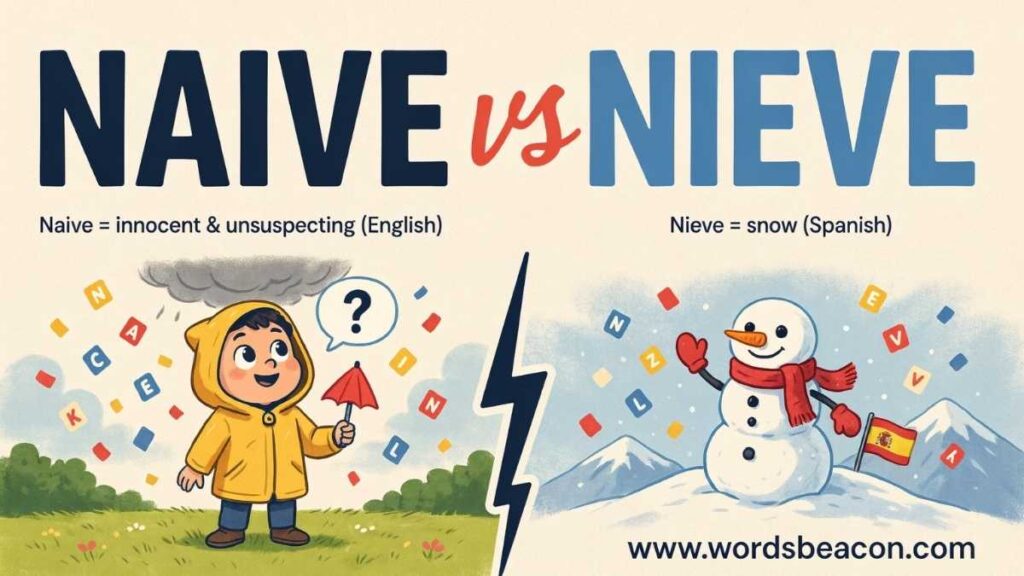
Naive vs nieve is a small spelling confusion that can easily trip you up. The two words look almost the same, but only one is correct when you mean someone who lacks experience or trusts people too easily. The correct English spelling is naive, or naïve. So, where does nieve fit in? In this case, it’s simply the wrong spelling. Don’t worry, though. This mix-up is easy to fix. In this article, you’ll learn the meaning, spelling, pronunciation, and correct usage of naive vs nieve, along with simple examples and helpful tips to remember the right word every time you write it.
quick answer
| Word | Correct English spelling? | Meaning | Pronunciation |
|---|---|---|---|
| Naive | Yes | Lacking experience, knowledge, or good judgment | /naɪˈiːv/ |
| Naïve | Yes | Same meaning as naive | /naɪˈiːv/ |
| Nieve | No, not as a spelling of naive | Not an English spelling of naive | Not applicable in this context |
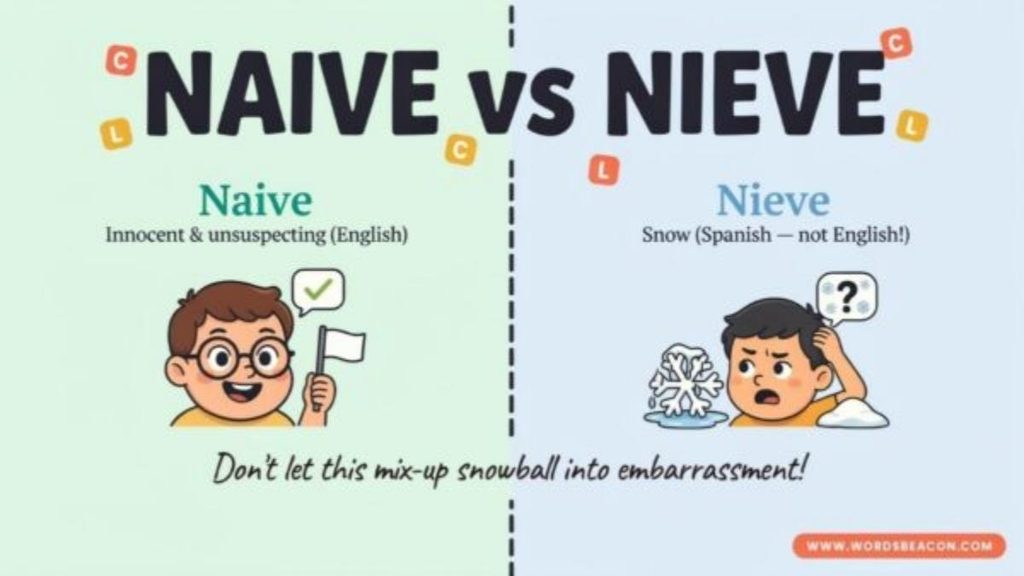
The main difference between naive vs nieve is simple: naive is the correct English word, while nieve is a common spelling mistake when someone is trying to write naive.
There is one interesting twist, though. Nieve can appear as a real word in other languages, including Spanish, where it means “snow.” That doesn’t make it a correct English spelling of naive.
What Does Naive Mean?
Naive is an adjective used to describe someone who lacks experience, worldly knowledge, or good judgment.
A naive person may believe that people are always honest and that situations are simpler than they really are. The word often suggests that someone trusts too easily because they haven’t had enough experience to recognize deception, complications, or hidden motives.
For example:
She was naive enough to believe that everyone she met had good intentions.
The sentence doesn’t necessarily mean that she was unintelligent. Instead, it suggests that she lacked the experience needed to recognize that some people might not be trustworthy.
That distinction matters.
A person can be intelligent and still be naive. Someone might have excellent academic knowledge but little experience dealing with dishonest people, difficult situations, or the realities of everyday life.
In simple terms, naive often means “too inexperienced or trusting.”
Naive Meaning in English
The naive meaning in English centers on a lack of experience, knowledge, or worldly wisdom.
The word can describe a person, idea, assumption, reaction, or approach. When it describes a person, it often suggests that the person doesn’t fully understand how complicated a situation can be.
For example:
He was naive about how difficult it would be to start a business.
Her naive assumption was that everyone would keep their promises.
The student had a naive view of how competitive the job market could be.
In each example, naive points to a gap in experience or judgment.
The word can also describe something that seems overly simple or unrealistic.
For instance:
It was naive to think that the problem would disappear overnight.
Here, the speaker isn’t necessarily calling the person foolish. The criticism focuses on the unrealistic expectation.
Is Naive the Correct Spelling?
Yes. Naive is the correct spelling in English.
You may also see the word written as naïve. The two spellings have the same meaning and pronunciation. The version with the diaeresis is closer to the French spelling from which the English word developed, while naive is now a standard English spelling as well.
So, if you’re wondering how to spell naive, you can safely use either naive or naïve.
For everyday US English writing, naive is especially convenient because it avoids the special character.
Here are both forms in sentences:
That was a naive assumption.
That was a naïve assumption.
Both sentences are correct.
The important point is that neither form should be changed to nieve.
Naive vs Nieve Spelling Why the Confusion?
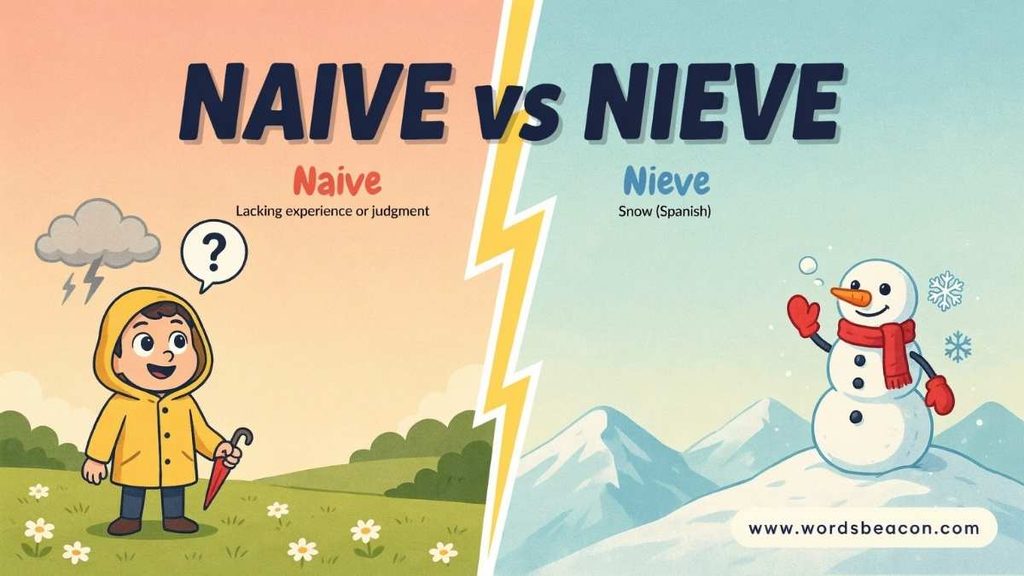
The confusion between naive vs nieve probably comes from the way the word sounds and the way English spelling works.
When people hear naive pronounced aloud, they may try to spell it based on familiar English spelling patterns. The “eev” sound at the end can make the word feel as though it should contain “ie,” leading some writers to produce nieve.
However, English spelling doesn’t always give you a neat one-to-one relationship between sounds and letters. Naive is one of those words where pronunciation alone doesn’t reliably tell you how to spell it.
There is another reason for the confusion. The letters in naive and nieve are almost identical. They contain the same basic letters, but the order changes.
Naive has the pattern “nai-ve.”
Nieve has the pattern “nie-ve.”
That small difference is enough to turn the correct spelling into a spelling error.
If you often hesitate between naive vs nieve, remember that the correct English spelling begins with “nai,” not “nie.”
How Do You Spell Naive?
The correct spelling is naive.
You can remember it as:
N-A-I-V-E
You can also write it as:
N-A-Ï-V-E
The second version is naïve, which uses a diaeresis over the “i.”
A useful way to remember the spelling is to connect naive with words such as naively and naivety. Once you recognize the “nai” beginning, the spelling becomes easier to recall.
For example:
She naively believed the advertisement.
His naivety made him easy to deceive.
The adjective is naive, the adverb is naively, and the noun is naivety.
These related forms can help reinforce the correct spelling.
Naive Pronunciation
The pronunciation of naive is usually written as /naɪˈiːv/.
It sounds roughly like “nye-EVE.”
The word has two syllables:
naive = nye-EVE
The stress falls on the second syllable.
This pronunciation can sometimes contribute to the spelling confusion because the sound doesn’t immediately reveal the spelling.
For example, if you hear someone say naive without seeing the word written down, you might reasonably wonder whether it should be spelled naive, naïve, or nieve.
English spelling makes that uncertainty understandable, but the standard English forms are naive and naïve.
Is Naive Two Syllables?
Yes. Naive is generally pronounced with two syllables.
The pronunciation can be represented as “nye-EVE.”
The first syllable sounds like “nye,” while the second sounds like “eve.”
So, when learning how to pronounce naive, avoid treating it as a single syllable. Saying something like “nave” changes the pronunciation and doesn’t match the standard pronunciation of the word.
For example:
Correct: nye-EVE
Incorrect: nave
The two-syllable pronunciation is one of the easiest ways to recognize the word when you hear it in conversation.
Naive With Diaeresis Is Naïve Correct?
Yes. Naïve is completely correct.
The two dots over the “i” are called a diaeresis. In naïve, the diaeresis signals that the vowels should be pronounced separately rather than treated as one combined sound.
You’ll see both naive and naïve in English writing.
For example:
He had a naive understanding of the situation.
He had a naïve understanding of the situation.
Both are acceptable.
In modern US English, naive without the diaeresis is very common. You don’t need to add the two dots every time you write the word.
The important thing is to avoid assuming that nieve is simply another version of the same spelling. It isn’t.
What Does Nieve Mean?
When people search for nieve meaning, they’re usually trying to determine whether nieve is a spelling variant of naive.
In standard English, it isn’t.
Nieve is not the correct spelling for the English adjective meaning inexperienced, overly trusting, or lacking worldly wisdom.
However, nieve can exist as a word outside English. For example, nieve is the Spanish word for “snow.” That is a completely different word with a completely different meaning.
This distinction explains why you might occasionally encounter nieve online and wonder whether it’s actually a word.
It can be a real word in another language, but that doesn’t make it the correct English spelling of naive.
Is Nieve a Word?
The answer depends on the language and the context.
If you mean, “Is nieve an English spelling of naive?” the answer is no.
If you mean, “Does the sequence of letters nieve exist as a real word?” then yes, it can appear as a word in other languages.
This is an important difference. A spelling can be legitimate in one language while being incorrect in another.
For English writing, however, you should use naive or naïve when you mean someone who is inexperienced, overly trusting, or lacking worldly wisdom.
For example:
Incorrect: He was nieve about the risks.
Correct: He was naive about the risks.
Correct: He was naïve about the risks.
The first sentence contains the common spelling mistake. The other two use standard English forms.
Naive vs Nieve Meaning
The difference between naive vs nieve meaning becomes much clearer once you separate English from other languages.
Naive has a well-established meaning in English. It describes someone or something that shows a lack of experience, knowledge, or sound judgment.
Nieve does not carry that meaning in standard English. As a result, searching for a nieve definition in English can be confusing because dictionaries may not treat it as an English equivalent of naive.
Consider these examples:
His naive approach caused several problems.
She was naive about the risks involved.
They had a naive belief that everyone would agree with them.
In all three sentences, naive describes an unrealistic or inexperienced way of thinking.
Replacing naive with nieve would create a spelling error.
Naive vs Innocent
Naive and innocent can overlap, but they aren’t always interchangeable.
Innocent usually emphasizes a lack of guilt, wrongdoing, or harmful intention. It can also describe someone who has little experience of the world.
Naive, by contrast, focuses more strongly on a lack of experience, knowledge, or judgment.
Consider these two sentences:
The child was innocent and had done nothing wrong.
The child was naive and believed everything strangers told him.
The first sentence focuses on innocence and lack of wrongdoing. The second focuses on trust and lack of worldly experience.
Sometimes a person can be both innocent and naive, but the words emphasize different qualities.
Naive vs Inexperienced
Naive and inexperienced are also closely related, but they carry different shades of meaning.
Inexperienced simply means that someone has little experience with something.
For example:
She was inexperienced at managing a large team.
That statement doesn’t necessarily criticize her judgment. It simply says she hasn’t done it before or hasn’t done it enough to gain experience.
Naive can go further. It may suggest that someone has unrealistic expectations or trusts people too easily.
For example:
He was inexperienced in business.
He was naive about how easily dishonest partners could take advantage of him.
The first sentence describes a lack of experience. The second suggests a lack of worldly judgment.
That difference becomes important when you choose the right word for a sentence.
Learn how to use confusing more words correctly
Finaly vs Finally difference and usage?
Naive vs Gullible What’s the Difference?
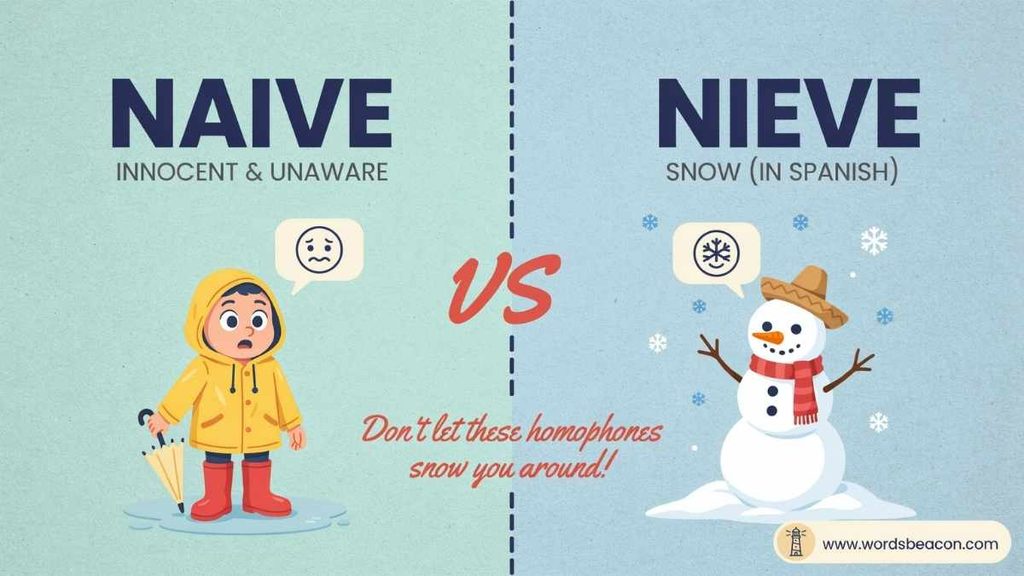
Naive and gullible often appear together because both words can describe someone who believes others too easily. However, they don’t mean exactly the same thing.
A naive person lacks experience, worldly knowledge, or good judgment. Because of that lack of experience, they may believe something that a more experienced person would question.
A gullible person is especially easy to deceive or persuade. Gullibility focuses more directly on how readily someone accepts what other people tell them.
For example:
She was naive about how dishonest some people could be.
She was gullible enough to believe the fake story.
The first sentence emphasizes her lack of experience. The second focuses on her willingness to believe something without questioning it.
You can think of naive as a broader description of someone’s outlook, while gullible often describes a specific weakness in judgment.
Naive vs Trusting
Trusting is not automatically a negative quality.
A trusting person believes that others are generally honest or reliable. In many situations, that can be a positive personality trait.
Naive, however, often carries a critical meaning. It can suggest that someone trusts people without considering the possibility that they might have dishonest motives.
For example:
She’s naturally trusting, so she gives people the benefit of the doubt.
She was naive to believe that a stranger would return the money without any proof.
The first sentence presents trust as a personality trait. The second suggests that the person’s trust went too far because she lacked practical judgment.
This distinction matters when you’re choosing between the words. Calling someone trusting can sound positive. Calling someone naive can imply that they need more experience.
Naive vs Simple-Minded
These words should not be treated as synonyms.
Naive usually refers to a lack of experience, worldly knowledge, or judgment. It does not mean that someone has low intelligence.
Simple-minded, on the other hand, can suggest that someone thinks in an unsophisticated or overly simplistic way. Depending on the context, it can sound insulting.
For example:
He was naive about the challenges of running a company.
That sentence says he lacked experience or realistic expectations.
Calling him simple-minded would make a much stronger judgment about the way he thinks.
This is why naive shouldn’t automatically be replaced with words that suggest a lack of ability or intelligence. A highly intelligent person can still be naive in an area where they have little experience or knowledge.
Is Naive a Negative Word?
Naive can have a negative meaning, but the context determines how strong that meaning becomes.
When people describe an idea as naive, they often mean that the idea is unrealistic because it ignores important facts or complications.
For example:
It was naive to assume that the project would be completed in one day.
Here, the speaker is criticizing the assumption rather than the person’s intelligence.
The word can also describe a person in a gentler way, especially when talking about someone who is young or inexperienced.
For example:
He was young and naive when he first moved to the city.
In this sentence, naive suggests a lack of worldly experience rather than stupidity.
Naive can even have a positive or approving sense in certain contexts. It may describe something innocent, natural, or uncomplicated.
For example:
The painting has a naive charm that makes it appealing.
Here, naive does not mean foolish. It describes a simple, childlike, or unsophisticated quality.
Naive Definition More Than Just “Inexperienced”
A common mistake is to assume that naive simply means inexperienced.
Although the two words overlap, naive usually carries an additional idea about judgment or expectations.
Imagine someone who has never negotiated a business contract before. That person is inexperienced.
Now imagine that same person believes every business partner will automatically honor every promise because “people are basically honest.” That belief is naive.
The difference is subtle but important.
Inexperienced describes what someone lacks.
Naive often describes how that lack of experience affects their thinking.
That’s why you might say:
She was inexperienced but cautious.
You would be less likely to call her naive because she recognized the risks and acted carefully.
A naive person may not recognize those risks at all.
Naive Example Sentences
Seeing naive in different contexts can make its meaning easier to understand.
It was naive to think that the job would be easy.
He had a naive belief that everyone would tell him the truth.
She was too naive to recognize the warning signs.
The teenager had a naive understanding of how expensive adulthood could be.
His first business plan was ambitious but somewhat naive.
I was naive when I thought every online review was genuine.
The new employee was inexperienced, not incompetent, but his expectations were still naive.
These examples show that naive can describe people, beliefs, assumptions, expectations, and approaches.
The common thread is a lack of realistic understanding caused by limited experience or judgment.
Naive Used in a Sentence
When using naive in a sentence, pay attention to what you’re describing.
You can use naive before a noun:
She had a naive understanding of the situation.
You can also use it after a linking verb:
His expectations were naive.
Another common structure uses naive with an infinitive:
It was naive to believe that everything would work perfectly.
You can also use naive with “about” when discussing a subject someone doesn’t understand realistically:
He was naive about the risks of investing.
These sentence patterns make the word easy to use naturally in everyday English.
Why Do People Spell Naive as Nieve?
If you’ve ever written nieve instead of naive, the mistake probably comes from pronunciation rather than a lack of understanding.
When people hear the word, they hear something close to “nye-EVE.” English spelling doesn’t always make the relationship between sound and letters obvious, so it’s easy to guess the wrong letter order.
Another reason is that “ie” is a familiar letter combination in English. People may instinctively put the “i” before the “e” because of how the word sounds.
There’s also a visual factor. Naive vs nieve look so similar that a quick glance may not reveal the error.
The best way to avoid the mistake is to memorize the first three letters.
Naive begins with nai.
If you mean the English adjective describing someone who lacks worldly experience or judgment, write naive, not nieve.
Common Spelling Mistakes With Naive
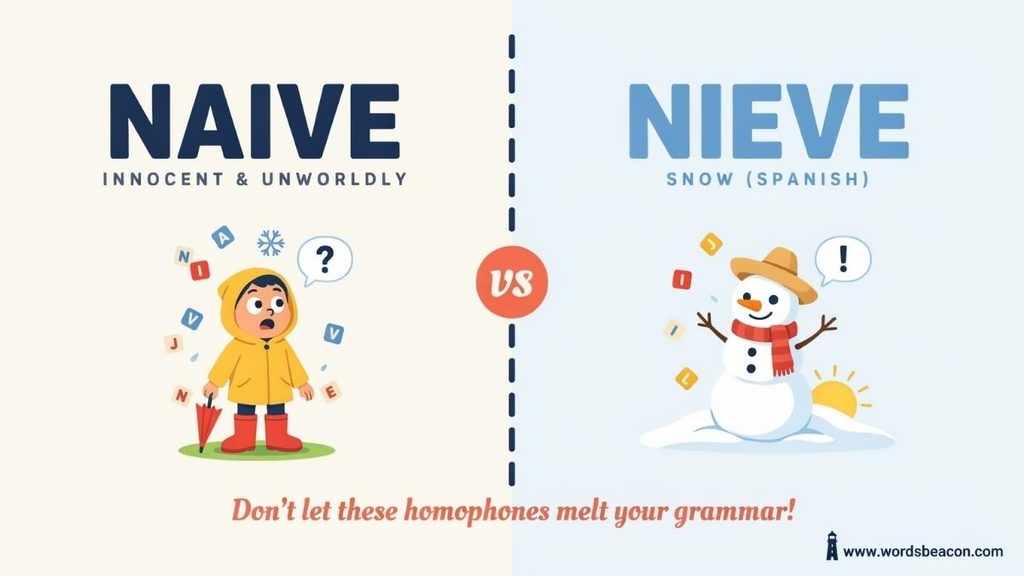
Naive has several possible spelling errors because its pronunciation doesn’t make the written form immediately obvious.
Nieve is one of the most common mistakes.
Some writers may also forget the second vowel or rearrange the letters because they are spelling the word according to sound.
The safest approach is to remember the standard form:
naive
You can also remember the alternative:
naïve
Both are correct English spellings.
The form nieve should not be used when you mean naive.
Is Nieve an English Word?
The question “is nieve an English word?” needs a little context.
Nieve is not the standard English word for someone who is inexperienced or overly trusting. You should not use it as an alternative spelling of naive.
However, the same sequence of letters can have a meaning in another language. Spanish uses nieve for “snow.”
That explains why the word may occasionally appear in genuine writing without being a spelling mistake.
Language is full of these situations. A word can be perfectly legitimate in one language while having no place in another.
For English learners, the key point is simple: if you’re writing in English and want to describe someone as inexperienced or overly trusting, use naive or naïve.
Is Nieve a Scrabble Word?
Whether nieve appears as an accepted word depends on the particular Scrabble dictionary and language version being used.
That question is also different from asking whether nieve is a correct spelling of naive in standard English.
Even if a particular word game accepts a word from a specialized word list, that doesn’t mean you can use it as an English spelling variant of naive.
For normal English writing, the correct choice remains naive or naïve.
If your goal is spelling accuracy rather than word-game strategy, there’s no reason to replace naive with nieve.
Can Nieve Be Used in a Sentence?
Yes, but not as a replacement for naive in standard English.
If you’re writing an English sentence and want to describe someone as inexperienced, use naive:
He was naive about the risks.
She was naive enough to trust the stranger.
It would be incorrect to write:
He was nieve about the risks.
She was nieve enough to trust the stranger.
Those sentences contain a spelling error if nieve is intended to mean naive.
Nieve may appear in a sentence when it is being used in another language or as a proper name, but that is a different situation entirely.
Naive in English vs Nieve in English
The contrast between naive in English and nieve in English is straightforward once you separate meaning from appearance.
Naive is an established English adjective. It has a clear dictionary definition and a regular place in English vocabulary.
Nieve is not an English spelling variant of naive.
If you’re writing an essay, article, email, school assignment, or professional document, choose naive or naïve.
For example:
Correct: The proposal was naive because it ignored the financial risks.
Incorrect: The proposal was nieve because it ignored the financial risks.
The difference is only one letter, but that one letter determines whether you’ve used the correct English word.
Naive vs Nieve Pronunciation
There is no standard English pronunciation of nieve that corresponds to naive because nieve is not the English spelling of that word.
Naive is pronounced approximately “nye-EVE,” with two syllables and stress on the second syllable.
When someone writes nieve while intending to mean naive, the spelling error doesn’t create a new English pronunciation. It simply creates an incorrect written form.
This is worth remembering because pronunciation can sometimes trick you into accepting a spelling that looks reasonable.
English has many words where spelling must be learned rather than guessed from sound.
Naive is one of them.
The Difference Between Naive and Nieve
The difference between naive and nieve can now be summed up clearly.
Naive is the correct English adjective. It describes someone who lacks experience, worldly knowledge, or good judgment. It can also describe an unrealistic belief, assumption, or approach.
Nieve is not the correct English spelling of that word.
If you’re asking which is correct, naive vs nieve, choose naive.
If you want the spelling with the diaeresis, choose naïve.
If you see nieve in English writing where the writer clearly means naive, you’re most likely looking at a spelling mistake.
A Simple Way to Remember the Correct Spelling
When you’re stuck between naive vs nieve, focus on the beginning of the word.
Naive starts with nai.
Think of the word as:
nai + ve
The incorrect form switches the middle letters:
nie + ve
That small difference is the entire spelling problem.
Another useful trick is to connect naive with naively and naivety. The same “nai” pattern appears at the beginning of the word family.
Naive.
Naively.
Naivety.
Once that pattern becomes familiar, the spelling becomes much easier to remember.
A Real-Life Example of Naive Thinking
Imagine that someone receives a message saying they’ve won a large prize. The message asks for personal information before the prize can be delivered.
An experienced internet user might immediately question the message. They may look for warning signs, verify the sender, or recognize it as a possible scam.
A naive person might think, “Why would anyone lie about this?” They may trust the message without checking it.
That doesn’t mean the person is unintelligent. They may be excellent at mathematics, science, writing, or another field. They simply lack experience with this particular kind of deception.
That example captures the heart of the word naive. The issue is not necessarily intelligence. It’s the gap between what someone believes and what real-world experience has taught them.
Naive Does Not Mean Unintelligent
This distinction matters because “naive” doesn’t simply mean uninformed or lacking good judgment.
It isn’t.
Calling someone naive usually tells you something about their experience, judgment, or expectations. It doesn’t automatically tell you anything about their intelligence.
A person can be naive about investing, politics, relationships, technology, business, or social situations while being highly intelligent in other areas.
For example:
She was naive about the housing market, but she was an excellent financial analyst.
The sentence may sound surprising at first, but it makes perfect sense. Someone can possess strong technical knowledge and still lack practical experience in a particular area.
Naivety often disappears with experience. As people encounter more situations, they learn to question assumptions, recognize warning signs, and understand that not everyone has good intentions.
Naive and Worldly Wisdom
The idea of worldly wisdom sits at the center of many uses of naive.
Worldly wisdom comes from experience. You learn it by dealing with people, making mistakes, observing consequences, and seeing that life rarely follows a perfectly simple script.
A naive person may still have excellent formal education. What they may lack is practical knowledge about how people and situations actually behave.
For example, a young employee might believe that working hard automatically guarantees a promotion. That belief may sound reasonable, but real workplace experience can teach them that timing, communication, relationships, business conditions, and organizational decisions also matter.
The original belief could therefore be described as naive.
Experience doesn’t make someone cynical. Ideally, it makes them more realistic.
Naive, Innocent, and Gullible in Everyday English
These three words can overlap, but each one paints a slightly different picture.
Innocent suggests purity, lack of wrongdoing, or limited exposure to the harsher side of life.
Naive suggests limited experience or unrealistic expectations.
Gullible suggests that someone is particularly easy to deceive.
Consider a child who believes that everyone is kind.
You might call the child innocent because the belief comes from a pure and uncomplicated view of the world.
You might call the child naive because the child has little experience with dishonesty.
You might call the child gullible if the child believes every story that strangers tell.
The right word depends on what you want to emphasize.
When Should You Use Naive?
Use naive when you want to describe a person, belief, expectation, or approach that lacks realistic understanding because of limited experience or judgment.
It works especially well when someone trusts too easily or assumes that a complicated situation is much simpler than it really is.
For example:
It was naive to assume that the contract had no hidden conditions.
He was naive about the difficulties of running a small business.
Her naive optimism disappeared after she gained more experience.
The word fits naturally in conversations, essays, articles, workplace writing, and everyday English.
Just make sure you’re using it to describe a lack of experience or realistic judgment rather than simply calling someone unintelligent.
Here’s a trusted source for clear more words Comparison:
Practice Session Naive vs Nieve
Fill in each blank with either Naive vs Nieve.
- It was ______ to believe that everyone would tell the truth.
- She was too ______ to recognize the warning signs.
- The young traveler had a ______ idea of how difficult the journey would be.
- He made a ______ assumption about the cost of starting a business.
- Writing “______” instead of “naive” is a common spelling mistake.
- The student was ______ about how competitive the job market could be.
- She had a ______ belief that every stranger was trustworthy.
- Remember that ______ is the correct English spelling.
- He was intelligent but still ______ about dealing with dishonest people.
- The sentence contains an error because “______” is not the standard English spelling of naive.
- It would be ______ to assume that the problem will disappear overnight.
- Her ______ nature made her easy to deceive.
- If you mean inexperienced or overly trusting, use ______.
- He had a ______ understanding of the risks involved.
- Many people accidentally write “______” when they mean naive.
- The child was ______ enough to believe every story he heard.
- In standard English, ______ and naïve are both correct forms.
- She realized that her earlier expectations had been ______.
- Choose ______ when you want to describe someone who lacks worldly experience.
- The writer corrected “______” to “naive” before publishing the article.
- It was ______ of him to trust an unknown person without checking the facts.
- His ______ view of business changed after he gained more experience.
- ______ is not an alternative English spelling of naive.
- The new employee was inexperienced and somewhat ______ about workplace politics.
- If you’re unsure about “naive or nieve,” remember that the correct spelling is ______.
Answers
- naive
- naive
- naive
- naive
- nieve
- naive
- naive
- naive
- naive
- nieve
- naive
- naive
- naive
- naive
- nieve
- naive
- naive
- naive
- naive
- nieve
- naive
- naive
- nieve
- naive
- naive
FAQs
Can “nieve” replace “naive” in English?
No. If you mean someone who lacks experience, worldly knowledge, or good judgment, the correct word is naive or naïve. Nieve should not be used as an alternative English spelling.
Can “naive” describe an idea as well as a person?
Yes. Naive can describe a person, but it can also describe an idea, belief, assumption, plan, or expectation that seems unrealistic or overly simple.
For example, you might describe an assumption as naive if it ignores important facts or complications.
Can an intelligent person be naive?
Yes. Naivety has more to do with experience and judgment than intelligence. Someone can be highly intelligent yet still be naive about a subject they haven’t encountered before.
Can “naive” have a positive meaning?
Yes. In some contexts, naive can suggest innocence, simplicity, or a natural, childlike quality. The word often has a critical sense, but its meaning depends on how it is used.
What is the noun form of “naive”?
The common noun form is naivety. It refers to a lack of experience, worldly knowledge, or realistic judgment.
For example: His naivety made him easy to deceive.
You may also see naïveté, a form borrowed from French that is also used in English.
What is the adverb form of “naive”?
The adverb is naively. It describes something done or believed in a way that shows limited experience or judgment.
For example: She naively assumed that everyone would keep their promises.
Can “naive” describe an argument?
Yes. A naive argument usually overlooks important facts, practical difficulties, or possible complications.
For example: The argument is naive because it assumes that the problem has an easy solution.
Can “naive” describe a business plan?
Yes. A business plan can be called naive when it relies on unrealistic assumptions or fails to consider important risks.
For example: The proposal seemed promising, but its financial assumptions were naive.
Does “naive” always mean overly trusting?
No. Being overly trusting is one common aspect of naivety, but naive has a broader meaning. It can also describe someone who lacks experience or has an unrealistic understanding of a situation.
What is a softer way to describe someone as naive?
If you want to sound more polite, you can say that someone is inexperienced, new to the situation, unfamiliar with the realities involved, or still learning.
These alternatives can communicate the idea without making the statement sound overly critical.
Is “inexperienced” a synonym for “naive”?
Not always. Inexperienced simply means that someone has little experience. Naive often suggests that limited experience has affected the person’s judgment or expectations.
Someone can be inexperienced but careful and realistic. In that case, naive may not be appropriate.
Can “naive” describe a child?
Yes. Children often have limited experience of the world, so naive can describe their understanding of certain situations.
However, the word can also describe adults who lack experience in a particular area.
Can someone become less naive with experience?
Yes. Experience can help people recognize risks, question assumptions, and understand that situations are often more complicated than they first appear.
Becoming less naive doesn’t necessarily mean becoming cynical. It can simply mean developing better judgment.
Is “naive” common in American English?
Yes. Naive is a common word in American English. People use it in everyday conversations as well as in academic, professional, and general writing.
Can “naive” describe something other than a person?
Yes. You can describe beliefs, assumptions, expectations, plans, approaches, interpretations, and ideas as naive.
For example: The proposal was based on a naive assumption about consumer behavior.
What is an example of naive thinking?
Believing that everyone you meet will always tell the truth is an example of naive thinking. The belief may come from innocence or limited experience rather than a lack of intelligence.
Does “naive” mean innocent?
The two words can overlap, but they aren’t identical. Innocent can describe someone who has done nothing wrong or who has little exposure to the harsher side of life. Naive focuses more on limited experience, knowledge, or judgment.
Does “naive” mean gullible?
Not exactly. Gullible describes someone who is particularly easy to deceive. Naive is broader and can describe someone whose limited experience leads to unrealistic expectations or poor judgment.
What is the difference between “naive” and “ignorant”?
Naive generally relates to limited experience or judgment, while ignorant usually means lacking knowledge or information about something.
For example, someone can be ignorant of a subject because they haven’t learned about it. Someone can be naive about that subject because they don’t understand its practical difficulties.
Can “naive” be used in formal writing?
Yes. Naive is suitable for academic, professional, journalistic, and other formal contexts when it accurately describes the situation.
For example: The study challenges the naive assumption that all consumers behave in the same way.
Should I write “Naive vs Nieve” in American English?
Both spellings are correct. Naive is particularly common in American English because it is easy to type and doesn’t require a special character. Naïve is also acceptable.
The important point is consistency. If you choose one spelling, use it consistently throughout your writing.
What is the easiest way to remember the spelling of “naive”?
Remember the beginning of the word: nai.
The correct spelling is naive, not nieve.
If you prefer the version with the diaeresis, the spelling is naïve.
Why is “naive” easy to misspell?
The pronunciation doesn’t make the spelling immediately obvious, and naive and nieve look almost identical. When people write the word from memory or spell it according to sound, they can easily switch the vowels.
Remembering the “nai” pattern can help prevent the mistake.
Can “naive” describe a belief that turns out to be wrong?
Yes. A belief can be called naive when it comes from limited experience or fails to account for important realities.
For example: His naive belief that the project would be completed overnight quickly proved unrealistic.
What does “naive approach” mean?
A naive approach is a way of dealing with a problem that doesn’t fully account for its complexity, risks, or practical challenges.
It may seem reasonable at first, but it often needs more experience or a deeper understanding of the situation.
What does “naive assumption” mean?
A naive assumption is a belief that seems simple or reasonable but overlooks important facts or complications.
For example: Assuming that every customer will immediately like a new product could be described as a naive assumption.
What does “naive optimism” mean?
Naive optimism means being very hopeful without giving enough attention to possible problems or negative outcomes.
It differs from realistic optimism, which remains hopeful while still recognizing potential difficulties.
What does “naive perspective” mean?
A naive perspective is a way of looking at a subject that reflects limited experience or an overly simple understanding.
The phrase often suggests that someone needs more information or experience to develop a more realistic view.
Conclusion
The confusion between naive vs nieve is easy to understand. The two spellings look almost the same, but only one is the correct English word for someone who lacks experience or trusts people too easily: naive.
You can also write the word as naïve. Both naive and naïve are correct. The version with the two dots over the i simply uses a diaeresis to show how the vowels are pronounced.
Nieve is not the correct English spelling of this word. So, if you’re writing about someone who is inexperienced, overly trusting, or lacking worldly wisdom, choose naive, not nieve.
Here’s an easy way to remember it: naive starts with nai, not nie. That small spelling trick can save you from making the same mistake again.
Also, remember that being naive doesn’t mean lacking intelligence. Someone can be intelligent and still be naive about something they haven’t experienced before. With time, knowledge, and experience, that naivety can fade.
So, when you’re stuck between “naive vs nieve,” keep it simple: naive is correct. Nieve is the spelling mistake. One little vowel caused all this confusion, but now you know exactly which one belongs in your sentence.

Luna AJS is an experienced blogger and dedicated language enthusiast at Words Beacon. She specializes in making English grammar, spelling, vocabulary and commonly confused words easy to understand. She provides clear explanations, practical examples to help readers write with confidence.