English spelling can be tricky, and vallies vs valleys is a good example. At first, vallies may look right because you know that city changes to cities. So why doesn’t valley follow the same rule? The answer is simpler than you might think. Valley becomes valleys because the letter before y is a vowel, so you just add s. In this guide, you’ll learn which spelling is correct, why vallies is a common mistake, and how to use valley and valleys in everyday sentences. Whether you’re writing about mountains, rivers, or travel, you’ll soon know the correct spelling without second-guessing yourself.
vallies vs valleys Quick Answer
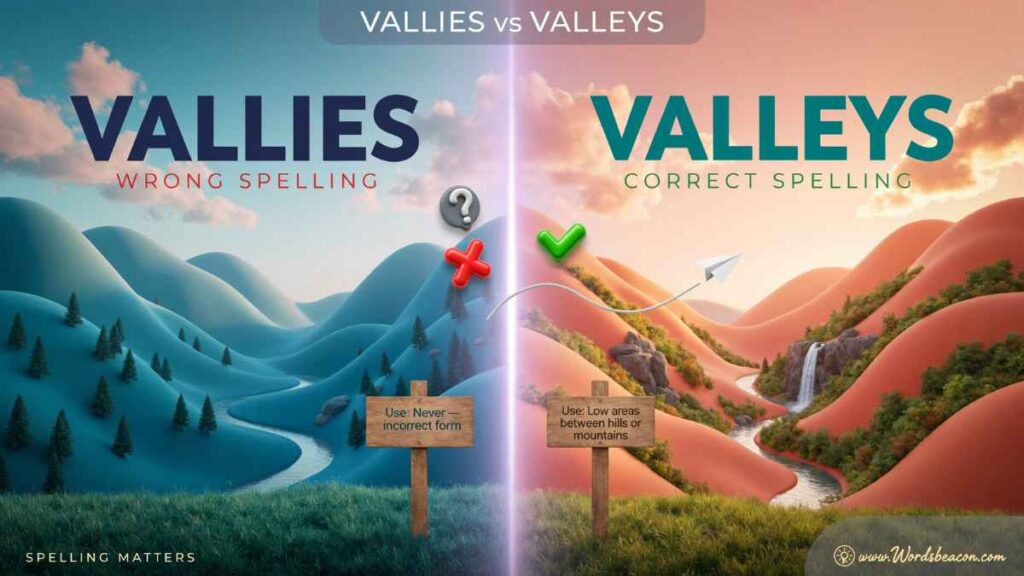
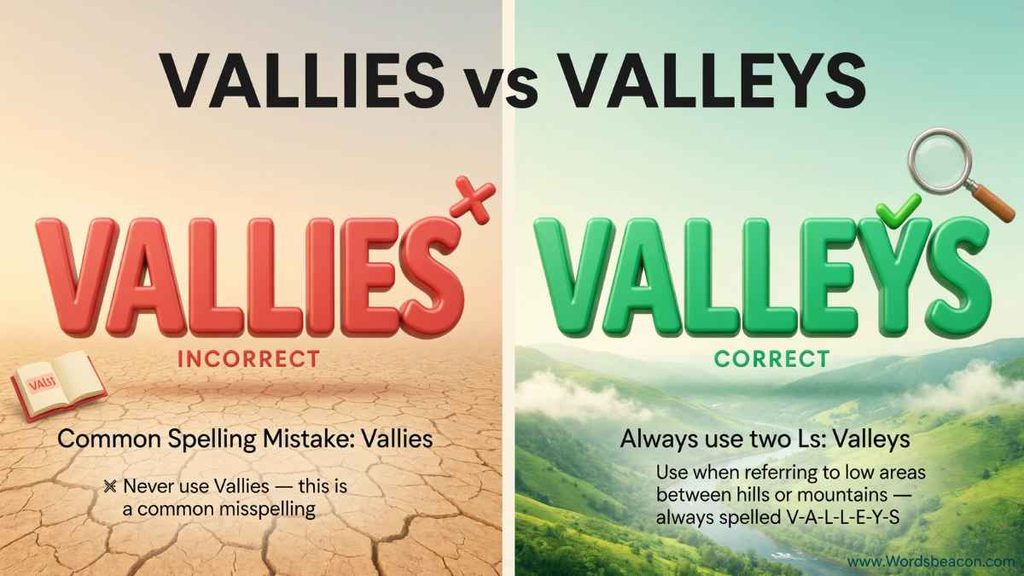
Valleys is the correct spelling. It is the standard plural form of the singular noun valley.
Vallies is an incorrect spelling when used as the plural of valley.
Here’s the correct word formation:
- Singular: Valley
- Plural: Valleys
- Incorrect plural: Vallies
For example:
Correct: The beautiful valleys are surrounded by green mountains.
Incorrect: The beautiful vallies are surrounded by green mountains.
The first sentence uses the correct spelling because it follows the vowel + y plural rule. The second sentence applies the wrong spelling pattern.
Remember this simple formula:
Valley + s = Valleys
You don’t need to remove the final y or replace it with ies.
Fix common more word mistakes in English
Neighbor vs Neighbour One Word, Two Spellings
Vallies vs Valleys Comparison Table
Although these two spellings look similar, only one is correct for the plural of valley.
| Feature | Vallies | Valleys |
|---|---|---|
| Correct spelling | No | Yes |
| Grammatical status | Incorrect as the plural of valley | Standard plural noun |
| Singular form | Intended form: valley | Valley |
| Meaning | Not the standard plural meaning | More than one valley |
| Spelling pattern | Incorrect y-to-ies change | Keep y and add s |
| Standard English usage | Incorrect for this meaning | Correct |
| Example | The vallies look beautiful. | The valleys look beautiful. |
The main difference is the ending. Valleys keeps the original y and adds s, while vallies incorrectly changes the y to ies.
If you’re ever unsure, remember that the correct spelling of valleys contains two l letters followed by eys.
Valley and Valleys Meaning and Definitions
Understanding the meaning of a word makes it easier to use it correctly. Before looking at the spelling rules, let’s understand what valley and valleys actually mean.
What Does Valley Mean?
A valley is a low area of land between hills, mountains, or other elevated areas. It often contains a river or stream and may have gentle slopes, steep sides, or a relatively flat floor.
Valleys form naturally over long periods. Rivers gradually wear away rock and soil, while glaciers can reshape large areas of land as they move. Tectonic activity can also contribute to the formation of certain valleys.
Depending on their location and formation, valleys can have different shapes and features.
Some common types include:
- River valleys: These develop through the movement and erosion of flowing water. Many contain rivers, streams, and fertile land.
- Glacial valleys: These form when moving glaciers reshape the land. They often have a broad U-shaped profile.
- Mountain valleys: These lie between mountains or mountain ridges. They may contain forests, rivers, villages, and farmland.
- Narrow valleys: These have limited space between their sides and often feature steep slopes.
- Wide valleys: These have broader floors and may support agriculture, settlements, and transportation routes.
For example:
“The small village sits in a peaceful valley surrounded by green hills.”
Here, valley refers to one geographical area.
What Does Valleys Mean?
Valleys is the plural form of valley. It refers to two or more low areas of land between hills or mountains.
The word appears in geography, travel writing, school assignments, environmental studies, and everyday conversations. You can use it when discussing several landscapes, describing different mountain regions, or explaining where rivers flow.
Consider these examples:
- Several valleys separate the surrounding mountain peaks.
- The region contains green valleys and fertile farmland.
- Rivers flow through many of the nearby valleys.
- Snow covers the mountain valleys during winter.
Each sentence refers to more than one geographical area. That’s why the plural form is necessary.
What Does Vallies Mean?
People searching for vallies meaning usually want to know whether this spelling has a separate definition.
In standard modern English, vallies is not the accepted plural of valley. It is simply a spelling mistake when used to describe multiple geographical areas.
However, you might occasionally encounter Vallies as part of a surname, business name, username, or another proper name. Special names can have their own spellings, but that doesn’t make vallies the correct plural of the geographical noun.
For ordinary writing, remember:
- Valley means one geographical area.
- Valleys means two or more geographical areas.
- Vallies is incorrect when used as the plural of valley.
Fix common more word mistakes in English
Occured vs Occurred Which Spelling Is Correct?
Why Is Valleys the Correct Spelling?
The confusion between vallies vs valleys comes from a common English grammar rule. Many nouns ending in y change that letter to i before adding es. However, this rule doesn’t apply to every word.
The letter immediately before the final y determines which spelling pattern you should generally follow.
Nouns Ending in a Vowel Followed by Y
When a noun ends in a vowel followed by y, you usually keep the y and add s to form the plural.
This is called the vowel followed by y plural rule.
English has five main vowel letters:
- A
- E
- I
- O
- U
If one of these letters appears immediately before the final y, the noun generally keeps its original ending when you make it plural.
Look at these examples:
| Singular | Plural |
|---|---|
| Valley | Valleys |
| Key | Keys |
| Boy | Boys |
| Toy | Toys |
| Day | Days |
| Monkey | Monkeys |
| Donkey | Donkeys |
| Journey | Journeys |
| Alley | Alleys |
Notice something important: none of these words changes its final y to i.
Instead, you simply add s.
The same pattern explains why valley becomes valleys. The letter e appears immediately before the final y, so you keep both letters and add s.
Nouns Ending in a Consonant Followed by Y
Now let’s look at the other pattern.
When a noun ends in a consonant followed by y, you usually remove the y, change it to i, and add es.
This creates the plural ending ies.
Here are some familiar examples:
| Singular | Plural |
|---|---|
| City | Cities |
| Baby | Babies |
| Lady | Ladies |
| Story | Stories |
| Family | Families |
| Country | Countries |
| Party | Parties |
| Library | Libraries |
In these words, a consonant appears immediately before the final y.
For example, city ends in ty. The letter t is a consonant, so the plural becomes cities.
Similarly, baby becomes babies because b is a consonant.
This explains why some words take ies while others take only s.
Why Doesn’t Valley Become Vallies?
Here’s where everything becomes clear.
Look closely at the spelling of valley:
V – A – L – L – E – Y
The letter immediately before the final y is e. Since e is a vowel, valley follows the vowel + y rule.
That means you keep the original y and add s.
Valley → Valleys
Writing vallies would mean applying the consonant + y rule incorrectly.
Compare these words:
| Singular | Letter Before Y | Correct Plural |
|---|---|---|
| Valley | E (vowel) | Valleys |
| City | T (consonant) | Cities |
| Key | E (vowel) | Keys |
| Baby | B (consonant) | Babies |
| Monkey | E (vowel) | Monkeys |
| Family | L (consonant) | Families |
The rule is easy to remember: check the letter immediately before the final y. If it’s a vowel, generally add s. If it’s a consonant, usually change y to i and add es.
That’s the entire reason valleys is correct and vallies is not.
Learn how to use confusing more words correctly
Separate vs Seperate Which Is Correct?
How to Use Valley and Valleys in Sentences
Knowing a spelling rule is one thing. Using it naturally in a sentence is another.
The easiest way to understand the difference is to look at examples from everyday situations.
Examples Using Valley
Use valley when you’re talking about one geographical area.
Here are some examples:
- A narrow valley separates the two mountain ranges.
- The village stands in a beautiful green valley.
- A small river flows through the valley.
- Farmers grow crops in the fertile valley.
- Thick fog covered the valley early in the morning.
- The mountain valley attracts visitors throughout the year.
- We stopped to admire the beautiful valley landscape.
- The road passes through a deep valley before reaching the town.
Each sentence describes one location, so the singular noun valley is correct.
Examples Using Valleys
Use valleys when referring to two or more geographical areas.
For example:
- The mountain range contains several beautiful valleys.
- Green valleys stretch across the countryside.
- Rivers flow through the valleys between the hills.
- The region is famous for its wide and fertile valleys.
- Heavy snowfall covered the mountain valleys.
- Several small communities developed in the surrounding valleys.
- The hikers explored three narrow valleys during their journey.
- These valleys provide suitable land for farming and settlements.
In every example, the word describes multiple locations.
Vallies vs Valleys Incorrect and Correct Sentences
Comparing incorrect and correct examples between s vallies vs valleys is a helpful way to remember the spelling.
| Incorrect | Correct |
|---|---|
| The vallies are full of green trees. | The valleys are full of green trees. |
| Several vallies surround the village. | Several valleys surround the village. |
| Snow covered the mountain vallies. | Snow covered the mountain valleys. |
| These vallies contain fertile soil. | These valleys contain fertile soil. |
| Rivers flow through deep vallies. | Rivers flow through deep valleys. |
| The vallies look beautiful in spring. | The valleys look beautiful in spring. |
The meaning stays the same after correction. Only the spelling changes.
Whenever you write about multiple valleys, use the form with s.
Learn how to use confusing more words correctly
Analysis vs Analyses difference and usage
When Should You Use Valley or Valleys?
Choosing between valley and valleys isn’t difficult once you understand singular and plural nouns.
Use valley when you’re talking about one place. And Use valleys when you’re talking about more than one.
Use Valley for One Geographical Area
The singular form describes a single location.
You can use it with words such as a, the, one, this, and that.
Examples:
- A valley separates the two hills.
- The valley looks peaceful.
- One valley lies beyond the forest.
- This valley receives plenty of rainfall.
- That valley contains a small village.
Each example refers to one geographical area.
Use Valleys for Multiple Geographical Areas
The plural form is appropriate when you’re discussing two or more places.
You can use it with numbers and words such as several, many, these, and those.
Examples:
- Two valleys lie between the mountain peaks.
- Several valleys surround the town.
- Many valleys contain rivers and streams.
- These valleys support local agriculture.
- Those valleys remain covered in snow during winter.
You can also use valleys when making a general statement.
For example:
“Valleys often provide natural routes through mountainous regions.”
This sentence discusses valleys as a geographical feature rather than one particular location.
Singular and Plural Verb Agreement
The spelling of a noun isn’t the only thing that matters. You also need to use the correct verb.
A singular noun generally takes a singular verb, while a plural noun takes a plural verb.
Compare these examples:
| Singular | Plural |
|---|---|
| The valley is peaceful. | The valleys are peaceful. |
| A valley has fertile soil. | Several valleys have fertile soil. |
| The valley looks beautiful. | The valleys look beautiful. |
| This valley receives rain. | These valleys receive rain. |
Notice how the verbs change along with the nouns.
Avoid writing:
Incorrect: The valleys is surrounded by mountains.
Correct: The valleys are surrounded by mountains.
Likewise:
Incorrect: The valley are beautiful.
Correct: The valley is beautiful.
Using the correct noun and verb together makes your writing clearer and grammatically accurate.
Learn how to use confusing more words correctly
Todays vs Today’s Which one Is Correct?
Common Spelling Mistakes Related to Valley
Even familiar English words can become confusing when you apply a spelling rule without checking it first.
Here are some mistakes to watch out for.
Writing Vallies Instead of Valleys
This is the most common mistake associated with this topic.
Incorrect: The vallies are beautiful in autumn.
Correct: The valleys are beautiful in autumn.
The writer has applied the consonant + y rule even though valley ends in a vowel + y combination.
Changing Every Final Y to IES
Not every noun ending in y changes to ies.
For example:
- Key becomes keys.
- Boy becomes boys.
- Monkey becomes monkeys.
- Valley becomes valleys.
However:
- City becomes cities.
- Baby becomes babies.
- Story becomes stories.
- Family becomes families.
The important thing is to check the letter before the final y instead of applying the same pattern to every word.
Confusing Singular and Plural Forms
Sometimes writers use the plural form when they mean one place or forget the s when describing several locations.
Incorrect: The valleys is located near the river.
Correct: The valley is located near the river.
Incorrect: Three valley surround the mountain.
Correct: Three valleys surround the mountain.
Always check whether you’re discussing one place or several.
Using the Wrong Verb
Another common mistake involves subject-verb agreement.
Incorrect: The valleys looks green.
Correct: The valleys look green.
Incorrect: The valley are beautiful.
Correct: The valley is beautiful.
The noun and verb must agree in number.
Adding an Apostrophe to Form the Plural
You don’t need an apostrophe to make valley plural.
The correct plural is valleys, not valley’s.
These three forms have different purposes:
- Valley: One geographical area.
- Valleys: More than one geographical area.
- Valley’s: Something belonging to one valley.
For example:
“The valley’s river overflowed after heavy rain.”
Here, the apostrophe shows possession. It doesn’t create a plural noun.
Pronunciation of Valley and Valleys
The words valley and valleys have similar pronunciations. The main difference is the additional sound at the end of the plural form.
In American English, valley is pronounced with two syllables. The stress falls on the first syllable.
The pronunciation of the two words is:
| Word | American English IPA | Syllables |
|---|---|---|
| Valley | /ˈvæl.i/ | 2 |
| Valleys | /ˈvæl.iz/ | 2 |
When you say valleys, you add a voiced z sound at the end.
The main pronunciation remains the same. You don’t need to change the way you pronounce the beginning of the word.
Remember that spelling and pronunciation serve different purposes. Even though the plural adds a letter s, its sound is closer to z in this word.
Understand confusing English more words simply
Ensure vs Insure Difference and usage
Etymology and Origin of Valley
The word valley has an interesting history.
It entered English through Old French, where it appeared in forms such as valee or valée. These forms came from the Latin word vallis, meaning a valley or low area of land.
Over time, English adopted the spelling valley and established it as the standard word for this geographical feature.
Today, the word describes a low area between hills or mountains. It often refers to land shaped by rivers, glaciers, or other natural processes.
Its plural form follows the ordinary English vowel + y spelling pattern. Although the word has historical roots in Latin and French, its modern plural is formed according to English grammar.
That’s why the correct form is valleys rather than vallies.
Valley vs Valleys in American and British English
Some English words have different spellings depending on the country. For example, American English uses color, while British English commonly uses colour.
However, valley doesn’t have this kind of regional spelling difference.
American, British, Australian, and Canadian English all use the same standard forms.
| English Variety | Singular | Plural |
|---|---|---|
| American English | Valley | Valleys |
| British English | Valley | Valleys |
| Australian English | Valley | Valleys |
| Canadian English | Valley | Valleys |
There is no standard regional rule that makes vallies correct in any of these varieties.
Whether you’re writing a school assignment in the United States, preparing a geography report in Britain, or describing a landscape in Australia, valleys remains the correct plural spelling.
Valley and Valleys in Real-Life Contexts
These words aren’t limited to spelling exercises. You’ll find them in geography books, travel articles, school assignments, and everyday conversations.
Understanding how people use them in different situations makes the distinction easier to remember.
Geography and Science
Geographers use valley and valleys when describing landforms and explaining how natural processes shape the Earth’s surface.
For example:
- A river valley develops as flowing water gradually erodes the surrounding land.
- Glacial valleys often have broad, U-shaped profiles.
- Mountain valleys can influence local drainage patterns.
- Fertile valleys may support agriculture and human settlements.
When describing one landform, use valley. When discussing several, use valleys.
Travel and Tourism
Travel writers often use valleys when describing scenic regions, mountain destinations, and natural landscapes.
For example:
“The region is famous for its beautiful valleys, forest trails, and peaceful mountain villages.”
However, when discussing one destination, the singular form is more suitable:
“The valley attracts visitors with its hiking trails and impressive mountain views.”
The choice depends on the number of geographical areas being described.
Academic and School Writing
Students commonly encounter these words in geography lessons, English grammar exercises, and spelling assignments.
Here are some simple sentences:
- A valley is a low area between hills.
- Rivers often flow through valleys.
- The valley is surrounded by mountains.
- Green valleys provide land for farming.
- Several valleys lie between the mountain peaks.
For a valleys sentence for class 3, you can use:
“The valleys are green and beautiful.”
Another simple example is:
“Many rivers flow through the valleys.”
Both sentences are easy to understand and use the plural noun correctly.
Everyday Conversation
You don’t need to be a geographer to use these words. They fit naturally into ordinary conversations.
For example:
- “We drove through a beautiful valley.”
- “The mountains have several green valleys.”
- “I would love to visit those valleys.”
- “The valley looks peaceful in the morning.”
- “These valleys are famous for their beautiful scenery.”
The rule remains the same in everyday speech: valley for one place and valleys for multiple places.
Understand confusing English more words simply
Principal vs Principle Difference and usage
Vallies vs Valleys in Everyday Writing
The spelling difference between vallies vs valleys can be confusing when you write about geographical places. You might use the word in a school assignment, travel blog, nature description, or conversation about mountains. Understanding vallies vs valleys helps you choose the correct spelling and make your writing clear and professional.
For example, if you describe one beautiful landscape, you can write, “The valley was surrounded by tall mountains.” However, when discussing several landscapes, write, “The valleys were filled with green trees and flowing rivers.”
The confusion in vallies vs valleys often happens because many English nouns change their ending from y to -ies. However, valley follows a different pattern. It keeps the letter y and takes an s at the end. Once you understand this spelling rule, the difference between becomes vallies vs valleys much easier to remember. You can also avoid this common spelling mistake when proofreading your sentences.
Related Words and Similar Pluralization Patterns
Comparing valley with other English words helps you understand why some nouns take s while others take ies.
Look at these examples:
| Singular | Plural | Spelling Rule |
|---|---|---|
| Valley | Valleys | Vowel + y: add s |
| Key | Keys | Vowel + y: add s |
| Boy | Boys | Vowel + y: add s |
| Day | Days | Vowel + y: add s |
| Monkey | Monkeys | Vowel + y: add s |
| City | Cities | Consonant + y: change y to ies |
| Baby | Babies | Consonant + y: change y to ies |
| Family | Families | Consonant + y: change y to ies |
| Country | Countries | Consonant + y: change y to ies |
Notice that monkey and valley follow the same pattern. Both have a vowel immediately before the final y.
On the other hand, city and family follow a different pattern because a consonant appears before the final y.
This comparison is useful when learning English pluralization rules. Instead of memorizing every word separately, you can recognize the pattern and apply it to other regular plural nouns.
Understand confusing English more words simply
Happened vs Happend Which Spelling Is Correct?
Easy Ways to Remember the Correct Spelling of Valleys
Spelling rules become much easier when you have a simple trick to remember them.
Here are three useful methods to help you avoid writing vallies.
Remember the Vowel Before Y
Look at the last two letters of valley.
They are ey.
The letter e is a vowel, so you keep the y and add s.
Valley → Valleys
This is the most reliable memory trick because it explains the actual spelling rule rather than asking you to memorize the word without understanding it.
Compare Valley With City
Think about these two words:
- Valley → Valleys
- City → Cities
Why do they have different endings?
Because the letter before the final y is different.
In valley, that letter is e, a vowel.
In city, that letter is t, a consonant.
That’s why one takes s while the other changes to ies.
Use a Simple Spelling Formula
Remember these two patterns:
- Vowel + y + s = Keep y and add s.
- Consonant + y = Change y to i and add es.
Examples:
- Key → Keys
- Toy → Toys
- Valley → Valleys
- Baby → Babies
- Story → Stories
Once you learn this difference, you’ll find it much easier to spell other words ending in y.
Learn the difference between tricky more English words
Seeing vs Seing Which Spelling Is Correct?
practice session Vallies vs Valleys
Choose the correct spelling to complete each sentence. Write either vallies vs valleys in the blank.
- The river flows through a beautiful green __________.
- The mountains have several deep __________.
- We stopped to admire the __________ from the hilltop.
- A narrow __________ separated the two mountain ranges.
- Many __________ contain rivers and fertile farmland.
- The hikers walked through a peaceful __________.
- Snow covered the tops of the mountains and filled the nearby __________.
- This __________ is famous for its beautiful scenery.
- Farmers grow crops in the fertile __________.
- Several __________ stretch across the region.
- The small village sits in a quiet __________.
- We explored three __________ during our vacation.
- A river runs through the __________ below.
- The green __________ looked stunning in the morning sunlight.
- Some __________ are surrounded by steep mountains.
- The road winds through a deep __________.
- Tourists visit these __________ every summer.
- The __________ was covered with wildflowers.
- The map shows several __________ in the northern region.
- We watched the sunset over the __________.
Answers
- valley
- valleys
- valleys
- valley
- valleys
- valley
- valleys
- valley
- valley
- valleys
- valley
- valleys
- valley
- valley
- valleys
- valley
- valleys
- valley
- valleys
- valleys
Remember: Valley is singular. Valleys is its correct plural form. Vallies is incorrect.
Here’s a trusted source for clear word meanings:
FAQs
Is vallies a correct English word?
No, vallies is not the correct spelling of the plural form of valley. The standard spelling is valleys. Use valleys whenever you refer to more than one low area between hills or mountains.
What is the correct plural of valley?
The correct plural of valley is valleys. You form it by adding -s to the singular word because valley ends in a vowel followed by y.
Why is it valleys instead of vallies?
The spelling rule explains the difference. When a noun ends in a vowel followed by y, you simply add -s. Since the letter before y in valley is e, the correct plural is valleys, not vallies.
What does valley mean in English?
A valley is a low area of land between hills or mountains. It often has a river, stream, or flat area running through it. Valleys can vary in size, shape, and depth.
What does valleys mean?
Valleys is the plural form of valley. It refers to two or more low areas of land surrounded by hills or mountains. For example, a region may contain several valleys with rivers and villages.
How do you spell vallies correctly?
If you mean more than one valley, spell it valleys. The spelling vallies is incorrect for this meaning. Remember to keep the letter y and add -s at the end.
Should I use valley or valleys?
Use valley when referring to one low area of land. Use valleys when talking about two or more. For example, “The valley looks beautiful” refers to one place, while “The valleys look beautiful” refers to several places.
Is vallies ever used as a name?
Vallies may appear as an unusual surname, personal name, or proper name. However, it is not the standard plural spelling of valley. In ordinary writing, use valleys when referring to multiple geographical valleys.
What is another word for valley?
Vale, dale, glen, hollow, and basin are words sometimes used as alternatives to valley. Their meanings can differ slightly depending on the landscape and context. For example, glen often describes a narrow valley.
What is a small valley called?
A small valley may be called a dell, glen, or hollow. A dell usually describes a small, sheltered valley, while a glen often refers to a narrow valley, particularly in a scenic or wooded area.
Is a vale the same as a valley?
Yes, a vale is another word for a valley. Both describe a low area between hills or mountains. However, vale appears more often in literary writing and place names, while valley is more common in everyday English.
What are the main types of valleys?
Three common valley forms are V-shaped valleys, U-shaped valleys, and flat-floored valleys. Rivers often create V-shaped valleys through erosion, while glaciers shape U-shaped valleys. Flat-floored valleys have broader, more level bottoms.
How are valleys formed?
Valleys develop through natural processes such as river erosion, glacial movement, and tectonic activity. Over long periods, flowing water or moving ice can wear away rock and soil, creating different valley shapes.
What is the difference between a valley and a gorge?
A valley is a low area between hills or mountains and can have gentle or steep sides. A gorge is a narrow, deep valley with steep rocky walls, often formed by a river cutting through rock.
What is the difference between a valley and a glen?
A valley is a general geographical term for low land between hills or mountains. A glen usually describes a narrow, often wooded valley. The word glen is especially associated with Scottish and Irish geographical names.
Can a valley have more than one river?
Yes, a valley can contain several rivers or streams. Some valleys have one main river with smaller streams flowing into it. These waterways may shape the landscape through erosion over thousands of years.
Are valleys always found between mountains?
No, valleys do not always lie between large mountains. They can also form between hills, ridges, or elevated areas of land. Their defining feature is their lower position compared with the surrounding landscape.
What is the difference between a valley and a basin?
A valley is generally a long, low area between higher landforms. A basin is a broader, often bowl-shaped area surrounded by higher ground. Although both are low areas, their shapes and geographical features differ.
What is the easiest way to remember the spelling of valleys?
Remember that valley ends in e followed by y. When you make it plural, keep the y and add -s. The result is valleys. Unlike words such as city, valley does not change its y to ies.
Learn the difference between tricky more English words
installment vs Instalment One Word Two Spellings
Conclusion
Choosing between vallies vs valleys may seem confusing at first, especially when words like city change to cities in the plural form. However, the spelling rule is simple once you understand it. Valley becomes valleys because it ends in a vowel followed by y. You only change y to -ies when a word ends in a consonant followed by y.
So, remember this easy rule: one valley, two valleys. The spelling vallies is incorrect when you mean more than one valley. Whether you’re writing about beautiful mountain scenery, deep river valleys, or places you hope to visit, always use valleys for the plural. No need to let one little letter turn your writing into a spelling adventure! Keep the y, add -s, and you’re good to go.

Luna AJS is an experienced blogger and dedicated language enthusiast at Words Beacon. She specializes in making English grammar, spelling, vocabulary and commonly confused words easy to understand. She provides clear explanations, practical examples to help readers write with confidence.