
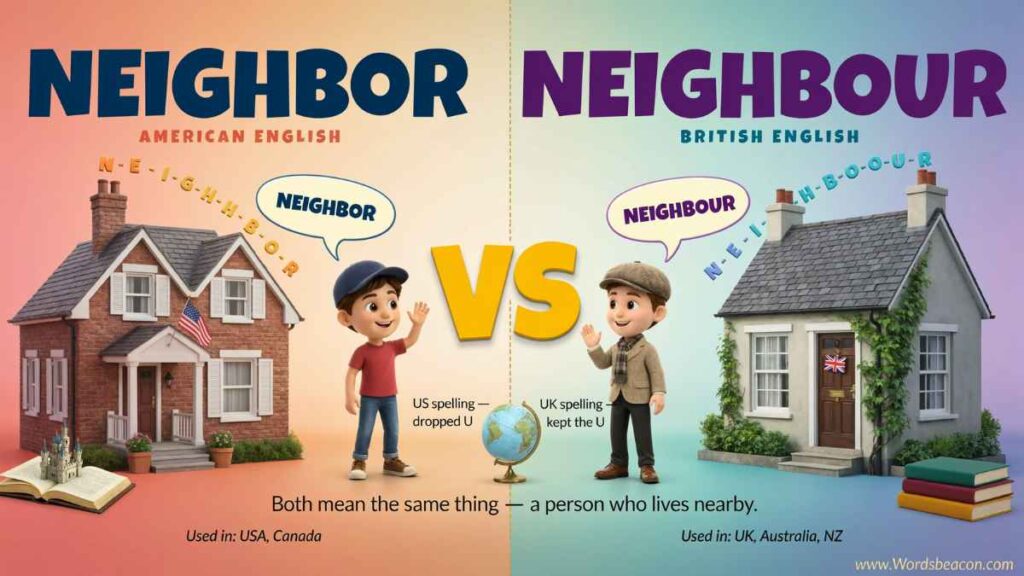
The spelling difference between neighbor vs neighbour can leave you wondering whether you’ve made a mistake or simply followed a different English spelling rule. The good news? Both spellings are correct! The difference comes down to where you use them. American English drops the extra u and spells the word “neighbor,” while British English keeps it as “neighbour.” Although the difference looks small, choosing the right version matters when you’re writing for a particular audience. Let’s clear up the confusion by exploring their meanings, spelling rules, grammar, and common mistakes so you can use the correct form with confidence.
comparison table
| Comparison | Neighbor | Neighbour |
|---|---|---|
| English variety | American English | British English |
| Meaning | A person who lives nearby | A person who lives nearby |
| Pronunciation | /ˈneɪ.bɚ/ | /ˈneɪ.bə/ |
| Part of speech | Noun and verb | Noun and verb |
| Plural | Neighbors | Neighbours |
| Related adjective | Neighboring | Neighbouring |
| Related noun | Neighborhood | Neighbourhood |
| Common usage | United States | United Kingdom, Australia, New Zealand, and other English-speaking regions |
Fix common more word mistakes in English
Occured vs Occurred Correct Spelling, Rules and Examples
Quick Answer Neighbor vs Neighbour?
Both neighbor vs neighbour are correct English spellings. Your choice depends on the type of English you’re using.
- Neighbor is the standard American English spelling.
- Neighbour is the standard British English spelling.
- Both words have exactly the same meaning.
- Both are used as nouns and verbs.
- Their basic pronunciation is the same within the same accent.
- Their plural and related forms follow the same regional spelling pattern.
Consider these two sentences:
American English: My neighbor helped me move into my new house.
British English: My neighbour helped me move into my new house.
Both sentences are correct. The only difference is the spelling.
If you’re writing an article, email, essay, or report for an American audience, use neighbor. For British English, choose neighbour. Once you select one version, keep it consistent throughout your writing.
Neighbor vs Neighbour Comparison Table
The following table makes the spelling difference easy to remember.
| Word form | American English | British English |
|---|---|---|
| Singular | Neighbor | Neighbour |
| Plural | Neighbors | Neighbours |
| Adjective or participle | Neighboring | Neighbouring |
| Related noun | Neighborhood | Neighbourhood |
| Related adjective | Neighborly | Neighbourly |
Notice the pattern? American English drops the U, while British English keeps it.
This rule applies to the main word and its related forms. You shouldn’t write neighbor in one sentence and neighbourhood in another if you’re following standard American English.
What Do Neighbor and Neighbour Mean?
The first thing to understand is that neighbor and neighbour have the same definition. Neither spelling changes the meaning of the word.
Both describe someone who lives near you or something located close to another person, place, or object.
Neighbor Meaning and Definition
Neighbor is the standard American English spelling. As a noun, it refers to a person who lives near or next to another person.
For example, someone living in the house beside yours is your neighbor. The person across the street or in the apartment next door can also be your neighbor.
The neighbor definition isn’t limited to residential relationships. It can also describe nearby places, communities, and countries.
Examples:
- My neighbor has a friendly dog.
- Our new neighbor moved in last week.
- The neighbors across the street are very helpful.
- Canada is a northern neighbor of the United States.
Neighbor can also work as a verb. In this form, it means to be located near, next to, or alongside something.
For example:
- The farm neighbors a large forest.
- Our town neighbors a busy commercial area.
Although the noun is more common in everyday conversation, the verb is also grammatically correct.
Neighbour Meaning and Definition
Neighbour is the British English spelling of the same word. It refers to a person living nearby or something located close to another place.
For example:
- Our neighbour invited us to dinner.
- The new neighbours have two children.
- The neighbouring village attracts many visitors.
- France is a neighbouring country of Germany.
The extra U doesn’t change the definition, pronunciation, or grammatical function.
In other words, the neighbor and neighbour meaning is identical. Only the regional spelling changes.
Fix common more word mistakes in English
Separate vs Seperate Which Spelling Is Correct? (Easy Guide)
Why Are There Two Spellings of Neighbor?
English has developed different spelling conventions over hundreds of years. That’s why some words have two accepted forms, depending on where they’re used.
Neighbor vs neighbour both developed from the Old English word nēahgebūr. This word combined two elements:
- Nēah, meaning near or close.
- Gebūr, meaning a dweller or inhabitant.
Together, they described someone who lived nearby.
The word later developed through Middle English before reaching its modern forms. Over time, American and British English adopted different spelling preferences.
Noah Webster’s Influence on American Spelling
Noah Webster, an American lexicographer, helped establish several spelling differences between American and British English.
He supported simpler spelling conventions and promoted forms that he considered more practical for American education and publishing.
His dictionaries helped popularize many American spellings, including the shorter -or forms.
For example:
| American English | British English |
|---|---|
| Neighbor | Neighbour |
| Color | Colour |
| Favor | Favour |
| Honor | Honour |
| Labor | Labour |
| Humor | Humour |
| Behavior | Behaviour |
These examples show a common pattern: American English often uses -or, while British English uses -our in certain words.
However, this isn’t a rule that applies to every English word. Words such as author, doctor, and visitor use the same spelling in both varieties.
Why Does British English Use Neighbour?
British English generally preserves the U in many words ending in -our. These spellings developed through historical French and Latin influences and became established in British writing.
Meanwhile, American English gradually favored shorter forms in several words.
That’s why British writers use neighbour, colour, and favour, while American writers use neighbor, color, and favor.
Neither system is better. They’re simply different spelling traditions.
Fix common more word mistakes in English
Todays vs Today’s Which one Is Correct?
Neighbor vs Neighbour American and British English Differences

The spelling difference becomes easier to understand when you look at how different English-speaking countries use the word.
American English Neighbor
In the United States, neighbor is the standard spelling.
You’ll see it in American dictionaries, newspapers, books, school assignments, business emails, and everyday messages.
Examples:
- My neighbor invited me to a birthday party.
- We have friendly neighbors.
- The neighboring town has a new shopping mall.
- Good neighborly relationships make a community stronger.
American English uses these related forms:
- Neighbor
- Neighbors
- Neighboring
- Neighborhood
- Neighborly
If you’re writing for American readers, these are the spellings you should use.
British English Neighbour
In the United Kingdom, neighbour is the standard spelling.
British newspapers, books, educational materials, and everyday communication generally use this form.
Examples:
- My neighbour lives next door.
- Our neighbours are planning a garden party.
- The neighbouring village has a small school.
- She has always been friendly and neighbourly.
The related British forms are:
- Neighbour
- Neighbours
- Neighbouring
- Neighbourhood
- Neighbourly
So, if someone asks, “Is neighbour British or American spelling?” the answer is straightforward: neighbour is the standard British form.
Canadian English Neighbour
Canadian English generally uses neighbour rather than neighbor.
Canada follows a combination of British and American spelling conventions. For example, Canadian writers commonly use colour, favour, and centre.
However, Canadian English has its own spelling preferences. It doesn’t follow every British convention without exception.
For this particular word, neighbour, neighbours, and neighbourhood are the usual Canadian forms.
Australian English Neighbour
Australian English generally follows British-style spelling.
Australians commonly write:
- Neighbour
- Neighbours
- Neighbouring
- Neighbourhood
- Neighbourly
For example:
“Our neighbours organized a community event in the local neighbourhood.”
These spellings are common in Australian publications, educational materials, and everyday writing.
New Zealand English Neighbour
New Zealand English also generally uses neighbour.
The same spelling pattern applies to its related forms, including neighbours, neighbouring, and neighbourhood.
For example:
“Our neighbours invited us to a local community gathering.”
Irish English Neighbour
Irish English generally follows British spelling conventions for this word.
Therefore, neighbour, neighbours, and neighbourhood are standard choices in Irish English writing.
Neighbor vs Neighbour Pronunciation
Does the extra U change how you say the word? No. Neighbor vs neighbour generally have the same pronunciation within the same accent.
The main pronunciation difference comes from American and British accents.
| English variety | IPA pronunciation |
|---|---|
| American English | /ˈneɪ.bɚ/ |
| British English | /ˈneɪ.bə/ |
Both versions have two syllables, with the main stress on the first syllable.
The first syllable contains the long A sound found in words such as day and say. The final syllable has a reduced vowel sound.
American speakers generally pronounce the final R. Many British speakers don’t pronounce it unless a vowel sound follows.
So, although the spelling changes, the word’s basic pronunciation stays the same.
Are neighbor and neighbour homophones? Yes. They represent the same spoken word when pronounced in the same accent.
Learn how to use confusing more words correctly
Ensure vs Insure Difference and usage
Grammar Rules for Neighbor and Neighbour
Both spellings follow the same grammar rules. You can use them as nouns and verbs, while their related forms work as adjectives and nouns.
Neighbor as a Noun
A noun names a person, place, thing, or idea.
As a noun, neighbor refers to someone who lives close to you. This could be a person next door, across the street, or somewhere in your local community.
Examples:
- My neighbor owns a small restaurant.
- A new neighbor moved into the apartment upstairs.
- Our neighbors have a beautiful garden.
- Every neighbor received an invitation.
The word can also describe nearby places and countries.
For example:
- Canada is a neighbor of the United States.
- The neighboring states share a border.
British English uses neighbour in the same way.
Neighbor as a Verb
Neighbor can also function as a verb. It means to be located near, next to, or alongside something.
Examples:
- The property neighbors a public park.
- Our village neighbors a historic town.
- Several farms neighbor the river.
British English uses neighbour with the same meaning.
For example:
“The farm neighbours a small residential community.”
This verb form is less common in everyday conversation than the noun. However, it appears in geographical descriptions and formal writing.
Neighboring and Neighbouring
Neighboring and neighbouring describe something located near or next to another place.
Examples in American English:
- The neighboring houses have similar designs.
- Several neighboring towns share a railway station.
- The neighboring country offered assistance.
Examples in British English:
- The neighbouring houses have similar designs.
- Several neighbouring towns share a railway station.
- The neighbouring country offered assistance.
The rule is simple: use neighboring in American English and neighbouring in British English.
Neighborly and Neighbourly
Neighborly is an adjective that describes friendly, helpful, and considerate behavior toward people living nearby.
British English uses neighbourly.
Examples:
- Our new neighbor was very neighborly.
- The community showed neighborly kindness after the storm.
- Her neighbourly attitude made everyone feel welcome.
Helping someone carry groceries, collecting a package while they’re away, or checking on an older people resident are all examples of neighborly behavior.
Understand confusing English more words simply
Happened vs Happend Which Spelling Is Correct?
Neighbor, Neighbors, and Neighbour Singular and Plural Forms
The plural forms are easy to remember. Simply add S to the singular spelling.
| Singular | Plural | English variety |
|---|---|---|
| Neighbor | Neighbors | American |
| Neighbour | Neighbours | British |
| Neighbor | Neighbors | US English |
| Neighbour | Neighbours | Standard Canadian English |
Examples:
- One neighbor lives upstairs.
- Three neighbors attended the meeting.
- My neighbour owns a small bakery.
- Several neighbours helped clean the street.
Possessive Forms
You can also use both spellings to show ownership.
For a singular noun, add apostrophe + S:
- My neighbor’s car is outside.
- My neighbour’s garden looks beautiful.
For a plural noun ending in S, add an apostrophe after the final S:
- Our neighbors’ houses have new roofs.
- The neighbours’ children attend the same school.
The possessive rules don’t change between American and British English.
Neighbor vs Neighborhood What’s the Difference?
Neighbor and neighborhood look similar, but they don’t mean the same thing.
A neighbor is usually a person who lives nearby. A neighborhood is an area or community where people live.
The only difference between neighborhood and neighbourhood is the regional spelling.
| Word | Meaning | English variety |
|---|---|---|
| Neighbor | A person living nearby | American |
| Neighbour | A person living nearby | British |
| Neighborhood | A residential area or community | American |
| Neighbourhood | A residential area or community | British |
Examples of Neighbor
- My neighbor lives across the street.
- Our neighbors are friendly.
- The new neighbor introduced himself yesterday.
Examples of Neighborhood
- We live in a quiet neighborhood.
- The neighborhood has several parks.
- A new supermarket opened in our neighborhood.
British examples:
- We live in a quiet neighbourhood.
- The neighbourhood has several parks.
- A new supermarket opened in our neighbourhood.
Here’s an easy way to remember the distinction:
Neighbor refers to a person. Neighborhood refers to the place where people live.
Understand confusing English more words simply
Principal vs Principle Difference and usage
Neighbor vs Neighbour in Everyday Writing
Choosing the correct spelling matters in everyday communication, professional documents, academic work, and published articles.
Daily Conversation
In informal messages, use the spelling that matches your English variety.
American examples:
- My neighbor is having a party tonight.
- We invited our neighbors for dinner.
- The new neighbor has two children.
British examples:
- My neighbour is having a party tonight.
- We invited our neighbours for dinner.
- The new neighbour has two children.
Workplace and Business Communication
Professional writing should follow consistent spelling conventions.
An American company might write:
“Our neighboring offices will participate in the annual meeting.”
A British company would generally write:
“Our neighbouring offices will participate in the annual meeting.”
Both sentences are correct. The difference reflects the company’s preferred English variety.
Academic and Formal Writing
Academic writing requires consistency. Universities, journals, and educational institutions often specify which English variety students and authors should follow.
For example:
- American universities generally expect neighbor.
- British universities generally expect neighbour.
- Canadian publications generally favor neighbour.
If you’re preparing an essay, research paper, or formal report, check the required style guide before submitting your work.
News Articles and Publications
Newspapers and magazines usually maintain editorial style guides to keep their content consistent.
An American publication will generally use neighbor and neighborhood. A British publication will generally use neighbour and neighbourhood.
This approach helps prevent unnecessary spelling changes throughout an article.
Learn the difference between similar English words
installment vs Instalment One Word Two Spellings
Common Neighbor and Neighbour Spelling Mistakes
Although the main difference is simple, writers sometimes make mistakes when using related words or switching between American and British conventions.
Mixing American and British Spellings
One common mistake is using both versions in the same document without a reason.
For example:
“My neighbour invited the neighbors from the neighbouring neighborhood.”
This sentence mixes British and American spellings.
The consistent American version is:
“My neighbor invited the neighbors from the neighboring neighborhood.”
The consistent British version is:
“My neighbour invited the neighbours from the neighbouring neighbourhood.”
Choose one spelling system and stick with it.
Misspelling Neighbors and Neighbours
The correct plural forms are neighbors and neighbours.
Common incorrect forms include:
- Neighboors
- Neighbores
- Neighburs
- Neighbers
Remember that you only need to add S to the correct singular spelling.
Confusing Neighboring and Neighbouring
Both forms are correct, but they belong to different English varieties.
American: The neighboring state introduced a new law.
British: The neighbouring state introduced a new law.
Don’t add the U when following American English or remove it when following standard British English.
Assuming One Spelling Is Always Wrong
Some writers believe that neighbour is incorrect in the United States or that neighbor is incorrect in the United Kingdom.
That’s not quite right.
Both are established English spellings. However, each region has a preferred standard form.
Confusing Neighbor With Neighborhood
These words aren’t interchangeable.
Incorrect: My neighborhood helped me move.
Correct: My neighbor helped me move.
The first sentence refers to an entire residential area, while the second identifies a person.
Learn the difference between tricky more English words
Analysis vs Analyses difference and usage
How to Remember Neighbor vs Neighbour
Here’s a simple trick: American English drops the U, while British English keeps it.
You can remember this pattern by looking at other familiar spelling pairs.
| American English | British English |
|---|---|
| Color | Colour |
| Favor | Favour |
| Honor | Honour |
| Labor | Labour |
| Humor | Humour |
| Behavior | Behaviour |
| Neighbor | Neighbour |
These examples make the neighbor vs neighbour spelling rule easier to remember.
Keep these quick reminders in mind:
- Writing for the United States? Choose neighbor.
- Writing for the United Kingdom? Choose neighbour.
- Writing for Australia? Generally choose neighbour.
- Writing for New Zealand? Generally choose neighbour.
- Writing for Canada? Generally choose neighbour.
- Unsure about a publication? Follow its style guide.
Remember the related forms, too. American English uses neighbors, neighboring, and neighborhood. British English uses neighbours, neighbouring, and neighbourhood.
Which Spelling Should You Use in Formal Writing?
The correct choice depends on your readers and the writing standards you need to follow.
Use neighbor when writing for:
- American schools and universities
- US newspapers and magazines
- American businesses
- US government publications
- Websites targeting American readers
Use neighbour when writing for:
- British schools and universities
- UK publications
- Australian and New Zealand audiences
- Canadian publications following standard Canadian spelling
- Other publications that use British-style spelling
A Simple Example
Imagine you’re writing an article for an American home improvement website.
You might write:
“Your neighbor can help you identify property boundaries and discuss shared fencing responsibilities.”
For a British property website, the sentence would generally read:
“Your neighbour can help you identify property boundaries and discuss shared fencing responsibilities.”
The meaning remains exactly the same. Only the spelling changes.
The most important rule is to follow your audience’s spelling convention and remain consistent throughout the document.
Understand confusing English more words simply
Seeing vs Seing Which Spelling Is Correct?
Practice session Neighbor vs Neighbour
Test your understanding with these fill-in-the-blank questions. Choose the spelling that matches the English variety used in each sentence.
- My American ______ invited us to a barbecue. (neighbor / neighbour)
- Our British ______ has a beautiful garden. (neighbor / neighbour)
- Several ______ attended the community meeting. (neighbors / neighbours)
- The ______ town has a new shopping center. (neighboring / neighbouring)
- We live in a quiet American ______. (neighborhood / neighbourhood)
- The British family moved into the ______ house. (neighboring / neighbouring)
- My ______ helped me carry the furniture. (neighbor / neighbour)
- The two ______ share a common garden. (neighbors / neighbours)
- Canada is a northern ______ of the United States. (neighbor / neighbour)
- The Australian ______ organized a street party. (neighbor / neighbour)
- Good ______ relationships can make a community stronger. (neighborly / neighbourly)
- Several ______ countries signed the agreement. (neighboring / neighbouring)
- My American ______’s car is outside. (neighbor / neighbour)
- The ______ children played together after school. (neighbors / neighbours)
- The village is located in a peaceful British ______. (neighborhood / neighbourhood)
- The farm ______ a large forest. (neighbors / neighbours)
- Our ______ invited us to dinner. (neighbors / neighbours)
- The company opened an office in a ______ state. (neighboring / neighbouring)
- The American ______ helped organize the event. (neighbor / neighbour)
- Her ______ behavior made the new family feel welcome. (neighborly / neighbourly)
Answers
- Neighbor
- Neighbour
- Neighbours
- Neighboring
- Neighborhood
- Neighbouring
- Neighbor
- Neighbours
- Neighbor
- Neighbour
- Neighborly
- Neighbouring
- Neighbor
- Neighbors
- Neighbourhood
- Neighbors
- Neighbours
- Neighboring
- Neighbor
- Neighborly
Here’s a trusted source for clear word meanings:
FAQs
Why are neighbor and neighbour spelled differently?
“Neighbor” and “neighbour” are regional spellings of the same word. American English uses “neighbor,” while British English uses “neighbour.” The difference developed through changes in English spelling conventions, including Noah Webster’s influence on American English.
Which spelling is correct neighbor vs neighbour?
Both spellings are correct. Use “neighbor” when writing in American English and “neighbour” when following British English conventions. The right choice depends on your audience and the spelling style you follow.
Is neighbor the correct spelling in the United States?
Yes. “Neighbor” is the standard American English spelling. You’ll find it in US dictionaries, newspapers, books, and everyday writing. “Neighbour” is not the standard spelling in the United States.
Is neighbour grammatically correct?
Yes. “Neighbour” is grammatically correct in British English and other varieties that follow British spelling conventions. It works as both a noun and a verb, just like the American spelling “neighbor.”
How do Australians spell neighbor?
Australians generally spell the word “neighbour.” Australian English follows British spelling conventions for many words, including “colour,” “favourite,” and “neighbourhood.”
Does Canada use neighbor vs neighbour?
Canadian English generally uses “neighbour.” Although Canadian spelling combines British and American influences, the version with u is the usual spelling of this word.
How do you spell neighbor in American English?
The correct American spelling is “neighbor,” without a u before the r. If you’re writing for a US audience, use this form.
What is the plural of neighbor?
The American plural is “neighbors,” while the British plural is “neighbours.” Both forms follow the regular English rule of adding -s to make a noun plural.
How do you use neighbor in a sentence?
Use “neighbor” when referring to someone who lives near you. For example: “My neighbor helped me carry the groceries.” In British English, write: “My neighbour helped me carry the groceries.”
What is the difference between neighbor and neighborhood?
A “neighbor” is a person who lives nearby, while a “neighborhood” is the area or community where people live. British English uses “neighbour” and “neighbourhood” for the same meanings.
How do you pronounce neighbour in British English?
In many standard British accents, “neighbour” is pronounced /ˈneɪ.bə/. It has two syllables, with the stress on the first. The pronunciation can vary slightly across regional accents.
What does neighbor mean in simple English?
A neighbor is someone who lives close to you, such as a person in the next apartment or a family on your street. The word can also describe something nearby, such as a neighboring town or country.
What did Jesus mean by the word neighbour?
In Jesus’ teachings, “neighbour” means more than someone who lives next door. It refers to other people whom you should treat with love, compassion, and kindness. His teaching encourages people to care for others beyond their immediate families and communities.
What does ex-neighbor mean?
An ex-neighbor is someone who used to live near you but has since moved away. For example, if your former next-door neighbor moves to another city, you can call that person an ex-neighbor or former neighbor.
What is the opposite of neighbor?
“Neighbor” has no exact opposite. Depending on the context, words such as “stranger” or “outsider” may express a contrasting idea. However, neither word is a direct antonym.
Should you write neighbor’s house or neighbors’ house?
Use “neighbor’s house” when the house belongs to one neighbor. Use “neighbors’ house” when it belongs to multiple neighbors. The apostrophe shows ownership, so “neighbors house” is incorrect.
What is the British English spelling of neighbor?
The British English spelling is “neighbour.” Both versions have the same meaning and grammatical function. The only spelling difference is the additional u in the British form.
Is neighbourhood the correct spelling in American English?
No. “Neighbourhood” is the British spelling, while “neighborhood” is the standard American spelling. Both words refer to a residential area or local community.
Can neighbor be used as a verb?
Yes. “Neighbor” can function as a verb meaning to be located next to or near something. For example: “The school neighbors a public park.” British English uses “neighbour” in the same way.
Is neighbor a noun or an adjective?
“Neighbor” is primarily a noun and can also function as a verb. “Neighboring” is the adjective form used to describe something nearby, as in “a neighboring town” or “neighboring countries.”
Learn the difference between tricky more English words
Oversight vs Oversite Which Spelling Is Correct?
Conclusion
The difference between neighbor and neighbour is simple once you know the spelling rules. Both words are correct and have exactly the same meaning. The only difference is regional: American English uses “neighbor,” while British English uses “neighbour.” Canadian and Australian English generally prefer “neighbour” as well.
To avoid confusion, think about who will read your writing. If you’re writing for an American audience, choose “neighbor,” “neighbors,” and “neighborhood.” If you’re following British spelling conventions, use “neighbour,” “neighbours,” and “neighbourhood.” Most importantly, stay consistent throughout your writing.
So, don’t let that little letter u turn a simple word into a spelling puzzle! Remember the regional difference, choose the right version for your audience, and you’ll use neighbor vs neighbour correctly every time.

Luna AJS is an experienced blogger and dedicated language enthusiast at Words Beacon. She specializes in making English grammar, spelling, vocabulary and commonly confused words easy to understand. She provides clear explanations, practical examples to help readers write with confidence.