
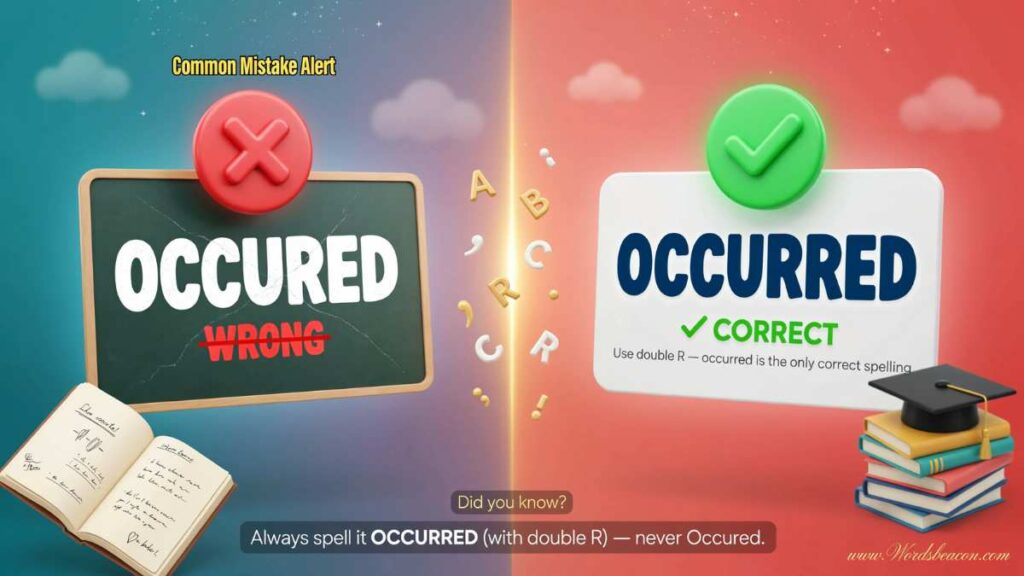
Some words can easily trip you up, and Occured vs Occurred is a perfect example. One small spelling mistake can make your writing look less polished. So, which spelling is correct? The answer is occurred, with two C’s and two R’s. Although occured may look right at first, it’s actually a misspelling. In this article, you’ll learn why occurred is the correct form, how to use it in everyday sentences, and what simple trick can help you remember its spelling.
quick comparison table
| Word | Correct or Incorrect? | Meaning | Example |
|---|---|---|---|
| Occured | Incorrect | Common misspelling of occurred | The accident occured yesterday. |
| Occurred | Correct | Happened or took place in the past | The accident occurred yesterday. |
Occured vs Occurred Quick Answer
Occurred is the correct spelling. Occured is a misspelling and isn’t accepted in standard English.
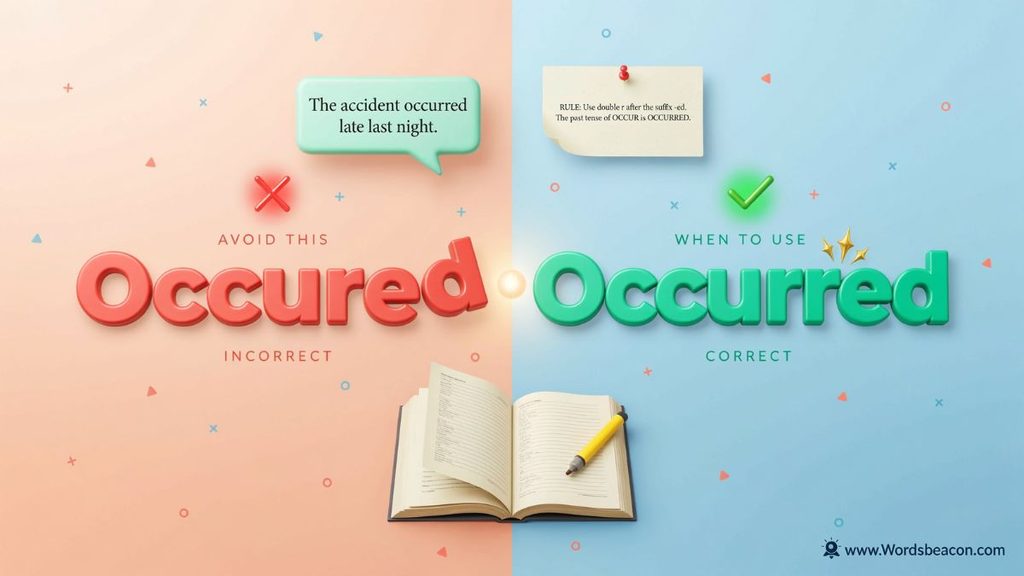
The difference is simple: the verb occur needs an extra R before you add -ed.
Here’s the correct spelling pattern:
- Occur: Base verb
- Occurred: Past tense and past participle
- Occurring: Present participle
- Occurrence: Noun
Look at these examples:
- Correct: The accident occurred near the school.
- Incorrect: The accident occured near the school.
- Correct: A technical problem occurred during the meeting.
- Incorrect: A technical problem occured during the meeting.
If you’re wondering how to spell occurred, remember that the word has two C’s and two R’s.
The mistake usually happens because people add -ed without doubling the final R. However, English spelling rules require that extra letter in this case.
Fix common more word mistakes in English
Separate vs Seperate Which Spelling Is Correct? (Easy Guide)
Occured vs Occurred Comparison Table
Although the two forms look similar Occured vs Occurred , they don’t have the same spelling status.
| Feature | Occured | Occurred |
|---|---|---|
| Spelling | Incorrect | Correct |
| Number of C’s | Two | Two |
| Number of R’s | One | Two |
| Standard English usage | No | Yes |
| Verb form | Incorrect past-tense form | Past tense and past participle |
| Base verb | Intended form: occur | Occur |
| Example | The event occured. | The event occurred. |
The main difference is the second R. You don’t need to learn two different meanings because occured doesn’t have a separate meaning. It’s simply an incorrect spelling of occurred.
What Does Occurred Mean?
The word occurred is the past-tense and past-participle form of occur. It means that something happened, took place, or came about in the past.
You can use it when talking about accidents, incidents, changes, problems, experiences, and other events.
For example:
- The meeting occurred earlier than expected.
- A power outage occurred during the storm.
- Several unexpected changes occurred overnight.
- A strange incident occurred outside the building.
In each sentence, occurred tells you that something happened.
However, the word has another common use. It can also describe an idea or realization that enters someone’s mind.
For example:
- It suddenly occurred to me that I had forgotten my keys.
- The possibility never occurred to him.
- A better solution occurred to Sarah during the discussion.
In these sentences, occurred doesn’t describe a physical event. Instead, it explains that someone suddenly thought of something or realized something.
Occured Meaning vs Occurred Meaning
People sometimes search for the meaning of occured because they’re unsure whether the spelling is correct. The important thing to understand is that occured is a misspelling. The intended word is occurred.
The meaning of occurred depends on how you use it in a sentence.
It can describe:
- Something that happened in the past.
- An event that took place at a particular time or location.
- A problem or situation that developed.
- An idea that entered someone’s mind.
Consider these examples:
- The accident occurred on Monday. (The accident happened.)
- A misunderstanding occurred between the two friends. (A misunderstanding developed.)
- It suddenly occurred to me that I had left my phone at home. (I suddenly realized something.)
Occurred Definition and Word Meaning
A simple occurred definition is something that happened or took place in the past.
The word usually describes an event, situation, or experience. It can also appear in expressions about thoughts and realizations.
For example, you might say:
“The problem occurred during the inspection.”
This means the problem happened while the inspection was taking place.
You could also write:
“It never occurred to me that she might need help.”
Here, the sentence means that the thought never entered your mind.
Understanding these two uses will help you recognize the word in different situations.
Why Is Occurred the Correct Spelling?
The reason comes from a common English spelling rule called consonant doubling.
The base verb is occur. When you add the past-tense ending -ed, you must double the final R before adding the ending.
The correct formation looks like this:
Occur + ed = Occurred
If you add -ed without doubling the R, you get occured, which is incorrect.
This rule applies to several English verbs. For example:
| Base Verb | Correct Past Tense |
|---|---|
| Occur | Occurred |
| Prefer | Preferred |
| Admit | Admitted |
| Refer | Referred |
| Permit | Permitted |
These words follow a similar spelling pattern. Their final consonants double before the past-tense ending.
Why Is Occurred Spelled With Two R’s?
The word occur has two syllables: oc-cur. The second syllable carries the main stress.
In English, many verbs that end in a single consonant after a single vowel in a stressed final syllable double that consonant before adding endings such as -ed and -ing.
That’s exactly what happens with occur.
- Occur becomes occurred.
- Occur becomes occurring.
The second R is added to follow the spelling rule. It isn’t pronounced as a separate sound.
This is why the correct spelling can sometimes feel confusing. You hear the word as one sound, but you need to remember the extra letter when writing it.
Why Does Occurred Have Two C’s and Two R’s?
This question is easier to answer when you look at the original word.
The two C’s are already present in occur. They remain unchanged when you form occurred.
The two R’s have a different explanation. The original word has one R at the end, and the consonant-doubling rule adds another before -ed.
So, remember:
- Two C’s come from the original verb occur.
- Two R’s come from doubling the final consonant.
That’s why occurred contains two C’s and two R’s.
Occurred Spelling Rule Understanding Consonant Doubling
The double consonant spelling rule helps explain why some English verbs change their spelling when you add an ending.
Here’s how the rule generally works:
- Start with a verb that ends in a single consonant.
- Check whether a single vowel letter appears immediately before that consonant.
- Check whether the final syllable carries the main stress.
- If the word follows this pattern, double the final consonant before adding a vowel-initial ending such as -ed or -ing.
For example:
- Occur + ed = occurred
- Occur + ing = occurring
- Prefer + ed = preferred
- Admit + ing = admitting
Not every verb follows this exact pattern. Some words have different stress patterns or spelling conventions. However, occur follows the standard consonant-doubling rule.
Fix common more word mistakes in English
Todays vs Today’s Which one Is Correct?
Occur, Occurred, Occurring, and Occurrence
Learning the different forms of occur will help you avoid more than one spelling mistake.
Although these words look similar, they serve different purposes in a sentence.
| Word | Form | Meaning | Example |
|---|---|---|---|
| Occur | Base verb | To happen | Accidents occur unexpectedly. |
| Occurs | Present tense | Happens | This problem occurs frequently. |
| Occurred | Past tense | Happened | The incident occurred yesterday. |
| Occurred | Past participle | Happened | The error has occurred before. |
| Occurring | Present participle | Happening | The changes are occurring gradually. |
| Occurrence | Noun | An event or incident | Such an occurrence is unusual. |
Notice that occurred and occurrence both contain two R’s. However, one is a verb form and the other is a noun.
Occur Past Tense and Past Participle
The past tense of occur is occurred. Its past participle is also occurred.
The difference isn’t in spelling. It depends on how you use the word.
Use the simple past tense when describing something that happened:
- The accident occurred last night.
- A communication error occurred during the call.
- Several changes occurred after the new policy was introduced.
Use the past participle with an auxiliary verb such as has, have, or had:
- The accident has occurred before.
- Several unexpected changes have occurred recently.
- A similar incident had occurred in the past.
Both forms use the same spelling, so you don’t need to memorize separate versions.
Occurred vs Occurring
The Occurred and occurring come from the same base verb, but they describe different time relationships.
Occurred generally describes something that happened in the past. Occurring describes something that is happening now or developing over a period of time.
Compare these examples:
- The problem occurred last week.
- The problem is occurring again.
- Several changes occurred during the meeting.
- Several changes are occurring across the organization.
The spelling also follows the same consonant-doubling rule.
Correct: Occurred and occurring.
Incorrect: Occured and occuring.
Remember the complete pattern: occur, occurred, occurring.
How to Use Occurred in a Sentence
Once you understand its meaning, using occurred becomes quite simple. It usually follows a subject and describes an event or situation that happened in the past.
However, you can use it in different sentence structures depending on the information you want to share.
Occurred After a Subject
In a regular sentence, the subject usually comes before occurred.
Examples:
- The accident occurred near the school.
- An unexpected problem occurred during the test.
- Several changes occurred after the new policy took effect.
- The incident occurred without warning.
The subject tells readers what happened, while occurred explains that the event took place.
Occurred at the Beginning of a Sentence
You can also use occurred near the beginning of a sentence when the sentence starts with a question word or introductory expression.
Examples:
- What occurred next surprised everyone.
- Before the meeting started, an unexpected incident had occurred.
- Only after the investigation did the team understand what had occurred.
These structures help you introduce an event without repeating the same sentence pattern.
Occurred in the Middle of a Longer Sentence
Longer sentences often include additional information about when, where, or why something happened.
Examples:
- The power failure occurred while technicians were repairing the electrical system.
- A misunderstanding occurred because neither person explained the instructions clearly.
- The delay occurred after heavy traffic blocked the main highway.
These sentences give readers a clearer picture of the situation.
Occurred With To
One of the most common expressions is occurred to me.
It means that an idea, possibility, or realization entered someone’s mind.
Examples:
- It suddenly occurred to me that I had left my phone at home.
- The possibility never occurred to him.
- It occurred to Sarah that she had misunderstood the question.
- A better solution occurred to the manager during the discussion.
Pay attention to the difference between these two sentences:
- The accident occurred near the station.
- It occurred to me that the station was closed.
The first describes an actual event. The second describes a thought or realization.
Occurred With Dates, Times, and Locations
You can use occurred with dates, times, and places to explain exactly when or where something happened.
Examples:
- The accident occurred on November 12.
- The meeting occurred at 9 a.m.
- The incident occurred in Chicago.
- The delay occurred during the morning rush hour.
This type of sentence is especially useful in professional reports, historical writing, news articles, and academic assignments.
Fix common more word mistakes in English
Ensure vs Insure Difference and usage
Occurred Example Sentences in Different Situations
The easiest way to understand a word is to see how people use it in real situations.
Here are some examples from everyday life and professional writing.
Everyday Conversation
- Something unusual occurred while I was walking home.
- The same problem occurred yesterday.
- It never occurred to me that you might need help.
- A strange incident occurred outside the building.
Workplace and Professional Writing
- An unexpected technical error occurred during the presentation.
- The delay occurred because the supplier missed the delivery deadline.
- Several changes occurred after the company introduced its new policy.
- A communication problem occurred between the two departments.
Academic and Educational Writing
- The experiment occurred under controlled conditions.
- A significant change occurred during the final stage of the study.
- Similar patterns occurred in earlier research.
- The chemical reaction occurred after the temperature increased.
News and Historical Writing
- The earthquake occurred shortly after midnight.
- The incident occurred near the city center.
- The historic event occurred during the early twentieth century.
- Heavy rainfall occurred across several regions.
A Real-Life Example: Using Occurred in an Incident Report
Imagine a school preparing for an important science exhibition. Everything is ready, but the electricity suddenly stops working.
The organizers need to explain what happened in a short report.
They might write:
“An unexpected power outage occurred shortly before the exhibition began. The organizers contacted the maintenance team, which identified a problem with the electrical supply. Fortunately, the issue was resolved before visitors arrived.”
Notice how occurred describes the power outage in a clear and professional way. It also helps the report sound direct without adding unnecessary words.
Learn how to use confusing more words correctly
Happened vs Happend Which Spelling Is Correct?
Common Occurred Spelling Mistakes
The spelling of occurred often causes confusion because several related words follow similar consonant-doubling patterns.
Here are some common mistakes and their correct forms:
| Incorrect Spelling | Correct Spelling |
|---|---|
| Occured | Occurred |
| Occuring | Occurring |
| Occurence | Occurrence |
| Occurrance | Occurrence |
Occured vs Occurred
This is the main spelling confusion.
Incorrect: A problem occured during the inspection.
Correct: A problem occurred during the inspection.
The incorrect version leaves out the second R.
Occuring vs Occurring
The same rule applies when you add -ing.
Incorrect: An unusual event is occuring.
Correct: An unusual event is occurring.
Remember to double the final R before adding -ing.
Occurence vs Occurrence
Occurrence is the noun form of occur.
Incorrect: This is a rare occurence.
Correct: This is a rare occurrence.
The correct noun contains two R’s and ends in -ence.
Occurrance vs Occurrence
Some writers use an A in the ending because they confuse occurrence with words such as appearance.
However, occurrence is the correct spelling.
Incorrect: The unusual occurrance worried everyone.
Correct: The unusual occurrence worried everyone.
Learning these related forms will help you avoid several common English spelling mistakes.
Learn how to use confusing more words correctly
Principal vs Principle Difference and usage
Occurred vs Happened What’s the Difference?
Both occurred and happened describe something that took place in the past. In many situations, you can use either word without changing the main meaning.
However, they have slightly different tones.
Occurred often sounds more formal and is common in reports, academic writing, and professional communication. Happened sounds more conversational and appears frequently in everyday speech.
| Feature | Occurred | Happened |
|---|---|---|
| Meaning | Took place or happened | Took place or came about |
| Tone | Often more formal | More conversational |
| Common use | Reports and formal writing | Everyday conversation |
| Example | The accident occurred yesterday. | The accident happened yesterday. |
For example:
- The meeting occurred at noon.
- The meeting happened at noon.
Both sentences are correct. However, occurred may sound more suitable in a formal report.
Happened also feels more natural in questions such as “What happened?” or “What happened next?”
Choose the word that best fits your sentence rather than using occurred every time you describe a past event.
Occurred vs Accrued vs Incurred
These three words can look or sound similar, but their meanings are completely different.
Using the wrong one can change the meaning of your sentence, especially in financial or professional writing.
| Word | Meaning | Example |
|---|---|---|
| Occurred | Happened or took place | The accident occurred yesterday. |
| Accrued | Accumulated or increased over time | Interest accrued on the account. |
| Incurred | Became responsible for a cost, debt, or liability | The company incurred additional expenses. |
Occurred
Use occurred when an event, situation, or incident happened.
Example: A technical problem occurred during the inspection.
Accrued
Use accrued when something builds up over time. It’s commonly used for interest, benefits, money, and expenses.
Example: The account accrued interest throughout the year.
Incurred
Use incurred when someone becomes responsible for a cost, expense, debt, or liability.
Example: The business incurred unexpected repair costs.
Here’s an easy way to remember the difference:
- Occurred means something happened.
- Accrued means something accumulated.
- Incurred means someone became responsible for something.
These words aren’t interchangeable, even though their spellings look similar.
Occurred Synonyms and Antonyms
Sometimes using the same word repeatedly makes your writing sound dull. Synonyms can help you express the same idea in a more natural way.
However, choose an alternative that fits the meaning of your sentence.
Common Synonyms for Occurred
| Synonym | Meaning | Example |
|---|---|---|
| Happened | Took place | The incident happened yesterday. |
| Took place | Happened at a particular time or location | The ceremony took place on Friday. |
| Transpired | Happened or became known | An unexpected event transpired. |
| Arose | Developed or appeared | A problem arose during the discussion. |
| Emerged | Became apparent or appeared | A new concern emerged. |
| Developed | Began or progressed | A disagreement developed between the teams. |
| Came about | Happened or resulted | The change came about gradually. |
Occurred Antonyms
There isn’t one exact opposite of occurred that works in every situation. However, some expressions communicate the opposite idea.
- Didn’t happen: An expected event failed to take place.
- Was prevented: Someone stopped an event from happening.
- Was avoided: A potentially negative event didn’t happen.
- Failed to occur: Something expected never happened.
For example:
“The accident occurred because the driver lost control.”
“The accident was prevented because the driver reacted quickly.”
The second sentence describes the opposite outcome.
Understand confusing English more words simply
Analysis vs Analyses difference and usage
How to Pronounce Occurred
The standard American English pronunciation of occurred is /əˈkɝːd/.
The word has two syllables, and the second syllable carries the main stress.
Here are a few pronunciation points to remember:
- The first syllable has an unstressed vowel sound.
- The second syllable receives the main emphasis.
- The R sound is prominent in the stressed syllable.
- The word ends with a D sound.
You don’t pronounce both R’s separately. They work together as part of the same sound.
Occurred Pronunciation vs Spelling
English pronunciation doesn’t always tell you how to spell a word.
That’s one reason people write occured instead of occurred. When speaking, you won’t hear a separate sound for the doubled R. However, when writing, you still need both letters.
The best way to avoid this mistake is to remember the spelling rule instead of relying entirely on pronunciation.
Is Occurred Spelled Differently in American and British English?
No. Occurred is the standard spelling in American, British, Canadian, and Australian English.
Unlike some English words that have regional spelling variations, occurred doesn’t change from one country to another.
Occured vs Occurred US
American English uses occurred with two R’s.
Example: The accident occurred near the highway.
Occured vs Occurred UK
British English also uses occurred.
Example: The incident occurred during the afternoon.
Canadian and Australian English
Canadian and Australian English follow the same spelling.
Examples:
- The problem occurred during the inspection.
- Several unexpected events occurred overnight.
You may notice differences between words such as color and colour or organize and organise. However, occurred has the same spelling in these English varieties.
Understand confusing English more words simply
Seeing vs Seing Which Spelling Is Correct?
Etymology and Origin of Occurred
The word occurred comes from the verb occur, which traces back to the Latin verb occurrere.
The Latin word combines elements associated with moving toward something and running. Its historical meaning relates to meeting or coming across something.
The word entered English through French and gradually developed its modern meaning of happening, taking place, or coming to someone’s attention.
This history also helps explain the spelling of the base verb occur. The two C’s are already part of its established spelling.
The second R in occurred, however, comes from the consonant-doubling rule.
Understanding this difference makes it easier to see why the word has its particular spelling.
Why Do People Commonly Misspell Occurred?
Even experienced writers sometimes make this mistake. The extra R is easy to overlook, especially when you’re writing quickly.
Here are some common reasons:
- Forgetting to double the final R: Many people know they need to add -ed but forget the consonant-doubling rule.
- Confusing spelling with pronunciation: The doubled R doesn’t create a separate sound, so one R may seem sufficient.
- Applying the wrong spelling pattern: Some verbs simply take -ed without changing their final consonants. Writers sometimes apply that pattern to occur.
- Typing too quickly: A missing letter can easily escape your attention when you’re focused on getting your thoughts down.
- Confusing related word forms: Occurred, occurring, and occurrence have different endings, which can make their spelling confusing.
The good news is that you don’t need to memorize dozens of separate rules. Once you understand how occur changes, its related forms become easier to spell.
Learn the difference between similar English words
installment vs Instalment One Word Two Spellings
How to Remember Occurred Spelling
A simple memory trick can help you avoid this mistake whenever you write.
Remember the Double-R Pattern
Start with the base verb and look at what happens when you add -ed:
Occur → Occurred
The final R doubles before the ending. That’s the key to remembering the correct spelling.
Learn the Three Main Forms Together
Instead of memorizing only occurred, learn these three forms as a group:
- Occur
- Occurred
- Occurring
Once you remember this pattern, spelling occurrence also becomes easier.
Connect the Word With the Consonant-Doubling Rule
Remember that occur has a stressed final syllable. When you add -ed or -ing, double the final R.
This simple grammar rule explains why the extra letter belongs in both forms.
Use a Short Memory Sentence
Try remembering this sentence:
“An event can occur, an event occurred, and another event may be occurring.”
It includes all three common verb forms in one natural sentence.
Check Related Words While Proofreading
Before submitting an article, assignment, or professional email, look for these common misspellings:
- Occured
- Occuring
- Occurence
- Occurrance
Correcting these small errors can make your writing look more polished and professional.
Learn the difference between tricky grammar words
Oversight vs Oversite Which Spelling Is Correct?
practice session Occured vs Occurred
Complete these sentences by choosing the correct spelling or word form Occured vs Occurred. Write your answers first, then check the answer key at the end.
1. The accident ________ late last night.
2. A strange thing ________ during the meeting.
3. It never ________ to me that she might be right.
4. Several changes have ________ since last year.
5. The same problem keeps ________ every winter.
6. What ________ after the power went out?
7. The mistake ________ because nobody checked the details.
8. This type of error rarely ________ in professional writing.
9. A similar incident ________ at the school yesterday.
10. The idea suddenly ________ to him while he was driving.
11. Many unexpected events have ________ this month.
12. The problem is ________ more frequently than before.
13. Nothing unusual ________ during the experiment.
14. The word ________ several times in the report.
15. A spelling error ________ in the final paragraph.
16. The incident ________ around midnight.
17. It had never ________ to her to ask for help.
18. These problems are ________ because of poor planning.
19. The event ________ exactly as the organizers expected.
20. One important ________ changed the course of the discussion.
Answers
- occurred
- occurred
- occurred
- occurred
- occurring
- occurred
- occurred
- occurs
- occurred
- occurred
- occurred
- occurring
- occurred
- occurred
- occurred
- occurred
- occurred
- occurring
- occurred
- occurrence
Quick reminder:
- Occur = present form
- Occurs = present form with he, she, or it
- Occurred = past tense and past participle
- Occurring = -ing form
- Occurrence = noun
Remember: The correct spelling is always occurred, with two C’s and two R’s.
Here’s a trusted source for clear word meanings:
FAQs
Which spelling is correct occured vs occurred?
Occurred is the correct spelling in standard English. Occured is a misspelling. Always use two C’s and two R’s when writing the past tense of occur.
Why does occurred have two R’s?
The verb occur ends in a consonant preceded by a stressed vowel sound. When you add -ed, you double the final R before adding the suffix. This creates occurred.
Does occurred have two C’s as well?
Yes. The word occurred contains two C’s and two R’s. The two C’s come from the original verb occur, while the second R comes from the spelling rule used when adding -ed.
What does occurred mean?
Occurred means happened, took place, or came about. It describes an event, action, or situation that took place in the past.
What is the past tense of occur?
The past tense of occur is occurred. For example: “A technical problem occurred during the presentation.”
What is the difference between occur and occurred?
Occur is the base form of the verb, while occurred is its past-tense form. Use occur for present, future, or general statements and occurred for completed past events.
When should you use occurred in a sentence?
Use occurred when you want to describe something that happened in the past. For example: “The accident occurred early in the morning.”
Is occurred grammatically correct?
Yes. Occurred is the standard past-tense and past-participle form of occur. You can use it in everyday conversations, academic writing, and professional documents.
What is the difference between occurred and occurring?
Occurred refers to something that happened in the past. Occurring describes an event that is happening now or taking place over a period of time.
Is occurring or occuring correct?
Occurring is correct because the final R in occur doubles before adding -ing. Occuring is a misspelling.
What is the noun form of occurred?
The noun form is occurrence. It refers to an event, incident, or instance of something happening. For example: “The unusual occurrence surprised everyone.”
What does “occurred to me” mean?
The phrase “occurred to me” means that an idea, thought, or realization suddenly came into your mind. For example: “It occurred to me that I had forgotten my keys.”
What does “has occurred” mean?
“Has occurred” describes an event that happened in the past but has a connection to the present. For example: “A serious error has occurred” means the error happened and its result may still matter.
What is the difference between “occurred” and “has occurred”?
“Occurred” is the simple past tense, usually used to describe a completed past event. “Has occurred” is the present perfect form, which connects a past event to the present.
What is another word for occurred?
Depending on the context, you can replace occurred with happened, took place, arose, emerged, or transpired. Happened and took place are common alternatives for everyday writing.
Can occurred describe something that happened repeatedly?
Yes. Occurred can describe events that happened once or several times. For example: “The same error occurred three times during the test.”
Is occurred spelled the same way in American and British English?
Yes. Both American and British English use the spelling occurred. It is not a case of different regional spelling preferences.
How can you remember the correct spelling of occurred?
Remember that the base verb is occur. When you add -ed, double the final R. A simple memory trick is to think of the spelling as occ + urr + ed: two C’s, two R’s, and -ed.
Learn the difference between similar English words
Filed vs Filled Differences and Everyday Usage
Conclusion
The spelling confusion between Occured vs Occurred is easy to fix once you remember one simple rule: occurred is always correct, while occured is a misspelling. The extra R isn’t just there for decoration! You need it when adding -ed to the verb occur. The same rule gives you occurring when you add -ing.
Understanding Occured vs Occurred also helps you use the correct word form in different sentences. Use occurred when talking about something that happened in the past and occurring when something is happening or taking place. If you need the noun, remember occurrence.
With a little practice, you’ll stop making the same mistake when writing Occured vs Occurred. Keep this simple rule in mind: occur becomes occurred, not occured. After all, one extra letter can make all the difference in correct spelling!

Luna AJS is an experienced blogger and dedicated language enthusiast at Words Beacon. She specializes in making English grammar, spelling, vocabulary and commonly confused words easy to understand. She provides clear explanations, practical examples to help readers write with confidence.