
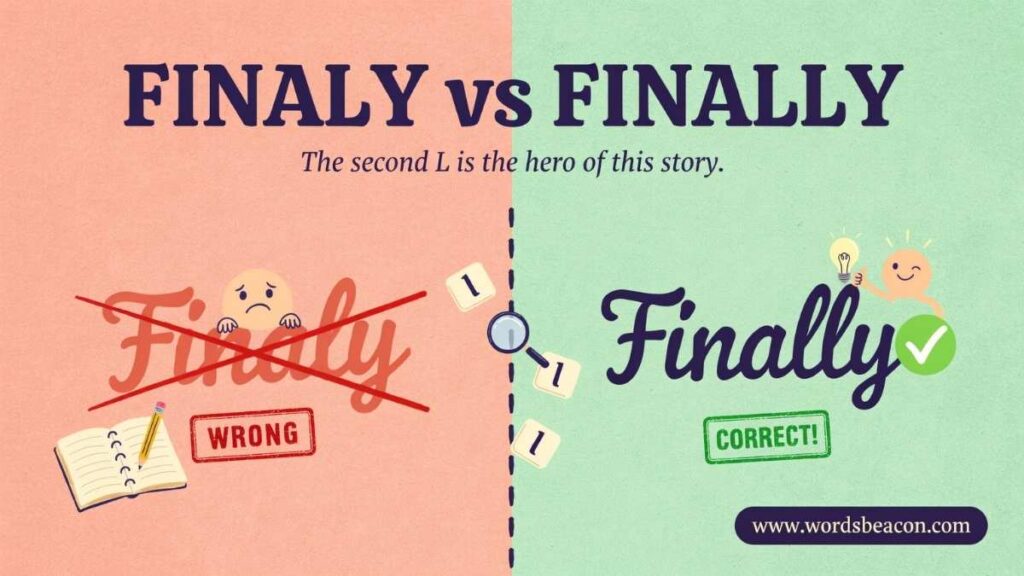
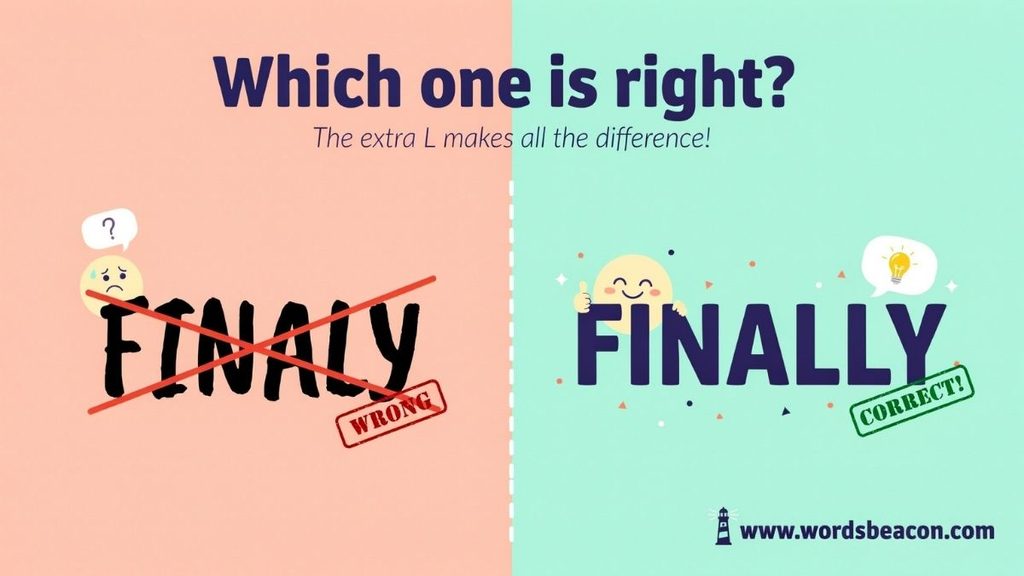
The Finaly vs Finally confusion comes down to one small but important letter. Finaly is a common spelling mistake, while finally is the correct English spelling. That extra l may look insignificant, but leaving it out can turn a correct word into an error. Finally is an adverb that can mean “at last,” “in the end,” or the last point in a series. Once you understand its meaning, spelling, and proper usage, the confusion becomes much easier to avoid. This guide explains the difference in simple language, with clear grammar rules and practical examples to help you use finally correctly and confidently in everyday writing.
Quick Answer
The correct spelling is finally.
Finaly is a misspelling. It should not be used in standard English writing.
The word finally is an adverb. It commonly means “after a long time,” “at last,” or “as the last point in a sequence.”
Here’s the basic difference:
| Word | Correct? | Meaning | Example |
|---|---|---|---|
| Finally | Yes | After a delay, at last, or as the last point | We finally finished the project. |
| Finaly | No | Incorrect spelling of finally | We finaly finished the project. |
If you’re trying to remember the correct spelling, look at the relationship between final and finally.
Final + ly = finally
That extra l is the detail that often gets lost when someone types too quickly.
Why Is Finally Spelled With Two Ls?
The easiest way to understand the finally spelling is to look at the base word.
The word final is an adjective. It describes something that comes at the end or represents the last stage of something.
When the suffix -ly is added, the word becomes finally.
Final + ly = finally
This gives you the double l spelling that appears in the middle of the word.
The spelling can seem unusual when you look at it quickly because the two l’s sit next to each other. However, they make sense when you recognize that one l comes from final and the other begins the suffix -ly.
This is also a useful example of English word formation. Understanding how words are built can make spelling much easier because you don’t always have to memorize every word as an unrelated collection of letters.
Think of it as putting two puzzle pieces together. The first piece is final. The second is ly. When they join, you get finally.
Finaly vs Finally Meaning
The finaly vs finally meaning depends on the sentence, but the word generally connects an action or idea with an ending, completion, or point in a sequence.
Most commonly, finally tells you that something happened after a long period of waiting, difficulty, effort, or uncertainty.
For example:
“She finally found her keys.”
The sentence suggests that she had been looking for them for some time.
Compare that with:
“She found her keys.”
The second sentence simply tells you what happened. Adding finally gives the reader more information about the timing and experience surrounding the event.
Finally can also mean at last.
“We finally arrived home.”
This suggests that reaching home took some time or came after a journey, delay, or difficulty.
The word has another important use. It can introduce the last point in a sequence of events, instructions, or ideas.
“First, review the information. Next, compare the results. Finally, write your conclusion.”
In this example, finally doesn’t mean that the writer waited a long time. Instead, it tells the reader that writing the conclusion is the last step.
What Does Finally Mean?
The finally definition is closely connected with the idea of reaching an endpoint.
In everyday English, finally can describe something that happens after a delay.
“The rain finally stopped.”
It can also express the completion of something that required time or effort.
“She finally completed the assignment.”
Finally may also introduce the concluding point in a discussion.
“Finally, we need to consider the cost.”
These meanings are related, but context tells you exactly how the word works.
When someone says, “The train finally arrived,” the focus is on a delayed event.
When someone says, “Finally, let’s discuss the budget,” the word signals the last point in a discussion.
That flexibility makes finally a very useful word in both conversation and writing.
What Does Finaly Mean?
The finaly meaning is different from what some writers may assume because finaly isn’t a standard English word in this context.
In most cases, finaly is simply an incorrect spelling of finally.
It doesn’t represent a different pronunciation or a special form of the word. It’s usually the result of leaving out one l while typing or writing.
So, if you’re asking, “Is finaly a word?” the practical answer is no when you intend to use the standard English adverb meaning “at last” or “as the last point.”
The same applies to the questions “Is finaly correct?” and “Is finaly a correct English word?” The answer is no.
The proper spelling is finally.
Finaly vs Finally What’s the Difference?
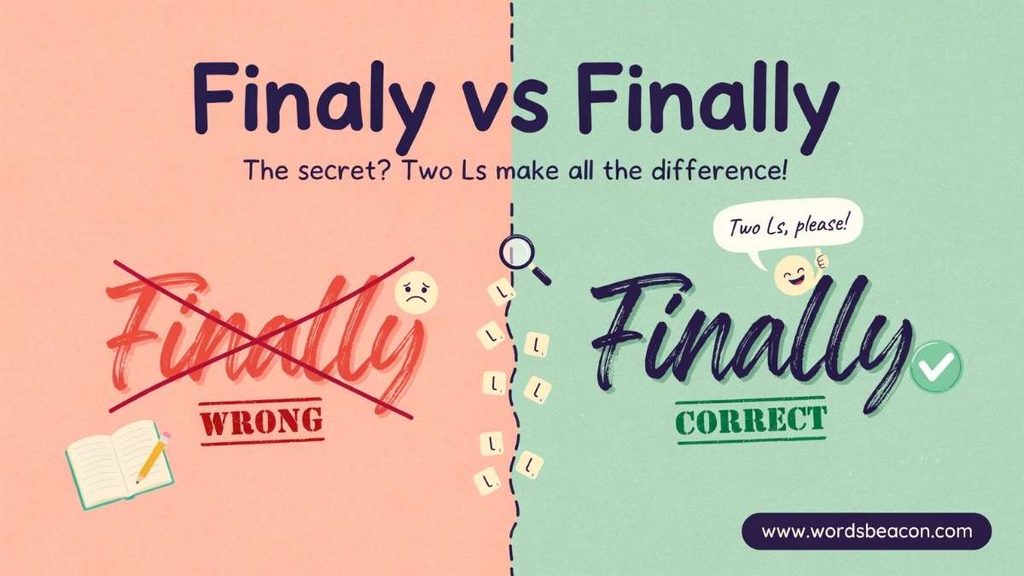
The finaly vs finally difference comes down to spelling and correctness.
Finally is the standard English word. Finaly is a spelling error.
| Feature | Finally | Finaly |
|---|---|---|
| Standard English spelling | Yes | No |
| Correct word spelling | Yes | No |
| Contains two l’s | Yes | No |
| Functions as an adverb | Yes | No |
| Can mean at last | Yes | No |
| Can introduce a final point | Yes | No |
Unlike genuine differences between American and British English, finaly is not a regional spelling variation.
For example, color and colour are recognized spelling differences between varieties of English. Finaly vs finally don’t work that way.
If you’re writing for a US English audience, use finally.
Finally as an Adverb
If you’re asking, “Is finally an adverb?” the answer is yes.
An adverb can modify a verb, adjective, another adverb, or sometimes an entire statement. Finally commonly tells us something about when an action occurs or helps organize a series of ideas.
Consider this sentence:
“She finally called.”
Finally tells us that the call happened after some waiting or delay.
Now consider:
“Finally, we should review the results.”
Here, finally signals that the writer is moving to the last point.
This second use is especially common in essays, presentations, instructions, reports, and explanations. It helps readers understand the sequence of ideas without requiring a long explanation.
That makes finally both a useful adverb and an effective transition word.
Fix common more word mistakes in English
Naive vs Nieve difference and usage?
How to Use Finally in a Sentence
Learning how to use finally in a sentence becomes much easier when you understand its two main functions.
The first involves something happening after a delay.
The second involves introducing the last point in a sequence.
When finally appears before a main verb, it often describes something that happened after waiting or difficulty.
“She finally finished the report.”
“They finally reached an agreement.”
“He finally understood the instructions.”
“We finally decided to leave.”
These sentences all suggest that the action took some time to happen.
1.Finally can also appear at the beginning of a sentence when it introduces the final stage or point.
2.“Finally, check your answers before submitting the test.”
3.“Finally, we need to discuss the budget.”
4.“Finally, save the document in the correct folder.”
In these sentences, finally acts as a signpost. It tells the reader that the last step or idea is coming.
Finaly vs Finally in a Sentence
When looking at finaly vs finally in a sentence, the correct choice is always finally when you intend to express the standard adverb.
Consider these examples:
“She finally finished her homework.”
“The bus finally arrived.”
“We finally solved the problem.”
“Finally, we can move on to the next stage.”
“They finally decided to accept the offer.”
“After several attempts, he finally completed the task.”
Each sentence uses the correct spelling and shows a slightly different context.
The word can describe an action that happens after repeated attempts, a long wait, or a difficult process. It can also introduce the last point in a sequence.
Finally Examples in Everyday English
Finally appears naturally in many ordinary situations.
Imagine someone waiting for a delayed flight. They might say, “The plane finally arrived.”
A student who has spent hours working on an assignment might say, “I finally finished my paper.”
Someone who has been trying to solve a difficult problem could say, “I finally figured it out.”
A manager explaining a process might say, “Finally, send the completed form to the accounting department.”
These examples show why finally is more than a simple synonym for “last.” The word can describe the end of a process, the result of waiting, or the final stage of an organized sequence.
Finally vs Final the Difference?
The final and finally difference is worth learning because the two words are closely related but serve different grammatical purposes.
Final is generally an adjective. It describes something that is last, conclusive, or completed.
“This is the final exam.”
“The final decision has been made.”
“The final chapter was unexpected.”
Finally is an adverb.
“She finally took the exam.”
“They finally made a decision.”
“We finally reached the final chapter.”
The difference becomes clear when the words appear together.
“The final report was submitted.”
Here, final describes the report.
“They finally submitted the report.”
Here, finally describes the action of submitting it.
A simple way to remember the distinction is this: final describes the last thing, while finally tells you that something happened at last or introduces the last point.
Final Meaning vs Finally Meaning
The final meaning and finally meaning are connected because both words relate to an ending.
Final generally describes something that comes last.
For example, “the final round” means the last round.
“The final decision” means the last or conclusive decision.
Finally, on the other hand, usually describes an action or marks a stage in communication.
“She finally made a decision.”
“Finally, we reached the last part of the discussion.”
Changing final to finally isn’t simply a matter of adding letters for appearance. The grammatical function changes as well.
Why Does Finally Have Two Ls?
If you’re asking, “Why does finally have two l’s?” the answer becomes clear when you separate the word into its parts.
The base word is final.
The suffix is -ly.
Put them together:
Final + ly = finally
Because final already ends with l and -ly begins with l, the finished word contains two l’s.
This is why the spelling pattern is useful to remember.
When you see finaly, ask yourself whether you have actually added -ly to final. If you have, the answer should be finally.
That small mental check can prevent a surprisingly common typo.
Finally Pronunciation and Spelling
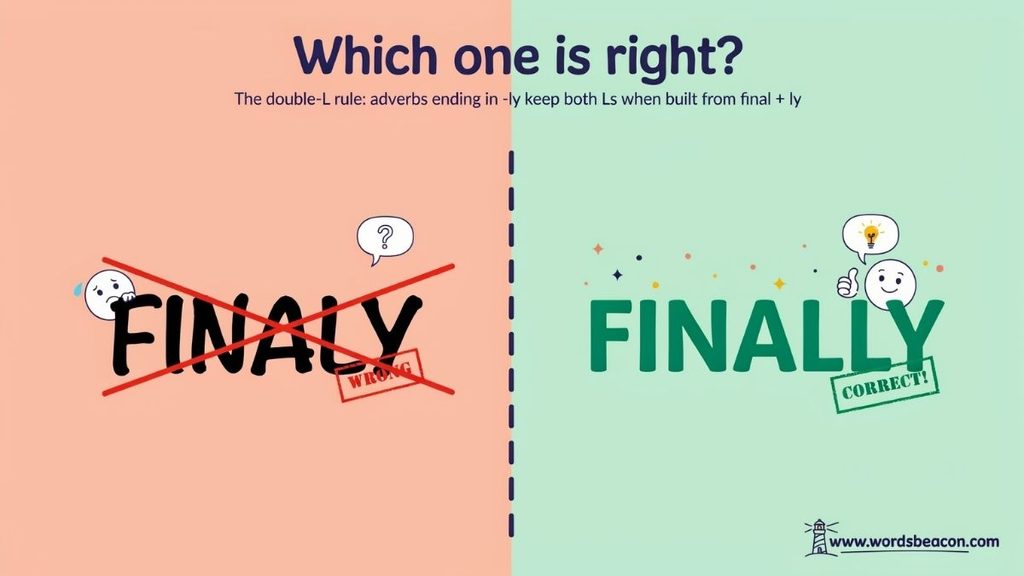
The spelling and pronunciation of finally don’t match letter-for-letter in a way that would make every letter obvious when spoken.
In US English, the word has three syllables. The pronunciation begins with the same sound found in final and continues with the unstressed ending associated with -ly.
The important point for spelling is that you shouldn’t rely entirely on pronunciation to determine how many letters appear in a word.
English contains many words in which spelling preserves information that isn’t immediately obvious from the sound.
That’s why learning the word’s structure can be more reliable than trying to spell it only by sound.
Is “Finaly” Correct?
No. “Finaly” is not the correct spelling.
The correct spelling is finally.
If you see finaly in an essay, email, article, school assignment, report, or other piece of writing, it should normally be corrected to finally.
This is a straightforward spelling correction rather than a difference in meaning.
The same rule applies whether the word appears at the beginning, middle, or end of a sentence.
“Finaly, we reached the station” is incorrect.
“Finally, we reached the station” is correct.
“She finaly finished” is incorrect.
“She finally finished” is correct.
Is Finally Correct?
Yes. Finally is the correct standard English spelling.
It is also the form you should use in professional and academic writing.
The word can function naturally in casual conversation as well.
“I finally got home.”
“We finally figured it out.”
“Finally, let’s get started.”
There is no need to replace finally with a different spelling.
Is “Finaly” a Common Spelling Mistake?
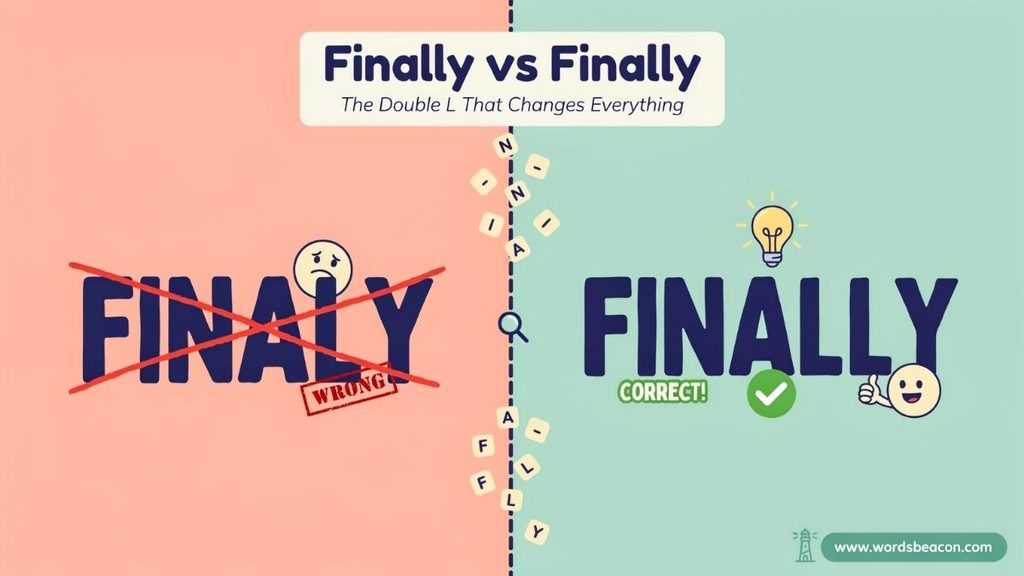
Yes. Dropping one l from finally is an easy spelling error to make, especially when typing quickly.
The mistake probably feels natural because the two l’s appear together. When you read the word as a whole rather than letter by letter, your brain can easily overlook one of them.
This is a common typo rather than a difficult grammar problem.
The best correction is simply to remember the spelling pattern:
Final + ly = finally.
Once that pattern becomes familiar, the missing l becomes much easier to notice.
Finally vs At Last
Finally and at last can have similar meanings when something happens after a delay.
“We finally arrived.”
“We arrived at last.”
Both sentences suggest that the journey took time.
However, at last can sound more emotional. It often carries a feeling of relief, impatience, or satisfaction.
For example:
“The package finally arrived.”
“The package arrived at last!”
The second sentence may sound more expressive because the speaker emphasizes the relief of waiting being over.
Finally is more flexible because it can also introduce the last point in a sequence.
“Finally, let’s review the conclusion.”
At last doesn’t normally perform that same organizational role.
Finally vs Eventually
Finally and eventually sometimes overlap, but they aren’t interchangeable in every situation.
Eventually usually means that something happens at some later point, often after a period of time.
“She eventually found the missing document.”
This tells us that she found it after some time.
Finally can express a similar idea:
“She finally found the missing document.”
However, finally can also introduce the last item in a list or discussion.
“First, examine the evidence. Next, compare the results. Finally, write the conclusion.”
Eventually would not fit naturally in that sequence because the writer isn’t describing when the conclusion happened after an unknown period. The writer is identifying it as the last step.
That distinction is especially useful in academic and professional writing.
Finally vs Lastly
Finally and lastly can both introduce the last point in a sequence.
For example:
“First, consider the cost. Second, examine the quality. Finally, make your decision.”
The word lastly could also introduce the final point.
However, finally has a wider range of uses.
“We finally arrived.”
This sentence describes an event that happened after a delay.
“We lastly arrived” doesn’t sound natural in standard everyday English.
So, while finally and lastly can overlap when organizing a sequence, finally is generally more versatile.
Is “Finally” Always Followed by a Comma?
No.
A comma often follows finally when the word appears at the beginning of a sentence as an introductory transition.
For example:
“Finally, we reviewed the results.”
However, you normally don’t place a comma after finally when it appears before the main verb.
“We finally reviewed the results.”
Compare the two sentences and notice how the position changes the punctuation.
| Sentence | Punctuation |
|---|---|
| Finally, we reviewed the results. | Comma after introductory finally |
| We finally reviewed the results. | No comma |
| She finally finished the report. | No comma |
| Finally, she finished the report. | Comma after introductory finally |
The important lesson is that the word itself doesn’t automatically require a comma. Sentence structure determines the punctuation.
Finally Usage in Academic Writing
Finally is useful in academic writing when you need to identify the concluding point of a discussion.
For example:
“First, the study examines the available evidence. Next, it compares the competing explanations. Finally, it considers the limitations of the research.”
Here, finally clearly tells the reader that the discussion has reached its final stage.
It can also appear when explaining a process:
“First, the samples were prepared. Next, the measurements were recorded. Finally, the results were analyzed.”
The word makes the sequence easier to follow.
However, it shouldn’t appear merely because a paragraph needs a transition. Good writing uses transition words because they add meaning, not because they fill empty space.
Finally Usage in Professional Writing
In professional communication, finally can help explain the last action, decision, or stage of a process.
For example:
“After reviewing the proposals, the committee finally selected a supplier.”
Here, finally emphasizes the decision as the result of a longer process.
It can also introduce the last instruction:
“Finally, save the completed document and send a copy to the project manager.”
This makes the sequence clear without adding unnecessary explanation.
The word works especially well when the reader needs to understand what happens last.
Common Finaly Spelling Mistakes
The most obvious mistake is writing finaly instead of finally.
“I finaly completed the report.”
The correct version is:
“I finally completed the report.”
Another common mistake involves confusing final with finally.
“This is the finally version.”
That sentence is incorrect because the adjective final is needed.
“This is the final version.”
However:
“We finally completed the final version.”
Both words can appear in the same sentence because they perform different jobs.
Final describes the version. Finally describes the timing of the completion.
How to Spell Finally Correctly
If you’re wondering how to spell finally, remember one simple formula:
Final + ly = finally.
Don’t remove the second l.
The correct word looks like this:
Finally
The incorrect form looks like this:
Finaly
A useful memory trick is to say “final plus ly” in your head when you aren’t sure.
The base word final already contains an l at the end. The suffix -ly starts with another l. Together, they produce the familiar double-l spelling.
This is much easier to remember than trying to memorize a complicated spelling rule.
When to Use Finally
Use finally when something happens after waiting, effort, difficulty, or delay.
“She finally passed the exam.”
Use it when you want to express “at last.”
“We finally arrived home.”
Use it when you introduce the last point in a sequence.
“Finally, check your answers.”
Use it when describing the final stage of a process.
“The team finally completed the project.”
The common thread is the idea of reaching an endpoint, whether that endpoint comes after time, effort, or a sequence of steps. Understanding when and how to use finally will help you avoid common grammar mistakes and make your writing clearer, more natural, and closer to perfect English.
Here’s a trusted source for clear more words Comparison:
Practice Session Finaly vs Finally
Fill in each blank with the correct word. Choose between Finaly vs Finally unless the sentence asks for a different form.
- After waiting for two hours, the bus ______ arrived.
- She ______ finished her homework before dinner.
- ______, we need to discuss the cost of the project.
- They ______ reached an agreement after several meetings.
- He ______ understood what the teacher was explaining.
- After many attempts, I ______ solved the problem.
- ______, check your answers before submitting the test.
- The team ______ completed the difficult assignment.
- We ______ arrived home after a long journey.
- She ______ decided to accept the job offer.
- ______, let’s look at the final part of the report.
- The missing documents were ______ found in an old folder.
- After months of preparation, the event ______ happened.
- He ______ received the package he had been waiting for.
- ______, save the document and close the program.
- The students ______ completed the experiment.
- After several delays, construction ______ began.
- She ______ understood why the instructions were important.
- ______, we can move on to the next stage.
- The manager ______ approved the proposal.
- After searching everywhere, they ______ found the missing keys.
- ______, review the information one more time.
- We ______ decided which option was best.
- After a long discussion, the committee ______ made its decision.
- Which spelling is correct: “finaly” or “______”?
Answers
- finally
- finally
- Finally
- finally
- finally
- finally
- Finally
- finally
- finally
- finally
- Finally
- finally
- finally
- finally
- Finally
- finally
- finally
- finally
- Finally
- finally
- finally
- Finally
- finally
- finally
- finally
FAQs
Is it Finaly vs Finally?
Finally is the correct spelling. Finaly is a common spelling mistake and is not the standard English form. If you mean “at last” or “in the end,” use finally.
Is “Finaly” a correct English word?
No. Finaly is not the correct standard spelling. The correct word is finally, spelled with two l’s.
Why does Finally have two L’s?
Finally comes from final plus the suffix -ly. When these parts combine, the word is spelled finally with two l’s. A simple way to remember it is final + ly = finally.
How do you spell Finally correctly?
The correct spelling is finally: f-i-n-a-l-l-y. It has two l’s. The spelling finaly, with one l, is incorrect.
What does Finally mean?
Finally is an adverb that usually means “at last,” “in the end,” or after a long period of waiting, effort, or difficulty. For example, “She finally finished her project.”
What type of word is Finally?
Finally is an adverb. It can show when something happens after a delay or introduce the last point in a sequence, discussion, or explanation.
Can you use Finally in a sentence?
Yes. For example, “After several attempts, he finally solved the problem.” In this sentence, finally shows that the solution came after several unsuccessful attempts.
When should you use Finally in a sentence?
Use finally when something happens after waiting, effort, difficulty, or delay. You can also use it to introduce the last point in a series. For example, “Finally, the report explains the expected results.”
Is “Finally completed” grammatically correct?
Yes. Finally completed is grammatically correct when finally modifies the verb phrase completed. For example, “The team finally completed the project.”
Is “Finally made it” grammatically correct?
Yes. The phrase is grammatically correct when it appears in a complete sentence. For example, “We finally made it home.” Here, finally shows that reaching home happened after some delay or difficulty.
What is the difference between Final and Finally?
Final is generally an adjective that describes something last or conclusive, such as “the final exam.” Finally is an adverb that describes an action or event, such as “She finally finished the exam.”
What is the difference between Finally and Finale?
Finally is an adverb meaning “at last” or “in the end.” Finale is a noun that refers to the final part of a performance, event, story, or musical work. For example, “The concert ended with a spectacular finale.”
Is Finally the same as At Last?
Finally and at last can have the same meaning when something happens after waiting or difficulty. For example, “She finally arrived” and “She arrived at last” both show that her arrival happened after a delay. At last can sometimes add a stronger sense of relief.
Is Finally the same as Eventually?
Finally and eventually can overlap in meaning, but they aren’t always interchangeable. Finally often emphasizes the moment something happens after waiting or effort. Eventually focuses more generally on something happening in the end after a period of time or a series of events.
Is Finally or Lastly better for the last point?
Both can introduce the last point in a sequence. Finally is often more natural when you are moving toward a conclusion, while lastly can simply signal the final item in a list or series.
What can you say instead of Finally?
Depending on the context, you can use at last, eventually, in the end, ultimately, or lastly. In formal conclusions, phrases such as in conclusion may also work.
What is a more formal alternative to Finally?
The best formal alternative depends on the sentence. Ultimately, in conclusion, and in the end can sometimes replace finally. However, finally itself is completely acceptable in academic and professional writing.
Is Finally a good transition word?
Yes. Finally can act as a transition when you introduce the last point in a series of ideas or arguments. For example, “Finally, the report considers the long-term effects of the policy.”
What is the opposite of Finally?
There is no single opposite of finally in every context. Depending on the meaning, initially, first, beforehand, or at the beginning may express the opposite idea because these words refer to an earlier stage rather than the end.
Is “Finally” spelled correctly?
Yes. Finally is the correct spelling. It contains two l’s. Finaly, with only one l, is a spelling error.
Why do people use the word Finally?
People use finally to show that something has happened after waiting, effort, difficulty, or delay. They also use it to introduce the last point in a sequence. For example, “Finally, let’s consider the main conclusion.”
Can Finally be used at the beginning of a sentence?
Yes. Finally can begin a sentence, especially when it introduces the last point or shows that something happened after a delay. For example, “Finally, the meeting came to an end.”
Can Finally appear in the middle of a sentence?
Yes. Finally can appear in different positions depending on the sentence and the emphasis. For example, “She finally understood the instructions.”
What is the easiest way to remember the spelling of Finally?
Think of finally as final + ly. This gives you finally with two l’s. When you’re choosing between Finaly vs Finally, remember that finally is the correct spelling.
What is the correct spelling in “Finaly vs Finally”?
The correct spelling is finally. Finaly is the misspelled version. Therefore, when comparing Finaly vs Finally, always choose finally when you mean “at last,” “in the end,” or the last point in a sequence.
Conclusion
The Finaly vs Finally confusion is actually pretty simple once you know the correct spelling. Finally is correct, while finaly is a common spelling mistake. That extra l may seem small, but it makes a big difference.
Finally is an adverb that usually means “at last” or “in the end.” You can use it when something happens after a long wait, some difficulty, or several attempts. For example, “She finally finished her assignment” tells you that the assignment took some time to complete.
A simple trick can help you remember the spelling: final + ly = finally. The word final ends with l, and adding -ly gives you finally with two l’s.
So, if you ever stop and wonder, “Is it Finaly vs Finally?” there’s no need to second-guess yourself. Choose finally. Once that extra l sticks in your memory, this little spelling mistake should finally stop causing trouble.

Luna AJS is an experienced blogger and dedicated language enthusiast at Words Beacon. She specializes in making English grammar, spelling, vocabulary and commonly confused words easy to understand. She provides clear explanations, practical examples to help readers write with confidence.