

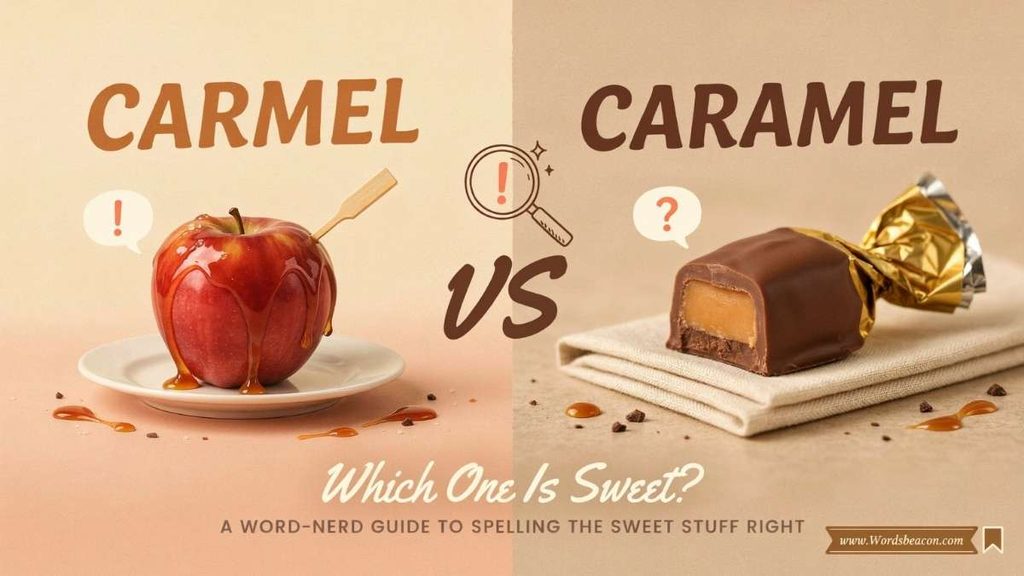
Carmel vs Caramel can be confusing because the two words often sound almost identical in everyday speech. Yet, they have different meanings and uses. Caramel is the sweet, rich treat made by heating sugar, while Carmel is usually used as a name or place name. The confusion becomes even greater because people in different regions pronounce caramel in different ways. In this guide, we’ll make the difference simple and easy to remember. You’ll learn the correct spelling, pronunciation, meaning, and everyday use of both words, along with clear examples. By the end, you’ll know exactly when to use Carmel and when caramel is the right choice.
quick answer
The difference between carmel and caramel becomes much clearer when you look at what each word means rather than how each one sounds.
Caramel is a common noun. It refers to a sweet substance produced when sugar is heated. The word can also describe a chewy confection, a flavor, a sauce, or a brown color associated with caramel.
Carmel, on the other hand, is generally a proper noun. It appears in geographic names, personal names, and other established names. Mount Carmel is a well-known geographic and biblical reference, while Carmel-by-the-Sea is a California city.
Here is the basic distinction:
| Word | Main meaning | Common examples | Typical capitalization |
|---|---|---|---|
| Caramel | Cooked sugar, candy, flavor, sauce, or color | Caramel sauce, caramel candy, caramel apple | Lowercase |
| Carmel | A name or place | Mount Carmel, Carmel-by-the-Sea | Capitalized |
| carmel | A disputed variant of caramel in some dictionaries | Less common food usage | Usually lowercase |
The difference is therefore about meaning and context, not simply spelling.
For example, you would write, “She poured caramel sauce over the cake.” The word refers to food, so caramel is correct.
You would write, “They spent the weekend in Carmel-by-the-Sea.” Here, Carmel is part of a city name, so the capitalized spelling is correct.
That simple distinction answers most questions about the carmel caramel difference.
Is Carmel a Word?
Is Carmel a word? Yes.
The answer becomes important because calling Carmel an incorrect word would oversimplify the issue. Carmel has several legitimate uses in English.
Carmel can be a personal name. It also appears in geographic names, including Mount Carmel and Carmel-by-the-Sea. These uses have their own histories and meanings and aren’t simply alternative spellings of the food word caramel.
Carmel is also associated with Hebrew origins. In the context of the personal name, the word is traditionally connected with a Hebrew term meaning “garden” or “garden-land.” The name has a long history of use and appears in religious and geographic contexts.
Mount Carmel is particularly significant because the name appears in biblical tradition and refers to a mountain ridge in northwestern Israel. The name has therefore existed independently of the English food word caramel.
Carmel-by-the-Sea provides another familiar example. This California city officially uses Carmel as part of its name.
There is also a more complicated dictionary issue. Some dictionaries record lowercase carmel as a disputed variant of caramel. That means the spelling does appear in English usage, but it isn’t the best choice when you’re writing standard food-related English.
So, is Carmel a word or a misspelling?
It can be either, depending on context.
If you write, “I visited Carmel,” you may be using a perfectly correct place name. If you write, “I ordered a carmel latte,” you are most likely using carmel as a spelling of caramel.
The context tells you which meaning is intended.
What Does Caramel Mean?
The caramel meaning is closely connected to heated sugar.
When sugar is heated to a high enough temperature, it undergoes caramelization. During this process, the sugar changes chemically and develops a deeper color, richer flavor, and characteristic aroma.
That transformation is what gives caramel its familiar golden brown to deep brown appearance.
Caramel can refer to the substance itself, but English speakers use the word in several related ways.
A caramel candy is a chewy confection made by cooking sugar with ingredients such as butter, milk, or cream. Caramel sauce is a softer preparation that can be poured over desserts or added to beverages. Salted caramel combines the sweetness of caramel with salt to create a contrasting flavor.
The word can also describe a flavor. A coffee shop might sell a caramel latte, while an ice cream company might offer caramel-flavored ice cream.
Caramel can describe color as well. A warm brown or golden brown shade may be called caramel because it resembles the color produced when sugar caramelizes.
That gives us several common uses of the word:
| Expression | Meaning |
|---|---|
| Caramel candy | A chewy sweet made with caramelized sugar and other ingredients |
| Caramel sauce | A pourable sweet sauce made from caramelized sugar |
| Salted caramel | Caramel combined with salt |
| Caramel flavor | The rich sweet flavor associated with caramel |
| Caramel color | A brown coloring substance or caramel-like shade |
| Caramel apple | An apple coated with caramel |
| Caramel popcorn | Popcorn covered with caramel |
Notice that every food-related expression uses caramel.
That is why caramel is the correct spelling of caramel for the candy, sauce, flavor, and color in standard writing.
What Is the Caramel Definition?
The caramel definition can be explained simply: caramel is a brown substance produced by heating sugar, and the word also refers to candy and other food products made using caramelized sugar.
The process itself is called caramelization.
When heated sugar begins to change, it doesn’t simply become “burned sugar.” Chemical reactions create hundreds of different flavor and aroma compounds. These reactions are responsible for the complex taste and smell associated with caramel.
That is why caramel has a much deeper flavor than ordinary sugar.
The exact result depends on temperature, cooking time, moisture, and other ingredients. A lightly caramelized sugar can have a delicate golden color and mild flavor, while further heating can produce a darker brown color and stronger, more bitter notes.
This explains why the word caramel can describe both a cooking ingredient and a broader flavor profile.
How Do You Pronounce Caramel?
The caramel pronunciation debate is probably the biggest reason people confuse caramel with Carmel.
There isn’t just one pronunciation used by every English speaker.
Many Americans pronounce caramel with two syllables:
KAR-muhl
Other speakers use three syllables:
KAR-uh-muhl
Both forms occur in English, and pronunciation varies according to region, accent, family background, and individual speech habits.
British English commonly uses a clearer three-syllable pronunciation, while the two-syllable form is especially common in American English. That doesn’t mean every American uses two syllables or every British speaker uses three.
Language doesn’t work that neatly.
The important point is that different pronunciations don’t automatically create different spellings.
Caramel Two Syllables or Three?
The answer is both.
Caramel can have a two-syllable pronunciation or a three-syllable pronunciation.
With the two-syllable pronunciation, it sounds roughly like “KAR-muhl.” With the three-syllable pronunciation, it sounds closer to “KAR-uh-muhl.”
This explains why someone may hear caramel and think the speaker said Carmel.
The middle unstressed syllable can become very short or disappear entirely in casual speech. English speakers do this with many words, especially when speaking quickly.
So the question “how many syllables are in caramel?” doesn’t have one universal answer.
The spelling remains caramel even when the speaker uses the two-syllable pronunciation.
Caramel Pronunciation in American English
In American English, the two-syllable pronunciation is extremely familiar.
You may hear someone say “KAR-muhl apple” rather than “KAR-uh-muhl apple.” That doesn’t mean the speaker has changed the word.
Both pronunciations can exist within American English, and individual speakers may even switch between them depending on the situation.
A person might use the three-syllable pronunciation in careful speech and the two-syllable pronunciation in casual conversation.
That kind of variation is normal in English.
Caramel Pronunciation in British English
British English commonly uses the three-syllable pronunciation.
The middle syllable remains more noticeable, giving the word a sound similar to “KAR-uh-muhl.”
Regional pronunciation doesn’t change the spelling, though.
Whether someone says caramel with two syllables or three, the standard written form for the food remains caramel.
Caramel Pronunciation in the South
The caramel pronunciation in the South can vary just as it does elsewhere in the United States.
Some Southern speakers use the two-syllable form, while others use three syllables. Regional accents influence the way unstressed sounds are reduced, but there isn’t one single pronunciation shared by every Southern speaker.
It’s therefore better to think of caramel pronunciation by region as a range rather than a strict rule.
How Do You Pronounce Carmel?
The Carmel pronunciation is generally close to “KAR-muhl” in American English.
That similarity is what makes Carmel vs caramel especially easy to confuse when you’re listening rather than reading.
For many American speakers, these two words can sound nearly identical:
Carmel: KAR-muhl
Caramel: KAR-muhl
The difference becomes clearer through context.
If someone says, “We’re driving to Carmel,” the listener understands that Carmel is probably a place or name.
If someone says, “We’re making caramel,” the surrounding context tells you that the word refers to food.
This is a useful reminder that spoken language depends heavily on context. A sound alone doesn’t always tell you exactly which written word a speaker means.
Learn the difference between tricky more English words
Finaly vs Finally difference and usage?
Carmel vs Caramel Pronunciation Why Are They So Similar?

The carmel vs caramel pronunciation difference can be surprisingly small.
The three-syllable pronunciation of caramel clearly separates the middle vowel:
KAR-uh-muhl
The two-syllable version reduces that middle sound:
KAR-muhl
Once that vowel disappears in ordinary speech, the pronunciation becomes very close to Carmel.
This creates what might be called pronunciation confusion.
Someone who has mostly heard the two-syllable form may naturally assume the spelling is carmel. That assumption becomes especially likely if they haven’t seen the word written very often.
The problem is that English spelling doesn’t always mirror modern speech.
Words can retain historical spellings even after their pronunciations change. Other words develop regional pronunciations while keeping one standard written form.
Caramel is a good example.
Why Do People Say “Carmel” Instead of “Caramel”?
Why do people pronounce caramel as carmel?
Usually, the answer is simple: they aren’t necessarily saying a different word. They’re using a pronunciation in which the unstressed middle syllable is reduced or dropped.
In casual American English, caramel is often pronounced with two syllables. When spoken quickly, the word naturally becomes closer to Carmel.
This is a pronunciation difference, not necessarily a vocabulary difference.
The spelling confusion comes later.
A person hears “KAR-muhl,” remembers the sound, and writes carmel. That’s how a carmel spelling mistake can develop.
The same thing can happen with other English words whose spelling contains sounds that speakers reduce during ordinary conversation.
Why Do People Spell Caramel Carmel?
People often spell caramel as carmel because they spell according to sound.
If a speaker has always heard “KAR-muhl,” the spelling carmel looks perfectly reasonable. It is shorter and appears to match the pronunciation.
The problem is that pronunciation isn’t a reliable spelling guide for every English word.
For standard food writing, the established spelling is caramel.
That’s the form you’ll want when writing about caramel sauce, caramel candy, caramel apples, caramel flavor, or caramel color.
Carmel vs Caramel Spelling and Meaning
The carmel vs caramel spelling difference is only one letter, but that single letter changes the word’s standard use.
Caramel contains the extra “a”:
C-A-R-A-M-E-L
Carmel contains:
C-A-R-M-E-L
That middle “a” is easy to miss when you’re thinking about pronunciation rather than spelling.
Here’s a useful comparison:
| Feature | Caramel | Carmel |
|---|---|---|
| Letters | 7 | 6 |
| Main use | Food, flavor, color, candy, sauce | Name or place |
| Common noun | Yes | Usually no |
| Proper noun | Usually no | Yes |
| Common pronunciation | Two or three syllables | Usually two syllables |
| Example | Caramel sauce | Carmel-by-the-Sea |
The correct spelling of caramel is therefore easy to remember when you connect it to its meaning.
If you’re describing something edible, the longer spelling is usually the one you want.
Is Carmel the Correct Spelling?
The answer depends entirely on what you’re trying to write.
If you’re referring to Carmel-by-the-Sea, then Carmel is absolutely correct.
If you’re referring to Mount Carmel, Carmel is also correct.
If you’re writing a person’s name and that person’s established name is Carmel, then Carmel is correct.
But if you mean the sweet confection, caramel is the standard spelling.
That is why asking “is Carmel the correct spelling?” without giving context can lead to confusion.
There isn’t one spelling that replaces the other in every situation.
Is Carmel a Misspelling of Caramel?
Carmel can be a misspelling of caramel, but it isn’t always one.
Consider these two sentences:
“I bought a caramel apple.”
“I visited Carmel-by-the-Sea.”
Neither sentence is confusing once you understand the context.
The first sentence uses caramel as a food word. The second uses Carmel as a place name.
The real issue appears when someone writes carmel in a food context, such as “carmel sauce.” In standard English, caramel sauce is the preferred spelling.
Some dictionaries acknowledge lowercase carmel as a disputed variant of caramel, so the situation is more nuanced than simply saying that every use of carmel is wrong.
For formal, professional, educational, and published writing, however, caramel is the clear choice when you mean the food.
Carmel vs Caramel Examples in Sentences

Sentence examples make the spelling difference much easier to remember.
Here are natural examples using caramel:
“I made caramel sauce for the cheesecake.”
“She ordered a caramel latte.”
“The bakery sells homemade caramel candy.”
“The recipe uses heated sugar to create a rich caramel flavor.”
“The ice cream contains ribbons of salted caramel.”
“The designer chose a warm caramel brown color.”
Each example refers to food, flavor, cooking, or color.
Now consider examples using Carmel:
“We spent three days in Carmel-by-the-Sea.”
“Mount Carmel is located in northwestern Israel.”
“Carmel is also used as a personal name.”
In these sentences, Carmel refers to a name or geographic location.
The meaning determines the spelling.
Caramel or Carmel for the Candy?
If you’re talking about the sweet confection, use caramel.
The standard phrase is caramel candy.
You can also write caramel chew, caramel-filled candy, caramel coating, or caramel confection.
Writing carmel candy may reflect the way someone pronounces the word, but it isn’t the standard spelling used in most formal food writing.
This distinction matters on menus, recipes, product descriptions, packaging, school assignments, and articles because readers generally expect caramel when they see a reference to the confection.
Caramel or Carmel for the Color?
Use caramel when you’re describing the color associated with caramelized sugar.
For example, you might describe a fabric as having a caramel brown color or say that a sauce has developed a deep caramel color.
Caramel can refer to a range of warm brown and golden brown shades.
The exact shade isn’t fixed. Depending on the context, caramel can look light and golden or much darker and richer.
The spelling doesn’t change.
You would write:
“a caramel-colored jacket”
“a warm caramel shade”
“a rich caramel brown”
You wouldn’t normally replace caramel with carmel simply because the word is describing a color rather than food.
Fix common more word mistakes in English
Naive vs Nieve difference and usage?
Common Carmel vs Caramel Mistakes
One common mistake is writing carmel because that’s how the word sounds.
Another is assuming that caramel must always have three syllables because its spelling contains the extra “a.”
Neither assumption works reliably.
A third mistake is treating Carmel as an incorrect word in every situation. That ignores legitimate uses such as Mount Carmel and Carmel-by-the-Sea.
Capitalization can also provide a clue.
Caramel is normally lowercase when it functions as a common noun.
Carmel is usually capitalized when it functions as a proper noun.
For example:
“The dessert contains caramel.”
“We’re visiting Carmel.”
The first sentence names a food substance. The second uses a proper name.
Why Is Caramel Spelled Caramel?
Why is caramel spelled caramel when many people pronounce it like carmel?
The answer lies in the history of the English word.
Merriam-Webster traces caramel through French and Spanish forms, including Spanish caramelo. The word entered English centuries ago, with Merriam-Webster dating its first known English use to 1702.
As with many borrowed words, the spelling and pronunciation developed over time.
English has never required every word to be spelled exactly as it sounds. Pronunciation can change while spelling remains relatively stable.
That is why modern speakers can say “KAR-muhl” while still writing caramel.
The spelling reflects the established history and standard written form of the word rather than every modern regional pronunciation.
Caramel vs Carmel American English and British English

The caramel vs carmel American English question often focuses on pronunciation.
American English frequently uses the two-syllable pronunciation, which makes caramel sound like Carmel.
British English commonly uses a three-syllable pronunciation, making the middle vowel more noticeable.
But neither dialect needs a different spelling for the food.
The same word can have different pronunciations across English-speaking regions while retaining the same written form.
This is one reason pronunciation guides should be treated separately from spelling guides.
A regional accent can change how a word sounds without changing how it should appear on the page.
Is Caramel a Word?
Is caramel a word?
Yes. It is a well-established English word with several related meanings.
It can refer to cooked sugar, caramel candy, caramel sauce, caramel flavor, caramel color, and other products or qualities associated with caramelized sugar.
It is also used in broader descriptions of taste and appearance.
For example, a food writer might describe a dessert as having a deep caramel flavor. A color description might call a warm brown shade caramel. A recipe might instruct the cook to make caramel before adding cream or butter.
The word therefore has a much wider role in English than simply naming one type of candy.
Carmel vs Caramel Which One Should You Use?
When you’re deciding between caramel or carmel, start with the meaning.
If you’re talking about a food item, dessert, confection, sauce, flavor, or color, choose caramel.
If you’re referring to a person, place, city, mountain, or another established name, choose Carmel when that is the correct name.
For example:
“The restaurant serves caramel pudding.”
“Her favorite candy is caramel.”
“They drove through Carmel-by-the-Sea.”
“Mount Carmel has a long geographic and religious history.”
The surrounding context makes the choice clear.
A Simple Way to Remember Carmel vs Caramel
If spelling isn’t your strong suit, don’t try to memorize a complicated rule.
Think of it this way:
Caramel belongs in the kitchen.
Carmel belongs on a map or name list.
Caramel can be something you eat, drink, cook with, or use to describe a color.
Carmel is usually something you name.
That gives you a quick mental test whenever you hesitate.
If you’re writing about caramel sauce, you’re in the kitchen.
If you’re writing about Carmel-by-the-Sea, you’re on the map.
practice sesstion Carmel vs Caramel
Fill in each blank with the correct spelling Carmel vs Caramel.
- The chef made a delicious __________ sauce for the dessert.
- We visited __________, California, during our vacation.
- She loves the rich, sweet taste of __________.
- The recipe says to heat the sugar until it turns into __________.
- __________ is a coastal city in California.
- The ice cream was topped with warm __________.
- My friend lives in __________, Indiana.
- The baker added __________ to the chocolate cake.
- The word used for cooked sugar that becomes brown and sweet is __________.
- __________ can refer to a place name as well as a personal name.
- I bought a __________ candy bar from the store.
- The __________ color of the sauce made the dessert look delicious.
- We planned a weekend trip to __________ by the sea.
- Be careful not to burn the __________ while making the sauce.
- Some people pronounce “caramel” almost like “__________.”
- The correct spelling for the sweet ingredient is __________.
- __________ is not normally the correct spelling for the sweet candy.
- The restaurant served apples covered in __________.
- They spent the afternoon exploring __________ Beach.
- The cake had a layer of smooth __________ between the sponge layers.
- If you’re talking about the sweet food made from heated sugar, use __________.
- If you’re talking about the California city, use __________.
- The __________ sauce was thick, glossy, and sweet.
- Sarah accidentally wrote “carmel” when she meant __________.
- Remember: candy and sweet sauce are usually spelled __________.
Answers
- caramel
- Carmel
- caramel
- caramel
- Carmel
- caramel
- Carmel
- caramel
- caramel
- Carmel
- caramel
- caramel
- Carmel
- caramel
- Carmel
- caramel
- Carmel
- caramel
- Carmel
- caramel
- caramel
- Carmel
- caramel
- caramel
- caramel
Here’s a trusted source for clear more words Comparison:
FAQs
Why do Americans say “carmel” instead of “caramel”?
Many Americans pronounce “caramel” with two syllables, which can make it sound almost identical to “Carmel.” This pronunciation is common in several parts of the United States. Even when people say it this way, the standard spelling for the sweet is still “caramel.”
Is “Carmel” the same as “caramel”?
No. “Carmel” and “caramel” are different words with different meanings. Carmel is most often a place name or personal name, while caramel is the sweet substance made by heating sugar. The two words can sound similar because of regional pronunciation.
Is it “Carmel apple” or “caramel apple”?
The correct spelling is “caramel apple.” A caramel apple is an apple covered with a layer of caramel. “Carmel apple” is usually the result of spelling the word the way some people pronounce it.
How do British people pronounce caramel?
British speakers commonly pronounce caramel with three syllables. The middle sound is more noticeable than it is in the common two-syllable American pronunciation. However, pronunciation can still vary from person to person.
How do Californians pronounce caramel?
There isn’t one pronunciation used by every Californian. You may hear both two-syllable and three-syllable versions of caramel. Personal speech habits and regional influences play a bigger role than a single California pronunciation.
How do New Yorkers pronounce “Carmel”?
The pronunciation can vary depending on the speaker and the place or person being discussed. When “Carmel” is used as a proper name, it is generally pronounced as a two-syllable word. It can therefore sound similar to the shorter American pronunciation of caramel.
How do Southerners pronounce caramel?
Southern speakers use both two-syllable and three-syllable pronunciations of caramel. The shorter version is common in some Southern accents, which can make caramel sound almost the same as Carmel.
Where do people say “carmel” instead of “caramel”?
The shorter pronunciation occurs across different parts of the United States rather than in one specific region. It is influenced by local accents, family speech patterns, and individual preference. That’s why you can hear different pronunciations even within the same state.
Is the candy called “Carmel” or “caramel”?
The standard spelling is “caramel.” Whether you’re talking about caramel candy, caramel sauce, or caramel flavor, the word is spelled with the extra “a.” “Carmel” isn’t the standard spelling for the sweet.
Are there two ways to pronounce caramel?
Yes. English has both two-syllable and three-syllable pronunciations of caramel. Neither pronunciation changes the meaning of the word. The difference mainly comes from regional and individual speech patterns.
How do Americans pronounce caramel?
Americans pronounce caramel in more than one way. Some speakers use two syllables, while others pronounce three. The two-syllable pronunciation can sound like “Carmel,” which is one reason the spelling causes so much confusion.
How do Canadians pronounce caramel?
Canadian English also has variation in how caramel is pronounced. Some speakers use two syllables while others use three. Regardless of pronunciation, the standard spelling remains “caramel” when referring to the sweet.
How do Texans pronounce caramel?
Texans may pronounce caramel with either two or three syllables. The shorter pronunciation can be especially noticeable in casual conversation, but there isn’t a single pronunciation that applies to everyone in Texas.
How do French people pronounce caramel?
French speakers pronounce caramel according to French pronunciation rules, so it sounds different from the common English versions. English speakers generally adapt the borrowed word to their own accent when using it in English.
Is it “car-a-mel” or “care-a-mel”?
The pronunciation depends on the speaker’s accent. Some English speakers pronounce all three syllables, while others use a shorter two-syllable form. Both pronunciations are established in English.
How do you pronounce Carmel correctly?
“Carmel” is generally pronounced as a two-syllable word. The exact pronunciation can vary slightly when it refers to a particular person or place. It should not be confused with the standard spelling of the sweet word “caramel.”
Who says “caramel” and who says “Carmel”?
Speakers who use the two-syllable pronunciation of caramel may make it sound like “Carmel.” Speakers who pronounce all three syllables create a clearer distinction between the two words. The difference usually reflects accent and personal speech habits rather than different meanings.
What is the difference between “Carmel” and “caramel”?
Carmel is generally a proper name or place name, while caramel refers to a sweet substance made by heating sugar. Caramel can also describe a sauce, candy, flavor, or brownish color. Although the words can sound alike in some accents, they aren’t interchangeable in standard writing.
Are butterscotch and caramel the same?
No. Butterscotch and caramel are different confections. Caramel is made by heating sugar until it develops its characteristic color and flavor, while traditional butterscotch is made primarily with brown sugar and butter. Their flavors can be similar, but they’re not the same thing.
Are Tootsie Rolls a type of caramel?
No. Tootsie Rolls are a separate type of chewy candy with a distinctive chocolate flavor and texture. They may have a texture that reminds some people of caramel, but they aren’t simply another form of caramel.
What are the main types of caramel?
Caramel comes in several forms depending on how it’s prepared and used. Common examples include caramel sauce, soft caramel candy, hard caramel, and caramel used as a flavoring or coloring ingredient. The texture and consistency can change depending on the cooking method and ingredients.
Why does caramel fall off apples?
Caramel may fall off an apple when the fruit is wet, waxy, or too cold. Moisture makes it harder for the caramel to stick to the skin. Thoroughly drying the apples before dipping them can help the coating adhere better.
Is “Carmel” ever correct when talking about food?
Yes, but only when “Carmel” is part of a proper name or specific product name. If you’re referring to the sweet ingredient, candy, sauce, or flavor, the correct spelling is “caramel.” Using “Carmel” for the sweet simply because that’s how it sounds in some accents is not standard spelling.
Conclusion
Carmel vs caramel can be confusing, especially when you hear people pronounce caramel in different ways. The good news is that the spelling is much easier to remember than it first seems.
When you mean the sweet, sticky treat made by heating sugar, the correct word is caramel. That includes caramel sauce, caramel candy, caramel apples, caramel flavor, and all those delicious desserts topped with caramel.
Carmel is different. It’s usually a name or a place name. For example, Carmel can refer to a city or a person. It isn’t the standard spelling for the sweet treat.
So why do people get them mixed up? Pronunciation is the main reason. Many Americans pronounce caramel with two syllables, making it sound very similar to Carmel. Other people pronounce caramel with three syllables. Both pronunciations are used in English, but the spelling doesn’t change.
Here’s the easiest way to remember it: if you can eat it, pour it, drizzle it, or dip an apple in it, it’s caramel. If it’s the name of a person or place, it may be Carmel.
Think of it this way: Carmel might take you somewhere, but caramel belongs on your dessert.
Once you understand that small difference, the confusion disappears. You can confidently write “caramel apple,” “caramel sauce,” or “caramel candy” without wondering whether that missing “a” is hiding somewhere.
In the end, your pronunciation may depend on where you’re from, but your spelling should depend on what you mean. Carmel is a name or place. Caramel is the sweet stuff. Keep that simple rule in mind, and you’ll never have to second-guess this sticky little spelling problem again.

Luna AJS is an experienced blogger and dedicated language enthusiast at Words Beacon. She specializes in making English grammar, spelling, vocabulary and commonly confused words easy to understand. She provides clear explanations, practical examples to help readers write with confidence.