
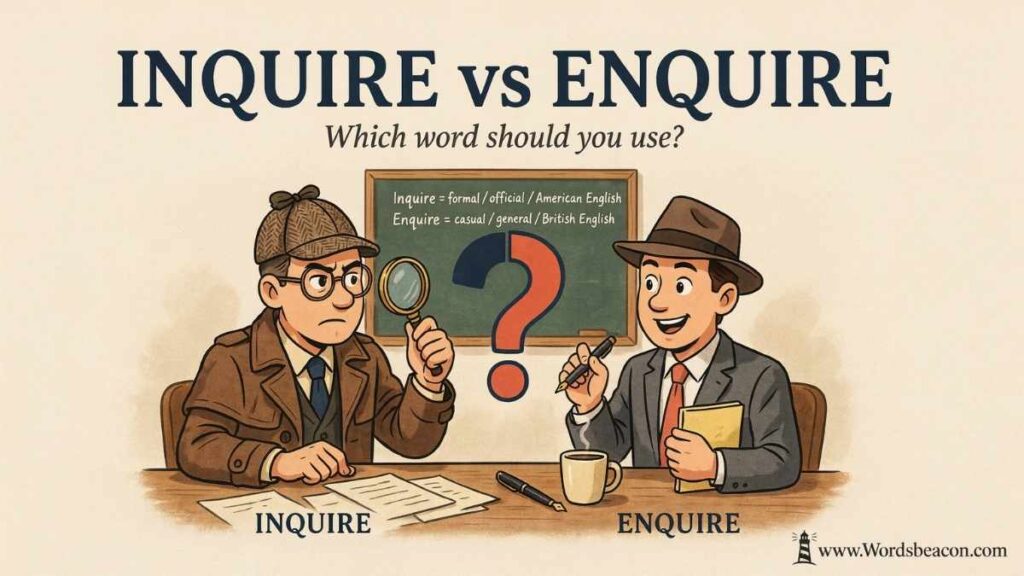
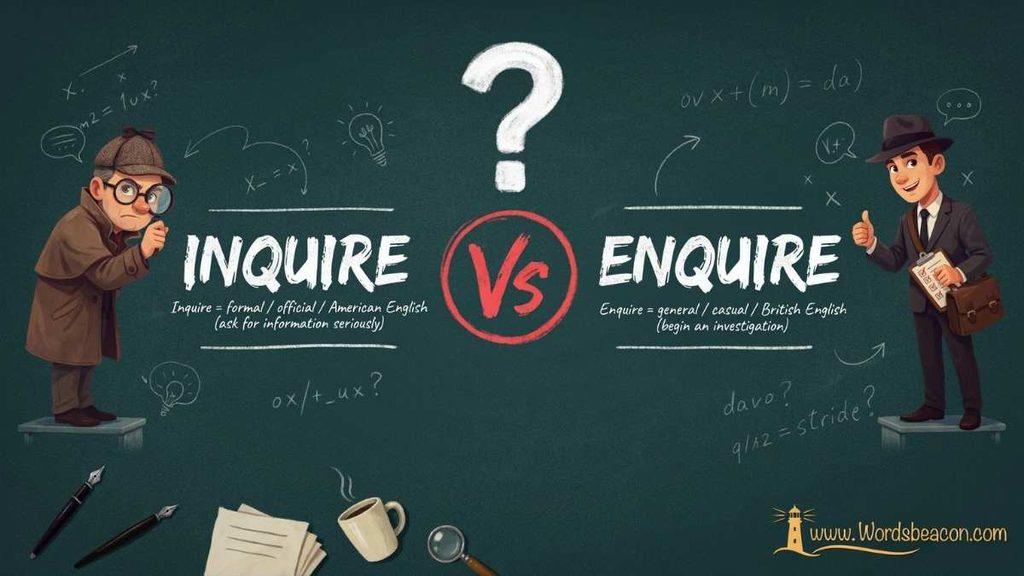
Inquire vs enquire look almost identical, so its easy to wonder whether one is correct and the other is a spelling mistake. The good news is that both are correct. The main difference is where they are commonly used. American English usually prefers inquire, while British English often uses enquire when asking for information. Their noun forms, inquiry and enquiry, can also vary by region and context. In this guide, the inquire vs enquire difference is explained in simple terms, with clear examples and practical grammar tips. By the end, you’ll know which form to use and why, without getting tangled in complicated English rules.
Quick Answer
Inquire and enquire are both correct English words. In most everyday situations, they mean the same thing: to ask for information or seek an answer.
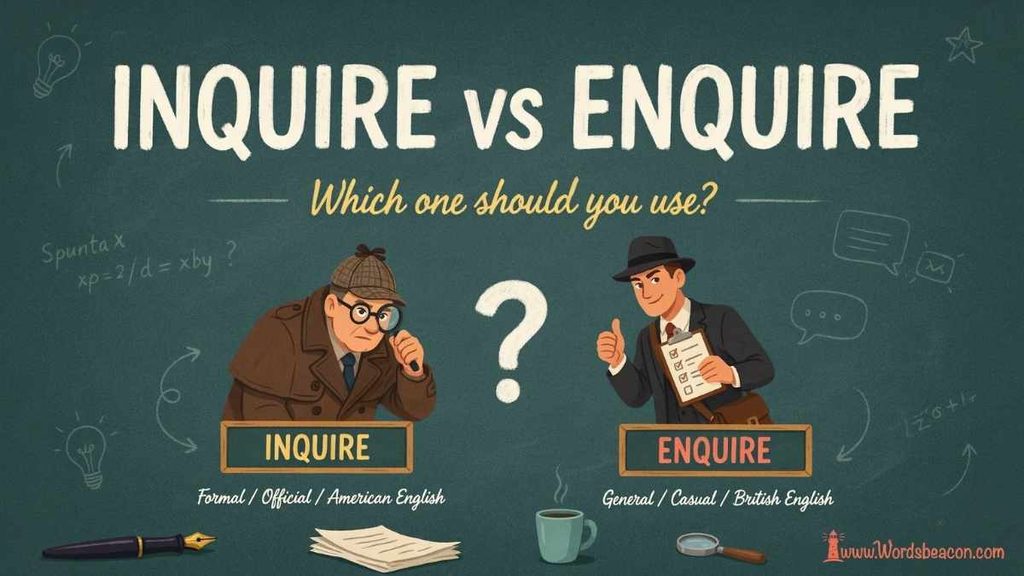
American English normally uses inquire. British English commonly uses enquire for a general request for information, although inquire is also used in British English, especially in formal contexts.
For example, an American writer might say, “I’m writing to inquire about the position.” A British writer could write, “I’m writing to enquire about the position.”
The meaning doesn’t really change. The spelling reflects the variety of English being used.
The noun forms follow a similar pattern. American English generally uses inquiry, while British English often uses enquiry when referring to a general request for information. In British English, inquiry is also widely used for a formal investigation.
What Does “Inquire” Mean?
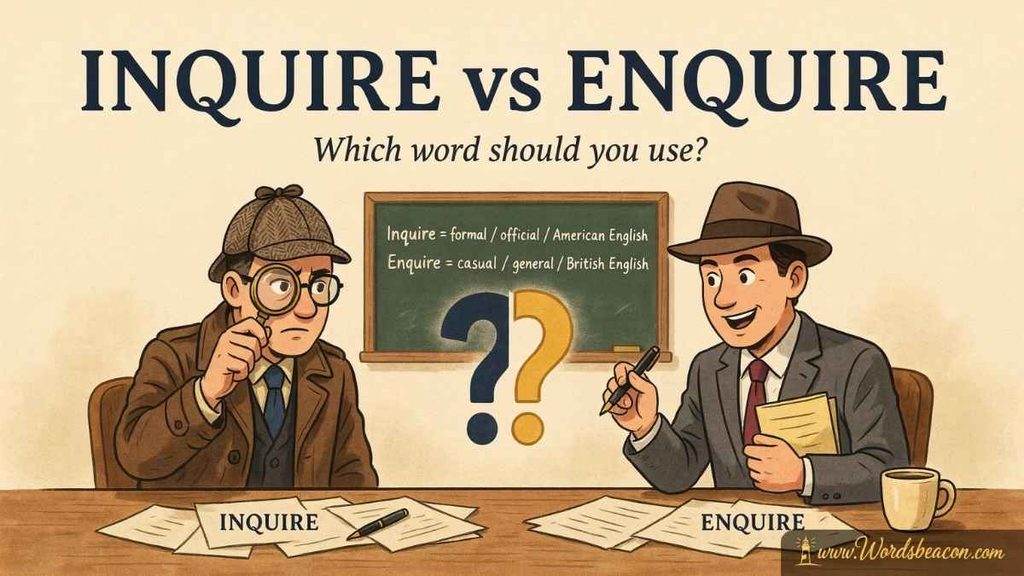
The inquire meaning is simply to ask for information, seek an answer, or investigate something.
Inquire is a verb. You use it when someone wants to find out something by asking a question or requesting information.
For example, someone might inquire about a job, a product, a price, a course, a delivery, or an appointment.
“I called to inquire about the delivery date.”
“She inquired about the cost of the course.”
“He inquired whether the position was still available.”
Inquire often sounds more formal than ask. In everyday conversation, people usually say, “I want to ask about the price.” In a professional email, however, “I’d like to inquire about the price” can sound more polished.
That doesn’t mean inquire is always better. Good writing depends on context. Sometimes ask is clearer, shorter, and more natural.
Inquire Definition
A useful inquire definition is “to ask for information or seek to discover something through questioning.”
The word can also refer to investigating a matter. This meaning becomes especially clear when inquire appears with the preposition into.
For example, “The committee will inquire into the allegations” means that the committee will investigate the allegations.
That is different from simply asking someone about the allegations.
Inquire in a Sentence
Here are a few natural examples of inquire in a sentence.
“I called to inquire about the new course.”
“She inquired about the registration process.”
“The customer inquired whether the product was still available.”
“The committee will inquire into the cause of the incident.”
These examples show two useful patterns. Inquire about usually introduces the information someone wants. Inquire into often suggests an investigation or detailed examination.
Learn how to use confusing more words correctly
Carmel vs Caramel difference and usage?
What Does “Enquire” Mean?
The enquire meaning is very similar to the meaning of inquire. It means to ask for information, seek an answer, or investigate something.
The main difference is regional usage.
Enquire is particularly common in British English. You may see it in emails, business letters, customer service messages, advertisements, and ordinary requests for information.
For example, a British writer might say, “I’d like to enquire about the available courses.”
Another natural example would be, “She enquired about the price.”
The spelling may look different to an American reader, but the basic meaning remains the same.
Enquire Definition
A practical enquire definition is “to ask for information or seek an answer.”
Like inquire, enquire can also be used when talking about an investigation. For example, “The committee was asked to enquire into the matter.”
However, British English often makes a useful distinction between enquiry and inquiry when the noun is involved.
Enquire in a Sentence
Consider these examples of enquire in a sentence.
“I’d like to enquire about your services.”
“She enquired whether breakfast was included.”
“Please enquire at reception for further information.”
“They enquired about the availability of the rooms.”
Each example involves someone seeking information. The British spelling simply uses enquire rather than inquire.
Inquire vs Enquire the Difference?
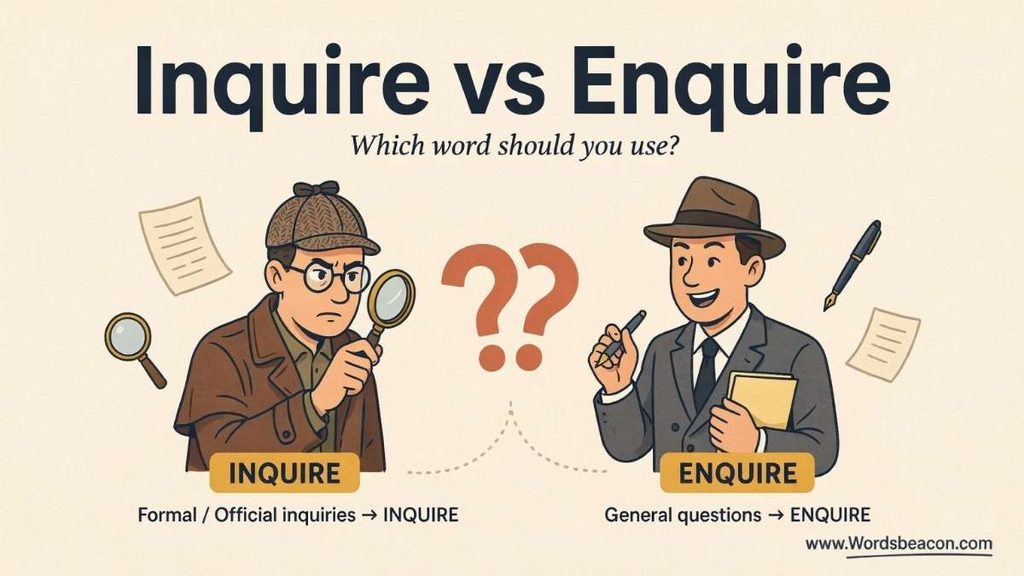
The inquire and enquire difference is mainly a matter of regional spelling and usage.
In American English, inquire is the standard choice. In British English, enquire is common when someone is making a general request for information.
There is also an additional distinction worth knowing. Traditional British usage often uses enquiry for a general request for information and inquiry for a formal investigation.
For example, “I made an enquiry about the hotel” means that someone asked for information about the hotel.
On the other hand, “The government ordered an inquiry into the incident” refers to an official investigation.
This distinction is useful, but it isn’t an absolute rule that every British writer follows. Modern British usage allows some variation, and inquiry is common in many formal British contexts.
That is why context matters just as much as spelling.
Inquire vs Enquire Spelling
The inquire vs. enquire spelling difference is easy to spot. The words differ by one letter at the beginning.
The forms are inquire and enquire.
1.Their related nouns are inquiry and enquiry.
2.Their past-tense forms are inquired and enquired.
3.Their present participles are inquiring and enquiring.
The spelling pattern generally stays consistent within each regional variety of English.
If you’re wondering how to spell inquire in American English, use inquire.
If you’re wondering how to spell enquire in British English, use enquire.
Neither spelling is simply a mistake.
Learn how to use confusing more words correctly
Finaly vs Finally difference and usage?
Inquire vs Enquire in American English
When it comes to inquire vs. enquire American English usage, the choice is straightforward.
American English normally uses inquire.
For example, an American company might write, “Please contact us if you have any questions or inquiries.”
An American university might say, “For more information, please inquire at the admissions office.”
A job applicant might write, “I’m writing to inquire about the status of my application.”
This makes inquire the normal American spelling in professional, academic, commercial, and everyday writing.
Is “Enquire” Correct in American English?
The question “is enquire correct in American English” needs a little explanation.
Enquire is a genuine English word. It isn’t an invented spelling, and it isn’t grammatically meaningless. However, American English generally does not use it as its standard form.
For an American audience, inquire will almost always look more familiar and natural.
The same applies to the noun. American English normally uses inquiry rather than enquiry.
Inquiry vs. Enquiry in American English
When comparing inquiry vs. enquiry American English usage, inquiry is the standard form.
You will commonly see phrases such as “customer inquiry,” “business inquiry,” “email inquiry,” “make an inquiry,” and “submit an inquiry.”
American English therefore generally follows a simple pattern: inquire becomes inquiry.
Inquire vs Enquire in British English
The inquire vs. enquire UK question is slightly more complicated because British English uses both forms.
Enquire is particularly common when someone is asking for information.
For example, a British business might write, “Please enquire about availability.”
A customer might say, “I’d like to enquire about your services.”
A student might write, “I’m contacting you to enquire about the application process.”
At the same time, inquire remains a valid British English word.
Is “Enquire” Correct in British English?
Yes. Enquire is completely correct in British English.
The British spelling enquire is well established and appears in everyday and professional writing.
It isn’t simply an alternative spelling that people use casually. It has a long history of use in British English.
However, British English doesn’t reject inquire. Both forms exist.
Is “Inquire” Correct in British English?
Yes.
The idea that inquire is exclusively American is too simplistic.
British English uses inquire too, especially in formal or institutional contexts. It is particularly familiar in expressions involving investigation.
This is why a British writer can correctly use either form depending on the context and preferred style.
Inquiry vs Enquiry Why the Noun Matters
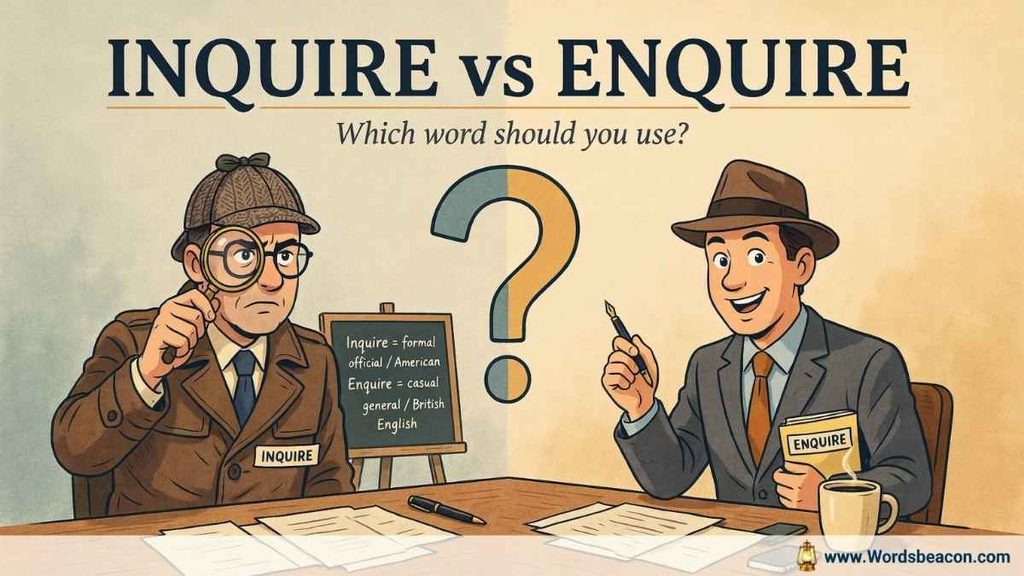
The inquiry vs. enquiry difference is especially interesting because the noun forms can carry different meanings in British English.
Inquiry can mean a request for information or an investigation.
Enquiry commonly refers to a request for information.
For example, “We received an enquiry about our services” describes a customer asking for information.
By contrast, “The government launched an inquiry into the incident” describes a formal investigation.
In American English, inquiry generally handles both meanings.
This creates an important regional difference. An American writer may use inquiry for a customer question and an official investigation without changing the spelling.
A British writer may choose enquiry for the customer question and inquiry for the formal investigation.
Inquire About vs Enquire About
Inquire about and enquire about have the same basic grammatical function.
They mean to ask for information about something.
An American writer might say, “I called to inquire about the price.”
A British writer might say, “I called to enquire about the price.”
The structure stays the same. Only the regional spelling changes.
You can use these forms when asking about a service, product, job, appointment, course, price, schedule, application, or other subject.
Inquire Into vs Enquire Into
Inquire into and enquire into usually suggest investigation.
For example, “The committee will inquire into the complaint” means that the committee will examine the complaint.
A British version could read, “The committee will enquire into the complaint.”
This is different from inquire about or enquire about.
“Inquire about the complaint” means asking for information concerning the complaint.
“Inquire into the complaint” suggests examining or investigating the complaint itself.
That small preposition can change the meaning considerably.
“I Would Like to Inquire” or “I Would Like to Enquire”?
Both expressions are correct.
The better choice depends on your audience.
For American English, use “I would like to inquire about the position.”
For British English, “I would like to enquire about the position” is perfectly natural.
Both sentences communicate the same message.
If you’re writing a formal email, either form can work when it matches the regional style of the audience. If you’re writing casually, you might simply say, “I’d like to ask about the position.”
That version is shorter and sounds more conversational.
Inquire vs Enquire Pronunciation
The inquire pronunciation and enquire pronunciation are generally the same.
The different spelling doesn’t normally create a different spoken word. Most speakers pronounce both forms in essentially the same way.
Regional accents can affect the exact sound, just as they do with many English words. However, there isn’t a major pronunciation difference that learners need to memorize between inquire and enquire.
The important distinction is therefore written rather than spoken.
Inquire vs Enquire in Professional Emails
Professional writing is one of the places where this difference becomes especially noticeable.
Imagine someone wants to ask a company about its services.
In American English, the email might begin, “I’m writing to inquire about your pricing options.”
In British English, it might begin, “I’m writing to enquire about your pricing options.”
Both sound professional.
The key is consistency. If the rest of your writing follows American English spelling, inquire makes sense. If you’re following British English conventions, enquire may be the better choice.
The same principle applies to the noun forms.
An American company may receive a customer inquiry.
A British company may receive a customer enquiry.
Neither organization is using incorrect English.
Inquire vs Enquire in Real-Life Situations
Consider a hotel booking.
An American guest might write, “I’d like to inquire about room availability for Friday.”
A British guest might write, “I’d like to enquire about room availability for Friday.”
Now imagine a job application.
An American applicant might write, “I’m writing to inquire about the status of my application.”
A British applicant could write, “I’m writing to enquire about the status of my application.”
The same pattern appears in customer service.
An American company might say, “We received your inquiry yesterday.”
A British company might say, “We received your enquiry yesterday.”
The message stays the same. The spelling reflects the variety of English.
Inquire vs Enquire vs Ask
The word ask deserves attention because it is often the most natural choice.
Ask is neutral and extremely common. It works in casual conversation, professional communication, academic writing, and almost every other setting.
Inquire and enquire can sound more formal.
Compare these sentences:
1. “Can I ask about the schedule?”
2.“Can I inquire about the schedule?”
3.“Can I enquire about the schedule?”
All three are grammatically acceptable. The first sounds the most natural in everyday conversation. The second fits American formal writing. The third fits British formal writing.
There is no need to replace every simple use of ask with inquire or enquire. Clear writing usually wins over unnecessarily formal language.
Common Mistakes With Inquire and Enquire
One common mistake is assuming that enquire is simply a misspelling of inquire. It isn’t. Enquire is a standard word in British English.
Another mistake is assuming that inquire is only an American word. British English also uses inquire.
Some writers also assume that the two verbs always have completely different meanings. In ordinary usage, they can both mean asking for information.
Another problem occurs when writers mix inquiry and enquiry without understanding the regional convention. If the writing follows American English, inquiry is usually the natural noun. If it follows British English, enquiry is common for a general request for information.
Finally, some people overuse inquire or enquire when ask would be clearer. Formal language has its place, but a simple question doesn’t need a tuxedo.
When to Use Inquire vs Enquire
1.If you’re writing American English, inquire is the safest choice.
2.If you’re writing British English and you’re making a general enquiry, enquire is a natural choice.
3.If you’re describing an official investigation, inquiry is widely used, including in British English.
4.If the situation is casual, ask may sound more natural than either formal verb.
The audience should guide your decision.
Understand confusing English more words simply
Naive vs Nieve difference and usage?
Inquire vs Enquire A Simple Way to Remember
Think of the distinction as a regional spelling preference rather than a battle over correctness.
American English generally prefers inquire and inquiry.
British English commonly uses enquire and enquiry for general requests for information, while inquiry is widely used for formal investigations.
Other varieties of English can follow their own conventions. Canadian English often uses inquire, while Australian English commonly uses enquire in line with British-influenced spelling patterns. Commonwealth English is broad enough that usage can vary from one country to another.
The safest approach is to follow the spelling standard expected by your readers or organization.
Inquire vs Enquire Practice Session
Fill in each blank with the correct word or form: inquire, enquire, inquiry, enquiry, inquired, enquired, inquire into, or enquire into.
- I’m writing to ______ about the available positions at your company.
- She called the hotel to ______ about room availability.
- The customer made an ______ about the price of the service. (American English)
- The customer made an ______ about the price of the service. (British English)
- The committee will ______ the cause of the accident. (American English)
- The committee will ______ the cause of the accident. (British English)
- He ______ about the course fees before submitting his application. (American English)
- She ______ about the course fees before submitting her application. (British English)
- If you need more information, please ______ at the reception desk. (American English)
- If you need more information, please ______ at the reception desk. (British English)
- We received a customer ______ about the delivery date. (American English)
- We received a customer ______ about the delivery date. (British English)
- The journalist decided to ______ into the matter. (American English)
- The journalist decided to ______ into the matter. (British English)
- I would like to ______ whether the position is still available. (American English)
- I would like to ______ whether the position is still available. (British English)
- The company received several ______ about its new product. (American English)
- The company received several ______ about its new product. (British English)
- The government ordered an official ______ into the incident. (British English)
- She ______ about the return policy before buying the product. (American English)
- He ______ about the return policy before buying the product. (British English)
- Please contact our office if you wish to ______ about the application process. (American English)
- Please contact our office if you wish to ______ about the application process. (British English)
- The manager asked the team to ______ into the complaint. (American English)
- The manager asked the team to ______ into the complaint. (British English)
Answers
- inquire
- enquire
- inquiry
- enquiry
- inquire into
- enquire into
- inquired
- enquired
- inquire
- enquire
- inquiry
- enquiry
- inquire
- enquire
- inquire
- enquire
- inquiries
- enquiries
- inquiry
- inquired
- enquired
- inquire
- enquire
- inquire
- enquire
Here’s a trusted source for clear more words Comparison:
FAQs
Can “Inquire vs Enquire” be used interchangeably?
In most situations, yes. Both words can mean asking for information. The main difference is regional preference. American English generally favors inquire, while British English commonly uses enquire for general requests.
Does “inquire” sound different from “enquire”?
Usually, no. The two words are generally pronounced the same or very similarly. The difference is mainly found in spelling rather than pronunciation. Regional accents can naturally affect how either word sounds.
Can I use “inquire” in British English?
Yes. Inquire is a valid British English word. It is often seen in formal contexts, particularly when referring to an investigation. British English also commonly uses enquire for general requests for information.
Can I use “enquire” in American English?
Yes, but it isn’t the usual American spelling. U.S. English generally favors inquire. Using enquire in American writing may therefore appear unusual or reflect a British English style.
Is there a difference between a general enquiry and a formal inquiry?
In British English, the two nouns can have different associations. Enquiry commonly refers to a general request for information, while inquiry is often used for a formal investigation. However, this distinction isn’t absolute, and usage varies among British writers and organizations.
Is “inquire” more formal than “ask”?
Generally, inquire has a more formal tone than ask. It often appears in professional, academic, or official communication. However, ask is usually more natural in everyday conversation, so the best choice depends on the situation.
Is “enquire” more formal than “ask”?
Enquire can sound more formal than ask, particularly in British English. It works well in professional correspondence and formal requests. Still, using a more formal word doesn’t always make a sentence better. Clear and natural wording should come first.
Can I say “inquire about”?
Yes. Inquire about is a standard expression used when someone wants information about a particular subject. It works naturally with topics such as jobs, prices, services, courses, bookings, and applications.
Can I say “enquire about”?
Yes. Enquire about is also a standard expression, especially in British English. It has essentially the same meaning as inquire about and is commonly used when requesting information.
What is the difference between “inquire about” and “inquire into”?
Inquire about generally means to ask for information about something. Inquire into usually suggests investigating or examining something more closely. For example, you might inquire about a complaint but inquire into the cause of the complaint.
Can “inquiry” refer to a customer request?
Yes. In American English, inquiry can describe a customer’s request for information about a product, service, price, order, or availability. This is why phrases such as customer inquiry and business inquiry are common.
Can “enquiry” refer to a customer request?
Yes. Enquiry is commonly used for customer requests in British English. A customer enquiry might involve asking about a product, service, booking, delivery, or application.
Can “inquiry” mean an official investigation?
Yes. Inquiry can refer to a formal investigation, particularly in American English. It can also have this meaning in British English, where formal investigations are often described as inquiries.
Why does English have both “inquire” and “enquire”?
Both forms developed as established English spellings through different linguistic and regional traditions. Over time, inquire became the standard form in American English, while enquire remained especially common in British English.
Is one spelling older than the other?
Both forms have a long history in English. Their development is connected to different influences on English spelling and vocabulary. Neither form is simply a modern misspelling of the other.
Does the choice matter in academic writing?
It can, especially when following a particular regional or institutional style. American academic writing generally uses inquire and inquiry. British academic writing may use enquire and enquiry, depending on the context and the style guide being followed.
Does the choice matter in professional writing?
The main concern is consistency. A U.S. company will generally use inquire and inquiry, while a British company may use enquire and enquiry for general requests. Following one consistent spelling style makes professional writing look more polished.
Can a business use both “inquire” and “enquire”?
It can, especially when communicating with customers from different English-speaking regions. However, using a consistent style within the same document, website, or brand is usually preferable.
Does “inquiry” always mean a question?
No. Inquiry can mean a request for information, but it can also refer to a formal investigation. The context determines which meaning is intended.
Is “enquiry” limited to simple questions?
No. Enquiry is commonly used for general requests for information in British English, but its exact use can vary according to context and regional writing conventions.
Are “inquire” and “enquire” used the same way in every English-speaking country?
No. English differs across regions. American English generally favors inquire, while British and Australian English commonly use enquire in many contexts. Canadian English can show both British and American influences, so usage may vary.
Which spelling should a website use?
A website should generally match the English variety of its main audience. A U.S.-focused website will usually use inquire, while a UK-focused website may prefer enquire. The most important thing is to use the chosen style consistently.
Which form should an international business use?
There isn’t one universal answer. An international business should consider its main audience and existing style guidelines. If its primary customers are American, inquire may be the more familiar choice. For a primarily British audience, enquire may be more appropriate.
Is it okay to mix “inquire” and “enquire” in the same document?
It’s better not to mix them without a clear reason. Both are correct, but switching between regional spellings can make the writing appear inconsistent. Choose the style that suits your audience and follow it throughout the document.
Is “inquiry” more common than “enquiry”?
It depends on the variety of English and the context. Inquiry is the standard noun in American English and is also widely used in British English. Enquiry is particularly common in British English when referring to a general request for information.
Do “inquire” and “enquire” have different meanings today?
Usually, they don’t have a major difference in meaning. Both can mean to seek information. British English sometimes distinguishes enquiry from inquiry based on whether the matter is a general request or a formal investigation, but modern usage isn’t completely consistent.
Should I replace “enquire” with “inquire” in American English?
If you’re editing text for an American audience, inquire is usually the better choice. It matches standard American spelling and will look more natural to most U.S. readers.
Should I replace “inquire” with “enquire” in British English?
Not necessarily. Enquire is common in British English, particularly for general requests, but inquire is also correct. The context and the style being followed should determine which form you use.
conclusion
So, should you use inquire vs enquire? The good news is that you don’t need to turn this small spelling difference into a grammar headache. Both words are correct. The main difference is where and how they’re commonly used.
If you’re writing in American English, inquire is the standard spelling. If you’re writing in British English, enquire is commonly used when asking for general information. British English also uses inquire, especially in formal contexts, so it isn’t wrong either.
The noun forms can be a little trickier. American English generally uses inquiry for both a request for information and a formal investigation. British English often uses enquiry for a general request and inquiry for a formal investigation. However, this distinction isn’t a strict rule, so you may see some variation.
The easiest rule is simple: think about your readers. Writing for an American audience? Go with inquire and inquiry. Writing for a British audience? Enquire and enquiry will usually feel more natural when you’re asking for information. In casual conversation, you can always use ask, which works almost everywhere.
Most importantly, don’t treat enquire as a spelling mistake or assume that inquire is only American. Both forms have a place in English. Once you know the regional difference and keep your spelling consistent, choosing between them becomes easy.
English already has plenty of tricky rules. Fortunately, inquire vs. enquire doesn’t have to be one of them. Choose the form that fits your audience, use it consistently, and move on with confidence.

Luna AJS is an experienced blogger and dedicated language enthusiast at Words Beacon. She specializes in making English grammar, spelling, vocabulary and commonly confused words easy to understand. She provides clear explanations, practical examples to help readers write with confidence.