
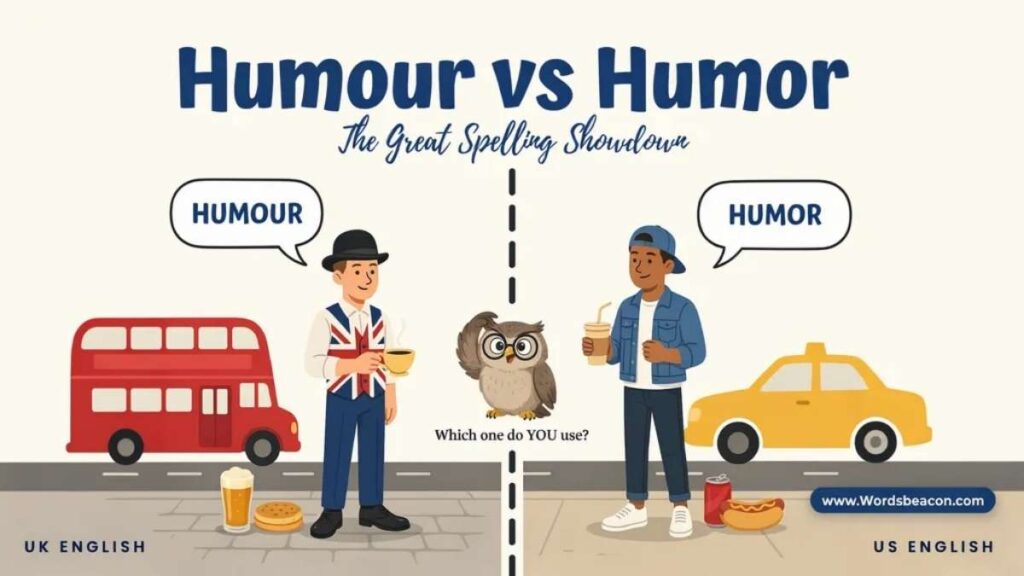
Humor vs humour which spelling is correct? If that little “u” has ever made you stop and wonder, there’s an easy answer: both spellings are correct. The difference is simply based on the type of English you’re using. American English uses “humor,” while British English uses “humour.” They have the same meaning and are used in the same way. In this guide, you’ll see the difference between humor and humour, understand why both spellings exist, and learn which one to use in different situations. With a few simple examples, this small spelling mystery will be much easier to handle. No grammar headache required!
Quick Answer
Both humor and humour are correct spellings.
American English normally uses humor, while British English normally uses humour. The meaning doesn’t change simply because the spelling does.
For example, an American writer might say, “She has a great sense of humor.” A British writer would normally write, “She has a great sense of humour.”
Both sentences mean exactly the same thing.
The difference is similar to other regional spelling differences in English. American English uses color, favor, honor, and behavior, while British English generally uses colour, favour, honour, and behaviour.
This is why neither spelling should automatically be labeled wrong. The correct choice depends on the English variety you’re following.
Humor vs Humour the Difference?
The difference between humor and humour is mainly a matter of spelling.
American English writes the word as humor. British English writes it as humour. The pronunciation and basic meaning remain essentially the same.
This means humor vs humour isn’t really a vocabulary question. It’s a spelling question.
Consider these two sentences:
“She has a wonderful sense of humor.”
“She has a wonderful sense of humour.”
There is no meaningful difference in what the sentences communicate. The first follows American English spelling, while the second follows British English spelling.
The same pattern appears in many English words. American English often uses shorter forms such as color, favor, and honor, while British English keeps the traditional u in colour, favour, and honour.
These are examples of regional spelling differences rather than differences in grammar or meaning.
What Does Humor or Humour Mean?
The humor definition and humour definition are essentially the same.
Humor or humour can describe something that is funny or amusing. It can also describe a person’s ability to recognize and appreciate funny situations, jokes, or ideas. In other contexts, it refers to a particular style of comedy or a quality that makes something entertaining.
For example, someone might say, “The movie is full of humor.” Another person might write, “The movie is full of humour.”
Both sentences describe the movie as containing amusing or funny elements.
The word can also describe someone’s personality. When you say that someone has a good sense of humor or a good sense of humour, you’re usually talking about their ability to see, appreciate, or create funny moments.
Humor is also connected with words such as comedy, wit, amusement, laughter, and entertainment. However, these words aren’t always interchangeable.
For instance, wit often suggests cleverness, especially in speech or writing. Comedy usually refers to a type of entertainment designed to make people laugh. Amusement describes the feeling of being entertained.
Humor is broader. It can exist in a joke, a conversation, a person’s personality, a story, a movie, or even a serious situation.
The word also has an older historical meaning. In traditional medicine, the four humors referred to bodily fluids that ancient physicians believed influenced health and temperament. That meaning appears mainly in historical or literary contexts today.
Why Are There Two Spellings of Humor?
The story behind the humor or humour spelling goes back much further than modern American and British English.
The English word developed through French and Latin influences. Over time, English spelling changed in different ways, and regional varieties began developing their own conventions.
British English generally retained the -our ending in several words. American English increasingly favored shorter -or forms.
That’s why American English has humor, color, favor, honor, and labor, while British English generally uses humour, colour, favour, honour, and labour.
The change wasn’t about creating different meanings. It was simply part of the development of different English spelling systems.
This distinction matters because people sometimes describe American spelling as “incorrect British spelling” or British spelling as “old-fashioned American spelling.” Neither description is accurate.
Both systems are established forms of standard English.
Learn the difference between confusing more English words
Naive vs Nieve difference and usage?
American English Humor vs British English Humour

The clearest way to understand humor vs humour is to look at how each variety of English uses the word.
In American English, humor is the standard spelling. An American writer would normally write, “His sense of humor made everyone laugh.”
In British English, humour is the standard spelling. A British writer would normally write, “His sense of humour made everyone laugh.”
The meaning doesn’t change.
The same applies when the word describes a style of comedy. An American publication might refer to dark humor, dry humor, or political humor. A British publication would generally use dark humour, dry humour, or political humour.
This difference can also appear in related words, although the spelling pattern isn’t always as simple as adding or removing a u.
For example, American English commonly uses humored and humoring, while British English generally uses humoured and humouring.
The adjective humorous, however, keeps its standard spelling in both varieties. Humourous isn’t the normal British equivalent.
Humor vs Humour Meaning Does the Meaning Change?
The humour vs humor meaning remains the same in ordinary modern English.
Likewise, the humor vs humour meaning doesn’t change according to the spelling.
Imagine an American writer saying, “I enjoy his humor,” while a British writer says, “I enjoy his humour.” Both speakers are talking about the same quality.
The difference affects spelling rather than meaning.
This is an important point for English learners because two different spellings can sometimes suggest two different words. That isn’t what happens here.
Humor and humour are spelling variants of the same word.
The same meaning can refer to a person’s ability to make people laugh, their appreciation of comedy, the funny quality of something, or a particular comedic style.
The context determines the exact sense, but the spelling doesn’t.
Humor or Humour Meaning and Examples
Examples make the difference much easier to see because the sentence itself remains almost completely unchanged.
In American English, you might write:
“She has a great sense of humor.”
In British English:
“She has a great sense of humour.”
The meaning is identical.
Another example involves comedy:
“The movie relies on dark humor.”
British English would normally write:
“The movie relies on dark humour.”
Again, nothing changes except the spelling.
The same thing happens in everyday conversation:
“I like your humor.”
“I like your humour.”
Both sentences compliment the person’s ability to be funny or their particular comedic style.
This is why looking at humour vs humor examples can be more useful than memorizing a complicated rule. Once you see the pattern, the distinction becomes quite straightforward.
Sense of Humor vs Sense of Humour
The phrase sense of humor is extremely common in American English, while sense of humour is standard in British English.
The sense of humor meaning refers to someone’s ability to recognize, appreciate, or create things that are funny.
A person with a good sense of humor doesn’t necessarily tell jokes all day. They might simply notice funny details that other people miss. They might enjoy clever wordplay, laugh at absurd situations, or know how to lighten a tense conversation without taking things too far.
For example:
“She has a great sense of humor.”
This tells the reader something about her personality and how she responds to funny situations.
The British version is:
“She has a great sense of humour.”
The meaning remains the same.
Humor can also vary from person to person. Someone may prefer dry humor, while another person enjoys slapstick comedy. One person might appreciate sarcasm, while another prefers gentle jokes.
So, having a sense of humor doesn’t mean everyone finds the same things funny.
“I Like Your Humor” or “I Like Your Humour”?
Both versions are correct.
For example, “I like your humor” follows American English spelling, while “I like your humour” follows British English spelling. Therefore, the choice depends mainly on which variety of English you are using.
The phrase “I like your humor” is usually a compliment. In other words, it tells someone that you enjoy their jokes, comedic style, or the way they find amusing things in everyday situations. So, whether you use humor or humour, the meaning remains the same.
For example, imagine two coworkers dealing with a stressful meeting. One makes a clever comment that breaks the tension. Afterward, someone might say, “I like your humor.”
A British speaker could say, “I like your humour.”
The intended message is the same.
This is also why searches such as I like your humor or humour don’t have two different answers. The choice depends on regional spelling rather than meaning.
Fix common more word mistakes in English
Finaly vs Finally difference and usage?
Humor vs Humour Examples in Everyday Writing
The easiest way to compare the two forms is to place them side by side.
| American English | British English |
|---|---|
| She has a great sense of humor. | She has a great sense of humour. |
| His humor is very dry. | His humour is very dry. |
| The film uses dark humor. | The film uses dark humour. |
| I appreciate your humor. | I appreciate your humour. |
| The book adds humor to a serious subject. | The book adds humour to a serious subject. |
| Her humor made everyone comfortable. | Her humour made everyone comfortable. |
Notice how little changes.
The sentence structure stays the same. The grammar stays the same. The meaning stays the same.
Only the regional spelling changes.
Humor vs Humour as a Verb
The word can also function as a verb, and similarly, the regional spelling difference continues in its related forms.
For example, in American English, you might write:
“She humored her younger brother.”
By contrast, in British English, you would write:
“She humoured her younger brother.”
Here, humor does not mean “to be funny.” Instead, as a verb, it can mean going along with someone’s wishes or behavior, often because doing so helps keep the situation pleasant.
The same spelling difference also appears in the present participle. Therefore, American English uses humoring, while British English uses humouring.
For example:
“He was humoring his friend.”
“He was humouring his friend.”
In both cases, the meaning remains the same. Consequently, the extra u only reflects the regional spelling preference, not a difference in meaning.
This is useful to remember because writers sometimes notice the extra u in humour and assume that every related word must follow the same pattern mechanically. However, English does not always work that neatly. Instead, spelling patterns can vary depending on the word, its history, and the variety of English being used.
Humored vs Humoured Difference

The humored vs humoured difference is another example of regional spelling variation.
American English generally uses humored.
British English generally uses humoured.
Both come from the same verb and carry the same meaning.
For example:
“Sarah humored her little brother.”
“Sarah humoured her little brother.”
Both sentences suggest that Sarah went along with her brother’s wishes or tolerated his behavior.
The difference is spelling, not grammar or meaning.
Humoring vs Humouring Difference
The same principle applies to humoring and humouring.
American English uses humoring.
British English uses humouring.
British spelling retains the u, while American spelling drops it.
For example:
“He was humoring his friend.”
“He was humouring his friend.”
Neither version is grammatically superior. The appropriate form depends on the English variety being used.
Fix common more word mistakes in English
Carmel vs Caramel difference and usage?
Humorous vs Humourous Which Is Correct?
This is where English throws in a small curveball.
The correct spelling is humorous in both American and British English.
Humourous is generally considered a misspelling.
So, even though British English writes humour, it doesn’t normally change humorous into humourous.
That means you should write:
“Her speech was humorous.”
You shouldn’t write:
“Her speech was humourous.”
The spelling doesn’t follow a simple “add u everywhere” rule.
A useful comparison looks like this:
| American English | British English |
|---|---|
| humor | humour |
| humorous | humorous |
| humorist | humourist |
| humorless | humourless |
| humored | humoured |
| humoring | humouring |
This small table highlights an important lesson: regional spelling patterns affect related words differently.
Humor vs Humour Pronunciation
The humour pronunciation and humor pronunciation are very similar.
The extra u in humour doesn’t create an additional syllable. The word isn’t pronounced as though every letter receives its own separate sound.
British and American speakers can have slightly different vowel or ending sounds because their accents differ, but the spelling difference itself isn’t responsible for a major change in pronunciation.
For English learners, the main point is simple: don’t treat the u in humour as a separate syllable.
This is another reason why humor vs humour is primarily a spelling issue.
Is Humor American or British?
If you’re asking, is humor American or British, the clearest answer is that humor is the standard American spelling.
British English normally uses humour.
However, British readers are familiar with humor because American English appears everywhere in international media, books, websites, movies, software, and online communication.
The same thing happens in reverse. American readers regularly encounter humour when reading British publications or material from other English-speaking regions.
English is a global language, so regional forms often cross borders.
Seeing humor in a British publication doesn’t necessarily mean the writer doesn’t know British spelling. The publication may have adopted American English, quoted an American source, or used a particular editorial style.
Context matters.
Is Humour British Spelling?
Yes, humour is the standard British spelling.
The word is commonly used in British English in phrases such as sense of humour, dry humour, dark humour, and British humour.
Other English varieties also use humour. Canadian English, for example, commonly retains many British-style spellings, although Canadian spelling has its own conventions and isn’t simply identical to British English.
This is why it’s better to think of British spelling as one major regional system rather than assuming every English-speaking country follows exactly the same rules.
Learn the difference between tricky more English words
Inquire vs Enquire difference and Usage?
American Spelling of Humor vs British Spelling of Humour
The American spelling of humor and the British spelling of humour fit into a wider pattern of American vs British spelling.
| American spelling | British spelling |
|---|---|
| humor | humour |
| color | colour |
| favor | favour |
| honor | honour |
| behavior | behaviour |
| neighbor | neighbour |
| labor | labour |
The pattern is easy to notice. American English often removes the u from these forms, while British English retains it.
Still, don’t turn this observation into a universal spelling rule. English has plenty of exceptions and historical quirks.
Language isn’t a spreadsheet, unfortunately. It doesn’t always follow the cleanest pattern.
Why Consistency Matters in Your Writing
Once you know the difference, the most important thing is consistency.
Suppose you’re writing an American English article and use color, favorite, and behavior throughout the text. Suddenly writing humour in the middle of the article creates a small mismatch.
The word won’t become incomprehensible. It simply doesn’t match the spelling style of the rest of the writing.
The same problem can happen in British English.
A British article might consistently use colour, favourite, and behaviour. Dropping in humor can make the text look as though two different spelling systems have been mixed together.
For professional writing, consistency gives your work a more polished appearance.
This matters especially in academic papers, websites, business documents, marketing materials, school assignments, reports, and published content.
The goal isn’t to prove that one spelling is better. The goal is to choose the spelling that fits your audience and maintain that choice.
Learn the difference between tricky more English words
Eyeing vs Eying difference and usage?
A Simple Case Study One Sentence, Two English Varieties
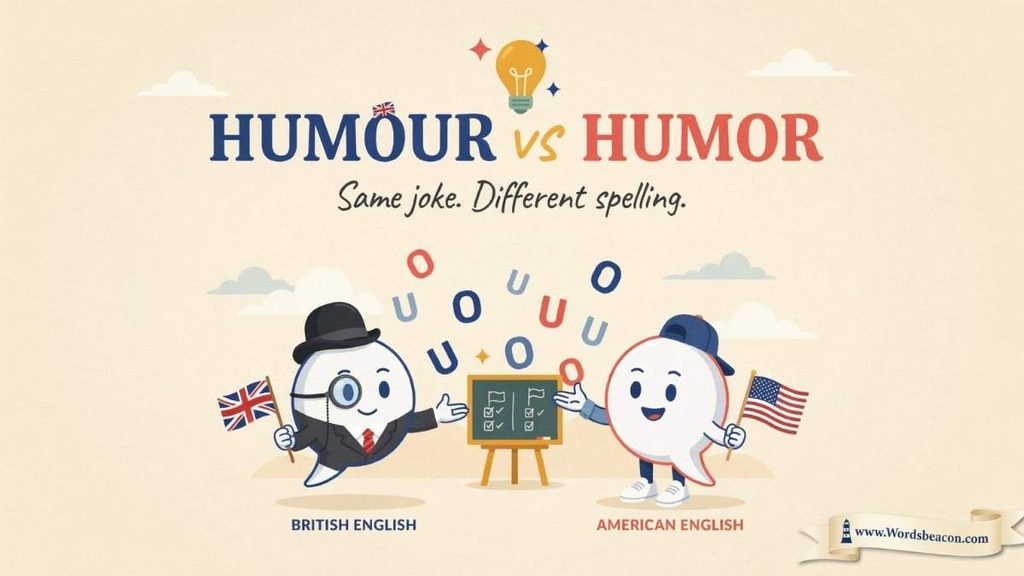
Consider this sentence:
“Her sense of humor made the difficult meeting easier.”
This sentence fits American English.
The British version is:
“Her sense of humour made the difficult meeting easier.”
Nothing else needs to change.
The grammar remains identical. The meaning remains identical. The sentence sounds natural in both varieties.
This small example captures the entire difference between humor and humour.
If you understand why these two sentences are both correct, you already understand the central rule.
Common Mistakes With Humor and Humour
One common mistake is assuming that one spelling must be correct everywhere. English doesn’t work that way. A spelling can be standard in one regional variety and less common in another.
Another mistake is assuming that humor and humour have different meanings. In modern everyday English, they normally don’t.
Some writers also spell humorous as humourous because they assume the British spelling of humour must carry into every related word. That’s incorrect. Humorous is the standard spelling.
Another problem occurs when writers mix American and British spelling throughout the same piece without a clear reason. A mixed style can distract readers, particularly in formal writing.
Finally, some learners think the extra u in humour should affect pronunciation. It doesn’t create an additional syllable.
When Should You Use “Humor”?
Use humor when you’re writing in American English.
This is the natural choice for writing intended primarily for readers in the United States or for publications that follow American English spelling.
For example:
“She has a great sense of humor.”
“The comedian is known for his sharp humor.”
“The novel combines suspense with dark humor.”
If the rest of your writing follows American spelling, humor will normally be the right choice.
When Should You Use “Humour”?
Use humour when you’re following British English spelling.
For example:
“She has a great sense of humour.”
“The comedian is known for his sharp humour.”
“The novel combines suspense with dark humour.”
The word works in exactly the same grammatical situations as humor.
The only major difference is the spelling convention.
Practice Session Humor vs Humour
Fill in each blank with the correct word: humor vs humour.
- She has a great sense of __________ and always makes everyone laugh.
- His dry __________ makes his stories even more entertaining.
- The comedian used clever __________ to connect with the audience.
- I really like your __________; you always know how to make me smile.
- Her British __________ is often subtle and sarcastic.
- American comedy often uses a different style of __________.
- He has a wonderful sense of __________ and never takes himself too seriously.
- The writer added some light __________ to the article.
- His __________ helped make the difficult situation easier to handle.
- She is known for her sharp sense of __________.
- The movie combines drama with plenty of __________.
- His friendly __________ made everyone feel comfortable.
- The speaker used __________ to keep the audience interested.
- Her clever __________ made the conversation more enjoyable.
- The article contains a little __________ to make the topic less serious.
- He used __________ to explain the complicated idea in a fun way.
- Her sense of __________ makes her excellent company.
- The comedian’s __________ was appreciated by the audience.
- The British newspaper is known for its witty __________.
- His __________ helped him deal with stressful situations.
- The teacher used __________ to make the lesson more engaging.
- She has a unique style of __________ that people remember.
- The American writer prefers the spelling __________.
- The British writer prefers the spelling __________.
- Both “humor” and “humour” have the same meaning, but the spelling depends on the variety of English. In American English, the correct spelling is __________.
Answers
- humor
- humor
- humor
- humor
- humour
- humor
- humor
- humor
- humor
- humor
- humor
- humor
- humor
- humor
- humor
- humor
- humor
- humor
- humour
- humor
- humor
- humour
- humor
- humour
- humor
Here’s a trusted source for clear more words Comparison:
FAQs
Which one is correct, humor vs humour?
Both “humor” and “humour” are correct. “Humor” is the standard spelling in American English, while “humour” is the standard spelling in British English and other varieties that follow British spelling conventions.
What is the difference between humor and humour?
The difference is spelling, not meaning. “Humor” is used in American English, while “humour” is used in British English. Both words refer to something funny or amusing, or to the ability to recognize and appreciate what is funny.
Is humor American or British spelling?
“Humor” is the American English spelling. For example, American English uses the phrase “sense of humor,” while British English generally uses “sense of humour.”
Is humour British spelling?
Yes. “Humour” is the standard British English spelling. It’s also used in several other varieties of English that follow British spelling conventions.
What does humor vs humour mean?
“Humor” or “humour” refers to the quality of being funny or amusing. It can also describe someone’s ability to recognize and appreciate jokes, comedy, wit, or amusing situations.
How do you spell humor in American English?
In American English, the word is spelled “humor,” without the letter “u.”
How do you spell humour in British English?
In British English, the word is spelled “humour,” with a “u” before the final “r.”
Do humor and humour have the same meaning?
Yes. “Humor” and “humour” have the same meaning. They’re simply different regional spellings of the same word.
What is a sense of humor or sense of humour?
A sense of humor or sense of humour is the ability to recognize, appreciate, or create things that are funny or amusing. The meaning remains the same in both American and British English.
Is “I like your humor” correct?
Yes. “I like your humor” is correct in American English. In British English, the usual spelling is “I like your humour.” Both sentences express the same idea: you appreciate someone’s ability to be funny or amusing.
What does “humor me” mean?
“Humor me” means to go along with someone’s request or idea, even if you don’t completely agree with it. For example, “Humor me and give it another try” means “Please do this for me, even if you’re not convinced.”
What is the verb form of humor vs humour?
“Humor” is the verb form used in American English, while “humour” is used in British English. As a verb, it means to accommodate someone or go along with their wishes or ideas.
What is the difference between humored and humoured?
“Humored” is the American English spelling, while “humoured” is the British English spelling. Both are past-tense forms of “humor” or “humour” when the word is used as a verb.
What is the difference between humoring and humouring?
“Humoring” is the American English spelling, while “humouring” is the British English spelling. Both forms describe the act of accommodating someone or going along with their wishes.
Is “humorous” or “humourous” correct?
“Humorous” is the correct standard spelling in both American and British English. “Humourous” is generally considered an incorrect spelling. “Humorous” means funny, amusing, or entertaining.
How do you pronounce humor?
“Humor” is normally pronounced with two syllables. Its pronunciation is essentially the same as “humour,” although the exact sound can vary slightly depending on the speaker’s accent.
How do you pronounce humour?
“Humour” is generally pronounced the same way as “humor.” The spelling changes between American and British English, but the pronunciation is usually very similar.
Can I use humor in British English?
Yes, British readers will understand “humor,” but “humour” is the standard British spelling. If you’re writing specifically for a British audience, using “humour” will keep your spelling consistent with British English.
Can I use humour in American English?
Yes, American readers will understand “humour,” but “humor” is the standard American spelling. For American English writing, “humor” is the more appropriate choice.
Which should I use, humor or humour?
Use “humor” when writing in American English and “humour” when writing in British English. Neither spelling is more correct than the other. The best choice depends on the variety of English you’re using.
Conclusion
At the end of the day, the choice between Humor vs Humour is much simpler than it first appears. Both are correct. They have the same meaning, the same role in a sentence, and nearly the same pronunciation. The only difference is which variety of English you’re using.
If you’re writing in American English, use “humor.” If you’re following British English, use “humour.” The same pattern applies to related forms: Americans write “humored” and “humoring,” while British English uses “humoured” and “humouring.”
There’s no need to wonder whether one spelling is somehow more proper than the other. The extra “u” isn’t a grammar mistake, and leaving it out isn’t one either. It’s simply a regional spelling difference.
One small trap is worth remembering: “humorous” is correct in both American and British English. So, don’t add an extra “u” and turn it into “humourous.”
In short, choose “humor” for American English and “humour” for British English. Keep your spelling consistent throughout your writing, and you’ll have one less thing to worry about. After all, grammar has plenty of serious rules. This one is just having a little fun.

Luna AJS is an experienced blogger and dedicated language enthusiast at Words Beacon. She specializes in making English grammar, spelling, vocabulary and commonly confused words easy to understand. She provides clear explanations, practical examples to help readers write with confidence.