

English loves creating spelling traps, and Weiner vs Wiener is a perfect example. Change one vowel, and suddenly a simple word choice can make you stop and wonder which spelling belongs on the page. Wiener is the standard spelling for a type of sausage or hot dog, while Weiner commonly appears as a surname. Since both spellings look and sound similar, it’s easy to mix them up. The good news? The difference is simple once you consider the context. This guide explains the meaning, spelling, pronunciation, origins, and common uses of Weiner and Wiener, so you can choose the right word without second-guessing every letter.
quick answer
| Word | Meaning | Common Use | Example |
|---|---|---|---|
| Wiener | A type of sausage or hot dog | Food, informal expressions | I ordered a grilled wiener. |
| Weiner | Mainly a surname | People’s names | Sarah Weiner joined the meeting. |
The key difference is simple: wiener usually refers to a sausage or hot dog, while Weiner commonly appears as a surname. Context makes the spelling easy to choose.
Fix common more word mistakes in English
Flakey vs Flaky which one is correct ?
Weiner vs Wiener The Simple Difference
Wiener is the standard spelling when you mean a type of sausage, a hot dog, or the related informal slang term. The word comes from German Wiener, meaning “of Vienna,” combined with Wurst, meaning “sausage.”
Weiner is primarily used as a surname. It has several documented surname origins, including German and Ashkenazic Jewish origins. It can also appear as a spelling variant of Wiener in some family-name histories.
Therefore, if you are ordering food, write Wiener. If you are writing someone’s last name, use the spelling that person actually uses.
That simple rule solves most cases of Weiner vs. Wiener.
What Does Wiener Mean?
Wiener is an English noun that originally refers to a sausage associated with Vienna. In American English, people commonly use Wiener for a frankfurter or hot dog sausage.
The word comes from German Wiener, which means “of Vienna” or “Viennese.” German speakers use Wien for Vienna, so Wiener literally carries the idea of something connected with Vienna.
The word entered American English through Wienerwurst, a German term for a Vienna-style sausage. Over time, English speakers shortened the expression to Wiener.
For example:
I ordered a grilled Wiener at the baseball game.
The restaurant serves smoked Wiener sausages.
He put a Wiener on the grill.
In everyday American English, you may also hear Wiener used as a humorous or informal term for a hot dog. The meaning usually becomes obvious from the surrounding sentence.
For instance, someone might say, “Let’s grill some Wieners,” and everyone understands that the speaker means sausages or hot dogs.
Learn the difference between confusing word pairs
Premier vs Premiere which one is correct ?
Wiener Meaning and Origin
The history of Wiener explains why the word uses ie rather than ei.
Wiener comes from German Wiener, meaning “of Vienna,” and Wurst, meaning “sausage.” The shorter English form Wiener became established around the beginning of the twentieth century.
Interestingly, the German name for Vienna is Wien. That connection gives you a useful memory clue:
Wien → Wiener → Vienna-related sausage.
The word has a long history in English, too. Etymological records date the English noun Wiener to around 1900, while Wienerwurst appeared earlier in American English.
So, the spelling is not random. The ie spelling connects the word with its German origin and the German name Wien for Vienna.
What Does Weiner Mean?
Weiner has a different story.
Most commonly, Weiner appears as a surname or family name. Therefore, if you meet someone named Weiner, you should not automatically assume that person has misspelled Wiener.
For example:
Sarah Weiner joined the company last year.
Mr. Weiner teaches history.
The Weiner family moved to the city decades ago.
In these sentences, Weiner functions as a proper name. You should preserve the spelling exactly as the person or family uses it.
Surname research records several possible origins for Weiner. These include a German occupational surname connected with a cartwright, a Central German form related to Wagner, an altered form of German Wiener, and an Ashkenazic Jewish occupational surname connected with a wine merchant or keeper of a wine shop.
Consequently, Weiner does not have just one simple historical explanation.
That distinction matters because people sometimes see Weiner and immediately label it a misspelling. However, that assumption can create another mistake. A family name has its own spelling history, and names do not always follow the spelling rules that apply to ordinary English words.
Weiner vs Wiener Meaning
The easiest way to understand the Weiner vs. Wiener meaning difference is to look at context.
Wiener usually refers to a sausage, hot dog, a related informal term, or a surname.
Weiner most commonly appears as a surname, although surname histories can connect it with Wiener and other German or Jewish name traditions.
In other words, the two spellings overlap in some name histories, but they do not function as interchangeable spellings in ordinary English.
If you write, “I ate a Weiner,” readers may understand what you mean. However, Wiener is the standard spelling for the sausage.
On the other hand, if a person’s family name is Weiner, changing it to Wiener would create a different spelling of that person’s name.
That is why context matters so much.
Wiener vs Weiner Main Difference
The central difference is spelling, meaning, and usage.
Wiener is the standard English word for the sausage or hot dog sausage. Weiner is primarily a surname.
The difference may look tiny on the page, yet it can matter greatly in writing.
Consider these examples:
Weiner is a family name.
Wiener is a sausage.
The restaurant sells Wiener sausages.
Dr. Weiner gave a speech.
The first two examples show the basic distinction. Meanwhile, the last two demonstrate why context tells you which spelling belongs in a sentence.
So, if you are asking, “Weiner or Wiener?” first ask yourself what you are naming.
If you are naming food, Wiener is normally the correct spelling.
If you are naming a person, check the person’s actual surname.
Learn the difference between confusing word pairs
Attornies vs Attorneys difference and usage ?
Weiner vs Wiener Spelling Which One Is Correct?
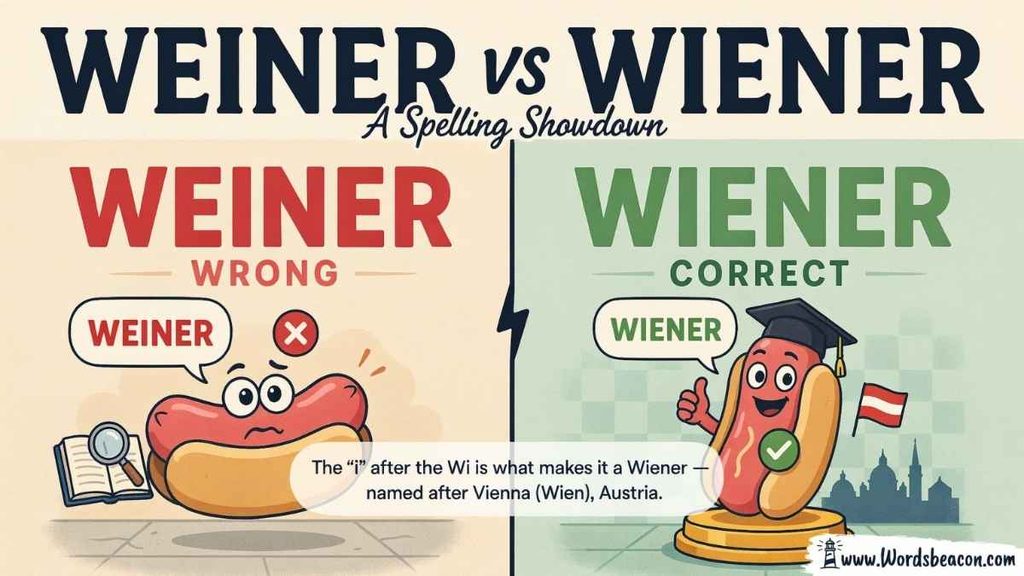
Both spellings can be correct, but they are correct in different situations.
Wiener is the standard spelling for the common noun referring to a type of sausage. It also appears in informal expressions and as a surname.
Weiner is a legitimate surname. Therefore, calling every use of Weiner a spelling mistake would be inaccurate.
For example, this sentence uses the standard food spelling:
We grilled several Wieners for the family picnic.
However, this sentence correctly uses Weiner as a surname:
Professor Weiner published a new book.
Changing Weiner to Wiener in the second sentence would alter the person’s name.
Similarly, changing Wiener to Weiner in the first sentence would make the food spelling nonstandard.
So, the correct spelling depends on what you mean.
Is Weiner a Misspelling of Wiener?
Not necessarily.
If someone writes Weiner when referring to a sausage, the spelling is generally considered a misspelling of Wiener.
For example:
Incorrect for the sausage: Weiner
Standard spelling: Wiener
However, if Weiner appears as a person’s surname, it is not a misspelling simply because it looks like Wiener.
That difference often causes the confusion in the first place.
English has many words that resemble names, and names can have historical spellings that differ from ordinary vocabulary. Therefore, you cannot judge a surname only by comparing it with a similar-looking dictionary word.
Learn the difference between confusing word pairs
Bear vs Bare Difference and usage ?
Why Do People Confuse Weiner and Wiener?
The confusion comes from the tiny difference between ie and ei.
Wiener contains ie.
Weiner contains ei.
When people pronounce the two words, the difference may not always stand out clearly. In addition, English spelling does not always give learners a reliable clue about pronunciation.
There is another reason for the confusion. Wiener and Weiner can both appear as surnames.
As a result, someone may see a person’s name and assume it should match the spelling of the food word. However, surnames can develop independently over generations.
Furthermore, people often type quickly. A single vowel swap can turn Wiener into Weiner without the writer noticing.
That small spelling error becomes especially easy to make because both forms look familiar.
Why Is Wiener Spelled With IE?
The spelling Wiener reflects its German origin.
In German, Wien means Vienna. Wiener means “of Vienna” or “Viennese.” The English food word comes from this German form.
The word also connects with Wienerwurst, which combines Wiener with Wurst, meaning sausage.
Therefore, the spelling has a logical historical connection:
Wien → Wiener → Wienerwurst → Wiener
Once you understand that chain, the spelling becomes easier to remember.
You do not have to memorize the word as a random combination of letters. Instead, connect Wiener with Wien, the German name for Vienna.
Wiener Spelling How Do You Spell It?
The standard spelling is Wiener.
It contains ie:
W-I-E-N-E-R
A useful memory trick is to connect Wiener with Wien.
Wien is the German name for Vienna, and Wiener means something associated with Vienna.
Therefore:
Wien → Wiener
If you are writing about a sausage or hot dog, Wiener is the spelling you want.
Weiner Spelling How Do You Spell It?
Weiner is spelled:
W-E-I-N-E-R
The important point is that Weiner usually appears as a surname.
For example:
David Weiner
Rachel Weiner
The Weiner family
When you write someone’s name, spelling accuracy matters. Therefore, do not “correct” Weiner to Wiener simply because Wiener is the standard food spelling.
A person’s surname belongs to that person. Use the documented spelling.
Wiener Pronunciation
In American English, Wiener is commonly pronounced something like “WEE-ner.”
The first part sounds like “wee,” followed by a short “ner” sound.
You may hear slight pronunciation differences depending on the speaker, region, or context. However, the common English pronunciation remains easy to recognize.
For example:
Wiener → WEE-ner
The German pronunciation can differ from the English pronunciation, so English speakers should not assume that every speaker uses exactly the same sound pattern.
Weiner Pronunciation
Weiner is also commonly pronounced like “WEE-ner” in English.
That similarity creates another layer of confusion.
In other words, the spelling difference between Wiener and Weiner may be much easier to see than to hear.
That is why context becomes important. If someone says, “Mr. Weiner,” you need the spelling of the surname to know which form they use.
Likewise, if someone says, “I want a Wiener,” the food context makes the intended word clear.
Learn the difference between similar English words
Aid vs Aide which one is correct?
Wiener Hot Dog Is That the Correct Spelling?
Yes. Wiener is the standard spelling when you mean the sausage associated with the term Wiener or Wienerwurst.
You may see several related words for similar foods, including frankfurter, hot dog, and wiener. These words have overlapping meanings in American English, although regional usage and food traditions can create differences.
For example:
We cooked Wieners over the fire.
The children wanted hot dogs.
The menu includes grilled frankfurters.
All three sentences can describe familiar sausage-style foods, but the terms have different histories.
The important spelling point remains simple: Wiener is the standard form when you use the word wiener for this type of sausage.
Weiner Hot Dog Is It Correct?
If you mean the food, Weiner is generally not the standard spelling.
For example:
We grilled five Weiner dogs.
This sentence uses the nonstandard spelling for the food.
A better version is:
We grilled five Wiener dogs.
However, there is one important exception. If a restaurant, business, person, or brand deliberately uses Weiner as part of its proper name, keep that exact spelling.
Proper names follow their own spelling.
Wiener Dog vs Weiner Dog?
Wiener dog is the standard spelling of the informal nickname for a dachshund.
The nickname comes from the dog’s long, low body shape, which people compare humorously with a sausage.
For example:
My neighbor has a playful Wiener dog.
The children love the little Wiener dog.
You may occasionally see weiner dog online, especially in casual writing or as a typo. However, Wiener dog is the standard spelling when you mean the nickname.
The formal breed name is dachshund, so you can always use that if you want to avoid the informal term altogether.
Is Wiener a Surname?
Yes. Wiener can also function as a surname.
Surname research describes Wiener as a German and Ashkenazic Jewish habitational name associated with someone from Vienna, Austria.
Therefore, Wiener does not belong exclusively to the world of sausages.
For example:
Anna Wiener moved to the United States.
Mr. Wiener teaches mathematics.
The Wiener family lived in the area for generations.
In each case, Wiener works as a proper noun because it identifies a person or family.
So, context once again decides the meaning.
Is Weiner a Surname?
Yes. Weiner is an established surname with several documented origins.
Surname sources connect Weiner with German occupational naming traditions, an altered form of Wiener, and an Ashkenazic Jewish occupational name associated with a wine merchant or wine shop.
Because of these different origins, you should not assume that every Weiner family has the same historical background.
That point also explains why Weiner can appear as a genuine family name rather than simply a misspelling.
Learn the difference between similar English words
Steer vs Stear which one is correct?
Wiener Surname vs Weiner Surname

Both Wiener and Weiner can function as surnames, but their histories are not necessarily identical.
Wiener can indicate a connection with Vienna. The German word Wien means Vienna, so Wiener can describe someone from Vienna or someone associated with the city.
Weiner has several possible origins. Some connect it with German occupational naming, while others connect it with an altered form of Wiener or with the Yiddish word for a wine merchant.
Therefore, you should treat each surname as its own name rather than assuming one spelling represents an error.
This distinction becomes especially important when writing names in professional, academic, historical, or legal contexts.
Common Weiner vs Wiener Mistakes
One common mistake happens when writers use Weiner for the food.
For example:
We cooked several Weiner sausages.
The standard spelling is:
We cooked several Wiener sausages.
Another mistake happens when writers change someone’s surname without checking it.
For example, suppose a professor’s surname is Weiner. Writing Wiener because you think the name looks like the food word would be incorrect.
The same rule works in reverse. If someone’s surname is Wiener, changing it to Weiner would also create an incorrect name.
So, before correcting either spelling, look at the context.
Food usually points to Wiener.
A person’s name requires the person’s actual spelling.
Learn the difference between similar English words
High School vs Highschool Which one Is Correct?
Weiner vs Wiener in Formal Writing
Formal writing requires extra care because spelling errors can affect names, meanings, and credibility.
If you are writing an academic paper, article, report, email, or business document, use Wiener for the food term.
At the same time, preserve Weiner when it appears as a surname.
For example:
The researchers interviewed Professor Weiner.
The researchers served Wiener sausages at the event.
These sentences use both spellings correctly.
Notice how one small letter changes the function of the word. The first identifies a person. The second identifies food.
Therefore, context should guide your spelling choice instead of a general spelling rule.
Real-Life Examples of Wiener
Wiener can appear in several everyday contexts.
The children ate grilled Wieners at the picnic.
The store sells several types of Wiener sausages.
He ordered a Wiener with mustard.
The menu includes a traditional Wiener.
The family prepared Wieners for the barbecue.
In each example, Wiener refers to food.
The word can also appear in informal or humorous language. However, slang can sound crude depending on the audience, so formal writing should use the word carefully.
Real-Life Examples of Weiner
Weiner most often appears in names.
Dr. Weiner spoke at the conference.
Lisa Weiner wrote the article.
The Weiner family opened a small business.
Mr. Weiner joined the committee.
The researchers interviewed Weiner about the project.
Here, Weiner functions as a surname rather than a food word.
That difference makes the context easy to identify once you know what to look for.
Wiener Slang Meaning
Wiener also has an informal slang meaning.
Because of the shape of the sausage, English speakers have used Wiener as a slang term for the penis. The slang use can also extend to a person in a mildly insulting or humorous way.
For example, someone might jokingly call another person a “wiener” when describing them as foolish or annoying.
However, this usage is informal and can sound childish, rude, or offensive depending on the situation.
Therefore, avoid it in professional or academic writing unless you are discussing the word itself.
The food meaning remains perfectly ordinary, while the slang meaning depends heavily on context.
Weiner Slang Meaning
Weiner does not normally function as the standard spelling of the slang word.
If someone writes Weiner as slang, they may simply have misspelled Wiener or may be using the spelling of a surname.
That distinction matters because a spelling that looks similar does not automatically carry the same dictionary meaning.
When you mean the informal slang term connected with the sausage word, Wiener is the established spelling.
When you mean someone’s family name, use Weiner if that is the person’s actual surname.
A Simple Memory Trick
If you keep mixing up Weiner and Wiener, use one simple connection:
Wiener has Wien inside it.
Wien is the German name for Vienna.
So:
Wien → Wiener → Vienna → sausage
That gives you a clear reason for the ie spelling.
For Weiner, think of a person’s name.
Weiner → surname
Of course, this memory trick does not cover every historical detail, but it works well for everyday English.
When you see the food, think Wiener.
When you see the person’s family name, check the spelling.
Learn the difference between confusing more English words
Treck vs Trek Which one Is Correct?
Weiner vs Wiener Which One Should You Use?
The answer depends on your sentence.
1.If you are talking about a sausage, use Wiener.
2.If you are talking about a hot dog sausage, Wiener works.
3.If you are talking about a dachshund nickname, use Wiener dog.
4.If you are writing a person’s surname, use the spelling that person actually uses.
5.If the surname is Weiner, keep Weiner.
6.If the surname is Wiener, keep Wiener.
This approach prevents the most common mistakes without forcing you to memorize complicated rules.
Weiner vs Wiener for Students
Students often confuse these words because they sound almost identical and differ by only one vowel combination.
The best strategy involves context.
If the sentence describes food, Wiener is probably the correct word.
If the sentence identifies a person, check whether the surname is Weiner or Wiener.
For example:
We grilled a Wiener for lunch.
Professor Weiner teaches English.
These examples make the difference obvious.
Students should also remember that names deserve special attention. A spelling checker may not always understand the intended surname, so do not rely on automatic correction alone.
Learn the difference between confusing more English words
Worshiped vs Worshipped which one is correct ?
A Closer Look at the Word History

The history of Wiener makes the spelling much easier to understand.
The word traces back to German Wiener, meaning “of Vienna,” and connects with Wienerwurst, a Vienna sausage. English shortened the longer expression and eventually used Wiener on its own.
Meanwhile, the city of Vienna has the German name Wien.
That creates a direct historical relationship between the place and the word:
Wien means Vienna.
Wiener means of Vienna.
Wienerwurst means Vienna sausage.
English later used Wiener as a shortened food term.
Therefore, the ie spelling reflects the word’s German background rather than an arbitrary English spelling choice.
Why Names Make the Difference More Complicated
Surnames can develop through migration, regional spelling changes, translation, pronunciation changes, and family traditions.
As a result, two families with similar-looking names may have different spellings and different histories.
For Weiner, surname research identifies multiple possible origins. Some connect the name with German occupational traditions, while another documented origin connects it with an Ashkenazic Jewish occupational term related to a wine merchant.
Wiener also appears as a surname, including as a name associated with someone from Vienna.
Consequently, you should not assume that every Weiner is a misspelled Wiener or that every Wiener is related to the sausage word.
A surname deserves its own context.
Learn the difference between confusing more English words
Ingrained vs Engrained which one is correct?
Practice Session Weiner vs Wiener
Fill in each blank with Weiner vs Wiener.
- We grilled several ________ sausages at the family picnic.
- Professor ________ teaches English at the university.
- A ________ dog is another name for a dachshund.
- The restaurant serves a traditional ________ with mustard.
- Sarah ________ joined the meeting this morning.
- The German word ________ means “of Vienna” or “Viennese.”
- We ordered two ________ dogs for lunch.
- Mr. ________ wrote an interesting article about language.
- The children enjoyed eating grilled ________ at the barbecue.
- The ________ family has lived in the area for many years.
- If you are talking about the sausage, ________ is the standard spelling.
- Dr. ________ gave a lecture on German history.
- The menu includes a smoked ________ sausage.
- My friend has a playful ________ dog.
- ________ is an established surname with several documented origins.
- The word ________ connects with Wien, the German name for Vienna.
- We bought some ________ sausages for the weekend cookout.
- Rachel ________ published a new research paper.
- When writing someone’s last name, use ________ if that is the spelling the person uses.
- If you are unsure whether to write Weiner or Wiener, first consider the ________ of the word in the sentence.
Answers
- Wiener
- Weiner
- Wiener
- Wiener
- Weiner
- Wiener
- Wiener
- Weiner
- Wiener
- Weiner
- Wiener
- Weiner
- Wiener
- Wiener
- Weiner
- Wiener
- Wiener
- Weiner
- Weiner
- context
Here’s a trusted source for clear word meanings:
FAQs
Is Wiener a standard English word?
Yes. Wiener is a standard English word commonly used for a type of sausage, especially a frankfurter or hot dog. The word comes from German Wiener, meaning “Viennese,” referring to Vienna.
Can Weiner be a correct spelling?
Yes, but the context matters. Weiner is a legitimate spelling, especially as a surname. However, when you mean the sausage, wiener is the standard spelling in English.
Why does Wiener have an “ie” instead of “ei”?
Wiener comes from the German word Wiener, which means “Viennese” or “from Vienna.” English kept this spelling when the word entered common usage. Therefore, wiener uses “ie,” while Weiner may appear as a separate surname.
Is Wiener related to the German word for Vienna?
Yes. Vienna is called Wien in German, and Wiener means “of Vienna” or “Viennese.” The connection explains why the word appears in the name of a Vienna-style sausage.
Can Wiener be someone’s last name?
Yes. Wiener can function as a surname. In that case, you should keep the person’s spelling exactly as they use it, including the capital W.
Can Weiner and Wiener have the same surname origin?
They can have overlapping historical connections, but the two surnames do not necessarily share one origin. Weiner has several documented surname origins, while Wiener can also occur as a family name. Therefore, you should consider the specific family or historical record rather than assuming the names mean the same thing.
Is Wiener only used for food?
No. Although Wiener commonly refers to a sausage, the word can also appear in surnames and informal expressions. Its meaning depends on the context.
Does Wiener always mean a hot dog?
Not necessarily. Wiener can refer to a type of sausage, while people also use it informally for a hot dog. In some contexts, it can carry a slang meaning as well.
What is the difference between Wiener and Wienerwurst?
Wiener is the shorter English form commonly used for the sausage. Wienerwurst is a longer German-derived term containing Wurst, the German word for “sausage.” Both terms connect to the idea of a Viennese-style sausage.
Is Wiener a German word or an English word?
Wiener has German roots, but English uses it as an established word. In German, Wiener means “Viennese” or “from Vienna,” while English commonly uses wiener for a type of sausage.
Can you use Wiener in a person’s name?
Yes. If Wiener is part of someone’s legal or professional name, use it exactly as the person spells it. Proper names follow the individual’s established spelling rather than a general spelling rule.
Should you correct Weiner to Wiener in a person’s name?
No. You should not change a person’s surname simply because it resembles the word wiener. If someone’s name is Weiner, keep Weiner. The correct spelling depends on the person’s actual name.
Why do Wiener and Weiner sound so similar?
The two spellings contain the same basic vowel sounds in many English pronunciations, so they can sound nearly identical. That similarity makes the spelling difference easy to miss, especially when you hear the word before seeing it written.
Is “Weiner” acceptable in casual writing for the sausage?
It may appear informally, but wiener remains the standard spelling for the sausage. If you want clear, conventional writing, especially in school, business, or published content, choose wiener.
Does the word Wiener have a slang meaning?
Yes. In informal English, wiener can have slang uses in addition to its food-related meaning. The intended meaning usually becomes clear from the surrounding sentence and tone.
Is Weiner used as a word outside surnames?
Most commonly, Weiner appears as a surname. It can also show up as a spelling variant or misspelling of wiener in informal contexts. However, that does not make Weiner the standard spelling for the sausage.
How can you remember the spelling of Wiener?
A simple memory trick connects wiener with Wien, the German name for Vienna. Think “Wien → Wiener.” For the food, remember: Wiener has “ie.”
What should you write in a formal document: Weiner or Wiener?
Use the spelling that matches your meaning. For the sausage, write wiener. For a person’s surname, copy the person’s actual spelling. Accuracy depends on context, not just the letters.
Does “wiener” need a capital letter?
Usually, no. When wiener refers to the common noun for a sausage, lowercase wiener works. Capitalize it when it appears as part of a proper name or surname, such as Wiener.
What is the easiest way to avoid a Weiner vs. Wiener spelling mistake?
First, identify what you mean. If you are talking about the sausage, use wiener. If you are writing someone’s surname, use that person’s exact spelling. That simple context check eliminates most Weiner vs. Wiener mistakes.
Conclusion
The Weiner vs Wiener confusion becomes much easier once you look at the context. If you mean the sausage, hot dog, or wiener dog, use wiener. If you’re talking about a person’s surname, use the spelling that person actually uses, whether it’s Weiner or Wiener. After all, you wouldn’t want to “fix” someone’s name just because the spelling looks unfamiliar.
Here’s the easiest trick to remember it: wiener connects with Wien, the German name for Vienna. So, when you mean the food, choose wiener. When you mean a person, check the surname. That small difference between “ie” and “ei” can prevent a surprisingly awkward spelling mistake. Once you remember the context, Weiner vs. Wiener is no longer a tricky word puzzle.

Luna AJS is an experienced blogger and dedicated language enthusiast at Words Beacon. She specializes in making English grammar, spelling, vocabulary and commonly confused words easy to understand. She provides clear explanations, practical examples to help readers write with confidence.