

The aid vs aide confusion is easy to make because both words sound the same. However, they have different meanings and jobs in a sentence. Aid means help, support, or something that makes a task easier. Aide means a person who provides that help. For example, financial aid can help you pay for college, while a classroom aide can help students with their work. See the difference? One means help, and the other is the helper. Once you understand this simple rule, you will know when to use aid vs aide without second-guessing yourself. Let’s clear up this common grammar mix-up once and for all.
Quick Answer
The difference between aid and aide is simple.
| Word | What It Means | Example |
|---|---|---|
| Aid | Help, support, or assistance | Financial aid helped her pay for college. |
| Aide | A person who provides help | The classroom aide helped the students. |
Easy reminder: aid is the help; aide is the person who helps.
Aid means help, assistance, support, or something that helps you do something. It can also work as a verb meaning to help or assist. Cambridge Dictionary defines aid as help or support, something that provides help, and a verb meaning “to help.”
Aide means a person whose job involves helping someone. The word often appears in professional, political, government, military, educational, and healthcare settings. Cambridge Dictionary defines an aide as a person whose job is to help someone, particularly someone in an important position.
Compare these two sentences:
The organization provided medical aid.
The doctor’s aide prepared the documents.
In the first sentence, aid means assistance. In the second, aide refers to a person.
The easiest rule to remember is this:
Aid means help.
Aide means a person who helps.
Learn how to use confusing more words correctly
Steer vs Stear which one is correct?
Aid vs Aide Meaning
The aid vs aide meaning becomes much clearer when you focus on what each word represents.
Aid describes help, support, assistance, or something that makes a task easier. It can refer to money, medical supplies, equipment, information, or other forms of assistance. It can also describe the action of helping when you use it as a verb.
Aide describes a person who assists someone else. An aide may work in a classroom, office, hospital, government department, political organization, or another professional setting.
This gives you the basic difference between aid and aide:
| Word | Meaning | Part of speech | Example |
|---|---|---|---|
| Aid | Help, support, or something that helps | Noun and verb | The charity provided medical aid. |
| Aide | A person who assists | Noun | The senator’s aide answered the phone. |
So, when you ask what is the difference between aid and aide, think about whether you mean help or the person providing that help.
Fix common more word mistakes in English
High School vs Highschool Which one Is Correct?
What Is Aid?
Aid means help, support, or assistance. It can also describe something that helps you complete a task.
The word appears in many areas of everyday life. You might receive financial aid to pay for education, use a hearing aid to improve hearing, give first aid after an injury, or use a visual aid during a presentation.
For example:
The charity provided emergency aid to the community.
The teacher used a chart as a visual aid.
The treatment may aid recovery.
The word stays the same, but its grammatical role changes depending on the sentence.
Aid as a Noun
When aid works as a noun, it refers to help, support, assistance, or something that provides help.
This use appears in familiar expressions such as financial aid, foreign aid, humanitarian aid, medical aid, emergency aid, first aid, hearing aid, and visual aid.
Cambridge Dictionary also describes aid as a piece of equipment that helps someone do something. Teaching aids, for example, can include books and videos.
Consider these examples:
The student received financial aid.
The injured man needed medical aid.
The teacher prepared several visual aids for the lesson.
The rescue team delivered emergency aid.
In each sentence, aid refers to assistance or something that provides assistance.
That is why aid can describe both an idea and a physical object. A hearing aid is a device that helps with hearing. A visual aid is something that helps people understand information.
Aid as a Verb
Aid can also function as a verb. In this form, it means to help or assist.
For example:
The treatment may aid recovery.
The new technology aids communication.
Volunteers aided the rescue effort.
The government program aims to aid families in need.
This use is slightly more formal than the everyday verb help. In casual conversation, people often say help. In formal, academic, medical, business, or professional writing, aid can sound natural when the context calls for it.
The important point is that aid can describe an act of helping. Aide cannot normally perform this grammatical role.
Fix common more word mistakes in English
Treck vs Trek Which one Is Correct?
What Is Aide?
Aide means a person who helps or assists someone.
The word often describes someone whose job involves providing support. For example, a political aide may assist a politician, while a classroom aide may help a teacher and students.
Cambridge Dictionary specifically identifies aide as a noun for someone whose job is to help another person, particularly someone in an important government or military position.
Consider these examples:
The president’s aide attended the meeting.
The classroom aide helped the students.
The executive asked an aide to organize the documents.
The nurse aide assisted with routine tasks.
In every example, aide refers to a person.
That gives you another useful way to remember the difference:
If you can replace the word with assistant or helper, aide may be the word you need.
Aide as a Noun
Aide is a noun. It identifies a person who provides assistance.
You will often see it in job titles and professional descriptions such as classroom aide, teacher’s aide, nurse aide, political aide, presidential aide, executive aide, personal aide, administrative aide, research aide, and legislative aide.
For example:
The administrative aide organized the files.
The political aide prepared the briefing materials.
The classroom aide worked with the students.
The executive aide arranged the schedule.
The exact duties of an aide can vary from one workplace to another. However, the basic meaning remains the same: an aide is a person who provides assistance.
Learn the difference between confusing word pairs
Worshiped vs Worshipped which one is correct ?
Difference Between Aid and Aide
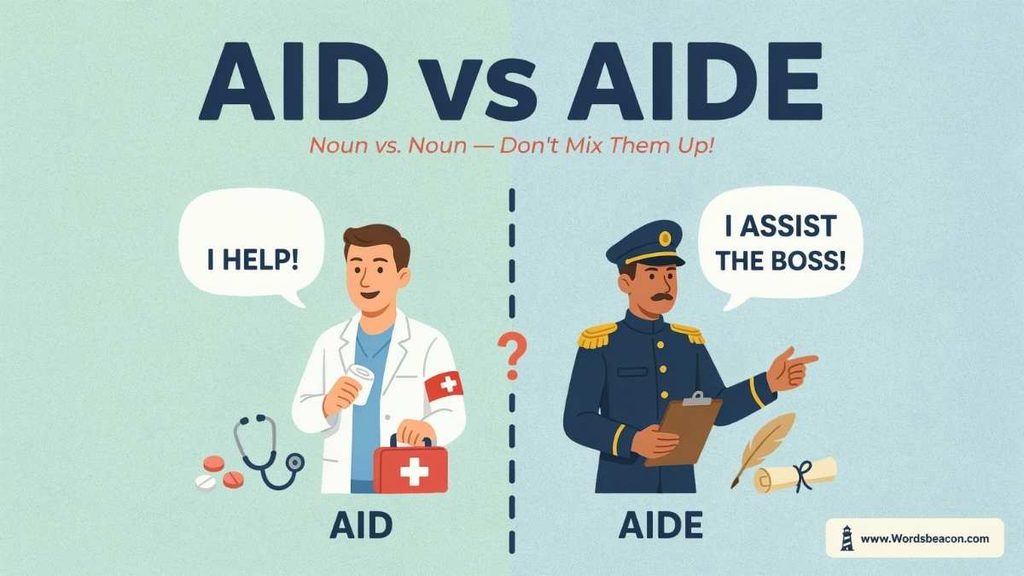
The difference between aid and aide comes down to two ideas: help and helper.
Aid can describe help itself, something that provides help, or the action of helping. Aide refers to a person who provides that help.
Compare these examples:
The hospital provided medical aid.
The hospital hired a nurse aide.
The first sentence talks about assistance. The second talks about a person.
Now consider another pair:
The teacher used a visual aid.
The teacher asked the classroom aide for help.
A visual aid is a thing. A classroom aide is a person.
This distinction works across many situations, which makes it one of the most useful rules for correct word usage.
Aid and Aide Comparison
| Feature | Aid | Aide |
|---|---|---|
| Basic meaning | Help, support, or assistance | A person who helps |
| Grammar | Noun and verb | Noun |
| Refers to a person | Usually no | Yes |
| Means help | Yes | No |
| Can mean “to help” | Yes | No |
| Example | She received financial aid. | Her aide arranged the meeting. |
There is no need to memorize a complicated grammar formula. Just remember what each word represents.
Aid is the help.
Aide is the person.
Visual Aid or Visual Aide?
The standard phrase is visual aid.
A visual aid is something that helps people understand, explain, or remember information. A teacher might use a chart, diagram, map, photograph, illustration, or slide as a visual aid.
For example:
The teacher used a diagram as a visual aid.
The presentation included several visual aids.
Here, aid refers to something that supports understanding.
Visual aide would suggest a person who provides visual assistance. That is not the normal meaning of the phrase.
The same pattern appears in teaching aid, study aid, memory aid, and reading aid. When you mean a resource or object that helps, aid is the natural choice.
Learn the difference between confusing word pairs
Ingrained vs Engrained which one is correct?
Hearing Aid or Hearing Aide?
The correct standard expression is hearing aid.
A hearing aid is a device that helps a person hear. Here, aid refers to something that provides assistance. Cambridge Dictionary lists hearing aid among the established meanings and compounds of aid.
For example:
She uses a hearing aid.
His hearing aid needed a new battery.
Hearing aide would suggest a person rather than the device.
This follows the same rule as visual aid. If you mean a helpful device, resource, or object, use aid.
First Aid or First Aide?
The correct expression is first aid.
First aid refers to immediate care given to someone who is injured or suddenly becomes ill. The phrase appears in everyday expressions such as first-aid kit, first-aid training, first-aid course, and first-aid supplies.
For example:
She completed a first-aid course.
Keep a first-aid kit in the car.
He received first aid after the accident.
First aide is not the standard expression for emergency medical assistance.
Again, the reason is straightforward. First aid means first assistance. It does not describe a person.
Job Aid or Job Aide?
The correct choice depends on what you mean.
A job aid is something that helps a person perform a task. It might be a checklist, instruction sheet, guide, diagram, or reference tool.
For example:
The company created a job aid to explain the new procedure.
Here, aid refers to a resource.
Job aide would suggest a person who assists with work. In ordinary professional English, more specific terms such as aide, assistant, employee, or support staff may sound more natural depending on the role.
The key difference remains the same. A job aid is a helpful resource. An aide is a person.
Learn the difference between confusing word pairs
Cudos vs Kudos Which one Is Correct?
Classroom Aide or Classroom Aid?
Both expressions can make sense, but they describe different things.
A classroom aide is a person who assists in a classroom.
The classroom aide helped the teacher organize the activity.
A classroom aid is something that helps with teaching or learning.
The teacher created a chart as a classroom aid.
That small spelling difference changes the meaning.
This distinction also helps with teacher aide and teacher’s aide. When those terms refer to a person who assists a teacher, aide is the appropriate word.
Teacher assistant is another common term for a person who helps with teaching or classroom duties. The exact job title can vary between schools and organizations, so the responsibilities may not always match perfectly.
Aid vs Aide in Professional Life
These words appear frequently in professional settings, but they perform different jobs.
A political aide is a person who assists a politician or political office.
The political aide prepared the documents for the meeting.
A presidential aide is a person who works in a supporting role for the president.
The presidential aide accompanied the president to the event.
An executive aide assists an executive with administrative or professional duties.
The executive aide arranged the meeting.
In each example, aide refers to a person.
Aid takes a different role.
Foreign aid refers to assistance provided to another country or population. Humanitarian aid refers to assistance intended to address human needs during emergencies and crises. Financial aid refers to financial assistance.
The aid worker is the person involved in delivering or organizing aid.
That creates a useful contrast:
Humanitarian aid is assistance.
An aid worker is a person.
The words can appear next to each other, but they do not mean the same thing.
Aid vs Aide Examples
The easiest way to understand these commonly confused words is to see them working in real sentences.
The university offered financial aid to eligible students.
The teacher’s aide helped prepare the classroom.
The rescue team delivered emergency aid.
The senator’s aide spoke with reporters.
The doctor provided medical aid.
The patient uses a hearing aid.
The teacher used a visual aid.
The treatment may aid recovery.
The classroom aide helped several students.
The organization received humanitarian aid.
Notice the pattern. Every sentence involving help, support, or a useful resource uses aid. Every sentence involving a person who assists uses aide.
Learn the difference between confusing word pairs
Coozie vs Koozie Which one Is Correct?
Common Mistakes With Aid and Aide
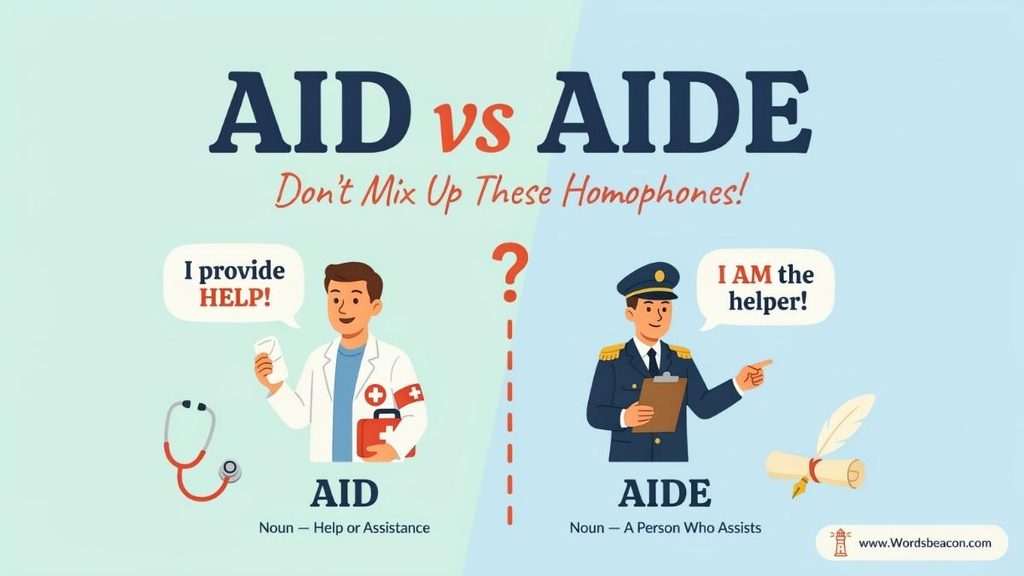
One common mistake occurs when writers use aide to mean general help.
For example:
The organization provided humanitarian aide.
The standard form is:
The organization provided humanitarian aid.
Humanitarian aid refers to assistance. It does not refer to a person.
The opposite mistake happens when someone uses aid to describe a person.
For example:
The senator’s aid attended the meeting.
The correct sentence is:
The senator’s aide attended the meeting.
The senator’s aide is a person.
These mistakes happen because the two words sound identical. When you hear them, there is no pronunciation clue that tells you which spelling to choose. You have to use the meaning and context.
Aid vs Aide and Assistance vs Assistant
Another useful comparison is assistance versus assistant.
Assistance means help. Assistant means a person who helps.
That relationship closely resembles aid and aide.
Aid is similar to assistance.
Aide is similar to assistant.
For example:
Thank you for your assistance.
Thank you to your assistant.
You could also say:
Thank you for your aid.
Thank you to your aide.
The words are not interchangeable in every sentence, but this comparison provides a helpful memory shortcut.
If you are talking about help or support, think of aid.
If you are talking about a person who provides that help, think of aide.
Learn the difference between similar English words
Labelling vs Labeling Which one Is Correct?
Are Aid and Aide Homophones?
Yes. Aid and aide are homophones because they have the same pronunciation but different spellings and meanings.
Both are pronounced /eɪd/ in standard English. That identical sound explains why these words often cause spelling mistakes.
English has many commonly confused words that sound alike but carry different meanings. Context becomes especially important with homophones because pronunciation cannot tell you which spelling belongs on the page.
With aid and aide, the meaning provides the answer.
If you mean help, use aid.
If you mean a person who helps, use aide.
Is Aid a Noun or a Verb?
Aid can be both a noun and a verb.
As a noun, it means help, assistance, support, or something that helps.
The dictionary was a useful aid to understanding the topic.
As a verb, it means to help or assist.
The new system may aid communication.
This flexibility makes aid different from aide. You can use aid to describe both a thing and an action.
Is Aide a Noun or a Verb?
Aide is a noun.
It refers to a person who assists someone.
For example:
The aide prepared the paperwork.
The teacher spoke with her aide.
In standard modern English, aide does not function as the ordinary verb meaning “to help.” If you need a verb, use aid or assist.
The program aids students.
The program assists students.
Those sentences use the verbs correctly.
Can Aid Be a Verb?
Yes. Aid can be a verb meaning to help or assist.
The medicine may aid recovery.
The technology aids communication.
Volunteers aided the rescue effort.
The verb can appear in different forms, including aid, aids, aided, and aiding.
This is an important part of the aid definition because many people know aid only as a noun. Understanding its verb use helps you recognize the word in more formal writing.
Can Aide Be a Verb?
No. Aide is normally used as a noun for a person who assists someone.
If you mean “to help,” use aid.
If you mean “to assist,” use assist.
For example:
The program aids workers.
The program assists workers.
Not:
The program aides workers.
That spelling would change the word into something that does not carry the standard verb meaning you want.
Learn the difference between similar English words
Tying vs Tieing which one is correct?
Aid Meaning in English
The aid meaning in English covers several connected ideas.
Aid can mean help or support. It can describe assistance given to people or organizations. It can also describe something that helps someone perform a task. As a verb, it means to help or assist.
That explains phrases such as financial aid, medical aid, emergency aid, foreign aid, hearing aid, visual aid, and first aid.
A simple example captures the main idea:
The organization provided aid.
The organization provided help.
Both sentences communicate the same basic idea.
Aide Meaning in English
The aide meaning in English is narrower.
An aide is a person who assists someone.
For example:
The senator’s aide prepared the speech.
The classroom aide helped the students.
The executive’s aide arranged the meeting.
The word often appears in professional titles and descriptions. Cambridge Dictionary specifically gives examples involving government aides and presidential aides.
This is why aide is closely related to words such as assistant, helper, and staff member.
When to Use Aid vs Aide
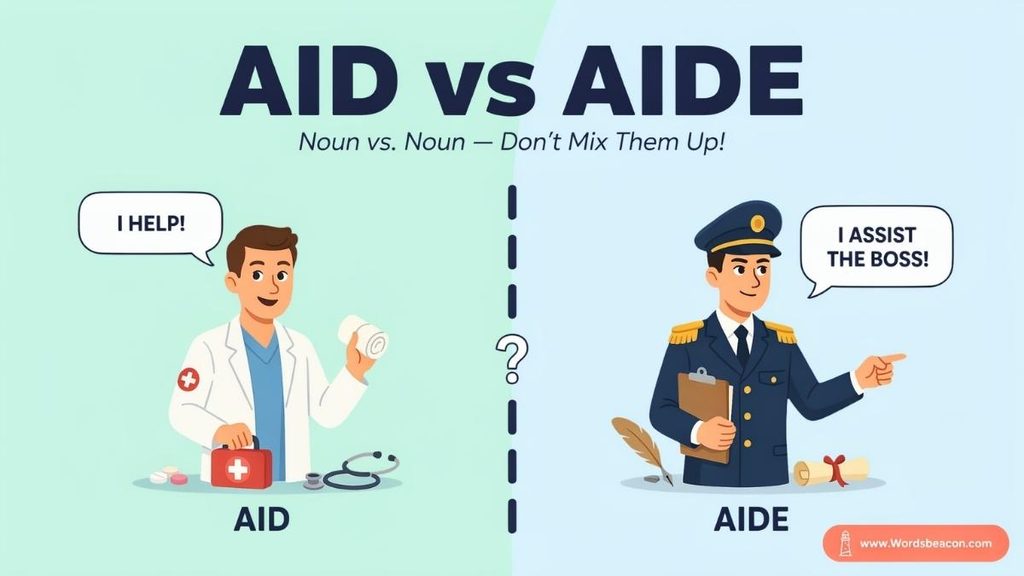
The deciding when to use aid vs aide, ask yourself what you are describing.
If you mean help, assistance, support, a useful resource, or the act of helping, use aid.
If you mean a person who assists someone, use aide.
For example:
She applied for financial aid.
The politician’s aide answered the question.
The chart is a visual aid.
The classroom aide helped the teacher.
The treatment may aid recovery.
The executive’s aide arranged the appointment.
The pattern stays consistent even when the context changes.
How to Remember Aid vs Aide
Here is the simplest memory trick:
Aid equals help.
Aide equals helper.
The extra e in aide can remind you that you are talking about a person who assists someone.
You can also use a replacement test.
If you can replace the word with help, assistance, or support, choose aid.
If you can replace it with assistant or helper, choose aide.
For example:
The charity provided ___.
Help fits naturally, so the answer is aid.
The senator’s ___ arrived.
Assistant fits naturally, so the answer is aide.
This quick test can save you from many spelling mistakes.
Learn the difference between similar English words
Busing vs Bussing difference and which one is correct?
Practice Session Aid vs Aide
Fill in each blank with the correct word: aid vs aide.
- The organization provided emergency ______ to families affected by the flood.
- The teacher asked her classroom ______ to help students with their assignments.
- A hearing ______ can help a person hear sounds more clearly.
- The nurse gave first ______ to the injured cyclist.
- The president’s ______ answered questions from reporters.
- Financial ______ helped the student pay for college.
- The new visual ______ made the lesson easier to understand.
- The hospital hired a nurse ______ to support patients and medical staff.
- Volunteers traveled overseas to provide humanitarian ______.
- The executive ______ arranged the manager’s meetings.
- This guide can ______ you in understanding the new system.
- The political ______ accompanied the senator to the meeting.
- The company created a job ______ to help employees complete the task correctly.
- The teacher’s ______ helped organize the classroom.
- The government announced a new aid ______ for low-income families.
- The doctor explained how the medical ______ could support the patient’s recovery.
- The chief ______ helped the government official prepare for the meeting.
- The first ______ kit contained bandages, antiseptic wipes, and gauze.
- The research ______ helped the professor collect and organize information.
- Extra classroom ______ gave students more support during the activity.
Answers
- aid
- aide
- aid
- aid
- aide
- aid
- aid
- aide
- aid
- aide
- aid
- aide
- aid
- aide
- aid
- aid
- aide
- aid
- aide
- aide
Here’s a trusted source for clear more words Comparison:
FAQs
Can aid refer to something that helps you?
Yes. Aid can mean help, support, or something that makes a task easier. For example, a visual aid can help you understand a lesson, while a hearing aid can help you hear more clearly.
Can aide refer to a person who provides support?
Yes. Aide is a noun that refers to a person who helps or assists someone. You might see the word in terms such as classroom aide, political aide, or administrative aide.
Can aid be used as a verb?
Yes. Aid can work as both a noun and a verb. As a verb, it means to help or assist. For example, “Regular exercise may aid recovery.”
Can aide be used as a verb?
No. Aide functions as a noun in standard English. If you want a verb meaning “to help,” use aid instead.
Why do aid and aide sound the same?
Aid and aide are homophones. They share the same pronunciation but have different spellings and meanings. That’s why context matters when you choose between them.
Can aid refer to financial support?
Yes. Aid often refers to money or resources given to provide support. Common examples include financial aid, disaster aid, foreign aid, and humanitarian aid.
Can aide describe a workplace position?
Yes. Aide can describe a job that involves assisting another person, group, or organization. The duties vary depending on the position and workplace.
Does aid always mean physical assistance?
No. Aid can refer to many forms of help. It can mean money, medical support, useful equipment, resources, or the act of helping someone.
Can a person provide aid?
Yes. People can give, offer, or provide aid. For example, “Volunteers provided aid to families after the storm.”
Does aide always mean personal assistant?
No. An aide is a person who provides assistance, but the role can take many forms. A classroom aide, executive aide, and government aide may have completely different duties.
What is the easiest way to remember aid and aide?
Remember this simple rule: aid means help, while aide means a person who helps. If you can replace the word with “assistance,” use aid. If you mean “assistant,” use aide.
Can aid and aide appear in the same sentence?
Yes. For example, “The political aide helped organize financial aid for the community.” Here, aide refers to a person, while aid refers to assistance.
What does aid mean in professional writing?
In professional writing, aid usually means help, assistance, support, or a resource that serves a useful purpose. Its meaning depends on the context, such as medical aid, financial aid, or technical aid.
What does aide mean in a job title?
Aide identifies a person whose role involves providing assistance. Examples include classroom aide, legislative aide, executive aide, and administrative aide.
How can you tell whether aid is a noun or a verb?
Check how the word works in the sentence. If aid names help or a helpful resource, it is a noun. If it describes the action of helping, it is a verb.
Can aid describe help given to an organization?
Yes. Aid can support individuals, groups, organizations, communities, or governments. For example, an organization may provide financial aid to another organization.
Can an aide have different responsibilities depending on the job?
Yes. The word aide describes a support role, not one fixed set of duties. A classroom aide may support students, while an executive aide may help manage schedules and administrative tasks.
What is the plural form of aide?
The plural form of aide is aides. For example, “The senator met with several aides.” Aid usually remains aid when it refers to help or assistance as a general concept.
How does context help you choose between aid and aide?
Ask one simple question: Are you talking about help or a person? If you mean help, assistance, or support, use aid. If you mean a person who provides assistance, use aide.
Why does the spelling matter if aid and aide sound identical?
Their pronunciation may be the same, but their meanings differ. Using the wrong spelling can make your sentence unclear or change what you mean. Remembering “aid = help” and “aide = helper” makes the distinction easy.
Conclusion
The aid vs aide confusion is easy to clear up once you remember one simple rule: aid means help, while aide means a person who helps. Aid can work as a noun or a verb, so you can talk about financial aid or say that something may aid recovery. Aide, on the other hand, refers to a person who provides assistance, such as a classroom aide or political aide. The two words sound exactly alike, which makes them easy to mix up. Just remember: aid is the help, and an aide is the helper. Once that clicks, choosing the right word becomes much easier.

Luna AJS is an experienced blogger and dedicated language enthusiast at Words Beacon. She specializes in making English grammar, spelling, vocabulary and commonly confused words easy to understand. She provides clear explanations, practical examples to help readers write with confidence.