
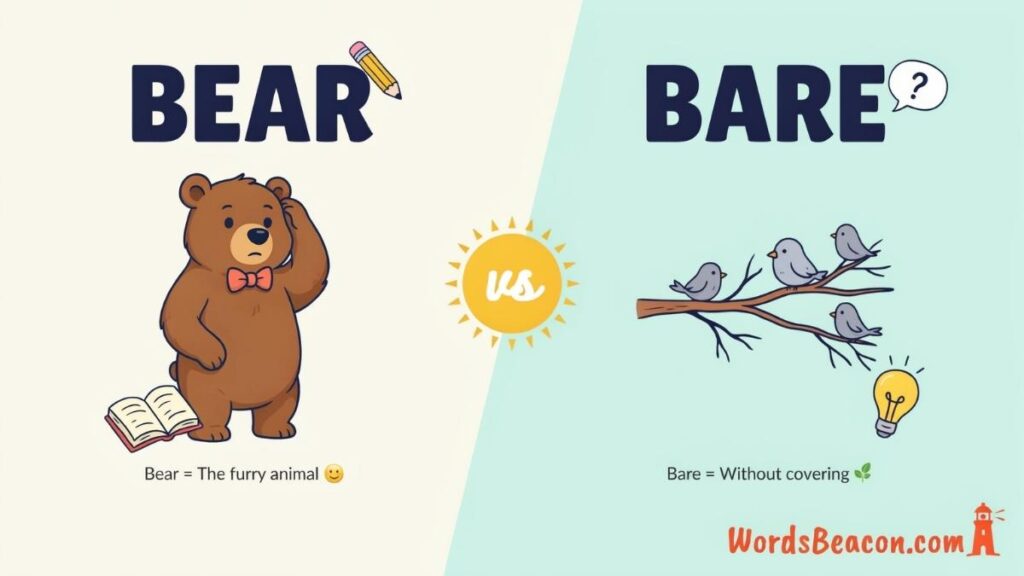
Bear and bare sound the same, but they do not mean the same thing. That simple difference makes bear vs bare a common spelling and grammar mix-up. Bear can mean to carry, support, or endure something, while bare describes something uncovered or reduced to the basics. The confusion becomes even funnier with phrases like “bear with me” and “bare with me.” One asks for patience, while the other sounds like a very different request. Luckily, the rule is easy once you know what each word means. This guide breaks down bear and bare with clear examples, useful expressions, and simple tips to help you choose the right word.
quick answer
The easiest way to remember the difference is simple: if something involves carrying or enduring, think bear. If something has no covering or has only the basics, think bare.
| Word | Meaning | Example |
|---|---|---|
| Bear | Carry, support, endure, or produce | I cannot bear the pain. |
| Bare | Uncovered, exposed, or basic | He walked with bare feet. |
Learn how to use confusing more words correctly
Aid vs Aide which one is correct?
What Is the Difference Between Bear and Bare?
The main bear and bare difference is meaning.
Bear works as both a noun and a verb. As a noun, it refers to the large, furry animal. As a verb, it can mean to endure something unpleasant, carry something, support weight, accept responsibility, produce something, or have a particular name or characteristic.
Bare commonly works as an adjective and a verb. As an adjective, it describes something uncovered, exposed, empty, or reduced to the most basic amount. As a verb, it means to uncover or reveal something that was previously covered.
| Word | Main grammatical roles | Main ideas | Example |
|---|---|---|---|
| Bear | Noun, verb | Animal, endure, carry, support, produce | I cannot bear the noise. |
| Bare | Adjective, verb | Uncovered, exposed, basic, reveal | She walked with bare feet. |
The pronunciation creates much of the confusion. In American English, the words are pronounced alike, which makes them homophones. Their spelling and meaning, however, remain different.
Compare these sentences:
I cannot bear the pain.
She walked across the sand with bare feet.
The first sentence uses bear because the person must endure something. The second uses bare because the feet have no covering.
The sound cannot tell you which spelling to use. The context can.
Learn how to use confusing more words correctly
Steer vs Stear which one is correct?
What Does Bear Mean?
The bear meaning depends on how the word functions in a sentence. It has several established uses, so learning only one definition is not enough.
The word can name an animal, but it can also describe endurance, carrying, support, production, responsibility, and other ideas.
Bear as a Noun
The bear noun refers to a large, strong wild animal with thick fur.
For example:
A bear crossed the road near the forest.
The children saw a polar bear at the zoo.
He bought a teddy bear for his niece.
In these sentences, bear simply names the animal. The surrounding words make its meaning clear.
The animal meaning is probably the easiest use to remember because you can picture the word immediately. The more difficult uses usually involve the verb.
Bear as a Verb
The bear verb has several meanings, but one of the most important is to accept or endure something unpleasant.
For example:
For example, I cannot bear the noise.
Similarly, she could not bear the thought of leaving.
Likewise, he could barely bear the pain.
In fact, the pain was too much to bear.
In these examples, bear means tolerate, endure, or withstand something difficult. More specifically, Cambridge lists this use as accepting or enduring something unpleasant.
Therefore, that gives you a useful connection:
Bear can mean endure.
So when something is difficult to tolerate, bear is often the correct choice.
Bear to Carry
Bear can also mean carry.
For example:
He entered the room bearing a tray of drinks.
The workers carried a heavy box between them.
The verb often carries the idea of having or carrying something from one place or situation to another.
The same idea appears in less literal expressions. You can bear a responsibility, bear a cost, or bear a burden. In each case, the person carries something in a figurative sense.
Bear to Support
Bear can also mean support weight.
For example:
The bridge can bear the weight of heavy vehicles.
Similarly, I do not think this chair can bear his weight.
Likewise, the shelf was not strong enough to bear the books.
Therefore, this meaning explains why bear the weight is correct. In other words, something that bears weight supports or carries it. More importantly, Cambridge includes support for the weight of something among the established meanings of bear.
Bear Responsibility or Cost
English also uses bear when someone accepts responsibility or a cost.
For example:
The company will bear the cost of the repairs.
She had to bear the responsibility for the decision.
The two partners agreed to bear the expense together.
Here, bear does not mean physically carry something. It means accept or take responsibility for something.
Bear Fruit
Another established use appears in the expression bear fruit.
Literally, a tree can bear fruit.
The apple tree bears fruit every summer.
The phrase can also have a figurative meaning. An effort, plan, or action can bear fruit when it produces a useful result.
For example:
Years of research finally bore fruit.
The new strategy began to bear fruit.
The expression works because the original idea involves a plant producing fruit. English later extended that idea to results and achievements.
Bear a Name or Resemblance
Bear can also describe something that carries a name, mark, symbol, or resemblance.
For example:
The building bears the architect’s name.
She bears a strong resemblance to her mother.
The document bore the company’s official seal.
These uses may seem unrelated to endurance, but they all belong to the established range of the verb bear. Cambridge also lists uses involving resemblance, names, symbols, and other characteristics.
Fix common more word mistakes in English
High School vs Highschool Which one Is Correct?
What Does Bare Mean?

The bare meaning usually centers on the idea of having nothing covering something or having only the most basic amount.
Bare can describe something uncovered, exposed, empty, plain, or minimal. It can also work as a verb meaning to uncover or reveal something.
Bare as an Adjective
The bare adjective describes something that is not covered.
For example:
She walked across the beach with bare feet.
He touched the surface with his bare hands.
The room had bare walls.
The tree stood bare during winter.
The floor had bare wooden boards.
Cambridge defines bare in this sense as not covered by clothes or not covered by anything.
The central idea is exposure.
If something normally has a covering and that covering is missing, bare may be the right word.
Bare as a Verb
The bare verb means to uncover or expose something.
For example:
The dog bared its teeth.
He bared his chest.
She bared her soul during the conversation.
The men bared their heads as a sign of respect.
In each sentence, something that was normally covered becomes visible.
The phrase bared its teeth is especially common. It means an animal exposed its teeth, often as a warning or sign of aggression. Cambridge lists this exact use in its dictionary definition of bare.
Notice the spelling carefully.
The dog bared its teeth.
Not:
The dog beared its teeth.
The first version comes from bare, meaning to expose.
Bare Means Basic or Minimal
Bare does not always describe physical exposure. It can also mean only the most basic or necessary amount.
This meaning appears in familiar expressions such as bare minimum and bare essentials.
For example:
For example, he did the bare minimum required for the assignment.
Similarly, we packed only the bare essentials.
Likewise, the report included only the bare facts.
In addition, they had enough money for the bare necessities.
More importantly, Cambridge defines the bare minimum as the least possible amount and bare essentials as the most basic and necessary things.
Therefore, the underlying idea remains the same.Something has been reduced until very little remains.
Fix common more word mistakes in English
Treck vs Trek Which one Is Correct?
Bear vs Bare Examples
The clearest way to understand bear vs bare is to see the words in realistic sentences.
| Bear | Bare |
|---|---|
| I cannot bear the pain. | She walked with bare feet. |
| Please bear with me. | He used his bare hands. |
| She had to bear the burden. | The walls were bare. |
| The bridge can bear the weight. | The room looked bare. |
| The tree will bear fruit. | We packed the bare essentials. |
| A bear crossed the road. | He did the bare minimum. |
| I cannot bear the noise. | The dog bared its teeth. |
| Bear in mind the deadline. | She bared her soul. |
The pattern becomes easier when you look at the meaning rather than the spelling.
Bear often connects with carrying, enduring, supporting, producing, or the animal.
Bare often connects with being uncovered, exposed, basic, minimal, or revealing something.
Fix common more word mistakes in English
Worshiped vs Worshipped which one is correct ?
Bear With Me or Bare With Me?
If you are asking someone to be patient, the correct phrase is bear with me.
The phrase bare with me is not the standard expression for this meaning.
Cambridge defines bear with someone as being patient and waiting while that person does something.
For example:
Please bear with me while I check the information.
Bear with me for a moment while I find the document.
Thank you for bearing with me while I sort this out.
The phrase makes sense because bear can mean tolerate or endure something. When you ask someone to bear with you, you are asking that person to tolerate a short delay or inconvenience.
Bear With Me Meaning
The bear with me meaning is essentially “please be patient with me.”
It often appears when someone needs extra time to explain something, find information, solve a problem, or complete a task.
For example:
Please bear with me while I review the figures.
Bear with me while I pull up the correct file.
Bear with me for another minute while I finish this explanation.
It works in everyday conversation as well as professional communication.
Why Bare With Me Is Confusing
The phrase sounds perfectly plausible when spoken because bear and bare have the same pronunciation in American English.
However, bare means uncovered, exposed, or reduced to a basic amount. That meaning does not fit a request for patience.
So if you are wondering, “Should I say bear with me or bare with me?” the answer is simple.
Use bear with me when you mean “please be patient.”
Learn the difference between confusing more English words
Ingrained vs Engrained which one is correct?
Bear the Pain or Bare the Pain?
The correct phrase is bear the pain.
For example:
She could not bear the pain any longer.
He managed to bear the pain until help arrived.
The medicine made it easier to bear the pain.
The reason is straightforward. Bear can mean endure or tolerate. Pain is something a person can endure.
Bare does not have that meaning.
So when you see the question bear or bare the pain, choose bear.
I Cannot Bear It or Bare It?
The correct expression is I cannot bear it when you mean that something is impossible or extremely difficult to tolerate.
For example:
I cannot bear this noise anymore.
She could not bear the thought of losing her home.
He could not bear to watch the final scene.
The phrase I cannot bare it does not work when you mean “I cannot tolerate it.”
A useful memory connection is this:
If you can tolerate it, you can bear it.
Bear the Burden or Bare the Burden?
The correct expression is bear the burden.
For example:
She had to bear the burden of responsibility.
He continued to bear the financial burden.
The team shared the burden rather than leaving one person to bear it alone.
A burden is something you carry, whether that burden is physical, emotional, financial, or practical.
Because bear can mean carry or endure, it fits naturally.
Bare does not.
So if you are searching for bear or bare the burden, choose bear.
Bear or Bare the Weight?
The correct expression is bear the weight when you mean support or carry weight.
For example:
The bridge can bear the weight of several trucks.
Similarly, this shelf cannot bear the weight of all those books.
Likewise, the chair was strong enough to bear his weight.
Again, the meaning gives you the answer.
Therefore, bear can mean support.
By contrast, bare means uncovered or minimal.
That is why bear the weight is correct.
Bear and Bare Homophones

The Bear and bare are commonly treated as homophones because they share the same pronunciation in standard American English while having different spellings and meanings.
This makes them a classic example of a pronunciation problem that becomes a spelling problem.
When you hear the words, you may not know which one the speaker means. When you see the words in writing, however, the spelling tells you which meaning applies.
Consider this sentence:
The bear walked across the bare field.
The two words sound alike, but their meanings are completely different.
Bear refers to the animal.
Bare describes the field as uncovered or lacking vegetation.
That is the central lesson behind bear vs bare homophones: sound alone cannot determine spelling.
Bear and Bare Homophones Sentences
Here are, for example, a few examples that naturally show the contrast.
First, the bear wandered through the forest.
Similarly, she walked across the floor with bare feet.
In contrast, I cannot bear the noise.
Likewise, the room had bare walls.
Meanwhile, please bear with me while I finish.
In addition, he grabbed the object with his bare hands.
For example, the bridge can bear the weight.
Similarly, they packed only the bare essentials.
Finally, the dog bared its teeth.
Likewise, she had to bear the burden herself.
Overall, each sentence gives you a useful context clue.
Learn the difference between confusing more English words
Cudos vs Kudos Which one Is Correct?
Bear vs Bare Grammar and Parts of Speech
More importantly, understanding the parts of speech can make this confusion much easier.
First, bear can function as a noun or a verb.
On the other hand, bare can function mainly as an adjective or a verb.
| Word | Part of speech | Example | Meaning |
|---|---|---|---|
| Bear | Noun | A bear crossed the trail. | Animal |
| Bear | Verb | I cannot bear the noise. | Endure |
| Bear | Verb | The shelf can bear the weight. | Support |
| Bear | Verb | The tree bears fruit. | Produce |
| Bare | Adjective | She has bare feet. | Uncovered |
| Bare | Adjective | We packed the bare essentials. | Most basic |
| Bare | Verb | The dog bared its teeth. | Exposed |
This grammatical difference does not solve every example by itself, but it gives you another useful clue.
If the sentence needs a word describing something uncovered, bare may fit.
If it needs a verb meaning endure or support, bear is usually the right choice.
Learn the difference between similar English words
Coozie vs Koozie Which one Is Correct?
Common Bear and Bare Mistakes
The most common mistakes come from writing the word that sounds right instead of choosing the word that means right.
Bare With Me
Incorrect:
Bare with me while I check the file.
Correct:
Bear with me while I check the file.
The phrase asks for patience, so bear is correct.
Bare the Pain
Incorrect:
She could not bare the pain.
Correct:
She could not bear the pain.
Pain is something you endure.
Bare the Burden
Incorrect:
He had to bare the burden alone.
Correct:
He had to bear the burden alone.
A burden is something you carry or endure.
Bear Feet
Incorrect:
She walked along the beach with bear feet.
Correct:
She walked along the beach with bare feet.
Feet without shoes or another covering are bare.
Beared Its Teeth
Incorrect:
The dog beared its teeth.
Correct:
The dog bared its teeth.
Here, bare is a verb meaning expose. The dog exposed its teeth.
Learn the difference between similar English words
Labelling vs Labeling Which one Is Correct?
Bear With Me, Bear in Mind, and Other Useful Expressions
Learning common phrases can help you remember the difference naturally.
Bear With Me
Bear with me means be patient with me.
Please bear with me while I finish the report.
Bear in Mind
The Bear in mind means remember or keep something in consideration.
Bear in mind that the schedule may change.
The phrase uses bear, not bare, because it belongs to an established expression involving keeping something in mind.
Bear Fruit
Bear fruit means produce fruit in the literal sense or produce useful results in a figurative sense.
The apple trees bear fruit every summer.
The new strategy eventually bore fruit.
Bare Minimum
Bare minimum means the smallest amount necessary.
He did the bare minimum to complete the assignment.
Bare Essentials
Bare essentials means the most basic and necessary things.
We packed only the bare essentials.
Bare Your Soul
Bare your soul means reveal your deepest feelings or thoughts.
She finally bared her soul during the conversation.
The word bare works here because it carries the idea of exposing something that normally remains hidden.
Bear vs Bare Spelling Difference
The bear vs bare spelling difference is only one letter, but the meanings are far apart.
Bear contains the letters “ear,” while bare contains “are.”
That spelling trick may help you for a moment, but meaning-based memory usually works better.
Think of these expressions as memory anchors:
1.Bear with me.
2.Bear the pain.
3.Bear the burden.
4.Bear the weight.
5.Bear fruit.
6.Bear in mind.
7.Bare feet.
8.Bare hands.
9.Bare minimum.
10.Bare essentials.
11.Bare walls.
12.Bared its teeth.
13.Bare your soul.
When you remember the phrases as complete expressions, the correct spelling becomes much easier to recall.
How to Remember Bear vs Bare
A simple meaning-based method can clear up most confusion.
Think of bear as connected with carrying and enduring.
1.You bear a burden.
2.You bear the weight.
3.You bear the pain.
4.You bear responsibility.
5.You bear with someone when you remain patient.
6.You can also think of bear as the animal.
Now think of bare as connected with exposure and lack of covering.
You have bare feet.
You have bare hands.
For example, a room can have bare walls.
Similarly, a cupboard can be bare.
Likewise, you can do the bare minimum.
In addition, you can bare your soul.
Finally, an animal can bare its teeth.
Overall, the easiest memory rule is this:
Bear connects with carrying, enduring, supporting, producing, or an animal.
On the other hand, bare connects with being uncovered, exposed, basic, minimal, or revealing.
Bear vs Bare in Everyday English

These words appear in ordinary conversation, professional writing, school assignments, and informal messages.
At work, you might write:
Please bear with me while I confirm the details.
The company will bear the cost of the repair.
The report contains only the bare essentials.
At home, you might say:
I cannot bear this noise.
The children ran outside with bare feet.
The cupboard was almost bare.
In school writing, you might see:
Bear in mind that the results may vary.
The plant began to bear fruit.
The classroom walls were bare.
The important point is that the correct word depends on the intended meaning.
Bear vs Bare Case Study in Context
Imagine a project manager dealing with a delayed presentation.
The manager writes:
Please bear with me while I check the server. We may need to bear the cost of an emergency repair. For now, keep the bare essentials ready for the presentation.
The paragraph contains three different uses.
Bear with me means be patient.
Bear the cost means accept or carry the financial responsibility.
Bare essentials means only the most necessary items.
The words sound similar, but their meanings are completely different.
This is exactly why context matters so much with homophones.
Learn the difference between similar English words
Tying vs Tieing which one is correct?
Practice Session Bear vs Bare
Fill in each blank with the correct word: bear vs bare. Check the answers at the end.
- I cannot ______ the noise from the construction site anymore.
- Please ______ with me while I check the information.
- The hikers spotted a large ______ near the forest.
- The room had ______ walls and very little furniture.
- She had to ______ the responsibility for the entire project.
- The dog ______ its teeth when the stranger came closer.
- These shelves can ______ a lot of weight.
- He walked across the beach with his ______ feet.
- The company hopes its new investment will ______ fruit soon.
- I cannot ______ the thought of losing my favorite book.
- The workers removed the paint to ______ the original wood underneath.
- The tree can ______ fruit throughout the summer.
- You should ______ in mind that the deadline is tomorrow.
- The small cabin offered only the ______ essentials.
- The old building could not ______ the weight of the heavy snow.
- She decided to ______ her soul and tell him the truth.
- The mother watched the ______ carefully from a safe distance.
- The athlete had to ______ the pain and finish the race.
- The walls looked ______ after the furniture was removed.
- Please ______ with me for another minute while I finish this task.
Answers
- bear
- bear
- bear
- bare
- bear
- bared
- bear
- bare
- bear
- bear
- bare
- bear
- bear
- bare
- bear
- bare
- bear
- bear
- bare
- bear
Here’s a trusted source for clear more words Comparison:
FAQs
What is the main difference between bear and bare?
Bear usually means to carry, support, endure, or have something. It can also refer to the large animal. Bare means uncovered, exposed, empty, or reduced to the basics. The right word depends on what you mean.
When should you use bare?
Use bare when something has no covering or contains very little. For example, “The room had bare walls” means the walls had little decoration or covering.
Why are bear and bare easy to confuse?
Bear and bare have the same pronunciation in standard English, but their meanings and spellings differ. Because they sound alike, context helps you choose the correct word when writing.
What does “bear down” mean?
Bear down means to apply pressure, make a strong effort, or focus intensely on something. For example, “The players had to bear down and finish the game.”
Is it “bear fruit” or “bare fruit”?
“Bear fruit” is correct when something produces a useful result or outcome. For example, “Her hard work finally began to bear fruit.”
What does “bare minimum” mean?
Bare minimum means the smallest amount needed to meet a requirement. For example, “He did the bare minimum to finish the assignment.”
Is it “bear a grudge” or “bare a grudge”?
“Bear a grudge” is correct. It means to continue feeling resentment toward someone because of something that happened.
What does “bare essentials” mean?
Bare essentials are the most basic things you need. For example, “She packed only the bare essentials for the weekend.”
What does “bare your teeth” mean?
“Bare your teeth” means to expose your teeth, often as a sign of anger or aggression. The verb bare means to uncover something that normally remains covered.
Is it “bear a name” or “bare a name”?
“Bear a name” is correct when you mean to have or carry a particular name. For example, “The building bears the name of its original owner.”
Can bear be both a noun and a verb?
Yes. As a noun, bear refers to the large furry animal. As a verb, it can mean to carry, support, endure, or produce something.
Can bare be used as a verb?
Yes. As a verb, bare means to uncover or expose something. For example, “The workers bared the original brick beneath the plaster.”
What does “bear responsibility” mean?
“Bear responsibility” means to accept or carry responsibility for something. For example, “The manager must bear responsibility for the final decision.”
What does “bare bones” mean?
“Bare bones” describes something reduced to its simplest or most basic form. For example, “The article gives a bare-bones explanation of the topic.”
Is it “bear weight” or “bare weight”?
“Bear weight” is correct when you mean to support or carry weight. For example, “The shelf can bear the weight of several books.”
What does “bare” mean in “bare feet”?
In “bare feet,” bare means uncovered. Bare feet have no shoes or socks covering them.
Is it “bear witness” or “bare witness”?
“Bear witness” is correct. It means to give evidence or testify about something. For example, “Several people agreed to bear witness to the event.”
What does “bear in mind” mean?
“Bear in mind” means to remember or consider something. For example, “Bear in mind that the schedule may change.”
Is it “bear the cost” or “bare the cost”?
“Bear the cost” is correct. It means to accept or pay an expense. For example, “The company agreed to bear the cost of the repairs.”
What is an easy way to remember bear vs bare?
Use bare for something uncovered, exposed, or reduced to the basics. Use bear when you mean to carry, support, endure, or produce something. A simple memory trick is: bare has the idea of “nothing covering it,” while bear often involves “carrying something.”
conclusion
Bear and bare sound the same, but their meanings are completely different. Bear usually means to carry, support, endure, or produce something. Bare means uncovered, exposed, or reduced to the basics. That small spelling difference can change the whole meaning of your sentence.
When you mean bearing pain, carrying responsibility, or keeping something in mind, use bear. When you mean bare feet, bare walls, or the bare minimum, use bare. One easy trick can save you from the mix-up: if something is uncovered, think bare. If you are carrying or enduring something, think bear. And remember, “bear with me” asks for patience. “Bare with me” creates a very different picture!

Luna AJS is an experienced blogger and dedicated language enthusiast at Words Beacon. She specializes in making English grammar, spelling, vocabulary and commonly confused words easy to understand. She provides clear explanations, practical examples to help readers write with confidence.