

The flaky vs flakey confusion can make a simple spelling question feel surprisingly tricky. Both forms appear in English, but flaky is the usual and more familiar spelling. Flakey is also recognized as a variant, so it is not always a spelling mistake. The word flaky can describe a delicious pastry, dry skin, peeling paint, or even a person who often changes plans. But why does one version have an extra “e”? Which spelling should you use in your writing? This guide makes the difference easy to understand with clear meanings, simple examples, and practical tips, so you can choose the right form without second-guessing every letter.
quick answer
| Flaky | Flakey |
|---|---|
| Usual spelling | Variant spelling |
| More familiar in writing | Less common form |
| Same basic meanings | Same basic meanings |
| Best default choice | Still recognized |
In simple terms, flaky is the spelling you should normally choose, while flakey is an accepted variant.
Learn the difference between similar English words
Premier vs Premiere which one is correct ?
Flaky vs Flakey The Simple Difference
If you are asking flakey vs flaky, the answer depends on whether you mean the standard spelling or whether you are asking whether the alternative exists.
Flaky is the standard, widely used spelling. Flakey is an accepted variant spelling. Both forms can describe something that breaks into small, thin pieces, such as pastry, skin, paint, or another surface. They can also describe a person who behaves strangely, forgets things, or does not act reliably.
For example, you can write:
The pie has a flaky crust.
Her skin looks dry and flaky.
The old paint is flaky.
He can be a little flaky when making plans.
In each sentence, flaky describes a quality. The word works as an adjective, and its exact meaning comes from the context.
So, if your question is “is flaky or flakey correct,” the clearest answer is this:
Flaky is the preferred spelling. Flakey is a recognized variant.
Oxford lists flaky with flakey as an alternative spelling and gives meanings involving thin pieces, unusual behavior, and, in British English, unreliable performance. Cambridge likewise lists flakey as another form of flaky.
What Is the Difference Between Flaky and Flakey?
The main flaky vs flakey spelling difference is simple: flakey contains an extra e.
The more common form is flaky.
The alternative form is flakey.
The spelling difference does not normally create a different meaning. In other words, the two forms are not like words such as affect and effect, where changing the spelling changes the meaning and grammatical function.
Instead, flaky and flakey generally describe the same thing.
Consider these two sentences:
The baker made a flaky crust.
The baker made a flakey crust.
The second sentence may look unusual to many readers, but the intended meaning remains clear. Both sentences describe a crust that breaks into thin layers or pieces.
The same thing happens with the figurative meaning:
He is a flaky friend.
He is a flakey friend.
Again, the spelling changes, but the basic idea does not.
That is why flaky vs flakey is primarily a spelling question rather than a vocabulary question.
Flaky
Flaky is the normal spelling you will see most often. It describes something that tends to break into small, thin pieces or something that comes away in flakes. It also has an informal figurative meaning connected with unusual or unreliable behavior. Oxford gives examples such as flaky pastry and dry flaky skin.
Flakey
Flakey is an alternative spelling of the same adjective. Cambridge explicitly identifies flakey as another form of flaky, while Oxford places the variant alongside the main spelling.
Therefore, if you are wondering whether flakey is spelled correctly, the answer can be yes. However, that does not mean it is the spelling you should normally choose.
For general writing, flaky remains the better default.
Learn the difference between similar English words
Attornies vs Attorneys difference and usage ?
What Does Flaky Mean?
The flaky meaning changes slightly depending on the context, but the central idea connects to flakes or thin pieces.
Oxford defines flaky as something that tends to break into small, thin pieces. Cambridge describes it as something that comes off easily in small, flat, thin pieces.
That physical meaning appears in phrases such as flaky pastry, flaky crust, flaky skin, flaky scalp, and flaky paint.
Imagine a pie crust breaking apart into delicate layers when you cut into it. That is flaky.
Now picture old paint separating from a wall in small pieces. That can also be flaky.
The same word describes both situations because the physical idea remains similar. Something separates into flakes, layers, or small pieces.
The word also has a figurative meaning. When you describe a person as flaky, you usually mean that the person behaves in an unusual, inconsistent, or unreliable way. Cambridge labels this use informal and sometimes offensive, while Oxford describes the person-related meaning as informal.
Flaky as an Adjective
Flaky is a flaky adjective, which means it describes a noun rather than naming the thing itself.
For example:
The pastry is flaky.
The paint looks flaky.
Her scalp is flaky.
He seems flaky.
In each example, flaky tells you something about the subject.
The adjective also has comparative and superlative forms:
flaky
flakier
flakiest
So you can say:
This crust is flaky.
That crust is flakier.
This is the flakiest pastry I have ever tasted.
Oxford lists flakier and flakiest as the comparative and superlative forms.
Flaky Meaning for Food
Food is one of the clearest places to understand the literal meaning of flaky.
When you describe food as flaky, you are usually talking about texture. The food breaks apart into thin layers or small pieces.
Flaky pastry is a classic example.
A well-made pie crust can have several delicate layers that separate as you cut through it. A croissant can also have a flaky texture because its dough forms distinct layers.
You might describe a food as having a flaky crust, flaky pastry, or flaky texture.
For example:
The pie had a buttery, flaky crust.
The croissant was crisp and flaky.
The fish became tender and flaky after cooking.
Notice that flaky does not automatically mean dry.
That distinction matters.
A food can be flaky and buttery. It can also be flaky and moist. The adjective mainly tells you how the food breaks apart or separates into layers.
So, when you see flaky crust on a menu, the word tells you about texture rather than flavor.
Learn the difference between similar English words
Bear vs Bare Difference and usage ?
Flaky Meaning for Skin and Scalp
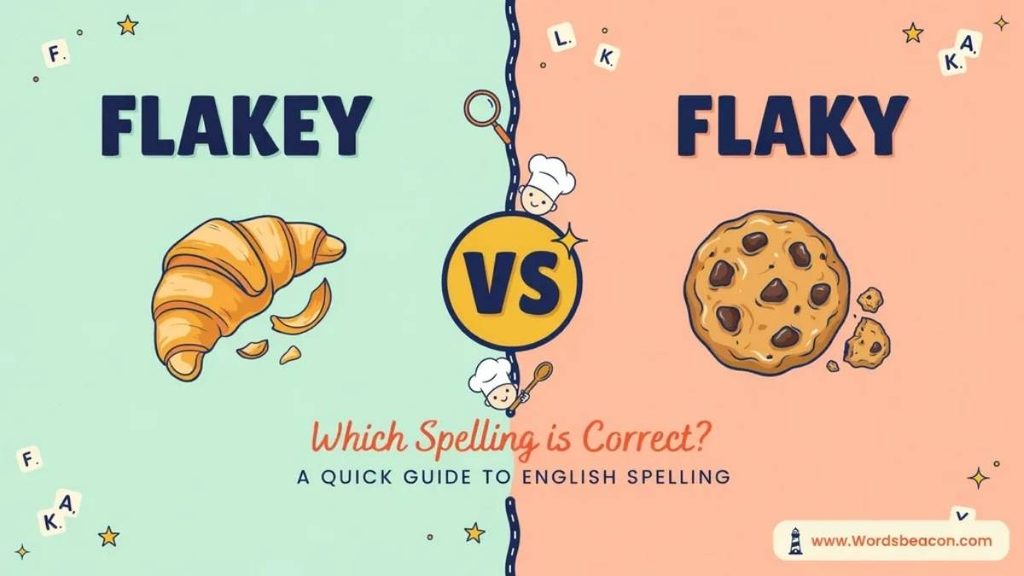
The Flaky also appears frequently when people describe skin.
The phrases flaky skin and flaky scalp are especially common.
When skin looks flaky, it may appear to shed or break into small pieces. Cambridge specifically gives dry, flaky skin and a flaky scalp as examples.
For example:
The cold weather left my hands dry and flaky.
Her scalp looked flaky after several days of dry weather.
The adjective describes what the skin looks or feels like. It does not, by itself, identify the reason for the condition.
That distinction is useful because flaky and dry are not always identical.
Dry describes a lack of moisture. Flaky describes a visible texture or the shedding of small pieces.
In everyday writing, the two words often appear together:
dry, flaky skin
dry, flaky scalp
However, they are not exact synonyms.
Flaky Meaning for Paint and Surfaces
Paint can also become flaky.
Imagine an old wall that has spent years exposed to weather. The paint may begin to break away in small pieces or thin layers. In that situation, flaky describes the condition of the paint.
For example:
The old house had flaky paint around the windows.
The ceiling looked cracked and flaky.
The coating became flaky after years of exposure.
The physical idea remains the same. A layer separates into smaller pieces.
This meaning connects naturally to the noun flake. Cambridge defines a flake as a small, thin piece of something, especially a piece that has come from a surface.
That connection makes the word easier to remember.
A flake is the piece.
Flaky describes something that produces, contains, or resembles those pieces.
Learn the difference between similar English words
Aid vs Aide which one is correct?
What Does Flakey Mean?
The flakey meaning is essentially the same as the flaky meaning.
That point matters because many people assume the extra e must create a completely different word. It does not.
Cambridge lists flakey as another form of flaky, and Oxford includes flakey as an alternative spelling.
So, is flakey a word?
Yes.
Is flakey a word that dictionaries recognize?
Yes.
Is flakey spelled correctly?
It can be, when you are using the accepted variant.
However, there is an important difference between “recognized” and “preferred.”
English contains many spelling variants. A dictionary may record a variant because people use it and because it has an established place in the language. That does not mean every variant appears equally often or works equally well in every style of writing.
For that reason, flaky is still the sensible choice when you want the most familiar spelling.
Flaky vs Flakey Comparison
| Feature | Flaky | Flakey |
|---|---|---|
| Part of speech | Adjective | Adjective |
| Basic meaning | Breaking into small, thin pieces | Same |
| Figurative meaning | Unusual or unreliable behavior | Same |
| Food use | Common | Possible variant |
| Skin use | Common | Possible variant |
| Paint use | Common | Possible variant |
| Standard spelling | Preferred | Alternative |
| Familiarity | Very high | Lower |
| Best choice for general writing | Yes | Usually no |
The important point is that this is not a battle between two completely different words.
Instead, it is a choice between a common standard form and a less common variant.
Learn the difference between confusing more English words
Steer vs Stear which one is correct?
Why Is Flaky Spelled Without an E?
The easiest way to understand flaky spelling is to look at the base word.
The base word is flake.
When the adjective ending y attaches to it, the final e disappears:
flake → flaky
This pattern appears in several other English words.
For example:
shake becomes shaky.
smoke becomes smoky.
spice becomes spicy.
noise becomes noisy.
taste becomes tasty.
That pattern explains why flaky is the preferred spelling.
Still, English does not always behave like a perfectly organized filing cabinet. Some words develop variant spellings through actual usage. Flakey exists as one of those variants, even though flaky follows the more familiar spelling pattern.
So, if you are trying to remember how to spell flaky, think of the base word first:
flake → flaky
That simple connection solves the problem.
How to Spell Flaky
If you are searching for how to spell flaky, the standard form is:
F-L-A-K-Y
The final e from flake disappears before y.
A useful memory sentence is:
The flake becomes flaky.
That gives you the spelling and meaning at the same time.
If you write flakey, readers will usually understand you. However, flaky is the form that will look more natural and familiar in most edited writing.
How to Spell Flakey
If you specifically want to know how to spell flakey, the variant is:
F-L-A-K-E-Y
The important thing is to understand why you may see this spelling.
It is not simply a random typo in every case. Dictionaries recognize it as an alternative spelling of flaky.
Still, if you are writing from scratch and have no reason to reproduce a variant, flaky is the better choice.
Is Flaky a Word?
Yes. Flaky is a well-established English word.
It functions as an adjective and has several established meanings.
In its literal sense, it describes something that breaks into small, thin pieces.
For example:
The pastry is flaky.
In its figurative sense, it can describe a person who behaves strangely, forgets things, or acts unreliably.
For example:
He can be flaky about making plans.
Oxford also records a British English informal use for something that does not work well or frequently stops working. That use can apply to software or an internet connection.
For example:
The software has been flaky all morning.
So, is flaky a word? Absolutely.
It has established meanings, established pronunciation, and established grammatical uses.
Is Flakey a Word?
Yes, but the explanation needs a little more detail.
Flakey appears as an alternative spelling of flaky in major dictionaries. Oxford lists it directly as another form, and Cambridge identifies it in the same way.
Therefore, saying “flakey is not a word” would be too absolute.
A more accurate explanation is:
Flakey is a recognized variant spelling, while flaky is the usual spelling.
That distinction gives readers a much clearer understanding of the issue.
Learn the difference between confusing more English words
High School vs Highschool Which one Is Correct?
Flaky Meaning When Describing a Person
The figurative meaning of flaky can be quite different from the physical meaning.
When someone calls a person flaky, they usually mean that the person behaves in an unreliable, unusual, or unpredictable way.
For example:
John is flaky about making plans.
That sentence suggests John may agree to something and then forget, cancel, change his mind, or fail to follow through.
1.A flaky friend might repeatedly cancel plans.
2.A flaky coworker might forget commitments.
3.A flaky person might act unpredictably or seem unusually absent-minded.
Cambridge describes this person-related use as informal and sometimes offensive. Oxford also marks it as informal.
Because of that, tone matters.
If you are writing a formal performance review, calling someone flaky may sound too casual or judgmental. A phrase such as unreliable or inconsistent can communicate the specific issue more clearly.
For example:
The employee has been inconsistent with deadlines.
That sentence sounds more precise than:
The employee has been flaky.
In conversation, however, flaky can sound completely natural.
What Does Flaky Mean in Slang?
The slang or informal meaning of flaky usually describes a person who behaves in a strange, unreliable, or unpredictable way.
It can overlap with words such as eccentric, unreliable, inconsistent, strange, or undependable.
However, these words are not perfect substitutes.
Eccentric focuses more on unusual personality or behavior.
Unreliable focuses more strongly on whether someone can be trusted to do what they promised.
Inconsistent focuses on a lack of steady behavior or performance.
Flaky can cover several of these ideas at once.
That flexibility makes it useful in casual conversation, but it also means that the exact meaning depends heavily on context.
Flaky vs Similar Words
A good flaky synonym depends on what you are describing.
1.When talking about food, words such as layered or crumbly may work.
2.When talking about skin, peeling or dry may fit better.
3.When talking about a person, unreliable, inconsistent, unpredictable, or eccentric may communicate the intended idea more precisely.
Consider these examples.
The pastry is flaky.
Here, layered may also work.
The paint is flaky.
Here, peeling may sometimes work, depending on what the paint actually does.
He is flaky.
Here, unreliable may give a clearer meaning.
This matters because synonyms often overlap without being interchangeable in every sentence.
Learn the difference between confusing more English words
Treck vs Trek Which one Is Correct?
Flaky Usage in American English
Flaky is not limited to one variety of English.
Oxford includes flaky in its American English dictionary and gives the physical and person-related meanings. Cambridge also provides both US and UK pronunciation information for the word.
Therefore, flaky is completely natural in American English.
You can write:
1.flaky pastry
2.flaky skin
3.flaky paint
4.flaky behavior
5.flaky person
The spelling does not need an extra e simply because you are using American English.
Flaky Usage in British English
British English also uses flaky.
Oxford records an additional British informal meaning for something that does not work reliably. For example, software or an internet connection can be described as flaky.
This use is particularly interesting because it extends the word beyond physical texture and personal behavior.
For example:
The internet connection has been flaky today.
The software is still a little flaky.
Here, flaky means unreliable in operation.
So, if you are wondering whether flaky is American or British English, the answer is both.
It is used in both varieties.
Learn the difference between tricky grammar words
Worshiped vs Worshipped which one is correct ?
Flaky Pronunciation and Flakey Pronunciation
The spelling difference does not normally change the pronunciation.
Cambridge gives the pronunciation of flaky as /ˈfleɪ.ki/ in both US and UK English.
The alternative flakey follows the same basic pronunciation.
Therefore, flaky pronunciation and flakey pronunciation do not create the kind of contrast you might find between two genuinely different words.
The extra e is a spelling feature, not a signal that you should pronounce the word differently.
Flaky in a Sentence
A flaky example sentence can show the meaning more clearly than a dictionary definition alone.
Consider these examples:
The baker made a flaky pie crust.
Here, flaky describes the texture of the crust.
The winter air left my skin dry and flaky.
Here, flaky describes skin that is shedding or forming small pieces.
The old paint became flaky.
Here, flaky describes paint that is breaking away in small pieces.
My internet connection has been flaky today.
Here, flaky means unreliable. Oxford specifically records this informal British English usage for technology and connections.
He is too flaky to depend on for last-minute plans.
Here, flaky describes unreliable behavior.
These examples show how one adjective can move from food to skin, surfaces, technology, and people without changing its basic spelling.
Flakey in a Sentence
The phrase flakey in a sentence can be confusing because many readers expect the more common spelling.
Still, the variant can appear in ordinary contexts.
For example:
The recipe produces a light, flakey crust.
Her flakey behavior made planning difficult.
The old coating looked flakey.
These sentences use flakey in the same basic way that flaky would work.
However, when writing new content, flaky remains the more natural choice for most readers.
Learn the difference between tricky grammar words
Ingrained vs Engrained which one is correct?
Common Mistakes With Flaky and Flakey
One common mistake is assuming that flakey must always be incorrect simply because flaky is more common.
That conclusion goes too far.
Major dictionaries recognize flakey as a variant. Therefore, it is better to describe it as an alternative spelling rather than automatically labeling every occurrence a misspelling.
Another mistake involves assuming that both spellings are equally common.
They are not equally familiar to most readers. Flaky is the form that normally appears first and works best as the default spelling.
A third mistake involves believing that the extra e changes the meaning.
It generally does not.
The sentence “The crust is flaky” and the sentence “The crust is flakey” point to the same basic idea.
Finally, some writers assume that flaky must be American English while flakey must be British English.
That is also incorrect.
Flaky is used in both American and British English.
Is Flakey a Misspelling?
Not automatically.
This is probably the most important point in the entire flaky vs flakey discussion.
If someone writes flakey, you may prefer flaky, but that does not mean the writer necessarily made a simple spelling error.
Oxford and Cambridge both recognize flakey as an alternative form of flaky.
Therefore, context matters.
1.If you are editing an article for modern general English, changing flakey to flaky may improve consistency.
2.If you are quoting a source, preserving a particular spelling may make more sense.
3.If you are discussing the spelling variant itself, flakey is obviously relevant.
The best approach is to distinguish between “less common” and “incorrect.” Those two ideas are not always the same.
Is Flaky the Correct Spelling?
Yes.
If you need the standard spelling for everyday writing, choose flaky.
It works naturally in phrases such as flaky pastry, flaky crust, flaky skin, flaky scalp, flaky paint, flaky behavior, and flaky person.
The dictionaries support the word and its established meanings.
So, if someone asks for the flaky correct spelling, the answer is simple:
Flaky is correct.
If they ask whether flakey can also occur, the answer is also yes.
That is the small detail that prevents the topic from becoming unnecessarily confusing.
Flaky Plural Does Flaky Have a Plural Form?
The answer becomes easier once you remember that flaky is an adjective.
Adjectives in English normally do not change when the noun becomes plural.
For example:
one flaky pastry
two flaky pastries
one flaky biscuit
several flaky biscuits
Notice what changes.
The noun changes from pastry to pastries.
The adjective remains flaky.
So, when people search for flaky plural, they are usually looking for a form that does not actually exist in ordinary adjective usage.
You do not normally write flakies when you mean several things that are flaky.
Instead, make the noun plural.
Which Is Correct Flaky vs Flakey?
If the question is which is correct flaky or flakey, both forms deserve a nuanced answer.
Flaky is the preferred and more familiar spelling.
Flakey is a recognized spelling variant.
Therefore, if you want one spelling to use consistently in your writing, choose flaky.
That choice works especially well for academic writing, professional communication, edited articles, educational material, and general American English.
At the same time, seeing flakey does not automatically mean that you have discovered a spelling disaster.
It may simply reflect the accepted variant.
A Simple Memory Trick for Flaky vs Flakey
Here is the easiest way to remember the standard spelling:
flake → flaky
The final e disappears.
Think of the word as a little transformation:
flake + y = flaky
That pattern appears in several familiar words, such as shake to shaky and smoke to smoky.
So, whenever you hesitate between flaky and flakey, return to the base word.
Flake.
Then drop the e.
Flaky.
It is a tiny trick, but it can save you from making the same spelling choice every time you write the word.
Learn the difference between tricky grammar words
Cudos vs Kudos Which one Is Correct?
Practice Session Flakey vs Flaky
Fill in each blank with the correct word: flaky vs flakey.
- The croissant had a light, ______ crust.
- Her skin became dry and ______ during the winter.
- The old paint on the wall looked ______ and started coming off.
- He is quite ______ and often forgets important appointments.
- The pie had a wonderfully ______ pastry crust.
- The doctor noticed some ______ patches on his scalp.
- My internet connection has been ______ all afternoon.
- The biscuits were warm, buttery, and ______.
- She has a ______ personality and sometimes changes her plans at the last minute.
- The dry, ______ skin needed extra moisture.
- The pastry had several thin, ______ layers.
- The software became ______ after the latest update.
- The wall looked ______ because the paint was peeling away.
- His ______ behavior made it difficult for his friends to rely on him.
- The chef wanted the pastry to be crisp and ______.
- The bread developed a ______ texture after baking.
- The ______ surface began to break into small, thin pieces.
- She described her friend as a little ______ because he frequently canceled plans.
- The recipe promises a golden and ______ crust.
- Although you may see both spellings, ______ is the usual dictionary headword, while ______ is also recognized as a variant.
Answers
- flaky
- flaky
- flaky
- flaky
- flaky
- flaky
- flaky
- flaky
- flaky
- flaky
- flaky
- flaky
- flaky
- flaky
- flaky
- flaky
- flaky
- flaky
- flaky
- flaky, flakey
Here’s a trusted source for clear more words Comparison:
FAQs
Can flaky describe food?
Yes. Flaky describes food that breaks or separates into thin, delicate layers or pieces. For example, you can have flaky pastry, a flaky pie crust, or a flaky croissant.
Can flaky describe skin or a scalp?
Yes. Flaky can describe skin or a scalp when dry skin comes off in small, thin pieces. For example, “Cold weather left my skin flaky.”
Can flaky describe peeling paint?
Yes. Flaky can describe old paint that breaks away from a surface in small pieces. For example, “The house has flaky paint around the windows.”
Can flaky describe something that does not work reliably?
Yes, especially in informal British English. You can describe software, an internet connection, or another system as flaky when it works inconsistently or keeps stopping.
Do flaky and flakey sound the same?
Yes. Flaky and flakey have the same basic pronunciation. The extra e in flakey changes the spelling, not the way you normally pronounce the word.
What are the comparative and superlative forms of flaky?
The comparative form is flakier, while the superlative form is flakiest. For example, “This pastry is flakier than that one” and “This is the flakiest crust I have ever made.”
Can flaky come before a noun?
Yes. Flaky works as an adjective and can appear before a noun. Common examples include flaky pastry, flaky skin, flaky scalp, and flaky paint.
Does flakey have the same meaning as flaky?
Yes. Flakey works as a spelling variant of flaky and can carry the same basic meanings. However, flaky serves as the usual main dictionary form, so it makes the safer choice for most formal writing.
Is flaky always negative?
No. The meaning depends on how you use it. Flaky pastry and flaky paint describe physical qualities without criticizing anyone. However, when you describe a person as flaky, the word can sound critical because it may suggest unreliable, forgetful, or unusual behavior.
What is the difference between flake and flaky?
Flake can work as a noun or a verb, while flaky functions as an adjective. A flake can mean a small, thin piece of something. Flaky describes something that breaks into or consists of such pieces. In informal English, flake can also describe a person who behaves unreliably or unusually.
Can flaky describe someone’s behavior?
Yes. In informal English, flaky can describe behavior that seems unpredictable, forgetful, strange, or unreliable. For example, “His flaky behavior made it difficult to plan the trip.”
What does flaking mean in informal English?
In informal English, especially in US usage, flaking can mean failing to do something you agreed or promised to do. For example, if someone agrees to meet you but does not show up, you might say that they flaked on the plan.
Is flaky mainly an adjective?
Yes. Flaky is primarily an adjective. It can describe physical qualities, such as flaky pastry, as well as a person’s behavior in informal contexts.
What noun comes from flaky?
The noun form is flakiness. It can describe the quality of being flaky, whether you are talking about a physical texture, behavior, or another context where the adjective applies.
Can flaky describe texture?
Yes. Flaky can describe a texture that breaks apart into thin, delicate pieces or layers. That is why flaky pastry and flaky crust are such common expressions.
Is flaky used in both American and British English?
Yes. Flaky appears in both American and British English. However, some meanings differ by variety. For example, Oxford identifies the unreliable technology sense, such as flaky software or flaky internet, as informal British English.
Is flakey simply a spelling mistake?
Not necessarily. Although flaky is the usual spelling, flakey is also recognized as a spelling variant by major dictionaries. Therefore, calling every use of flakey a mistake would be too broad.
Why does flaky lose the e from flake?
Flaky follows a common English spelling pattern in which the final e in a word such as flake drops before the suffix -y. You can see a similar pattern in words such as shaky from shake and smoky from smoke. This pattern helps explain why flaky is the usual spelling.
Does flakey count as a Scrabble word?
Yes. FLAKEY appears in the Merriam-Webster Scrabble dictionary as a playable word. It is listed as a variant form of flaky.
Does flaky count as a Scrabble word?
Yes. FLAKY is also recognized as a playable Scrabble word. Its meaning relates to something that resembles or consists of flakes.
What is the easiest way to remember flaky and flakey?
Use flaky as your default spelling. It is the main form you will normally want in everyday and formal English. If you see flakey, remember that it is not automatically a misspelling because dictionaries recognize it as a variant.
Conclusion
The confusion in Flaky vs Flakey is easy to clear once you know the difference in spelling. In Flaky vs Flakey, flaky is the standard and more common form, so it is the best choice for most everyday, academic, and professional writing. Flakey is also a recognized spelling variant, so it is not always a mistake.
Both forms can describe something that breaks into thin pieces, such as flaky pastry or flaky paint. In informal English, Flaky vs Flakey can also describe someone who acts unpredictably or cannot always be relied on.
So, when you are unsure about Flaky vs Flakey, remember one simple rule: choose flaky. The extra “e” in flakey is allowed, but flaky keeps your writing simple, familiar, and clear.

Luna AJS is an experienced blogger and dedicated language enthusiast at Words Beacon. She specializes in making English grammar, spelling, vocabulary and commonly confused words easy to understand. She provides clear explanations, practical examples to help readers write with confidence.