

The phrase ingrained vs engrained can turn a simple spelling choice into a surprisingly tricky one. Both forms look right at first glance, so it is easy to wonder which one belongs in your sentence. The good news is that the confusion is easier to clear up than it seems. Ingrained is the more common spelling for habits, beliefs, behaviors, or ideas that have become deeply fixed over time. Engrained is also used as a spelling variant, but it is less common. In this guide, you will learn how ingrained and engrained differ, which form is usually preferred, and how to use each one correctly without second-guessing your writing.
quick comparison
| Feature | Ingrained | Engrained |
|---|---|---|
| Meaning | Deeply fixed or established | Same basic meaning |
| Usage | More common | Less common variant |
| Best choice | Preferred in most writing | Acceptable but less familiar |
| Example | An ingrained habit | An engrained habit |
| Recommendation | Use this spelling | Use with awareness of the variant |
Learn the difference between similar English words
Cudos vs Kudos Which one Is Correct?
Ingrained vs Engrained Which Spelling Is Correct?
Ingrained is the standard and more familiar spelling in modern English when you are talking about something deeply established or difficult to change.
For example:
“Checking her phone before bed became an ingrained habit.”
“His fear of public speaking was deeply ingrained.”
“The tradition is ingrained in the local culture.”
Engrained is also a recognized spelling variant. It can carry the same general meaning, especially when describing habits, beliefs, attitudes, or dirt that has become difficult to remove.
That means the answer to “is engrained a word” is yes. However, if you are writing an essay, article, email, report, or other piece of general communication, ingrained is usually the more natural choice.
The simplest rule is this: when you mean deeply established or firmly fixed, ingrained is the spelling most readers will expect.
What Does Ingrained Mean?
The ingrained meaning is something that has become deeply established and difficult to change or remove.
The word often describes something that develops gradually. A person may repeat a behavior for years until it becomes automatic. A belief may become firmly established through family, culture, education, or personal experience. A reaction may become so familiar that the person performs it without thinking.
For example, imagine someone who always makes a checklist before starting work. At first, the person may have to remind themselves to make the list. After years of doing it, the routine becomes automatic. It has become an ingrained habit.
In simple terms, ingrained can mean deeply rooted, firmly fixed, deeply embedded, or firmly established.
The word commonly describes habits, beliefs, attitudes, behaviors, traditions, values, reactions, and even physical dirt.
Learn the difference between similar English words
Labelling vs Labeling Which one Is Correct?
Ingrained Definition in Simple English
The ingrained definition can be understood as something that has become so firmly established over time that changing or removing it is difficult.
Consider these examples:
“Her ingrained habit of checking every detail helped prevent mistakes.”
“The belief was ingrained in him from childhood.”
“Years of dirt had become ingrained in the carpet.”
Together, these sentences show the two main ways the word works.
In the first two examples, ingrained describes something abstract. More specifically, a habit or belief has become deeply established. In other words, it has become firmly fixed over time.
And In the third example, however, it describes something physical. In this case, the dirt has worked its way into the material and, as a result, is no longer sitting only on the surface.
That physical meaning gives the word a useful image. Something ingrained has gone deep rather than simply staying on the outside.
What Does Engrained Mean?
The engrained meaning is very similar to the meaning of ingrained. It can describe something that has become deeply established, firmly fixed, or difficult to change.
For example:
“The belief was deeply engrained in the community.”
“The habit became engrained over many years.”
“Dirt had become engrained in the fabric.”
The important point is that engrained is not simply a random spelling mistake. It appears in English dictionaries as a variant of ingrained.
Still, dictionary recognition does not mean that both spellings are equally common or equally preferred in every situation. In general modern writing, ingrained is much more familiar.
That is why many editors, teachers, and readers will naturally expect ingrained even though they may recognize engrained.
Ingrained vs Engrained Meaning
The main issue in the ingrained vs engrained meaning discussion is spelling rather than a major difference in meaning.
Both forms can describe something that has become deeply established or difficult to remove.
For example, both can describe a habit that has become automatic or a belief that has become firmly fixed.
The same overlap can appear when describing dirt or stains that have become embedded in a material.
So if you have been wondering about the engrained vs ingrained difference, the answer is fairly simple. The words have closely related meanings, but ingrained is the more familiar spelling for most modern readers.
Learn the difference between similar English words
Tying vs Tieing which one is correct?
Is Engrained a Correct Word?
Yes, engrained is a recognized English word.
This is an important detail because it is common to see the spelling dismissed as completely incorrect. That explanation is too simple.
Engrained is recognized as a variant spelling of ingrained. However, a recognized variant is not necessarily the best choice for every piece of writing.
Think about it this way: dictionaries can record forms that exist in real English usage, while writers and editors may still prefer one form for clarity and consistency.
For most general writing, ingrained is the safer choice because it is the form readers are more likely to expect.
So if the question is “is engrained a correct spelling,” the answer is yes. If the question is “should I use engrained in my article or essay,” ingrained will usually be the better choice.
Is Ingrained a Word?
Yes. Ingrained is a well-established English word.
It commonly functions as an adjective when it describes something deeply established. It can describe a habit, belief, attitude, behavior, tradition, or physical substance such as dirt.
For example:
“Her ingrained habit was difficult to break.”
“His ingrained belief shaped his decisions.”
“The dirt was ingrained in the carpet.”
Ingrain is also a verb. It means to establish something so deeply that it becomes difficult to change.
For example:
“Years of practice ingrained the routine into her daily life.”
Ingrained can therefore work as the past form of the verb ingrain and as an adjective.
Ingrained Spelling vs Engrained Spelling
The ingrained spelling begins with in:
ingrained
The engrained spelling begins with en:
engrained
That one-letter difference causes most of the confusion.
The pronunciation does not provide much help either. Both forms are generally pronounced the same way, which means you cannot always hear which spelling a writer has in mind.
This is one reason English spelling can be frustrating. Two forms may sound identical while looking slightly different on the page.
If you are unsure how to spell ingrained, remember the familiar phrase “deeply ingrained.” That expression is widely used and can help reinforce the standard spelling in your memory.
Learn the difference between confusing word pairs
Busing vs Bussing difference and which one is correct?
Ingrained vs Engrained and the Word Engrave
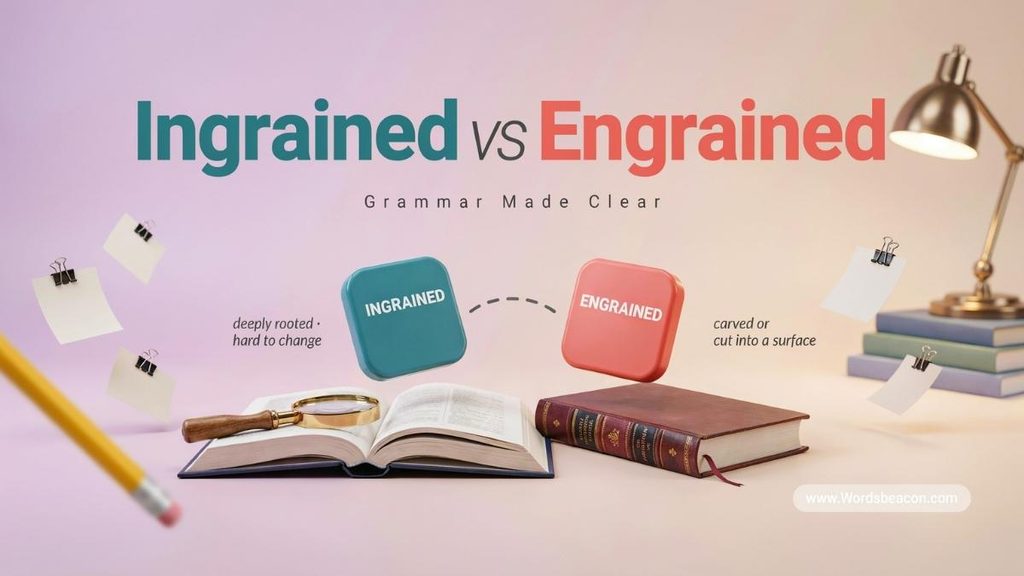
The word engrave is one reason people may naturally choose engrained.
Engrave means to cut, carve, or mark something onto a surface.
For example:
“The artist engraved the design on the metal.”
“The jeweler engraved her name on the ring.”
In these sentences, something physical is being marked or carved.
Ingrained works differently. It usually describes something that has become deeply established.
For example:
“Years of practice ingrained the technique in her memory.”
The distinction is easier when you picture the two words.
Engraving creates a physical mark on a surface. Ingraining describes something becoming deeply fixed in a habit, belief, mind, behavior, or material.
So if you mean carving a name into metal, the word you probably need is engraved, not engrained.
Ingrained vs Engrained Examples
The best way to understand ingrained vs engrained examples is to see the words in natural sentences.
An ingrained habit can develop through years of repetition.
“Waking up early became an ingrained habit.”
An ingrained belief can develop through family, culture, education, or personal experience.
“Respect for elders was an ingrained belief in his family.”
Ingrained behavior can become almost automatic.
“Her ingrained behavior made her check the doors twice before leaving.”
Something can also be ingrained in your mind.
“That childhood memory remains ingrained in my mind.”
The word can describe physical substances too.
“The old stain had become deeply ingrained in the fabric.”
People may use “engrained” in similar contexts because English recognizes it as a spelling variant.
“The community had deeply engrained the tradition.”
However, many readers will find this version more familiar:
“The community had deeply ingrained the tradition.”
That difference in familiarity is the main reason ingrained is usually the better choice.
Ingrained in a Sentence
The phrase ingrained in is especially common.
When something becomes ingrained in a person, group, culture, or mind, it means that it has become deeply established there.
For example:
“Good manners became ingrained in her from childhood.”
“The tradition became ingrained in the local community.”
“His fear of failure became ingrained in his thinking.”
“The habit became so ingrained that he did it without noticing.”
“The smell had become ingrained in the fabric.”
The expression works with both abstract and physical ideas.
Learn the difference between confusing word pairs
Coozie vs Koozie Which one Is Correct?
Ingrained in My Mind Meaning
The phrase ingrained in my mind meaning is quite simple. It means that something has become deeply fixed in your thoughts or memory.
For example:
“My grandmother’s advice is still ingrained in my mind.”
This sentence suggests that the advice has stayed with the person for a long time and continues to influence their thinking.
The phrase does not necessarily mean that the person remembers every word exactly. Instead, the main idea or memory has become deeply established.
You may also see related expressions such as deeply embedded in the mind, firmly fixed in memory, deeply rooted, or etched in memory.
These expressions overlap, but each has a slightly different feel. Ingrained emphasizes something becoming firmly established through time, repetition, or experience.
Ingrained Habit Meaning
An ingrained habit is a behavior that has become deeply established through repetition.
At first, a new routine may require conscious effort. You might have to remind yourself to exercise, organize your desk, check your work, or prepare for the next day.
After repeating the behavior for a long time, it can start to feel automatic.
That is when it can become an ingrained habit.
For example:
“Making a to-do list every morning became an ingrained habit.”
The habit can be positive or negative. The word itself does not judge the behavior.
A person can have an ingrained habit of exercising every morning. Someone else might have an ingrained habit of procrastinating until the last minute.
The key idea is repetition and deep establishment.
Learn the difference between confusing word pairs
Brasil vs Brazil Difference and which one is correct?
Deeply Ingrained Meaning
The phrase deeply ingrained simply makes the idea stronger.
If something becomes ingrained, it has become firmly established. If something becomes deeply ingrained, the writer emphasizes how strongly it has become established.
Compare these sentences:
“The habit has become ingrained.”
“The habit has become deeply ingrained.”
The second sentence suggests that changing the habit may take considerable effort because it has become such a strong part of the person’s routine.
You can use deeply ingrained with beliefs, habits, attitudes, behaviors, traditions, values, and social practices.
For example:
“Her deeply ingrained fear made public speaking difficult.”
“The family deeply ingrained respect for education in its values.”
“His deeply ingrained routine was hard to change.”
You may also encounter deeply engrained. Because English speakers recognize “engrained” as a variant, people use the phrase in English. However, deeply ingrained is the more familiar form.
Ingrained Behavior and Ingrained Beliefs
Ingrained behavior is behavior that has become firmly established through repetition or experience.
For example:
“Checking the locks became an ingrained behavior.”
The person may no longer think carefully about the action. It has become part of the normal routine.
An ingrained belief works in much the same way.
An ingrained belief is an idea or opinion that has become deeply established in someone’s thinking.
For example:
“The idea that success requires constant hard work was an ingrained belief in his family.”
Beliefs can become ingrained through many influences, including upbringing, education, culture, personal experience, and repeated exposure to certain ideas.
That is why the word often appears in discussions about habits, attitudes, traditions, and character.
Fix common more word mistakes in English
Ambience vs Ambiance which one is correct ?
Ingrained vs Engrained in American and British English

The question of ingrained or engrained UK and ingrained or engrained American English can make the issue seem more complicated than it really is.
There is no simple rule saying that American English uses one spelling while British English uses the other.
Ingrained is widely established in both varieties of English. Engrained also appears as a recognized variant.
The main practical difference is familiarity and preference rather than a strict American-versus-British spelling rule.
For American English, this sentence is completely natural:
“The habit is deeply ingrained.”
The same sentence works naturally in British English:
“The habit is deeply ingrained.”
So if you are writing for either audience, ingrained is a reliable choice.
Ingrained vs Engrained Grammar
From a grammar perspective, both forms can function as adjectives.
You can place the adjective before a noun:
1.“an ingrained habit”
2.“an ingrained belief”
3.“an ingrained attitude”
You can also use it after a linking verb:
“The habit is ingrained.”
“The belief became ingrained.”
“The behavior remains ingrained.”
The word does not change for singular and plural nouns.
For example:
“an ingrained habit”
“ingrained habits”
“an ingrained belief”
“ingrained beliefs”
The main concern with ingrained or engrained grammar is therefore not grammatical agreement. The real issue is which spelling fits your intended meaning and writing style.
Fix common more word mistakes in English
Tyre vs Tire difference and which one is correct?
Common Mistakes With Ingrained vs Engrained
One common mistake is assuming that the two spellings must have completely different meanings. In most contexts, they do not. Their meanings overlap closely.
Another mistake is choosing engrained because it looks connected to engrave. The spelling may look logical, but engrave and ingrain have different meanings.
A third mistake is assuming that because engrained appears in a dictionary, it must be equally common everywhere. Dictionary recognition and everyday frequency are not the same thing.
A fourth mistake is using ingrained when engraved is actually the intended word.
Consider this sentence:
“The initials were ingrained into the metal.”
If you mean that someone physically carved the initials into the metal, engraved is clearer:
“The initials were engraved into the metal.”
Ingrained is normally about something becoming deeply established or embedded, not about an artist carving a design.
Ingrained and Physical Dirt
The physical meaning of ingrained is worth remembering because it explains the word’s imagery.
Dirt can become ingrained in fabric. A stain can become ingrained in a carpet. Grime can become ingrained in a surface.
For example:
“The old dirt was ingrained in the carpet.”
Here, the dirt is not simply lying on top. It has become deeply embedded in the material.
This physical sense connects nicely with the figurative meaning.
A habit can become ingrained in your behavior. A belief can become ingrained in your thinking. Dirt can become ingrained in fabric.
In each case, the central idea is depth. Something has moved beyond the surface and become firmly established.
Ingrained vs Engrained A Simple Case Study
Imagine a student who begins checking every assignment twice before submitting it.
During the first few weeks, the student consciously remembers to check the work. After several years, the routine becomes automatic.
At that point, you could describe it as an ingrained habit.
Now imagine a craftsperson carving the student’s name into a wooden desk.
That name has been engraved into the wood.
The two situations sound somewhat similar because both involve something becoming fixed. However, they describe different processes.
The habit becomes deeply established through repetition.
The name becomes physically marked through engraving.
That distinction helps explain why ingrained and engraved should not be treated as interchangeable.
Fix common more word mistakes in English
Peices vs Pieces difference and usage?
How to Remember the Correct Spelling
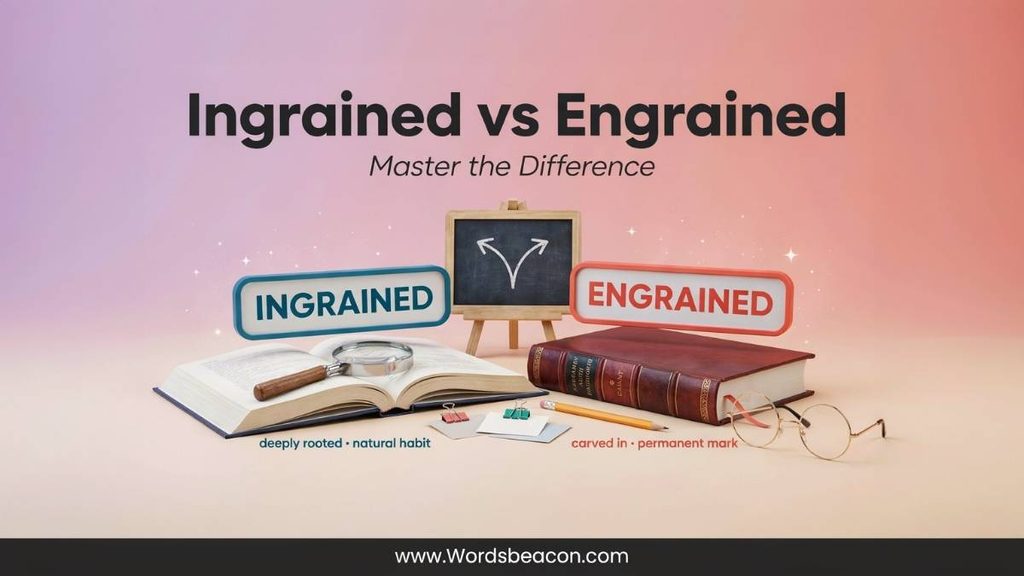
If you regularly forget whether to use “ingrained vs engrained,” connect “ingrained” with the idea of something going deeply “in.”
A habit becomes deeply in your routine.
A belief becomes deeply in your thinking.
A memory becomes deeply in your mind.
That gives you a simple reminder:
Ingrained means deeply established or embedded.
Engrave means physically carve or mark.
The phrase deeply ingrained is also worth remembering because it appears frequently in everyday and formal writing.
Should I Use Ingrained vs Engrained?
If you are wondering, “should I use ingrained or engrained,” the practical answer is simple: use ingrained in most general writing.
That includes school assignments, articles, professional communication, reports, academic writing, and everyday messages.
Engrained is not automatically incorrect. It is a recognized variant. However, ingrained is more familiar to many readers and is the spelling most likely to look natural on the page.
If a particular publication, organization, or style guide prefers one form, follow that standard consistently.
For most writers, though, there is little reason to choose the less familiar form when ingrained communicates the meaning clearly.
Synonyms for Ingrained
Several words can replace ingrained depending on the sentence.
Deeply rooted works well for beliefs, traditions, and attitudes.
Firmly established emphasizes something that has become stable over time.
Deep-seated often describes strong feelings, beliefs, or attitudes.
Deeply embedded emphasizes something that has become firmly fixed within something else.
Second nature works particularly well for skills and habits that have become automatic.
Long-standing describes something that has existed for a long period, although it does not always suggest that the thing is difficult to change.
These words are related, but they are not exact replacements in every sentence.
For example, a long-standing tradition has existed for a long time. An ingrained tradition suggests that the tradition has become deeply established within a group or culture.
Learn the difference between often confused words
Sneek vs Sneak difference and usage?
Practice Session Ingrained vs Engrained
Fill in each blank with the correct word: ingrained vs engrained.
- Years of practice made the technique deeply __________ in her mind.
- His habit of checking his phone every few minutes had become __________.
- The belief was so __________ that changing his opinion was difficult.
- Good manners should become __________ through regular practice.
- The dirt had become __________ in the fabric after years of use.
- Her morning routine was so __________ that she followed it without thinking.
- Fear of failure can become deeply __________ after repeated negative experiences.
- The teacher helped students replace an __________ habit with a healthier one.
- The tradition was firmly __________ in the community.
- The memory of that childhood experience remained __________ in his mind.
- Some attitudes become __________ over time and are difficult to change.
- The stain was __________ in the carpet and could not be removed easily.
- His respect for his parents was deeply __________ in his character.
- The company had an __________ culture of teamwork and cooperation.
- Repeated practice can make a skill feel __________ rather than difficult.
- Her belief in the importance of honesty was deeply __________.
- The behavior had become so __________ that he did it automatically.
- The idea was firmly __________ in the public imagination.
- A long-standing habit can become deeply __________ without you noticing.
- In formal writing, __________ is generally the more familiar spelling for something firmly established or deeply embedded.
Answers
- ingrained
- ingrained
- ingrained
- ingrained
- ingrained
- ingrained
- ingrained
- ingrained
- ingrained
- ingrained
- ingrained
- ingrained
- ingrained
- ingrained
- ingrained
- ingrained
- ingrained
- ingrained
- ingrained
- ingrained
Here’s a trusted source for clear more words Comparison:
Frequently Asked Questions
Is “engrained” accepted in English?
Yes. “Engrained” is a recognized spelling variant of “ingrained.” However, “ingrained” is the more common choice in modern English and is usually the safer option for formal writing.
Does “engrained” have a different meaning from “ingrained”?
No significant difference exists in meaning. Both words can describe something that has become firmly established, deeply rooted, or difficult to change. The main difference is the spelling and how commonly each form is used.
Why is “ingrained” spelled with an “i”?
“Ingrained” comes from the verb “ingrain,” which means to establish something deeply or fix it firmly. The spelling with “in-” has become the more familiar form in modern English.
Is “ingrained” an adjective or a verb?
“Ingrained” can be an adjective and can also serve as the past participle of “ingrain.” As an adjective, it describes something that has become deeply established or firmly fixed.
What does “ingrain” mean when talking about habits?
When “ingrain” describes a habit, it means to establish that habit through repetition. For example, regular practice can ingrain a routine until it becomes almost automatic.
Can “ingrained” describe dirt or stains?
Yes. “Ingrained” can describe dirt, stains, or other material that has become deeply embedded in a surface or fabric. It often suggests that the material is difficult to remove.
What does “ingrained” mean when describing a belief?
An ingrained belief is an idea that has become firmly established in someone’s thinking. Because it has often developed over time, changing that belief may be difficult.
Can a skill become ingrained?
Yes. Repeated practice can make a skill ingrained. Once a skill becomes deeply established, you may perform it naturally without consciously thinking about every step.
Is “ingrained” always used in a negative sense?
No. “Ingrained” can describe positive, negative, or neutral things. For example, an ingrained habit of helping others can be positive, while an ingrained fear may create difficulties.
What does “ingrained behavior” mean?
“Ingrained behavior” is a pattern of behavior that has become firmly established through repetition or experience. It can feel natural or automatic because the person has practiced it for a long time.
Why is “engrained” sometimes confused with “engraved”?
The two words look similar, but they have different meanings. “Engraved” usually means carved, cut, or marked onto a physical surface. “Ingrained” refers to something becoming deeply established or embedded.
Can “ingrained” describe a personality trait?
Yes. It can describe a quality that has become a deeply established part of someone’s character. For example, honesty can become an ingrained part of a person’s behavior.
What does “ingrained over time” mean?
It means that something became firmly established gradually. A habit, belief, attitude, or behavior can become ingrained after being repeated or reinforced for a long time.
Is “ingrained” appropriate for formal writing?
Yes. “Ingrained” works well in academic, professional, formal, and everyday writing. It is a familiar word for describing something that has become deeply established.
What is the difference between “ingrain” and “ingrained”?
“Ingrain” is the base form of the verb, while “ingrained” is its past participle and can also function as an adjective. For example, repetition can ingrain a habit, while the resulting habit can become ingrained.
Can “ingrained” describe a memory?
Yes. An ingrained memory is one that has become deeply fixed in your mind. The word emphasizes that the memory remains strong or difficult to forget.
Is “deep-rooted” always the same as “ingrained”?
They often have similar meanings, but they are not identical in every situation. Both can describe something firmly established. “Deep-rooted” often works with beliefs, traditions, and problems, while “ingrained” is especially common with habits, behaviors, attitudes, and beliefs.
What does “firmly ingrained” mean?
“Firmly ingrained” means that something has become strongly established and is not easy to change. It adds emphasis to the idea that a habit, belief, or behavior is deeply fixed.
Can a tradition become ingrained?
Yes. A tradition can become ingrained when people follow it for so long that it becomes a natural and established part of a family, community, organization, or culture.
What is the easiest way to remember “ingrained”?
Think of “ingrained” as something that has become deeply fixed through time, repetition, or experience. When you are describing a firmly established habit, belief, attitude, or behavior, “ingrained” is the spelling most readers will expect.
conclusion
The ingrained vs engrained confusion is easy to clear up once you know what each spelling means. Ingrained is the more common spelling when you are talking about a habit, belief, behavior, attitude, or memory that has become deeply fixed over time.People also use “engrained” as a spelling variant, but they use it less often.
If you are unsure which one to use, ingrained is usually the better choice for everyday, academic, and professional writing. Also, do not mix up ingrained with engraved. You can have something ingrained in your mind, but you can have a name engraved on a ring. Keep that simple difference in mind, and this tricky little spelling problem becomes much easier to avoid.

Luna AJS is an experienced blogger and dedicated language enthusiast at Words Beacon. She specializes in making English grammar, spelling, vocabulary and commonly confused words easy to understand. She provides clear explanations, practical examples to help readers write with confidence.