

The tying vs tieing confusion can make a simple English spelling rule seem harder than it really is. “Tieing” may look correct because it seems natural to add “-ing” to “tie.” However, the correct spelling is “tying.” When “-ing” is added to a verb ending in “-ie,” the “-ie” changes to “-y.” That gives us tie → tying. This small spelling change is easy to miss, but using the wrong form can make your writing look careless. Whether you are tying your shoes, tying a package, or tying a game, knowing the correct spelling helps you write clearly and confidently without getting tied up in confusion.
Quick Answer
Tying is correct. Tieing is incorrect when you want the present participle or gerund form of tie.
The spelling follows a simple pattern:
tie → tying
The final ie changes to y before the suffix -ing is added. You can see the same pattern in other common verbs:
| Base verb | -ing form |
|---|---|
| tie | tying |
| lie | lying |
| die | dying |
So, if you are asking is tying correct, the answer is yes. If you are asking is tieing correct, the answer is no in standard English.
For example:
“She is tying her shoes.”
“He is tying a knot.”
“The goal was tying the game.”
“Tying the package securely takes practice.”
The correct spelling of tying remains the same whether the word describes a physical action, a figurative connection, or an equal score.
Learn the difference between confusing more English words
Busing vs Bussing difference and which one is correct?
Tying vs Tieing The Basic Difference
The tying vs tieing question comes down to one spelling rule. Tying is the standard form of the verb tie with the suffix -ing. Tieing is a common spelling mistake.
The word tie can mean to fasten something, connect two things, create a relationship, or make two scores equal. When you need its -ing form, English changes the spelling before adding the suffix.
Tying Is the Correct Form
Tying is the present participle and gerund form of tie.
The word can describe many different actions. Someone can be tying a shoelace, tying a package, tying two ropes together, or tying a ribbon around a gift.
For example:
“She is tying her shoes before school.”
“They are tying the ropes together.”
“He is tying a ribbon around the box.”
Tying can also have a figurative meaning.
“The evidence is tying him to the incident.”
Here, tying means connecting someone or something with another person, event, or fact.
The word also appears in sports. If a team makes an unequal score equal, it can be described as tying the game.
Tieing Is the Incorrect Form
Tieing looks logical because you can see the complete word tie inside it. A writer may simply add -ing and assume the result should be tieing.
That approach does not work here.
The correct spelling changes the final ie to y before adding -ing:
tie → tying
Therefore, a sentence such as “She is tieing her shoes” should be corrected to “She is tying her shoes.”
The meaning stays the same. Only the spelling changes.
Why Is Tying Spelled With a Y?
The answer lies in the spelling rule for verbs ending in ie.
When certain verbs ending in ie take the suffix -ing, the final ie changes to y. This gives us the following pattern:
tie → tying
lie → lying
die → dying
This is why the answer to why is tying spelled with y is connected to word formation rather than pronunciation.
The process can be remembered this way:
tie + ing
becomes
tying
The ie does not remain in the word.
This pattern is especially useful because many people already know the word lying. Once you remember lie → lying, the spelling of tie → tying becomes easier to recognize.
Learn the difference between confusing more English words
Brasil vs Brazil Difference and which one is correct?
Tying Definition and Meaning
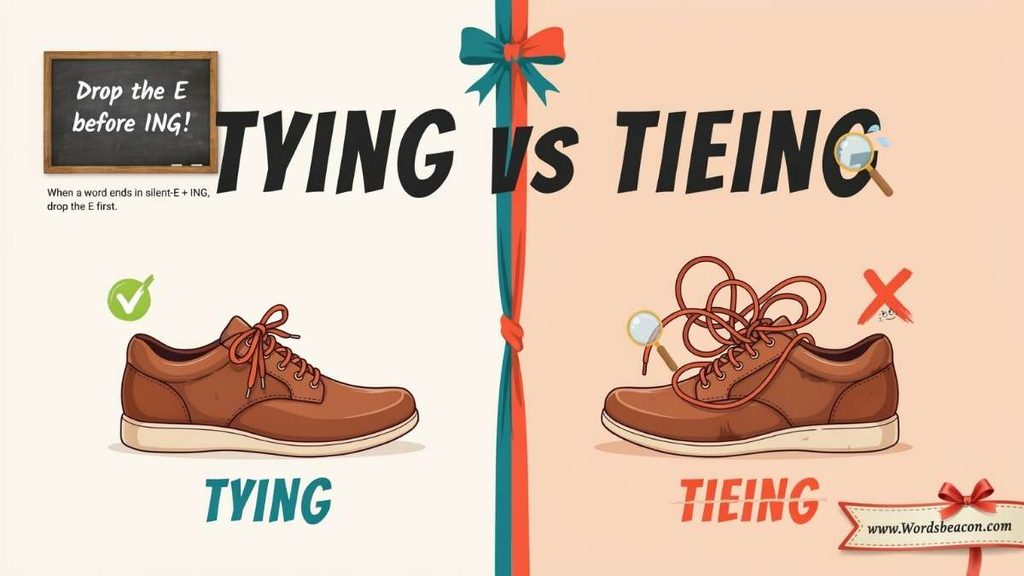
The tying definition depends on the context, but the basic idea involves fastening, connecting, or making things equal.
When someone physically ties something, they usually secure it with a knot, string, rope, cord, ribbon, or another material.
“She is tying the package with a piece of string.”
Tying can also mean connecting things.
“They are tying the two ropes together.”
In figurative language, tying can describe a connection between ideas, events, people, or evidence.
“The final paragraph ties the main ideas together.”
The word can also refer to equal results in sports and competitions.
“The late goal is tying the game.”
So, the tying meaning is not limited to one situation. It depends on how the verb tie is being used.
Tieing Definition and Meaning
The tieing definition is different because tieing is not the standard -ing form of tie.
When someone writes tieing, they usually mean tying. There is no need to give the incorrect spelling a separate meaning when the intended word is clear.
For example:
Incorrect: “He is tieing his shoes.”
Correct: “He is tying his shoes.”
Incorrect: “The team is tieing the game.”
Correct: “The team is tying the game.”
If you are searching for the tieing meaning, the useful word to check is tying.
Tie + Ing How Does the Spelling Work?
The easiest way to understand tie + ing is to avoid simply attaching the suffix to the complete base verb.
The incorrect approach looks like this:
tie + ing = tieing
The standard spelling pattern works like this:
tie → replace ie with y → add ing → tying
This is the tie + ing spelling rule you need to remember.
The same idea appears in verbs ending in ie, such as lie and die.
| Base verb | Correct -ing form |
|---|---|
| tie | tying |
| lie | lying |
| die | dying |
English spelling can be full of surprises, but this pattern is quite consistent with these familiar verbs.
Tie Verb Forms
Knowing the different tie verb forms can make the spelling easier to understand.
| Verb form | Word | Example |
|---|---|---|
| Base verb | tie | “Please tie the rope.” |
| Third-person singular | ties | “She ties her shoes quickly.” |
| Past tense | tied | “He tied the package.” |
| Past participle | tied | “The rope was tied securely.” |
| Present participle | tying | “She is tying the rope.” |
| Gerund | tying | “Tying knots takes practice.” |
The present participle of tie is tying.
The past tense and past participle are both tied, while the present participle changes the spelling more noticeably.
That gives you the main verb forms:
tie, ties, tied, tied, tying
There is no standard form of tieing in this conjugation.
Learn the difference between confusing more English words
Ambience vs Ambiance difference and which one is correct ?
Tying as a Present Participle
The present participle of tie is tying.
You usually see it after a form of be when describing an action in progress.
“She is tying her shoes.”
“They are tying the ropes.”
“I was tying the package when the phone rang.”
In each sentence, tying describes an action that is happening or was happening at a particular time.
The spelling does not change based on the subject.
I am tying.
She is tying.
They are tying.
We were tying.
Tying as a Gerund
Tying can also function as a gerund. A gerund is an -ing form that works as a noun.
For example:
“Tying knots takes practice.”
Here, tying names the activity rather than describing what someone is doing at that exact moment.
Another example is:
“She enjoys tying fishing knots.”
The spelling remains tying even though the grammatical role changes.
This is why learning only the present continuous form is not enough. The same word can serve different grammatical purposes.
Learn the difference between similar English words
Tyre vs Tire difference and which one is correct?
Tying Shoes The Correct Spelling
Tying shoes is one of the most common everyday uses of the word.
If you are wondering about tying vs tieing shoes, always choose tying.
Correct:
“She is tying her shoes.”
Incorrect:
“She is tieing her shoes.”
The phrase refers to fastening shoelaces. It does not require a different spelling because shoes are involved.
The same rule applies whether someone is tying sneakers, boots, dress shoes, or another type of footwear.
Tying a Knot
You can tie a knot, and when you describe the action, you use tying a knot.
For example:
“He is tying a knot in the rope.”
“Tying a secure knot takes practice.”
The word can describe simple everyday activities as well as specialized skills such as sailing, climbing, fishing, crafts, or securing equipment.
Again, the spelling stays the same:
tie → tying
Tying the Knot
Tying the knot has both a literal and an idiomatic meaning.
Literally, it can describe the act of tying an actual knot:
“She is tying the knot in the rope.”
However, tying the knot is also a common expression meaning getting married.
“They are tying the knot this summer.”
In this idiomatic use, no physical knot is necessary. The phrase refers to marriage.
If you are wondering about tying vs tieing the knot, the correct phrase is tying the knot.
Tying a Game Meaning
The phrase tying a game has a specific meaning in sports.
Tying a game means making the scores equal.
Imagine a soccer match where one team trails 2–1. The trailing team scores another goal and makes the score 2–2. That goal has tied the game.
For example:
“The team scored in the final minute, tying the game.”
“The three-point shot was tying the game.”
“The late goal gave them a chance to finish by tying the game.”
The phrase can also appear with score:
“The basket was enough for tying the score.”
However, depending on the sentence, “tying the score” or “to tie the score” may sound more natural.
Tying for First Place
Tying can also describe an equal position in a competition.
For example:
“Both players are tied for first place.”
You can also encounter the ongoing form:
“The two players are tying for first place.”
The exact construction depends on what is happening and what the sentence intends to describe.
Learn the difference between similar English words
Sneek vs Sneak difference and usage?
Tying Up and Tying Down
The Tying also appears in common phrasal expressions.
Tying Up
Tying up can mean physically securing something.
“They are tying up the boat.”
“She is tying up the package.”
It can also have a figurative meaning.
“The paperwork is tying up the project.”
In this sentence, tying up means delaying or restricting progress.
Tying Down
Tying down can mean securing something so it cannot move easily.
“They are tying down the equipment.”
The phrase can also describe restriction in a figurative sense.
“The contract is tying him down.”
Here, tying down means limiting someone’s freedom or choices.
These expressions still follow the same spelling pattern. You do not write tieing up or tieing down in standard English.
Common Mistakes With Tying vs Tieing
The most common mistake is adding -ing directly to the word tie.
A writer may think:
tie + ing = tieing
That looks reasonable at first. However, English spelling rules require the ie ending to change before the suffix is added.
The correct form is:
tie → tying
Another mistake happens when writers forget that tie belongs to the group of verbs ending in ie.
Compare:
lie → lying
die → dying
tie → tying
Seeing the pattern makes the correct spelling much easier to remember.
Some people also assume that both forms might be acceptable because tieing is easy to understand. In standard English, however, tying is the form to use in schoolwork, professional writing, articles, emails, and everyday communication.
Tying vs Tieing in Real Sentences
Real examples make the difference much clearer.
| Incorrect | Correct |
|---|---|
| “She is tieing her shoes.” | “She is tying her shoes.” |
| “He is tieing a knot.” | “He is tying a knot.” |
| “They are tieing the ropes together.” | “They are tying the ropes together.” |
| “The goal is tieing the game.” | “The goal is tying the game.” |
| “She is tieing a ribbon.” | “She is tying a ribbon.” |
| “Tyeing the package takes time.” | “Tying the package takes time.” |
The correction is simple in every case. Replace tieing with tying.
Learn the difference between similar English words
Peices vs Pieces difference and usage?
A Simple Case Study Why People Write Tieing
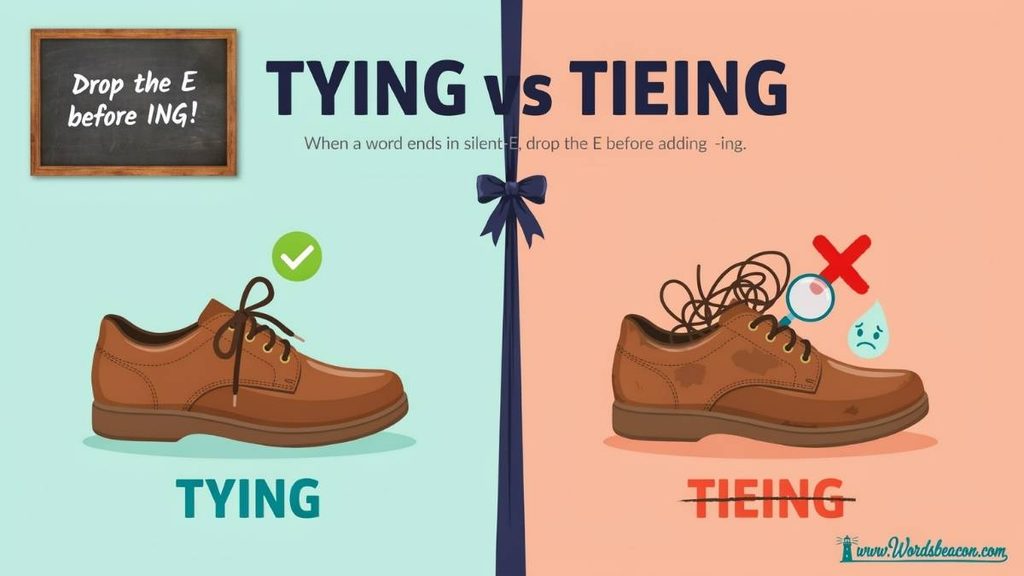
Consider a student writing this sentence:
“Tom is tieing his shoes.”
The student probably knows the base verb is tie. They simply added -ing to the end of the word.
That gives:
tie + ing = tieing
The problem is that the student has missed the spelling pattern for verbs ending in ie.
The correct process is:
tie → tying
So the final sentence becomes:
“Tom is tying his shoes.”
Now consider a different sentence:
“The late goal is tieing the game.”
The same mistake appears even though the meaning of tie has changed. Here, tie means making the score equal rather than fastening something.
The corrected sentence is:
“The late goal is tying the game.”
This shows an important point: the meaning can change with context, but the spelling rule stays the same.
A Second Case Study Tying as a Gerund
Consider this sentence:
“Tieing knots takes practice.”
The writer may know that the sentence needs an -ing form because the activity appears at the beginning of the sentence. However, the spelling still needs to follow the same rule.
The correct sentence is:
“Tying knots takes practice.”
Here, tying works as a gerund. It acts as the subject of the sentence.
Compare that with:
“She is tying knots.”
In this sentence, tying is a present participle.
The grammatical roles differ, but the spelling stays exactly the same.
A Third Case Study Tying a Game
Imagine a basketball team is behind 78–76 with only a few seconds remaining. A player scores two points, making the score 78–78.
A sports report might say:
“The basket was tying the game.”
More naturally, a writer could say:
“The basket tied the game.”
Or:
“The basket gave the team a chance to tie the game.”
However, if the writer uses the -ing form, it must be tying rather than tieing.
This is another useful example of how the correct verb form depends on grammar while the spelling pattern remains fixed.
Learn the difference between similar English words
Crier vs Cryer Difference and usage ?
How to Remember the Correct Spelling of Tying
The easiest memory trick is to remember three verbs together:
tie → tying
lie → lying
die → dying
All three end in ie and change that ending to y before -ing.
A simple rule to keep in mind is:
ie changes to y before ing.
So when you ask how to spell tying, think of the sequence:
tie → y → ing → tying
Do not preserve the original ie.
This also helps answer why is tieing incorrect. The spelling does not follow the standard pattern used for this verb.
Tying vs Tieing in Different Expressions
The answer remains the same in different contexts.
| Expression | Correct form |
|---|---|
| Tying or tieing shoes | tying shoes |
| Tying or tieing a game | tying a game |
| Tying or tieing the knot | tying the knot |
| Tying or tieing a package | tying a package |
| Tying or tieing a rope | tying a rope |
| Tying or tieing ideas together | tying ideas together |
| Tying or tieing someone to an incident | tying someone to an incident |
The meaning changes according to the sentence, but the spelling never changes to tieing.
Learn the difference between similar English words
Laid Down vs Lied Down Difference and usage?
Tying vs Tieing Which Is Correct in American English?
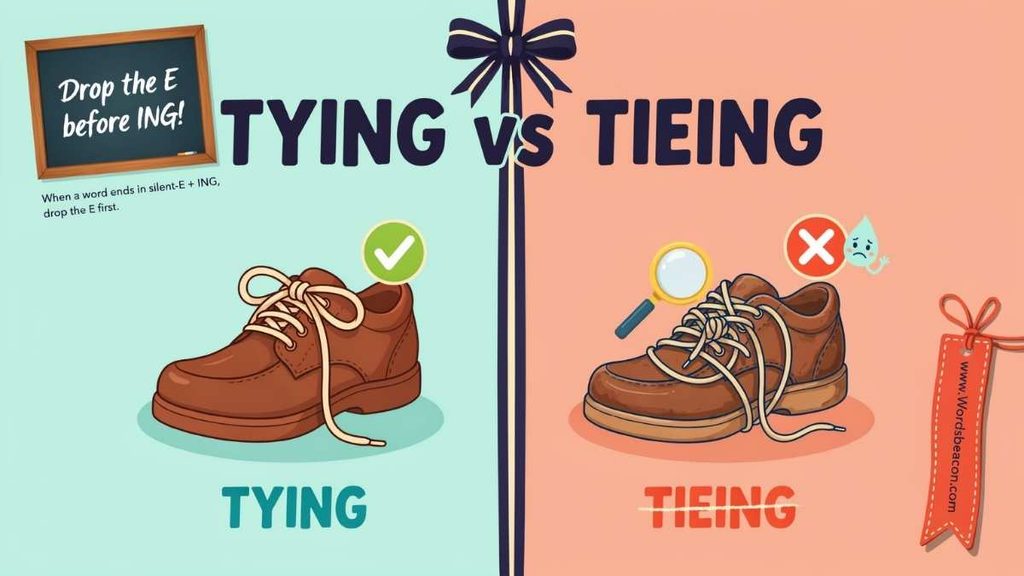
In standard US English, tying is the correct spelling for the -ing form of tie.
There is no American English rule that makes tieing the preferred alternative. If you are writing an essay, email, report, article, school assignment, or social media post, use tying.
The spelling pattern is part of standard English word formation.
Is Tying Correct?
Yes. Tying is correct.
It is the present participle and gerund form of tie.
You can use it when talking about fastening something, connecting things, creating a figurative relationship, or making a game score equal.
Examples include:
“She is tying her shoes.”
“They are tying the ropes together.”
“He is tying a package.”
“The goal is tying the game.”
“Tying the knot” is a common expression for getting married.
Is Tieing Correct?
No. Tieing is not the standard spelling of the -ing form of tie.
If you write tieing in an ordinary sentence, replace it with tying.
Incorrect:
“I am tieing my shoes.”
Correct:
“I am tying my shoes.”
The same correction applies to phrases such as tieing a knot, tieing up a package, and tieing the game.
Is Tieing a Word?
Tieing is not the standard modern form of the verb tie with -ing.
When you need the present participle or gerund, use tying.
Although unusual spellings can sometimes appear in historical texts, names, specialized sources, or accidental writing, that does not make tieing the standard form for modern English grammar.
For normal writing, the choice is simple:
tying is correct.
tieing is incorrect.
Learn the difference between tricky grammar words
Seel vs Seal Difference and usage?
Tying vs Tieing Synonyms
If you are looking for a tying vs tieing synonym, the right choice depends on the meaning.
1.When tying means fastening something, words such as fastening, securing, binding, and knotting can sometimes work.
2.When it means connecting ideas or things, linking, joining, connecting, and associating may fit.
3.When it refers to a score, equalizing or leveling may express a similar idea.
Still, synonyms do not always have exactly the same meaning.
For example, tying shoes and fastening shoes can describe a similar action, but tying is the natural word when you specifically mean securing shoelaces with a knot.
Quick Grammar Check
When you are unsure about the spelling, ask yourself one question: What is the base verb?
If the base verb is tie and you need the -ing form, write tying.
If you see tieing, check the spelling again.
The pattern is:
tie → tying
lie → lying
die → dying
That small pattern can save you from one of the most common spelling errors involving verbs ending in ie.
Learn the difference between tricky grammar words
Truly vs Truely difference and usage?
Practice Tying vs Tieing
Fill in each blank with the correct form. Tying vs Tieing
- I am ________ my shoelaces before leaving the house.
- She was ________ a ribbon around the gift.
- The players scored again, ________ the game at 2–2.
- He is ________ the ropes together.
- They are ________ the knot at the wedding ceremony.
- Please stop ________ your brother to the chair as a joke.
- I spent ten minutes ________ the package securely.
- The team is ________ for first place in the competition.
- She is ________ her hair before going outside.
- He was busy ________ up loose cables.
- The correct present participle of “tie” is ________.
- The spelling ________ changes “tie” to “tying” before the suffix -ing.
- When a verb ends in -ie, English spelling rules may require you to drop -ie and add ________.
- “Tieing” is a common spelling ________ rather than the standard form.
- The correct spelling is ________, not “tieing.”
- In the sentence “She is tying her shoes,” “tying” acts as the present ________ of “tie.”
- The phrase “tying the knot” means ________ married.
- If two teams have the same score, one team may be ________ the game.
- The verb forms of “tie” include tie, ties, ________, and tying.
- If you are unsure how to spell “tying,” remember: tie → ________.
Answers
- tying
- tying
- tying
- tying
- tying
- tying
- tying
- tying
- tying
- tying
- tying
- rule
- -ying
- mistake
- tying
- participle
- getting
- tying
- tied
- tying
Here’s a trusted source for clear more words Comparison:
FAQs
Can “tieing” be used as the -ing form of “tie”?
No. In standard modern English, “tying” is the correct -ing form of “tie.” The spelling changes from “tie” to “tying,” not “tieing.”
Why does “tie” change when we add -ing?
Because verbs ending in -ie follow a special spelling pattern. Before adding -ing, the final -ie changes to -y. That gives you tie → tying. The same pattern appears in lie → lying and die → dying.
What is the base verb of “tying”?
The base verb is “tie.” Its common forms are tie, ties, tied, and tying. “Tying” works as both the present participle and gerund, depending on how you use it in a sentence.
Can “tying” have a figurative meaning?
Yes. “Tying” does not always involve ropes, strings, or physical objects. It can also describe making a connection between ideas, people, events, or situations. For example, “The evidence is tying the suspect to the scene” describes a connection rather than a physical knot.
Can “tying” refer to equal results?
Yes. In games and competitions, “tying” can describe reaching the same score or result as another player or team. For example, “The final goal put them at 2–2, tying the game.”
Can “tying” work as a noun?
Yes. When “tying” functions as a gerund, it can act like a noun. For example, “Tying knots requires patience.” Here, “tying” names the activity rather than describing what someone is doing at that moment.
Can “tying” be part of a longer verb phrase?
Yes. You can use “tying” with helping verbs to describe an ongoing action. For example, “She is tying the package” uses “is tying” as a present progressive verb phrase.
Does “tying” have more than one meaning?
Yes. Depending on the context, “tying” can mean fastening something, connecting things, creating an association, reaching an equal score, or forming part of an idiomatic expression. The surrounding words usually make the intended meaning clear.
Can you use “tying” with “to”?
Yes. “Tying to” can be correct when it expresses a connection or relationship. For example, “The report is tying the delay to a technical problem” shows that the report connects the delay with the problem.
Is “tying into” grammatically correct?
Yes. “Tying into” is a standard expression when you mean connecting with, relating to, or fitting into something. For example, “This lesson is tying into the topic we discussed earlier.”
Can “tying” describe securing several objects together?
Yes. “Tying” commonly describes fastening or connecting objects with string, rope, wire, or another material. For example, “He is tying the boxes together” clearly shows this physical meaning.
What words can replace “tying”?
The best synonym depends on the context. You might use “fastening,” “securing,” “connecting,” “binding,” or “linking.” For example, “securing the package” can replace “tying the package” when the focus is on keeping it firmly closed.
What is the opposite of “tying”?
The opposite depends on what you are describing. “Untying” works for knots and cords, while “separating,” “disconnecting,” or “loosening” may work for other situations.
Can “tying” describe a connection between two ideas?
Yes. “Tying ideas together” means connecting them so their relationship becomes clear. For example, “The conclusion is tying the main arguments together” shows how the ideas work as one complete point.
Why is “tieing” such a common spelling mistake?
“Tieing” looks logical because people often assume they can simply add -ing to the base verb. However, English spelling rules treat verbs ending in -ie differently. Remembering the tie → tying pattern makes the correct spelling easier to recognize.
Can “tying” be used in the past progressive tense?
Yes. You can use “was tying” or “were tying” to describe an action that was happening in the past. For example, “She was tying her shoes when the phone rang.”
Can “tying” be used in the future progressive tense?
Yes. “Will be tying” describes an action that will be happening at a particular future time. For example, “They will be tying the decorations before the event begins.”
Is “tying” always pronounced with two syllables?
In standard pronunciation, “tying” is generally pronounced with two syllables, while “tie” has one syllable. The spelling may look unusual, but the pronunciation follows the natural formation of the word.
What is the easiest way to remember “tying”?
Think of the spelling as a small transformation: tie loses its final -ie and takes -ying. So the pattern is tie → tying. Once you remember that change, the “tying vs tieing” confusion becomes much easier to avoid.
conclusion
The tying vs tieing confusion is easy to clear up once you know the spelling rule. Tying is the correct spelling, while tieing is a common mistake. When you add -ing to the verb tie, the final -ie changes to -y, giving you tying.
You can use tying when talking about tying your shoes, tying a package, tying a knot, or tying a game. Just remember the simple pattern: tie → tying. Once that sticks, you will not have to stop and wonder which spelling looks right. And thankfully, this little spelling rule does not have to tie you up in knots!

Luna AJS is an experienced blogger and dedicated language enthusiast at Words Beacon. She specializes in making English grammar, spelling, vocabulary and commonly confused words easy to understand. She provides clear explanations, practical examples to help readers write with confidence.