
Labelling vs labeling may look like a tiny spelling issue, but that extra L can make you stop and wonder which version is right. Here is the simple answer: both are correct. American English uses “labeling,” while British English uses “labelling.” The meaning does not change, and neither spelling is a grammar mistake. The difference comes from regional spelling rules. In this guide, you will see why the two forms exist, when to use each one, and how “labeled” and “labelled” fit into the same pattern. Once you understand the rule, this spelling mix-up becomes much easier to handle without second-guessing every L.
Quick Answer
Both labelling and labeling are correct spellings.
American English uses labeling.
British English uses labelling.
The meaning stays the same in both varieties. For example, an American writer might say, “The company is labeling the products,” while a British writer would normally write, “The company is labelling the products.”
The same difference appears in related forms.
| Word form | American English | British English |
|---|---|---|
| Base verb | label | label |
| Present participle | labeling | labelling |
| Gerund | labeling | labelling |
| Past tense | labeled | labelled |
| Past participle | labeled | labelled |
| Person who labels | labeler | labeller |
So, if you are wondering, “Is labeling or labelling correct?” the answer depends on which variety of English you are using.
Learn how to use confusing more words correctly
Tying vs Tieing which one is correct?
What Does Labeling vs Labelling Mean?
Before sorting out the spelling, it helps to understand what the word actually means.
The verb label means to put a label on something or to give something a particular name, description, or category. A physical label might appear on a bottle, package, folder, diagram, or piece of clothing.
For example:
“The store labels every package with a delivery address.”
Here, label refers to the physical act of putting identifying information on something.
However, label can also have a figurative meaning. You can label a person, idea, behavior, or situation by giving it a particular description or category.
For example:
“It is unfair to label someone a failure after one mistake.”
No sticker appears in this sentence. Instead, label means to describe or classify someone in a particular way.
Labeling definition
The labeling definition is the act of putting a label on something or assigning a name, description, or category to it.
You might be labeling a package, labeling a diagram, labeling a folder, labeling ingredients, or labeling someone according to a particular characteristic.
Labelling definition
The labelling definition is exactly the same. The additional l does not change the meaning.
That is the key point to remember. Labelling and labeling describe the same action. The spelling changes because British and American English use different spelling conventions.
Fix common more word mistakes in English
Busing vs Bussing difference and which one is correct?
Labelling vs Labeling Why Are There Two Spellings?
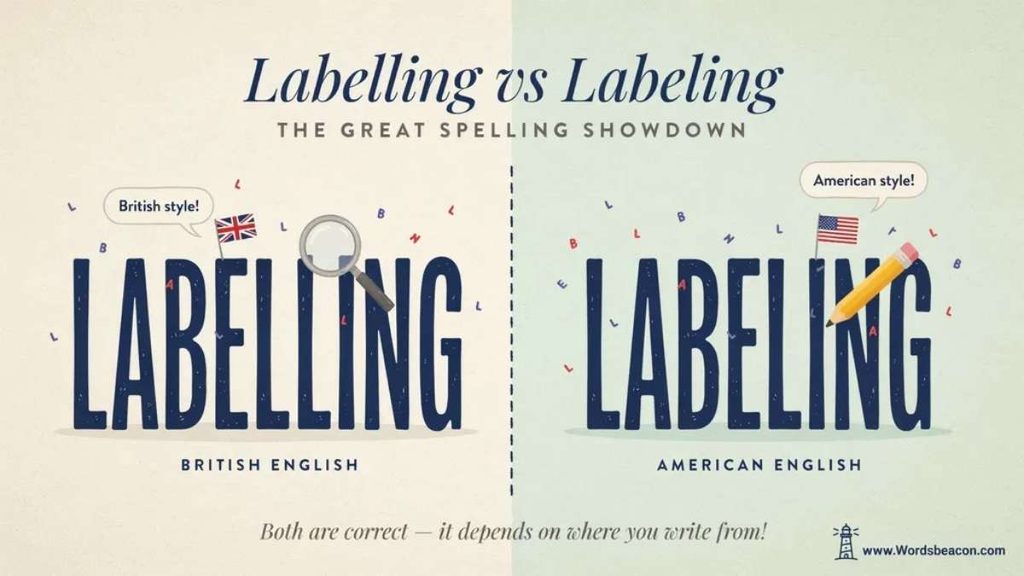
The difference between labeling and labelling comes from regional spelling.
British English generally doubles the final l when certain words take endings such as -ing or -ed. American English often keeps a single l in these forms.
That gives us a clear contrast:
British English: label → labelling → labelled → labeller
American English: label → labeling → labeled → labeler
The base word label remains the same. The spelling changes when the word takes a suffix.
This is a spelling variation, not a difference in grammar or meaning. It is similar to other regional spelling differences found throughout the English language.
For example, American English usually writes traveling, while British English writes travelling. American English uses canceled, while British English uses cancelled. Similarly, American English uses labeling, while British English uses labelling.
These patterns are useful comparisons, but English spelling contains several exceptions. It is better to learn established forms rather than assume that every word follows exactly the same rule.
Labelling in British English
Labelling in British English is the standard form used for the -ing form of label.
For example:
“The company is labelling its new products.”
“The teacher is labelling the parts of the diagram.”
“The report discusses food labelling requirements.”
The extra l does not change how the word functions in a sentence. It simply reflects British spelling.
The same pattern continues with the past form. British English uses labelled.
For example:
“The boxes were labelled correctly.”
“The diagram was clearly labelled.”
“The products were labelled before they were shipped.”
British English also commonly uses labeller for a person who labels something.
This creates a simple pattern:
label → labelling → labelled → labeller
If you are writing in British English, these forms work together naturally.
Labeling in American English
Labeling in American English uses one l before the -ing ending.
For example:
“The company is labeling its new products.”
“The teacher is labeling the parts of the diagram.”
“The report discusses food labeling requirements.”
American English also uses labeled for the past form.
For example:
“The boxes were labeled correctly.”
“The diagram was clearly labeled.”
“The products were labeled before they were shipped.”
The noun labeler follows the same spelling pattern.
The American pattern is:
label → labeling → labeled → labeler
This spelling is not an informal shortcut. It is the standard American spelling.
Fix common more word mistakes in English
Brasil vs Brazil Difference and which one is correct?
Labeling vs Labelling Comparison
The easiest way to see the difference is to place the forms side by side.
| Meaning or function | American English | British English |
|---|---|---|
| Base verb | label | label |
| Action in progress | labeling | labelling |
| Past action | labeled | labelled |
| Person performing the action | labeler | labeller |
| Meaning | Same | Same |
| Pronunciation | Essentially the same | Essentially the same |
There is no difference in the underlying word. A reader understands the same idea whether the sentence contains labeling or labelling.
The spelling simply tells you which regional convention the writer is following.
Fix common more word mistakes in English
Laid Down vs Lied Down Difference and usage?
Labeling vs Labelling Which One Should You Use?
Choosing between labeling or labelling is usually straightforward. First, identify the variety of English used by your audience or publication.
If you are writing in American English, use labeling.
If you are writing in British English, use labelling.
The most important thing is consistency. A document should not switch between American and British spelling without a clear reason.
For example, suppose an American English article uses color, center, traveling, and canceled. In that same article, labeling fits naturally.
On the other hand, a British English article might use colour, centre, travelling, and cancelled. In that setting, labelling is the natural choice.
Neither system is universally better. They are simply different varieties of standard written English.
Use labelling when writing in British English
Choose labelling when your document follows British English spelling conventions.
For example:
“The teacher is labelling the diagram.”
“The company changed its product labelling policy.”
“The boxes were labelled before delivery.”
Use labeling when writing in American English
Choose labeling when your document follows American English spelling conventions.
For example:
“The teacher is labeling the diagram.”
“The company changed its product labeling policy.”
“The boxes were labeled before delivery.”
What if you are unsure?
Look at the spelling style used throughout your document.
If you already use American forms such as color, favorite, center, and traveling, labeling will usually fit that style.
If you use British forms such as colour, favourite, centre, and travelling, labelling will usually fit better.
A grammar checker can also help if you set it to the correct variety of English. A tool using US English may prefer labeling, while one using UK English may prefer labelling.
The important thing is to check the language setting before treating one spelling as an error.
Learn the difference between similar English words
Seel vs Seal Difference and usage?
Labeled vs Labelled What Is the Past Tense of Label?
The question of labeled vs labelled often appears immediately after the labeling vs labelling question.
Both forms are correct.
American English uses labeled.
British English uses labelled.
For example:
American English:
“The technician labeled every wire.”
British English:
“The technician labelled every wire.”
Both sentences describe an action that happened in the past.
The forms also work as past participles.
“The package was labeled correctly.”
“The package was labelled correctly.”
So, if someone asks for the past tense of label, the answer depends on the variety of English:
American English: labeled
British English: labelled
What is the past tense of labeling?
Labeling itself is not the past tense. It is the -ing form of the verb label.
For example:
“She is labeling the boxes.”
The word labeling describes an action in progress.
To describe the completed action in American English, use labeled:
“She labeled the boxes yesterday.”
In British English, use labelled:
“She labelled the boxes yesterday.”
Understanding the grammatical forms makes the spelling much easier to remember.
| Grammatical form | American English | British English |
|---|---|---|
| Base form | label | label |
| -ing form | labeling | labelling |
| Past tense | labeled | labelled |
| Past participle | labeled | labelled |
Labeller vs Labeler What About the Person Who Labels?
The spelling difference also appears in the noun used for a person who labels something.
American English uses labeler.
British English uses labeller.
For example:
“The labeler checked the packages before shipping.”
“The labeller checked the packages before shipping.”
Both sentences refer to a person performing the same task.
This follows the same regional spelling pattern found in labeling and labelling.
American English:
label → labeling → labeled → labeler
British English:
label → labelling → labelled → labeller
Once you recognize the pattern, these related forms stop looking like separate spelling problems.
Learn the difference between similar English words
Ambience vs Ambiance difference and which one is correct ?
Labeling vs Labelling in Real-Life Examples
The word appears in many everyday situations. It is not limited to stickers on products.
Labeling products
Labeling products is common in manufacturing, retail, shipping, and food production.
For example:
“The company is labeling products before they reach stores.”
Product labels can provide important information such as the product name, ingredients, quantity, instructions, warnings, storage information, and manufacturer details.
In British English, the same idea would normally appear as:
“The company is labelling products before they reach stores.”
The spelling changes, but the business activity does not.
Product labeling can also have legal and regulatory importance. Food packaging, for example, may need to provide specific information so consumers can identify what a product contains and how it should be used or stored.
That is why labeling is not always just a matter of making a package look neat. In many industries, accurate labels are an important part of communication and consumer information.
Labeling diagrams
Teachers and students often use the word when identifying parts of a diagram.
An American student might write:
“I am labeling the parts of the cell.”
A British student might write:
“I am labelling the parts of the cell.”
The base verb label stays unchanged.
This is an important detail. You do not change label to a different base word. Only the spelling of the derived form changes.
Labeling files and digital information
Technology has created even more situations where labeling is useful.
You might label a folder, image, email, dataset, document, button, or category.
For example:
“The research team is labeling thousands of images.”
In British English:
“The research team is labelling thousands of images.”
Here, labeling means assigning information or a category that helps identify and organize the data.
This use is especially common in data management and classification. A label can tell users what something represents without requiring a long explanation.
Labeling people or ideas
Label can also describe the act of assigning a description to a person or idea.
For example:
“People sometimes label an unfamiliar idea as strange before understanding it.”
This use is figurative. The word label represents a category or description rather than a physical object attached to something.
Because labels can influence how people understand a person or idea, this meaning often appears in discussions about language, education, psychology, media, and social behavior.
Learn the difference between similar English words
Tyre vs Tire difference and which one is correct?
Common Labelling vs Labeling Mistakes
The biggest mistakes usually come from treating regional spelling as if only one form can ever be correct.
Mixing both spellings
Switching between labeling and labelling in the same document can make your writing look inconsistent.
For example:
“The company is labeling its products. Later, the team started labelling the packages.”
There is no grammatical reason for the spelling to change halfway through the document.
If the document follows American English, use labeling consistently.
If it follows British English, use labelling consistently.
Assuming one spelling is always wrong
Labelling is not simply a misspelling of labeling.
Likewise, labeling is not a careless version of labelling.
Both forms belong to established varieties of standard English. The intended audience and writing style determine which form fits.
This is one of the most important points in the labeling vs labelling grammar discussion.
Confusing labeling with labeled
These forms have different grammatical functions.
Labeling or labelling is the -ing form:
“She is labeling the boxes.”
Labeled or labelled is the past form:
“She labeled the boxes yesterday.”
Changing the spelling alone does not fix a grammatical problem. You also need to choose the form that fits the sentence.
Adding too many letters
The correct forms are labeling and labelling.
A common typing mistake is to add another l and create an incorrect form such as labellling.
That is not necessary.
Remember the two standard choices:
American English: labeling
British English: labelling
There is no need to keep adding letters until the word looks like it needs its own luggage tag.
Thinking pronunciation tells you the spelling
Pronunciation does not usually help you choose between the two forms.
Labeling and labelling are generally pronounced the same way. The additional written l in the British form does not create an additional spoken syllable.
That means someone can say the word aloud without giving you any clue about which spelling they would use.
This is why the issue belongs mainly to written English rather than spoken English.
Learn the difference between confusing more English words
Sneek vs Sneak difference and usage?
Labeling vs Labelling Grammar Is There a Difference?
When people search for labeling vs labelling grammar, they may expect the two forms to follow different grammatical rules.
They do not.
Both forms function as the present participle or gerund of the verb label.
For example:
“Labeling the boxes takes time.”
“Labelling the boxes takes time.”
The grammatical structure is identical.
The same applies to labeled and labelled:
“The files were labeled correctly.”
“The files were labelled correctly.”
The grammar remains unchanged.
Therefore, the difference is best understood as regional spelling rather than a grammar difference.
How to Spell Labeling
If you are asking how to spell labeling in American English, the correct form is labeling.
It has one l before the -ing ending.
For example:
“The worker is labeling the containers.”
This is the standard American spelling.
If your document follows US English, labeling is the form to choose.
How to Spell Labelling
If you are asking how to spell labelling in British English, the correct form is labelling.
It has two l’s before the -ing ending.
For example:
“The worker is labelling the containers.”
This is the standard British spelling.
The spelling difference is small, but it becomes easy to remember once you connect it with the regional English variety.
Learn the difference between confusing more English words
Peices vs Pieces difference and usage?
Labeling vs Labelling in Canada?
The question of Canadian spelling, labeling or labelling, is slightly more complicated because Canadian English has influences from both British and American English.
Both forms can be found in Canadian usage. However, labelling is well established in Canadian official and formal usage.
For example, Canadian government and regulatory material commonly uses labelling when discussing food and consumer information.
Because Canadian English has its own conventions, the safest approach in formal Canadian writing is to follow the style guide or terminology used by the organization.
So, if you are asking, “How do you spell labeling in Canada?” the answer is not as simple as saying that Canadians always use one form. Labelling is widely established, while variation can occur depending on the context and style guide.
Labeling vs Labelling in Australia?
Australian English generally uses labelling.
For example:
“The manufacturer is labelling the products correctly.”
“The products were clearly labelled.”
Australian English shares many spelling conventions with British English, although Australian English also has its own established vocabulary and usage preferences.
Therefore, if you are writing for an Australian audience, labelling is the natural spelling in standard Australian English.
Are Labeling and Labelling Pronounced the Same?
Yes. Labeling and labelling are generally pronounced the same.
The difference exists mainly in written English.
The extra l in labelling does not create an additional syllable. It is simply part of the British spelling convention.
That means you cannot normally hear whether a speaker would write labeling or labelling.
The same applies to labeled and labelled. The pronunciation is generally the same even though the spelling differs.
Case Study Product Packaging
Consider a company that sells packaged food in both the United States and the United Kingdom.
Its US materials might say:
“Our team is labeling every package with ingredient and allergen information.”
Its UK materials might say:
“Our team is labelling every package with ingredient and allergen information.”
The spelling changes, but the process remains exactly the same.
The company still puts information on the package. The customer still reads that information. The only difference is the regional spelling convention used in the written material.
This example shows why it is useful to separate spelling from meaning. A different number of l’s does not turn one word into another word.
Case Study Academic Diagrams
Imagine a biology class where students must identify parts of a cell.
An American textbook might instruct students to label the diagram. A student could then write:
“I am labeling the parts of the cell.”
A British student could write:
“I am labelling the parts of the cell.”
The instruction itself may use label because the base form does not change between these varieties.
The difference appears when the student uses the -ing form.
This provides a useful way to remember the spelling. When the word stays as label, both varieties use the same form. When the suffix is added, regional spelling conventions can create labeling and labelling.
A Simple Memory Trick for Labelling vs Labeling
The easiest memory trick is short enough to remember without turning it into a spelling lecture.
US English uses labeling.
UK English uses labelling.
Then connect the past forms:
US English uses labeled.
UK English uses labelled.
You can also compare the pattern with familiar spelling differences such as traveling and travelling or canceled and cancelled.
The important thing is not to memorize dozens of isolated words. Instead, recognize the regional spelling system your writing follows.
Learn the difference between confusing more English words
Crier vs Cryer Difference and usage ?
Practice Session Labelling vs Labeling
Fill in each blank with the correct form: Labelling vs Labeling, labeled, labelled, labeler, or labeller.
- In American English, the correct spelling is ______.
- In British English, the preferred spelling is ______.
- The package was clearly ______ with a warning about fragile contents.
- The company is ______ all its products before shipping them.
- The British team is ______ the boxes for international delivery.
- In US English, the past tense of “label” is ______.
- In UK English, the past tense of “label” is ______.
- The worker carefully added a ______ to each container.
- The museum is ______ the historical objects for its new exhibition.
- The researcher spent the afternoon ______ samples according to their categories.
- Both “labeling” and “labelling” have the same basic ______.
- A grammar checker set to US English may suggest ______ instead of “labelling.”
- A British English spelling checker may prefer ______ instead of “labeling.”
- The word “label” becomes ______ in American English when the -ing form is used.
- The word “label” becomes ______ in British English when the -ing form is used.
- The products were ______ before they were placed on the shelves.
- The company hired a professional ______ to prepare the product packages.
- The British publisher hired a ______ to check the package labels.
- “Labeling” and “labelling” are examples of regional spelling ______.
- If you are writing for a US audience, use ______ consistently throughout your document.
Answers
- labeling
- labelling
- labeled
- labeling
- labelling
- labeled
- labelled
- label
- labelling
- labeling
- meaning
- labeling
- labelling
- labeling
- labelling
- labeled
- labeler
- labeller
- variation
- labeling
Here’s a trusted source for clear more words Comparison:
FAQs
Is labeling the same word as labelling?
Yes. “Labeling” and “labelling” are the same word with the same meaning. “Labeling” is the standard American English spelling, while “labelling” is the standard British English spelling.
Why does British English use two Ls in labelling?
British English commonly doubles the final consonant in words such as “label” before adding endings like -ing and -ed. This produces “labelling” and “labelled.” American English normally keeps one L, giving “labeling” and “labeled.”
Does label have different spellings in American and British English?
No. The base word “label” is spelled the same in both varieties. The spelling changes when certain endings are added, which creates forms such as “labeling” and “labelling.”
Is labeling pronounced differently from labelling?
Generally, no. The two spellings usually have the same pronunciation. The extra L in “labelling” represents a spelling difference rather than a change in how the word is spoken.
What is the -ing form of the verb label?
The -ing form can be written as “labeling” in American English and “labelling” in British English. Both forms are grammatically correct within their respective spelling conventions.
Should I use labeling in American English writing?
Yes. “Labeling” is the usual American English spelling. If your document follows US English, using “labeling” consistently will keep your spelling aligned with that convention.
Is labelling acceptable in American English?
It is understandable, but “labeling” is the standard American form. “Labelling” is more closely associated with British English and other varieties that follow similar spelling conventions.
Is labeling acceptable in British English?
Yes, readers will understand “labeling,” but “labelling” is the conventional British spelling. Formal British English writing generally uses “labelling.”
How does label change in the past tense?
The past tense is “labeled” in American English and “labelled” in British English. Both forms come from the same verb and have the same meaning.
Why do dictionaries include both labeling and labelling?
English has different regional spelling conventions. Dictionaries record standard forms used in different varieties of English, which is why both “labeling” and “labelling” can appear as accepted spellings.
What is the difference between labeler and labeller?
Both words describe someone or something that applies labels. “Labeler” follows American English spelling, while “labeller” follows the British spelling pattern.
Does the extra L appear in other forms of label?
Yes. The same regional pattern appears in several related forms. American English uses “labeling,” “labeled,” and “labeler,” while British English uses “labelling,” “labelled,” and “labeller.”
Is product labeling different from product labelling?
No. Both terms refer to the same process of adding information, identification, instructions, or warnings to a product. The only difference is the regional spelling.
Which spelling should international businesses use?
The best choice depends on the audience and market. A business targeting US readers can use “labeling,” while one targeting UK readers can use “labelling.” The key is to follow one spelling system consistently.
Can labeling describe something other than a physical label?
Yes. “Labeling” can also mean giving something a name, category, or description. For example, calling an idea “unusual” can be described as labeling the idea, even when no physical label is involved.
Can labeling function as a noun?
Yes. “Labeling” can work as the -ing form of the verb, as in “They are labeling the boxes.” It can also function as a noun, as in “Accurate labeling is important.”
Does labeling always involve a sticker or tag?
No. Labeling can involve physical labels, such as stickers or tags, but it can also mean assigning a name, category, or description to something.
How can I remember labeling vs labelling?
Use the audience as your guide. American English uses “labeling,” while British English uses “labelling.” The meaning does not change, so the extra L is simply a regional spelling difference.
Can a grammar checker change labeling to labelling?
Yes. A grammar or spelling checker may suggest a different form when its language setting does not match your preferred variety of English. Check whether the document is set to US or UK English before changing the spelling.
Conclusion
Labelling vs labeling sounds more complicated than it really is. Both spellings are correct, but they belong to different varieties of English. American English uses “labeling,” while British English uses “labelling.” The same difference appears in “labeled” and “labelled.”
So, there is no need to stare at the extra L and wonder if the word has suddenly changed its identity. It has not. The meaning and pronunciation remain essentially the same. Just choose the spelling that matches your audience and keep it consistent throughout your writing. Once you know this simple regional difference, labeling vs labelling is easy to handle.

Luna AJS is an experienced blogger and dedicated language enthusiast at Words Beacon. She specializes in making English grammar, spelling, vocabulary and commonly confused words easy to understand. She provides clear explanations, practical examples to help readers write with confidence.