

One small letter can cause a surprisingly big spelling mistake. That is exactly what happens with cudos vs kudos. You may have seen both spellings and wondered which one is correct. The answer is simple: kudos is the correct spelling when you mean praise, admiration, or recognition. Cudos is a common misspelling that can easily slip into a message, email, or piece of writing. In this guide, you will learn what kudos means, where the word comes from, and how to use it correctly. You will also discover an easy trick to remember the spelling, so you can give kudos without second-guessing yourself.
Quick Answer
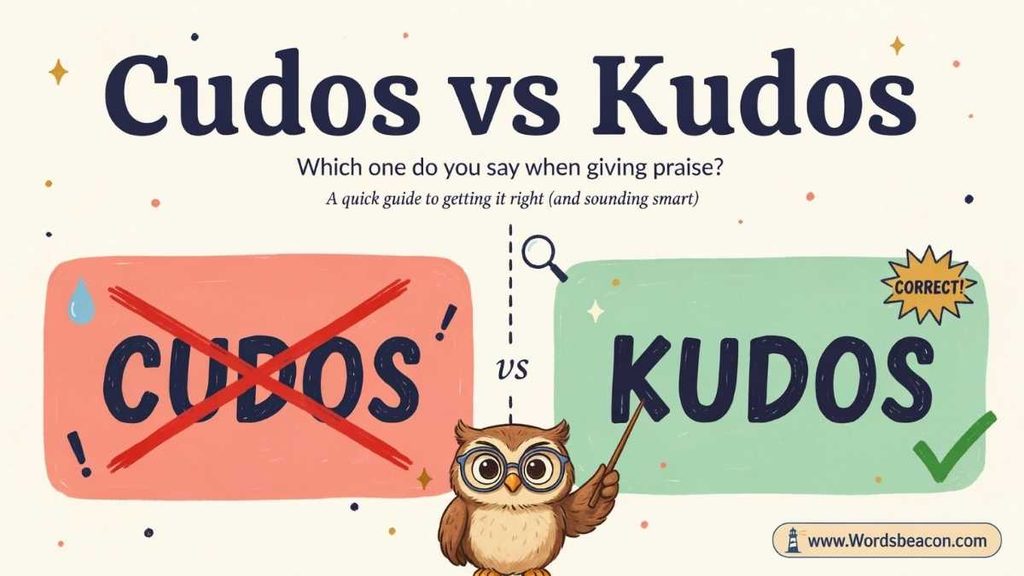
Kudos is the correct spelling.
Cudos is generally an incorrect spelling when the intended meaning is praise, recognition, or admiration.
| Word | Standard spelling? | Meaning |
|---|---|---|
| Kudos | Yes | Praise, admiration, honor, or recognition |
| Cudos | No, for this meaning | Usually a misspelling of kudos |
| Kudo | Yes, in some modern usage | A single item or instance of praise |
For example:
Correct: Kudos to Maya for completing the presentation early.
Incorrect: Cudos to Maya for completing the presentation early.
Therefore, if you are searching for cudos vs kudos which is correct, the answer is kudos.
Learn how to use confusing more words correctly
Crier vs Cryer Difference and usage ?
Cudos vs Kudos The Basic Difference
The difference between cudos and kudos is mainly a matter of spelling.
Kudos is an established English noun. It refers to praise, respect, admiration, or recognition connected with an achievement, contribution, or position.
Cudos is not the standard spelling of that word. When someone writes cudos while talking about praise, they are normally making a spelling mistake.
The error often happens because both c and k can represent the same basic /k/ sound in English. If someone has heard the word but has rarely seen it written, cudos may seem perfectly reasonable.
Consider these examples:
“Kudos to the team for completing the project ahead of schedule.”
“The researcher received kudos for her work.”
“He deserves kudos for helping the new employees.”
In each sentence, kudos expresses praise or recognition.
Writing cudos would make the sentence understandable, but the spelling would still be incorrect in standard English.
What Does Kudos Mean?
The simplest kudos definition is praise or recognition for an achievement.
Kudos can express admiration, approval, respect, honor, or appreciation for something someone has accomplished. The word often highlights the reason a person deserves recognition.
For example:
“Kudos to James for getting the problem fixed.”
This sentence does more than say that James solved a problem. It specifically recognizes his effort and achievement.
Kudos can therefore be connected with several ideas, including praise, recognition, appreciation, commendation, honor, and acclaim.
The exact tone depends on the situation. In everyday conversation, kudos can sound friendly and encouraging. In professional settings, it can recognize someone’s contribution without sounding overly formal.
Fix common more word mistakes in English
Coozie vs Koozie Which one Is Correct?
What Is the Kudos Meaning in English?
The kudos meaning in English centers on praise and recognition.
You might use it to describe the admiration that comes from an achievement:
“Winning the award gave her considerable kudos in the industry.”
You can also use it as a direct expression of praise:
“Kudos to everyone who helped organize the event.”
In the first example, kudos refers to the respect or prestige connected with an accomplishment. In the second, it directly praises the people involved.
That flexibility makes kudos useful in professional writing, workplace conversations, journalism, education, and everyday English.
Is Kudos a Word?
Yes. Kudos is a standard English word.
If you are asking is kudos a word, the answer is clearly yes. It is a noun used for praise, admiration, recognition, or prestige associated with an achievement or position.
The word has a long history in English, which also explains why its spelling looks unusual.
If you are wondering is kudos the correct spelling, the answer is also yes when you mean praise or recognition.
For example:
“She received kudos for her excellent presentation.”
“The team earned kudos for completing the project early.”
Both sentences use the word correctly.
Is Cudos a Word?
If you mean cudos as an alternative spelling of praise or recognition, it is not the standard English form.
This means the question is cudos a word needs a little context. A particular name, brand, or specialized term could contain the letters cudos, but that does not make it the standard spelling of the English word kudos.
When you want to praise someone, use kudos.
Correct: She deserves kudos for her leadership.
Incorrect: She deserves cudos for her leadership.
This distinction matters because a spelling can appear online without being accepted as standard English. For professional writing, academic work, and careful everyday communication, kudos is the form to use.
Fix common more word mistakes in English
Labelling vs Labeling Which one Is Correct?
Where Does the Word Kudos Come From?
The kudos origin goes back to Greek.
The English word comes from the Greek word kydos, which referred to glory, fame, or renown. English borrowed kudos in the late 18th century.
Its original meaning helps explain its modern connection with achievement. Someone who gained glory or renown had earned recognition and respect.
Over time, English speakers developed the word into the modern sense of praise or admiration.
The unusual spelling is therefore not random. It reflects the word’s history.
A Useful Fact About the Word
The Greek word kydos was singular. The final s was not originally an English plural ending.
That detail becomes important when discussing the grammar of kudos. Because the word ends in s, English speakers sometimes assume it must be plural. However, its history and traditional usage tell a different story.
Kudos Pronunciation and the Spelling Confusion
The pronunciation of kudos can vary between British and American English.
In both cases, however, the word begins with a k sound. That sound is one reason people sometimes write cudos.
English uses both c and k to represent the k sound in different words. Consider words such as keep, kind, classic, credit, and culture. The sound alone does not always tell you which letter belongs in the spelling.
Kudos is one of those words that needs to be remembered visually.
The easiest reminder is simple:
Kudos starts with K.
Cudos does not give you the standard spelling.
Fix common more word mistakes in English
Tying vs Tieing which one is correct?
Kudos Usage How to Use the Word Correctly
Understanding kudos usage becomes much easier when you remember its main purpose. You use kudos to recognize something positive that someone has done or achieved.
“Kudos to You” Meaning
The phrase kudos to you means that someone deserves praise or recognition.
For example:
“Kudos to you for staying calm during the presentation.”
The sentence praises the person for handling a difficult situation well.
You could use the same expression with a friend:
“Kudos to you for finishing your first marathon.”
Or in a workplace:
“Kudos to you for finding the error before the report was sent.”
The tone is positive and approving. It can sound friendly without being too casual.
“Kudos To” and “Kudos For”
Two common structures are kudos to and kudos for.
“Kudos to Daniel for leading the team so effectively.”
Here, Daniel is the person receiving the praise, while leading the team explains why he deserves it.
You can also say:
“Kudos for handling the situation so professionally.”
This version focuses more directly on the action.
A useful pattern to remember is:
Kudos to + person + for + action or achievement.
For example:
“Kudos to Sarah for organizing the entire event.”
Give Someone Kudos
The phrase give someone kudos means to praise or recognize that person.
“Let us give the volunteers some kudos for their hard work.”
“The manager gave the design team kudos during the meeting.”
“She gave him kudos for solving the problem quickly.”
This expression works especially well in workplace and everyday conversations.
Deserve Kudos
Another common expression is deserve kudos.
“The entire team deserves kudos for finishing the project on time.”
This construction makes it clear that an achievement or contribution deserves recognition.
Receive Kudos
You can also say that someone received kudos.
“The developer received kudos from customers after the update.”
Here, kudos refers to the praise or recognition given by other people.
Learn the difference between similar English words
Busing vs Bussing difference and which one is correct?
Kudos in a Sentence Examples
If you are wondering how to use kudos in a sentence, the following examples show how naturally it fits different situations.
| Context | Example |
|---|---|
| Workplace | Kudos to Elena for completing the report ahead of schedule. |
| School | Kudos to Marcus for winning the science competition. |
| Teamwork | The whole group deserves kudos for working together so well. |
| Customer service | The employee received kudos for handling the complaint professionally. |
| Achievement | She earned considerable kudos after completing the project. |
| Everyday conversation | Kudos to you for remembering everyone’s birthday. |
| Online communication | Kudos to the volunteers who organized the event. |
The common thread is recognition. Someone has done something worthy of praise, and kudos acknowledges that achievement.
Is Kudos Singular or Plural?
This is one of the more interesting parts of the word’s grammar.
Traditional English usage treats kudos as a singular mass noun rather than an ordinary plural noun. That means the final s does not work like the s in regular plural words such as books or cars.
For example:
“She received a lot of kudos.”
Here, kudos behaves much like praise or recognition. You do not need to count individual units of praise.
The confusion becomes greater because modern English also uses kudo as a singular count noun in some contexts.
For example:
“She received a kudo for her contribution.”
You may also see:
“She received several kudos for her work.”
This newer usage developed partly because some English speakers interpreted kudos as though it were a plural form and then created the singular kudo.
For everyday writing, the important point is that kudos is perfectly normal when used as a mass noun.
Cudos vs Kudos Comparison Table
| Feature | Kudos | Cudos |
|---|---|---|
| Standard English spelling | Correct | Incorrect for this meaning |
| Meaning | Praise, admiration, honor, or recognition | Usually intended to mean kudos |
| Origin | Greek kydos | Not the standard spelling of this word |
| Part of speech | Noun | Not the standard noun for praise |
| Common phrase | Kudos to you | Cudos to you is incorrect |
| Professional writing | Appropriate | Avoid |
| Everyday English | Common | Common misspelling |
Learn the difference between similar English words
Brasil vs Brazil Difference and which one is correct?
Common Cudos vs Kudos Mistakes

Writing “Cudos”
This is the main mistake behind the cudos vs kudos question.
Because kudos begins with a k sound, some people naturally choose c when spelling it. The correction is simple:
Cudos → Kudos
Once you remember the first letter, the rest of the spelling is straightforward.
Thinking Kudos Is an Acronym
Some people assume that kudos must stand for a longer phrase because it does not look like an ordinary English word.
It is not an acronym.
Kudos comes from Greek and entered English as a borrowed word. There is no hidden phrase behind the letters.
Treating the Final S as a Regular Plural
The final s can make kudos look plural. However, traditional usage treats it as a singular mass noun.
That is why this sentence is natural:
“The team received plenty of kudos.”
You do not need to treat kudos as a regular plural simply because it ends in s.
Using Kudos as a Verb
Kudos is primarily a noun.
You may occasionally encounter informal expressions such as “I kudos you,” but that is not the standard way to use the word.
Instead, write:
“I commend you.”
“I praise you.”
“You deserve kudos.”
“I want to give you kudos.”
These alternatives make the grammar clear while keeping the intended meaning.
Assuming Cudos and Kudos Have Different Meanings
They do not represent two standard English words with different meanings in this context.
If someone writes cudos while talking about praise, they almost certainly mean kudos.
That is why searches for cudos vs kudos meaning can be misleading. The important distinction is between the standard word and its common misspelling.
Learn the difference between similar English words
Ambience vs Ambiance difference and which one is correct ?
Where Can You Use Kudos?
In Professional Writing
Kudos works naturally when recognizing a colleague, employee, manager, team, or organization.
For example:
“Kudos to the marketing team for completing the campaign ahead of schedule.”
The word gives the message a positive and encouraging tone.
In very formal documents, words such as recognition, commendation, or appreciation may be more suitable. The choice depends on the tone of the document.
In School and Academic Settings
Kudos can also be used when praising an academic achievement.
For example:
“Kudos to the students who presented their research at the conference.”
In a formal academic paper, however, recognition or commendation may sound more appropriate.
In Everyday Conversation
Everyday conversation is one of the easiest places to use kudos.
“Kudos to you for getting everything organized.”
“Kudos! That was a great idea.”
The word communicates approval without sounding overly formal.
On Social Media
1.Kudos also fits naturally into short social media messages.
2.“Kudos to everyone who volunteered!”
3.“Kudos to the entire team!”
4.“Kudos for making this event happen.”
Its short, positive tone makes it useful when you want to recognize someone’s work without writing a long message.
Learn the difference between confusing more English words
Tyre vs Tire difference and which one is correct?
Kudos vs Praise vs Congratulations
Kudos, praise, congratulations, recognition, and commendation all involve positive feedback, but they are not exactly the same.
| Word | Main idea | Example |
|---|---|---|
| Kudos | Recognition or admiration for an achievement | Kudos to her for solving the problem. |
| Praise | Positive approval of a person or action | The teacher praised her work. |
| Congratulations | Good wishes for an achievement or milestone | Congratulations on your promotion. |
| Recognition | Acknowledgment of an achievement or contribution | He received recognition for his research. |
| Commendation | Formal or official praise | She received a commendation for her service. |
| Acclaim | Strong public praise or approval | The film received critical acclaim. |
For example, congratulations often celebrates someone’s success. Kudos focuses more directly on giving recognition for something the person has done.
Why Do People Spell Kudos as Cudos?
The cudos spelling is easy to understand once pronunciation enters the picture.
The first sound in kudos is a k sound. English represents that sound with both c and k in different words. Someone who has heard the word but rarely seen it written may therefore guess cudos.
The word is also less common in everyday speech than simple alternatives such as praise or credit. Because it has an unusual appearance and a Greek origin, its spelling can be easy to forget.
That makes cudos a common spelling mistake, but familiarity does not make it correct.
Correct Spelling of Kudos An Easy Memory Trick
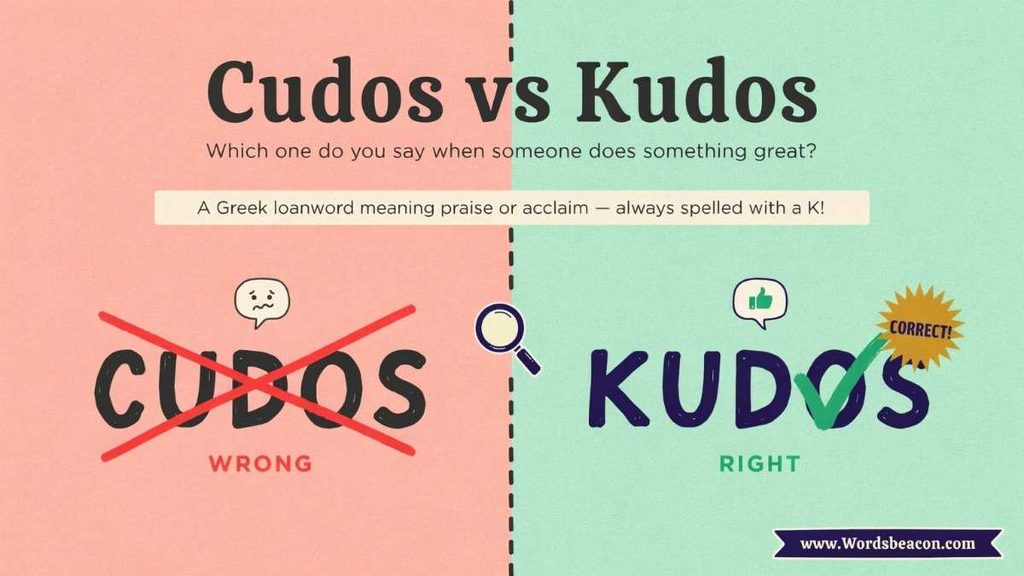
If you want an easy way to remember the correct spelling of kudos, connect the K with kindness and recognition.
Kudos = K for kindness.
You can also remember the common expression:
“Kudos to you!”
The phrase almost acts as a spelling reminder. When you think about giving someone praise, picture the word beginning with K.
The correct form is:
K-U-D-O-S
Not:
C-U-D-O-S
Once the first letter is fixed, the rest is easy.
Cudos vs Kudos Correct and Incorrect Examples
Seeing the two forms side by side makes the difference clear.
| Incorrect | Correct |
|---|---|
| Cudos to you for your hard work. | Kudos to you for your hard work. |
| She received cudos for her achievement. | She received kudos for her achievement. |
| The team deserves cudos. | The team deserves kudos. |
| He got cudos from his manager. | He got kudos from his manager. |
| Cudos for handling the situation well. | Kudos for handling the situation well. |
The rule is consistent. When you mean praise or recognition, use kudos.
A Workplace Example
Imagine that a software team releases a major update without serious problems.
The team leader writes:
“Kudos to everyone who worked late to make this release possible.”
The message does more than announce the team’s work. It recognizes the effort behind the achievement.
Now consider:
“Cudos to everyone who worked late to make this release possible.”
Most readers will understand the intended meaning, but the spelling is still incorrect.
This example shows why correct spelling matters even when the context makes a word understandable. A reader may understand a misspelled word, but accurate spelling keeps the message polished and professional.
Learn the difference between confusing more English words
Sneek vs Sneak difference and usage?
A School Achievement Example
Imagine that a student wins a regional science competition.
A teacher might say:
“Kudos to Emma for presenting such a clear and creative project.”
Here, kudos recognizes the student’s achievement and effort.
A more formal report could say:
“Emma received recognition for her outstanding project.”
Both sentences express a similar idea. The difference is tone. Kudos sounds warmer and more conversational, while recognition sounds more formal.
How to Spell Kudos Correctly
If you are still wondering how to spell kudos correctly, remember the five letters:
K-U-D-O-S
The correct spelling is kudos.
The incorrect spelling is cudos.
The kudos correct spelling is especially important in professional emails, school assignments, articles, reports, and other situations where accuracy matters.
When proofreading, look specifically for cudos. If the word is supposed to mean praise or recognition, change it to kudos.
Is It Cudos vs Kudos?
1.If you are asking is it cudos vs kudos, choose kudos when you mean praise, honor, admiration, or recognition.
2.If you are wondering should I write cudos vs kudos, the answer is kudos.
3.If the question is is cudos the correct spelling, the answer is no when you are using the word to mean praise.
The same rule applies to questions such as cudos vs kudos which is correct and what is the correct spelling kudos or cudos.
The correct form is:
Kudos.
Learn the difference between confusing more English words
Peices vs Pieces difference and usage?
Practice Session Cudos vs Kudos
Fill in each blank with the correct word.
- ________ is the correct standard spelling when you mean praise or recognition.
- The manager gave Sarah ________ for completing the project ahead of schedule.
- “________ to you for handling the difficult situation so well!”
- Many people accidentally write “cudos” when they actually mean ________.
- The teacher gave the student ________ for an excellent presentation.
- You deserve ________ for all the effort you put into this assignment.
- Which spelling is correct: cudos or ________?
- The word ________ comes from the Greek word kydos, associated with glory or renown.
- The director received ________ for improving the company’s customer service.
- “Give ________ to everyone who helped make the event successful.”
- ________ is a commonly misspelled word because its pronunciation can make the spelling seem less obvious.
- The coach offered ________ to the players after their impressive performance.
- If you are writing a professional email, use ________ when you want to express praise.
- “________ to you for reaching your goal!”
- The employee received plenty of ________ from her colleagues after completing the challenging task.
- Is “cudos” the correct spelling, or should you write ________?
- The article praised the scientist and gave her ________ for her important contribution.
- “You deserve ________ for staying calm under pressure.”
- When asking “cudos vs kudos meaning,” remember that ________ means praise, honor, or recognition.
- If you want the correct spelling of this word, choose ________ rather than “cudos.”
Answers
- Kudos
- Kudos
- Kudos
- Kudos
- Kudos
- Kudos
- Kudos
- Kudos
- Kudos
- Kudos
- Kudos
- Kudos
- Kudos
- Kudos
- Kudos
- Kudos
- Kudos
- Kudos
- Kudos
- Kudos
Here’s a trusted source for clear more words Comparison:
FAQs
Why is “cudos” often confused with “kudos”?
The confusion usually comes from pronunciation. Kudos begins with a /k/ sound, which English can spell with different letters in different words. However, when you mean praise or recognition, the standard spelling is kudos.
What is the correct spelling for the word that means praise?
The correct spelling is kudos. It is an established English noun that means praise, admiration, honor, or recognition for an achievement.
Why does “kudos” end in “s” if it is not plural?
Kudos comes from the Greek word kydos. The word entered English with its final s and does not follow the usual pattern of an English plural noun. Traditional usage treats kudos as a singular mass noun.
Can “kudos” describe praise for an achievement?
Yes. Kudos often refers to praise or recognition for something someone has accomplished. For example, “She received kudos for improving the team’s results.”
What part of speech is “kudos”?
Kudos is primarily a noun. It refers to praise, acclaim, honor, or recognition. Common expressions include “give kudos,” “receive kudos,” and “deserve kudos.”
Can “kudos” refer to a group as well as an individual?
Yes. You can give kudos to one person, several people, a team, or an organization. The word simply identifies the praise being given.
Can you use “kudos for” in a sentence?
Yes. “Kudos for” can introduce the action or achievement being praised. For example, “Kudos for finding such a practical solution.”
Can you use “kudos to” in a sentence?
Yes. “Kudos to” identifies the person or group receiving praise. For example, “Kudos to the design team for finishing the project early.”
Is “kudos” suitable for everyday English?
Yes. Kudos works in everyday conversation as well as professional communication. The tone depends on the surrounding words and situation.
Can “kudos” be used in academic writing?
Yes, although the context matters. In highly formal academic writing, words such as recognition, commendation, or acknowledgment may sometimes be more precise. Kudos is still a legitimate English word.
Does “kudos” always have a positive meaning?
Yes. Kudos expresses approval, admiration, or recognition. It is normally used when someone has done something deserving of praise.
Does “kudos” have to refer to a major achievement?
No. You can use kudos for both major accomplishments and smaller successes. The key idea is that someone has done something worthy of recognition.
Is “kudos” connected to the Greek word “kydos”?
Yes. Kudos comes from the Greek kydos, a word associated with glory, fame, or renown. The English word developed from this idea of honor and acclaim.
Does “cudos” have a different meaning from “kudos”?
When cudos is written as a spelling of the word meaning praise, it is generally a misspelling of kudos. It is not the standard spelling for this meaning.
Can you use “kudos” for a team achievement?
Yes. Kudos can recognize the work of an entire team. For example, “Kudos to the whole team for completing the project ahead of schedule.”
Can “kudos” be used in workplace communication?
Yes. Kudos is common in workplace messages when someone deserves recognition for good work, an achievement, or a useful contribution. For example, “Kudos to the support team for handling the issue so quickly.”
What is an easy way to remember how to spell “kudos”?
Remember the K in kudos. When you mean praise or recognition, choose kudos rather than cudos. A simple memory trick is: “Kudos gets the K.”
Can “kudos” describe appreciation for creative work?
Yes. You can give kudos for writing, artwork, music, design, presentations, or other creative work. The word highlights appreciation or recognition for the result.
What does “kudos” communicate in a sentence?
Kudos communicates that someone deserves praise or recognition. It often highlights a successful action, achievement, contribution, or piece of work.
Is “kudos” exactly the same as “praise”?
The meanings are closely related, but the words do not work exactly the same way grammatically. Praise can function as both a noun and a verb, while kudos is primarily used as a noun.
Can you give kudos to several people at once?
Yes. You can give kudos to multiple people or an entire group. For example, “Kudos to everyone who helped make the event successful.”
Can “kudos” be used for creative achievements?
Yes. Writers, artists, designers, musicians, and other creators can receive kudos for their work. For example, “Kudos to the writer for creating such an engaging story.”
Why do people sometimes spell “kudos” as “cudos”?
The mistake often happens because people spell the word based on its pronunciation. The /k/ sound can be represented by different letters in English, which can make the spelling less obvious. However, the standard form is kudos.
Conclusion
The cudos vs kudos confusion is easy to fix once you know which spelling is correct. If you want to show praise, admiration, or recognition, the correct word is kudos. Cudos is simply a common misspelling, often caused by writing the word the way it sounds.
A simple trick can help you remember it: kudos starts with K. So, when you want to praise someone for a great idea, achievement, or effort, give them kudos. The next time you stop and wonder, “Cudos vs kudos?” you will know exactly which one to choose. One little K clears up the whole confusion.

Luna AJS is an experienced blogger and dedicated language enthusiast at Words Beacon. She specializes in making English grammar, spelling, vocabulary and commonly confused words easy to understand. She provides clear explanations, practical examples to help readers write with confidence.