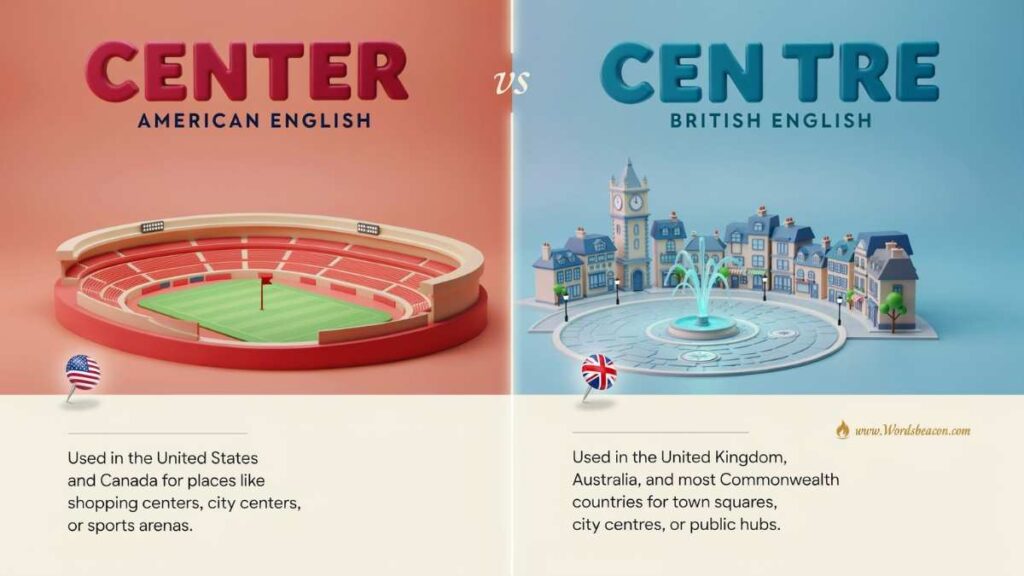
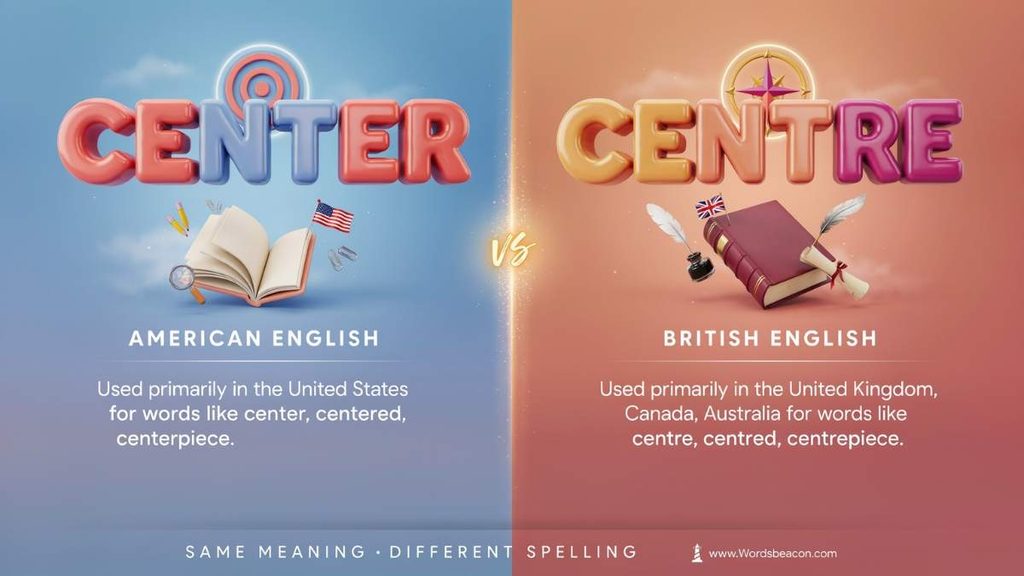
Center vs Centre can be confusing when you see both spellings used in English. Is one correct and the other a mistake? Not at all! Both are correct, but the choice depends on where you are writing. Center is the standard spelling in American English, while centre is commonly used in British English, Australian English, and New Zealand English. Canadian English generally prefers centre as well. Although the spelling changes, the meaning stays exactly the same. So, how do you know which one to use? Let’s explore their differences, look at simple examples, and clear up the confusion once and for all.
Center vs Centre Quick Comparison
| Feature | Center | Centre |
|---|---|---|
| Standard spelling | American English | British English |
| Meaning | Middle point or central area | Middle point or central area |
| Pronunciation | Generally /ˈsen.tɚ/ in American English | Generally /ˈsen.tə/ in non-rhotic British English |
| Part of speech | Noun and verb; also used in noun modifiers | Noun and verb; also used in noun modifiers |
| Singular | Center | Centre |
| Plural | Centers | Centres |
| Past tense | Centered | Centred |
| Present participle | Centering | Centring |
| Common expression | Shopping center | Shopping centre |
| Main regions | United States | United Kingdom, Australia, New Zealand, and generally Canada |
Learn how to use confusing more words correctly
Sleeve vs Sleave Difference and which is correct ?
What Does Center Mean?
Center is the standard American English spelling of a word that describes the middle point, central part, or main area of something. It can refer to a physical position, a geographical location, a public facility, or the main focus of an activity.
For example, imagine placing a flower vase exactly in the middle of a round dining table. You would say that the vase sits in the center of the table. Similarly, the central area of a city is its city center, while a building that provides services to local residents may be called a community center.
However, the meaning of center isn’t limited to physical locations. It can also describe the main subject of attention. When someone becomes the center of attention, people focus on that person. Likewise, when an important issue takes center stage, it becomes the main topic of discussion.
In short, the center definition covers several related ideas, but they all connect to one central concept: the middle point, an important location, or the main focus.
Center as a Noun
As a noun, center refers to the middle point, central area, or an important place where people gather or activities take place.
Depending on the context, it can describe:
- Physical middle: The point halfway between the edges of an object or area.
- Geographical position: A central location within a city, town, or region.
- Public facility: A building that provides particular services or activities.
- Main focus: A person, subject, or event receiving the most attention.
- Mathematical point: The fixed point inside a circle that lies at an equal distance from every point on its circumference.
Consider these center examples:
- The clock hangs in the center of the living room.
- The hospital stands near the city center.
- Our neighborhood has a community center for public events.
- Education became the center of their discussion.
- The center of a circle lies at an equal distance from every point on its circumference.
As you can see, the word takes on slightly different applications depending on the sentence. Nevertheless, its basic meaning remains connected to a middle point, central location, or main focus.
Center as a Verb
Center also functions as a verb. In this form, it means to place something in the middle or organize attention and activity around a particular subject.
For instance, a designer might center a photograph above a fireplace. Similarly, a teacher might center a lesson on practical communication skills.
Here are more examples:
- Please center the picture above the sofa.
- The teacher centered the lesson on practical communication.
- The company centers its services on customer needs.
- The discussion centered on improving public education.
Furthermore, writers often use centered on when describing the main subject of a story, discussion, or project.
For example, a documentary might be centered on a young athlete’s journey. In this sentence, the athlete’s experiences form the main focus of the documentary.
Center in Common Expressions
Center also appears in many familiar expressions, particularly when it comes before another noun to describe a central position or facility.
Common American English expressions include:
- Center stage
- Center field
- Center console
- Center section
- Center line
- Shopping center
- Research center
- Community center
For example, a performer standing center stage occupies the middle area of the stage. Similarly, a center console in a vehicle refers to the central section between the front seats.
Therefore, when writing for an American audience, use center consistently in these expressions.
What Does Centre Mean?
Centre is the standard British English spelling of the same word. It carries the same definitions, meanings, and grammatical functions as center. The only essential difference is the spelling.
British writers use centre to describe the middle point of an object, the central area of a geographical location, or a facility where people gather for a particular purpose.
For example, someone in London might visit a shopping centre, while someone in New York might visit a shopping center. Both expressions describe the same type of commercial property.
Likewise, the centre meaning can refer to the middle of a circle, the central part of a town, or the main focus of a discussion. In other words, centre and center don’t have separate definitions. They are simply regional spelling variations.
Centre as a Noun
As a noun, centre refers to the middle point, central area, or an important location.
Its common uses include:
- Physical middle: The point halfway between the edges of an object.
- Geographical position: The central area of a town, city, or region.
- Public facility: A building that provides services or activities.
- Main focus: A person, issue, or event receiving the most attention.
- Mathematical point: The fixed point inside a circle that lies at an equal distance from its circumference.
For example:
- The centre of the table was decorated with fresh flowers.
- The hotel is located near the centre of town.
- The children attend activities at the local community centre.
- The environment became the centre of public debate.
- The centre of the circle lies at an equal distance from every point on its circumference.
Notice that these examples follow the same grammatical patterns as their American equivalents. Only the spelling changes.
Centre as a Verb
Centre also works as a verb in British English. It means to place something in the middle or direct attention toward a particular subject.
For example:
- She centred the photograph above the fireplace.
- The teacher centred the lesson on creative writing.
- The campaign centres on improving public transportation.
- The novel is centred on a family living in a small village.
In each sentence, centre performs the same function as center. Consequently, the difference is regional rather than grammatical.
Centre in Common Expressions
British English uses centre in many everyday expressions, especially when describing buildings, facilities, and central locations.
Common examples include:
- City centre
- Shopping centre
- Community centre
- Sports centre
- Medical centre
- Garden centre
- Town centre
- Research centre
For instance, a sports centre might contain a gym, swimming pool, indoor courts, and exercise rooms. A garden centre, meanwhile, sells plants, gardening tools, and outdoor supplies.
Although these expressions may look different from their American counterparts, they communicate exactly the same ideas.
Understand confusing English more words simply
Symptomatology Vs Symptomology Difference and usage
Center vs Centre What Is the Actual Difference?
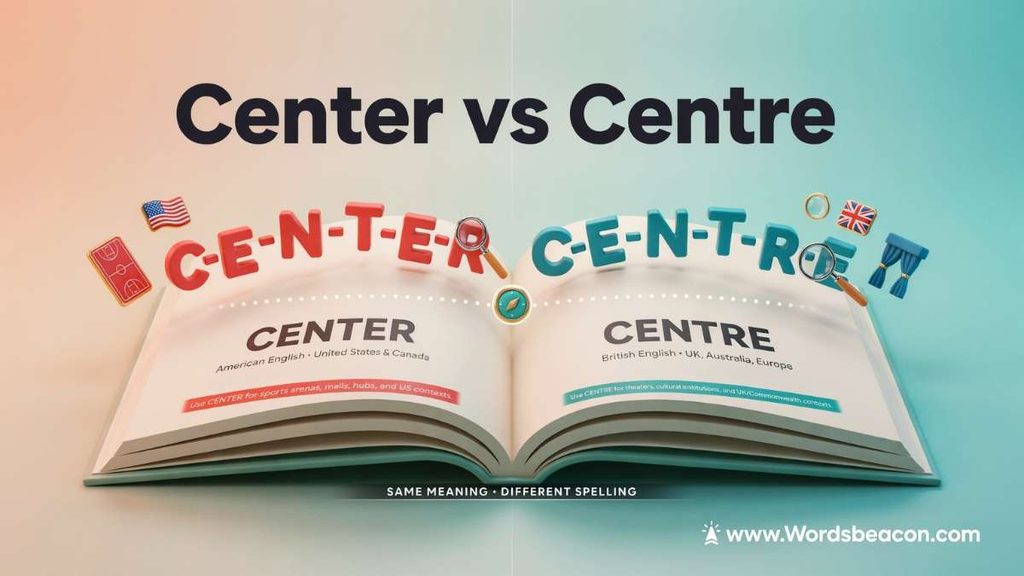
When comparing Center vs Centre, the most important point is that both words have the same basic meaning and grammatical function. Their primary difference comes from regional spelling conventions.
However, understanding the distinction involves more than remembering that one ends in -er and the other in -re. You should also recognize how pronunciation, word forms, and regional preferences work.
Spelling Difference
The most noticeable difference between center and centre is their final letter arrangement.
- American English: Center
- British English: Centre
This spelling pattern appears in several other English words as well.
| American English | British English |
|---|---|
| Center | Centre |
| Theater | Theatre |
| Meter | Metre |
| Fiber | Fibre |
| Liter | Litre |
These examples demonstrate a familiar regional spelling difference. However, some pairs have additional distinctions depending on context. For instance, American English uses meter for both a measuring device and a unit of length. British English generally distinguishes meter from metre.
Meaning Difference
There is no essential difference between center and centre meaning. Both words describe the middle point, central area, or main focus of something.
For example:
- The center of the room is empty.
- The centre of the room is empty.
Both sentences describe the same physical position.
Similarly, a research center and a research centre refer to the same kind of facility. The regional spelling changes, but the meaning remains intact.
Pronunciation Difference
Center vs centre generally follow the same pronunciation pattern within a particular regional accent.
Both words have two syllables, with the main stress on the first syllable. However, American and British accents can differ in their pronunciation of the final vowel and r sound.
In standard American English, speakers generally pronounce the final r. In many non-rhotic British accents, speakers don’t pronounce that r unless a following vowel affects the sound.
Therefore, the spelling difference doesn’t indicate a completely different pronunciation. The accent of the speaker matters more than the written form.
Grammar Difference
Center and centre follow essentially the same English grammar rules. Both can function as nouns and verbs, and both form plurals and possessives in the same way.
Nevertheless, their related forms follow regional spelling conventions.
| Grammatical form | American English | British English |
|---|---|---|
| Singular | Center | Centre |
| Plural | Centers | Centres |
| Past tense | Centered | Centred |
| Present participle | Centering | Centring |
| Singular possessive | Center’s | Centre’s |
| Plural possessive | Centers’ | Centres’ |
As a result, you should consider the entire word family rather than correcting only the main word.
Regional Usage Difference
American English prefers center, while British English generally uses centre.
The same preference appears in Australia and New Zealand. Canadian English also generally favors centre, although Canadian spelling combines several British and American conventions.
Consequently, the correct spelling depends on your audience, publication, and preferred writing standard.
Fix common more word mistakes in English
Channel vs Chanel difference and usage
American English vs British English Spelling
The Center vs Centre difference is part of a broader distinction between American English and British English. Although both varieties share the same language, they developed different spelling conventions over time.
These variations appear in everyday vocabulary, academic writing, professional communication, newspapers, and publishing. In the United States, writers generally follow standard American English. Meanwhile, British writers follow standard British English.
Neither spelling system is universally better. Instead, each has its own established rules and accepted forms.
Why Do Americans Spell Centre as Center?
American spelling developed through several historical changes, particularly during the late 18th and early 19th centuries.
One influential figure was Noah Webster, an American lexicographer who wanted to establish a more distinct and consistent approach to American spelling. His dictionaries helped popularize several spelling differences, including the preference for center over centre.
Webster also promoted familiar American forms such as:
- Color instead of colour.
- Honor instead of honour.
- Theater instead of theatre.
- Labor instead of labour.
However, Webster didn’t single-handedly create every American spelling difference. Some variations existed before his dictionaries became influential. His work helped standardize and spread several forms through American education and publishing.
Today, center is firmly established in the United States. American dictionaries, schools, newspapers, and professional publications generally use this spelling.
Why Do British People Write Centre Instead of Center?
British English retained the traditional -re spelling in words such as centre, theatre, and fibre.
These forms have historical roots in French and Latin. They became established in English long before American spelling conventions developed separately.
British dictionaries and educational institutions continued to support these traditional forms. Consequently, centre remained the standard spelling in the United Kingdom.
For example:
- A British newspaper might report on a new shopping centre.
- A school might organize an event at its local sports centre.
- A local council might announce improvements to the town centre.
Thus, the British spelling reflects regional writing conventions rather than a difference in meaning.
American English vs British English Other Spelling Differences
Center and centre aren’t isolated examples. English contains many regional variations that can confuse writers who regularly read material from different countries.
Here are some familiar comparisons:
| American English | British English |
|---|---|
| Center | Centre |
| Color | Colour |
| Favorite | Favourite |
| Theater | Theatre |
| Defense | Defence |
| Traveling | Travelling |
| Jewelry | Jewellery |
| Gray | Grey |
| Check | Cheque (bank payment) |
| License (noun and verb) | Licence (noun), license (verb) |
Some differences involve spelling alone, while others involve vocabulary or grammatical conventions.
For example, Americans generally use apartment, whereas British writers commonly use flat. These are vocabulary differences rather than alternative spellings of the same word.
Understanding these patterns makes it easier to recognize regional English variations and choose the appropriate form for your writing.
Fix common more word mistakes in English
Stich vs Stitch difference and usage
Center vs Centre Examples in Sentences
Examples make the Center vs Centre spelling difference much easier to understand. Although the words look different, they communicate the same ideas.
The following examples show how each spelling works in everyday American and British English.
Center Examples in American English
In the United States, center is the preferred spelling in both formal and informal writing.
Consider these sentences:
- The library is located in the center of the city.
- My parents visited a new shopping center last weekend.
- The school plans to build a modern science center.
- She placed the painting in the center of the wall.
- The community center offers free classes for children.
- The company opened a new business center downtown.
- The discussion centered on improving public education.
- The hospital’s research center studies infectious diseases.
- He stood in the center of the basketball court.
- The entire event was centered on environmental awareness.
Each example follows standard American spelling conventions.
Centre Examples in British English
British writers use centre in the same contexts. The meaning and sentence structure remain unchanged.
Here are equivalent examples:
- The library is located in the centre of the city.
- My parents visited a new shopping centre last weekend.
- The school plans to build a modern science centre.
- She placed the painting in the centre of the wall.
- The community centre offers free classes for children.
- The company opened a new business centre downtown.
- The discussion centred on improving public education.
- The hospital’s research centre studies infectious diseases.
- He stood in the centre of the basketball court.
- The entire event was centred on environmental awareness.
As you can see, the spelling changes while the meaning stays the same.
Center vs Centre Side-by-Side Examples
For a clearer comparison, look at these American and British sentences together.
| American English | British English |
|---|---|
| The city center is crowded. | The city centre is crowded. |
| The shopping center closes at nine. | The shopping centre closes at nine. |
| She works at a medical center. | She works at a medical centre. |
| The school has a sports center. | The school has a sports centre. |
| The discussion centered on climate change. | The discussion centred on climate change. |
| The project is centered on technology. | The project is centred on technology. |
| The new business center opens tomorrow. | The new business centre opens tomorrow. |
This comparison highlights the central rule: the spelling changes, but the meaning and grammatical structure remain the same.
One additional point is worth remembering. The expression centered around is also common in English. However, centered on often communicates the intended focus more directly. The same preference applies to centred on in British English.
Centered vs Centred What’s the Difference?
The spelling difference between center vs centre continues when you change the word into a past-tense verb or an adjective.
This detail matters because writers sometimes remember the correct basic spelling but accidentally mix regional conventions in the same document.
Centered is the standard American spelling, whereas centred is the standard British spelling. Both forms describe something placed in the middle or organized around a particular subject.
For example:
- American: The picture is centered above the fireplace.
- British: The picture is centred above the fireplace.
- American: The campaign centered on public health.
- British: The campaign centred on public health.
When to Use Centered
American English adds the regular past-tense ending -ed to center without dropping the final e.
For example:
- The designer centered the logo on the page.
- The meeting centered on the company’s future.
- The artist centered the painting above the sofa.
Centered can also function as an adjective. For instance, a centered design has its main element positioned in the middle.
When to Use Centred
British English uses centred instead.
For example:
- The designer centred the logo on the page.
- The meeting centred on the company’s future.
- The artist centred the painting above the sofa.
The grammar and meaning remain identical. Only the spelling follows a different regional convention.
Centering vs Centring
The same distinction appears in the present participle and gerund forms.
| American English | British English |
|---|---|
| Centering | Centring |
| Centering the image | Centring the image |
| Centering the discussion | Centring the discussion |
| Centering the design | Centring the design |
Why does the spelling change? American English generally retains the final e when adding -ing to center, while British English drops the e before adding the ending.
For example:
- American: She is centering the photograph.
- British: She is centring the photograph.
Both sentences are grammatically correct. Therefore, choose the form that matches the rest of your writing.
Learn how to use confusing more words correctly
Prooving vs Proving Which Spelling Is Correct?
Center vs Centre in Canada and Australia
English spelling conventions don’t stop at the borders of the United States and the United Kingdom. Countries such as Canada, Australia, and New Zealand have developed their own accepted writing standards.
Although these countries share several British spelling traditions, their usage sometimes overlaps with American English.
Does Canada Use Center vs Centre?
Canadian English generally favors centre.
For example, Canadian writers commonly use:
- Shopping centre
- Community centre
- City centre
- Medical centre
- Sports centre
However, Canadian English isn’t simply identical to British English. It combines several British and American spelling conventions.
For instance, Canadians generally write colour rather than color, but they commonly use organize rather than following only the British preference for organise.
There can also be variation among Canadian publications and organizations. Therefore, it’s best to follow an established Canadian dictionary or the relevant publication’s style guide rather than assume that every organization uses precisely the same rules.
Is Center Correct in Australian English?
Australian English generally uses centre.
Common expressions include:
- Shopping centre
- Town centre
- Community centre
- Medical centre
- Sports centre
- Garden centre
These forms follow established Australian spelling conventions.
Australian publications, schools, and government communications generally prefer centre. Nevertheless, an official organization may use center as part of its registered name or branding.
For Australian writing, a recognized Australian dictionary provides a more reliable reference than automatically applying every British or American spelling rule.
Which Spelling Does New Zealand Use?
New Zealand English also generally favors centre.
The spelling appears in everyday expressions such as:
- City centre
- Shopping centre
- Service centre
- Community centre
- Health centre
New Zealand English shares many spelling conventions with British and Australian English. However, it also has its own vocabulary and language characteristics.
Regional Spelling Comparison
| Region | General preference | Example |
|---|---|---|
| United States | Center | Shopping center |
| United Kingdom | Centre | Shopping centre |
| Canada | Centre | Community centre |
| Australia | Centre | Medical centre |
| New Zealand | Centre | City centre |
These preferences describe common usage rather than an absolute rule for every institution or publication.
In countries such as the United Arab Emirates and Singapore, English is widely used in international business and education. However, spelling preferences can depend on the organization, publication, and intended audience. Japan also uses English in international communication without having one universal English spelling convention for every context.
Consequently, follow the relevant institutional or editorial standard instead of assuming that every country uses one fixed version.
Learn how to use confusing more words correctly
Cheer vs Chear Difference and Correct Usage
Center vs Centre Grammar Rules and Word Forms
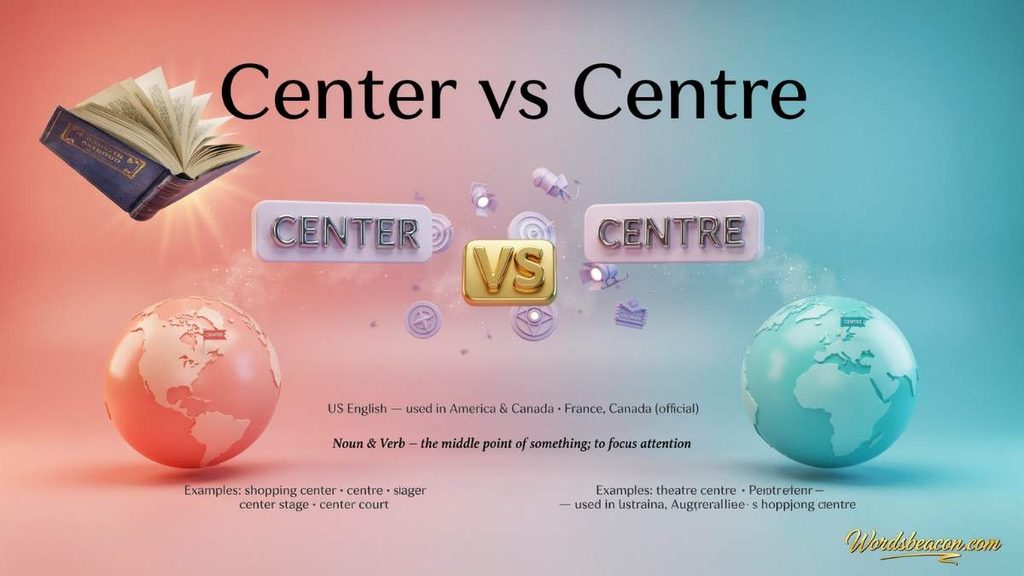
Although center and centre have different spellings, they follow the same basic English grammar rules. Both can function as nouns and verbs, form plurals, and take possessive endings.
The main difference appears in regional spelling conventions. Understanding these forms will help you avoid mistakes in essays, business documents, articles, and everyday communication.
Singular and Plural Forms
Both words form their plurals by adding -s.
- Singular: Center
- Plural: Centers
- Singular: Centre
- Plural: Centres
Examples:
- The city has three shopping centers.
- The city has three shopping centres.
- Several research centers operate in the region.
- Several research centres operate in the region.
Neither spelling requires an unusual plural rule.
Past Tense and Past Participle
When center vs centre functions as a verb, its past-tense form follows the regional spelling convention.
- American English: Centered.
- British English: Centred.
The same forms work as past participles.
For example:
- The designer centered the image above the desk.
- The designer has centered the image above the desk.
- The designer centred the image above the desk.
- The designer has centred the image above the desk.
The sentences follow the same grammatical structure. Only the spelling changes.
Present Participle and Gerund
The present participle and gerund forms also differ.
- American English: Centering.
- British English: Centring.
A present participle can describe an ongoing action:
- She is centering the photograph.
- She is centring the photograph.
A gerund functions as a noun:
- Centering the image requires careful measurement.
- Centring the image requires careful measurement.
In both cases, the spelling follows the regional convention.
Possessive Forms
To show ownership or association, add an apostrophe and s to the singular form.
- American English: Center’s.
- British English: Centre’s.
For example:
- The center’s entrance is on the eastern side.
- The centre’s entrance is on the eastern side.
For plural possessives, place the apostrophe after the plural s:
- The centers’ parking areas are well maintained.
- The centres’ parking areas are well maintained.
The apostrophe rules remain the same in both regional varieties.
Common Expressions and Compound Words
Center and centre appear in many compound expressions. The spelling generally follows the regional convention.
| American English | British English |
|---|---|
| City center | City centre |
| Shopping center | Shopping centre |
| Community center | Community centre |
| Medical center | Medical centre |
| Research center | Research centre |
| Sports center | Sports centre |
| Cultural center | Cultural centre |
| Business center | Business centre |
| Town center | Town centre |
| Garden center | Garden centre |
These expressions describe different kinds of central places or facilities.
For example, a cultural center provides space for artistic events, exhibitions, and community programs. A research center focuses on investigation and specialized study.
One spelling rule applies throughout: don’t switch regional forms without a good reason.
Understand confusing English more words simply
Bachelor vs Batchelor difference and correct usage
Centre vs Center Etymology and Word Origin
The history of centre and center explains why English has two accepted spellings for the same word.
Both forms trace their roots through French and Latin to the ancient Greek word kentron, which referred to a sharp point or the point of a compass used to draw a circle.
Over time, the word developed its connection with the middle point of a circle and eventually gained broader meanings.
Where Did the Word Centre Come From?
The spelling centre entered English through Old French centre, which came from Latin centrum. The Latin term originated from Greek kentron.
Its early meaning related to the central point of a circle.
As English developed, the word gained additional uses. People began using it to describe the middle of physical objects, important geographical locations, and places where activities took place.
Today, centre can describe almost any central position or important hub.
Interestingly, centre wasn’t the only spelling used in early English. Historical records show that center also appeared in English writing before American spelling reforms became influential.
How Did Center Become the American Spelling?
American English gradually developed its own spelling conventions, particularly during the 18th and 19th centuries.
Noah Webster played an important role in this process. His dictionaries promoted several American spellings that differed from common British forms.
His work helped establish center alongside other familiar American variants such as color, honor, and theater.
However, it’s important not to assume that every American spelling difference originated with Webster. Some variations existed before his dictionaries became influential. His reforms helped popularize and standardize them.
Why Did British English Retain Centre?
British English maintained the traditional -re spelling in many established words.
Samuel Johnson’s influential dictionary, published in 1755, helped establish British spelling conventions. His dictionary recorded established forms rather than attempting a broad spelling reform.
The traditional centre spelling remained familiar through British education, dictionaries, publishing, and everyday communication.
Consequently, centre remained the accepted spelling in Britain, while center became standard in the United States.
Centre vs Center Common Mistakes to Avoid
Even though the difference looks simple, writers sometimes make avoidable mistakes when using these words.
Here are the most common problems and how to prevent them.
Mixing Both Spellings in One Document
Imagine writing an American English article that uses shopping center in one paragraph and community centre in another.
Neither expression is individually incorrect. However, mixing them without a reason creates inconsistent writing.
Choose one regional spelling system and follow it throughout the document.
Assuming One Spelling Is Wrong
Some writers believe centre is a misspelling because American spell-checkers flag it. Others assume center is incorrect because British dictionaries prefer centre.
Both assumptions are wrong.
The correct spelling depends on the English variety you’re using.
Confusing Spelling with Meaning
Center and centre don’t describe different objects or locations.
For example, a shopping center and a shopping centre refer to the same type of commercial property.
The same applies to city center and city centre.
Don’t assign separate meanings to the two forms.
Using Incorrect Verb Forms
Writers sometimes remember the correct basic spelling but forget to adjust related forms.
For example:
- American English: The project was centered on education.
- British English: The project was centred on education.
Similarly:
- American English: She is centering the photograph.
- British English: She is centring the photograph.
Keep the entire word family consistent.
Changing Official Names
Proper nouns require special attention.
Suppose an organization officially calls itself the International Centre for Research. An American writer shouldn’t automatically change its name to International Center for Research.
Official names, registered business names, institution titles, and trademarks should retain their established spelling.
This rule also applies when quoting a source or reproducing the title of a publication.
Trusting Automatic Spell-Checkers Too Much
Spell-checking software usually follows a selected language setting.
If your document uses American English, the software might flag centre. If it uses British English, it might flag center.
That doesn’t necessarily mean either word is incorrect.
Before accepting a suggested correction, check:
- Which English variety is selected?
- Who will read the document?
- Does the publication follow a specific style guide?
- Is the word part of an official name?
A spell-checker can catch typing errors, but it can’t always determine your intended regional standard.
Understand confusing English more words simply
Access vs Acess Which Spelling Is Correct?
How to Choose Between Center and Centre
Choosing the correct spelling doesn’t require memorizing dozens of complicated rules. In most situations, you simply need to identify your audience and follow its accepted English conventions.
Match Your Audience
If you’re writing for American readers, use center.
If you’re addressing British, Australian, or New Zealand readers, use centre.
For Canadian readers, centre is generally the conventional choice, although individual publications may follow different preferences.
This approach also works for international communication. Identify the main audience before deciding which spelling system to use.
Follow a Dictionary or Style Guide
A reliable dictionary can help you verify regional spelling.
For American English, Merriam-Webster provides a useful reference. For British English, the Oxford English Dictionary and Cambridge Dictionary provide information about definitions, pronunciation, and word history.
Australian writers can consult the Macquarie Dictionary, while Canadian writers can follow established Canadian dictionary and government language guidance.
A style guide is particularly helpful for professional writing because it establishes consistent rules for spelling, punctuation, capitalization, and word usage.
Maintain Consistency Throughout Your Writing
Consistency matters more than choosing one regional spelling over another.
For example, an American article should generally use:
- Center
- Centers
- Centered
- Centering
A British article should generally use:
- Centre
- Centres
- Centred
- Centring
This approach keeps your writing clear and professional.
Consider Search Engines Without Sacrificing Readability
Writers sometimes wonder whether they should use both spellings to improve search visibility.
The answer is to prioritize natural language and audience expectations.
If your website targets American readers, use center naturally in headings, body text, and examples. If it targets British readers, use centre.
You can mention the alternative spelling where it genuinely helps explain the difference.
Search engines can recognize related spelling variations and understand the context of a page. Repeating every keyword variation unnecessarily won’t make an article more useful.
For example, this sentence works naturally:
“Center is the American spelling, whereas centre is preferred in British English.”
It covers both variations without awkward repetition.
A Practical Case Study Choosing the Right Spelling for a Website
Imagine a company that operates community facilities in New York and London.
Its American website describes a new location as a community center. Meanwhile, its British website calls the same type of facility a community centre.
The services remain identical. The spelling changes to match each audience.
| Website | Appropriate wording |
|---|---|
| American website | Visit our community center. |
| British website | Visit our community centre. |
Now imagine the company publishes one international report for both markets.
It could choose one consistent spelling convention and explain that choice in its editorial guidelines. Alternatively, it could produce separate regional versions.
The important point is that spelling should support communication rather than distract readers.
The lesson is simple: match the language to the audience, preserve official names, and apply the same spelling rules throughout each publication.
Learn the difference between tricky more English words
Comprable vs Comparable Which Spelling Is Correct?
Practice Session Center vs Centre
Test your understanding of American and British spelling with these fill-in-the-blank questions. Choose the correct form based on the regional English variety or the sentence context.
1. The library is located in the city ______. (American English)
2. We visited a new shopping ______ in London. (British English)
3. The teacher ______ the lesson on environmental protection. (American English)
4. The community ______ offers free activities for children. (British English)
5. She placed the vase in the ______ of the table. (American English)
6. The hospital has opened a modern research ______. (British English)
7. The designer is ______ the photograph above the sofa. (American English)
8. The children attend swimming lessons at the local sports ______. (British English)
9. The discussion ______ on improving public education. (American English)
10. The hotel is situated near the town ______. (British English)
11. The company opened three new shopping ______ last year. (American English)
12. The campaign was ______ on improving healthcare services. (British English)
13. Please place the logo in the ______ of the page. (American English)
14. The new medical ______ provides services to local residents. (British English)
15. She is ______ the image carefully before printing it. (American English)
16. The city’s cultural ______ hosts art exhibitions and performances. (British English)
17. The photograph was ______ above the fireplace. (American English)
18. Several community ______ operate throughout the region. (British English)
19. The children played basketball in the ______ of the court. (American English)
20. The new shopping ______ will open next month. (British English)
Answers
Correct answers
| No. | Answer |
|---|---|
| 1 | Center |
| 2 | Centre |
| 3 | Centered |
| 4 | Centre |
| 5 | Center |
| 6 | Centre |
| 7 | Centering |
| 8 | Centre |
| 9 | Centered |
| 10 | Centre |
| 11 | Centers |
| 12 | Centred |
| 13 | Center |
| 14 | Centre |
| 15 | Centering |
| 16 | Centre |
| 17 | Centered |
| 18 | Centres |
| 19 | Center |
| 20 | Centre |
Here’s a trusted source for clear word meanings:
FAQs
Which is correct, centre vs center?
Both centre and center are correct spellings. The difference comes down to regional English conventions. Center is the standard spelling in American English, while centre is preferred in British English. Both words have the same meaning and refer to the middle of something or a place where an activity takes place.
When should you use center vs centre?
Use center when writing for an American audience, and choose centre when writing for readers who follow British English. For example, an American newspaper might mention a shopping center, while a British publication would use shopping centre. Matching your spelling to your audience keeps your writing consistent and professional.
Is it a shopping centre or a shopping center?
Both phrases are correct, but their spelling reflects different English conventions. Shopping center is the standard American English form, whereas shopping centre is common in British English, Australian English, and New Zealand English. Regardless of the spelling, both phrases describe a place with several shops and businesses.
Is it center vs centre in Canada?
Canadian English generally uses centre rather than center. As a result, you will commonly see expressions such as city centre, shopping centre, and community centre in Canadian writing. However, Canadian English blends British and American spelling conventions, so its rules do not always match either variety completely.
Why is centre spelled differently from center?
The difference comes from the development of regional spelling conventions. British English retained the French-influenced ending in centre, while American English adopted center as part of its preference for certain simplified spellings. American spelling reformers, particularly Noah Webster, helped popularize these conventions. Over time, both forms became established in their respective varieties of English.
Is centre grammatically correct?
Yes, centre is grammatically correct in British English and other varieties that follow this spelling convention. It can function as both a noun and a verb. For instance, “The community centre opens at nine” uses centre as a noun, while “Please centre the image on the page” uses it as a verb. The spelling does not make the word more or less grammatical.
Is it exam center or exam centre?
Exam center is correct in American English, while exam centre is the preferred British English form. Both expressions describe a location where students take examinations. If you are writing for a school, university, or examination board, follow its official spelling conventions to avoid inconsistency.
How do you spell centered in British English?
In British English, centered is usually spelled centred. For example, an American writer would say, “The picture is centered on the wall,” while a British writer would write, “The picture is centred on the wall.” The same regional spelling difference appears in other forms of the word.
Is it centering or centring?
Both spellings are correct, but they belong to different regional conventions. Centering is standard in American English, whereas centring is commonly used in British English. For example, an American designer might describe centering a photograph, while a British designer would write centring a photograph. The meaning remains unchanged.
Do Australians and New Zealanders use centre or center?
Australians and New Zealanders generally use centre, following British spelling conventions. Therefore, expressions such as shopping centre, town centre, and sports centre are standard in both countries. Although regional vocabulary and usage can vary, centre is the usual spelling in their formal writing.
How is centre spelled in the United States?
In the United States, the standard spelling is center, not centre. Americans use this form in expressions such as city center, medical center, and center of the circle. Although centre is recognizable, it is generally considered the British spelling in American writing.
What does center vs centre mean?
Center vs centre have the same basic meaning. They can refer to the middle point of an object, area, or shape, or to a place where a particular activity takes place. For example, the center of a circle is its middle point, while a community center is a facility where people gather for events, programs, and services.
Learn the difference between tricky more English words
Sentence vs Sentance Which Spelling Is Correct?
Conclusion
The difference between center vs centre is easier than it looks. Both spellings are correct, and neither is a mistake. The only difference is where you use them. Center is the standard American English spelling, while centre is preferred in British English. Australians and New Zealanders also generally use centre, and Canadians commonly follow the same spelling.
So, which one should you choose? It depends on your audience. If you’re writing for readers in the United States, use center. If you’re following British English conventions, choose centre. The same pattern applies to related words: Americans write centered and centering, while British writers generally use centred and centring.
Remember, you don’t need to memorize two different meanings because center and centre mean exactly the same thing. Just follow the spelling style that suits your readers and stay consistent. After all, the only thing that needs changing is the spelling, not the meaning!

Luna AJS is an experienced blogger and dedicated language enthusiast at Words Beacon. She specializes in making English grammar, spelling, vocabulary and commonly confused words easy to understand. She provides clear explanations, practical examples to help readers write with confidence.