
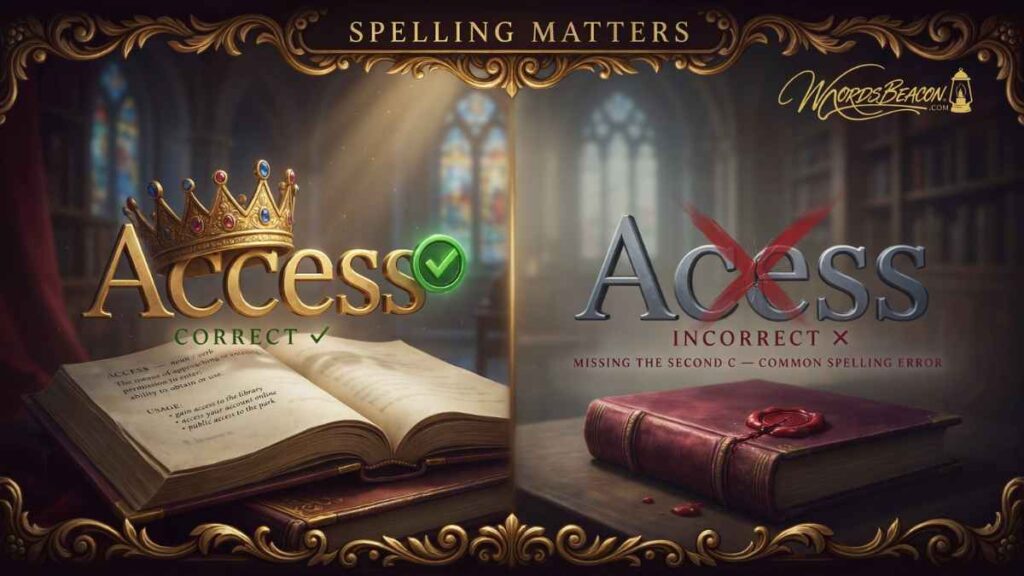
Spelling mistakes can happen to anyone, especially when two words look almost alike. Access vs Acess is a common source of confusion, but the correct choice is easier than you might think. Access is the standard English spelling, while acess is simply a misspelling. The confusion doesn’t end there, though. Many people also mix up access and assess, even though these words have different meanings and uses. So, how can you tell them apart? In this guide, you’ll learn their correct spellings, meanings, grammar, and everyday uses through simple explanations and examples. By the end, you’ll know which word to choose without second-guessing yourself.
quick comprasion
| Comparison | Correct form | Meaning |
|---|---|---|
| Access vs Acess | Access | The correct spelling; acess is a misspelling. |
| Access as a noun | Access | The right or opportunity to enter, reach, or use something. |
| Access as a verb | Access | To open, reach, retrieve, or use something. |
| Access vs Assess | Different words | Access means to reach or use; assess means to evaluate. |
| Access vs Excess | Different words | Access means availability or entry; excess means more than necessary. |
| Access to vs Access something | Both are correct | Use access to as a noun phrase and access directly with an object as a verb. |
Learn the difference between tricky more English words
Comprable vs Comparable Which Spelling Is Correct?
Is It Access vs Acess?
When comparing access vs acess, access is the correct spelling in standard English, while acess is a misspelling. The mistake usually happens when someone accidentally leaves out one of the two C’s. Although the difference looks small, using the correct spelling matters in emails, school assignments, business documents, and everyday writing.
The correct word contains six letters:
A-C-C-E-S-S
Notice the two C’s in the middle and the two S’s at the end. Both letter pairs are essential, so leaving out even one letter makes the spelling incorrect. Therefore, whenever you’re unsure about access vs acess, remember that the standard spelling always includes two C’s and two S’s.
Consider these examples:
- Correct: Students need access to reliable learning materials.
- Incorrect: Students need acess to reliable learning materials.
- Correct: Employees can access the company website from home.
- Incorrect: Employees can acess the company website from home.
As you can see, the correct spelling works whether you’re using access as a noun or a verb. Moreover, this simple spelling rule can help you avoid mistakes when preparing an assignment, writing an email, or publishing an article. Ultimately, understanding access vs acess makes it easier to choose the right spelling and keep your writing clear and professional.
Is Acess a Real English Word?
No. Acess is not a standard English word or an accepted alternative spelling of access. You may occasionally encounter it in usernames, informal messages, brand names, or typing mistakes. However, those appearances don’t make it a correct spelling.
For formal and everyday writing, use access.
Why Do People Misspell Access?
Several common writing habits can lead to this mistake.
- Forgetting a repeated letter: Writers sometimes remember the final double S but overlook the double C.
- Typing too quickly: When you type without checking your work, it’s easy to leave out a letter.
- Relying on pronunciation: The two C’s don’t create separate spoken sounds, so pronunciation doesn’t reveal the complete spelling.
- Confusing similar words: Access, assess, and excess look alike, which can make them harder to distinguish at a glance.
- Skipping proofreading: A quick review can catch missing letters before you submit or publish your writing.
The easiest solution is to remember the complete spelling rather than relying on how the word sounds.
What Does Access Mean?
Access means the ability, right, or opportunity to enter, reach, obtain, or use something. Depending on the context, it can describe physical entry, permission, availability, or the ability to retrieve information.
For example, having access to a library means you have the opportunity or permission to use it. Similarly, having access to an online account means you can sign in and use its features.
The word appears in many areas of everyday life, including technology, education, healthcare, business, and transportation.
Access as a Noun
As a noun, access describes a person’s ability or permission to reach, enter, or use something.
Examples:
- Employees have access to the company’s internal documents.
- The school provides access to digital learning materials.
- Visitors need access to the restricted area.
- The library offers public access to its research collection.
- The new entrance improves access for wheelchair users.
In each example, access describes an opportunity or condition rather than an action.
When access refers to permission or availability, it generally functions as an uncountable noun. Therefore, you normally say “She has access to the database,” not “She has an access to the database.”
Access as a Verb
Access also functions as a verb. In this form, it means to reach, open, retrieve, or use something.
Examples:
- You can access your account through the official website.
- The manager accessed the financial records.
- Students access their assignments online.
- The technician accessed the database to investigate the problem.
- She accessed the document from her laptop.
Notice that the verb connects directly to its object. You access a document, a website, or an account. You don’t normally put to between the verb and its object.
Access Meaning in Different Situations
The meaning stays connected to reaching or using something, but the context determines exactly what kind of access you’re discussing.
| Context | Meaning | Example |
|---|---|---|
| Technology | Ability to use a digital system or resource | I have access to the internet. |
| Education | Opportunity to use learning resources | Students need access to textbooks. |
| Healthcare | Ability to receive medical services | Rural communities need access to healthcare. |
| Business | Permission to use workplace information | Managers have access to financial reports. |
| Government | Ability to obtain public information or services | Citizens need access to public records. |
| Transportation | A route to reach a location | This road provides access to the village. |
| Buildings | Ability or permission to enter a place | Visitors need access to the main entrance. |
For instance, access to healthcare describes the opportunity to receive medical services. By comparison, access a medical record describes the action of opening or retrieving that record.
The surrounding words help you understand the intended meaning.
Understand confusing English more words simply
Sentence vs Sentance Which Spelling Is Correct?
Access as a Noun Common Expressions and Examples
When access functions as a noun, it often appears with the preposition to. This construction describes the resource, place, or information someone can reach or use.
Here are some common expressions:
| Expression | Meaning | Example |
|---|---|---|
| Have access to | Have permission or the ability to use something | I have access to the files. |
| Gain access to | Obtain permission or entry | Visitors must register to gain access to the building. |
| Provide access to | Make something available | The school provides access to online courses. |
| Restrict access to | Limit permission or availability | The company restricts access to private records. |
| Deny access to | Refuse permission or entry | Security denied access to unauthorized visitors. |
| Full access | Unrestricted permission | Administrators have full access to the system. |
| Limited access | Restricted permission | Temporary employees have limited access. |
| Public access | Availability to the general public | The park offers public access. |
These expressions are useful in both casual and professional communication. For example, a company might provide employees with access to shared documents while restricting access to confidential financial records.
Access as a Verb How to Use It Correctly
When access functions as a verb, it usually takes a direct object. This means you place the thing being reached or used immediately after the verb.
The basic sentence structure is:
Subject + access + direct object.
Examples:
- I access my email every morning.
- She accessed the website yesterday.
- They can access the shared folder.
- The administrator accesses the database regularly.
- We accessed the information through the company portal.
Because access is a transitive verb, it normally needs an object in this type of sentence. The object tells readers what someone accessed.
Different Verb Forms of Access
The spelling remains consistent when you use access in different tenses.
| Verb form | Example |
|---|---|
| Present | I access the website daily. |
| Present continuous | I am accessing the website now. |
| Past | I accessed the website yesterday. |
| Present perfect | I have accessed the website before. |
| Future | I will access the website tomorrow. |
Notice that the word keeps both C’s and both S’s in accessed and accessing.
Access To or Access Without To?
One of the most common grammar questions is whether to write access to or access without to. Both constructions are correct, but they serve different grammatical purposes.
Use access to when access functions as a noun. However, when access functions as a verb, place the object directly after it.
When to Use Access To
Use access to when you’re talking about permission, availability, or the opportunity to use something.
Examples:
- I have access to my email account.
- Students need access to educational resources.
- The employees received access to the company database.
- She requested access to the financial report.
- The public deserves access to reliable information.
In these sentences, access is a noun, and to introduces the resource or place involved.
When to Use Access Without To
Use access directly before an object when it functions as a verb.
Examples:
- I can access my email account.
- Students access educational resources online.
- The employees accessed the company database.
- She accessed the financial report.
- The public can access reliable information.
Here, access describes an action. Consequently, adding to before the object would make the sentence incorrect in standard usage.
Access To vs Access Common Grammar Mistakes
| Incorrect | Correct | Explanation |
|---|---|---|
| I can access to my account. | I can access my account. | The verb takes a direct object. |
| She accessed to the file. | She accessed the file. | The verb doesn’t need to. |
| We need access the database. | We need access to the database. | Access functions as a noun. |
| They have access the records. | They have access to the records. | The noun uses to in this construction. |
| He requested access the website. | He requested access to the website. | Access is a noun after requested. |
A useful way to remember the rule is to ask yourself whether you’re describing permission or an action.
- Permission: I have access to the website.
- Action: I can access the website.
Both sentences are correct because access performs a different grammatical role in each one.
Learn the difference between tricky more English words
Provider vs Providor Which word Is Correct?
Access vs Acess What’s the Difference?
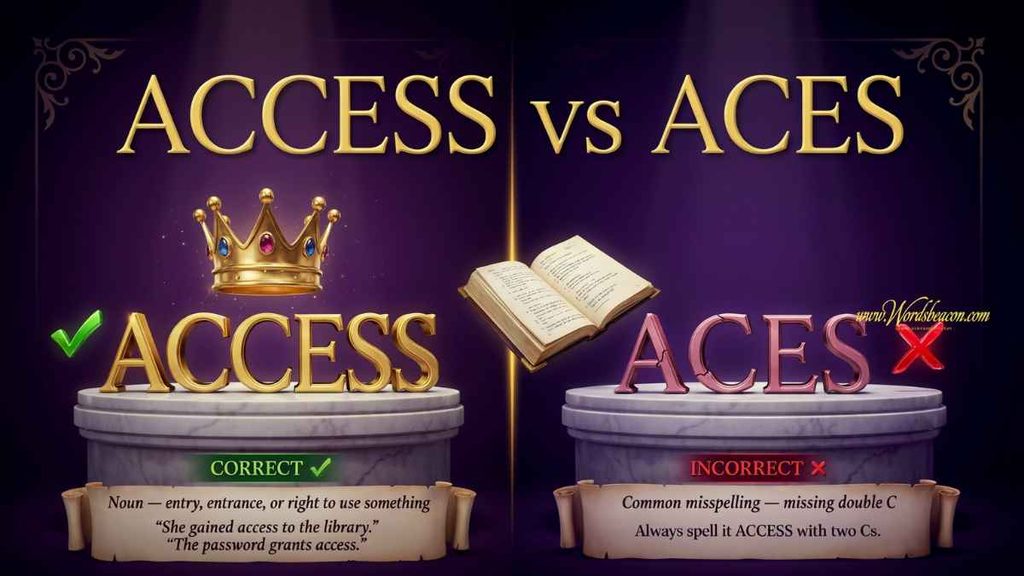
The Access vs Acess is a common spelling confusion, especially because both forms look almost identical. However, only access is the correct standard English spelling. Acess is simply a misspelling, so you should avoid using it in formal and everyday writing.
It’s also important not to confuse access with assess. Although access and assess are both correct English words, they have completely different meanings and uses.
Access means to reach, enter, retrieve, or use something. It can function as both a noun and a verb. Assess, on the other hand, is a verb that means to examine, evaluate, or judge something to understand its quality, condition, value, or importance.
For example, a teacher might access an online learning platform to review student records. Afterward, the teacher might assess each student’s performance. In the first action, the teacher retrieves information, whereas the second involves evaluating it.
Understanding this difference makes Access vs Acess easier to remember and helps you avoid confusing three different spellings.
Access Meaning and Usage
Access can function as either a noun or a verb, depending on how you use it in a sentence. As a noun, it refers to the ability, permission, or opportunity to reach or use something. As a verb, it means to open, reach, retrieve, or use a particular resource.
Here are some examples:
- I need access to the company’s website.
- The administrator accessed the employee database.
- Students can access their examination results online.
- The security team restricted access to the building.
- Employees have access to important company documents.
As you can see, each example involves reaching, entering, or using something. Therefore, when you want to describe the ability or permission to use a resource, access is the correct word.
Assess Meaning and Usage
Assess is a verb that means to examine something carefully and form a judgment about it. Unlike access, it focuses on evaluation rather than reaching or using something.
People commonly use assess in education, business, healthcare, finance, and other professional settings. For instance, teachers assess students’ progress, doctors assess patients’ conditions, and managers assess business performance.
Consider these examples:
- The teacher will assess each student’s progress.
- The company hired an expert to assess the damage.
- Doctors assess a patient’s condition before recommending treatment.
- The manager needs to assess the project’s financial risks.
- The committee will assess the applications before making a decision.
In each sentence, assess describes the process of examining or evaluating something. Consequently, it cannot replace access when you mean entering a place, opening a file, or using information.
Access vs Acess How to Remember the Difference
The easiest way to remember Access vs Acess is to focus on the spelling. Access contains two c’s followed by two s’s. Acess leaves out one c, making it incorrect in standard English.
Meanwhile, access and assess are both valid words, but their meanings are different. You access something when you reach or use it, and you assess something when you evaluate it.
For example, you can access a student’s academic record and then assess their performance. This simple distinction makes it easier to choose the right word without second-guessing yourself.
Access vs Assess Comparison Table
| Feature | Access | Assess |
|---|---|---|
| Meaning | To reach, enter, or use something | To examine, evaluate, or judge something |
| Part of speech | Noun and verb | Verb |
| Main purpose | Obtaining entry or availability | Making an evaluation |
| Example | I accessed the report. | I assessed the report. |
| Related words | Accessible, accessibility | Assessment, assessor |
| Common contexts | Technology, permission, information | Education, business, evaluation |
Remember the difference by connecting access with availability and assess with assessment.
You access a document when you open it. You assess that document when you examine its contents and judge its quality.
Access vs Assess in Example Sentences
The following examples show how each word works in everyday situations.
| Access | Assess |
|---|---|
| The manager accessed the employee records. | The manager assessed the employee’s performance. |
| Students can access the online course. | Teachers assess students’ progress. |
| The technician accessed the computer system. | The technician assessed the system’s condition. |
| The doctor accessed the patient’s records. | The doctor assessed the patient’s condition. |
The words may look similar, but they aren’t interchangeable. Using the wrong one can change the meaning of your sentence.
Access vs Assess Pronunciation
Both words have two syllables, but their first vowel sounds and stress patterns differ in American English.
- Access: /ˈæk.ses/
- Assess: /əˈses/
Access begins with the short A sound found in cat, and its main stress falls on the first syllable.
Assess begins with an unstressed schwa sound, similar to the first vowel in about. Its main stress falls on the second syllable.
Listening for the first vowel and the stressed syllable can help you distinguish the words when speaking.
Understand confusing English more words simply
Encode vs Incode Differences and Usage ?
Access vs Excess What’s the Difference?
The Access and excess share several letters, but their meanings are unrelated.
Access refers to the ability, permission, or opportunity to reach or use something. Excess describes an amount that goes beyond what is necessary, normal, or acceptable.
For example, students need access to educational resources. However, excess homework may leave them with too little time for other activities.
Excess Meaning and Usage
Excess can function as both a noun and an adjective.
As a noun, it describes an unnecessary or unusually large amount of something.
Examples:
- The company had an excess of unused materials.
- The restaurant prepared an excess of food.
- Excess can lead to unnecessary expenses.
As an adjective, it describes something beyond the required or acceptable amount.
Examples:
- Excess baggage may require an additional fee.
- The doctor advised him to avoid excess sugar.
- The factory reduced its excess inventory.
In both forms, excess communicates the idea of too much.
Access vs Excess Comparison Table
| Feature | Access | Excess |
|---|---|---|
| Meaning | Ability or permission to reach or use something | An amount greater than necessary |
| Part of speech | Noun and verb | Noun and adjective |
| Main idea | Availability or entry | Too much of something |
| Example | I have access to the files. | The company has excess supplies. |
| Common expressions | Internet access, public access | Excess weight, excess baggage |
Access vs Assess vs Excess Three Different Words
These three words often cause confusion because their spelling patterns look similar. However, each has a distinct meaning.
| Word | Meaning | Example |
|---|---|---|
| Access | To reach, enter, or use something | I can access the website. |
| Assess | To evaluate or judge something | We need to assess the results. |
| Excess | More than necessary or acceptable | The order contained excess supplies. |
Consider a practical business situation. A manager needs access to the company’s financial records. After opening the files, the manager assesses the expenses to identify unnecessary spending or excess costs.
All three words fit naturally into the same situation, but each communicates a different idea.
How to Use Access in Everyday and Professional Writing

Understanding the definition is important, but real-life examples make the word easier to use. Access appears in conversations about technology, education, healthcare, employment, and public services.
Access in Technology and Computing
Technology is one of the most common areas where people use access. You might access a website, open a digital file, retrieve information from a database, or sign in to an online account.
Examples:
- Users need internet access to browse websites.
- Employees can access company applications through secure accounts.
- The administrator controls access to the database.
- You can access your files through cloud storage.
- The system requires permission before users can access confidential information.
In computing, access permission determines whether a user can view, change, or otherwise interact with a digital resource.
For example, a company might allow an employee to view a document without giving that person permission to edit or delete it.
Common technical expressions include:
- User access
- Database access
- File access
- Network access
- Administrator access
- Access control
- Unauthorized access
- Read-only access
Access in Education
Students need opportunities to use learning materials, facilities, and educational services. Therefore, access is an important word in discussions about education.
A school might provide students with access to:
- Online learning platforms.
- Digital textbooks and research materials.
- Libraries and laboratories.
- Educational software.
- Academic support services.
- Remote learning opportunities.
For example, “Every student should have access to quality educational resources” describes an opportunity to use those resources.
By contrast, “Students access their assignments online” describes the action of opening or retrieving their work.
Access in Healthcare
In healthcare, access often describes the ability to receive medical care or use health-related services.
Common expressions include:
- Access to hospitals and clinics.
- Access to qualified healthcare professionals.
- Access to medical records.
- Access to prescription services.
- Access to preventive healthcare.
For example, a rural community may have limited access to nearby hospitals because residents must travel long distances to receive treatment.
The expression access to healthcare is common because it describes whether people can obtain the medical services they need.
Access in Business and Workplace Communication
Businesses use access when discussing employee permissions, company information, and shared resources.
Examples:
- New employees receive access to the company email system.
- Managers have access to financial reports.
- The IT department controls employee access to internal applications.
- Staff members can access shared project documents.
- Only authorized employees can access confidential business records.
In professional writing, clear descriptions of permission are especially important. Instead of saying, “Everyone can access everything,” identify the people who can use particular resources.
For example, “All department managers have access to monthly financial reports” communicates a much clearer arrangement.
Access in Legal and Government Contexts
The word also appears in legal and government communication.
Common expressions include:
- Public access to government records.
- Access to public facilities.
- Access to legal representation.
- Access to public services.
- Restricted access to confidential information.
For example, a government agency might provide public access to certain records while protecting personal information under applicable privacy laws.
The exact rights and restrictions depend on the relevant laws and circumstances. Nevertheless, access still describes the ability or permission to obtain or use something.
Learn the difference between tricky more English words
Preform vs Perform which one is correct ?
Access vs Acess Pronunciation and Word Forms
Learning the correct spelling is important, but pronunciation and related word forms also help you understand how to use a word naturally. In Access vs Acess, knowing how to pronounce access and recognize its different forms can make your writing clearer and help you avoid common spelling mistakes.
How to Pronounce Access
In American English, access is pronounced /ˈæk.ses/. It has two syllables, with the main stress on the first syllable.
To pronounce it correctly, follow these simple steps:
- Start with the short A sound, as in cat.
- Follow it with a clear K sound.
- Pronounce the second syllable with a short E sound.
- Finish with an S sound.
The double letters in access are important for spelling, but you don’t pronounce them as separate sounds. Therefore, focus on the two syllables rather than trying to pronounce each letter individually.
Access Word Forms
Access has several related forms that appear in everyday English, academic writing, and professional communication. Learning these forms can help you understand their meanings and use them correctly in different sentences.
| Word | Part of speech | Meaning | Example |
|---|---|---|---|
| Access | Noun/verb | Entry, permission, or the act of using something | I need access to the files. |
| Accessed | Past tense/past participle | Reached or used something | She accessed the website yesterday. |
| Accessing | Present participle/gerund | The action of reaching or using something | He is accessing the database. |
| Accessible | Adjective | Easy to reach, enter, or use | The building is accessible. |
| Accessibility | Noun | The quality of being accessible | Website accessibility matters. |
| Inaccessible | Adjective | Difficult or impossible to reach or use | The road became inaccessible. |
Notice that the base spelling remains recognizable in accessed and accessing. However, accessible and accessibility have slightly different meanings because they describe how easily someone can reach, enter, or use something.
For example, a website may provide access to important information. If everyone, including people with disabilities, can use it easily, the website offers good accessibility.
Common Expressions Derived From Access
Several useful expressions come from the word access. Although they share the same root, each has a specific meaning and purpose.
- Accessible: The website is accessible on mobile devices.
- Accessibility: The company improved its website accessibility for users with disabilities.
- Inaccessible: The mountain village became inaccessible after heavy snowfall.
- Access control: The organization introduced access control to protect sensitive files.
- Easy access: The new entrance provides easy access to the main building.
These expressions appear in different situations, from technology and education to buildings and workplace security. For instance, access control describes the methods used to decide who can enter a restricted area or use a particular system.
Access vs Acess What Should You Remember?
The main difference in Access vs Acess is spelling: access is correct, while acess is a misspelling. However, learning its pronunciation and related forms makes the word easier to recognize and use.
Remember that access contains two c’s followed by two s’s. Also, its related forms, such as accessed, accessing, accessible, and accessibility, follow the same recognizable word family.
With these simple spelling and pronunciation rules in mind, you can use access confidently in everyday conversations, school assignments, emails, and professional writing.
Learn the difference between tricky more English words
Placque vs Plaque which one is correct ?
Synonyms and Alternative Words for Access
Sometimes, replacing access with another word can make your sentence more precise. However, synonyms don’t always carry exactly the same meaning, so choose one that fits the context.
Synonyms of Access as a Noun
| Synonym | Meaning | Example |
|---|---|---|
| Entry | The act or right of entering | Visitors received entry to the building. |
| Admission | Permission to enter a place or event | Admission to the museum is free. |
| Availability | The state of being obtainable or usable | The availability of online resources has increased. |
| Permission | Authorization to do something | She received permission to view the files. |
| Opportunity | A favorable chance to do something | Students have an opportunity to use the laboratory. |
| Approach | A way of reaching or getting near something | The northern approach leads to the entrance. |
These words overlap with access in certain situations, but they aren’t interchangeable everywhere.
For instance, admission often refers to entering a place or event, whereas availability describes whether something can be obtained or used.
Synonyms of Access as a Verb
When access functions as a verb, you can sometimes replace it with:
- Enter: To go into a place or system.
- Reach: To get to a location or person.
- Retrieve: To obtain stored information or an item.
- Obtain: To get something.
- Use: To make use of a resource.
- Open: To make a file, document, or application available for viewing.
Examples:
- Access the building → Enter the building.
- Access the stored data → Retrieve the stored data.
- Access the online account → Open the online account.
- Access the available resources → Use the available resources.
The best choice depends on the intended meaning. For example, retrieve a file emphasizes obtaining it, while access a file can simply mean opening or using it.
Access Word Origin and History
The history of access helps explain its connection to the ideas of approaching, entering, and reaching something.
Where Does the Word Access Come From?
The English word access entered the language through Old French and comes ultimately from the Latin word accessus. It is related to the Latin verb accedere, meaning to approach or come toward.
The Latin verb combines two elements:
- Ad: Toward.
- Cedere: To go or move.
Together, they express the idea of moving toward something.
Over time, the English word developed meanings associated with approach, entry, permission, and availability.
How Has the Meaning of Access Changed?
The word originally carried a sense of approaching or coming near something. Its meaning gradually expanded to include the ability or right to enter a place.
Later, people used it more broadly when discussing permission, resources, and availability.
Today, access also plays an important role in digital communication. When someone accesses a database, for example, they retrieve or interact with stored information rather than physically entering a location.
Despite these changes, the central idea remains connected to reaching or obtaining something.
Why Does Access Have Double C and Double S?
The standard English spelling preserves the established form of the word through its historical development. It contains two C’s and two S’s.
English spelling doesn’t follow one simple rule for every repeated consonant. Therefore, the most reliable approach is to remember the complete form:
ACCESS = A + CC + E + SS.
Is Access Spelled Differently in American and British English?
No. American and British English use the same spelling: access.
Unlike words such as color and colour or organize and organise, access doesn’t have a standard regional spelling variation.
| English variety | Correct spelling | Example |
|---|---|---|
| American English | Access | Students need access to the library. |
| British English | Access | Students need access to the library. |
| Canadian English | Access | Employees have access to the system. |
| Australian English | Access | Visitors can access the building. |
Therefore, you don’t need to choose between regional forms. Access is correct whether you’re writing for an American audience, a British reader, or an international audience.
The misspelling acess doesn’t become correct in another English-speaking country either.
Fix common more word mistakes in English
Phenix vs Phoenix Which Spelling Is Correct?
Common Spelling and Grammar Mistakes With Access
Even familiar words can cause trouble when you’re typing quickly. Fortunately, a few simple corrections can help you avoid the most common mistakes.
Leaving Out One C
Incorrect: I need acess to the website.
Correct: I need access to the website.
The correct spelling contains two C’s. Check the middle of the word before submitting your writing.
Leaving Out One S
Incorrect: The company provides acces to its records.
Correct: The company provides access to its records.
Remember that the word ends with two S’s.
Confusing Access With Assess
Incorrect: The teacher will access the students’ performance.
Correct: The teacher will assess the students’ performance.
The teacher evaluates performance rather than simply opening or retrieving it.
Adding To After the Verb
Incorrect: She accessed to the database.
Correct: She accessed the database.
When access functions as a verb, it normally takes a direct object without to.
Using an Unnecessary Article
Incorrect: She has an access to the files.
Correct: She has access to the files.
When access refers to permission or availability, it generally functions as an uncountable noun. Therefore, it doesn’t normally need an article in this construction.
Trusting Spell-Check Without Checking Meaning
Spell-checking tools can identify many typing errors. However, they may not catch a correctly spelled word used in the wrong context.
For example, both access and assess are valid words. A spell-checker may accept either one, even when only one fits your sentence.
That’s why proofreading should include a quick meaning check, not just a spelling check.
Fix common more word mistakes in English
Dought vs Doubt Which Spelling Is Correct?
Practical Examples Access in Real-Life Situations

Realistic situations make grammar rules easier to remember. These examples show how access, assess, and excess work in different contexts.
Access in Technology
Imagine a company that stores employee information in an online database.
New employees can view certain records, while administrators can update the information.
You could describe the arrangement in two ways:
- Employees have access to the company database.
- Administrators can access and update employee records.
The first sentence uses access as a noun. The second uses it as a verb.
Access in Education
Consider a school that provides students with an online learning platform.
Students use the platform to download lessons, submit assignments, and check examination results. Teachers, meanwhile, review submissions and assess student performance.
Examples:
- Students have access to the online learning platform.
- Students access their assignments through the platform.
- Teachers assess the quality of submitted work.
This situation shows how access and assess can appear in the same context without sharing the same meaning.
Access in Business
Imagine a business that wants to protect its financial information.
The company allows department managers to view financial reports but limits editing privileges to authorized accountants.
The following sentences describe the arrangement:
- Managers have access to financial reports.
- Accountants can access and update the records.
- Auditors assess the accuracy of financial information.
- The company removes excess permissions that employees no longer need.
Here, each word has a distinct purpose. Access describes permission or use, assess describes evaluation, and excess describes more than necessary.
Understand confusing English more words simply
Publicly vs Publically Which Spelling Is Correct?
Practice Session Access vs Acess
Choose the correct word to complete each sentence Access vs Acess . Pay attention to the meaning and grammar of each sentence.
1. Students need ______ to reliable educational resources to improve their learning.
2. The company has restricted ______ to its confidential files.
3. You can ______ your online account using your username and password.
4. The teacher will ______ each student’s progress at the end of the semester.
5. The warehouse has an ______ supply of office furniture.
6. Employees must request permission to gain ______ to the company database.
7. The manager needs to ______ the project’s overall performance.
8. I couldn’t ______ the website because my internet connection was down.
9. The doctor will ______ the patient’s condition before recommending treatment.
10. The school provides students with ______ to its digital library.
11. Please check whether you can ______ the shared folder on your computer.
12. The airline charged an additional fee for ______ baggage.
13. The security team denied ______ to unauthorized visitors.
14. We need to ______ the damage before deciding how much the repairs will cost.
15. The website is designed to improve ______ for people with disabilities.
16. She has full ______ to the company’s financial reports.
17. The auditor will ______ the accuracy of the financial records.
18. The organization wants to reduce ______ spending and unnecessary costs.
19. You must enter the correct password to ______ your personal information.
20. The students have limited ______ to computers outside regular school hours.
Answers
- Access
- Access
- Access
- Assess
- Excess
- Access
- Assess
- Access
- Assess
- Access
- Access
- Excess
- Access
- Assess
- Accessibility
- Access
- Assess
- Excess
- Access
- Access
Here’s a trusted source for clear word meanings:
FAQs
Is it access vs assess?
Both are correct English words, but they have different meanings. Access means the ability or permission to reach, enter, or use something. Assess means to examine or evaluate something. For example, you can access a document and then assess its accuracy.
Is it access vs acess?
Access is the correct spelling. Acess is a misspelling and is not accepted as a standard English word. Remember to write access with two c’s followed by two s’s whenever you mean the ability or permission to reach or use something.
What is the correct spelling of access?
The correct spelling is access. It contains six letters: A-C-C-E-S-S. You can use it as both a noun and a verb. For example, “She has access to the office” uses it as a noun, while “She can access the office” uses it as a verb.
Which is correct “access to” or “access”?
Both forms are correct, but their grammatical use differs. Use access to when a noun follows the phrase, as in “He has access to the records.” However, when access functions as a verb, place the object directly after it: “He can access the records.”
What does “assess it” mean?
Assess it means to examine or evaluate something carefully. For example, “The manager will assess it before making a decision.” In this expression, assess refers to judging its quality, condition, or value. It does not mean reaching or using something.
Is it correct to say “access”?
Yes, access is a correct English word and can function as either a noun or a verb. For example, “You need access to the building” uses access as a noun. In contrast, “You can access the building through the main entrance” uses it as a verb.
What does “acess” mean?
Acess has no standard meaning in English because it is a misspelling of access. If you mean the ability, permission, or opportunity to reach or use something, write access. The correct spelling always includes two c’s and two s’s.
What is another word for “access”?
Several words can replace access, depending on the intended meaning. Common alternatives include entry, admission, permission, availability, and opportunity. For example, entry may describe the right to enter a place, while availability can describe the opportunity to use a particular resource.
What is an example of access?
“Employees have access to the company’s confidential records” is a clear example. Here, access means employees have permission to view or use those records. Similarly, “The students have access to the school library” describes their opportunity to use the library.
How do I say access?
Access has two syllables, with the stress on the first syllable. It is pronounced “AK-sess.” The word begins with the same short vowel sound heard in “act” and ends with a sound similar to “success.”
Which is correct: access to or access of?
Access to is the standard expression in most everyday sentences. For example, “Residents have access to clean drinking water” is natural and grammatically correct. Although access of may appear in specialized contexts, access to is generally the better choice when describing the ability or opportunity to use something.
How do you spell access to something?
Write it as access to something. Access contains two c’s and two s’s, while to remains a separate word. For example, “Every employee needs access to the company website.” Avoid writing acess to or combining the words.
What is the full meaning of access?
Access means the ability, right, permission, or opportunity to reach, enter, obtain, or use something. It can describe entering a place, viewing information, or using a particular resource. For example, having access to a document means you can open, read, or use it.
How do you spell all access?
The correct spelling is all access, written as two separate words. The phrase commonly describes permission to enter or use several areas, facilities, or services. For example, an all-access pass may allow someone to enter restricted areas at an event.
Can you use “access to” in a sentence?
Yes, access to is commonly used when a noun follows it. For example, “The new policy gives employees access to important company resources.” Here, the phrase describes the permission or opportunity employees receive to use those resources.
What does “access me” mean?
Access me is not a common expression in standard everyday English. Its meaning depends on the context, but it may refer to reaching someone’s information or connecting with them through a system. If you mean communicating with someone, contact me is usually the clearer expression.
What is to access something?
To access something means to reach, enter, open, retrieve, or use it. For example, when you enter your login details to open a private account, you access that account. The verb can describe using information, files, services, places, or resources.
Is access correct spelling?
Yes, access is the correct and standard spelling. It can work as a noun or a verb, depending on the sentence. Acess is incorrect because it leaves out one c. Therefore, use access in formal writing, schoolwork, emails, and everyday communication.
How do you spell “easy access”?
The correct phrase is easy access. Write easy and access as two separate words, and remember that access contains two c’s and two s’s. For example, “The main entrance provides easy access to the building.”
Which is correct, access vs assess?
Both spellings are correct, but their meanings are different. Access means to reach, enter, or use something, whereas assess means to examine or evaluate it. For example, “The team will access the report and assess its accuracy.” Use access when you mean reaching something and assess when you mean judging it.
Understand confusing English more words simply
Tapping vs Taping difference and usage ?
Conclusion
The difference between access and acess becomes easy to remember once you understand the correct spelling. In fact, access vs acess has a simple answer: access is the only standard English spelling, while acess is a common misspelling. However, don’t confuse access with assess, either. Access means having the ability or permission to reach or use something, whereas assess means to examine or evaluate it. Understanding this distinction will help you avoid confusion when writing.
Here’s an easy way to keep these words straight: you access a file when you open it, but you assess it when you check its quality. Similarly, when learning access vs acess, remember that access has two c’s followed by two s’s. This small spelling detail can save you from a surprisingly common mistake.
Now that you’ve explored access vs acess, their meanings, and their everyday uses, choosing the correct word should feel much easier. Moreover, remembering the difference between access and assess will make your writing clearer and more accurate. Keep these simple rules in mind, and you’ll handle access vs acess with confidence. After all, spelling shouldn’t become the biggest obstacle between you and what you want to say!

Luna AJS is an experienced blogger and dedicated language enthusiast at Words Beacon. She specializes in making English grammar, spelling, vocabulary and commonly confused words easy to understand. She provides clear explanations, practical examples to help readers write with confidence.