
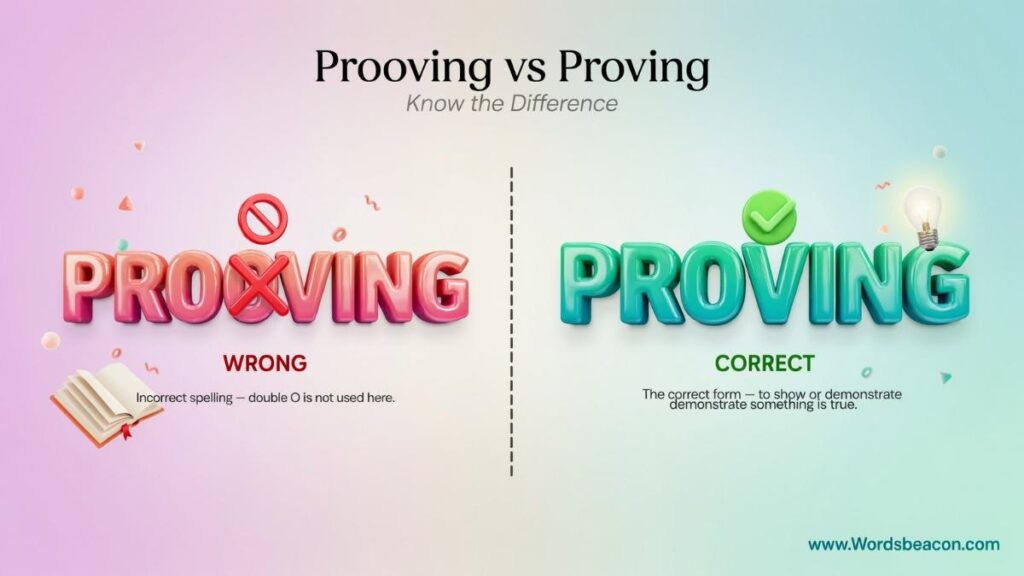
Prooving vs proving can be confusing, especially when you’re unsure what happens to the final e in prove. Should you keep it, remove it, or add another letter? The good news is that the spelling rule is simple. Proving is the correct form, while prooving is a common misspelling. When you add -ing to prove, you drop the silent e and write proving. In this article, you’ll learn what proving means, how to spell it correctly, and how to use it in everyday sentences. You’ll also discover how proving differs from proofing, so you won’t mix up these two words again.
Prooving vs Proving Key Differences
| Comparison | Proving | Prooving |
|---|---|---|
| Spelling status | Correct standard spelling | Nonstandard misspelling |
| Meaning | Showing that something is true or valid | No standard meaning as a form of prove |
| Grammar | Present participle and gerund of prove | Incorrect form |
| Spelling rule | Drop the silent e before adding -ing | Adds an unnecessary o |
| Example | She is proving her point. | She is prooving her point. |
Fix common more word mistakes in English
Cheer vs Chear Difference and Correct Usage
What Does Proving Mean?
Proving is the present participle and gerund form of the verb prove. It describes the process of showing that something is true, correct, genuine, or valid.
When you prove something, you support it with evidence, facts, examples, or logical reasoning. Therefore, proving often appears in discussions about arguments, education, research, science, law, business, and everyday experiences.
For example:
- The scientist is proving the theory through repeated experiments.
- She is proving that her original calculation was correct.
- The student is proving her answer with a clear explanation.
- The company is proving its reliability through consistent service.
In each example, proving describes an action or activity that supports a claim.
Proving as a Verb Form
Proving works with helping verbs such as is, am, are, was, and were to form continuous tenses. These forms describe an action that is happening now or was happening at a particular time.
For example:
- I am proving my point with facts.
- She is proving her ability through hard work.
- They are proving that the new method works.
- He was proving his argument when the discussion ended.
Notice how proving describes an ongoing action in each sentence. It tells you what someone is doing rather than simply naming the evidence.
Proving as a Gerund
A gerund is a verb ending in -ing that functions as a noun. Proving can also serve this purpose.
Consider these examples:
- Proving your skills takes patience.
- Proving the claim requires reliable evidence.
- Proving a scientific theory can involve years of research.
In these sentences, proving names an activity. It does not describe an action performed by a subject through a continuous verb tense.
Common Contexts for Proving
You can use proving in many situations. Although the subject changes, the central meaning remains the same: showing that something is true or valid.
| Context | Example |
|---|---|
| Education | The student is proving the answer with a mathematical formula. |
| Science | Researchers are proving the hypothesis through experiments. |
| Law | The attorney is proving the case with documented evidence. |
| Business | The company is proving its value to customers. |
| Personal life | She is proving her commitment through consistent actions. |
| Debate | He is proving his point with relevant examples. |
For instance, a student might prove a mathematical statement, while a researcher might prove a scientific claim. In both cases, the person uses evidence or reasoning to support a conclusion.
Understand confusing English more words simply
Phenix vs Phoenix Which Spelling Is Correct?
What Does Prooving Mean?
Prooving is not the standard spelling of the present participle or gerund of prove. It has no recognized separate meaning in standard English when someone uses it to describe the act of proving something.
The mistake usually happens when writers assume that adding -ing requires another vowel. However, the spelling of prove follows a specific pattern. You remove the final silent e and then add -ing.
Compare these examples:
- Incorrect: She is prooving that the report contains an error.
- Correct: She is proving that the report contains an error.
- Incorrect: Prooving your skills takes time.
- Correct: Proving your skills takes time.
The extra o does not create a new meaning. It simply makes the spelling incorrect.
Is Prooving Ever a Word?
You might occasionally encounter Prooving as a username, brand name, fictional expression, or deliberately invented spelling. People and businesses can choose unusual spellings for names.
However, that does not make prooving an accepted form of the verb prove. In standard writing, school assignments, professional communication, and edited content, use proving.
Fix common more word mistakes in English
Bachelor vs Batchelor difference and correct usage
Why Is Proving Correct and Prooving Incorrect?
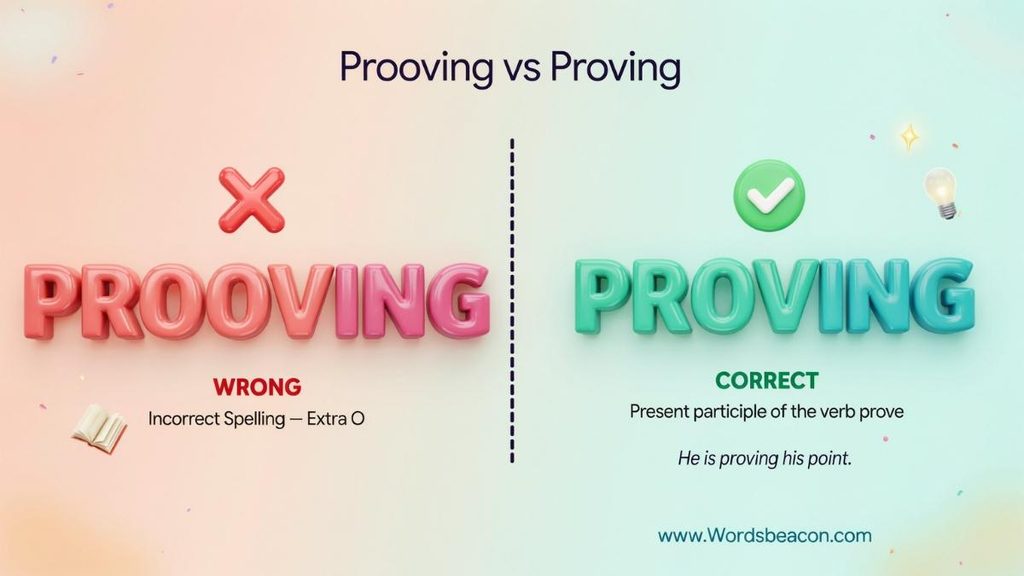
The easiest way to understand the difference is to look at the base word.
The original verb is prove. It ends with a silent e. When you add the suffix -ing, you remove that final e.
The spelling changes in three simple steps:
| Step | Word |
|---|---|
| Start with the base verb | Prove |
| Remove the silent e | Prov |
| Add -ing | Proving |
Therefore:
Prove + ing = Proving
You keep the original o and remove the final e. There is no reason to add another o.
Understanding the Silent-E Rule
Many English verbs end in a silent e. When you add a suffix that begins with a vowel, such as -ing, you usually drop the final e.
Here are some familiar examples:
| Base word | Correct -ing form |
|---|---|
| Make | Making |
| Write | Writing |
| Take | Taking |
| Hope | Hoping |
| Dance | Dancing |
| Drive | Driving |
| Prove | Proving |
The same pattern applies to proving. You remove the silent e and attach -ing without changing the other letters.
However, English spelling has exceptions. For example, see becomes seeing, and agree becomes agreeing. These words keep the final e to preserve their spelling and pronunciation patterns. Prove does not follow that exception, so its correct -ing form is proving.
Why You Should Not Double the O
Another source of confusion is the consonant-doubling rule. Some English verbs double their final consonant when they take -ing.
For example:
- Run becomes running.
- Sit becomes sitting.
- Stop becomes stopping.
- Plan becomes planning.
However, these verbs follow a different spelling pattern from prove. They do not end in a silent e that you need to remove.
Compare the two rules:
| Base word | Spelling change | Correct form |
|---|---|---|
| Run | Double the final n | Running |
| Sit | Double the final t | Sitting |
| Make | Drop the final e | Making |
| Prove | Drop the final e | Proving |
Once you recognize which spelling rule applies, the correct form becomes easier to remember. Prove follows the silent-e rule, not the consonant-doubling rule.
Learn how to use confusing more words correctly
Access vs Acess Which Spelling Is Correct?
Proving in a Sentence Correct Examples
Examples make spelling rules easier to understand because they show how a word works in real situations. When learning Prooving vs proving, seeing the correct form in everyday conversations, academic writing, and professional communication can help you avoid common mistakes. In every case, proving is the correct spelling, not prooving.
Everyday Examples
- She is proving that honesty builds trust.
- He keeps proving his dedication through his actions.
- I am proving my point with clear examples.
- They are proving that teamwork can solve difficult problems.
- The new employee is proving to be a valuable member of the team.
Academic and Scientific Examples
- The student is proving the theorem step by step.
- Researchers are proving the hypothesis through careful testing.
- The experiment is proving that temperature affects the reaction.
- Her research focuses on proving the connection between the two results.
- The teacher explained the process of proving a mathematical statement.
Professional Examples
- The business is proving its reliability by meeting every deadline.
- The manager is proving that the new strategy can improve productivity.
- The team is proving its ability to handle complex projects.
- The report is proving useful during the planning process.
- The company is proving its commitment to customer service.
Incorrect and Correct Sentence Examples
To understand Prooving vs proving more clearly, compare the incorrect sentences with their corrected versions below. Notice how one unnecessary letter creates a spelling mistake, even though the rest of the sentence remains correct.
| Incorrect sentence | Correct sentence |
|---|---|
| She is prooving her point. | She is proving her point. |
| They are prooving the theory. | They are proving the theory. |
| He is prooving his ability. | He is proving his ability. |
| Prooving the answer takes time. | Proving the answer takes time. |
| I am prooving that the claim is false. | I am proving that the claim is false. |
As these examples show, you don’t need to change the sentence structure to correct this mistake. You only need to remove the extra o. The spelling rule is straightforward: when you add -ing to prove, drop the silent e to form proving. Therefore, whenever you face the Prooving vs proving confusion, remember that proving is always the correct choice in standard English .
Learn how to use confusing more words correctly
Comprable vs Comparable Which Spelling Is Correct?
Proving a Point Meaning and Usage
The phrase proving a point means presenting evidence or making an argument to show that your statement, opinion, or belief is correct.
You might hear this expression during a discussion, disagreement, debate, or everyday conversation. It often describes someone who supports an argument with facts rather than relying on personal opinions.
For example:
- She brought the original documents to prove her point.
- He is proving his point with facts instead of opinions.
- They conducted another test to prove a point about the new method.
The phrase proving my point carries the same basic meaning. It describes the process of supporting your own statement with evidence.
For example:
- I am proving my point by showing the results.
- The latest report is proving my point.
- She understood that proving her point required more than repeating her opinion.
However, proving a point does not automatically mean winning an argument. A strong argument needs relevant evidence and sound reasoning. Simply insisting that you are right does not prove anything.
Common Spelling Mistakes Involving Proving
The spelling of proving seems simple, but a few common mistakes can still cause confusion. When comparing Prooving vs proving, remember that the correct form follows a straightforward spelling rule: remove the silent e from prove before adding -ing. However, spelling isn’t the only thing to watch. You should also choose the right word for your sentence and avoid confusing proving with similar-looking words.
Adding an Extra O
One of the most common mistakes is writing prooving instead of proving. The extra o may seem harmless, but it makes the word incorrect in standard English.
Incorrect: The evidence is prooving the claim.
Correct: The evidence is proving the claim.
To avoid this mistake, keep the original o and remove the final e. As a result, you get proving, not prooving. This is the main spelling difference to remember when dealing with Prooving vs proving.
Keeping the Final E
Another common mistake is writing proveing because some writers keep every letter from the base word. However, English spelling rules require you to drop the silent e before adding -ing in this case.
Incorrect: She is proveing her ability.
Correct: She is proving her ability.
The change is small, but it makes all the difference. Whenever you add -ing to prove, remove the final e first. Therefore, proving is the correct form, while proveing is another spelling error to avoid.
Confusing Proving With Proofing
Proving and proofing look and sound similar, but they have different meanings. Mixing them up can change the meaning of your sentence.
Proving means showing that something is true through evidence, facts, or reasoning. Proofing, on the other hand, can mean checking written material for errors or allowing bread dough to rise before baking.
For example:
- The lawyer is proving that the contract is valid.
- The editor is proofing the final document.
- The baker is proofing the dough before baking.
As you can see, each word describes a different action. So, when deciding between Prooving vs proving, make sure you’re using the correct spelling and not confusing proving with proofing.
Using Proof Instead of Proving
Proof and proving are closely related, but they serve different grammatical purposes. Proof is generally a noun, while proving is the -ing form of the verb prove. Therefore, you cannot always use one in place of the other.
Incorrect: She is proof the theory.
Correct: She is proving the theory.
Here are a few more examples to make the difference clear:
- She has proof of the theory.
- She is proving the theory.
- The results provide proof of the theory.
Notice how proof names the evidence, while proving describes the action of showing something to be true. Once you understand this distinction, you’ll find it easier to avoid grammar mistakes as well as spelling errors. Ultimately, the key to remembering Prooving vs proving is simple: use proving when you mean demonstrating something, and leave the extra o out.
Fix common more word mistakes in English
Sentence vs Sentance Which Spelling Is Correct?
Proving Pronunciation
Proving has two syllables, with the stress on the first syllable. In standard American English, the word begins with the same basic vowel sound as prove and ends with the familiar -ing sound.
The spelling prooving does not represent a different standard pronunciation. It is simply an incorrect spelling when someone intends to write proving.
You can practice the word in short phrases:
- Proving a point
- Proving the result
- Proving the theory
- Proving your ability
Reading these phrases aloud can help you connect the correct spelling with its natural use.
Prove, Proving, and Proof What Is the Difference?
Prove, proving, and proof belong to the same word family. However, each one has a different grammatical role.
| Word | Part of speech | Meaning | Example |
|---|---|---|---|
| Prove | Verb | To show that something is true | I can prove the result. |
| Proving | Present participle or gerund | The act of showing something is true | She is proving the result. |
| Proof | Noun | Evidence that supports a claim | We need proof of the result. |
Prove
Prove is the base form of the verb. You use it when describing the action of showing that something is true.
Examples:
- I can prove my answer.
- They want to prove the claim.
- The experiment may prove the theory.
Proving
Proving is the -ing form of prove. It can describe an ongoing action or function as a gerund.
Examples:
- She is proving her point.
- Proving the result requires more evidence.
- They are proving that the system works.
Proof
Proof is a noun. It refers to evidence, information, or a fact that supports a statement.
Examples:
- The detective found proof of the crime.
- Do you have proof of payment?
- The experiment provided proof of the theory.
A simple way to remember the difference is this: you prove something, you may be proving it, and the evidence you present can serve as proof.
Learn how to use confusing more words correctly
Provider vs Providor Which word Is Correct?
Proving vs Proofing Understanding the Difference

The Proving and proofing often create confusion because both words appear in discussions about writing and baking. However, they do not always mean the same thing.
Proving generally refers to demonstrating that something is true. Proofing has several established uses, including checking written material and allowing yeast dough to rise.
| Word | Common meaning | Example |
|---|---|---|
| Proving | Showing that a claim is true | She is proving her argument. |
| Proofing | Checking text for errors | He is proofing the final article. |
| Proofing | Allowing yeast dough to rise | The baker is proofing the bread dough. |
| Proving | Allowing dough to rise in some varieties of English | The dough is proving in a warm place. |
Proving and Proofing in Baking
Baking is one area where the distinction becomes especially interesting.
When you make yeast bread, the dough needs time to rise. During this stage, yeast produces carbon dioxide, which helps the dough expand. Bakers commonly call this process proofing in American English.
In British English, proving is also commonly used for the same stage.
For example:
- American English: The baker is proofing the dough.
- British English: The baker is proving the dough.
Both expressions can describe the rising stage of bread dough. Therefore, the choice may depend on the variety of English and the audience.
However, this regional difference does not make prooving correct. If you mean the ordinary -ing form of prove, the spelling remains proving.
Proving vs Proofreading
Proofreading is another related term, but it has a more specific meaning.
Proofreading means checking written material for spelling, punctuation, grammar, and formatting errors before publication or submission.
For example:
- The editor is proofreading the article.
- I need to proofread my assignment before submitting it.
- She finished proofreading the report yesterday.
Although proofreading and proving share a connection through the word proof, they describe different activities. Use proofreading when you mean checking a document for mistakes.
Learn the difference between tricky more English words
Placque vs Plaque which one is correct ?
Synonyms of Proving
The best synonym for proving depends on the context. Some alternatives focus on presenting evidence, while others emphasize confirming or demonstrating a claim.
| Synonym | Meaning | Example |
|---|---|---|
| Demonstrating | Showing how something is true or works | The experiment is demonstrating the result. |
| Establishing | Making something clear or accepted | The research is establishing a connection. |
| Confirming | Showing that something is correct | The test is confirming the earlier findings. |
| Verifying | Checking that information is accurate | The team is verifying the figures. |
| Validating | Showing that something is sound or acceptable | The results are validating the approach. |
| Substantiating | Supporting a claim with evidence | The documents are substantiating her statement. |
| Showing | Making something clear or visible | The figures are showing a clear pattern. |
| Supporting | Providing reasons or evidence for an idea | The new data is supporting the theory. |
These words are not always interchangeable. For instance, verifying often involves checking accuracy, while substantiating emphasizes providing evidence for a claim.
Therefore, choose the synonym that best matches the meaning you want to express.
Word Forms Related to Proving
Understanding the other forms of prove can help you use proving correctly in different sentences.
| Word form | Usage | Example |
|---|---|---|
| Prove | Base verb | I can prove the statement. |
| Proves | Third-person singular present | She proves her point with evidence. |
| Proved | Simple past tense | He proved that the result was correct. |
| Proved | Past participle | They have proved their ability. |
| Proven | Past participle, often used as an adjective | The method is proven to be effective. |
| Proving | Present participle or gerund | She is proving the theory. |
Both proved and proven are accepted past participle forms. Their use depends on the sentence and the style you prefer.
For example:
- The results have proved useful.
- The results have proven useful.
- This is a proven method.
The word proving follows its own clear spelling pattern. It does not become prooving in any of these grammatical contexts.
Learn the difference between tricky more English words
Encode vs Incode Differences and Usage ?
Practice Exercise Prooving vs Proving
Choose the correct spelling, Prooving vs Proving, to complete each sentence. Write your answers in the blanks.
- She is __________ her point with strong evidence.
- The scientist is __________ the theory through careful experiments.
- __________ your skills requires patience and hard work.
- He is __________ that his original answer was correct.
- The students are __________ their mathematical solutions.
- The lawyer is __________ the client’s innocence with reliable evidence.
- I am __________ my argument with facts and examples.
- The new employee is __________ his ability to handle difficult tasks.
- __________ the claim requires more research.
- The experiment is __________ that the new method works.
- They are __________ their commitment through consistent actions.
- She kept __________ that her decision was right.
- The researcher is __________ a connection between the two results.
- We are __________ that the information in the report is accurate.
- __________ a scientific theory can take years of investigation.
- The company is __________ its reliability through excellent service.
- He is __________ his teacher that he understands the lesson.
- The evidence is __________ that the original statement was false.
- __________ your point is easier when you have clear facts.
- The team is __________ that its new strategy can deliver better results.
Answers
- Proving
- Proving
- Proving
- Proving
- Proving
- Proving
- Proving
- Proving
- Proving
- Proving
- Proving
- Proving
- Proving
- Proving
- Proving
- Proving
- Proving
- Proving
- Proving
- Proving
Here’s a trusted source for clear word meanings:
FAQs
Is it Prooving vs Proving?
Proving is the correct spelling in standard English. It comes from prove, with the silent e removed before adding -ing. Prooving is a spelling mistake.
How do you spell proving?
The correct spelling is P-R-O-V-I-N-G. To remember it, start with prove, drop the final e, and add -ing.
What does proving it mean?
Proving it means showing that something is true or correct through evidence, facts, or logical reasoning. For example, a student proves an answer by explaining how they reached it.
What is the meaning of proving?
Proving means demonstrating that a statement, claim, or idea is true. You can prove something through experiments, evidence, examples, or clear explanations.
Is it proove or prove?
Prove is the correct spelling. Proove is not a standard English word. For example, you should write, “I can prove that my answer is correct.”
What does the word prove mean?
Prove means to demonstrate that something is true, accurate, or valid. It can also mean showing your ability through actions, such as proving that you can handle a difficult task.
What is the difference between proving and proofing?
Proving means demonstrating that something is true or correct. Proofing has several meanings, depending on the context. It can refer to checking written material for errors or allowing yeast dough to rise before baking. Although the words look similar, they aren’t interchangeable.
What does proofing mean?
Proofing means checking or preparing something before its final use. In writing, it involves reviewing text for spelling, grammar, and punctuation errors. In baking, it means allowing yeast dough to rise before baking.
Is proofing the same as proofreading?
No. Proofreading specifically involves checking written material for errors in spelling, grammar, punctuation, and formatting. Proofing has broader uses, including preparing bread dough to rise. Therefore, proofreading is one particular type of checking, not a synonym for every meaning of proofing.
What’s a better word for proving?
The best alternative depends on your sentence. Common options include demonstrating, establishing, confirming, verifying, and substantiating. For example, you could use “demonstrating” when explaining how evidence supports a claim.
What is another word for prove?
Some common alternatives are demonstrate, establish, confirm, verify, validate, and substantiate. Choose one that fits your intended meaning. For example, verify emphasizes checking accuracy, while demonstrate focuses on making something clear through evidence or examples.
What does proofing someone mean?
“Proofing someone” isn’t a common standard English expression. Depending on the context, someone might mean testing a person’s abilities, checking their work, or asking them to review a document. A more precise phrase makes the intended meaning clearer.
What is the difference between proof and proving?
Proof is a noun that means evidence supporting the truth of something. Proving is the act of presenting evidence or reasoning to establish that truth. For example, “The report provides proof” and “She is proving her point” use both words correctly.
How do you pronounce proving?
Proving has two syllables, with the stress on the first syllable. Its first syllable has the same vowel sound as prove, while the ending has the familiar sound found in words such as running and writing.
What does it mean to prove something?
To prove something means to provide enough evidence or reasoning to show that it is true, correct, or valid. For example, a scientist may prove a claim through experiments, while a lawyer may establish a case using reliable evidence.
What does proofing mean in Microsoft Word?
In Microsoft Word, proofing refers to tools that help you find and correct writing errors. These features can check spelling and grammar and may suggest improvements to your text. The available options depend on your Word version and settings.
Where is proofing in Microsoft Word?
In many desktop versions of Microsoft Word, open File, select Options, and then choose Proofing. There, you can adjust spelling and grammar settings. The steps may differ slightly in Word for Mac or Word for the web.
Why is it called proofing?
The word proofing has different uses in printing and baking. In printing, a proof is a sample copy that people review before producing the final version. In baking, proofing refers to allowing yeast dough to rise. Both uses involve checking or preparing something before the next stage.
Which is correct proof or proofed?
Both words are correct, but they have different grammatical uses. Proof is commonly a noun meaning evidence, while proofed is the past tense and past participle of the verb proof. For example, “The editor proofed the document before publication.”
What is the word for proving something is true?
The right word depends on the context. Demonstration, verification, confirmation, and substantiation can all describe ways of establishing the truth of something. In mathematics, a logical explanation that establishes a statement is called a proof.
What is the verb form of prove?
Prove is already the base form of the verb. Its main forms are prove, proves, proved, and proving. Proven is also an accepted past participle. For example, “She has proven her ability through years of experience.”
What does proof mean in English?
Proof means evidence or information that shows something is true, correct, or genuine. It can also refer to a sample copy of printed material or a measure of alcoholic strength. The intended meaning depends on how the word is used.
Learn the difference between tricky more English words
Dought vs Doubt Which Spelling Is Correct?
Conclusion
The choice between Prooving vs Proving is easier than it looks. Proving is the correct spelling, while prooving is simply a common spelling mistake. When you add -ing to prove, drop the silent e and write proving. That’s all there is to it! No extra o is needed.
Also, don’t confuse proving with proofing. Proving means showing that something is true with facts, evidence, or clear reasoning. Proofing, however, usually means checking written work for mistakes or allowing bread dough to rise. Although the words look similar, they have different meanings and uses. So, when you want to show that a claim is true, use proving. Remember this simple rule, and you’ll no longer have to second-guess your spelling!

Luna AJS is an experienced blogger and dedicated language enthusiast at Words Beacon. She specializes in making English grammar, spelling, vocabulary and commonly confused words easy to understand. She provides clear explanations, practical examples to help readers write with confidence.