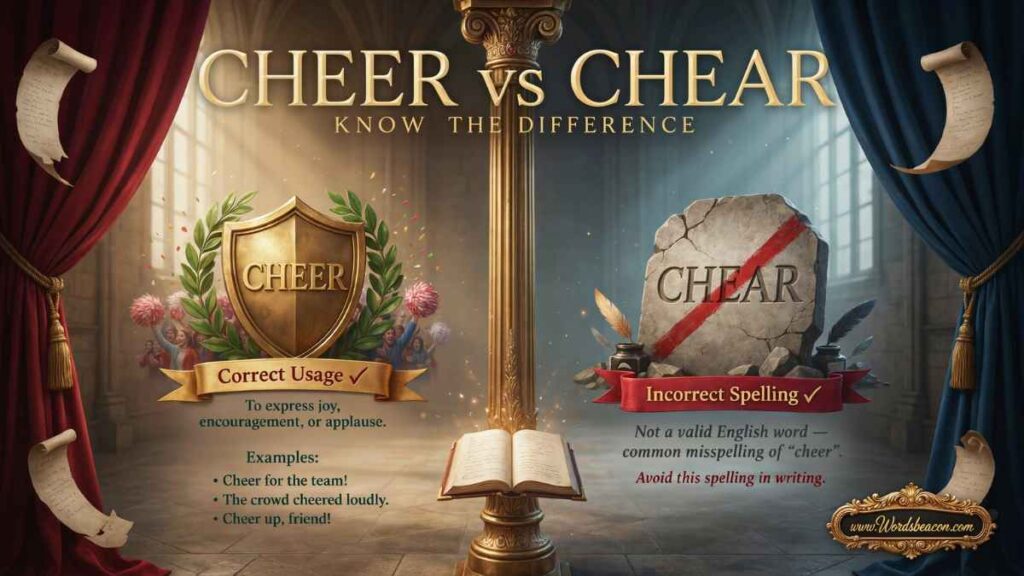
Some spelling mistakes are easy to make, especially when two words look almost alike. Cheer vs Chear is one such example. Both spellings may look possible, but only one is correct in modern English. Cheer is the word you should use when talking about happiness, support, applause, or encouragement. Chear, on the other hand, is an old spelling that may appear in historical writing, but it is not used in everyday English today. In this guide, you’ll learn what each spelling means, why people confuse them, and how to use cheer correctly in your writing. By the end, the difference will be easy to remember.
Cheer vs Chear Quick Comparison
| Comparison point | Cheer | Chear |
|---|---|---|
| Spelling status | Correct modern spelling | Obsolete historical spelling |
| Meaning | Happiness, encouragement, applause, or support | Historical form of cheer |
| Modern usage | Common in everyday English | Rare outside historical texts |
| Part of speech | Noun and verb | Historical noun and verb form |
| Pronunciation | /tʃɪr/ in standard American English | Historically connected with cheer |
| American English | Standard | Not standard |
| British English | Standard | Not standard |
| Recommended use | Modern writing and conversation | Historical quotations and research |
The main difference is straightforward: cheer is the spelling you should use today, whereas chear belongs to an earlier stage of English spelling. Although the two forms are historically connected, they are not interchangeable in modern communication.
Learn how to use confusing more words correctly
Bachelor vs Batchelor difference and correct usage
Cheer vs Chear Which Spelling Is Correct?
Cheer is the correct spelling in modern American and British English. It is a familiar word that describes happiness, positive feelings, encouragement, applause, and expressions of support.
For example:
- The crowd began to cheer when the players entered the stadium.
- Her kind words brought cheer to the entire family.
- We need a little holiday cheer this year.
- His friends cheered him on during the race.
- The audience gave the performers a loud cheer.
In each example, cheer follows standard modern spelling rules. Whether you use it as a noun or a verb, the spelling remains consistent.
Chear, on the other hand, is an obsolete spelling of the same word. Although older writers sometimes used it, modern dictionaries and writing conventions do not recognize it as a standard alternative.
For instance:
Incorrect in modern writing: The crowd gave the singer a loud chear.
Correct: The crowd gave the singer a loud cheer.
Therefore, if you are preparing a school assignment, business email, article, report, or social media post, always choose cheer. You should preserve chear only when reproducing an original historical text or discussing its spelling history.
What Does Cheer Mean?
Cheer has several meanings, depending on how you use it. Most commonly, it describes happiness, encouragement, applause, or a positive expression of support. Moreover, it can function as both a noun and a verb, which makes it useful in everyday English.
Cheer as a noun
As a noun, cheer can describe a happy feeling, an encouraging expression, or a loud reaction from a group of people.
Here are its main meanings:
- Happiness or good spirits: A positive feeling or cheerful state of mind.
- Encouragement: Words or actions that help someone feel hopeful.
- Applause: A loud expression of approval or excitement.
- Support: An enthusiastic response to a person, team, or idea.
- Celebration: A joyful atmosphere during a special occasion.
Consider these examples:
- The children filled the room with cheer.
- The team received a loud cheer from its supporters.
- Her message brought cheer to my difficult day.
- The festival filled the town with music, laughter, and good cheer.
- A little encouragement can bring cheer to someone facing a difficult situation.
In these sentences, cheer communicates a positive feeling or expression. However, the surrounding words help you understand its exact meaning.
For example, a cheer from a crowd usually means a loud expression of approval. By comparison, good cheer describes a happy or positive atmosphere.
Cheer as a verb
Cheer also works as a verb. In this form, it describes the action of encouraging someone, expressing excitement, or showing approval.
For example:
- The fans cheer for their favorite team.
- We cheered when the final score appeared.
- Her friends cheered her on during the competition.
- The good news cheered everyone.
- The children cheered loudly at the school event.
Notice that cheer can describe different actions. Sometimes, it means making an enthusiastic sound. In other situations, it means helping someone feel happier or more confident.
For example, when you cheer for a team, you show support. However, when you cheer someone up, you help that person feel better.
Common expressions with cheer
Cheer appears in several familiar English expressions. These phrases are especially useful in everyday conversations because they communicate encouragement and positive feelings naturally.
| Expression | Meaning | Example |
|---|---|---|
| Cheer up | Become happier or help someone feel better | Try to cheer up after a difficult day. |
| Cheer someone on | Encourage someone during an activity | We cheered our friend on during the race. |
| Good cheer | Happiness and a positive attitude | The family welcomed everyone with good cheer. |
| Holiday cheer | A happy feeling associated with a holiday | The decorations added holiday cheer. |
| Three cheers | A traditional expression of strong approval | Three cheers for the winning team! |
| Cheers! | An informal toast or expression of thanks in some varieties of English | Cheers for helping me today. |
As you can see, cheer appears in many everyday expressions. Therefore, learning these phrases can also improve your vocabulary and help you understand the word in different contexts.
Learn how to use confusing more words correctly
Access vs Acess Which Spelling Is Correct?
What Does Chear Mean?
Chear is an obsolete historical spelling of cheer. In other words, some older writers used chear where modern writers would use cheer.
The historical spelling does not represent a separate modern word with an entirely different meaning. Instead, it reflects an earlier form of the same English word.
Is chear a real word?
Yes, chear is a historically documented English spelling. However, its historical existence does not make it a correct alternative in modern writing.
Historical dictionaries identify chear as an archaic or obsolete form of cheer. Consequently, you may encounter it when reading older books, poems, manuscripts, and other historical documents.
For example, the English poet William Blake used chear in his 1789 collection Songs of Innocence. His poem “Introduction” preserves the phrases “merry chear” and “happy chear” in its original spelling.
This example shows that chear genuinely appeared in historical English. Nevertheless, it does not mean modern writers should use it today.
Why does chear appear in old writing?
English spelling developed gradually over many centuries. Before spelling conventions became more standardized, writers and printers sometimes used different forms of the same word.
As a result, older documents contain spellings that may look unusual to modern readers. Chear is one example of this historical variation.
You may find it in:
- Older poetry and literary collections
- Historical books and printed documents
- Archived letters and manuscripts
- Early English publications
- Research about the development of English spelling
However, finding a spelling in an old text does not automatically make it acceptable today. Historical usage and modern spelling standards serve different purposes.
Should you use chear today?
In almost every modern writing situation, no. You should use cheer instead.
Consider these examples:
Incorrect in modern writing: The children shouted with chear when the show began.
Correct: The children shouted with cheer when the show began.
Historical reference: William Blake used chear in an original poem.
The distinction is important. If you quote an old source, you may preserve its original spelling. Otherwise, use the modern standard form to keep your writing accurate and easy to understand.
Learn how to use confusing more words correctly
Phenix vs Phoenix Which Spelling Is Correct?
Cheer vs Chear Main Differences Explained

Although cheer vs chear look similar, their spelling status and modern usage are different. Understanding these points will make the choice much easier.
Spelling difference
Cheer contains the letters c-h-e-e-r, whereas chear contains c-h-e-a-r.
The difference appears in the middle of the word. Modern English uses the double e spelling in cheer, while chear represents an older written form.
This small change can cause confusion, particularly when you encounter chear in a historical poem. Nevertheless, modern spelling conventions make the correct choice clear.
Meaning difference
Cheer has several current meanings, including happiness, encouragement, applause, and support.
Chear, by comparison, does not have a separate, commonly accepted modern meaning. It is a historical spelling of cheer rather than a modern synonym with an independent definition.
Therefore, you should not treat the two forms as equally acceptable alternatives. Their connection comes from spelling history, not from two different modern meanings.
Usage difference
Cheer appears regularly in modern conversations, books, newspapers, educational materials, and professional writing. It is also common in familiar expressions such as cheer up, cheer for, and good cheer.
Chear, however, mainly appears in historical material. You might encounter it while studying an old poem, but you are unlikely to see it used intentionally in contemporary writing.
Pronunciation difference
In standard American English, cheer is pronounced /tʃɪr/. It has one syllable and rhymes with words such as near, dear, and clear in many American accents.
Because chear is an obsolete spelling of cheer, modern readers generally connect it with the standard word’s pronunciation. However, historical pronunciation could vary by period and speaker. Therefore, it is better not to assume that every historical writer pronounced the word exactly as a modern speaker does.
Fix common more word mistakes in English
Comprable vs Comparable Which Spelling Is Correct?
Cheer vs Chear Examples in Sentences
Examples make spelling differences easier to remember. The following sentences show how to use cheer correctly in modern English and how to recognize chear in a historical context.
Modern examples using cheer
- The fans began to cheer when their team scored.
- Her cheerful attitude brought cheer to the workplace.
- We heard a loud cheer from the stadium.
- A kind message can cheer someone up.
- His friends cheered for him during the marathon.
- The holiday decorations filled the house with good cheer.
- The audience gave the performers three cheers.
- The announcement brought excitement and cheer to the office.
- She tried to cheer her brother after his disappointing result.
- The supporters continued to cheer until the match ended.
Each sentence uses cheer or one of its grammatical forms according to modern spelling rules. Furthermore, these examples demonstrate how the word works as both a noun and a verb.
Historical examples using chear
Chear belongs in historical examples rather than ordinary modern sentences.
William Blake’s 1789 poem “Introduction,” from Songs of Innocence, provides a documented example. The original text uses the expressions “merry chear” and “happy chear.”
When discussing this passage today, explain that chear is an obsolete spelling. Otherwise, readers may assume that you are recommending it as a modern spelling choice.
A quick comparison of modern and historical usage
| Situation | Modern spelling | Historical spelling |
|---|---|---|
| A sports crowd shows excitement | The crowd gave a loud cheer. | Not normally used in modern reporting |
| Someone encourages a friend | I tried to cheer her up. | Not recommended |
| A family celebrates a holiday | The house was full of good cheer. | Not recommended |
| A writer studies an old poem | The modern text uses cheer. | The original text may preserve chear. |
| A student studies spelling history | Cheer is the standard form. | Chear is an obsolete form. |
This comparison highlights the central rule: use cheer in current writing, while reserving chear for historical discussion or accurately reproduced original texts.
Common Mistakes When Choosing Cheer vs Chear
Even though the difference is straightforward, readers sometimes confuse these spellings because both have appeared in English. Fortunately, a few simple rules can prevent this mistake.
Using chear in modern sentences
The most common error is choosing chear because it looks like an older or alternative spelling of cheer.
Incorrect: The children shouted with chear when the show began.
Correct: The children shouted with cheer when the show began.
Remember that modern English uses double e in cheer. Therefore, whenever you describe happiness, applause, or encouragement, choose this spelling.
Assuming chear is a modern synonym
A synonym has a similar meaning to another word and can replace it in an appropriate sentence. However, chear is not a useful modern synonym for cheer.
For example, you can replace cheer with joy in the sentence “The celebration filled the room with cheer.” Both words communicate a positive feeling.
By contrast, replacing cheer with chear would simply introduce an obsolete spelling. It would not improve the sentence or create a different meaning.
Treating an obsolete spelling as a regional variation
English contains many spelling differences between countries. For instance, American English usually uses color, while British English uses colour.
However, cheer vs chear do not follow that pattern. Chear is not an accepted British alternative or an American spelling preference. Both varieties use cheer in modern writing.
Changing an original historical quotation
There is one situation in which preserving chear makes sense: when you reproduce an original historical source.
For example, if you quote William Blake’s original poem, you may retain his spelling. However, if you modernize the passage for contemporary readers, make sure your changes do not misrepresent the original text.
This approach respects historical accuracy while keeping your own writing clear.
How to Pronounce Cheer
Cheer is pronounced /tʃɪr/ in standard American English. It has one syllable and begins with the same consonant sound found in the word chair.
To pronounce it clearly:
- Begin with the ch sound.
- Move into the vowel sound used in cheer.
- Finish with the r sound.
You can practice with these rhyming words:
- Cheer
- Clear
- Dear
- Near
- Year
Because cheer has only one syllable, you do not need to divide it into smaller spoken parts.
As for chear, modern readers generally understand it through its connection with cheer. Nevertheless, historical pronunciation can be difficult to establish from spelling alone. After all, spoken language changes over time, even when an old written form remains in a document.
Fix common more word mistakes in English
Sentence vs Sentance Which Spelling Is Correct?
Cheer Word Origin and Etymology

The history of cheer helps explain why an older spelling such as chear exists.
The word entered English around the beginning of the 13th century through Anglo-French and Old French. Its early history connects it with words meaning face, expression, or countenance.
Over time, however, its meaning developed. Instead of referring mainly to someone’s appearance, cheer became associated with mood, spirit, happiness, and encouragement.
How the meaning of cheer developed
The meaning of cheer changed gradually rather than all at once.
Initially, the word referred to the face or expression, particularly the way someone’s appearance showed emotion. By the middle of the 13th century, it had developed meanings connected with mood and state of mind.
Later, cheer became strongly associated with happiness and positive feelings. It also gained meanings related to encouragement and applause.
Today, the word covers several familiar ideas:
- A happy or positive mood
- Encouragement during a difficult situation
- An enthusiastic expression of approval
- A loud reaction from a crowd
- A supportive or celebratory atmosphere
Consequently, cheer has become a flexible word that appears in both casual conversations and formal writing.
How chear fits into the word’s history
Chear represents an obsolete spelling of cheer. Historical writers sometimes used forms that differ from the spelling conventions we follow today.
As English spelling became more standardized, cheer emerged as the accepted modern form. Meanwhile, chear gradually disappeared from ordinary writing.
Therefore, the historical form remains useful when studying older English, but it does not compete with cheer in modern usage.
Grammar Rules for Cheer
Cheer can function as both a noun and a verb. Understanding its grammatical role will help you use it correctly in different sentence structures.
Cheer as a countable and uncountable noun
Cheer can be countable when it refers to a particular shout or expression of support.
Example: We heard a loud cheer from the crowd.
Here, a cheer refers to one distinct sound or expression of approval. Similarly, you can use the plural form cheers when describing several expressions of support.
Example: The players received several cheers from their supporters.
However, cheer can also function as an uncountable noun when it describes a general feeling or atmosphere.
Example: The decorations brought cheer to the room.
In this sentence, cheer refers to a general sense of happiness rather than a separate, countable event.
Cheer as a verb
As a verb, cheer describes an action. You can use it in different tenses depending on when that action happens.
| Verb form | Example | Grammatical use |
|---|---|---|
| Base form: cheer | We cheer for our team. | Present tense or infinitive |
| Third-person singular: cheers | She cheers for her school. | Present tense with he, she, or it |
| Present participle: cheering | The fans are cheering. | Continuous tense |
| Simple past: cheered | Everyone cheered after the announcement. | Completed past action |
| Past participle: cheered | They have cheered for the team all season. | Perfect tense |
These forms follow the regular spelling pattern for verbs ending in a consonant plus e. You add -s, -ing, or -ed according to the grammatical structure.
Common grammar patterns with cheer
You will often see cheer in these sentence patterns:
- Cheer for + person or team: We cheer for the local team.
- Cheer someone on: Her family cheered her on.
- Cheer someone up: The funny story cheered him up.
- Cheer with + emotion: The children cheered with joy.
- A cheer from + group: A loud cheer came from the audience.
Pay attention to the prepositions and word order because they can change the meaning.
For example, cheer for a team means you support it. By comparison, cheer someone up means you help that person feel happier.
Fix common more word mistakes in English
Provider vs Providor Which word Is Correct?
Cheer in American and British English
The correct spelling of cheer does not change between American and British English. Both varieties use cheer.
| English variety | Correct spelling | Is chear standard? |
|---|---|---|
| American English | Cheer | No |
| British English | Cheer | No |
| Canadian English | Cheer | No |
| Australian English | Cheer | No |
| New Zealand English | Cheer | No |
Some English words have different spellings across regions. However, cheer does not follow that pattern.
Therefore, you do not need to change the spelling based on your audience’s location. Whether you are writing for readers in the United States, the United Kingdom, Canada, or Australia, use cheer.
Is chear an alternative British spelling?
No. Chear is not a standard British English spelling.
You may find it in older British texts because historical spelling practices differed from modern conventions. Nevertheless, modern British writing uses cheer.
The same rule applies to American English. A historical spelling does not become a regional spelling simply because an older writer used it.
Fix common more word mistakes in English
Placque vs Plaque which one is correct ?
Cheer Synonyms and Related Words
Learning synonyms can help you choose the right word for a sentence. However, because cheer has several meanings, no single synonym works in every situation.
Synonyms for cheer as a noun
When cheer refers to happiness or a positive mood, you can consider:
- Joy
- Happiness
- Delight
- Gladness
- Excitement
- Optimism
- Enthusiasm
- Good spirits
For example, consider this sentence:
“The good news brought cheer to the family.”
You could rewrite it as:
“The good news brought joy to the family.”
Both sentences communicate a positive emotional response. Therefore, joy works as a suitable synonym in this context.
However, when cheer refers to applause or support, different synonyms may work better:
- Applause
- Acclaim
- Encouragement
- Approval
- Support
- Celebration
For example, “The audience gave the singer enthusiastic applause” describes a reaction more precisely than “The audience gave the singer happiness.”
Synonyms for cheer as a verb
When cheer means to encourage someone, you might use:
- Encourage
- Support
- Motivate
- Inspire
- Comfort
- Reassure
- Applaud
- Celebrate
For example:
“Her teammates encouraged her during the final round.”
Here, encouraged can replace cheered because both words describe support.
When cheer means making someone happier, you might also use:
- Brighten
- Comfort
- Delight
- Lift
- Reassure
- Encourage
For instance:
“A friendly phone call brightened his day.”
Although these words share related meanings, they do not always fit the same sentence. Therefore, choose a synonym based on the message you want to communicate.
Understand confusing English more words simply
Encode vs Incode Differences and Usage ?
Related Words and Expressions
Cheer appears in several related words. These forms help you describe happiness, encouragement, and positive behavior with greater detail.
| Related word or phrase | Meaning | Example |
|---|---|---|
| Cheerful | Happy and positive | She has a cheerful personality. |
| Cheerfully | In a happy or positive way | He greeted everyone cheerfully. |
| Cheerfulness | The quality of being cheerful | Her cheerfulness lifted the team’s mood. |
| Cheerleader | A person who leads cheers or supports a team through organized routines | The cheerleader encouraged the crowd. |
| Cheerleading | Organized cheering, often involving chants and routines | Cheerleading is part of the school’s sports program. |
| Cheerless | Unhappy, gloomy, or lacking warmth | The empty room looked cheerless. |
| Cheer up | Become happier or help someone feel better | A short walk may help you cheer up. |
Notice that these words share the same spelling base. Consequently, learning cheer can also help you understand related vocabulary and recognize common word patterns.
How to Remember the Correct Spelling

A simple memory trick can help you avoid confusing cheer vs chear.
Remember this sentence:
Cheer brings happiness and encouragement.
The correct modern spelling contains double e. You can connect those two letters with the positive feelings that cheer often expresses.
Here are a few more ways to remember it:
- Cheer has the same spelling in American and British English.
- Cheer is the word you see in modern dictionaries and everyday writing.
- Chear belongs to historical texts, not ordinary modern sentences.
- If you mean happiness, applause, or encouragement, write cheer.
You can also remember the familiar expression “cheer for your team.” Because this phrase appears in everyday conversations, it reinforces the correct spelling naturally.
Understand confusing English more words simply
Dought vs Doubt Which Spelling Is Correct?
Practice session Cheer vs Chear
Now that you understand the difference, test your knowledge with these questions. Choose the correct spelling or grammatical form for each sentence. Cheer vs Chear
Remember that historical references may preserve the older form. However, modern sentences require cheer.
- The fans began to ______ when their team scored.
- Her kind words brought ______ to my difficult day.
- We always ______ for our school during the annual competition.
- The children filled the room with laughter and ______.
- His friends tried to ______ him up after the disappointing news.
- The audience gave the performers a loud ______.
- The holiday decorations added a little ______ to the house.
- Everyone started ______ when the singer returned to the stage.
- The coach encouraged the players to ______ for one another.
- A friendly message can bring ______ to someone who feels lonely.
- The crowd gave three ______ for the winning team.
- Her cheerful personality spreads ______ wherever she goes.
- The students ______ loudly during the school celebration.
- We heard a huge ______ from the stadium.
- His family came to ______ him on during the race.
- The original poem preserves the historical spelling ______.
- The good news helped ______ everyone in the office.
- The children shouted with excitement and ______.
- The supporters continued to ______ until the match ended.
- Modern English uses ______ rather than chear.
answers
- Cheer
- Cheer
- Cheer
- Cheer
- Cheer
- Cheer
- Cheer
- Cheering
- Cheer
- Cheer
- Cheers
- Cheer
- Cheered
- Cheer
- Cheer
- Chear
- Cheer
- Cheer
- Cheer
- Cheer
Here’s a trusted source for clear word meanings:
FAQs
What does chear mean?
Chear is an obsolete historical spelling of cheer. Earlier writers used it in poems and other texts, but modern English uses cheer as the standard form. Therefore, you may encounter chear when reading historical literature, although you should avoid it in everyday writing.
Can Americans say cheers?
Yes. Americans can say cheers when making a toast, celebrating an occasion, or informally thanking someone. However, the expression is more commonly associated with British English, where people frequently use it as a casual way to say thank you.
What’s the difference between a chant and a cheer?
A chant is a repeated phrase or group of words, usually spoken or shouted in a steady rhythm. A cheer is a broader expression of excitement, encouragement, or approval. For example, sports fans might repeat a team chant before celebrating a victory with loud cheers.
When can we use cheers?
You can use cheers when making a toast, expressing informal thanks, or celebrating an achievement. For example, friends might say it before sharing a drink. Similarly, someone in British English might use it instead of saying thank you after receiving help.
Is it cheer vs chear ?
Cheer is the correct modern spelling in both American and British English. Chear is an obsolete historical form. Therefore, use cheer in everyday conversations, school assignments, professional documents, and online content.
What does “cheer” mean in slang?
In informal English, cheer can express excitement, approval, or encouragement. Its meaning often depends on the phrase. For instance, cheering someone on means supporting or motivating them, while cheers can serve as a casual expression of thanks or a friendly toast.
Does cheer mean happy?
Cheer can refer to happiness, positive feelings, or a cheerful mood. However, it does not always mean happy. It can also describe applause, encouragement, or an enthusiastic shout from a crowd. For example, a loud cheer usually expresses excitement or approval.
What is a cheer girl?
A cheer girl is an informal term for a female cheerleader. A cheerleader supports a sports team or group through chants, cheers, movements, and organized routines. However, cheerleader is the more widely accepted term in modern English.
What are the two different types of cheer?
Two common forms of cheerleading are sideline cheerleading and competitive cheerleading. Sideline cheerleading focuses on supporting teams and encouraging spectators during sporting events. Competitive cheerleading, by contrast, involves performing routines before judges, often featuring stunts, jumps, tumbling, and choreography.
What does “chear” mean in older English?
In older English texts, chear appears as a historical spelling of cheer. It was associated with meanings such as happiness, good spirits, and a positive mood. However, the spelling eventually became obsolete, leaving cheer as the accepted modern form.
Why do people use cheer instead of cheering?
Cheer and cheering serve different grammatical purposes. Cheer can function as a noun or the base form of a verb, whereas cheering is the present participle or gerund. For example, “The crowd gave a cheer” uses a noun, while “The crowd is cheering” describes an ongoing action.
Can cheer be used as a singular noun?
Yes. Cheer can function as a singular countable noun when it describes one shout or expression of approval. For example, “A loud cheer came from the audience.” However, it can also be an uncountable noun when it describes general happiness or a positive atmosphere.
Is cheer the same as cheerfulness?
No. Cheer can describe happiness, encouragement, applause, or a supportive expression. Cheerfulness specifically refers to the quality or state of being cheerful. For example, “Her cheerfulness brightened the room” describes someone’s positive attitude.
Why does cheer have both noun and verb meanings?
Cheer developed several related meanings over time. As a noun, it can describe happiness or an expression of approval. As a verb, it describes showing encouragement, expressing excitement, or helping someone feel better. These meanings share a connection with positive feelings and support.
Can you use cheer in formal writing?
Yes. Cheer is appropriate in both formal and informal writing. You can use it in articles, reports, speeches, academic discussions, and everyday messages. However, choose the meaning carefully so your readers can understand whether you mean happiness, encouragement, or applause.
Why does chear appear in historical poems?
Older English spelling was less standardized than it is today. Consequently, poets and writers sometimes used forms that modern readers no longer recognize as standard. Chear is one example. Its appearance in historical poetry reflects the spelling practices of its time rather than a modern alternative.
Is chear an acceptable alternative spelling of cheer?
No. Although historical records confirm that writers once used chear, the spelling is now obsolete. Unlike regional spelling pairs such as color and colour, cheer vs chear are not two accepted modern alternatives. Use cheer in contemporary English.
How can I tell whether cheer is a noun or a verb?
Look at the word’s role in the sentence. If it names a feeling or an expression of approval, it functions as a noun. If it describes an action, it functions as a verb. For example, “The crowd gave a cheer” uses a noun, while “The crowd began to cheer” uses a verb.
What is the difference between cheer, cheers, and cheering?
Cheer is the base form and can function as a noun or verb. Cheers is its plural noun form or the third-person singular form of the verb. Cheering is the present participle or gerund. For example, “The fans cheer,” “She cheers,” and “The fans are cheering” demonstrate these different grammatical uses.
Should I correct chear when editing an old document?
Not automatically. If you are preparing a faithful transcription or quoting an original historical document, preserve chear to maintain the original spelling. However, if you are modernizing the text for contemporary readers, you can change it to cheer. When historical accuracy matters, explain your editing approach clearly.
Learn the difference between tricky more English words
Publicly vs Publically Which Spelling Is Correct?
Conclusion
Choosing between cheer vs chear doesn’t have to be confusing. Cheer is the correct spelling in modern English, while chear is an old spelling that you may still find in historical poems and writings. So, if you’re writing an email, an article, a school assignment, or a social media post, always choose cheer. There’s no need to give an outdated spelling a seat at the modern English table!
Remember, cheer has several uses. You can cheer for your favorite team, give someone a cheer, or spread good cheer during the holidays. You can also say cheers when making a toast or thanking someone informally. Although these expressions have different meanings, they all use the same correct spelling: cheer.
The easiest way to avoid this mistake is to remember one simple rule: use cheer in modern writing and recognize chear only when you come across it in older texts. Once you understand that difference, you’ll never have to second-guess these two spellings again. Now that’s something worth cheering about!

Luna AJS is an experienced blogger and dedicated language enthusiast at Words Beacon. She specializes in making English grammar, spelling, vocabulary and commonly confused words easy to understand. She provides clear explanations, practical examples to help readers write with confidence.