
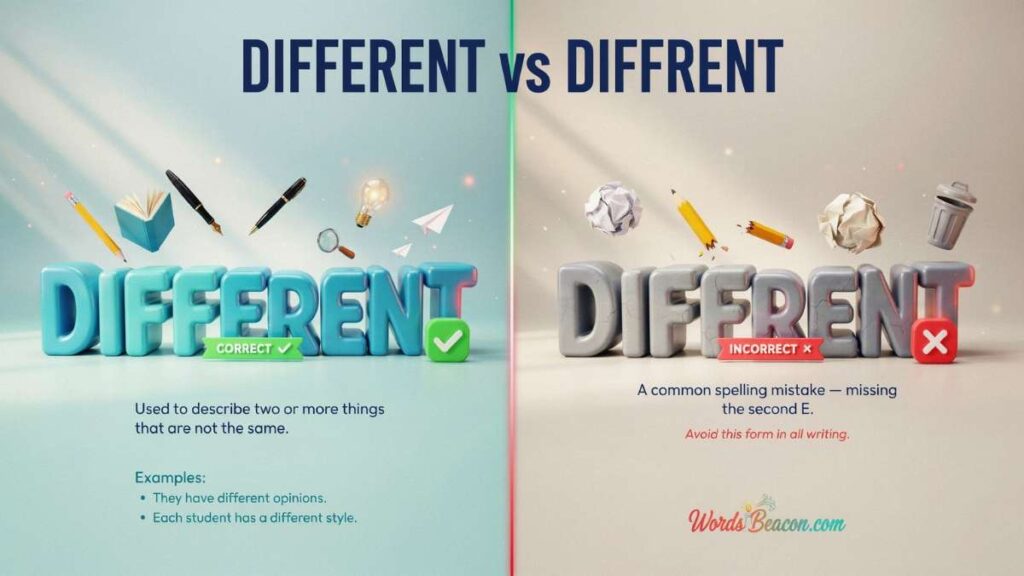
One missing letter can turn a perfectly good sentence into a spelling mistake! That’s exactly what happens with Different vs Diffrent . These two forms may look almost identical, but only one is correct. The confusion often comes from everyday pronunciation, which can make the middle of the word sound shorter than it looks. So, is it different vs diffrent ? The answer is simple: different is the correct spelling, while diffrent is a common error. However, there’s more to learn than just the spelling. Let’s explore its meaning, grammar, related words, and everyday examples so you can use it correctly and write with confidence.
Quick Comparison
| Word or phrase | Correct status | Meaning or use | Example |
|---|---|---|---|
| Different | Correct | Not the same; unlike something else | My answer is different from yours. |
| Diffrent | Incorrect | Common misspelling of different | Write different, not diffrent. |
| Difference | Correct | A way in which things are not the same | There is a clear difference between them. |
| Differently | Correct | In a way that is not the same | She approaches the problem differently. |
| Different from | Correct | Common comparison structure | This version is different from the original. |
| Different than | Correct in common North American usage | Another comparison structure, especially before clauses | The result was different than I expected. |
Learn the difference between tricky more English words
Center vs Centre Difference and Which one Is Correct?
Is Different vs Diffrent Correct?
When comparing Different vs Diffrent, the answer is simple: different is the correct spelling in standard American English and other major varieties of English. It is an adjective that describes something that is not the same as another person, object, idea, or situation. Therefore, understanding Different vs Diffrent starts with recognizing which form follows standard English spelling rules.
Diffrent, on the other hand, is a spelling mistake. It does not serve as a standard alternative spelling, so you shouldn’t use it in formal writing, school assignments, professional emails, articles, or other edited content. This is the main point to remember when learning Different vs Diffrent.
For example:
Correct: Each student has a different opinion.
Incorrect: Each student has a diffrent opinion.
These examples make the Difference vs Diffrent spelling confusion easier to understand. Although the two forms look similar, only one is accepted in standard English.
The mistake usually happens because the pronunciation of different can sound compressed in everyday conversation. As a result, writers sometimes leave out the second e when spelling the word. Nevertheless, the standard written form keeps that letter. This pronunciation issue is one reason why people frequently search for Different vs Diffrent.
To remember the correct spelling, try dividing the word into smaller parts:
different = dif + fer + ent
The spelling contains two e’s after the letter f: one in the middle sequence and another before the final n. Therefore, if you remember that second e, you’re less likely to write diffrent by mistake. This simple trick can also help you avoid confusion whenever you encounter Different vs Diffrent.
Different Meaning and Definition
Different means not the same as someone or something else. It describes a distinction between people, objects, experiences, opinions, methods, or conditions. Knowing this meaning gives you a clearer understanding of the correct form in Different vs Diffrent.
In everyday writing, the word can communicate several related ideas. Depending on the context, it can highlight a contrast, identify separate items, or describe something unusual. These uses also explain why the correct spelling matters in the Different vs Diffrent comparison.
Different Means Not the Same
This is the most common meaning. You use different when two or more things do not match.
Examples:
- My new phone is different from my old one.
- Their opinions are different.
- This year’s schedule looks different from last year’s.
- The two paintings have different colors and styles.
In each sentence, different highlights a distinction. However, it doesn’t necessarily mean that one thing is better or worse than another. It simply means they are not identical. This is the basic meaning to remember when considering Different vs Diffrent.
Different Means Separate or Individual
Different can also emphasize separate items within a group. In this case, it identifies individual types, choices, or categories rather than directly comparing two specific objects.
For instance:
- The store sells five different brands of coffee.
- We discussed different topics during the meeting.
- The teacher gave each group a different assignment.
As these examples show, different can describe several individual items within the same group. It doesn’t always suggest a direct comparison between two specific objects. Still, its spelling remains the same in every context, which is another useful point in Different vs Diffrent.
Different Can Mean Unusual
In informal conversation, different can describe someone or something that seems unusual or unlike what people normally expect.
For example:
- Her approach to problem-solving is different.
- That restaurant has a different atmosphere.
- He has a different sense of humor.
Still, the meaning depends on context. In one situation, different may simply mean distinctive. In another, it may suggest that something is unusual or unexpected. Regardless of the meaning, the correct spelling stays different, not diffrent.
Why Is Diffrent Incorrect?
Diffrent is incorrect because it leaves out a letter from the established spelling of different. Standard English uses different as the adjective, not diffrent as an alternative form. This spelling rule is central to understanding Different vs Diffrent.
Although the two spellings may look similar, they aren’t interchangeable. A spelling variation is acceptable when it is an established form in a particular variety of English. For example, American English uses color, while British English generally uses colour. Both forms are recognized regional spellings.
However, the same rule doesn’t apply to diffrent. It isn’t a recognized American or British spelling. So, when writing about Different vs Diffrent, always choose the form with the second e.
The Missing Letter Causes the Mistake
The main difference between the two forms is the second e in different.
Different: D-I-F-F-E-R-E-N-T
Diffrent: D-I-F-F-R-E-N-T
The correct spelling contains nine letters, while the misspelling contains eight. In other words, that missing e changes the written form and makes diffrent incorrect. Remembering this detail makes the Different vs Diffrent spelling choice much easier.
Pronunciation Can Make the Spelling Confusing
English pronunciation doesn’t always make every written letter easy to hear. In different, the unstressed middle sounds can become less distinct during natural speech.
The American pronunciation is /ˈdɪf.ɚ.ənt/, while the British pronunciation is /ˈdɪf.ə.rənt/. Both pronunciations place the main stress at the beginning of the word.
Because some sounds are reduced in ordinary conversation, you might hear a shorter version of the word. Even so, pronunciation does not change its standard spelling. This is why the spoken form shouldn’t determine your choice in Different vs Diffrent.
Typing Quickly Can Lead to Missing Letters
Fast typing is another common cause. When you write a long sentence or work under a deadline, you may accidentally skip a letter without noticing. This can lead to the same spelling error discussed in Different vs Diffrent.
For example:
Incorrect: The two plans have diffrent requirements.
Correct: The two plans have different requirements.
Spell-checking tools can catch many spelling mistakes, but you shouldn’t depend on them completely. Instead, a quick proofreading pass is still useful, especially when a misspelled word resembles a familiar word.
Learn the difference between tricky more English words
Sleeve vs Sleave Difference and which is correct ?
Different vs Difference
Different and difference belong to the same word family, but they have separate grammatical roles. More specifically, different is an adjective, while difference is a noun.
An adjective describes a person, place, object, or idea. A noun, by comparison, names something, including a quality, condition, or distinction.
| Word | Part of speech | Meaning | Example |
|---|---|---|---|
| Different | Adjective | Not the same | The two designs are different. |
| Difference | Noun | A point or quality that makes things unlike | There is a difference between the designs. |
| Differently | Adverb | In a way that is not the same | The designer arranged them differently. |
| Differ | Verb | To be unlike or disagree | Their opinions differ. |
When to Use Different
Use different when you want to describe how one thing is unlike another.
Examples:
- We have different goals.
- This route is different from the one we used yesterday.
- Her writing style is different from mine.
In each example, different describes a noun or pronoun. Therefore, it works as an adjective.
When to Use Difference
Use difference when you want to name the distinction itself.
Examples:
- What is the difference between these two products?
- There is a noticeable difference in quality.
- The age difference between the brothers is three years.
A useful test is to check what the sentence needs. If you are describing something, different may be the right choice. On the other hand, if you are naming a distinction, difference is usually the better option.
Different vs Differently
The Different and differently look similar, but they don’t perform the same job in a sentence.
Different is an adjective, whereas differently is an adverb. The adjective describes a noun or pronoun, while the adverb usually describes a verb by explaining how an action happens.
| Word | Part of speech | What it describes | Example |
|---|---|---|---|
| Different | Adjective | A person or thing | We chose a different design. |
| Differently | Adverb | An action or manner | We designed the room differently. |
Examples of Different:
- She bought a different dress.
- They have different priorities.
- We need a different solution.
Examples of Differently:
- She dresses differently for work.
- The children reacted differently to the news.
- You could organize the information differently.
Notice how the word changes according to the sentence. For instance, you wouldn’t normally write “She dresses different” in careful standard English when you mean that she dresses in a different way. Instead, the adverb differently expresses that meaning more precisely.
Learn the difference between tricky more English words
Symptomatology Vs Symptomology Difference and usage
Different From vs Different Than
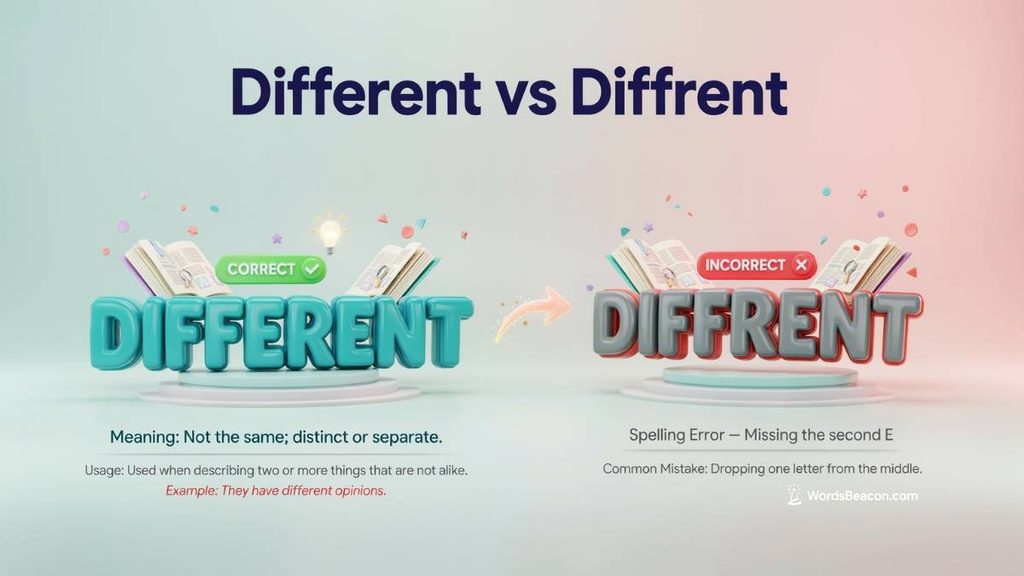
Both different from and different than appear in modern English. However, their usage can depend on the sentence structure and regional preference.
Different from is widely accepted in American English and works naturally before nouns, pronouns, and other comparison phrases. Meanwhile, different than is also common in North American English, particularly when it introduces a clause.
When to Use Different From
Use different from when comparing two people, objects, ideas, or situations.
Examples:
- My laptop is different from yours.
- Her opinion is different from mine.
- This year’s results are different from last year’s.
- Their teaching methods are different from ours.
This construction is a reliable choice in formal and academic writing. Therefore, if you’re unsure which comparison structure to use, different from is generally a safe option.
When to Use Different Than
Different than is common in American English, especially when the comparison introduces a complete clause or a phrase that would sound awkward with from.
Examples:
- The situation turned out differently than we expected.
- The final design looks different than it did last month.
- The journey was more difficult than we imagined, and the experience was different than we had planned.
In the last two examples, than introduces a comparison involving a longer idea rather than just a noun. As a result, this structure can sound natural in North American English.
What About Different To?
Different to is especially common in British English and also appears in other varieties.
For example:
- This model is different to the previous one.
- Her approach is different to mine.
For American audiences, different from is generally the safest choice in formal writing. Still, different than is not automatically incorrect. Ultimately, the sentence structure and intended meaning matter.
Learn the difference between tricky more English words
Cheer vs Chear Difference and Correct Usage
Different Spelling, Pronunciation, and Word Forms
Understanding the spelling becomes easier when you learn how different connects to its related forms. These words share a common base, but each one has its own grammatical purpose.
| Word | Part of speech | Meaning | Example |
|---|---|---|---|
| Different | Adjective | Not the same | We chose a different option. |
| Difference | Noun | A distinction | The difference is easy to see. |
| Differ | Verb | To be unlike or disagree | Their views differ. |
| Differently | Adverb | In a different way | She solved it differently. |
| Differing | Verb form/adjective | Not agreeing or not being the same | They have differing opinions. |
How to Spell Different Correctly
The easiest spelling strategy is to remember the complete sequence:
D-I-F-F-E-R-E-N-T
Pay attention to the e after the two f’s. That letter often disappears in the misspelling diffrent.
You can also connect the word to difference. Since both words contain the same opening sequence, this word family can serve as a useful memory aid.
Try writing the word three times:
1.Different
2.Different
3.Different
Then use it in a sentence. Repeating the correct form in context can help you remember it more effectively than memorizing isolated letters.
How to Pronounce Different
The standard American pronunciation is /ˈdɪf.ɚ.ənt/. The British pronunciation is /ˈdɪf.ə.rənt/. In both forms, the main stress falls on the first syllable.
You may hear the word pronounced more quickly in casual conversation. That’s normal because unstressed sounds often become shorter in connected speech. Nevertheless, the written spelling remains different.
Fix common more word mistakes in English
Channel vs Chanel difference and usage
Examples of Different in Sentences
Examples show how a word works in real situations. Since different can describe people, objects, opinions, places, and experiences, you can use it in many types of sentences.
Everyday Examples
- My sister and I have different tastes in music.
- We ordered two different meals.
- This neighborhood looks different at night.
- Every person has a different perspective.
- I need a different pair of shoes.
Academic Examples
- Students may have different interpretations of the same passage.
- The two studies reached different conclusions.
- Each theory offers a different explanation.
- Researchers used different methods to collect the data.
- The results were different from those reported in the earlier study.
Professional Examples
- Our company offers different services for small businesses.
- The new policy introduces different requirements.
- Each department follows a different procedure.
- The updated design looks different from the original proposal.
- We should consider a different strategy before making a final decision.
Examples With Related Words
- The difference between the two answers is clear.
- Their opinions differ on several important issues.
- She handled the situation differently.
- The team members have differing views.
- We noticed a significant difference in the final results.
These examples also show why choosing the correct word form matters. Although different, difference, differ, and differently are related, you cannot replace one with another without changing the grammar.
Common Spelling and Grammar Mistakes
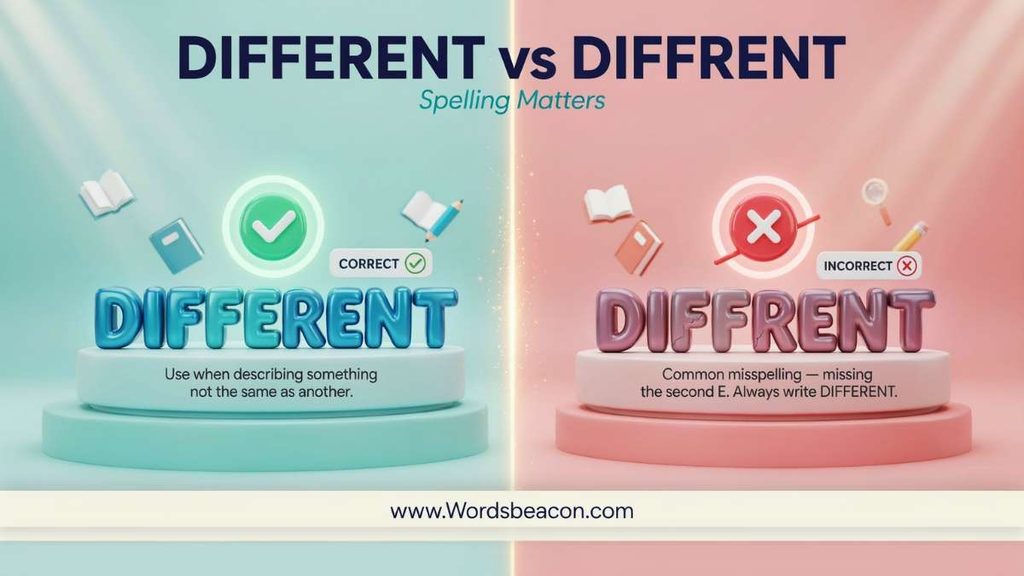
Even familiar words can cause trouble when you write quickly. Fortunately, most mistakes involving different are easy to correct once you recognize the pattern.
Writing Diffrent Instead of Different
Incorrect: I have a diffrent idea.
Correct: I have a different idea.
The incorrect form leaves out the second e. Therefore, check the spelling before submitting an assignment or publishing an article.
Using Difference Instead of Different
Incorrect: We need a difference approach.
Correct: We need a different approach.
Difference is a noun, whereas different is an adjective. Since approach is a noun that needs a description, different is the correct choice.
Using Different Instead of Differently
Incorrect: She completed the task different.
Correct: She completed the task differently.
The sentence describes how she completed the task. Consequently, the adverb differently fits the meaning.
Confusing Different From and Different Than
Both structures occur in English, but they don’t always fit the same sentence equally well.
For example:
- The new version is different from the old one.
- The result was different than we expected.
The first sentence compares two versions. By contrast, the second compares the result with an expectation. Choosing the structure that fits the sentence makes your writing clearer.
Assuming Different Means Better
Different does not automatically mean better, worse, stronger, or more useful. Instead, it simply identifies a distinction.
For example, “This method is different from the previous one” doesn’t tell readers whether the new method works better. You need additional information to communicate that judgment.
Fix common more word mistakes in English
Stich vs Stitch difference and usage
Synonyms and Antonyms of Different
Learning synonyms and antonyms can help you expand your vocabulary and avoid repeating the same adjective. However, not every synonym works in every context. Therefore, choose a replacement that preserves the meaning of your sentence.
Synonyms of Different
| Synonym | Meaning | Example |
|---|---|---|
| Distinct | Clearly separate or recognizable | The two designs have distinct features. |
| Dissimilar | Not alike | The candidates have dissimilar backgrounds. |
| Unlike | Not similar to something | Her response was unlike her usual reaction. |
| Diverse | Made up of varied types | The city has a diverse population. |
| Separate | Not joined or combined | They followed separate procedures. |
| Unusual | Not common or expected | The building has an unusual design. |
| Varied | Including different types | The course covers varied subjects. |
| Unique | One of a kind or especially distinctive | The artist has a unique style. |
Some of these words have narrower meanings. For example, unique often suggests something exceptional or one of a kind, while different simply means not the same. For that reason, don’t use them as automatic replacements.
Antonyms of Different
Antonyms express the opposite meaning.
Common antonyms include:
- Same
- Similar
- Identical
- Alike
- Equal
- Equivalent
- Comparable
Examples:
- The two products are similar in size.
- Their answers were identical.
- The twins look alike.
- Both methods produced comparable results.
Ultimately, using the right opposite can make comparisons more precise.
Origin and History of Different
The word different has a long history connected to the idea of separating or distinguishing things. It entered English through French and ultimately traces back to the Latin verb differre, meaning to carry apart or be unlike.
That history helps explain the modern meaning. When two things differ, they are not the same in some respect. Similarly, when you describe them as different, you highlight that distinction.
The spelling has remained established in modern English, even though pronunciation varies across accents and everyday speech. Importantly, the shortened-looking form diffrent does not represent a separate historical or regional spelling.
Learn how to use confusing more words correctly
Prooving vs Proving Which Spelling Is Correct?
Is Different Spelled the Same in American and British English?
Yes. Different has the same spelling in American English and British English.
Some English words change spelling depending on the region. For example, American English generally uses color, while British English uses colour. However, different does not follow that pattern.
| American English | British English |
|---|---|
| Different | Different |
| Difference | Difference |
| Differently | Differently |
| Different from | Different from |
| Different than | Used, but less common than in American English |
| Different to | Less common than in British English |
The main regional variation concerns usage rather than spelling. Different from is widely used across English varieties. Meanwhile, different than is especially common in North America, while different to is particularly associated with British English.
Therefore, if you’re writing for an American audience, use different as the standard spelling and choose a comparison structure that fits your sentence.
Learn how to use confusing more words correctly
Access vs Acess Which Spelling Is Correct?
Tips to Remember the Correct Spelling of Different
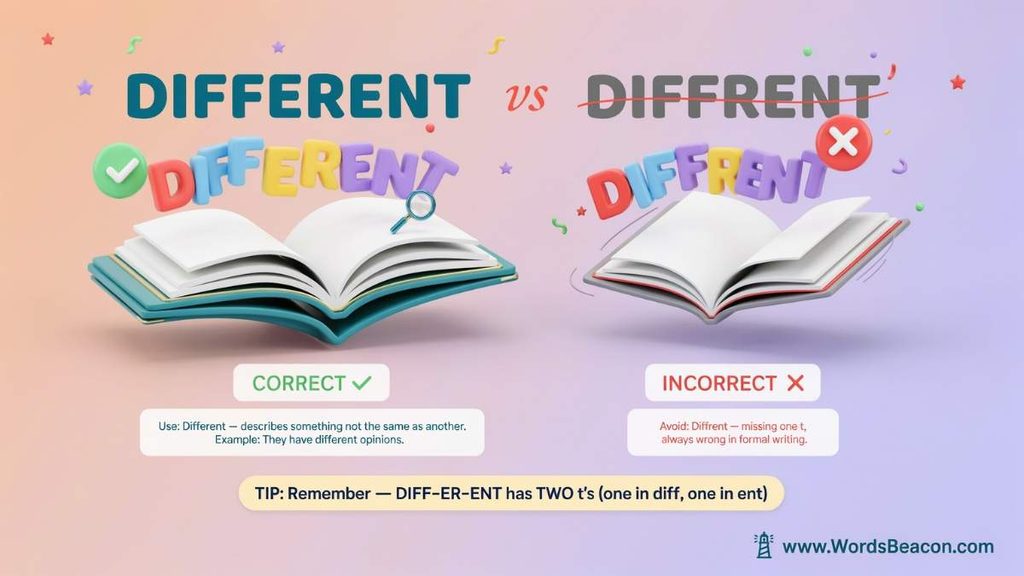
A few practical habits can help you avoid the diffrent spelling mistake. Fortunately, you don’t need a complicated memorization technique. Instead, focus on the letter that writers most often leave out.
Remember the Second E
The most useful trick is to remember that different contains an e after the two f’s.
Correct: diff-er-ent
Incorrect: dif-frent
When in doubt, pause and check the middle of the word.
Connect Different With Difference
Both words belong to the same word family. As a result, remembering difference can help you recall the spelling of different.
For example:
- The difference is obvious.
- The two options are different.
The shared opening letters make this connection useful.
Read the Word Slowly
When proofreading, look at each letter instead of relying only on how the word sounds. This is particularly important because everyday pronunciation can reduce unstressed sounds.
Use Spell-Check and Proofreading Together
A spell-checker can identify many misspellings, including diffrent. However, automated tools don’t always understand the meaning of a sentence or catch every word-choice problem.
For stronger results, combine spell-checking with a final manual review. Read the sentence aloud, check the spelling, and make sure the word fits the grammar.
Practice With Short Sentences
Write a few original sentences using different, difference, and differently. This helps you remember both the spelling and the grammatical role of each word.
For example:
- We chose a different route.
- The difference was easy to notice.
- They approached the task differently.
Understand confusing English more words simply
Bachelor vs Batchelor difference and correct usage
Different vs Diffrent Practice Session
Fill in each blank with the correct word. Choose from the word forms in parentheses. Write your answers first, then check the answer key at the end.
- My opinion is completely __________ from yours.
- There is a noticeable __________ between the two designs.
- Every student has a __________ learning style.
- The children reacted __________ to the unexpected news.
- This restaurant offers several __________ types of desserts.
- Can you explain the __________ between these two words? (different / difference)
- Her new hairstyle looks __________ from her previous one. (different / diffrent)
- The two researchers reached __________ conclusions. (different / differently)
- We should try a __________ approach to solve this problem. (different / difference)
- My brother and I think __________ about this issue. (different / differently)
- Their opinions __________ on several important topics. (differ / different)
- The final result was __________ than we expected. (different / difference)
- Each department follows a __________ procedure. (different / differently)
- The teacher asked us to identify the main __________ between the two passages. (different / difference)
- The new model is __________ from the older version. (different / differently)
- People often see the same situation __________ because of their experiences. (different / differently)
- The company introduced a __________ set of rules last month. (different / difference)
- Although the twins look alike, their personalities are quite __________. (different / diffrent)
- The two teams have __________ views about the best solution. (differing / difference)
- You can organize these files __________ to make them easier to find. (different / differently)
Answers
- different
- difference
- different
- differently
- different
- difference
- different
- different
- different
- differently
- differ
- different
- different
- difference
- different
- differently
- different
- different
- differing
- differently
Here’s a trusted source for clear word meanings:
FAQs
Is it differant or different?
Different is the correct spelling. Differant is a misspelling, just like diffrent. The standard spelling contains nine letters: D-I-F-F-E-R-E-N-T. Therefore, use different when describing something that is not the same as another person, object, or situation.
What is the correct way to spell different?
The correct spelling is different. A simple way to remember it is to focus on the second e after the two f’s: diff-er-ent. Additionally, you can connect it with difference, which shares the same opening letters.
Does differ mean different?
They are related, but they serve different grammatical purposes. Differ is a verb meaning to be unlike or disagree, while different is an adjective meaning not the same. For example, “Their opinions differ” and “They have different opinions” express a similar idea in different ways.
How do you use the word different?
Use different as an adjective to describe a person, object, idea, or situation that isn’t the same as another. It can appear before a noun or after a linking verb. For example, “She chose a different dress” and “Their opinions are different” both use the word correctly.
Is it correct to say “feel different” or “feel differently”?
Both expressions are grammatically correct, but their meanings differ. Feel different describes a change in someone’s emotional or physical state, as in “I feel different today.” In contrast, feel differently describes a person’s attitude or response, as in “I feel differently about that decision.”
Is it correct to say “hits different” or “hits differently”?
Both expressions appear in modern English, but they have different levels of formality. “Hits different” is an informal slang expression describing something that creates a special or unusually strong emotional effect. Meanwhile, “hits differently” follows the standard adverb pattern and is generally more suitable for formal writing.
Why do people say “hits different”?
People say “hits different” when something creates a stronger, deeper, or unexpected emotional reaction. For example, “This song hits different at night” suggests that the song feels more meaningful or powerful in that setting. The expression is common in casual conversations and online slang.
What does “I feel different” mean?
“I feel different” means that something about your emotional state, physical condition, attitude, or overall experience has changed. For example, someone might say, “I feel different after moving to a new city.” The sentence suggests that the person’s experience or outlook has changed.
Is it grammatically correct to say “different than”?
Yes. Different than is accepted in modern English, particularly in American usage before a clause. For example, “The results were different than we expected.” However, different from is also widely accepted and is often the safest choice in formal writing, especially before nouns and pronouns.
What is the difference between different and differently?
Different is an adjective that describes a person or thing, whereas differently is an adverb that describes how an action happens. For example, “We chose a different method” uses the adjective, while “We approached the problem differently” uses the adverb.
What is the difference between different and difference?
Different is an adjective meaning not the same, while difference is a noun that identifies a distinction between people or things. For example, “The two designs are different” describes the designs. In contrast, “There is a difference between the designs” names the distinction.
What is another word for different?
Several words can replace different, depending on the context. Common alternatives include distinct, dissimilar, unlike, diverse, varied, separate, and unusual. For example, distinct emphasizes clearly recognizable features, while diverse highlights variety.
What is a stronger word for different?
You can use vastly different, dramatically different, radically different, or fundamentally different to emphasize a stronger contrast. For example, “The revised plan is fundamentally different from the original” suggests a major change rather than a minor adjustment.
What is the opposite of different?
The most common opposite of different is same. Other antonyms include similar, identical, alike, equal, and equivalent. However, each word has a slightly different meaning. For example, identical suggests an exact match, while similar describes things that share certain features without being exactly alike.
How can you describe something as very different?
You can use expressions such as completely different, significantly different, remarkably different, vastly different, or entirely unlike. For example, “The new design is remarkably different from the original” communicates a strong contrast without relying on the phrase very different.
Is different a formal word?
Yes. Different is a standard English adjective suitable for academic, professional, and everyday writing. You can use it in essays, reports, business communication, and casual conversations. However, informal expressions such as “hits different” may not suit formal documents.
How do you pronounce different?
Different is pronounced with stress on the first syllable. Its American pronunciation is /ˈdɪf.ɚ.ənt/, while the British pronunciation is /ˈdɪf.ə.rənt/. Some unstressed sounds may become shorter in everyday speech, but the spelling remains different.
What are some examples of different in sentences?
Here are five examples showing how different works in everyday and professional contexts:
- My brother and I have different interests.
- This road follows a different route through town.
- The two products have different features.
- Her approach is different from mine.
- Researchers received different answers from the participants.
In each example, different describes a distinction between people, objects, methods, or ideas.
Understand confusing English more words simply
Comprable vs Comparable Which Spelling Is Correct?
Conclusion
The confusion between different vs diffrent is easy to understand, especially when the word sounds shorter in everyday conversation. However, only different is correct. The spelling diffrent is a common mistake, not an alternative version. Remember to keep the second e in the word, and you’ll avoid this error. Also, don’t mix up different, difference, and differently. Different describes something that isn’t the same, difference names what makes two things unlike, and differently explains how something is done. Once you understand these simple distinctions, using each word becomes much easier. After all, your ideas can be different, but your spelling should always be correct!

Luna AJS is an experienced blogger and dedicated language enthusiast at Words Beacon. She specializes in making English grammar, spelling, vocabulary and commonly confused words easy to understand. She provides clear explanations, practical examples to help readers write with confidence.