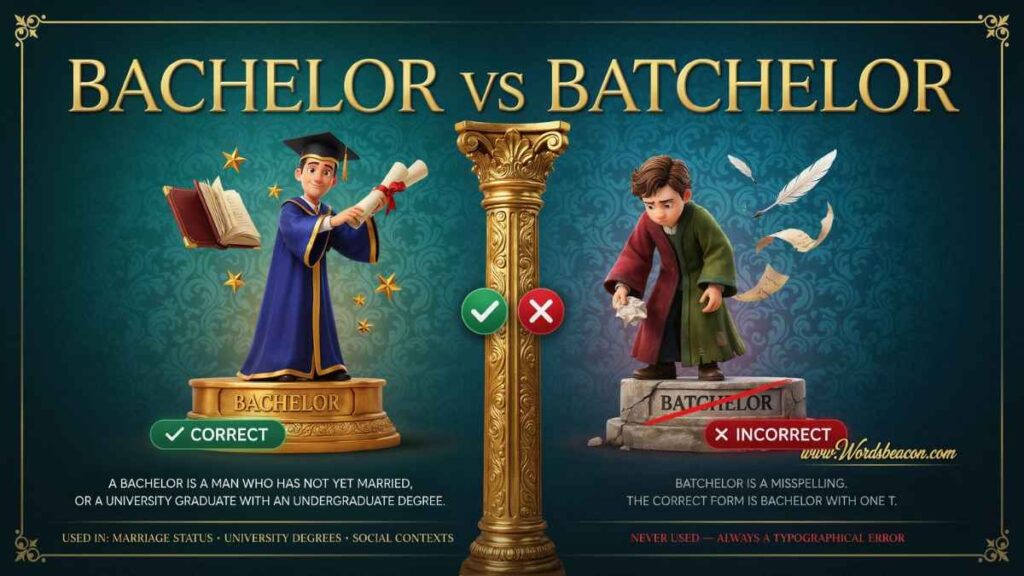
English spelling can be confusing, especially when two words look almost identical. The difference between bachelor vs batchelor is a good example. One extra letter can make you wonder which spelling is correct. Should you write “bachelor” when talking about an unmarried man or a college degree? And is “batchelor” always a mistake? Not exactly! “Bachelor” is the correct spelling in modern English, while “Batchelor” may appear as a family name or in older records. In this guide, you’ll learn the meaning of both spellings, see how they differ, and discover simple ways to avoid this common spelling mistake.
quick comprasion
| Bachelor | Batchelor |
|---|---|
| The standard modern English spelling | A historical spelling variant and a recognized surname |
| Used for an unmarried man | Used mainly in family names and proper nouns |
| Refers to an undergraduate academic degree | Not the standard spelling for the academic degree |
| Correct in phrases such as “bachelor’s degree” and “bachelor party” | Correct when it appears as someone’s actual name |
Understand confusing English more words simply
Access vs Acess Which Spelling Is Correct?
Is It Bachelor vs Batchelor?
If you’re writing a standard English sentence, use “bachelor.” This spelling appears in modern dictionaries and serves as the accepted form in everyday communication, academic writing, and professional documents.
For example:
- He is a bachelor who enjoys living alone.
- She earned a Bachelor of Science degree.
- My brother is planning a bachelor party.
- The university offers several bachelor’s degree programs.
On the other hand, “Batchelor” has a few specific uses. It appears as a family surname, and it also survives as an older spelling of the word “bachelor.” Therefore, you shouldn’t automatically treat every appearance of “Batchelor” as a spelling error.
The important distinction is context. When you mean an unmarried man or an academic qualification, write “bachelor.” However, when you’re referring to a person whose surname is Batchelor, preserve that spelling exactly.
Bachelor Meaning and Definition
The word “bachelor” is a noun with several related meanings. Most commonly, it describes an unmarried man. Additionally, it refers to a person who has earned an undergraduate degree from a college or university.
Although these meanings may seem unrelated at first, both are well-established uses of the same word.
Bachelor Meaning: An Unmarried Man
The most familiar definition of a bachelor is an unmarried man. Traditionally, the term describes a man who has never married.
For example:
- Daniel is a bachelor who lives in Chicago.
- The magazine interviewed several eligible bachelors.
- He remained a bachelor for most of his adult life.
- My uncle was a bachelor before he got married.
In everyday conversation, people often use “bachelor” to describe a single man who lives independently. However, the word can sound traditional or slightly formal in some situations.
Furthermore, being a bachelor doesn’t necessarily mean someone dislikes relationships or plans to remain unmarried forever. It simply describes his marital status in the traditional sense.
Bachelor Meaning in Education
In education, a bachelor is a person who has earned a bachelor’s degree. This degree usually represents the completion of an undergraduate program at a college or university.
For instance, a student may earn a Bachelor of Arts, Bachelor of Science, or Bachelor of Education degree.
Consider these examples:
- Maria earned a Bachelor of Arts in English.
- James completed his Bachelor of Science in Biology.
- My cousin is studying for a bachelor’s degree in business.
- The university offers a Bachelor of Education program.
In this context, “bachelor” has nothing to do with marital status. Instead, it identifies an academic qualification.
Bachelor as a Noun
“Bachelor” primarily functions as a noun. It can refer to an unmarried man, a degree holder, or a historical type of young knight.
For example:
- The bachelor invited his friends to dinner.
- Several bachelors attended the event.
- She is a Bachelor of Science graduate.
As you can see, the meaning changes according to the sentence. Nevertheless, the spelling stays the same.
Bachelor as an Adjective
The word “bachelor” can also appear in expressions that describe something associated with an unmarried man.
Common examples include:
- Bachelor apartment
- Bachelor lifestyle
- Bachelor pad
- Bachelor party
A bachelor apartment, for example, usually refers to a small living space designed for one person. Similarly, a bachelor pad describes a home associated with a single man.
However, don’t confuse these expressions with academic degree names. The spelling remains “bachelor” in both situations.
Understand confusing English more words simply
Comprable vs Comparable Which Spelling Is Correct?
What Does Batchelor Mean?
“Batchelor” is a real spelling found in English-language records, but it doesn’t replace “bachelor” in standard modern writing.
It has two main uses: as an older spelling and as a proper name.
Batchelor as an Archaic Spelling
In older English texts, writers sometimes used “batchelor” instead of “bachelor.” English spelling wasn’t always as standardized as it is today. Consequently, older documents contain several spelling variations that modern writers rarely use.
The additional “t” may look like a simple typing mistake to a modern reader. However, historical spellings often reflect older language patterns rather than careless writing.
For example, an old document might contain a sentence such as:
– He remained a batchelor throughout his life.
In contemporary English, you would normally rewrite that sentence as:
– He remained a bachelor throughout his life.
Therefore, if you’re quoting an old document, preserve its original spelling when accuracy matters. Otherwise, use the modern standard form.
Batchelor as a Surname
One important exception is the family name “Batchelor.”
People may have Batchelor as their legal surname, and you should never change it to “Bachelor” simply because the latter is the standard common noun.
For example:
- Mr. Batchelor attended the university meeting.
- Sarah Batchelor published her first book.
- The Batchelor family has lived in the area for generations.
In each sentence, “Batchelor” functions as a proper noun. Therefore, its spelling is correct.
Batchelor as a Proper Noun
Besides surnames, the spelling may appear in place names, business names, and other official titles.
For example, Batchelor is also the name of a town in Australia’s Northern Territory. In such cases, the spelling belongs to the official name.
As a result, context matters more than the apparent spelling difference. You should preserve the original spelling of a person’s name, location, or organization.
Learn how to use confusing more words correctly
Sentence vs Sentance Which Spelling Is Correct?
Key Differences Between Bachelor vs Batchelor
The difference between bachelor vs batchelor becomes easier to understand when you compare their meanings and uses.
| Feature | Bachelor | Batchelor |
|---|---|---|
| Standard spelling | Yes | No, not for the common noun |
| Meaning | An unmarried man or academic degree holder | Historical spelling variant |
| Modern everyday use | Very common | Uncommon |
| Academic writing | Correct | Incorrect for the degree |
| Family surname | Possible | Recognized surname |
| Proper noun | Possible | Used in personal and place names |
| Historical use | Yes | Yes |
The main takeaway is straightforward: “bachelor” is the correct modern spelling for the ordinary English word. Meanwhile, “Batchelor” remains valid when it forms part of an established name or appears in a historical text.
When Should You Use Bachelor?
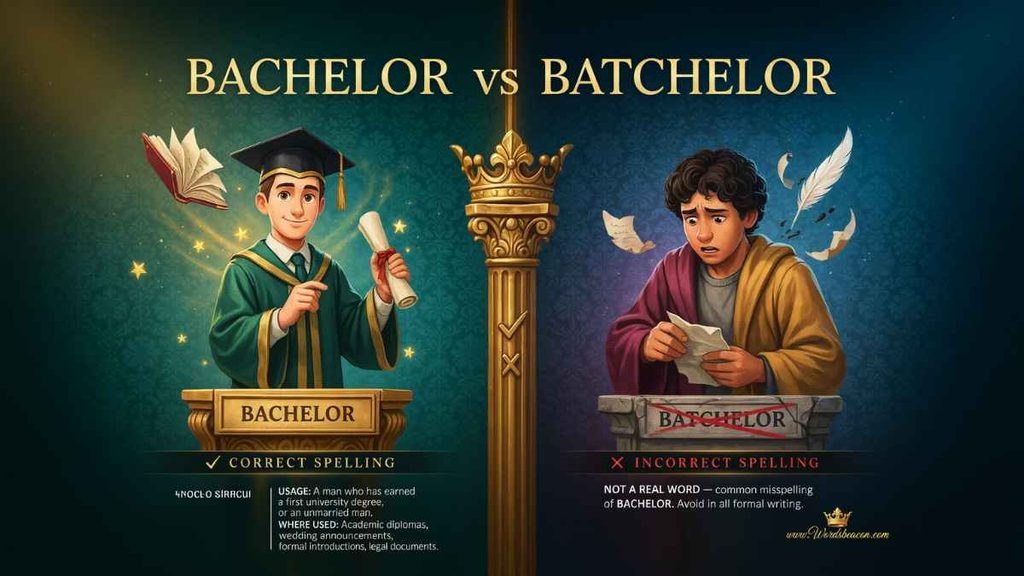
You should use “bachelor” in almost every modern sentence involving the common word. Whether you’re discussing marital status, university qualifications, or social events, this spelling is the appropriate choice.
Let’s look at its most common uses.
Use Bachelor for an Unmarried Man
When you describe a man who has never married, write “bachelor.”
Examples:
- He is a successful bachelor.
- The young bachelor bought a new apartment.
- My neighbor has been a bachelor for many years.
- Everyone considered him an eligible bachelor.
Furthermore, the plural form is “bachelors,” not “batchelors” in standard modern writing.
Use Bachelor for an Academic Degree
When discussing undergraduate education, use “bachelor” in the degree name.
Examples:
- Bachelor of Science
- Bachelor of Arts
- Bachelor of Education
- Bachelor of Business Administration
- Bachelor of Engineering
Notice that the word doesn’t change its spelling across these degree titles.
Use Bachelor in Common Expressions
Several familiar English expressions also use the standard spelling.
| Expression | Meaning |
|---|---|
| Bachelor party | A celebration for a man before his wedding |
| Bachelor pad | A home associated with an unmarried man |
| Bachelor lifestyle | A lifestyle associated with single living |
| Eligible bachelor | An unmarried man considered a desirable potential partner |
| Bachelor apartment | A small apartment, often designed for one occupant |
For example, you might write, “My brother is organizing a bachelor party before his wedding.”
Although these expressions have different meanings, they all use the same standard spelling.
When Should You Use Batchelor?
Although “bachelor” is the normal choice, “Batchelor” is appropriate in a few specific situations.
Use Batchelor for a Family Name
If someone’s official surname is Batchelor, retain the original spelling.
For example:
- Professor Batchelor teaches English literature.
- I received an email from Emily Batchelor.
- The Batchelor family organized a reunion.
Changing the surname to “Bachelor” would create an error, even though the common noun uses that spelling.
Use Batchelor in Historical Documents
When discussing old letters, books, legal records, or historical manuscripts, you may encounter “batchelor.”
In that case, preserve the spelling if you’re quoting the original material. However, when explaining the passage in modern English, use “bachelor” unless the historical spelling itself is important.
For example:
Original historical wording: “He was a batchelor of good reputation.”
Modern wording: “He was a bachelor of good reputation.”
The meaning remains the same, but the modern version follows current spelling conventions.
Use Batchelor in Official Place Names
Some geographical names contain the spelling “Batchelor.” Since proper names follow their official forms, you shouldn’t change them to match the common noun.
For example, the town of Batchelor in Australia’s Northern Territory retains its official spelling.
Therefore, remember this simple rule: use “bachelor” for the common word, but keep “Batchelor” when it’s part of an established name.
Learn how to use confusing more words correctly
Provider vs Providor Which word Is Correct?
Bachelor’s Degree Meaning and Requirements
One of the most common uses of “bachelor” appears in higher education. A bachelor’s degree is an undergraduate academic qualification awarded after a student completes an approved university or college program.
In the United States, many bachelor’s programs take about four years of full-time study. However, the exact duration depends on the institution, program requirements, course load, and individual progress.
What Is a Bachelor’s Degree?
A bachelor’s degree is an academic qualification that students typically pursue after completing high school or an equivalent level of education.
During the program, students study a chosen subject while also completing general education requirements and other courses.
For example, someone interested in science might choose a Bachelor of Science. Meanwhile, a student interested in literature or history might pursue a Bachelor of Arts.
A bachelor’s degree can help students prepare for professional careers, further education, or specialized training.
Common Types of Bachelor’s Degrees
Universities offer different bachelor’s degrees according to their academic subjects and program structures.
Some common examples include:
| Degree | Full Form | Common Study Areas |
|---|---|---|
| BA | Bachelor of Arts | English, history, sociology, and humanities |
| BS or BSc | Bachelor of Science | Biology, chemistry, physics, and mathematics |
| BEd | Bachelor of Education | Teaching and educational studies |
| BBA | Bachelor of Business Administration | Management, finance, and marketing |
| BEng | Bachelor of Engineering | Civil, mechanical, and electrical engineering |
| BFA | Bachelor of Fine Arts | Visual arts, design, and creative subjects |
Although degree names and abbreviations vary between countries and universities, the word “bachelor” remains correctly spelled.
Bachelor’s Degree Requirements
The requirements for a bachelor’s degree depend on the university and the chosen subject. Nevertheless, many programs include similar academic components.
Common requirements include:
- Completion of the required undergraduate courses.
- Fulfillment of general education requirements.
- Completion of major or specialization courses.
- Required examinations, assignments, and projects.
- Completion of any required practical training or internships.
- Meeting the university’s minimum credit and graduation standards.
In many US institutions, a bachelor’s degree requires approximately 120 semester credit hours. However, some programs require more, and institutions set their own graduation rules.
Therefore, students should always check their university’s official academic requirements instead of assuming every degree follows exactly the same structure.
Bachelor Degree Abbreviation
The abbreviation depends on the type of qualification.
For example:
- BA means Bachelor of Arts.
- BS or BSc means Bachelor of Science.
- BEd means Bachelor of Education.
- BBA means Bachelor of Business Administration.
- BEng means Bachelor of Engineering.
The apostrophe also matters when you write the possessive form “bachelor’s degree.” It shows that the degree belongs to the bachelor category.
Learn how to use confusing more words correctly
Encode vs Incode Differences and Usage ?
Common Bachelor Spelling Mistakes
English spelling can be tricky, especially when two forms look and sound almost identical. However, a few simple checks can help you avoid the most common mistakes.
Writing Batchelor Instead of Bachelor
This is the central mistake in the bachelor vs batchelor comparison.
Incorrect: She completed her Batchelor of Arts.
Correct: She completed her Bachelor of Arts.
The extra “t” doesn’t belong in the standard academic term. Therefore, always check the spelling before submitting an application, essay, resume, or official document.
Confusing Bachelor With Bachelor’s
Both forms are correct, but they serve different grammatical purposes.
“Bachelor” is the basic form. Meanwhile, “bachelor’s” is the possessive form commonly used in degree names.
Examples:
- He is a bachelor.
- She earned a bachelor’s degree.
- My brother completed a Bachelor of Science.
Notice that formal degree titles often capitalize the main words. However, general references to a degree usually use lowercase letters.
Using Incorrect Plural Forms
The standard plural of “bachelor” is “bachelors.”
Correct: Several bachelors attended the event.
Incorrect: Several batchelors attended the event.
Likewise, the possessive plural is “bachelors’” when something belongs to multiple bachelors.
For example: The bachelors’ apartments were located in the same building.
Misspelling Academic Degree Names
Academic titles deserve extra attention because they often appear in formal documents.
Correct examples include:
- Bachelor of Science
- Bachelor of Arts
- Bachelor of Education
- Bachelor of Engineering
Although the abbreviation may differ by institution or country, don’t insert an extra “t” into the word “bachelor.”
Bachelor Pronunciation
Both “bachelor” and the historical spelling “batchelor” have been associated with similar pronunciations. The extra letter in the older form doesn’t create a separate modern pronunciation.
In American English, “bachelor” is commonly pronounced:
- BACH-uh-ler
- BATCH-ler
The first syllable sounds like “batch,” while the remaining syllables are usually lighter and less stressed.
You can break the word into three parts:
- Bach
- Uh
- Ler
However, some American speakers reduce the middle vowel, making the word sound closer to two syllables.
The important point is that pronunciation doesn’t determine the modern spelling. Even if “batchelor” looks as though it might match the sound, “bachelor” remains the standard written form.
Bachelor Word Origin and Etymology
The history of “bachelor” is more interesting than its modern meaning might suggest.
The word entered Middle English through Old French “bacheler.” Historically, it referred to a young knight or a person of relatively low rank in a feudal system.
Over time, its meaning developed. It eventually became associated with an unmarried man. Today, it also appears in academic terminology, particularly in the phrase “bachelor’s degree.”
The deeper origin of the word remains uncertain. Linguists have discussed possible connections with medieval Latin and older European language forms, but its precise roots are not completely settled.
Why Does Batchelor Have an Extra T?
The spelling “Batchelor” reflects historical variation rather than a modern rule for adding a letter.
Family-name research records “Batchelor” alongside several related surname forms, including “Bachelor,” “Batchlor,” and “Batchellor.” Historical French pronunciation and regional spelling patterns help explain some of these variations.
As English spelling became more standardized, “bachelor” emerged as the accepted form for the common word.
Nevertheless, older spellings continued in family names and historical records. That’s why “Batchelor” still appears today, even though it isn’t the normal spelling for an unmarried man or an academic degree.
Fix common more word mistakes in English
Phenix vs Phoenix Which Spelling Is Correct?
Bachelor vs Batchelor in American and British English
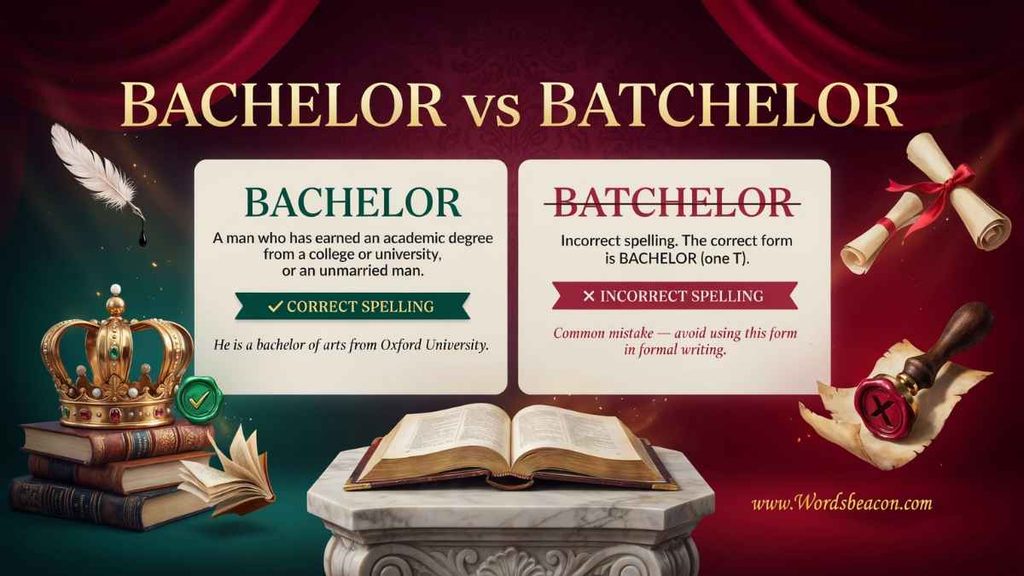
The standard spelling “bachelor” is used in both American and British English. There is no general American-versus-British spelling rule that changes it to “batchelor.”
For example:
- American English: He earned a bachelor’s degree.
- British English: He earned a bachelor’s degree.
- Canadian English: She completed a Bachelor of Science.
- Australian English: He is a bachelor.
Although educational systems and degree titles can vary between countries, the ordinary spelling remains “bachelor.”
However, surnames and place names may preserve “Batchelor” regardless of the country’s spelling conventions.
Consequently, don’t assume that “batchelor” is a British spelling or an accepted American alternative. It is a historical form and a proper name, not the standard modern variant.
Bachelor Grammar Plural, Possessive, and Capitalization
Correct spelling is only one part of using a word properly. You should also understand its plural form, possessive structure, and capitalization.
What Is the Plural of Bachelor?
The plural of “bachelor” is “bachelors.”
Examples:
- The bachelors attended a formal dinner.
- Several bachelors lived in the apartment building.
- The event attracted many eligible bachelors.
You don’t need to add an extra syllable or change the spelling.
What Is the Possessive Form of Bachelor?
The singular possessive form is “bachelor’s.”
For example:
- A bachelor’s apartment
- A bachelor’s lifestyle
- A bachelor’s degree
The plural possessive form is “bachelors’.”
For example:
– The bachelors’ apartments were recently renovated.
The placement of the apostrophe changes according to whether you’re referring to one bachelor or several.
Should Bachelor Be Capitalized?
In ordinary sentences, write “bachelor” with a lowercase b.
For example:
- My uncle is a bachelor.
- She wants to earn a bachelor’s degree.
However, capitalize the word when it appears in a formal degree title or at the beginning of a sentence.
Examples:
- Bachelor of Arts
- Bachelor of Science
- Bachelor of Education
Similarly, capitalize “Batchelor” when it appears as someone’s surname or as part of an official place name.
Fix common more word mistakes in English
Placque vs Plaque which one is correct ?
Bachelor vs Batchelor Sentence Examples
Sentence examples make the spelling difference easier to remember. Notice how “bachelor” works in everyday English, while “Batchelor” appears mainly in names and historical contexts.
| Correct or Contextual Use | Example Sentence |
|---|---|
| Bachelor as a noun | My brother is a bachelor. |
| Bachelor as a degree | She earned a Bachelor of Science. |
| Bachelor’s degree | He completed his bachelor’s degree last year. |
| Bachelor party | They organized a bachelor party for their friend. |
| Bachelor apartment | He moved into a bachelor apartment near his office. |
| Batchelor as a surname | Mr. Batchelor joined the meeting. |
| Batchelor in a historical text | The old document used the spelling “batchelor.” |
| Batchelor as a place name | They traveled to Batchelor in Australia. |
More Examples With Bachelor
- The young bachelor enjoys traveling around the world.
- My sister helped me choose a university for my bachelor’s degree.
- He wants to pursue a Bachelor of Arts in English.
- The university introduced a new Bachelor of Business Administration program.
- Their friends planned a surprise bachelor party.
- The apartment offers a comfortable space for a single resident.
- Several bachelors attended the annual celebration.
- She received her degree after four years of study.
More Examples With Batchelor
- Mr. Batchelor introduced himself to the new students.
- The Batchelor family attended the community event.
- The historical letter used the older spelling “batchelor.”
- The travel guide mentioned the town of Batchelor.
- The researcher found the surname in an old family record.
These examples show why you should consider the meaning before correcting a spelling. A surname isn’t an ordinary vocabulary mistake, and a historical quotation may need to preserve its original wording.
Learn the difference between tricky more English words
Dought vs Doubt Which Spelling Is Correct?
Easy Ways to Remember the Correct Spelling

If you frequently confuse “bachelor” and “batchelor,” a few memory tricks can help.
Remember the Standard Word Without T
The common modern word is “bachelor.” Think of the shorter spelling as the standard choice for everyday writing.
For example, remember these familiar expressions:
- Bachelor degree
- Bachelor party
- Bachelor lifestyle
- Bachelor apartment
Each one uses the same spelling without an extra “t.”
Connect Bachelor With Education
Think of a Bachelor of Science or Bachelor of Arts degree. These familiar academic titles can help you remember the correct spelling.
Whenever you’re writing about university qualifications, use “bachelor.”
Treat Batchelor as a Name
Remember that “Batchelor” can be a surname or part of an official name.
This distinction gives you a simple rule:
- Common word: bachelor
- Family name: Batchelor, when that’s the person’s actual surname
- Historical quotation: preserve the original spelling when appropriate
Check the Word Before Submitting Formal Writing
Finally, review the spelling in resumes, university applications, essays, business documents, and professional emails.
A small spelling mistake can make an otherwise polished document look careless. Therefore, take a moment to check whether you need “bachelor” or a proper name such as “Batchelor.”
Learn the difference between tricky more English words
Publicly vs Publically Which Spelling Is Correct?
practice session Bachelor vs Batchelor
Choose the correct word or form to complete each sentence. Use Bachelor vs Batchelor , or the appropriate grammatical form.
1. He is an eligible __________ who enjoys traveling and meeting new people.
2. Sarah earned a __________ of Science degree from her university.
3. My uncle remained a __________ for many years before getting married.
4. Mr. __________ will attend the family reunion next weekend.
5. She plans to complete her __________ degree in English literature.
6. The university offers a __________ of Arts program.
7. Several __________ attended the formal dinner.
8. My brother is organizing a __________ party before his wedding.
9. The old manuscript used the historical spelling “__________.”
10. A __________ apartment is often designed for one occupant.
11. He wants to pursue a __________ of Business Administration.
12. The __________ family has lived in this town for generations.
13. She completed her __________ of Education last year.
14. The correct plural form of bachelor is __________.
15. The possessive form used in “__________ degree” requires an apostrophe.
16. Although the two spellings look similar, __________ is the standard modern spelling.
17. The surname __________ should retain its original spelling.
18. He received a __________ of Engineering after completing his studies.
19. The phrase “eligible __________” traditionally describes an unmarried man considered a desirable potential partner.
20. In modern academic writing, you should write “Bachelor of Science,” not “__________ of Science.”
Answers
- Bachelor
- Bachelor
- bachelor
- Batchelor
- bachelor’s
- Bachelor
- bachelors
- bachelor
- batchelor
- bachelor
- Bachelor
- Batchelor
- Bachelor
- bachelors
- bachelor’s
- bachelor
- Batchelor
- Bachelor
- bachelor
- Batchelor
Here’s a trusted source for clear word meanings:
FAQs
What Is the Difference Between Batchelor vs Bachelor?
“Bachelor” is the standard modern English spelling for an unmarried man or an undergraduate academic degree. In contrast, “Batchelor” is a historical spelling variant and a recognized family surname. Therefore, use “bachelor” in everyday and academic writing, but retain “Batchelor” when it appears in a person’s name or an official place name.
What Does “Batchelor” Mean?
“Batchelor” is an older spelling of “bachelor” that also survives as a family surname. In historical documents, it may carry the same meaning as the modern word. However, it isn’t the accepted spelling for the common noun in contemporary English.
How Do You Spell Bachelor Correctly?
The correct modern spelling is B-A-C-H-E-L-O-R: “bachelor.” Although “batchelor” may look familiar, it isn’t the standard spelling for an unmarried man or an academic degree. The main exception is when “Batchelor” appears as someone’s actual surname or as part of an official name.
Is a Divorced Man Called a Bachelor?
Traditionally, “bachelor” describes a man who has never married. A divorced man is more accurately described as divorced or single because he was previously married. Nevertheless, some people use “bachelor” more broadly to describe any unmarried man, including someone who is divorced.
Why Does Bachelor Have Two Meanings?
The word “bachelor” developed from an older term associated with a young knight or a person of lower rank. Over time, it became associated with an unmarried man. Later, it also became the name of an undergraduate academic qualification. Although these meanings refer to different ideas today, they share the same historical word.
Who Is a Batchelor?
A “Batchelor” may be someone whose family surname is Batchelor. In older texts, the term may also appear as a historical spelling of “bachelor.” However, when you mean an unmarried man in modern English, the standard spelling is “bachelor.”
Can I Call a Girl a Bachelor?
Traditionally, “bachelor” refers to an unmarried man rather than a woman. For an unmarried woman, “single woman” is a clear and neutral expression. You can also use “bachelorette,” particularly in familiar expressions such as “bachelorette party.”
Is a Four-Year Degree a Bachelor’s Degree?
Yes. In the United States, a four-year undergraduate program commonly leads to a bachelor’s degree. However, not every bachelor’s program takes exactly four years. The duration depends on the university, subject, course requirements, and the student’s study schedule.
What Are the Four Main Types of College Degrees?
The four commonly recognized college degree levels in the United States are associate, bachelor’s, master’s, and doctoral degrees. An associate degree is generally a shorter undergraduate qualification, while a bachelor’s degree typically requires more extensive study. Master’s and doctoral degrees represent advanced levels of education.
Which Is Higher: a PhD or a Bachelor’s Degree?
A PhD is higher than a bachelor’s degree in the academic qualification hierarchy. A bachelor’s degree is an undergraduate qualification, whereas a PhD is an advanced research degree. Typically, students complete additional higher education and research before earning a doctorate.
Can You Pursue a PhD With Just a Bachelor’s Degree?
Yes, some universities allow students to enter a PhD program directly after completing a bachelor’s degree. However, admission policies differ by institution, country, and academic subject. Some universities require a master’s degree, while others accept strong undergraduate applicants with suitable academic and research experience.
Learn the difference between tricky more English words
Preform vs Perform which one is correct ?
Conclusion
The difference between bachelor vs batchelor is easier to understand than it first appears. If you’re writing about an unmarried man, a college degree, or a bachelor party, always use “bachelor.” It’s the correct spelling in modern English. On the other hand, “Batchelor” isn’t simply a random spelling mistake. It can appear as an old spelling or a person’s family name.
When comparing bachelor vs batchelor, the easiest way to remember the difference is to focus on the meaning. Use “bachelor” for the common English word, but keep “Batchelor” when it’s part of someone’s actual name or an official place name. That way, you won’t add an extra letter where it doesn’t belong or accidentally change someone’s name. Once you understand the difference between bachelor vs batchelor, choosing the correct spelling becomes much easier.

Luna AJS is an experienced blogger and dedicated language enthusiast at Words Beacon. She specializes in making English grammar, spelling, vocabulary and commonly confused words easy to understand. She provides clear explanations, practical examples to help readers write with confidence.