
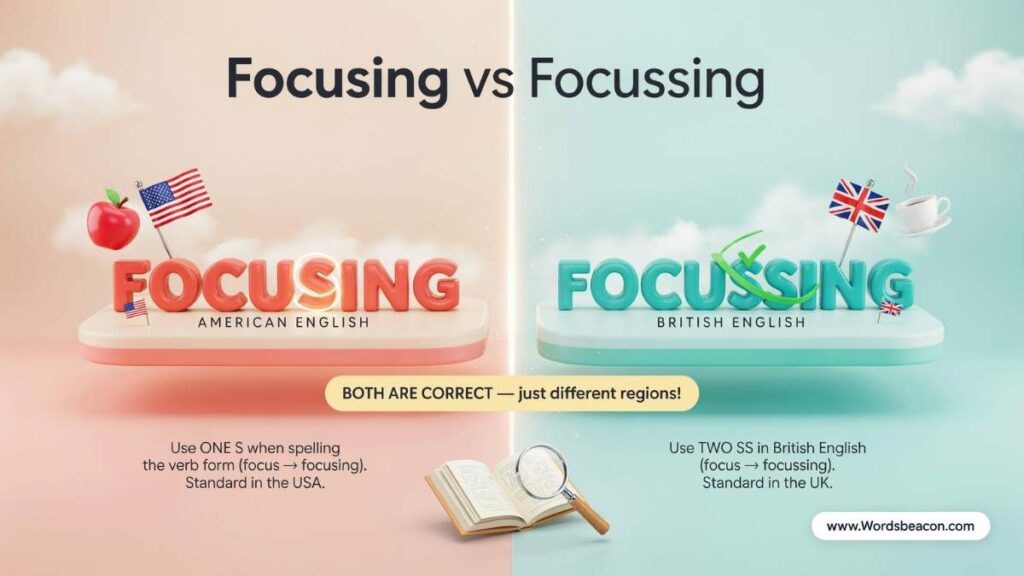
Focusing vs Focussing ? That extra S may seem small, but it can leave you wondering which spelling belongs in your writing. You might even question whether one is a spelling mistake and the other is correct. Fortunately, there’s no need to get caught up in this little spelling puzzle. Both forms are accepted and carry the same meaning. However, their popularity varies across different English-speaking regions. In this guide, you’ll discover the difference between focusing vs focussing, explore their spelling rules, and learn which form to use in American, British, and Australian English. Let’s clear up the confusion once and for all!
quick comprasion
| Feature | Focusing | Focussing |
|---|---|---|
| Spelling status | Correct | Accepted alternative |
| Meaning | Directing attention or concentration | Same meaning |
| American English | Preferred spelling | Less common |
| British English | Accepted and widely used | Accepted alternative |
| Canadian English | Accepted | Accepted |
| Australian English | Used | Also encountered |
| Pronunciation | Same | Same |
| Present participle | Yes | Yes |
| Gerund | Yes | Yes |
| Related past-tense form | Focused | Focussed |
Learn the difference between tricky more English words
Persuing vs Pursuing Difference and Correct Spelling
Focussing vs Focusing Quick Answer
Both focusing and focussing are correct spellings of the present participle and gerund of the verb focus. Although they look slightly different, they serve exactly the same grammatical purpose and communicate the same meaning.
Nevertheless, their regional preferences aren’t identical. American English generally uses focusing, while British English accepts both focusing and focussing. Canadian English also recognizes both forms, although individual publications may establish their own preferences.
For example:
- Sarah is focusing on her final examinations.
- Sarah is focussing on her final examinations.
Both sentences are grammatically correct. In either case, Sarah is directing her attention toward her examinations.
So, which version should you choose? If you’re writing for an American audience, focusing is the safest option. For British or international publications, consult the relevant dictionary or editorial guidelines. Above all, maintain consistency rather than switching between spellings without a reason.
What Do Focusing and Focussing Mean?
Before exploring their spelling differences, it’s worth understanding what these words actually describe. Both focusing and focussing come from the verb focus, which refers to directing attention, effort, or concentration toward a particular subject.
In everyday English, you might use either form when discussing personal goals, workplace priorities, academic responsibilities, or everyday activities. For instance, a student focuses on an examination, while a manager focuses on improving team performance.
However, the word isn’t limited to mental concentration. It also has important applications in photography, physics, optics, and other technical fields. A photographer, for example, focuses a camera lens to produce a sharp image. Similarly, optical equipment directs light toward a particular point.
Consequently, understanding the meaning helps you recognize both spellings in different contexts.
What Does Focusing Mean?
Focusing is the preferred American English spelling of the present participle and gerund of focus.
Its meaning involves directing your attention, energy, or effort toward something specific. Instead of allowing several things to distract you, you concentrate on one particular activity, person, or subject.
Consider these examples:
- Maria is focusing on her mathematics homework.
- The photographer is focusing the camera on the mountain.
- The research team is focusing its attention on climate change.
- I’m focusing on improving my writing skills.
As these examples demonstrate, focusing can describe different kinds of activities. In education, it often involves concentrating on studies or assignments. In business, it can refer to directing resources toward a particular objective.
Meanwhile, the word has a more technical meaning in photography and optics. When a photographer adjusts a camera lens, focusing helps produce a clear image rather than a blurred one.
Therefore, the focusing meaning depends on the context, but the central idea remains the same: directing something toward a particular point.
What Does Focussing Mean?
Focussing has exactly the same definition as focusing. The additional s doesn’t introduce a new meaning, change its pronunciation, or alter its grammatical function.
For example:
- The student is focussing on her final examination.
- The photographer is focussing the lens on a distant building.
- Our department is focussing on customer satisfaction.
- He spent the afternoon focussing on his research.
Each sentence expresses the same idea as its single-s counterpart.
The double-s spelling exists as an accepted English variant. However, recognition doesn’t automatically make it the preferred choice in every country. American writers generally favor focusing, while some British-oriented publications accept or prefer focussing.
In short, the difference concerns spelling conventions rather than meaning.
Understand confusing English more words simply
Sleeve vs Sleave Difference and which is correct ?
Why Do Focusing and Focussing Have Different Spellings?
The difference between focusing and focussing becomes easier to understand when you examine English spelling conventions.
English sometimes doubles a final consonant before adding suffixes such as -ing and -ed. However, this process follows particular spelling patterns. It doesn’t apply automatically to every verb.
To understand why focusing normally contains one s, you need to consider syllable structure, vowel patterns, and word stress.
The Rule for Verbs Ending in a Single Vowel and Consonant
English often doubles a verb’s final consonant before adding a suffix when the word meets certain conditions.
For example:
- Run becomes running.
- Sit becomes sitting.
- Stop becomes stopping.
- Plan becomes planning.
- Admit becomes admitting.
Generally, writers double the final consonant when a verb ends in a single vowel followed by a single consonant and its final syllable carries the main stress.
This pattern helps preserve the intended short vowel sound.
However, not every verb follows the same pattern. Compare these examples:
| Base verb | Form with -ing | Spelling pattern |
|---|---|---|
| Run | Running | Final consonant doubles |
| Stop | Stopping | Final consonant doubles |
| Begin | Beginning | Final syllable is stressed |
| Open | Opening | Final syllable is unstressed |
| Visit | Visiting | Final syllable is unstressed |
| Focus | Focusing | Standard form retains one s |
Notice the difference between beginning and focusing. In beginning, the stress falls on the second syllable. By contrast, focus has two syllables, fo-cus, with primary stress on the first.
Consequently, the standard spelling retains one s when you add -ing. That’s why focusing is the conventional American form.
Why Some Writers Double the S in Focussing
Although focusing follows the standard single-s spelling pattern, focussing has developed as an accepted alternative.
This variation isn’t limited to the present participle, either. You can also encounter the double-s forms focussed and focusses.
For instance:
- She is focussing on her studies.
- The team remained focussed throughout the meeting.
- He focusses on the details before making a decision.
All three forms communicate the same ideas as their single-s counterparts.
Oxford’s learner dictionaries recognize focusing and focussing as alternative verb forms. Similarly, established English dictionaries document the related forms focused and focussed.
Therefore, it’s inaccurate to describe focussing as an automatic spelling mistake. Nevertheless, if you’re following standard American English, focusing remains the more appropriate choice.
Learn the difference between tricky more English words
Holistic vs Wholistic Difference and Correct Spelling
Focusing vs Focussing Is the Extra S Really Necessary?
So, is it focusing vs focussing? The straightforward answer is that both spellings are accepted, but focusing is generally preferred in American English.
The distinction becomes particularly important when you’re writing for a specific audience. Although readers in different English-speaking countries understand both versions, publishers and educational institutions may follow different editorial conventions.
Here’s a practical guide:
- American English: Use focusing.
- British English: Both forms are accepted.
- Canadian English: Both forms are recognized.
- Australian English: Both forms occur in published usage.
- International English: Focusing is a widely recognized and practical choice.
The same spelling variation appears in related forms such as focused and focussed. Therefore, choosing a consistent spelling system is just as important as selecting the correct word.
Is Focusing Correct in American English?
Absolutely. Focusing is the standard and preferred American spelling.
You’ll encounter it in American newspapers, educational materials, academic papers, business reports, and everyday communication. It’s also the natural choice for websites and publications targeting readers in the United States.
For example:
- The company is focusing on customer service.
- She is focusing on her college applications.
- The photographer is focusing the camera on the subject.
- We are focusing our resources on improving product quality.
American English generally favors the following single-s forms:
| Form | Example |
|---|---|
| Focuses | She focuses on her goals. |
| Focusing | He is focusing on his work. |
| Focused | They remained focused during the meeting. |
Although dictionaries recognize alternative double-s forms, focusing remains the conventional spelling in American prose.
Therefore, if you’re preparing a school assignment, professional report, website article, or business email for a US audience, choose focusing. It follows the expected American spelling convention and avoids unnecessary inconsistency.
Is Focussing Correct in British English?
Yes. Focussing is an accepted British English spelling, although focusing is also correct.
British English doesn’t require every writer to double the final s in this word. Instead, preferences vary among dictionaries, publishers, and editorial style guides.
For example:
- The research team is focussing on renewable energy.
- The research team is focusing on renewable energy.
Both sentences are grammatically correct and express the same meaning.
The Oxford Advanced Learner’s Dictionary recognizes both forms. Furthermore, British publishers and educational institutions may adopt either spelling according to their house style.
As a result, you shouldn’t automatically replace focusing with focussing when editing British English content. Check the publication’s requirements first, particularly when preparing academic or professional documents.
Is Focusing vs Focussing Used in Canadian English?
Canadian English recognizes both forms, making it another useful example of regional spelling variation.
Canadian spelling combines conventions associated with British and American English. For instance, Canadian writers commonly use colour, centre, and travelled. However, this doesn’t mean every word follows a British spelling preference.
The Canadian government’s Language Portal recognizes both single-s and double-s forms of focus.
Consider these examples:
- She focuses on minute details.
- She focusses on minute details.
- He is focusing his thoughts.
- He is focussing his thoughts.
- The researcher focused on children’s musical abilities.
- The researcher focussed on children’s musical abilities.
As you can see, both versions occur within Canadian English.
If you’re preparing Canadian content, follow the organization’s preferred spelling convention. That approach is more reliable than assuming that every British spelling automatically applies to Canadian writing.
What About Australian and New Zealand English?
Australian and New Zealand English share several spelling conventions with British English. However, regional similarities don’t mean every word must follow the same spelling preference.
Both focusing and focussing occur in English usage. Their selection can depend on the dictionary, publisher, educational institution, or organization’s editorial guidelines.
For example, an Australian university may specify a particular spelling in its academic style guide. Similarly, a New Zealand publisher may follow its own house style.
If no specific preference exists, focusing is a practical option because readers across these regions recognize it easily.
Understand confusing English more words simply
Symptomatology Vs Symptomology Difference and usage
Grammar and Different Forms of Focus
Understanding focusing vs focussing grammar becomes much easier when you examine how the verb changes in different sentence structures.
Both spellings perform the same grammatical functions. In other words, the extra s doesn’t change the tense, sentence structure, or meaning.
To see why, let’s look at the present participle, gerund, and other grammatical forms of focus.
Focusing and Focussing as Present Participles
A present participle is a verb form that ends in -ing. Writers use it to create continuous tenses or describe an ongoing action.
For example:
- She is focusing on her studies.
- They were focusing on the main problem.
- We are focussing on the next stage of development.
- The photographer has been focusing on wildlife for years.
In these sentences, focusing and focussing describe actions that continue over time.
However, present participles can also appear in adjective-like expressions:
- A focusing lens helps produce a clear image.
- The focusing mechanism controls the camera’s sharpness.
The grammatical function stays the same when you use focussing instead. Therefore, the spelling choice doesn’t affect how the sentence works.
Focusing and Focussing as Gerunds
A gerund is an -ing verb form that functions as a noun.
Although focusing often describes an ongoing action, it can also name an activity or process. The difference becomes clear when you examine its position in a sentence.
Consider these examples:
- Focusing requires patience.
- Focusing on one task can improve productivity.
- Her main priority is focusing on customer needs.
- The workshop teaches focusing techniques.
In the first example, focusing acts as the subject. In the second, it functions as the object of the preposition on.
Likewise, you can use focussing in the same grammatical structures:
- Focussing requires patience.
- Focussing on one task can improve productivity.
This distinction is important because an -ing word doesn’t always form part of a continuous verb tense. Its grammatical role depends on how you use it.
Other Forms of the Verb Focus
The verb focus has several grammatical forms. Some have alternative double-s spellings, while others remain unchanged.
| Verb form | Standard American spelling | Alternative spelling |
|---|---|---|
| Base form | Focus | Focus |
| Third-person singular | Focuses | Focusses |
| Present participle | Focusing | Focussing |
| Past tense | Focused | Focussed |
| Past participle | Focused | Focussed |
To understand how these forms work, consider the following sentences:
Focus: I need to focus on my assignment.
Focuses: She focuses on her goals before making a decision.
Focusing: He is focusing on his professional development.
Focused: They focused their attention on the main issue.
Focussed: The team remained focussed throughout the presentation.
Notice that the base form remains focus. You don’t normally write focuss as the standard base verb.
Similarly, the third-person singular form can appear as focuses or focusses. Nevertheless, focuses is the conventional American spelling.
Learn how to use confusing more words correctly
Across vs Accross Which Is the Correct Spelling?
Focusing vs Focussing Examples in Sentences
Spelling rules become easier to remember when you see them in everyday situations. Since focusing and focussing have the same meaning, you can replace one with the other without changing the message.
The following examples show how both forms work in education, business, photography, research, and ordinary conversation.
Examples Using Focusing
Here are ten natural examples of focusing in different situations.
- Education: Emma is focusing on her final examinations this month.
- Work: Our department is focusing on improving customer satisfaction.
- Photography: The photographer is focusing the camera on the mountain.
- Personal development: I’m focusing on building better daily habits.
- Business: The company is focusing its resources on product development.
- Research: Scientists are focusing on the effects of climate change.
- Sports: The athlete is focusing on improving her performance.
- Technology: The camera automatically adjusts when focusing on nearby objects.
- Relationships: They are focusing on rebuilding trust after the disagreement.
- Everyday life: He is focusing on maintaining a balanced lifestyle.
These examples highlight the word’s flexibility. In some sentences, focusing describes mental concentration. In others, it refers to directing business resources or adjusting photographic equipment.
Examples Using Focussing
The same situations work with the alternative spelling.
- The student is focussing on completing her assignment.
- Our team is focussing on improving communication.
- The photographer is focussing the lens on a moving bird.
- The organization is focussing its efforts on community development.
- She spent the afternoon focussing on her research.
- The company is focussing on sustainable business practices.
- He is focussing his attention on the most urgent problem.
Notice that none of these sentences requires a different interpretation. The additional s changes only the written form.
Focusing vs Focussing Side-by-Side Examples
The following table makes the difference especially clear:
| Focusing | Focussing |
|---|---|
| She is focusing on mathematics. | She is focussing on mathematics. |
| He is focusing the camera. | He is focussing the camera. |
| They are focusing on safety. | They are focussing on safety. |
| I’m focusing on my goals. | I’m focussing on my goals. |
| The team is focusing on research. | The team is focussing on research. |
As the comparison shows, the meaning remains unchanged in every example. Therefore, the decision comes down to your preferred spelling convention rather than grammar.
Learn how to use confusing more words correctly
Different vs Diffrent Which Spelling Is Correct?
Common Mistakes When Using Focusing and Focussing
Even though the difference involves just one additional letter, writers sometimes misunderstand how these forms relate to each other.
Fortunately, a few simple distinctions can prevent most spelling mistakes.
Assuming Focussing Is Always Incorrect
One common mistake is treating focussing as a spelling error in every situation.
That assumption isn’t accurate. Established English dictionaries recognize the double-s form as an alternative spelling.
However, dictionary recognition doesn’t mean both forms are equally preferred everywhere. American English generally favors focusing.
Instead of correcting every instance of focussing automatically, consider the writer’s regional spelling convention and the publication’s style guide.
Thinking Focusing Is Exclusively American
Another misconception is that focusing belongs only to American English.
In reality, British writers also use focusing. The single-s version appears in British dictionaries, educational materials, and professional publications.
Consequently, you shouldn’t automatically replace focusing with focussing when editing British English content.
Confusing Focused and Focussed
The spelling variation also appears in the past tense and past participle.
Both focused and focussed are recognized forms.
For example:
- She focused on her studies.
- She focussed on her studies.
Both sentences communicate the same idea. Nevertheless, focused is the standard American choice and remains widely used internationally.
When editing a document, check these related forms alongside focusing and focussing. Otherwise, you may correct the present participle while overlooking inconsistent spelling elsewhere.
Switching Between Spelling Styles
Consistency is essential in professional writing.
Imagine an article that uses focusing in one paragraph, focussing in the next, and focused later without following a particular style. Even though the individual forms may be acceptable, their inconsistent use can make the document appear poorly edited.
To avoid this problem, select one convention before writing.
For example, an American English article should generally use:
- Focuses
- Focusing
- Focused
A publication that prefers the alternative forms may use:
- Focusses
- Focussing
- Focussed
Once you’ve selected a style, apply it throughout the document.
Applying the Consonant-Doubling Rule Incorrectly
Don’t assume that every verb needs a doubled consonant when you add -ing.
The English consonant-doubling rule depends on factors such as the final syllable, vowel pattern, and word stress.
For instance, run becomes running, but open becomes opening. Focus normally becomes focusing because its main stress falls on the first syllable.
Although focussing is an accepted alternative, the double-s spelling isn’t a universal requirement of the consonant-doubling rule.
Understanding this distinction will help you avoid similar mistakes with other English verbs.
Fix common more word mistakes in English
Channel vs Chanel difference and usage
What Do Dictionaries Say About Focusing and Focussing?
When two spellings look equally reasonable, established dictionaries provide a useful starting point.
However, there’s an important distinction between recognizing a spelling variant and recommending it for a particular audience. A dictionary may document both forms even when one remains more common in everyday writing.
Oxford Dictionary
The Oxford Advanced Learner’s Dictionary recognizes focusing and focussing as alternative -ing forms of focus.
It also lists focused and focussed as past-tense and past-participle forms.
Oxford explains that focus can describe directing attention or effort toward a particular subject, person, or situation. In addition, its definitions cover optical uses involving cameras and eyesight.
This recognition confirms that focussing isn’t automatically incorrect. Nevertheless, American writers generally favor focusing.
Merriam-Webster Dictionary
Merriam-Webster is an important reference for American English spelling and usage.
For general American writing, focusing, focused, and focuses are the conventional forms.
Writers should also distinguish between a general dictionary entry and a word-game listing. A word’s acceptance in a Scrabble reference doesn’t necessarily establish its preferred spelling in formal prose.
Therefore, when preparing American content, focusing remains the practical choice.
Cambridge Dictionary
The Cambridge Dictionary defines focus in terms of directing attention toward someone or something. It also covers the optical meaning of adjusting equipment to see an object clearly.
Its learner-dictionary entries provide the standard forms focusing and focused.
Cambridge’s treatment helps explain why focusing works naturally in everyday, academic, and professional English.
Collins Dictionary
Collins recognizes focusing and focussing as alternative present participles. It also lists focused and focussed among the past-tense and past-participle forms.
Its verb-conjugation information is particularly useful because it shows that the spelling variation extends beyond the -ing form.
Taken together, these dictionary references demonstrate that both spellings have a place in English. However, focusing remains the straightforward choice for standard American writing.
Fix common more word mistakes in English
Center vs Centre Difference and Which one Is Correct?
Focusing vs Focussing in Different Writing Contexts
Choosing the right spelling isn’t only about grammar. Your audience, publication requirements, and document type also influence the decision.
Although both forms are understandable, following a consistent spelling convention helps your writing look polished and professional.
Academic Writing
Academic writing requires consistency and attention to established spelling conventions.
If you’re preparing an American university assignment, research paper, dissertation, or academic article, focusing is generally the appropriate choice.
For example:
“The study is focusing on the relationship between sleep quality and academic performance.”
However, if you’re submitting work to a British academic journal, check its author guidelines first. Some publishers accept both forms, while others specify one spelling.
This small check can prevent unnecessary editing later.
Professional and Business Writing
Business documents often reach readers from several countries. As a result, consistent spelling helps maintain a professional appearance.
Consider a company preparing an annual report. If its editorial policy follows American English, the document should use focusing, focused, and focuses.
By contrast, an organization following a British English house style may choose focussing, focussed, and focusses.
Either approach works. What matters is selecting a convention and applying it consistently throughout the document.
Everyday Communication
In everyday messages, emails, and conversations, either spelling communicates the same idea.
For example:
“I’m focusing on finishing my work before dinner.”
“I’m focussing on finishing my work before dinner.”
Both sentences are understandable and grammatically acceptable.
Still, if you’re unsure which version to choose, focusing is a sensible default. It’s widely recognized and follows standard American spelling.
Publishing and Editorial Writing
Editors, bloggers, journalists, and website owners should pay attention to regional spelling preferences.
A publication that serves American readers should generally follow American English conventions. Similarly, a British publication may adopt a particular British dictionary or house style.
Consistency also matters for online articles. Readers shouldn’t have to wonder whether different spellings represent different meanings.
Before publishing, use this simple checklist:
- Choose the target variety of English.
- Check the preferred spelling in a reliable dictionary.
- Use the same form throughout the article.
- Check related words such as focused and focuses.
- Review spelling variations during proofreading.
By following these steps, you can avoid unnecessary corrections and maintain a consistent editorial style.
How to Remember the Difference Between Focusing and Focussing
If you regularly confuse these spellings, a simple reminder can save you time.
Keep these distinctions in mind:
- Focusing: The preferred spelling in American English.
- Focussing: An accepted alternative spelling.
- Focused: The usual American past-tense spelling.
- Focussed: An accepted alternative.
- Focuses: The standard American third-person singular form.
- Focusses: An accepted alternative form.
Here’s an easy memory trick:
One s for standard American writing: focusing.
For example, if you’re writing an article for a US audience, use focusing throughout. You don’t need to add another s simply because English has other verbs that double their final consonants.
Once you remember the regional preference, choosing the correct form becomes much easier.
Understand confusing English more words simply
Stich vs Stitch difference and usage
Practice Session Focusing vs Focussing
Test your understanding of Focusing vs Focussing with these fill-in-the-blank questions. Choose the correct spelling based on the sentence and its intended spelling convention.
1. Sarah is __________ on preparing for her final examination. (American English)
2. The photographer is __________ the camera on a distant bird. (British English; double-s spelling accepted)
3. Our company is __________ its efforts on customer satisfaction. (American English)
4. He remained __________ on his goals throughout the year. (American English)
5. The student __________ on understanding difficult grammar rules. (American English, present tense)
6. The research team is __________ on climate change. (British English; double-s spelling accepted)
7. She spent the entire afternoon __________ on her writing project. (American English)
8. The manager __________ on improving workplace communication. (American English, present tense)
9. They were __________ their attention on the main issue. (American English)
10. The athlete stayed __________ during the competition. (British English; double-s spelling accepted)
11. My brother is __________ on developing healthier habits. (American English)
12. The organization is __________ its resources on community development. (British English; double-s spelling accepted)
13. A good photographer knows how to adjust the lens when __________ on a subject. (American English)
14. She __________ on her studies before taking a break. (American English, past tense)
15. The team remained __________ despite the unexpected challenges. (American English)
16. He __________ on the small details when reviewing a document. (British English; double-s spelling accepted, present tense)
17. __________ on one task can help you avoid distractions. (American English)
18. The scientist is __________ on finding a solution to the problem. (American English)
19. The students were __________ on completing their assignments. (British English; double-s spelling accepted)
20. We should stay __________ on our priorities instead of worrying about distractions. (American English)
Answers
Check your answers after completing all 20 questions.
- Focusing
- Focussing
- Focusing
- Focused
- Focuses
- Focussing
- Focusing
- Focuses
- Focusing
- Focussed
- Focusing
- Focussing
- Focusing
- Focused
- Focussed
- Focusses
- Focusing
- Focusing
- Focussing
- Focused
Here’s a trusted source for clear word meanings:
FAQs
What does focussing mean?
Focussing means directing your attention, effort, or energy toward a particular task, subject, or goal. It has the same meaning as focusing and is an accepted spelling variant.
Is focussing a correct spelling?
Yes. Focussing is a correct alternative spelling of focusing. Both forms are grammatically acceptable, although focusing is generally preferred in American English and widely used internationally.
Does focussed have two S’s?
Yes. Focussed contains two S’s before the -ed ending. It is an accepted alternative to focused, which uses one S. Both spellings describe the same action or state of concentration.
Is it focused or focussed in Australian English?
Both focused and focussed are accepted in Australian English. However, focused is widely used in contemporary writing. If you’re writing for an Australian publication or organization, follow its preferred spelling style and remain consistent.
How do Americans spell focussed?
Americans generally use focused, with one S. They also prefer focusing and focuses rather than focussing and focusses. Therefore, focused is the safest choice for American readers.
What is the British spelling of focussed?
Focussed is an accepted spelling in British English, but focused is also widely used. Unlike some British and American spelling differences, this variation does not have a strict regional boundary. Both forms are correct.
Is it correct to say “it focuses” or “it focusses”?
Yes, both forms are grammatically correct. However, it focuses is the more widely preferred spelling, particularly in American English. It focusses is an accepted alternative.
Examples:
- The camera focuses on the main subject.
- The camera focusses on the main subject.
Both sentences have the same meaning.
What is another word for focussing?
Several words can replace focussing, depending on the context. Common alternatives include concentrating, emphasizing, prioritizing, directing, and paying attention. For example, you can say “concentrating on your studies” instead of “focussing on your studies.”
What is the opposite of focusing?
The opposite of focusing depends on the intended meaning. Common antonyms include distracting, ignoring, neglecting, and overlooking. For example, distraction describes a loss of concentration, while ignoring means deliberately paying no attention to something.
What is the past tense of focus?
The past tense of focus is focused or focussed. Both spellings are correct, although focused is generally preferred in American English.
Example: She focused on completing her assignment before the deadline.
What is the difference between focusing and focussing?
There is no difference in meaning or pronunciation. Focusing is the single-S spelling, while focussing uses a double S. Both are accepted forms, but focusing is more common in American English and widely used elsewhere.
Can I use focussing in formal or academic writing?
Yes. Focussing is acceptable in formal and academic writing. However, focusing is often the safer choice because it has broader usage. Most importantly, follow your institution’s style guide and use the same spelling throughout your document.
Understand confusing English more words simply
Prooving vs Proving Which Spelling Is Correct?
Conclusion
So, is it focusing vs focussing? The good news is that you don’t have to worry about choosing a wrong word. Both spellings are correct and carry exactly the same meaning. The only difference is the extra S in focussing. However, focusing is the more common choice in American English and is widely used around the world. Focussing is also accepted, especially in British and Commonwealth writing. The same applies to focused and focussed. Just remember to consider your audience and stick to one spelling throughout your writing. After all, you want readers to focus on your message, not get distracted by an extra S!

Luna AJS is an experienced blogger and dedicated language enthusiast at Words Beacon. She specializes in making English grammar, spelling, vocabulary and commonly confused words easy to understand. She provides clear explanations, practical examples to help readers write with confidence.