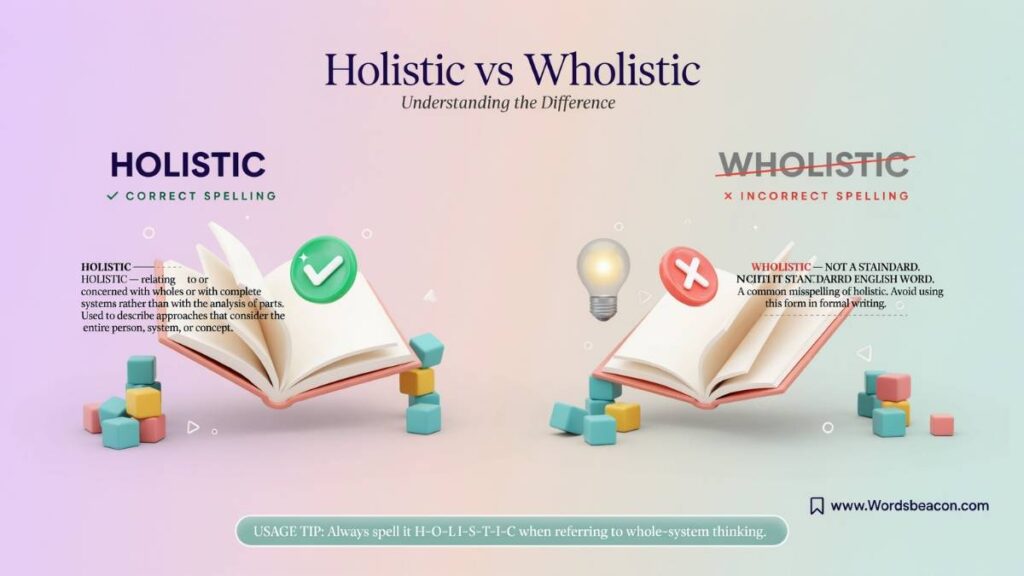
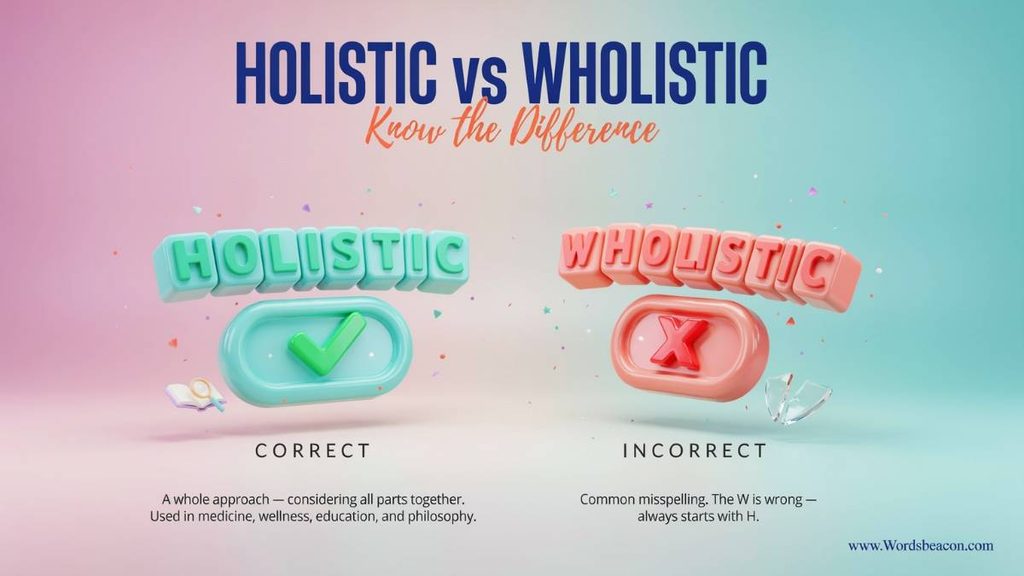
Holistic vs wholistic is one of those spelling questions that makes you pause and wonder, “Aren’t both correct?” After all, holistic refers to looking at the whole picture, so adding a W seems perfectly logical. However, English spelling doesn’t always follow the rules we expect! Holistic is the standard spelling, while wholistic is a much less common variant. Although both words share nearly the same meaning, only one is the best choice for everyday and professional writing. In this guide, you’ll discover what each spelling means, why holistic has no W, and how to avoid this common mistake with confidence.
quick comprasion
| Feature | Holistic | Wholistic |
|---|---|---|
| Spelling | Standard spelling | Less common variant |
| Meaning | Considering something as a complete whole | Generally the same meaning |
| Origin | Derived from holism and Greek holos | Influenced by the English word whole |
| First recorded use | 1926 | Around 1941 |
| Part of speech | Adjective | Adjective |
| Pronunciation | hoh-LIS-tik | hoh-LIS-tik |
| Common usage | Academic, professional, and everyday writing | Occasional and specialized usage |
| Formal writing | Preferred | Generally avoided |
| Recommendation | Use this spelling | Retain it in official names or quotations |
Learn the difference between tricky more English words
Across vs Accross Which Is the Correct Spelling?
What Does Holistic Mean?
Holistic is an adjective that describes an approach based on understanding something as a complete system rather than examining its individual parts in isolation. It emphasizes the relationships between different elements and recognizes that each part can influence the larger whole.
In simple terms, a holistic approach looks at the bigger picture.
For example, a teacher who considers a student’s academic performance, emotional development, social skills, and learning environment takes a holistic approach to education. Similarly, a healthcare professional who considers a patient’s physical condition, mental health, lifestyle, and medical history uses a holistic perspective.
In both situations, the goal is to understand the complete picture instead of concentrating on one detail.
Holistic Definition
The dictionary definition of holistic relates to holism or the idea that a complete system has characteristics that cannot always be understood by examining its separate components.
The word commonly describes methods, strategies, treatments, and perspectives that consider multiple connected factors.
Here are a few examples:
- A holistic education program supports academic, emotional, and social development.
- A holistic business strategy considers employees, customers, finances, and long-term goals.
- A holistic healthcare plan takes a patient’s overall well-being into account.
- A holistic environmental approach examines the connections between wildlife, natural resources, and human activities.
Although these examples involve different subjects, they share the same principle: individual elements make more sense when you understand how they work together.
Holistic Meaning in Different Contexts
The word holistic appears in several fields, and its precise application depends on the subject.
Healthcare: Holistic care considers a patient’s physical, emotional, mental, and social needs. It may include medical history, lifestyle, nutrition, sleep, and stress when developing an appropriate care plan.
Psychology: A holistic perspective examines how thoughts, emotions, behavior, relationships, and environmental influences interact. Rather than focusing on one factor, it considers the broader circumstances that shape human experiences.
Education: Holistic education supports the development of the whole student. Academic performance matters, but creativity, communication, confidence, and emotional growth also contribute to learning.
Business: A holistic management approach examines how different departments and business activities affect one another. For example, increasing sales without improving customer service may create problems elsewhere in the organization.
Environmental studies: A holistic perspective considers the relationships between ecosystems, human communities, natural resources, and environmental changes.
Across these subjects, holistic describes a broader way of understanding complex situations.
What Does Wholistic Mean?
Wholistic is a less common variant of holistic. It generally describes the same idea: considering a person, subject, or system as a whole rather than concentrating on individual parts.
The additional W comes from the influence of the English word whole. Because whole already expresses the idea of completeness, some writers find wholistic visually intuitive.
However, a spelling that looks logical does not automatically become the standard form. Holistic has a longer-established history and appears much more frequently in modern English.
Wholistic Definition
The wholistic definition refers to an approach that considers all relevant aspects of something together.
For example, a wholistic personal development program might consider physical health, emotional well-being, relationships, education, and individual goals.
Consider these sentences:
- The organization promotes a wholistic approach to community development.
- Her practitioner described the program as wholistic wellness.
- The school follows a wholistic model of student support.
- The company introduced a wholistic strategy for employee development.
In each example, you could replace wholistic with holistic without substantially changing the intended meaning.
Why Do People Use Wholistic?
Several factors explain why writers sometimes choose this alternative spelling.
First, its connection to the word whole makes the meaning look more obvious. Readers can immediately recognize the relationship between the spelling and the idea of completeness.
Second, some people consider wholistic a more intuitive spelling. They may assume that an adjective describing something complete should visibly include the word whole.
Additionally, certain wellness organizations, educational institutions, and businesses use wholistic in their names or promotional materials. In these situations, the spelling may reflect a branding decision or an established organizational preference.
Finally, readers who encounter wholistic in articles or professional communication may assume that it is just as common as holistic.
Nevertheless, the two forms do not have equal standing in everyday English. Holistic remains the more widely accepted choice.
Learn the difference between tricky more English words
Different vs Diffrent Which Spelling Is Correct?
Holistic vs Wholistic Key Differences
The difference between holistic and wholistic involves more than one additional letter. Their history, spelling, and frequency of use help explain why one form is generally preferred.
Difference in Meaning
Both words generally describe an approach that considers an entire person, subject, or system instead of examining separate components in isolation.
For example:
- A holistic approach to healthcare considers the patient’s overall well-being.
- A wholistic approach to healthcare considers the patient’s overall well-being.
Both sentences communicate essentially the same message.
Some writers try to distinguish the terms by suggesting that holistic emphasizes interconnectedness while wholistic emphasizes completeness. However, this distinction is not consistently established in standard dictionary usage.
Therefore, you should not treat them as separate concepts or assume that one describes a particular professional method.
Difference in Spelling
The spelling difference is straightforward:
- Holistic: H-O-L-I-S-T-I-C
- Wholistic: W-H-O-L-I-S-T-I-C
Holistic begins with H, while wholistic begins with WH.
This difference reflects their linguistic development. Holistic comes from holism, which traces back to the Greek word holos. Wholistic developed later under the influence of the English word whole.
Difference in Usage
Frequency of use is one of the clearest distinctions between these spellings.
Holistic appears regularly in academic research, healthcare discussions, educational materials, business communication, and everyday writing.
By comparison, wholistic appears less frequently. Writers may use it because of personal preference, organizational naming conventions, or a particular editorial style.
| Common spelling | Less common variant |
|---|---|
| Holistic healthcare | Wholistic healthcare |
| Holistic education | Wholistic education |
| Holistic approach | Wholistic approach |
| Holistic development | Wholistic development |
| Holistic wellness | Wholistic wellness |
| Holistic perspective | Wholistic perspective |
The expressions in the first column are more conventional. Consequently, they are generally better choices for articles, reports, assignments, and professional documents.
Difference in Reader Expectations
Familiar spelling makes written communication easier to understand.
Most English readers recognize holistic immediately, especially in common expressions such as holistic medicine, holistic care, and holistic education.
However, wholistic may cause some readers to pause. They might recognize it as a variant, while others may mistake it for a typing error.
That does not make the alternative automatically incorrect. Still, using the established spelling allows readers to concentrate on your message instead of questioning your word choice.
Difference in Formal Writing
Holistic is the preferred spelling in formal and professional communication.
Editors, teachers, publishers, and academic writers generally use this form because it follows established English usage.
For example, an academic paper discussing the relationship between physical and mental health would normally use the expression holistic approach.
Likewise, a company describing its management philosophy would generally write holistic business strategy.
Use wholistic when an official name, direct quotation, or specific style guide requires it. Otherwise, holistic is the more reliable option.
Learn the difference between tricky more English words
Center vs Centre Difference and Which one Is Correct?
Is Holistic vs Wholistic the Correct Spelling?
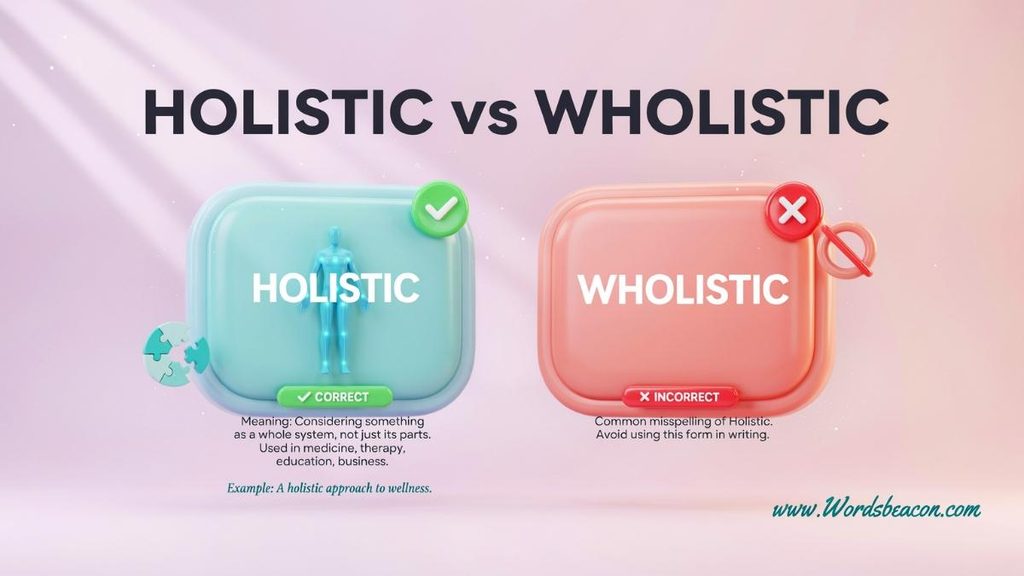
If you’re deciding between holistic vs wholistic, choose holistic for standard English writing.
The word is widely established in dictionaries and professional communication. Its spelling comes from holism, which describes the principle that a whole system cannot always be understood by examining its individual components separately.
However, wholistic is not simply an invented word or an entirely meaningless spelling. Major dictionary references recognize it as a variant of holistic.
This distinction is important because dictionary recognition and standard usage are not exactly the same thing. A word can be recognized as a variant without becoming the preferred form.
For everyday and professional writing, follow these guidelines:
- Use holistic in academic assignments and research papers.
- Choose holistic in business reports and professional emails.
- Write holistic when discussing healthcare approaches.
- Prefer holistic in website articles and educational materials.
- Retain wholistic when reproducing an official name or exact quotation.
The practical rule is simple: holistic is the standard spelling, while wholistic is an accepted but uncommon alternative.
Holistic vs Wholistic Pronunciation
Despite their different spellings, holistic and wholistic generally have the same pronunciation. The additional W does not create a separate sound.
As a result, listeners usually cannot determine which spelling a speaker intends simply by hearing the word.
How to Pronounce Holistic
The standard American English pronunciation is:
Holistic: /hoʊˈlɪs.tɪk/
The word contains three syllables, with the main stress on the second syllable.
When speaking, emphasize the middle syllable. The opening sound resembles the long O in home, while the ending sounds like the final part of artistic.
How to Pronounce Wholistic
The usual pronunciation of wholistic is identical:
Wholistic: /hoʊˈlɪs.tɪk/
The W does not introduce another spoken consonant. Therefore, both forms are generally considered homophones.
Common Pronunciation Mistakes
A few mistakes can make the word sound unnatural:
- Pronouncing the W as a separate consonant.
- Placing the main stress on the first syllable.
- Adding an unnecessary syllable.
- Assuming the alternative spelling requires a different pronunciation.
Remember that the two spellings generally sound alike. Their main distinction appears in writing, not speech.
Holistic vs Wholistic Origin and History
The history of these words explains why their spellings differ despite their similar meanings.
Interestingly, holistic and whole have different linguistic backgrounds. Their connection to the idea of completeness does not mean they developed from the same original word.
Where Did Holistic Come From?
Holistic developed from holism, a term associated with the ancient Greek word holos, meaning whole or entire.
The word holism entered modern philosophical vocabulary through the work of South African statesman and philosopher Jan Christian Smuts.
In 1926, Smuts published his influential book Holism and Evolution. He used the concept of holism to explain how nature produces organized wholes from individual parts.
His central idea challenged the assumption that understanding every separate component automatically provides a complete understanding of the entire system.
The development of the word can be summarized as follows:
- Holos: A Greek word meaning whole or entire.
- Holism: A philosophical concept centered on wholeness.
- Holistic: An adjective describing something related to holism.
This history explains why the established spelling begins with H rather than WH.
When Did Wholistic First Appear?
The alternative spelling wholistic appeared around 1941, according to historical word-origin records.
It developed through the influence of the English word whole and the existing word holistic.
The spelling likely appealed to writers because it made the connection to completeness more visible. Instead of following the Greek-derived form, it reflected a familiar English word.
However, the alternative did not introduce an entirely different philosophy or meaning. It simply provided another spelling for the established adjective.
Why Did Holistic Remain More Popular?
Several historical and practical factors helped holistic retain its position.
First, the adjective developed directly from the established philosophical term holism. As the concept gained recognition in academic discussions, the related adjective became familiar.
Second, healthcare, psychology, education, and other professional fields adopted the standard spelling.
Finally, dictionaries and editorial conventions reinforced its use. Once a spelling becomes established across several fields, writers have little reason to replace it with a less familiar alternative.
Today, holistic remains the conventional form in modern English.
Fix common more word mistakes in English
Stich vs Stitch difference and usage
Holistic vs Wholistic Examples in Sentences
Examples make the distinction easier to understand. Although both forms generally communicate the same idea, seeing them in context helps you recognize how writers use them.
Examples Using Holistic
Here are 10 examples featuring the standard spelling:
- The school introduced a holistic approach to student development.
- Her doctor recommended a holistic plan that considered her overall well-being.
- A holistic understanding of the problem requires examining its social and economic causes.
- The company adopted a holistic strategy to improve customer experience.
- Holistic education encourages intellectual, emotional, and social growth.
- The therapist considers family relationships as part of a holistic assessment.
- Environmental challenges often require holistic solutions.
- The research team took a holistic view of the community’s needs.
- A holistic approach to leadership considers employees and organizational goals.
- The program supports holistic development through learning and practical activities.
Notice how holistic describes an approach that considers multiple connected factors rather than concentrating on one isolated detail.
Examples Using Wholistic
The following sentences demonstrate the less common variant:
- The organization promotes a wholistic approach to community development.
- Her practitioner described the treatment as wholistic.
- The school follows a wholistic model of student support.
- The company adopted a wholistic strategy for employee development.
- The program emphasizes wholistic health and personal well-being.
- Their organization encourages wholistic thinking when addressing community challenges.
Each sentence could use holistic without changing its basic meaning.
Holistic vs Wholistic Sentence Comparison
| Holistic | Wholistic |
|---|---|
| We need a holistic approach. | We need a wholistic approach. |
| She values holistic education. | She values wholistic education. |
| The clinic offers holistic care. | The clinic offers wholistic care. |
| They support holistic development. | They support wholistic development. |
| The company needs a holistic strategy. | The company needs a wholistic strategy. |
The sentences communicate essentially identical ideas. However, the first column follows conventional spelling and is generally preferable.
Fix common more word mistakes in English
Sleeve vs Sleave Difference and which is correct ?
Holistic vs Wholistic in Different Fields
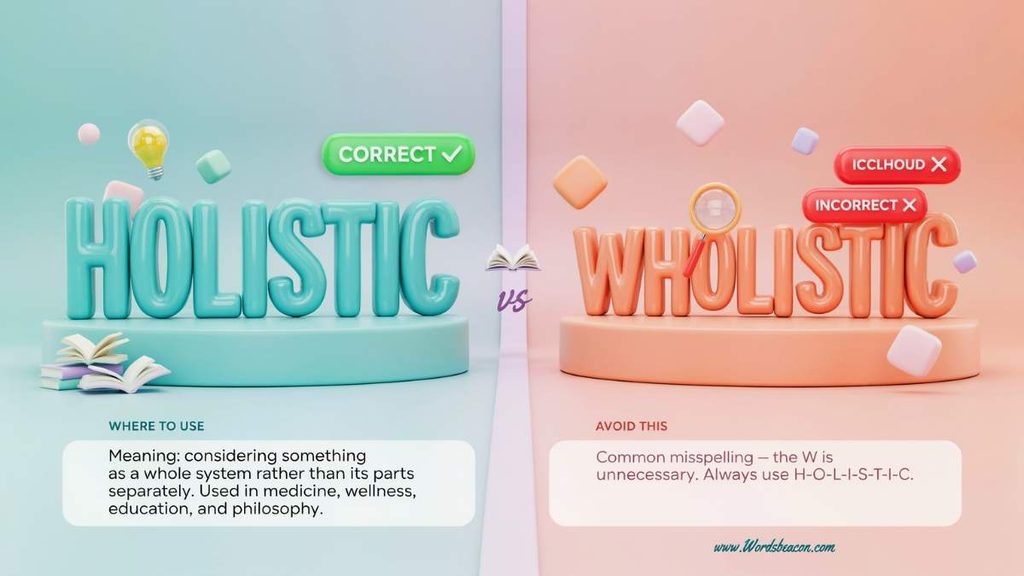
The word holistic appears in many professional and academic subjects. Understanding its contextual meaning helps explain why it has become such a useful adjective.
Holistic vs Wholistic in Psychology
In psychology, a holistic approach considers how different aspects of human experience interact.
Rather than studying thoughts, emotions, and behavior as completely separate elements, holistic psychology examines their relationships with one another and the surrounding environment.
Imagine someone experiencing ongoing stress at work.
A narrow assessment might concentrate exclusively on immediate emotional symptoms. A holistic perspective could also examine:
- Work responsibilities and professional relationships.
- Sleep habits and physical health.
- Family circumstances and social support.
- Personal expectations and coping strategies.
- Environmental pressures and lifestyle factors.
These elements can influence one another. Poor sleep may increase stress, while ongoing stress can affect relationships and physical well-being.
This broader perspective does not mean ignoring individual symptoms. Instead, it helps build a more complete understanding of a person’s circumstances.
The conventional expression is holistic psychology. Wholistic psychology generally communicates the same idea but remains less common.
Holistic vs Wholistic in Medicine
Healthcare provides one of the clearest examples of holistic thinking.
A holistic approach to health considers a person’s overall well-being rather than treating every concern as an isolated problem.
For instance, a patient experiencing recurring headaches might need an assessment of several relevant factors:
- Medical history and existing conditions.
- Sleep quality and daily routines.
- Stress levels and mental health.
- Nutrition and hydration.
- Medication use and other possible contributing factors.
A healthcare professional can consider this information when developing an appropriate care plan.
However, holistic medicine should not be confused with alternative medicine. These terms describe different things.
Holistic care refers to a broader approach to understanding a patient’s needs. Alternative medicine refers to practices used instead of conventional medical treatments.
Some holistic practitioners use complementary or alternative therapies. Nevertheless, a whole-person approach can also work alongside evidence-based conventional healthcare.
Similarly, integrative healthcare combines appropriate conventional treatments with selected complementary approaches.
Common expressions include holistic medicine, holistic treatment, holistic healthcare, and whole-person care.
Holistic vs Wholistic in Business
Business decisions often affect several departments at once. A change that appears beneficial in one area might create difficulties somewhere else.
That’s where a holistic business approach becomes useful.
Imagine a company wants to increase sales. Management could focus exclusively on advertising and sales targets. However, a broader strategy would also consider product quality, customer service, employee workload, inventory, pricing, and customer satisfaction.
For example, increasing advertising without improving inventory management might attract more customers than the company can serve. Sales could rise temporarily, but delayed orders and customer complaints might damage the business.
A holistic business strategy considers the entire operation.
It may examine:
- Financial performance.
- Customer experience.
- Employee development.
- Operational efficiency.
- Marketing and brand reputation.
- Long-term sustainability.
This interconnected perspective helps decision-makers understand the wider effects of their choices.
In professional communication, holistic business strategy is the conventional expression. Wholistic business strategy is a less common alternative, not a separate management theory.
Holistic vs Wholistic in Education
Education involves much more than memorizing facts and passing examinations.
A holistic approach to education recognizes that students develop through academic learning, social experiences, creativity, emotional growth, and practical activities.
For example, a school might evaluate a student’s progress through classroom performance, group projects, communication skills, creative work, and participation in extracurricular activities.
This approach recognizes that a student’s development cannot always be measured through test scores alone.
Holistic education may encourage:
- Critical thinking and problem-solving.
- Emotional awareness and confidence.
- Creativity and independent learning.
- Communication and teamwork.
- Physical activity and personal responsibility.
The term wholistic education can express the same idea, but holistic education remains the standard wording.
Holistic vs Wholistic in Personal Development
Personal growth rarely happens in just one area.
Improving your professional skills, for example, might require better time management, stronger communication, emotional resilience, and healthier daily habits.
A holistic approach to life considers how these different areas affect one another.
Imagine someone wants to become more productive. Simply working longer hours might seem like the obvious solution. However, a broader perspective would also consider sleep, exercise, nutrition, stress, relationships, and realistic goal-setting.
This does not mean every part of life needs equal attention every day. Rather, it means recognizing that personal well-being involves connected factors.
The same principle applies to holistic wellness, whole-body wellness, and personal development.
Fix common more word mistakes in English
Symptomatology Vs Symptomology Difference and usage
Holistic vs Reductionist Understanding the Difference
Although holistic and wholistic are spelling variants, holistic and reductionist describe different approaches to understanding complex subjects.
Holistic thinking considers the larger system and the relationships among its parts.
Reductionist thinking examines individual components to understand how they work and contribute to a larger process.
Neither approach is automatically better in every situation. Both can provide valuable information.
Holistic vs Reductionist Examples
Consider three practical examples:
Healthcare: A holistic approach considers a patient’s overall circumstances, while a reductionist approach might investigate a specific biological mechanism or symptom.
Education: Holistic evaluation considers a student’s academic, social, and emotional development. A reductionist evaluation might focus on a measurable skill, such as reading speed or mathematics performance.
Business: Holistic management examines the relationships between departments, while reductionist analysis might investigate one department’s expenses or productivity.
In practice, these approaches can complement each other. Studying individual components provides detailed information, while examining the larger system shows how those components interact.
Holism, Holistic, and Wholistic How Are They Related?
These three terms are closely connected, but they don’t perform the same grammatical role.
Understanding their relationship makes it easier to use them correctly.
Holism
Holism is a noun that describes the principle or philosophy of understanding something as a whole.
It emphasizes relationships between different parts and recognizes that the complete system may have characteristics that individual components don’t reveal on their own.
For example, holism can help explain why understanding a community requires examining its social relationships, economic conditions, institutions, and shared environment.
Holistic
Holistic is an adjective derived from holism.
It describes something that follows or relates to the principle of holism.
Common expressions include:
- Holistic approach.
- Holistic perspective.
- Holistic healthcare.
- Holistic education.
- Holistic development.
- Holistic philosophy.
Wholistic
Wholistic is a less common variant of holistic.
It generally carries the same meaning and functions as an adjective. Its spelling reflects the influence of the English word whole.
It does not represent a separate philosophical principle.
Holistically
Holistically is the adverb form of holistic.
It describes the way someone approaches, examines, or treats an entire subject.
For example:
- The organization evaluates employee development holistically.
- Doctors should consider relevant patient needs holistically.
- The research team examined the environmental problem holistically.
The word modifies the action rather than directly describing a noun.
Learn how to use confusing more words correctly
Prooving vs Proving Which Spelling Is Correct?
Holistic Grammar and Usage Rules
Understanding the grammar helps you use holistic naturally in different sentence structures.
Part of Speech
Both holistic and wholistic function primarily as adjectives.
They describe nouns by explaining the type of approach, perspective, treatment, or philosophy involved.
Examples:
- A holistic strategy.
- A holistic understanding.
- A wholistic perspective.
- A wholistic treatment plan.
Comparative and Superlative Forms
You can compare the degree of a holistic approach by using more and most.
Examples:
- This plan offers a more holistic view of the problem.
- Her research takes a more holistic approach than the previous study.
- The organization developed its most holistic strategy yet.
The same grammatical pattern can apply to the less common variant:
- A more wholistic approach.
- The most wholistic perspective.
However, the conventional spelling remains preferable in ordinary writing.
Adverb Forms
The adverb holistically describes how someone considers or approaches a subject.
For example:
- The team analyzed the situation holistically.
- The doctor evaluated the patient’s circumstances holistically.
- The school supports students holistically.
The less common form wholistically also exists, although it appears much less frequently.
Common Sentence Patterns
You can use holistic naturally in several sentence structures:
| Sentence pattern | Example |
|---|---|
| A holistic approach to something | The school adopted a holistic approach to learning. |
| A holistic view of something | We need a holistic view of the issue. |
| A holistic understanding of something | Researchers developed a holistic understanding of the ecosystem. |
| Consider something holistically | The organization must consider its long-term goals holistically. |
| Take a holistic perspective | Managers should take a holistic perspective when planning changes. |
These patterns work in everyday conversations, academic writing, and professional communication.
Learn how to use confusing more words correctly
Channel vs Chanel difference and usage
Common Mistakes When Using Holistic and Wholistic
Even though the spelling difference looks small, several misunderstandings can affect how writers use these words.
Assuming Wholistic Is Always Incorrect
Some people believe that wholistic is nothing more than a spelling mistake.
That’s not entirely accurate. Dictionaries recognize it as a variant of holistic. However, its recognition does not make it the preferred spelling.
Use holistic in standard writing unless a specific reason calls for the alternative.
Thinking the Two Words Have Completely Different Meanings
Another common mistake involves assigning separate definitions to the two forms.
Both generally communicate the idea of considering the whole. Any personal distinction a writer makes between them should not be presented as a universal language rule.
Confusing Holistic With Whole
Although holistic and whole have related meanings, their linguistic histories differ.
Holistic developed from holism, which comes from the Greek root holos. The English word whole developed from Old English hāl.
Their similar meanings help explain the alternative spelling, but they do not share the same immediate origin.
Using Both Spellings in One Document
Switching between holistic and wholistic can make an article or report look inconsistent.
Inconsistent: The company adopted a holistic strategy and later expanded its wholistic approach.
Consistent: The company adopted a holistic strategy and later expanded its holistic approach.
Choose one form and maintain it throughout your document.
Assuming Holistic Always Means Alternative Medicine
The word appears frequently in healthcare discussions, but it isn’t limited to medical treatments.
You can use holistic to describe education, psychology, business, environmental studies, leadership, and personal development.
Treating Holistic and Reductionist as Synonyms
These terms represent different approaches to understanding a subject.
Holistic thinking examines the larger system and its relationships. Reductionist thinking investigates individual components.
Understanding this distinction prevents inaccurate comparisons.
Holistic Synonyms and Related Words
Sometimes, another word communicates your intended meaning more naturally. Although no synonym works perfectly in every context, several alternatives can help you avoid repetition.
Common Synonyms for Holistic
| Synonym | Meaning | Example |
|---|---|---|
| Comprehensive | Covering many relevant aspects | A comprehensive assessment |
| Integrated | Combining connected elements | An integrated healthcare plan |
| All-inclusive | Including all relevant parts | An all-inclusive program |
| Unified | Bringing elements together | A unified strategy |
| Systemic | Relating to an entire system | Systemic changes |
| Whole-person | Considering the person as a whole | Whole-person care |
| Multidimensional | Involving several dimensions | A multidimensional analysis |
| Well-rounded | Covering different areas of development | A well-rounded education |
| Coordinated | Organized to work together | Coordinated patient care |
| Interconnected | Linked through relationships | An interconnected system |
These alternatives have slightly different meanings. For example, comprehensive emphasizes coverage, while holistic emphasizes the relationships between parts and the larger whole.
Words Related to Holistic
Several terms frequently appear alongside holistic:
- Holism: The principle of wholeness.
- Holistically: The adverb form.
- Wholeness: The condition of being complete.
- Whole: An entire entity.
- Interconnectedness: The state of being connected.
- Interdependence: Mutual reliance between elements.
- Systems thinking: Examining how components interact within a larger system.
- Reductionism: An approach that studies complex subjects through their components.
Holistic vs Comprehensive
These two words overlap, but they aren’t interchangeable in every situation.
A comprehensive approach aims to cover all important details or aspects of a subject. A holistic approach goes further by considering how those aspects relate to one another.
For example, a comprehensive business report might list every department’s performance figures. A holistic report would also examine how the departments influence overall organizational performance.
The distinction is subtle but useful.
Understand confusing English more words simply
Cheer vs Chear Difference and Correct Usage
Practice Session Holistic vs Wholistic
Fill in each blank with the correct word or phrase. Choose between Holistic vs Wholistic holism, holistically, or another suitable term where necessary.
1. The school follows a __________ approach to student development, supporting academic and emotional growth.
2. __________ is the standard spelling in modern English.
3. The word __________ developed from the Greek root holos, meaning whole or entire.
4. A __________ approach considers all relevant parts of a system rather than examining them separately.
5. The alternative spelling __________ is less common than holistic.
6. A healthcare professional may consider a patient’s physical and mental health when developing a __________ care plan.
7. The word holistic comes from the noun __________.
8. Holistic and wholistic generally have the same __________.
9. The company adopted a __________ strategy that considered employees, customers, and long-term goals.
10. The adverb __________ describes the way someone considers an entire subject.
11. The English word whole influenced the development of the alternative spelling __________.
12. In formal academic writing, __________ is generally the preferred spelling.
13. A __________ approach to education supports creativity, communication, and emotional development.
14. Holistic and wholistic are generally pronounced __________.
15. The opposite approach often contrasted with holistic thinking is called __________.
16. The philosopher Jan Christian Smuts published Holism and Evolution in __________.
17. A doctor who considers a patient’s lifestyle, medical history, and emotional well-being takes a __________ approach.
18. The noun __________ describes the principle of understanding something as a whole.
19. Writers should maintain __________ throughout a document rather than switching between holistic and wholistic.
20. When writing about whole-person healthcare, the preferred expression is __________ healthcare.
Answers
Check your answers after completing all 20 questions.
- Holistic
- Holistic
- Holistic
- Holistic
- Wholistic
- Holistic
- Holism
- Meaning
- Holistic
- Holistically
- Wholistic
- Holistic
- Holistic
- The same
- Reductionism
- 1926
- Holistic
- Holism
- Consistency
- Holistic
Here’s a trusted source for clear word meanings:
FAQs
Should I use wholistic or holistic?
Use holistic in standard American English. It is the established spelling and the preferred choice in dictionaries, educational materials, and professional writing. Although wholistic is a recognized variant, it is much less common and generally has the same meaning. Therefore, choose holistic unless a specific name, quotation, or style guide requires wholistic.
Is wholistic a real word?
Yes, wholistic is a recognized English word, but it is a less common variant of holistic. Both terms describe an approach that considers something as a complete whole rather than examining its individual parts separately. However, holistic remains the standard spelling in modern American English.
What does wholistic mean?
Wholistic means considering all parts of something together instead of focusing on just one element. It commonly appears in discussions about health, education, personal development, and well-being. Its meaning is essentially identical to holistic, although holistic is far more widely accepted in standard writing.
Why is holistic spelled without a W?
The spelling holistic comes from holism, which traces back to the Greek word holos, meaning whole or entire. Although holistic relates to the idea of wholeness, its spelling developed from holism rather than directly from the English word whole. That is why the standard spelling does not include a W.
What is the difference between holistic and holism?
Holism is a noun that describes the idea that a whole system can have qualities that cannot be fully understood by examining its individual parts alone. Holistic is an adjective that describes an approach based on this principle. For example, holism is the underlying concept, while a holistic approach applies that concept to healthcare, education, or another field.
What is the opposite of a holistic approach?
A reductionist approach is often considered the opposite of a holistic approach. It focuses on individual parts of a system rather than examining how everything works together. For example, a holistic approach to education considers academic performance, emotional development, and social skills, while a narrowly reductionist approach might focus mainly on test scores.
What is another word for holistic?
Possible alternatives include comprehensive, integrated, complete, all-encompassing, and whole-person. However, these words are not interchangeable in every sentence. For example, whole-person works well when discussing healthcare, while comprehensive may better describe a detailed plan or assessment.
What does holistic mean in simple words?
Holistic means looking at the whole picture instead of focusing on just one part. For example, a holistic approach to well-being considers physical health, emotional needs, relationships, and daily habits together. In simple terms, it means understanding how different parts connect and influence one another.
What is an example of a holistic approach?
A teacher who uses a holistic approach considers more than a student’s grades. They also pay attention to confidence, creativity, social skills, emotional development, and individual learning needs. By considering these connected factors, the teacher can better understand the student’s overall progress.
What are some examples of holistic care?
Holistic care considers a person’s overall needs rather than concentrating on a single symptom or health concern. Examples include combining appropriate medical treatment with emotional support, nutrition guidance, physical activity, and mental health care. These elements can complement one another while necessary medical treatment remains a priority.
What is a holistic lifestyle?
A holistic lifestyle focuses on maintaining balance across different areas of life. It may include regular exercise, nutritious meals, sufficient sleep, meaningful relationships, emotional well-being, and healthy daily routines. Rather than concentrating on one habit, this approach considers how everyday choices work together to support overall quality of life.
What is a holistic person?
A holistic person is someone who considers the bigger picture when understanding situations or making decisions. They recognize that different aspects of life influence one another. For example, they may consider how work, relationships, physical health, and personal values affect a person’s overall well-being.
What is the difference between holistic and holistically?
Holistic is an adjective, while holistically is an adverb. Use holistic to describe a person, method, or approach, as in “a holistic approach to education.” Use holistically to describe how someone considers or handles something, as in “The team examined the problem holistically.”
Is it correct to say “a holistic” or “an holistic”?
In standard American English, “a holistic” is correct because the H in holistic is pronounced. For example, write “a holistic approach” or “a holistic perspective.” The choice between a and an depends on the opening sound of a word, not simply its first letter.
What is the root word of holistic?
Holistic comes from holism, which traces back to the Greek word holos, meaning whole or entire. Jan Christian Smuts introduced the term holism in his 1926 book Holism and Evolution. The adjective holistic developed from holism with the addition of the suffix -istic.
What is a simpler word for holistic?
Whole-person, complete, or comprehensive may serve as simpler alternatives to holistic. The best choice depends on the context. For instance, “a whole-person approach” may be easier to understand when discussing healthcare, while “a comprehensive approach” may work better when describing a detailed plan.
Understand confusing English more words simply
Bachelor vs Batchelor difference and correct usage
Conclusion
Holistic vs wholistic can easily confuse you. After all, both spellings look right, and both carry the same basic meaning. However, only one is the standard choice in modern English: holistic. It means looking at the whole picture rather than focusing on just one part. Wholistic is a recognized but much less common variant, so it’s best to avoid it in everyday and professional writing.
The easiest way to remember the difference? Holistic starts with H, not W, even though it relates to the idea of being whole. English spelling can be a little quirky! So, whether you’re writing about healthcare, education, or personal growth, stick with holistic. One small spelling choice can make your writing clearer and more polished.

Luna AJS is an experienced blogger and dedicated language enthusiast at Words Beacon. She specializes in making English grammar, spelling, vocabulary and commonly confused words easy to understand. She provides clear explanations, practical examples to help readers write with confidence.