
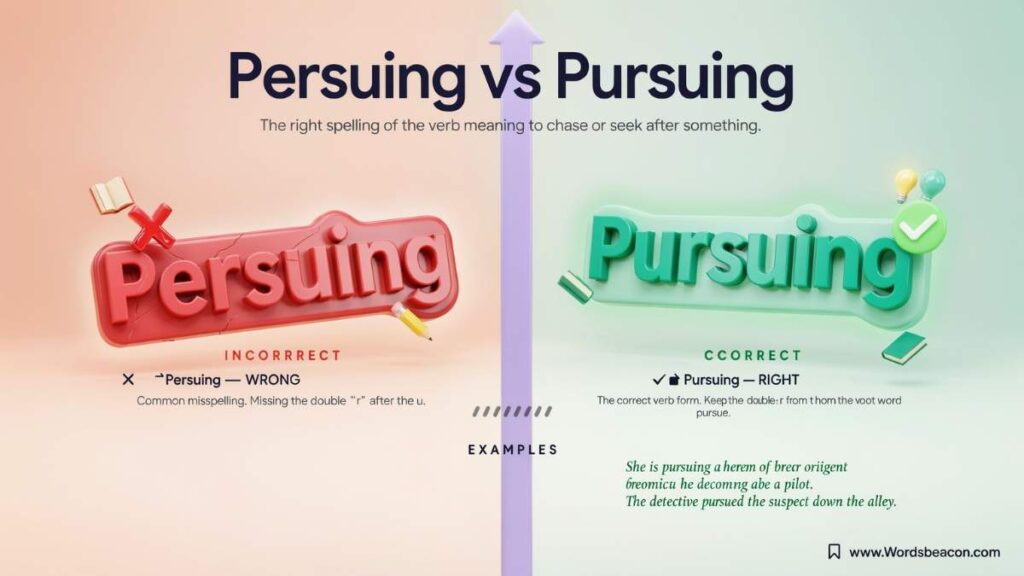
A small spelling mistake can change the look of an entire sentence, and “persuing” is a perfect example. You might have seen both “Persuing vs Pursuing” and wondered which one is correct. Don’t worry; the confusion is easy to fix! The correct spelling is “pursuing,” while “persuing” is simply a common misspelling. Whether you’re writing about pursuing a dream, building a career, or chasing a goal, using the right form matters. In this guide, you’ll learn what “pursuing” means, how to spell it, and how to use it correctly without second-guessing yourself.
quick comprasion
| Word or expression | Correctness | Meaning | Example |
|---|---|---|---|
| Persuing | Incorrect | Common misspelling of pursuing | Incorrect: She is persuing a degree. |
| Pursuing | Correct | Following, seeking, or working toward something | She is pursuing a degree. |
| Perusing | Correct, but different | Reading or examining something | She is perusing a university brochure. |
| Pursue | Correct | Base form of pursuing | She wants to pursue a career in medicine. |
Learn how to use confusing more words correctly
Holistic vs Wholistic Difference and Correct Spelling
Persuing vs Pursuing Quick Answer
If you’re comparing Persuing vs pursuing, the answer is simple: pursuing is the correct spelling, while persuing is a common spelling mistake. Standard American and British English both use pursuing. Neither variety recognizes persuing as an accepted alternative.
The confusion surrounding Persuing vs pursuing often comes from the way people remember or pronounce the word. However, once you understand its connection to the verb pursue, the correct spelling becomes much easier to remember.
Pursuing is the present participle and gerund form of pursue. Depending on the sentence, it can describe an action in progress, an effort to achieve something, or an activity someone continues.
For example:
- Correct: Maria is pursuing a master’s degree in education.
- Incorrect: Maria is persuing a master’s degree in education.
- Correct: The police are pursuing the suspect.
- Incorrect: The police are persuing the suspect.
- Correct: Pursuing a career in medicine requires dedication.
- Incorrect: Persuing a career in medicine requires dedication.
These examples make the difference between Persuing vs pursuing easy to spot. Only pursuing is correct, and that one letter can make the difference between accurate writing and a spelling error.
Here’s a simple way to remember the correct form:
- Start with the base verb pursue.
- Remove its final silent e.
- Add the suffix -ing.
- Write the resulting word as pursuing.
This spelling pattern also appears in familiar English verbs such as making, taking, and writing.
Therefore, whenever the Persuing vs pursuing spelling question leaves you second-guessing yourself, return to the original verb. Remember that pursue becomes pursuing when you add -ing. Once you know this simple rule, you’ll have no reason to let this common spelling mistake trip you up again.
What Is the Correct Spelling of Pursuing?
The correct spelling is p-u-r-s-u-i-n-g. Although persuing may look reasonable at first glance, it doesn’t follow the spelling of the original verb.
The base word is pursue. When you add -ing, English spelling rules generally require you to remove the final silent e. After that, you attach the suffix to the remaining letters without changing their order.
The word formation looks like this:
Pursue + -ing = Pursuing
Here’s how the different forms compare:
| Word form | Spelling | Status |
|---|---|---|
| Base verb | Pursue | Correct |
| Third-person singular | Pursues | Correct |
| Past tense | Pursued | Correct |
| Present participle | Pursuing | Correct |
| Common misspelling | Persuing | Incorrect |
| Another misspelling | Pursueing | Incorrect |
More importantly, you don’t need to memorize pursuing as an entirely separate word. Instead, learn how the base verb changes when you add a suffix. Once you understand that pattern, you’ll find it easier to spell similar words correctly.
Why Do People Spell Pursuing Incorrectly?
English spelling doesn’t always match pronunciation perfectly. As a result, even experienced writers sometimes struggle with commonly misspelled words.
Several factors can contribute to the persuing spelling mistake.
- Vowel confusion: Some writers replace the first u with e because they’re unfamiliar with the correct spelling.
- Unusual letter combinations: The sequence in pursue may look unfamiliar, particularly to people learning English.
- Pronunciation habits: Writers sometimes guess a word’s spelling based on how they hear it.
- Typing errors: Fast typing, autocorrect, and missed proofreading can allow incorrect spellings to slip into documents.
- Limited exposure: People who rarely encounter the word in reading may struggle to remember its exact form.
For instance, someone writing quickly might type, “I am persuing a new opportunity.” The meaning remains understandable, but the spelling is still incorrect.
Similarly, an English learner might recognize the word when reading but struggle to reproduce it while writing. This happens because recognizing a word and remembering its exact letter sequence are two different skills.
Fortunately, regular reading and a little spelling practice can help. Rather than relying entirely on an English spelling checker, learn the base word and the rule behind its -ing form.
Is Persuing Ever an Acceptable Alternative?
No. Persuing isn’t a standard alternative spelling in American or British English. It doesn’t have an independent dictionary meaning that makes it interchangeable with pursuing.
However, you might occasionally encounter Persuing as a personal name, username, brand, or deliberately created term. Such uses don’t change the standard spelling of the English verb.
Therefore, when you want to describe following, seeking, or working toward something, always use pursuing.
Learn how to use confusing more words correctly
Channel vs Chanel difference and usage
What Does Pursuing Mean? Definition and Explanation
The word pursuing has several related meanings. Its exact interpretation depends on what someone follows, seeks, or tries to accomplish.
In everyday English, pursuing usually describes an active effort to reach a goal or continue an activity. However, it can also refer to physically chasing a person or something that moves away.
The pursuing definition is closely connected to the verb pursue. Established English dictionaries recognize its uses in chasing, seeking, achieving goals, continuing activities, and following a particular course of action.
Pursuing Meaning in English
In simple terms, pursuing means following, seeking, or working toward something.
Imagine a student who wants to become a doctor. She studies biology, applies to medical school, attends classes, and works toward earning her qualification. Throughout this process, she is pursuing a medical career.
Likewise, a police officer who follows a fleeing suspect is pursuing that person. In this situation, the word describes physical movement rather than a personal ambition.
The main meanings of pursuing include:
- Following or chasing: Trying to catch a person, animal, vehicle, or moving object.
- Seeking something: Making an effort to find, obtain, or secure something.
- Working toward an objective: Taking steps to achieve a goal, dream, or ambition.
- Continuing an activity: Remaining involved in a particular interest, plan, or course of action.
- Investigating a matter: Continuing to examine a question, claim, problem, or possible solution.
Although these meanings share the same basic idea, the surrounding words help you understand the intended meaning.
For example, pursuing a suspect describes a physical chase, while pursuing an education describes a long-term effort to gain knowledge and qualifications. The word stays the same, but the situation changes its interpretation.
Pursuing Someone or Something by Following or Chasing
One common meaning of pursuing involves following someone or something, usually to catch up with it.
This meaning frequently appears in police reports, news stories, sports, and descriptions of animal behavior. Unlike pursuing a career or goal, this use often involves physical movement.
Consider these examples:
- The police were pursuing a stolen vehicle through downtown.
- The dog ran across the field while pursuing a rabbit.
- Several photographers were pursuing the famous actor.
- The goalkeeper moved quickly while pursuing the ball.
- The hunters spent hours pursuing their prey.
In each example, someone follows a moving person or object. The action involves trying to catch, reach, or keep up with the target.
However, pursuing doesn’t necessarily mean catching the target. For instance, police officers can pursue a suspect for several minutes without actually apprehending that person.
Consequently, the word describes the effort or action of following rather than guaranteeing a successful result.
Pursuing a Goal, Dream, or Ambition
Another important meaning involves trying to achieve something you want.
When you pursue a goal, you take deliberate steps toward a desired result. Those steps might include studying, practicing, saving money, gaining experience, or overcoming challenges.
For instance, someone pursuing a writing career might:
- Read books and articles to improve their knowledge.
- Practice writing regularly.
- Build a collection of published work.
- Apply for writing opportunities.
- Develop professional relationships.
- Continue improving through feedback and experience.
Clearly, the person doesn’t achieve a career simply by wishing for it. Instead, pursuing describes the ongoing effort required to move closer to that ambition.
Consider these additional examples:
- Daniel is pursuing his dream of becoming an architect.
- She spent five years pursuing a career in journalism.
- The company is pursuing its goal of expanding into new markets.
- They are pursuing better educational opportunities for their children.
This meaning explains why pursuing often appears alongside words such as dream, ambition, objective, success, and achievement.
In other words, pursuing a goal involves more than having a desire. It means actively working toward something that matters to you.
Pursuing an Activity, Interest, or Course of Action
Sometimes pursuing describes continuing an activity rather than reaching one specific destination.
For example, a person might pursue photography as a hobby, pursue scientific research, or pursue a particular business strategy.
Unlike a clearly defined objective, these activities may continue for months or even years. There doesn’t have to be one final achievement.
Consider these sentences:
- She is pursuing her interest in environmental science.
- The researchers are pursuing a new approach to scientific research.
- He decided to pursue photography after retiring.
- The organization is pursuing a policy of sustainable development.
- The company is pursuing a different marketing strategy.
Here, the pursuing word meaning focuses on continued involvement and effort.
Similarly, someone pursuing a hobby doesn’t necessarily expect a financial reward or professional achievement. They might simply enjoy the activity and want to improve their skills.
Therefore, pursuing can describe both ambitious professional plans and ordinary personal interests.
Learn how to use confusing more words correctly
Across vs Accross Which Is the Correct Spelling?
Pursue vs Pursuing What’s the Difference?
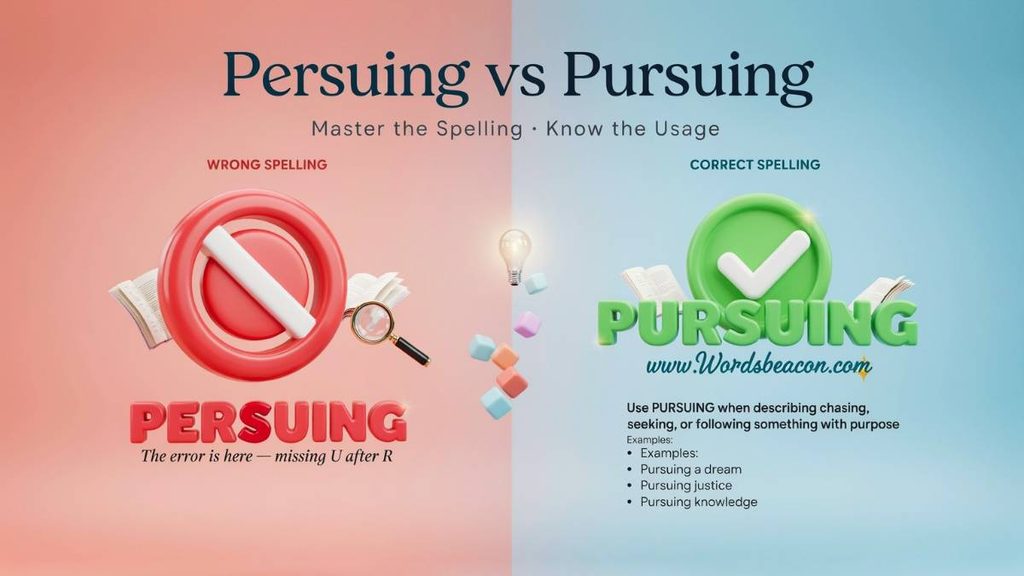
Although pursue and pursuing share the same basic meaning, they serve different grammatical purposes.
Pursue is the base form of the verb. Meanwhile, pursuing is its -ing form. You choose between them according to the sentence structure.
| Feature | Pursue | Pursuing |
|---|---|---|
| Word form | Base verb | Present participle or gerund |
| Ending | No -ing suffix | Ends in -ing |
| Main use | Expresses an action in its base form | Describes an ongoing action or functions as a noun |
| Example | I want to pursue medicine. | I am pursuing medicine. |
| Another example | They pursue their ambitions. | Pursuing ambitions takes effort. |
When to Use Pursue
Use pursue when the sentence requires the base form of the verb.
It commonly appears after modal verbs, the word to, and certain other verbs.
For example:
- I want to pursue a career in engineering.
- She plans to pursue higher education.
- They hope to pursue new business opportunities.
- You should pursue your interests with confidence.
- The company will pursue a different strategy.
- We decided to pursue another solution.
Notice that the verb doesn’t take -ing in these constructions.
For instance, “I want to pursuing a degree” is incorrect. The correct sentence is “I want to pursue a degree.”
Similarly, after modal verbs such as can, should, and will, use the base form.
- She can pursue another opportunity.
- He should pursue his academic interests.
- They will pursue a new business strategy.
Once you recognize these grammatical patterns, choosing the right form becomes much easier.
When to Use Pursuing
Use pursuing when the sentence calls for the -ing form.
It commonly appears after forms of the verb be, such as am, is, and are, when describing an ongoing action.
Examples:
- I am pursuing a degree in psychology.
- She is pursuing a new opportunity.
- They are pursuing their long-term goals.
- We were pursuing a different solution.
- He has been pursuing a career in finance.
Additionally, you can use pursuing as a gerund, where it functions as a noun.
For example:
- Pursuing a degree requires commitment.
- He enjoys pursuing creative projects.
- Pursuing new interests can broaden your experience.
The key is to identify the grammatical role the word plays rather than choosing a form based on how it looks.
Fix common more word mistakes in English
Different vs Diffrent Which Spelling Is Correct?
How to Spell Pursuing Correctly
If you want to understand how to spell pursuing, start with the original verb: pursue.
The word ends in a silent e. When you add the suffix -ing, you remove that final e and attach the suffix to the remaining letters.
The spelling process looks like this:
Pursue + -ing = Pursuing
Step by step:
- Original word: Pursue
- Remove the final e: Pursu
- Add -ing: Pursuing
This is a common English word-formation rule. Nevertheless, not every verb ending in e follows exactly the same pattern.
For example, verbs ending in -ee generally retain their final letters before adding -ing, as in seeing and agreeing.
Why Does Pursue Become Pursuing Instead of Pursueing?
The final e in pursue is silent. Therefore, English spelling generally drops this final silent e when a verb takes the suffix -ing.
That’s why pursue becomes pursuing rather than pursueing.
Compare these forms:
| Base verb | Correct -ing form | Incorrect form |
|---|---|---|
| Pursue | Pursuing | Pursueing |
| Make | Making | Makeing |
| Write | Writing | Writeing |
| Hope | Hoping | Hopeing |
| Dance | Dancing | Danceing |
| Value | Valuing | Valueing |
Although the final e disappears, the original pronunciation pattern remains recognizable.
Furthermore, the spelling rule explains why writing pursueing creates an unnecessary extra letter. Once you understand the change, there’s no reason to add another e.
An Easy Trick to Remember the Spelling of Pursuing
A simple memory trick can help you avoid this spelling error.
Think of the word pursue first. Then remove its final e before adding -ing.
You can remember the process with this formula:
PURSUE − E + ING = PURSUING
Here are three practical spelling tips:
- Memorize the correct base verb: pursue.
- Remember that its final silent e disappears before -ing.
- Check the first vowel: pursuing begins with pur, not per.
If you regularly confuse pursuing and persuing, practice writing the correct form in short sentences. Repeated exposure can make the spelling feel natural.
For example:
- I am pursuing my education.
- She is pursuing a new career.
- They are pursuing their goals.
In addition, try using the word in emails, short paragraphs, and everyday writing exercises. The more frequently you encounter the correct form, the easier it becomes to remember.
Verb Forms of Pursue
Understanding the different verb forms of pursue helps you use pursuing correctly in English grammar.
Pursue is a regular verb. Consequently, it changes according to tense, subject, and grammatical function. Its past tense and past participle use the -ed ending, while its present participle uses -ing.
| Verb form | Correct spelling | Example |
|---|---|---|
| Base form | Pursue | I pursue my interests. |
| Third-person singular | Pursues | She pursues her ambitions. |
| Simple past | Pursued | He pursued a new career. |
| Past participle | Pursued | They have pursued several opportunities. |
| Present participle | Pursuing | We are pursuing a solution. |
| Gerund | Pursuing | Pursuing knowledge takes effort. |
Pursue Meaning
The verb pursue means to follow, seek, or make an effort to achieve something.
It can describe a physical action, a professional ambition, or an ongoing plan.
For example:
- The officers pursue the suspect.
- She wants to pursue a career in law.
- We pursue opportunities that support our business.
- They pursue knowledge through research.
- The organization decided to pursue legal action.
The word also appears in formal contexts, especially when discussing legal matters, investigations, and business decisions.
For example, a company might decide to pursue legal action against another organization. In this context, pursue means taking steps toward a particular legal outcome.
Pursues Meaning
Pursues is the third-person singular form of pursue.
Use it with singular subjects such as he, she, it, or a person’s name.
Examples:
- Sarah pursues her academic goals.
- He pursues every opportunity to improve his skills.
- The organization pursues sustainable business practices.
- The athlete pursues excellence through regular training.
The final s matters. Therefore, don’t write “She pursue her dreams” when using the simple present tense. The correct sentence is “She pursues her dreams.”
Pursued Meaning
Pursued is both the simple past tense and the past participle of pursue.
Use it when describing an action that happened in the past or when forming perfect and passive constructions.
Examples:
- She pursued a degree in nursing.
- The company pursued several expansion opportunities.
- They have pursued this project for years.
- The suspect was pursued by police officers.
- He had pursued his ambition long before receiving recognition.
These examples demonstrate how the same verb form works in different grammatical constructions.
For instance, in “They have pursued this project,” pursued forms part of the present perfect tense. Meanwhile, in “The suspect was pursued,” it forms part of a passive construction.
Fix common more word mistakes in English
Center vs Centre Difference and Which one Is Correct?
How to Use Pursuing in a Sentence
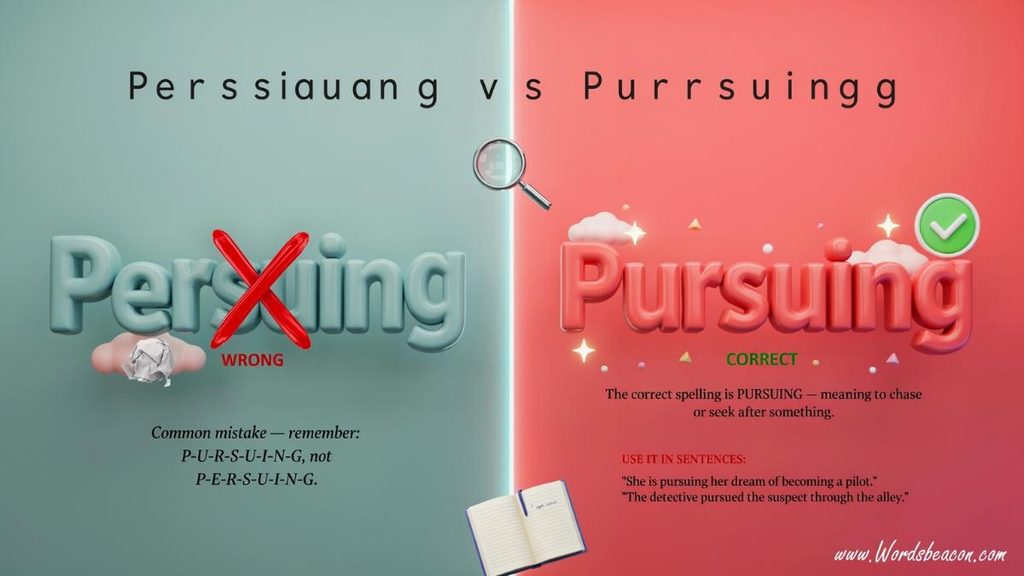
The word pursuing fits naturally into many everyday and professional situations. However, its meaning changes depending on the noun or object that follows it.
For example, pursuing a degree describes an educational commitment. Pursuing an opportunity means trying to obtain something beneficial. Meanwhile, pursuing someone may refer to chasing that person physically or showing romantic interest.
To make these differences clearer, consider the following examples from different contexts.
Pursuing a Degree or Higher Education
The phrase pursuing a degree means studying toward an academic qualification from a college, university, or another recognized educational institution.
It doesn’t necessarily mean that the student has already completed the program. Instead, it describes an ongoing educational journey.
For example:
- Maria is pursuing a bachelor’s degree in business administration.
- James plans to pursue a master’s degree in computer science.
- She spent four years pursuing a degree in nursing.
- Many working professionals pursue graduate education to advance their careers.
- He is pursuing a doctoral degree in environmental science.
Similarly, the phrase pursuing higher education refers to continuing formal education beyond high school, often through undergraduate or graduate programs.
Imagine that Alex finishes high school and enrolls in a university engineering program. He attends lectures, completes assignments, prepares for examinations, and works toward graduation. Throughout those years, Alex is pursuing an engineering degree.
Once he completes the required coursework and earns the qualification, he has finished pursuing that particular degree.
Therefore, if someone asks about the Persuing vs Pursuing degree meaning, the correct expression is pursuing a degree. It describes the process of working toward an academic qualification rather than the qualification itself.
Pursuing a Career or Profession
The phrase pursuing a career describes working toward a professional path or developing a long-term occupation.
It can include education, training, internships, practical experience, and professional development.
Examples:
- She is pursuing a career in medicine.
- Daniel wants to pursue a profession in architecture.
- He moved to Chicago while pursuing a career in finance.
- They are pursuing opportunities in the technology industry.
- After graduation, she plans to pursue a career in journalism.
Importantly, pursuing a career goes beyond finding a job. It often describes a broader commitment to building professional skills and gaining experience in a chosen field.
For instance, someone pursuing a teaching career might earn an education degree, complete classroom training, obtain the required certification, and apply for teaching positions.
Each step contributes to the larger objective. Thus, the phrase describes a continuing professional journey rather than one isolated activity.
Pursuing Goals and Dreams
People also use pursuing when discussing personal ambitions and objectives.
A goal might involve learning a new language, improving physical fitness, starting a business, or developing a creative skill.
Examples:
- She is pursuing her dream of becoming a professional musician.
- He continues pursuing his fitness goals.
- They are pursuing a more sustainable lifestyle.
- I am pursuing personal development through reading and training.
- The young entrepreneur is pursuing an ambitious business plan.
The word suggests action rather than passive interest. In other words, someone pursuing a goal usually takes practical steps to move closer to the desired result.
For example, wanting to learn Spanish is an intention. However, taking lessons, practicing conversations, and studying vocabulary are ways of pursuing that goal.
Pursuing an Opportunity
Pursuing an opportunity means making an effort to obtain or take advantage of a promising possibility.
This expression frequently appears in business, education, and professional communication.
Examples:
- The company is pursuing an opportunity to expand overseas.
- She is pursuing a scholarship to support her education.
- He contacted several employers while pursuing new job opportunities.
- The research team is pursuing funding for its latest project.
- They are pursuing a partnership with an established organization.
Nevertheless, pursuing an opportunity doesn’t guarantee success. It describes the effort to obtain something beneficial, not a promise that the effort will produce the desired result.
For example, a job applicant might pursue several positions but receive only one offer. The word describes the applications and efforts rather than the final outcome.
Pursuing Someone in a Relationship
The phrase pursuing someone has different meanings depending on the situation.
In romantic contexts, it usually means showing interest in someone and making an effort to develop a relationship.
For example:
- He has been pursuing her for several months.
- She decided to pursue a relationship with someone who shares her interests.
- They started dating after he expressed his interest.
- He stopped pursuing the relationship when he realized they wanted different things.
However, pursuing someone can also describe physically following that person.
For instance, a security officer pursuing an intruder has nothing to do with romance.
Context makes the difference. Moreover, romantic interest should always respect the other person’s comfort, consent, and boundaries.
Fix common more word mistakes in English
Sleeve vs Sleave Difference and which is correct ?
Pursuing in English Grammar
The word pursuing is an -ing form of the verb pursue. However, its grammatical role can change depending on how you use it.
It commonly functions as a present participle, gerund, or participial modifier.
Understanding these distinctions will improve your English writing skills. More importantly, it will help you avoid common grammar mistakes.
Pursuing as a Present Participle
A present participle is a verb form that ends in -ing. It helps form continuous tenses and can describe an action in progress.
For example:
- She is pursuing a degree in psychology.
- They are pursuing a new business strategy.
- I was pursuing a different career path.
- The officers were pursuing the suspect.
- He has been pursuing this opportunity for months.
In these sentences, pursuing works with a form of the verb be to create a continuous verb construction.
Consequently, the action appears ongoing rather than simply completed.
Notice the difference:
- She pursued a degree. This describes a past action.
- She is pursuing a degree. This describes an ongoing action.
Although both sentences use the same base verb, their grammatical forms communicate different time relationships.
Pursuing as a Gerund
A gerund is a verb ending in -ing that functions as a noun.
Although it comes from a verb, it can act as the subject or object of a sentence.
Examples:
- Pursuing a degree requires dedication.
- She enjoys pursuing creative interests.
- He believes pursuing knowledge is important.
- They discussed pursuing a new business strategy.
- Pursuing personal goals can improve motivation.
In the first example, pursuing a degree acts as the subject. In the second, it functions as the object of the verb enjoys.
Therefore, an -ing word doesn’t always describe an action in progress. Sometimes it names an activity.
Pursuing as a Participial Modifier
Pursuing can also describe a noun by providing additional information about it.
For example:
- The pursuing officers followed the suspect.
- The pursuing journalists waited outside the courthouse.
- The pursuing team continued its investigation.
In these examples, pursuing describes the officers, journalists, and team.
Although this use is less common than continuous tense and gerund constructions, it is grammatically valid.
Pursuing vs Perusing What’s the Difference?
Here’s another spelling confusion worth clearing up: Pursuing vs Perusing. Unlike “persuing,” both “pursuing” and “perusing” are correctly spelled English words. However, they have completely different meanings, so using one in place of the other can change your sentence.
- Pursuing means following, seeking, or working toward something.
- Perusing means reading or examining something, usually with attention.
For example, you might be pursuing a college degree while perusing a textbook in the library. Although these words contain similar letters and may look alike, they aren’t interchangeable. Understanding the difference between Pursuing vs Perusing will help you choose the right word and avoid an entirely different kind of spelling mistake.
| Feature | Pursuing | Perusing |
|---|---|---|
| Base verb | Pursue | Peruse |
| Meaning | Following or working toward something | Reading or examining something |
| -ing form | Pursuing | Perusing |
| Example | She is pursuing a law degree. | She is perusing a law textbook. |
| Correct spelling? | Yes | Yes |
What Does Perusing Mean?
Perusing is the present participle or gerund form of the verb peruse.
It describes reading, examining, or looking through written material. Depending on the context, someone might peruse a newspaper, report, contract, magazine, or website.
For example:
- The manager is perusing the monthly sales report.
- She spent the afternoon perusing travel magazines.
- He was perusing the contract before signing it.
- The students are perusing their research materials.
- I spent an hour perusing the university’s course catalog.
Perusing doesn’t describe working toward a professional goal or chasing someone. Instead, it focuses on examining information.
Pursuing or Perusing Examples That Show the Difference
Consider these pairs to understand how the meanings change.
| Pursuing | Perusing |
|---|---|
| She is pursuing a career in journalism. | She is perusing a journalism magazine. |
| He is pursuing a scholarship. | He is perusing the scholarship requirements. |
| The police are pursuing the suspect. | The detective is perusing the case documents. |
| They are pursuing a business opportunity. | They are perusing the business proposal. |
| I am pursuing higher education. | I am perusing a university brochure. |
Here’s an easy way to remember the difference:
Pursuing involves following or seeking something. Perusing involves reading or examining something.
For example, a student can be pursuing a degree while perusing a university’s course catalog. Both actions can happen at the same time, but they describe different activities.
Therefore, before choosing between pursuing or perusing, consider what you actually want to communicate. If you’re working toward a goal, use pursuing. If you’re examining written information, use perusing.
Understand confusing English more words simply
Symptomatology Vs Symptomology Difference and usage
Pursuing Synonyms What Are Other Words for Pursuing?
The best synonym for pursuing depends on the context. You wouldn’t normally replace pursuing a career with chasing a career because the second expression sounds unnatural in professional writing.
Likewise, following and seeking don’t always communicate precisely the same idea.
For that reason, choose a synonym that preserves the intended meaning rather than replacing the original word automatically.
Synonyms for Following or Chasing
When pursuing describes physically following someone or something, these alternatives may work:
| Synonym | Meaning | Example |
|---|---|---|
| Chasing | Moving after something to catch it | The dog is chasing a ball. |
| Following | Moving behind someone or something | The officer is following the suspect. |
| Tracking | Following someone’s movements or location | The team is tracking the missing animal. |
| Hunting | Searching for or chasing something | The hunters are hunting wild game. |
| Trailing | Following behind someone | The reporters are trailing the politician. |
These synonyms are particularly useful when describing movement, pursuit, or an attempt to catch someone.
However, each word has a slightly different emphasis. Tracking, for instance, focuses on monitoring someone’s location, while chasing often suggests an active attempt to catch a moving target.
Synonyms for Working Toward a Goal
When pursuing describes an ambition or objective, consider these alternatives:
- Seeking: Trying to find or obtain something.
- Striving for: Making a strong effort to achieve something.
- Working toward: Taking practical steps to reach a goal.
- Aiming for: Directing your efforts toward a desired result.
- Endeavoring: Making a serious effort to accomplish something.
- Aspiring to: Having a strong desire to achieve a particular position or goal.
For example:
- She is seeking a scholarship to support her education.
- He is striving for professional success.
- They are working toward a better financial future.
- Maria is aiming for a leadership position.
- The organization is endeavoring to improve public services.
Although these expressions can replace pursuing in suitable contexts, they aren’t always exact substitutes.
For instance, aspiring to a career describes a desire, whereas pursuing a career usually suggests active steps toward that profession.
Synonyms for Continuing an Activity
Sometimes pursuing means remaining involved in an activity or course of action.
In that case, these alternatives may fit:
| Synonym | Example |
|---|---|
| Continuing | She is continuing her research. |
| Engaging in | He is engaging in professional development. |
| Undertaking | They are undertaking a new project. |
| Carrying on | She is carrying on with her studies. |
| Following through with | He is following through with his original plan. |
These alternatives can make your writing more varied and natural. Nevertheless, always check the surrounding sentence because synonyms can carry slightly different meanings.
What Is the Opposite of Pursuing?
The opposite of pursuing depends on what the word describes.
When pursuing means chasing someone, its opposite might be retreating, fleeing, or avoiding.
On the other hand, when it means working toward a goal, possible opposites include abandoning, giving up, neglecting, or withdrawing from an objective.
For example:
- Pursuing a dream: Abandoning a dream.
- Pursuing an opportunity: Ignoring an opportunity.
- Pursuing a suspect: Fleeing from the suspect.
Therefore, there isn’t one universal antonym. The correct choice depends on the intended meaning and the context of the sentence.
Common Mistakes When Using Pursuing
Even when you know the correct spelling, several related errors can appear in everyday writing. Some involve incorrect letters, while others involve grammar or word choice.
Fortunately, understanding these mistakes can help you improve your spelling and sentence construction.
Writing Persuing Instead of Pursuing
This is the main spelling mistake discussed in this article.
Incorrect: She is persuing a degree in psychology.
Correct: She is pursuing a degree in psychology.
The correct spelling follows the base verb pursue. Remember to retain the u after the initial p.
Writing Pursueing Instead of Pursuing
Some writers keep the final e when adding -ing.
Incorrect: He is pursueing a career in medicine.
Correct: He is pursuing a career in medicine.
The final silent e disappears before the suffix -ing. This is the same general pattern found in making, taking, and hoping.
Confusing Pursuing With Perusing
These words have different meanings, so replacing one with the other can change the entire message.
Incorrect: She is perusing a career in teaching.
Correct: She is pursuing a career in teaching.
However:
Correct: She is perusing a book about teaching.
The first sentence describes working toward a profession. In contrast, the second describes reading a book.
Using Pursue Instead of Pursuing
The base verb and its -ing form aren’t interchangeable in every sentence.
Incorrect: I am pursue a business degree.
Correct: I am pursuing a business degree.
However, the base form is correct after certain verbs and expressions:
Correct: I want to pursue a business degree.
Pay attention to the words before the verb. They often determine which form you need.
Using Pursuing Without the Correct Helping Verb
When pursuing forms part of a continuous tense, it generally needs an appropriate form of the verb be.
Incorrect: She pursuing a new opportunity.
Correct: She is pursuing a new opportunity.
Other correct constructions include:
- I am pursuing a new career.
- They are pursuing their goals.
- He was pursuing a different strategy.
- We have been pursuing this project for months.
However, remember that a gerund doesn’t need a helping verb.
Correct: Pursuing a new career can be challenging.
In this sentence, pursuing functions as the subject rather than part of a continuous verb tense.
Understand confusing English more words simply
Stich vs Stitch difference and usage
Is Pursuing Spelled Differently in American and British English?
No. Pursuing has the same spelling in American and British English.
Unlike words such as color and colour or organize and organise, pursuing doesn’t have separate American and British spelling variations.
The standard spelling remains the same:
| English variety | Correct spelling |
|---|---|
| American English | Pursuing |
| British English | Pursuing |
| Australian English | Pursuing |
| Canadian English | Pursuing |
Although pronunciation may vary slightly between accents, these differences don’t change the written form.
For example, American English commonly uses a pronunciation beginning with the sound /pər/, while British English commonly begins with /pə/. Nevertheless, both varieties retain the same spelling.
How Do You Pronounce Pursue and Pursuing?
In American English, pursue is pronounced /pərˈsuː/. The main stress falls on the second syllable.
The -ing form adds another syllable:
- Pursue: Two syllables.
- Pursuing: Three syllables.
In American English, pursuing is commonly pronounced /pərˈsuː.ɪŋ/.
The pronunciation can help you recognize the word when speaking, but it shouldn’t determine your spelling. English contains many words whose written forms don’t follow simple sound-based patterns.
Therefore, if you’re unsure about the correct form, remember that spelling follows the established written convention rather than your personal pronunciation.
A Simple Case Study Choosing Between Persuing vs Pursuing

Consider a university student named Emma who wants to apply for a graduate program. While preparing her application, she writes:
“I am persuing a master’s degree in business administration.”
At first glance, the sentence seems perfectly understandable. However, it contains a spelling mistake.
Let’s examine how to correct it.
Step one: Identify the base verb.
The intended word comes from pursue, which means working toward or trying to achieve something.
Step two: Determine the grammatical form.
Emma describes an activity that is currently in progress. Therefore, she needs the -ing form of the verb.
Step three: Apply the spelling rule.
Remove the final silent e from pursue and add -ing.
Step four: Correct the sentence.
“I am pursuing a master’s degree in business administration.”
Now the sentence uses the correct spelling and grammatical form.
This example also highlights an important point: spelling and grammar work together. Choosing the right letters is essential, but selecting the correct verb form makes the entire sentence accurate.
Learn the difference between tricky more English words
Prooving vs Proving Which Spelling Is Correct?
Practice Session Persuing vs Pursuing
Choose the correct word to complete each sentence Persuing vs Pursuing . Use pursuing in the correct context. Pay attention to spelling, meaning, and sentence structure.
1. She is __________ a degree in environmental science.
2. After years of hard work, he is finally __________ his dream of becoming a doctor.
3. The police are __________ the suspect who escaped last night.
4. My brother is __________ a career in graphic design.
5. They spent several months __________ new business opportunities.
6. Instead of giving up, Maria kept __________ her goal.
7. He is __________ a master’s degree at a well-known university.
8. The company is __________ a new strategy to reach more customers.
9. Are you __________ a professional career in writing?
10. The athlete continued __________ excellence despite several setbacks.
11. She enjoys __________ creative projects in her free time.
12. The students are __________ different career paths before choosing their majors.
13. He has always been interested in __________ his passion for music.
14. The detective is __________ every possible lead in the case.
15. After graduating, Daniel plans to start __________ a career in medicine.
16. They are __________ legal action against the company.
17. My sister is __________ her ambition of becoming a successful entrepreneur.
18. The team is __________ a solution to the ongoing problem.
19. She decided to stop __________ unrealistic expectations and focus on practical goals.
20. Despite facing challenges, he remains committed to __________ his education.
Answers
- pursuing
- pursuing
- pursuing
- pursuing
- pursuing
- pursuing
- pursuing
- pursuing
- pursuing
- pursuing
- pursuing
- pursuing
- pursuing
- pursuing
- pursuing
- pursuing
- pursuing
- pursuing
- pursuing
- pursuing
Here’s a trusted source for clear word meanings:
FAQs
Is it persuing vs pursuing?
Pursuing is the correct spelling in modern English. Persuing is a common misspelling. For example, “She is pursuing a degree in psychology” is correct.
What does persuing mean?
“Persuing” has no standard meaning because it is a misspelling of “pursuing.” The correct word means following, seeking, or working toward something, such as a goal, career, or opportunity.
How do you spell pursuing correctly?
The correct spelling is P-U-R-S-U-I-N-G. It comes from “pursue.” Simply remove the final e and add -ing to form “pursuing.”
What is the meaning of pursuing in simple words?
Pursuing means trying to achieve, find, or obtain something. For example, if you are pursuing a career in teaching, you are taking steps toward becoming a teacher.
What is the difference between pursue and pursuing?
“Pursue” is the base form of the verb, while “pursuing” is its -ing form. Use “pursue” for an intention or action, as in “I want to pursue my dream.” Use “pursuing” for an ongoing action, as in “I am pursuing my dream.”
How do you use pursuing in a sentence?
Use “pursuing” when describing an ongoing effort, goal, or activity. For example: “After graduating, Emma started pursuing her dream of becoming a journalist.”
What does it mean to pursue something?
To pursue something means to make a deliberate effort to achieve, obtain, or follow it. You might pursue higher education, a professional opportunity, a personal ambition, or a long-term goal.
What is another word for pursuing?
Depending on the context, you can replace “pursuing” with seeking, following, chasing, striving for, or working toward. For example, “He is pursuing a new opportunity” can become “He is seeking a new opportunity.”
What is the opposite of pursuing?
Common opposites of pursuing include abandoning, avoiding, ignoring, and giving up. For example, “She stopped pursuing her original plan” means she decided not to continue working toward it.
Is it pursue or peruse?
Both words are correct, but they have different meanings. “Pursue” means to follow or work toward something, while “peruse” means to read or examine something carefully. For example, you can pursue a career but peruse a book.
Which is correct: to pursue or to pursuing?
“To pursue” is correct when “to” introduces an infinitive. For example, “He hopes to pursue a career in medicine.” However, use “pursuing” after a preposition, as in “She is committed to pursuing her goals.”
What does “I am pursuing” mean?
“I am pursuing” means that you are currently working toward, seeking, or trying to achieve something. For example, “I am pursuing a master’s degree” means you are studying toward that qualification.
What is the past tense of pursue?
The past tense of “pursue” is “pursued.” For example, “She pursued her dream of becoming an artist.” The past participle is also “pursued,” as in “He has pursued several career opportunities.”
What is the noun form of pursue?
The noun form of “pursue” is “pursuit.” It describes the act of seeking, following, or working toward something. For example, “His pursuit of knowledge never stopped.”
What does pursuing a relationship mean?
Pursuing a relationship means making an effort to develop a romantic connection with someone. It may involve expressing interest, spending time together, and communicating honestly while respecting the other person’s feelings and boundaries.
What does “actively pursuing” mean?
“Actively pursuing” means making consistent and intentional efforts to reach a goal or obtain something. For example, someone actively pursuing a job might submit applications, contact employers, and attend interviews.
How do you pronounce pursue and pursuing?
“Pursue” is pronounced per-SOO, with the stress on the second syllable. “Pursuing” is pronounced per-SOO-ing. Both words begin with the same sound and follow the same spelling pattern.
Why is pursuing sometimes misspelled as persuing?
People often misspell “pursuing” because they confuse its vowel pattern or rely on how the word sounds. However, its spelling follows a simple rule: remove the final e from “pursue” and add -ing. Therefore, “pursuing” is correct, while “persuing” is not.
Learn the difference between tricky more English words
Cheer vs Chear Difference and Correct Usage
Conclusion
The difference between Persuing vs Pursuing comes down to one simple spelling mistake. Although “persuing” may look right at first glance, it isn’t a correct English word. The correct spelling is “pursuing,” which comes from the verb “pursue.” Simply drop the final e and add -ing. That’s all there is to it!
When comparing Persuing vs Pursuing, remember that “pursue” means to work toward a goal or follow something, while “pursuing” describes that action in progress. For example, you pursue a career, but you are pursuing it when you’re actively working toward it.
Once you understand the spelling rule behind Persuing vs Pursuing, it’s much easier to avoid this common mistake. So, the next time you write about your goals, ambitions, or plans, make sure you choose the correct form. After all, pursuing your dreams is important, but pursuing the correct spelling matters, too!

Luna AJS is an experienced blogger and dedicated language enthusiast at Words Beacon. She specializes in making English grammar, spelling, vocabulary and commonly confused words easy to understand. She provides clear explanations, practical examples to help readers write with confidence.