
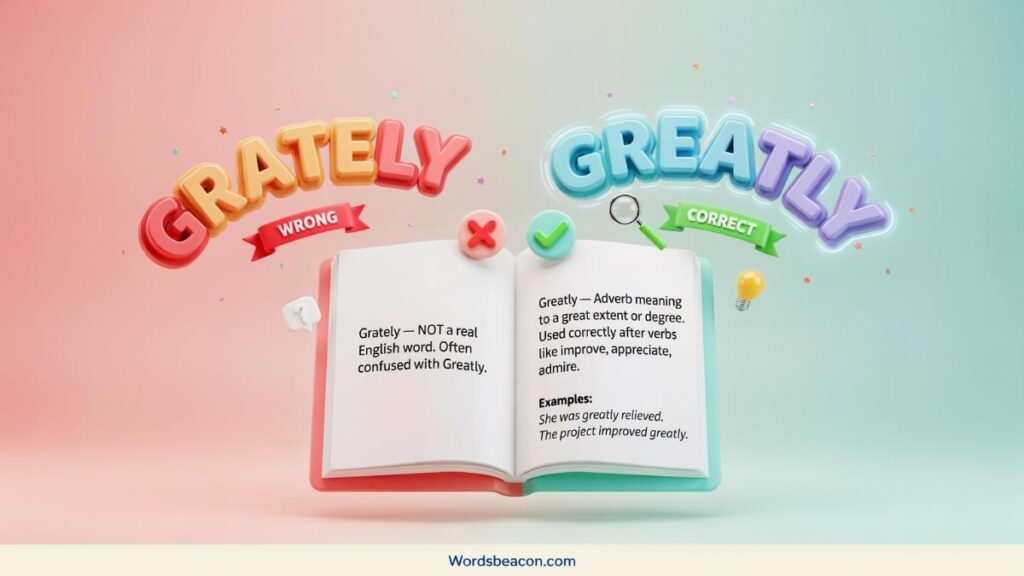
Choosing between grately vs greatly can be confusing because the words look almost identical. However, only one is correct in standard English: greatly. It means “very much” or “to a large extent,” as in “I greatly appreciate your help.” Grately, on the other hand, is a common spelling mistake. Think of it this way: one small spelling slip can turn a perfectly good sentence into a grammar hiccup! The good news is that the rule is simple. In this guide, you’ll learn the correct spelling, understand its meaning, explore easy examples, and discover how to avoid this mistake in your writing.
Quick Comparison table
| Feature | Greatly | Grately |
|---|---|---|
| Spelling | Correct standard spelling | Common misspelling |
| Meaning | To a large extent or degree | No standard adverb meaning in ordinary English |
| Part of speech | Adverb | Not a standard adverb |
| Word formation | Great + ly | Incorrect formation of greatly |
| Correct example | Your support greatly helped us. | Your support grately helped us. |
| Recommendation | Use in standard writing | Correct to greatly when that is the intended word |
Learn the difference between tricky more English words
Excel vs Accel Which Spelling Is Correct?
Quick Answer Greatly vs Grately?
Greatly is the correct spelling. Use it when you want to describe the extent, degree, or impact of an action, change, or feeling. Grately is not an accepted alternative spelling in standard English.
For example:
- Correct: I greatly appreciate your help.
- Incorrect: I grately appreciate your help.
- Correct: Her performance improved greatly.
- Incorrect: Her performance improved grately.
The difference comes down to spelling and standard usage. Greatly retains the complete word great before adding the suffix -ly. When writers omit or rearrange a letter, they often produce the incorrect form grately.
What Does Greatly Mean?
Greatly means to a large extent, degree, or amount. People use it to emphasize the strength of an effect, the size of a change, or the depth of a feeling.
For example, if a new system greatly improves productivity, it produces a substantial improvement. Similarly, when someone says, “I greatly appreciate your support,” the word emphasizes how much they value that support.
Greatly Definition and Meaning
The meaning of greatly depends on the sentence, but it usually expresses one of three related ideas:
- To a large extent: Something has a substantial effect or influence.
- Considerably: A change or difference is significant in size or degree.
- Very much: A feeling, such as appreciation or concern, is particularly strong.
Consider these examples:
- The new software greatly improved productivity.
- Her decision greatly influenced the final outcome.
- We greatly appreciate your patience.
- The results differed greatly from our expectations.
In each sentence, greatly emphasizes the degree or extent of something. However, the word doesn’t provide an exact measurement. If a report states that sales increased greatly, the reader understands that the increase was substantial, but the sentence doesn’t specify a percentage.
Greatly as a Part of Speech
Greatly functions as an adverb. Adverbs often modify verbs, adjectives, other adverbs, or entire clauses. In its common uses, greatly modifies verbs and expressions that describe a state or condition.
| Word | Part of speech | Example |
|---|---|---|
| Great | Adjective | She achieved great success. |
| Greatly | Adverb | She greatly improved her skills. |
| Grate | Verb | Please grate the cheese. |
| Grater | Noun | Put the grater in the drawer. |
| Grateful | Adjective | I am grateful for your help. |
The difference between great and greatly is especially important. An adjective describes a noun, while an adverb often explains how much an action or condition changes.
For example, “a great improvement” uses great to describe the noun improvement. In contrast, “the results improved greatly” uses greatly to describe the extent of the improvement.
Greatly Pronunciation
In standard American English, greatly is commonly pronounced /ˈɡreɪtli/. It has two syllables, with the stress on the first.
The word begins with the same sound as great, followed by the ending -ly. Although pronunciation can help you remember the word, it doesn’t always reveal every letter in English spelling. Therefore, learning the written form remains important.
Greatly in a Sentence
Greatly appears in everyday writing, professional communication, education, and research.
- Workplace: The updated process greatly increased efficiency.
- Education: Regular reading can greatly improve vocabulary.
- Personal relationships: I greatly value your friendship.
- Research: The discovery greatly influenced later studies.
- Customer service: Your feedback is greatly appreciated.
Notice how greatly emphasizes the extent of the action or feeling without changing the sentence’s basic meaning.
Learn how to use confusing more words correctly
Journeys vs journies Correct Spelling and usage ?
Is Grately a Word?
Grately is not the standard English adverb used to mean to a large extent or degree. In ordinary writing, it is generally a misspelling of greatly.
However, the spelling could appear as a company name, username, fictional name, or specialized term. Such uses depend on their particular context and don’t establish grately as an accepted alternative to greatly.
When you encounter grately in a sentence, consider what the writer intends to communicate. If the sentence expresses a substantial change, strong appreciation, or significant effect, greatly is probably the correct word.
Grately Meaning and Definition
Unlike greatly, grately has no established standard adverb meaning in ordinary English. Therefore, it shouldn’t be given a separate definition simply to explain the spelling error.
Consider this sentence:
“Your contribution is grately appreciated.”
The intended meaning is clear, but the spelling is incorrect. The corrected sentence reads:
“Your contribution is greatly appreciated.”
Readers may understand a misspelled word from its context, but that doesn’t make the spelling correct. In professional documents, school assignments, and published content, correcting the error helps maintain clarity and credibility.
Why Is Grately an Incorrect Spelling?
The confusion often begins when writers remember the sound or general appearance of greatly but forget its exact letter sequence.
The correct formation is:
great + ly = greatly
The base word great contains the letters G-R-E-A-T. Adding -ly produces G-R-E-A-T-L-Y. The original spelling remains intact.
Compare the two forms:
- Greatly: G-R-E-A-T-L-Y
- Grately: G-R-A-T-E-L-Y
The second form rearranges the letters rather than following the correct spelling of the base word. That’s why greatly is the correct choice.
Learn how to use confusing more words correctly
Drier vs Dryer Differences and Correct Usage ?
Greatly vs Grately Key Differences in Grammar and Spelling
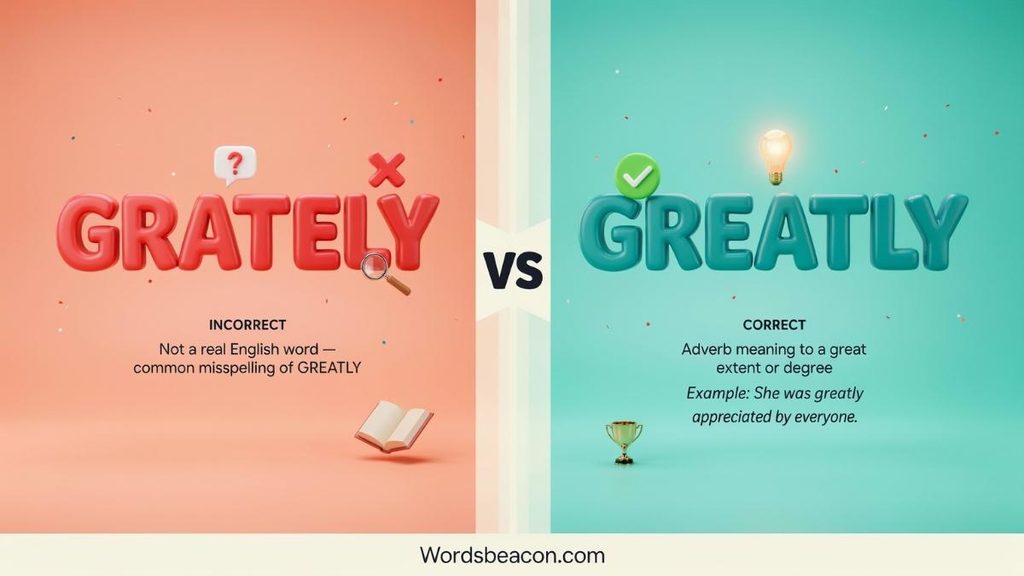
The difference between greatly and grately involves both spelling and grammatical usage. Greatly has a recognized meaning and grammatical function, while grately is generally an error when used in its place.
Greatly vs Grately Spelling
English often forms adverbs by adding -ly to adjectives. In this case, the process is straightforward: keep great intact and add the suffix.
| Base adjective | Correct adverb | Example |
|---|---|---|
| Great | Greatly | The decision greatly affected us. |
| Quick | Quickly | She quickly finished the task. |
| Careful | Carefully | He carefully checked the figures. |
| Slow | Slowly | The traffic moved slowly. |
These examples illustrate a common spelling pattern. However, English has exceptions, so you shouldn’t assume every adjective forms an adverb in exactly the same way.
Greatly vs Grately Grammar
Greatly commonly modifies verbs and participles that describe a condition or state.
For example:
- The weather greatly improved.
- We are greatly concerned about the delay.
- The team was greatly encouraged by the results.
In the first sentence, greatly modifies improved. And In the second, it emphasizes the degree of concern. In the third, it adds emphasis to the team’s state of encouragement.
By contrast, “The weather grately improved” contains a spelling error. The intended adverb is greatly.
Greatly vs Grate Understanding the Difference
Great and grate sound alike in standard American English, but they have different meanings.
- Great is an adjective meaning excellent, important, or considerable.
- Grate is a verb meaning to shred food or make a harsh scraping sound. It can also refer to a framework of bars.
- Grater is a tool used to shred food.
- Greatly is an adverb meaning to a large extent or degree.
Examples:
- That was a great idea.
- Please grate the cheese.
- The new design greatly improved the product.
- The metal grate covered the drain.
The similarity between great and grate can cause spelling confusion. Nevertheless, neither grate nor grately should replace greatly when you want to describe the degree of an action.
Great vs Greatly
Although great and greatly share the same root, they perform different grammatical jobs.
Use great to describe a person, object, quality, or result:
- She did a great job.
- They made great progress.
- The concert was great.
Use greatly to emphasize an action, effect, or degree:
- She greatly improved her skills.
- The policy greatly affected the community.
- We greatly appreciate the opportunity.
A useful rule is to check what the word modifies. If you need an adjective to describe a noun, great may fit. If you need an adverb to explain the extent of an action or condition, greatly may be the correct choice.
Fix common more word mistakes in English
Whiny vs Whiney Correct Spelling and How to Use Each
Greatly vs Grately Examples Correct and Incorrect Sentences
Examples make the spelling difference easier to recognize. In the following table, grately is incorrect whenever the writer intends the standard adverb greatly.
| Incorrect sentence | Correct sentence | Explanation |
|---|---|---|
| I grately appreciate your help. | I greatly appreciate your help. | Greatly emphasizes the strength of the appreciation. |
| Her performance improved grately. | Her performance improved greatly. | The adverb describes the extent of the improvement. |
| The delay grately affected our plans. | The delay greatly affected our plans. | Greatly emphasizes the delay’s substantial effect. |
| We are grately concerned about the issue. | We are greatly concerned about the issue. | Greatly modifies the degree of concern. |
| Sales have grately increased this year. | Sales have greatly increased this year. | The word emphasizes the size of the increase. |
| Your contribution is grately appreciated. | Your contribution is greatly appreciated. | Greatly is the standard spelling in this expression. |
Greatly Sentence Examples in Everyday Life
Greatly works naturally when discussing changes, feelings, results, or appreciation.
At work: “The new scheduling system greatly reduced administrative tasks.”
This sentence suggests a substantial reduction, although it doesn’t specify an exact percentage.
At school: “Studying the examples greatly improved my understanding of the topic.”
Here, greatly emphasizes how much the student’s understanding improved.
With friends and family: “I greatly appreciate everything you’ve done for me.”
The sentence expresses sincere gratitude without sounding overly formal.
In a report: “Customer satisfaction increased greatly after the company revised its support process.”
The adverb highlights the extent of the change without assigning a numerical value.
In an academic discussion: “The discovery greatly influenced later research.”
The sentence emphasizes the discovery’s significant influence.
A Practical Editing Example
Consider this email:
“Thank you for helping with the presentation. I grately appreciate the extra time you spent reviewing the slides.”
The message is understandable, but the misspelling distracts from the professional tone. Correcting one word produces a cleaner version:
“Thank you for helping with the presentation. I greatly appreciate the extra time you spent reviewing the slides.”
The correction preserves the original meaning while making the writing more polished. Small spelling errors may seem harmless, but reviewing them helps readers focus on the message instead of the mistake.
Fix common more word mistakes in English
Suing vs Sueing Which Spelling Is Correct?
Greatly Appreciated or Grately Appreciated?
The correct expression is greatly appreciated.
People commonly use this phrase to thank someone, acknowledge assistance, or show that a contribution matters. It appears in professional emails, workplace communication, customer service messages, and personal notes.
What Does Greatly Appreciated Mean?
Greatly appreciated means that something is valued or received with strong appreciation. The expression often appears in constructions such as is greatly appreciated or would be greatly appreciated.
Examples include:
- Your patience is greatly appreciated.
- Any additional information would be greatly appreciated.
- Your continued support is greatly appreciated.
- The team greatly appreciated your feedback.
The first three examples use a passive construction, while the final example uses the active verb phrase greatly appreciated. Both forms are grammatically correct.
Is It Correct to Say “I Greatly Appreciate Your Help”?
Yes. “I greatly appreciate your help” is grammatically correct and expresses sincere gratitude.
The sentence contains three main parts:
- I is the subject.
- Appreciate is the verb.
- Greatly is the adverb that emphasizes the degree of appreciation.
You can also express gratitude in other ways.
| Expression | Meaning and tone |
|---|---|
| I appreciate your help. | Direct and sincere |
| I greatly appreciate your help. | Emphasizes strong appreciation |
| I really appreciate your help. | Conversational and natural |
| I sincerely appreciate your help. | Emphasizes sincerity |
| I am deeply grateful for your help. | Expresses a strong feeling of gratitude |
Each expression works in a different context. Choose the one that best matches your intended tone.
Common Mistakes With Greatly Appreciated
Avoid these errors:
- Incorrect: Your help is grately appreciated.
- Correct: Your help is greatly appreciated.
- Incorrect: I am greatly appreciate your help.
- Correct: I greatly appreciate your help.
- Alternative: I am grateful for your help.
The second mistake involves grammar rather than spelling. After the subject I, use the verb phrase greatly appreciate instead of am greatly appreciate.
Accurate writing depends on both correct spelling and appropriate sentence structure.
Fix common more word mistakes in English
Nosy vs Nosey Which one Is Correct?
Greatly Synonyms and Alternative Words
Several words can replace greatly, but the best choice depends on the meaning you want to express. A synonym that works with one verb may sound awkward with another.
Significantly
Significantly emphasizes an important or substantial degree of change or effect.
Example: “The new procedure significantly reduced errors.”
This word works well in research, reports, and discussions involving measurable outcomes.
Considerably
Considerably indicates a noticeable or substantial amount.
Example: “Travel expenses increased considerably during the summer.”
It fits naturally when describing quantities, costs, differences, or changes.
Substantially
Substantially suggests a considerable amount or degree, often in formal or professional writing.
Example: “The company substantially expanded its operations.”
Use it when discussing major changes in size, scope, resources, or results.
Deeply
Deeply often emphasizes strong feelings, beliefs, or personal impact.
Example: “We are deeply grateful for your generosity.”
It works particularly well with gratitude, concern, regret, and emotional responses.
Extensively
Extensively emphasizes breadth, range, or a large amount of activity.
Example: “Researchers have extensively studied the issue.”
It is useful when discussing research, investigation, coverage, or detailed work.
Greatly Synonyms at a Glance
| Synonym | Best suited to | Example |
|---|---|---|
| Significantly | Important changes or effects | The results improved significantly. |
| Considerably | Substantial differences or amounts | The cost increased considerably. |
| Substantially | Major changes or developments | The project expanded substantially. |
| Deeply | Feelings and personal responses | I am deeply grateful. |
| Extensively | Broad or thorough activity | The subject has been extensively researched. |
| Dramatically | Striking or noticeable change | Performance improved dramatically. |
These alternatives can make your writing more precise. However, don’t replace greatly simply to avoid repetition. Choose a synonym only when it accurately communicates your intended meaning.
Understand confusing English more words simply
Conex vs Connex Which one Is actually Correct?
Greatly vs Very Which Word Should You Use?
Both greatly and very add emphasis, but their grammatical patterns differ.
Very commonly modifies adjectives and adverbs:
- The test was very difficult.
- She speaks very clearly.
- The room is very quiet.
Greatly more commonly modifies verbs, participles, and expressions of effect or degree:
- The test greatly challenged the students.
- Her skills improved greatly.
- We are greatly concerned about the results.
Some sentences allow a change in wording while preserving a similar meaning, but others require a different structure.
For example, “I greatly appreciate your help” sounds natural. “I very appreciate your help” does not. You could instead write “I really appreciate your help” or “I am very grateful for your help.”
The distinction involves grammar as well as meaning. Even when you know the correct spelling, you must choose a word that fits the sentence.
Greatly vs Grateful Don’t Confuse These Words
The Greatly and grateful look similar, but they serve different purposes.
Greatly is an adverb that describes degree or extent. Grateful is an adjective that means thankful or appreciative.
Compare these sentences:
- I greatly appreciate your support.
- I am grateful for your support.
Both express appreciation, but their grammar differs. In the first, greatly modifies the verb appreciate. In the second, grateful describes the speaker’s feeling.
Grateful vs Greatful
The correct spelling is grateful, not greatful.
Although grateful is associated with feeling thankful, its spelling doesn’t preserve the complete spelling of great. The words have different historical formations, so grateful follows its own established spelling.
| Word | Correct spelling? | Meaning |
|---|---|---|
| Greatly | Yes | To a large extent or degree |
| Grately | No, when intended as the standard adverb | Common misspelling of greatly |
| Grateful | Yes | Thankful or appreciative |
| Greatful | No, in standard English | Common misspelling of grateful |
| Gratefully | Yes | In a thankful or appreciative manner |
| Greatfully | No, in standard English | Common misspelling of gratefully |
Greatly vs Gratefully
Greatly and gratefully are both adverbs, but they don’t mean the same thing.
- “I greatly appreciate your help” emphasizes the strength of the appreciation.
- “I gratefully accepted the offer” explains that the person accepted it with gratitude.
You can also write, “I am grateful for your help.” In this sentence, grateful is an adjective, while gratefully is its adverbial form.
Understanding these distinctions helps prevent several common English spelling errors.
Understand confusing English more words simply
Bougie vs Boujee which one is correct?
Why Do People Spell Greatly Incorrectly?
People often confuse greatly and grately because the incorrect form resembles the correct one. Fast typing, imperfect recall, and confusion about word formation can all contribute to the mistake.
Typing Too Quickly
When typing an email or message, a writer may omit or rearrange a letter without noticing. Because grately looks similar to greatly, the error may survive a quick review.
Remembering the Sound Instead of the Spelling
English includes words that sound alike but have different spellings. Great and grate are familiar examples. Since they sound alike in standard American English, writers sometimes mix up their letter patterns.
However, greatly and grately are not two accepted spellings of the same adverb. One is the standard form, while the other is generally a misspelling.
Applying a Spelling Pattern Incorrectly
Writers may remember that adverbs often end in -ly but fail to preserve the complete root word. In this case, the correct method is simple: start with great and add -ly.
Trusting Spell-Check Too Much
A grammar checker can catch many errors, but it shouldn’t replace proofreading. Different tools use different dictionaries, settings, and correction methods.
For important writing, review the sentence yourself and check whether the word fits both the meaning and the grammar.
Understand confusing English more words simply
Immerse vs Emerse Which one Is Correct?
How to Remember the Correct Spelling of Greatly
A simple memory trick can help you avoid the grately spelling mistake.
Keep the Word Great Intact
Think of the word as two parts:
GREAT + LY = GREATLY
The base word great stays exactly the same. Add the suffix -ly, and the correct adverb appears.
Practice With Familiar Expressions
Remember a few common phrases:
- Greatly appreciated
- Greatly improved
- Greatly influenced
- Greatly concerned
- Greatly reduced
These expressions appear in everyday and professional writing, so practicing them helps reinforce the correct spelling.
Use a Quick Proofreading Test
When you see grately in a draft, ask yourself: “Am I trying to say ‘to a large extent’?”
If the answer is yes, use greatly.
For example:
- Incorrect: The changes grately improved the process.
- Correct: The changes greatly improved the process.
This meaning-based test helps you catch the error without memorizing a complicated spelling rule.
Common Spelling Mistakes Related to Greatly
The confusion between greatly and grately belongs to a broader group of spelling mistakes involving similar-looking or similar-sounding words.
Here are several distinctions worth remembering:
- Great vs grate: Great means excellent or considerable; grate can mean to shred food.
- Greatly vs grately: Greatly is the correct standard adverb.
- Grateful vs greatful: Grateful is the correct spelling for being thankful.
- Gratefully vs greatfully: Gratefully is the correct adverb meaning in a thankful manner.
- Greatly vs gratefully: Greatly emphasizes degree; gratefully emphasizes gratitude.
These pairs demonstrate why spelling by sound alone can be unreliable. English spelling reflects word history, established conventions, and patterns that sometimes include exceptions.
A spelling checker can help, but understanding the words makes it easier to catch mistakes that software may overlook.
Understand confusing English more words simply
Flier vs Flyer difference and usage ?
practice session Grately vs Greatly
Choose the correct word, Grately vs Greatly to complete each sentence. Remember, “greatly” is the standard spelling when you mean “to a large degree” or “very much.”
1. I would be ______ appreciative if you could help me with this project.
2. Her confidence has ______ improved since she started public speaking.
3. We are ______ indebted to everyone who supported our team.
4. The new policy has ______ benefited small businesses.
5. Your kind words are ______ appreciated by the entire staff.
6. The teacher was ______ impressed by the students’ creative ideas.
7. Regular exercise can ______ improve your physical and mental health.
8. I am ______ concerned about the safety of the children.
9. The company has ______ expanded its operations over the past year.
10. Your feedback has ______ helped us improve our services.
11. The discovery ______ changed scientists’ understanding of the subject.
12. She was ______ disappointed when the event was canceled.
13. The new software has ______ reduced the time needed to complete the task.
14. We ______ value your honesty and cooperation.
15. His writing skills have ______ developed through consistent practice.
16. The charity’s work has ______ benefited families in need.
17. I would be ______ grateful if you sent me the details today.
18. The decision will ______ affect the future of the organization.
19. The manager was ______ pleased with the team’s performance.
20. Your contribution has ______ influenced the success of this project.
Answers
- Greatly
- Greatly
- Greatly
- Greatly
- Greatly
- Greatly
- Greatly
- Greatly
- Greatly
- Greatly
- Greatly
- Greatly
- Greatly
- Greatly
- Greatly
- Greatly
- Greatly
- Greatly
- Greatly
- Greatly
Here’s a trusted source for clear word meanings:
FAQs
Is it grately vs greatly?
“Greatly” is the correct standard spelling. In the grately vs greatly comparison, remember that “greatly” means very much or to a large extent, while “grately” is generally a misspelling.
How do you use “greatly” in a sentence?
Use “greatly” to describe the degree of an action or change. For example, “The new training program greatly improved employee performance.”
Is “greatly appreciated” correct English?
Yes, “greatly appreciated” is grammatically correct and expresses sincere thanks. For example, “Your support is greatly appreciated.”
What is the difference between “grately vs greatly?
“Great” is an adjective that describes a noun, while “greatly” is an adverb that describes the extent of an action. For example, “She is a great teacher” and “She greatly influenced her students.”
Can “greatly” be used in a negative sentence?
Yes. “Greatly” can describe an undesirable effect as well as a positive one. For example, “The unexpected delay greatly affected our plans.”
What is the difference between “greatly” and “significantly”?
Both words can mean “to a large extent.” However, “significantly” often suits academic or technical writing, especially when discussing meaningful changes or statistical results. “Greatly” works well in general and professional writing.
Is “greatly” too formal for everyday writing?
Not at all. “Greatly” works in casual and formal contexts, although “a lot” or “very much” may sound more conversational. Choose the expression that best matches your tone.
What words can replace “greatly” in a sentence?
Depending on the context, you can use “considerably,” “substantially,” “immensely,” or “significantly.” For example, “The changes greatly reduced costs” could become “The changes substantially reduced costs.”
Why is “grately” a common spelling mistake?
Writers may accidentally alter the spelling when adding the “-ly” ending to “great.” The easiest way to avoid this error is to keep “great” intact and add “ly” to form “greatly.”
How can I remember the correct spelling in grately vs greatly?
Use this simple rule: great + ly = greatly. You don’t need to remove or change any letters. Remembering this pattern makes the grately vs greatly distinction easier to recognize.
Can “greatly” describe emotions or personal feelings?
Yes. “Greatly” can emphasize the intensity of a feeling or reaction. For example, “We were greatly relieved when the missing documents were found.”
Is “greatly” suitable for academic and professional writing?
Yes. “Greatly” is appropriate for essays, reports, business emails, and research discussions when it accurately describes the degree of an effect or change. In the grately vs greatly debate, using the standard spelling helps keep your writing clear and professional.
What is the easiest way to avoid the grately vs greatly spelling error?
Proofread the word by checking its base: “great.” Add “ly” without changing the original spelling. If you mean “very much” or “to a large extent,” choose “greatly,” not “grately.”
Conclusion
Choosing between grately vs greatly is easier than it looks. When comparing grately vs greatly, remember that the correct spelling is always greatly when you mean “very much” or “to a large extent.” For example, “I greatly appreciate your help” is correct, while “I grately appreciate your help” contains a spelling mistake. The confusion happens because the two spellings look similar, but only greatly is the standard English adverb. Here’s a simple trick to remember it: start with great and add ly to make greatly. No extra letters, no spelling drama! Keep this rule in mind to avoid mistakes in emails, schoolwork, and everyday writing. After all, grammar doesn’t have to be complicated when one simple tip clears up the confusion.

Luna AJS is an experienced blogger and dedicated language enthusiast at Words Beacon. She specializes in making English grammar, spelling, vocabulary and commonly confused words easy to understand. She provides clear explanations, practical examples to help readers write with confidence.