
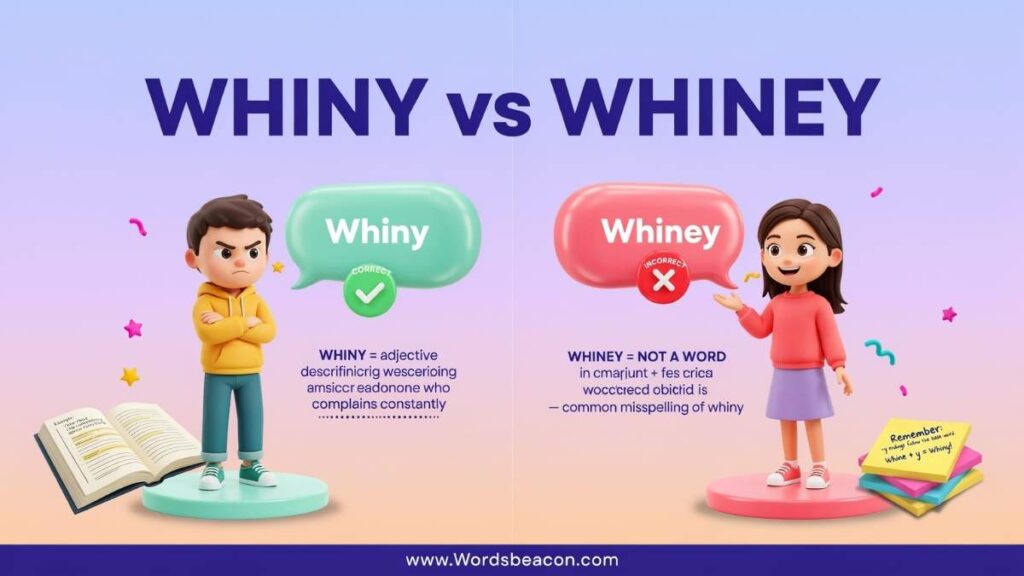
The difference between whiny vs whiney is easy to miss, especially when both spellings look right. So, which one should you use? “Whiny” is the preferred spelling in standard writing, while “whiney” is a less common alternative. Both describe someone who complains a lot or speaks in a high-pitched, complaining tone. To make things a little trickier, there’s also “whinny,” which refers to the sound a horse makes. Don’t worry, though! Understanding the meaning, spelling, and usage of each word will help you avoid common mistakes and choose the right word with confidence.
Quick Comparison
| Feature | Whiny | Whiney |
|---|---|---|
| Spelling | Preferred standard spelling | Less common variant |
| Meaning | Complaining or characterized by a whine | Generally the same meaning |
| Part of speech | Adjective | Adjective when used as a variant |
| Pronunciation | Usually pronounced the same as whiney | Usually pronounced the same as whiny |
| American English | Recommended | Less preferred |
| British English | Recommended for general writing | Less common |
| Formal writing | Preferred choice | Usually avoid |
| Example | The child sounded whiny. | The child sounded whiney. |
The simplest rule is to use whiny unless a specific source or style guide requires the alternative spelling. Once you remember this distinction, you can write confidently without changing the meaning of your sentence.
Learn how to use confusing more words correctly
Suing vs Sueing Which Spelling Is Correct?
Is It Whiny vs Whiney?
Whiny is the preferred spelling in standard English. It describes someone who complains repeatedly or speaks in a high-pitched, irritating, or drawn-out voice.
The word comes from the verb whine, which means to complain in a particular tone or make a long, unpleasant sound. When English speakers form the adjective by adding the suffix -y, the standard spelling drops the final e.
Consider these examples:
- Preferred spelling: The toddler became whiny after skipping his nap.
- Less common variant: The toddler became whiney after skipping his nap.
Both sentences communicate the same idea. However, the first follows the preferred spelling convention.
Is Whiney a Real Word?
Yes, whiney appears in actual English usage and is recognized as an alternative spelling in some dictionaries. However, that doesn’t mean both spellings have equal standing in standard edited writing.
English includes many spelling variations. Some become widely accepted alternatives, while others remain less common. A spelling can appear in published material or informal messages without becoming the preferred choice for general writing.
For example, you might encounter whiney in a social media post or an informal conversation. Nevertheless, when writing an article, school assignment, or professional email, whiny remains the safer option.
Is Whiny the Correct Spelling in American English?
Yes. Whiny is the recommended spelling in American English, and it also works well in British English and other varieties of English.
Unlike color and colour, the difference between whiny vs whiney does not represent a standard American-versus-British spelling distinction. You don’t need to change the spelling based on your audience’s location.
Whether you’re writing for readers in the United States, the United Kingdom, Canada, or Australia, whiny is the preferred general choice.
How Do You Spell Whiny Correctly?
The spelling becomes easier when you break the word into its parts:
- Base word: whine
- Suffix: -y
- Preferred adjective: whiny
The final e disappears before the suffix. A similar pattern appears in shine and shiny.
Remembering this connection can help you avoid adding an unnecessary e. When you need the adjective that describes someone who complains frequently, choose whiny.
Learn the difference between tricky more English words
Nosy vs Nosey Which one Is Correct?
What Does Whiny Mean?
Whiny is an adjective that describes frequent complaining or a voice that sounds unhappy, high-pitched, and irritating. The word often carries a negative tone because it suggests that someone’s complaints have become excessive or unpleasant.
Imagine a child asking for another cookie. The first request sounds ordinary. After several refusals, however, the child begins stretching out every word and repeating the same complaint. A parent might describe that behavior as whiny.
The adjective can also describe a sound rather than a person’s attitude. For instance, an old motor might produce a thin, high-pitched noise that someone calls whiny.
Whiny Definition and Examples
The whiny definition centers on a person, voice, behavior, or sound associated with whining.
Here are examples that show how the word works in different contexts:
- Person: The whiny customer complained about every small delay.
- Voice: He answered in a whiny voice when his mother said no.
- Behavior: Her whiny behavior made the long car ride more stressful.
- Sound: The old fan produced a whiny noise whenever it started.
- Fictional character: The author portrayed the villain as a whiny, self-centered character.
Notice how the meaning changes slightly with the context. When you describe a person, you may criticize their repeated complaints. When you describe a voice, you’re focusing on its sound.
What Does Whiny Person Mean?
A whiny person is someone who seems to complain repeatedly, often in a way that others find irritating. The description may refer to a temporary reaction or a more persistent habit.
For example, saying “He’s being whiny today” suggests that the behavior may be temporary. In contrast, saying “He’s always whiny” suggests a recurring pattern.
The distinction matters because one complaint doesn’t automatically make someone a whiny person. Someone may have a legitimate reason to express frustration, even if another person dislikes the way they communicate it.
The word can also dismiss a valid concern. If a colleague raises a serious workplace issue and someone labels the colleague whiny, the criticism may shift attention away from the actual problem.
What Does Whiny Girl Mean?
The expression whiny girl describes a girl who complains frequently or speaks in a high-pitched, complaining voice. The exact meaning depends on the situation and the speaker’s intention.
Consider these examples:
- The little girl became whiny when she got tired.
- The story portrays a whiny girl who complains whenever things don’t go her way.
- Don’t be such a whiny girl.
The first sentence describes temporary behavior. The second characterizes a fictional person. The third sounds more critical and may come across as dismissive.
The expression can also carry an unfair gender-based judgment when someone uses it to suggest that girls shouldn’t express frustration or sadness. In such cases, words like tired, upset, disappointed, or frustrated may describe the situation more accurately.
What Does Whiny Voice Mean?
A whiny voice sounds like a complaint. It often features a drawn-out, high-pitched, nasal, or plaintive tone.
For example, a child might say, “But I don’t want to go!” while stretching out the words. A writer could describe that delivery as whiny because it conveys frustration through the sound of the voice.
However, a high-pitched voice isn’t automatically whiny. Pitch describes how high or low a voice sounds, while whiny adds a judgment about its quality or emotional effect.
What Does Whiney Mean?
Whiney generally carries the same meaning as whiny. Writers who use this alternative spelling usually intend to describe persistent complaining, a fretful attitude, or an irritating vocal tone.
Some dictionaries recognize whiney as a spelling variant. Nevertheless, whiny remains the preferred choice for general writing.
The important distinction is between a spelling’s recognition and its recommendation. A dictionary may record an alternative form without making it the best choice for every situation.
Whiney Meaning With Examples
The whiney meaning generally matches the meaning of whiny. Both forms can describe someone who complains frequently or speaks in a way that sounds irritating.
Consider these examples:
- The puppy sounded whiney when it wanted attention.
- His whiney response annoyed his teammates.
- The character’s whiney complaints slowed the scene.
For standard edited writing, replace whiney with whiny:
- The puppy sounded whiny when it wanted attention.
- His whiny response annoyed his teammates.
- The character’s whiny complaints slowed the scene.
The meaning remains the same. Only the spelling changes.
Is Whiney Considered a Misspelling?
The answer requires some nuance. Whiney appears as an alternative spelling in some dictionaries, so it isn’t accurate to claim that every use is automatically invalid. However, whiny is the more widely preferred choice for standard writing.
Think of it this way: recognizing a spelling variant doesn’t mean recommending it as the first choice.
When editing an article, assignment, or business document, use whiny unless you need to preserve the spelling in a quotation, name, or original text.
Learn how to use confusing more words correctly
Signer vs Signor Differences and Usage ?
Whiny vs Whiney Key Differences
The main difference between whiny vs whiney is spelling preference. The two forms generally share the same meaning, grammatical function, and pronunciation.
| Comparison point | Whiny | Whiney |
|---|---|---|
| Main meaning | Complaining or characterized by whining | Generally the same |
| Spelling | Preferred form | Alternative form |
| Grammar | Adjective | Adjective when used in this sense |
| Pronunciation | Usually /ˈwaɪni/ | Usually the same |
| Best choice for edited writing | Yes | Usually not |
| Meaning changes? | No meaningful distinction in ordinary use | No meaningful distinction in ordinary use |
Spelling Difference
The standard spelling is whiny. The less common variant is whiney.
The adjective comes from whine with the suffix -y. In the preferred form, the final e drops before the suffix.
Compare these words:
| Base word | Preferred adjective |
|---|---|
| Whine | Whiny |
| Shine | Shiny |
| Ice | Icy |
| Noise | Noisy |
These examples show a useful spelling pattern, although English has exceptions. The best approach is to learn familiar word forms rather than assume every word follows precisely the same rule.
Meaning Difference
There is generally no separate definition that distinguishes whiny from whiney. When writers use whiney as a variant, they usually intend the same meaning.
For example, a whiny response and a whiney response generally convey the same criticism. The spelling doesn’t make one response more irritating than the other.
Grammar Difference
Both forms function as adjectives when they describe a person, voice, behavior, or sound.
An adjective can appear before a noun:
- A whiny child.
- A whiny complaint.
- A whiny voice.
It can also follow a linking verb:
- The child seems whiny.
- His voice sounds whiny.
- The complaint became whiny.
For standard spelling, use whiny in each example.
Tone and Context Difference
When comparing whiny vs whiney, neither spelling inherently creates a different tone. The word itself often conveys criticism, while the situation determines how harsh that criticism sounds. Understanding the whiny vs whiney difference helps you choose the right spelling without confusing meaning and tone.
Compare these examples:
- The toddler sounds whiny because she’s exhausted.
- The employee gave a whiny response to reasonable feedback.
The first sentence offers a possible explanation for temporary behavior. The second judges someone’s reaction in a workplace setting.
In both cases, whiny may sound dismissive. If you want a more neutral description, consider upset, frustrated, or dissatisfied. Knowing how to use whiny vs whiney correctly also helps you keep your writing clear, natural, and appropriate for the situation.
Learn the difference between tricky more English words
Conex vs Connex Which one Is actually Correct?
Examples of Whiny in Sentences
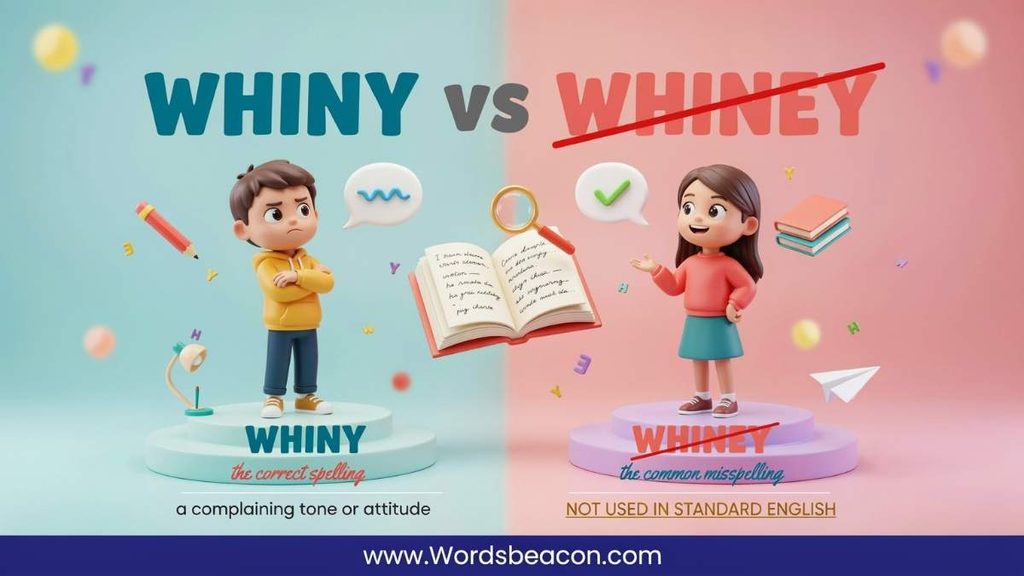
Sentence examples make the meaning easier to understand. They also show how the adjective works in everyday conversation, creative writing, and professional communication.
Whiny in Everyday Conversation
People often use whiny in casual conversations to describe repeated complaints or an irritating tone.
- My brother gets whiny whenever he loses a video game.
- The kids were tired and whiny after the long drive.
- Please stop using that whiny voice and tell me what happened.
- The puppy made a whiny noise when we left the room.
- She sounded whiny because she hadn’t slept well.
- His whiny complaints continued throughout the movie.
These examples show that the word can describe behavior, a voice, or a sound. Depending on the relationship between speakers, it may sound playful or insulting.
Whiny in Professional and Academic Writing
In formal writing, whiny is grammatically acceptable, but it may not always be the most precise choice. Because the word carries a judgment, consider whether you want to criticize someone’s tone or describe an observable behavior.
| Less neutral wording | More precise alternative |
|---|---|
| The employee sounded whiny during the meeting. | The employee repeatedly expressed frustration with the decision. |
| The report contains whiny complaints. | The report contains repeated complaints about the process. |
| The character is whiny throughout the novel. | The character repeatedly expresses dissatisfaction with the circumstances. |
| The customer became whiny about the delay. | The customer voiced frustration about the delay. |
The alternative isn’t always better. In literary analysis, whiny may accurately describe how an author presents a character. The key is to choose language that matches your purpose.
A Practical Example Choosing the Right Word
Imagine a manager receives two messages from employees about a delayed project.
Employee A writes:
“The deadline has moved three times, and we still haven’t received the files needed to finish the work.”
Employee B writes:
“This is ridiculous! Nothing ever works around here, and nobody cares!”
A colleague might call Employee B whiny because the message sounds emotional and sweeping. However, Employee A also raises a concern, and the facts may justify that concern.
The lesson is simple: whiny describes how a complaint comes across, not whether the complaint is valid. Good writing distinguishes between someone’s tone and the facts behind their concern.
Whiny in Creative Writing
Writers can use whiny to establish a character’s personality, reveal tension, or shape a reader’s impression.
For example:
“The game is never fair!” Max said in a whiny voice, folding his arms.
The adjective helps readers imagine Max’s delivery without requiring a lengthy explanation. However, repeating whiny in every paragraph can make the writing feel repetitive. Once readers understand the character’s behavior, dialogue and actions can communicate the same quality.
Fix common more word mistakes in English
Bougie vs Boujee which one is correct?
Whiny vs Whinny What’s the Difference?
The Whiny and whinny look similar, but they have different meanings.
Whiny describes complaining behavior or a voice that sounds like a complaint. Whinny refers to a horse’s characteristic sound, usually a soft or high-pitched neigh.
| Word | Part of speech | Meaning | Example |
|---|---|---|---|
| Whiny | Adjective | Complaining or having a complaining tone | The child sounded whiny. |
| Whiney | Adjective, as a variant | Same general meaning as whiny | His whiney tone was distracting. |
| Whinny | Noun or verb | A horse’s soft neigh or the act of making that sound | The horse gave a quiet whinny. |
| Whine | Noun or verb | A complaining sound or the act of complaining | He began to whine about the rules. |
What Does Whinny Mean for Horses?
A whinny is a sound a horse makes to communicate with other horses or respond to its surroundings. The word functions as both a noun and a verb.
Examples include:
- The mare gave a gentle whinny when her foal approached.
- We heard the horse whinny from the stable.
- The horses began whinnying when the rider arrived.
The words also differ in pronunciation. Whiny is generally pronounced /ˈwaɪni/, while whinny is generally pronounced /ˈwɪni/. The vowel sound changes, so the words don’t sound identical.
Whiny vs Whinny in a Sentence
These examples make the distinction clear:
- The whiny child complained about the cold weather.
- The horse gave a whinny when it heard the stable door open.
- The child began to whine about leaving the playground.
- The horse continued to whinny as the other horses approached.
Remember the distinction: a person can sound whiny, but a horse can whinny.
Fix common more word mistakes in English
Immerse vs Emerse Which one Is Correct?
Whining vs Whiny Understanding the Grammar
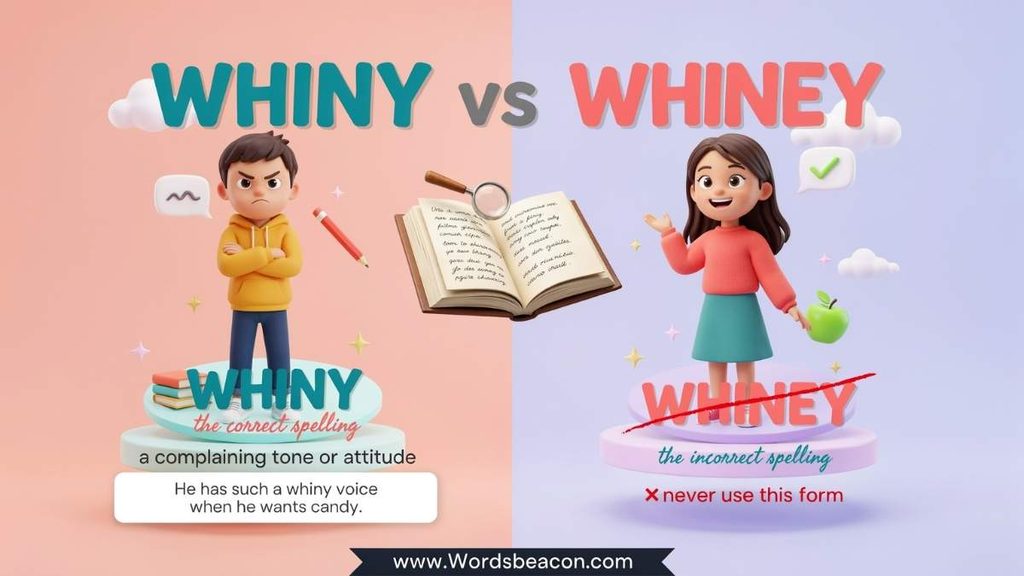
The Whining and whiny are related because both come from the verb whine. However, they perform different grammatical roles.
Whining is the present participle of whine and can also function as a gerund, a verb form used as a noun. Whiny is an adjective that describes a quality or characteristic.
Whine, Whined, Whining, and Whiny
| Word | Grammatical role | Example |
|---|---|---|
| Whine | Base verb or noun | Don’t whine about the rules. |
| Whined | Simple past or past participle | She whined about the homework. |
| Whining | Present participle or gerund | He is whining again. |
| Whiny | Adjective | He has a whiny tone. |
The forms whined and whining describe actions or participate in verb constructions. Whiny describes a quality.
Compare these sentences:
- The child is whining. This describes what the child is doing.
- The child is whiny. This describes the child’s behavior or manner.
- The child whined about dinner. This reports a past action.
The distinction may seem small, but choosing the correct form makes your writing clearer.
Comparative and Superlative Forms of Whiny
Like many adjectives, whiny has comparative and superlative forms:
- Whinier: more whiny than someone or something else.
- Whiniest: the most whiny in a group or comparison.
For example:
- My youngest cousin gets whinier when he’s tired.
- Of the three characters, the youngest one is the whiniest.
- The dog’s whining became more noticeable as the room grew quiet.
The preferred forms are whinier and whiniest, not whineyer and whineyest.
Fix common more word mistakes in English
Flier vs Flyer difference and usage ?
Synonyms for Whiny
Sometimes whiny is the right word. At other times, a more specific adjective can make your writing clearer and less judgmental.
The best synonym depends on what you want to describe: repeated complaining, irritability, an unpleasant voice, or general dissatisfaction.
Synonyms for Whiny Behavior
| Synonym | Meaning or emphasis | Example |
|---|---|---|
| Complaining | Expressing dissatisfaction | He spent the afternoon complaining about the schedule. |
| Petulant | Irritably upset, often over a small issue | She gave a petulant response to the suggestion. |
| Peevish | Easily annoyed or irritated | He became peevish after waiting for an hour. |
| Grumbling | Complaining in a low or muttered way | They were grumbling about the extra work. |
| Fretful | Worried, restless, or easily upset | The fretful child struggled to settle down. |
| Querulous | Habitually complaining in an irritated manner | His querulous remarks frustrated the group. |
| Discontented | Unhappy or dissatisfied with a situation | The discontented team requested better working conditions. |
| Irritable | Easily annoyed | She felt irritable after a sleepless night. |
These words aren’t interchangeable in every sentence. Fretful, for instance, often suggests worry or restlessness, while petulant emphasizes childish irritation. Choose the word that expresses the meaning you intend.
Synonyms for a Whiny Voice
When the issue is how someone sounds, consider these alternatives:
- High-pitched: describes a voice with a relatively high pitch.
- Nasal: describes a voice with a strong nasal quality.
- Plaintive: expresses sadness, longing, or a sense of suffering.
- Mewling: suggests a weak, small, complaining cry.
- Wheedling: describes speech intended to persuade or coax, often through an ingratiating tone.
For example, a plaintive voice may sound sad without necessarily being irritating. A nasal voice describes a vocal quality without implying that the person complains. These distinctions make the alternatives useful when whiny feels too broad.
Antonyms for Whiny
There isn’t one perfect opposite of whiny. The best antonym depends on the contrast you want to make.
Possible choices include:
- Contented: satisfied with a situation.
- Cheerful: noticeably happy or positive.
- Calm: not agitated or upset.
- Composed: in control of one’s emotions.
- Resilient: able to recover from difficulties.
- Good-humored: cheerful and easygoing.
For example, “The child was contented after lunch” contrasts with “The child was whiny before lunch.” However, resilient describes the ability to handle difficulty rather than simply the opposite of complaining.
Understand confusing English more words simply
Reins vs Reigns which spelling is correct ?
Common Whiny vs Whiney Spelling Mistakes

Even a small spelling difference can distract readers. Fortunately, once you understand the preferred form, most mistakes are easy to fix.
Adding an Unnecessary E
The most common mistake is writing whiney when you intend to use the preferred spelling.
Less preferred: The baby became whiney.
Preferred: The baby became whiny.
Although some dictionaries recognize whiney as a variant, whiny is the more reliable choice when you want to follow standard writing conventions.
Confusing Whiny With Whining
These words are related, but they aren’t interchangeable.
- Incorrect: He is very whining today.
- Correct: He is very whiny today.
- Also correct: He is whining today.
The first sentence uses whining where the adjective whiny would normally fit. The other sentences use the words according to their grammatical roles.
Using Whiny When You Mean Upset
A person can feel upset without behaving whinily. Calling someone whiny may suggest that their complaints are irritating or excessive.
For example:
- She was upset about the canceled trip describes an emotion.
- She was whiny about the canceled trip adds a negative judgment about how she expressed that emotion.
The distinction matters in personal conversations, professional feedback, and creative writing. Choose the word that best represents the behavior you want to describe.
Trusting Spell-Check Without Checking Context
Spell-checking tools can help you catch mistakes, but they don’t always explain why one spelling is preferable. Some tools may accept both forms because whiney appears as a variant.
When in doubt, consult a reliable dictionary or grammar reference. Dictionaries such as Merriam-Webster and Cambridge help clarify definitions and usage, while editing resources such as Grammarly and Wordvice offer guidance on grammar and sentence structure.
Understand confusing English more words simply
Cancelation vs Cancellation Which Spelling Is Correct?
practice session Whiny vs Whiney
Choose the correct word from “Whiny vs Whiney,” “whinny,” “whine,” “whined,” or “whining,” depending on the context.
1. The child became ______ when his parents refused to buy him a new toy.
2. The horse let out a gentle ______ as its owner approached the stable.
3. Please stop trying to ______ about every little problem.
4. She has a ______ voice that makes her complaints sound even more irritating.
5. The customer ______ about the long wait at the restaurant.
6. His constant ______ about homework frustrated his older sister.
7. The teacher asked the students not to use a ______ tone when discussing their grades.
8. The horse gave a cheerful ______ when it recognized its rider.
9. Instead of offering solutions, Mark continued to ______ about the difficult assignment.
10. The little boy sounded ______ because he was tired and hungry.
11. She spent the entire afternoon ______ about the hot weather.
12. The manager listened patiently while the employee ______ about the unfair schedule.
13. A horse’s ______ is different from a person’s complaint or expression of dissatisfaction.
14. The coach told the players to remain positive instead of becoming ______ after losing the match.
15. Although “______” sometimes appears as an alternative spelling, “whiny” is generally preferred in standard writing.
16. Stop ______ and tell me what is actually bothering you.
17. The child gave a soft ______ when he saw his mother enter the room.
18. His ______ attitude made it difficult for his friends to enjoy the trip.
19. They were tired of hearing him ______ about the same issue every day.
20. The puppy made a high-pitched, ______ sound as it waited for its food.
Answers
- Whiny
- Whinny
- Whine
- Whiny
- Whined
- Whining
- Whiny
- Whinny
- Whine
- Whiny
- Whining
- Whined
- Whinny
- Whiny
- Whiney
- Whining
- Whinny
- Whiny
- Whine
- Whiny
Here’s a trusted source for clear word meanings:
FAQs
Is “whiny” the correct spelling in American English?
Yes. “Whiny” is the standard and preferred spelling in American English. It describes someone who complains frequently or speaks in a high-pitched, pleading tone. “Whiney” is also used as a variant, but “whiny” is the better choice for standard writing.
Can you use “whiney” in formal writing?
Although “whiney” appears as an alternative spelling, “whiny” is generally preferred in formal and professional writing. Use “whiny” in articles, essays, and business documents to follow the more widely accepted spelling.
Does “whiny” describe a person’s voice or behavior?
“Whiny” can describe both a person’s behavior and the way they speak. A whiny person may complain repeatedly, while a whiny voice sounds drawn out, pleading, or irritating. For example, “He used a whiny voice to ask for another cookie.”
What does it mean when someone calls you whiny?
Calling someone “whiny” usually means the person thinks you complain too often or express dissatisfaction in an irritating way. The word often sounds critical or dismissive, especially during a disagreement.
Is “whiny” always an insult?
No. Although “whiny” often has a negative meaning, people sometimes use it humorously or to describe fictional characters. However, calling someone whiny during a serious conversation can make them feel that their concerns aren’t being taken seriously.
How can you describe someone who complains without sounding rude?
Use a more neutral expression that focuses on the person’s concerns rather than criticizing their personality. Depending on the context, you could say “frustrated,” “dissatisfied,” “concerned,” or “vocal about their concerns.” For example, instead of saying, “She’s whiny,” write, “She’s frustrated with the current schedule.”
What is the difference between a whiny voice and a nasal voice?
A whiny voice sounds pleading, complaining, or drawn out. A nasal voice has a noticeable resonance through the nose. Someone can have a nasal voice without sounding whiny, and a whiny voice doesn’t have to sound nasal.
Can “whiny” describe writing or messages?
Yes. “Whiny” can describe emails, comments, or messages that focus heavily on complaints. For example, “The email sounded whiny because it listed every inconvenience without suggesting a solution.” In professional writing, more neutral descriptions may communicate the point more effectively.
Is “whiny” appropriate for workplace communication?
Usually, it’s better to avoid calling a colleague or employee “whiny” because the word can sound personal and judgmental. Instead, describe the specific behavior with phrases such as “repeatedly raises concerns,” “expresses frequent dissatisfaction,” or “focuses on problems rather than solutions.”
What is the difference between “whiny” and “complaining”?
“Whiny” describes a tone or behavior associated with repeated complaints, while “complaining” means expressing dissatisfaction. Someone can complain about a legitimate problem without sounding whiny. The distinction often depends on the person’s tone, the context, and how they express their concerns.
Can “whiny” describe an adult?
Yes. “Whiny” can describe a person of any age. When used about an adult, it typically suggests that the person complains repeatedly or expresses frustration in a petulant or pleading manner. However, the word may sound insulting when directed at someone personally.
What is the difference between “Whiny vs Whiney”?
“Whiny” describes someone or something that sounds complaining or expresses frequent dissatisfaction. “Whinny” refers to the characteristic sound made by a horse and can function as either a noun or a verb. For example, “The whiny child complained about the wait” and “The horse gave a whinny.”
What does “stop being whiny” mean?
“Stop being whiny” means stop complaining repeatedly or using a tone the speaker considers irritating or childish. The expression can sound harsh. A more constructive alternative is “Let’s focus on how we can solve the problem.”
Is “whiny” an adjective or a noun?
“Whiny” is an adjective because it describes a person, voice, attitude, or behavior. For example, “The child sounded whiny.” The related word “whine” can function as both a verb and a noun, as in “Please don’t whine” and “I heard a whine.”
What words rhyme with “whiny”?
Words that rhyme with “whiny” include “shiny,” “tiny,” and “spiny.” They share a similar ending sound but have different meanings. For example, “shiny” describes something that reflects light, while “whiny” describes a complaining or pleading quality.
What words can replace “whiny” in a sentence?
The best alternative depends on the meaning. “Petulant” emphasizes childish irritation, “complaining” describes repeated expressions of dissatisfaction, “plaintive” suggests a sad or pleading tone, and “irritable” describes someone who becomes annoyed easily. Choosing a precise alternative can make your writing clearer and less judgmental.
Can “whiny” describe an animal’s sound?
Yes. Writers can use “whiny” to describe an animal’s high-pitched or pleading-sounding noise. However, “whinny” specifically refers to the characteristic sound of a horse. The words are similar in appearance, but their meanings differ.
How can you remember the correct spelling of “whiny”?
Remember that “whiny” comes from “whine” with the ending “-y.” Although “whiney” appears as an alternative spelling, “whiny” is the preferred form in standard writing. When you’re unsure, choose “whiny” for the clearest and most widely accepted spelling.
Understand confusing English more words simply
Pricey vs Pricy Which Spelling Is Correct?
Conclusion
Choosing between whiny vs whiney doesn’t have to be confusing. The difference between whiny vs whiney is simple once you know that “whiny” is the preferred spelling in standard writing, while “whiney” is a less common alternative. Both describe someone who complains a lot or speaks in a high-pitched, complaining tone. Just remember that “whinny” is a different word used for the sound a horse makes. Understanding whiny vs whiney helps you choose the right word, avoid spelling mistakes, and write with confidence. So, the next time someone complains about every little thing, you’ll know how to describe them correctly. Your spelling can stay clear and confident, even when the person you’re describing is being a little whiny!

Luna AJS is an experienced blogger and dedicated language enthusiast at Words Beacon. She specializes in making English grammar, spelling, vocabulary and commonly confused words easy to understand. She provides clear explanations, practical examples to help readers write with confidence.