
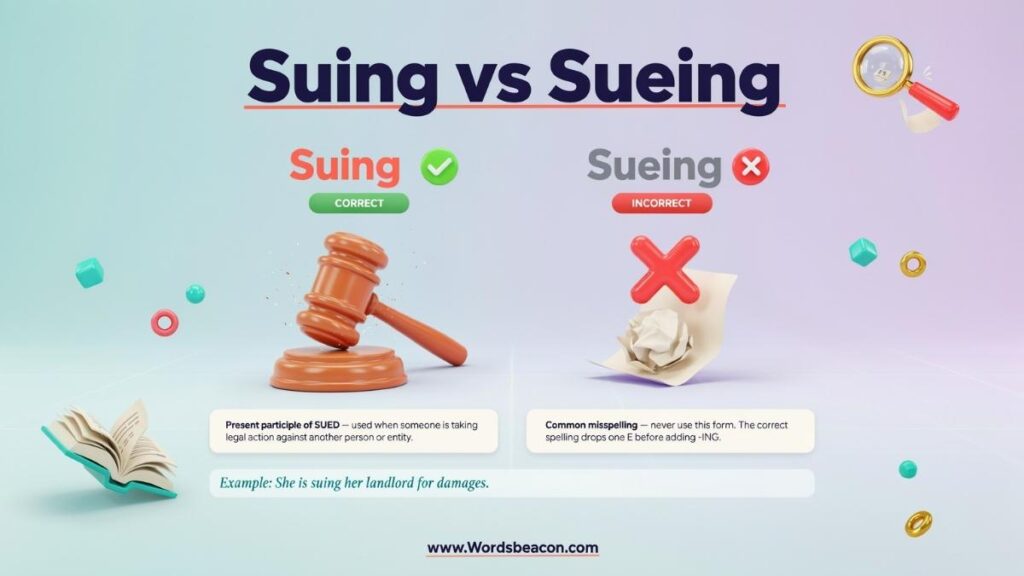
The difference between “Suing vs Sueing” is easy to miss, especially when the word “sue” already ends in an “e.” So, which spelling is correct? In the Suing vs Sueing debate, “suing” is the clear winner, while “sueing” is a common spelling mistake. The good news is that the rule is simple: drop the final “e” before adding “-ing.” Once you understand this small change, you can spell the word confidently without second-guessing yourself. In this guide, you’ll learn what “suing” means, how to use it in sentences, and how to avoid this common grammar mistake.
Quick Comparison
| Topic | Suing | Sueing |
|---|---|---|
| Correct spelling | Yes | No |
| Meaning | Bringing legal action against someone | Usually intended to mean the same as suing |
| Base verb | Sue | Sue |
| Grammar | Present participle or gerund | Nonstandard spelling |
| Spelling rule | Drops the final e before adding -ing | Incorrectly retains the final e |
| American English | Standard | Incorrect |
| British English | Standard | Incorrect |
| Example | She is suing the company. | She is sueing the company. |
The main difference is spelling, not meaning. To remember the correct form, use this simple rule: sue + ing becomes suing.
Learn how to use confusing more words correctly
Nosy vs Nosey Which one Is Correct?
Is Suing vs Sueing Correct?
Suing is the correct standard spelling. Sueing is a common spelling mistake that occurs when writers keep the final e before adding the suffix -ing.
The verb sue means to bring legal action against a person, business, or organization. Its -ing form describes an ongoing action or allows the action to function as a noun.
For example:
- Correct: The customer is suing the company.
- Incorrect: The customer is sueing the company.
- Correct: Suing someone can take time and money.
- Incorrect: Sueing someone can take time and money.
Both incorrect examples communicate the intended idea, but they don’t follow standard English spelling rules.
Is Suing a Word?
Yes. Suing is a standard English word derived from the verb sue. It appears in established dictionaries and works in everyday conversation, professional writing, news reports, and legal discussions.
For instance, someone might say, “She’s suing her landlord over the damage to her apartment.” A news report might state, “The business is suing a former supplier over an alleged contract violation.”
Both sentences use the word correctly. You don’t need to work in the legal profession to use it.
Is Sueing a Word?
Sueing appears in online posts, informal messages, and other writing, but it isn’t the standard spelling of the -ing form of sue. Writers usually make this error because they assume the base word must keep all its letters when they add a suffix.
Use suing in school assignments, business emails, reports, and legal correspondence. Even when a reader understands what you mean, correct spelling makes your writing clearer and more professional.
Why Is Suing Correct? The Sue + Ing Spelling Rule
English spelling can seem unpredictable until you recognize its patterns. One common rule explains why suing loses the final e: verbs that end in a silent e generally drop that letter before taking the suffix -ing.
This pattern is often called the drop-the-silent-e rule. It applies to familiar verbs such as make, write, hope, dance, and drive.
Why Do You Drop the E in Suing?
The base verb is sue. To create its -ing form, remove the final e and add the suffix.
Sue − e + ing = suing
The spelling changes, but the underlying verb remains the same. The word still refers to bringing legal action against someone.
Consider these examples:
| Base verb | Correct -ing form | Incorrect form |
|---|---|---|
| Sue | Suing | Sueing |
| Make | Making | Makeing |
| Write | Writing | Writeing |
| Hope | Hoping | Hopeing |
| Dance | Dancing | Danceing |
| Drive | Driving | Driveing |
| Bake | Baking | Bakeing |
Once you recognize the pattern, you can apply it to many other words. Instead of memorizing suing as an isolated spelling, learn how verbs ending in silent e usually behave before -ing.
Do All Verbs Ending in E Drop the E?
No. English has exceptions, so the general rule doesn’t apply to every verb in exactly the same way.
For example, dye becomes dyeing rather than dying when you mean coloring something. Keeping the e distinguishes dyeing from dying, which is the -ing form of die.
Compare these examples:
- Sue becomes suing: She is suing her former business partner.
- Die becomes dying: The plant is dying without water.
- Dye becomes dyeing: He is dyeing the fabric blue.
- See becomes seeing: I’m seeing the doctor tomorrow.
The final e disappears in most of these forms, but dyeing keeps it to prevent confusion with another word.
Therefore, learn the general spelling rule while paying attention to exceptions. When a spelling change could create a different word, check a trusted dictionary.
How to Add ING to a Verb Ending in Silent E
Follow these steps when forming an -ing word:
- Start with the base verb.
- Check whether the verb follows the usual silent-e pattern.
- Remove the final e when the spelling rule calls for it.
- Add -ing.
- Read the completed sentence to confirm that the word fits the meaning.
For example, if you want to explain that a customer is taking legal action, begin with sue. Remove the final e, add -ing, and write, “The customer is suing the company.”
A spelling checker can catch many mistakes. However, it may overlook errors that involve correctly spelled but incorrectly used words. Understanding the rule helps you spot mistakes that software might miss.
Learn how to use confusing more words correctly
Conex vs Connex Which one Is actually Correct?
What Does Suing Mean? Definition, Grammar, and Usage
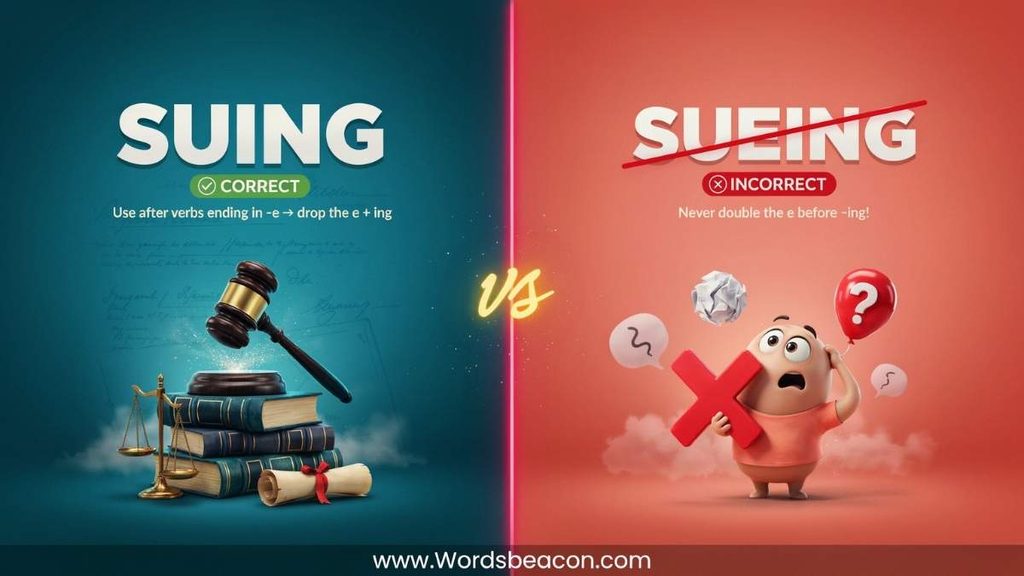
Suing means bringing or pursuing legal action against a person, business, or organization. The action usually involves asking a court to resolve a dispute or provide a legal remedy.
Major English dictionaries define sue as taking legal action against someone, often to seek compensation for harm or loss. The exact meaning in a particular case depends on the circumstances and the applicable law.
Suing Definition and Meaning in English
In everyday English, suing describes the act of bringing a lawsuit or pursuing a legal claim. People commonly use the word when discussing disputes involving money, property, contracts, injuries, or business agreements.
For example:
“The homeowner is considering suing the contractor after the repairs failed.”
Here, suing refers to a possible legal action. The sentence doesn’t mean that the homeowner has already filed a lawsuit or will necessarily win a case.
Other examples include:
- A customer suing a business over an injury.
- An employee suing an employer over an alleged workplace violation.
- A company suing a supplier over a contract dispute.
- A homeowner suing a contractor over property damage.
These situations share one feature: a person or organization is considering or pursuing a legal remedy. However, the legal requirements differ from one type of dispute to another.
What Does Suing Mean in Law?
In legal contexts, suing generally means bringing a civil claim against another party. The person bringing the claim seeks a remedy that the law allows, such as financial compensation or a court order.
Several legal terms often appear alongside suing:
- Plaintiff: The party who brings a civil lawsuit in legal systems that use this term.
- Defendant: The party against whom the lawsuit is brought.
- Lawsuit: A legal dispute pursued through court proceedings.
- Damages: Financial compensation that a court may award when the law permits.
- Breach of contract: An alleged failure to fulfill a contractual obligation.
- Legal claim: An assertion that a party has a legal right to a remedy.
For example, imagine that a supplier agrees to deliver equipment by a specific date but fails to do so. If the failure breaches the contract and causes a legally recognized loss, the other party might consider suing for breach of contract.
However, a disagreement doesn’t automatically create a successful legal claim. The person bringing the case generally needs a valid legal basis and must meet the relevant procedural and evidentiary requirements.
Suing Someone Meaning and Examples
The phrase “suing someone” means bringing legal action against that person. The other party might be an individual, a business, or another organization.
Consider these examples:
- “The tenant is suing the landlord over water damage.”
- “The customer threatened to sue the manufacturer.”
- “The company is suing its former partner over an alleged contract violation.”
- “The family discussed suing for damages after the accident.”
Each sentence uses the same general idea, but the grammatical construction changes.
In the first example, “is suing” describes an ongoing action. And In the second, “threatened to sue” describes a possible future action. In the fourth, “discussed suing” refers to considering legal action.
It’s also important to distinguish threatening to sue from filing a lawsuit. A person may threaten legal action without ever starting a court case.
Suing for Damages vs Suing for Breach of Contract
These expressions relate to legal disputes, but they emphasize different things.
| Expression | Meaning | Example |
|---|---|---|
| Suing for damages | Seeking financial compensation through legal action | The cyclist is suing for damages after the collision. |
| Suing for breach of contract | Bringing a claim based on an alleged failure to meet a contractual obligation | The supplier is suing for breach of contract. |
| Filing a lawsuit | Formally starting a court case through the required process | The company filed a lawsuit against its distributor. |
| Taking legal action | A broad expression for pursuing a legal remedy | The homeowner is considering taking legal action. |
Someone might sue for damages because another party allegedly breached a contract. In that situation, one phrase describes the remedy sought, while the other identifies the alleged legal wrong.
Learn how to use confusing more words correctly
Bellies vs Bellys Which Spelling Is Correct?
Sue vs Suing What’s the Difference?
Sue and suing come from the same verb, but they serve different grammatical purposes. Knowing when to use each form will help you write accurate sentences.
Sue Is the Base Verb
Sue is the base form of the verb. You use it after modal verbs such as can, may, might, and will. It also appears in infinitive constructions.
Examples:
- “They may sue the company.”
- “She plans to sue her former employer.”
- “You can sue if you have a valid legal claim.”
- “The business decided to sue for damages.”
The base form also appears after to, as in “to sue.”
Suing Is the Present Participle and Gerund
Suing is the present participle when it forms a progressive verb phrase. It can also function as a gerund when the -ing form acts as a noun.
As a present participle:
- “She is suing the company.”
- “They were suing the contractor when the parties reached an agreement.”
- “The family has been suing for compensation.”
As a gerund:
- “Suing can be expensive.”
- “They discussed suing.”
- “Suing the landlord was their last option.”
In the first group, suing helps express an ongoing action. In the second, it represents the action itself.
Is Suing a Verb or a Noun?
The answer depends on how you use the word in a sentence. Suing is a verb form, but it can function as a noun when it acts as a gerund.
| Sentence | Function of suing |
|---|---|
| She is suing the company. | Present participle in a progressive verb phrase |
| Suing takes time. | Gerund functioning as the subject |
| They considered suing the supplier. | Gerund functioning as the object of considered |
| Suing for damages can be costly. | Gerund phrase functioning as the subject |
The -ing ending doesn’t automatically make a word a noun. Instead, look at the word’s role in the sentence to determine its grammatical function.
Fix common more word mistakes in English
Bougie vs Boujee which one is correct?
Verb Forms of Sue Sue, Sues, Sued, and Suing
Learning the main forms of sue makes it easier to write about legal action in different tenses.
| Verb form | Grammatical use | Example |
|---|---|---|
| Sue | Base form | They plan to sue the company. |
| Sues | Third-person singular present | He sues when negotiations fail. |
| Sued | Simple past | She sued the contractor last year. |
| Sued | Past participle | They have sued the manufacturer. |
| Suing | Present participle or gerund | She is suing the supplier. |
What Is the Past Tense of Sue?
The simple past tense of sue is sued. The past participle is also sued.
Examples:
- Present: The customer sues the company.
- Past: The customer sued the company.
- Present perfect: The customer has sued the company.
- Past perfect: The customer had sued the company before the settlement.
Don’t write “sueed” or “suied.” The correct form is sued.
How to Spell Sue in Past and Present Forms
Use this guide to keep the main verb forms straight:
- Base form: sue
- Third-person singular present: sues
- Simple past: sued
- Past participle: sued
- Present participle: suing
- Gerund: suing
The spelling changes according to the form you need. Sue keeps its final e when used as the base verb, but that letter disappears in suing.
Fix common more word mistakes in English
Immerse vs Emerse Which one Is Correct?
Suing in a Sentence Correct Usage and Examples
Examples help you see how suing works in everyday conversation, business communication, and legal writing. The word always keeps the same spelling, although its grammatical role can change.
Suing in Everyday Conversation
People often use suing when discussing a dispute or a possible legal response.
- “My neighbor is suing the construction company over property damage.”
- “She is considering suing after the business refused to honor its agreement.”
- “They discussed suing but decided to explore mediation first.”
- “He threatened to sue the store over a defective product.”
These examples show that suing can describe an action in progress or an action someone is considering. However, the sentence must still follow standard grammar rules.
Suing in Professional and Business Writing
In professional communication, correct spelling helps your message look clear and polished.
Examples include:
- “The supplier is suing the retailer over unpaid invoices.”
- “The company is reviewing the risks associated with suing its former distributor.”
- “Our legal team is assessing the proposed claim before taking further action.”
- “The business may face a lawsuit if the parties cannot resolve the dispute.”
Notice that the final example uses lawsuit instead of suing. Both terms relate to legal proceedings, but they don’t serve the same grammatical purpose.
Suing in Legal Writing
Legal writing often uses suing alongside terms that identify the parties, the claim, and the remedy being requested.
- “The plaintiff is suing the defendant for an alleged breach of contract.”
- “The claimant is suing for damages arising from the disputed transaction.”
- “The company is suing a former partner over the alleged misuse of confidential information.”
- “The parties are discussing settlement while the lawsuit continues.”
These examples illustrate standard English usage. They don’t establish that a particular claim would succeed in court.
Fix common more word mistakes in English
Flier vs Flyer difference and usage ?
Suing Pronunciation How Do You Say It?
Correct spelling is only part of using a word confidently. Pronunciation matters, too, particularly because suing and sewing look and sound similar.
Suing Pronunciation Guide
Suing generally has two syllables, with the stress on the first. Its International Phonetic Alphabet transcription is /ˈsuː.ɪŋ/.
The first syllable sounds like the word sue, followed by the ending -ing. When speaking, move naturally from the vowel sound in sue into the final syllable rather than forcing the word into one syllable.
Suing vs Sewing Pronunciation and Meaning
Although these words sound similar, they refer to different activities.
| Word | Meaning | Example |
|---|---|---|
| Suing | Bringing legal action against someone | She is suing the company. |
| Sewing | Joining or repairing fabric with stitches | She is sewing a button onto her coat. |
Suing commonly sounds like “SOO-ing,” while sewing often sounds like “SOH-ing.” Pronunciation can vary slightly by accent, but the vowel difference helps distinguish the words.
Context also makes a difference. If someone is discussing a lawsuit, they probably mean suing. If they’re talking about repairing clothing, they likely mean sewing.
Understand confusing English more words simply
Pricey vs Pricy Which Spelling Is Correct?
Does Suing Change in American and British English?
No. Suing is the standard spelling in American, British, Canadian, and Australian English. None of these varieties uses sueing as the accepted spelling of the verb form.
Some words do have regional spelling differences. For example, American English uses color, while British English usually uses colour. However, suing follows the same spelling rule across these varieties.
| Feature | American English | British English |
|---|---|---|
| Correct spelling | Suing | Suing |
| Base verb | Sue | Sue |
| Past tense | Sued | Sued |
| Past participle | Sued | Sued |
| Incorrect form | Sueing | Sueing |
Legal procedures and terminology may differ between jurisdictions, but those differences don’t affect the spelling of suing.
Understand confusing English more words simply
Signer vs Signor Differences and Usage ?
Suing Synonyms and Related Legal Expressions
If you need a synonym for suing, choose an expression that matches the context. Some alternatives describe the same general action, while others refer to a specific stage of a legal dispute.
What Is Another Word for Suing?
Common alternatives include:
- Taking legal action: A broad expression for pursuing a legal remedy.
- Bringing a lawsuit: Emphasizes initiating or pursuing a court case.
- Filing a lawsuit: Usually refers to formally starting a case.
- Bringing a legal claim: Focuses on asserting a legal right or seeking a remedy.
- Litigating: Refers to participating in legal proceedings.
For example, “The company is suing its supplier” could become “The company is bringing a lawsuit against its supplier.”
However, these expressions aren’t interchangeable in every situation. Filing a lawsuit usually refers to a formal procedural step, while litigating can describe the broader process of resolving a legal dispute through the courts.
Common Mistakes When Spelling Suing
Even experienced writers sometimes make spelling mistakes when adding suffixes. Fortunately, most errors involving suing fall into a few predictable categories.
Keeping the Final E
The most common mistake is writing sueing. Writers recognize the base verb but forget to remove its final e.
Incorrect: The customer is sueing the manufacturer.
Correct: The customer is suing the manufacturer.
Remember the pattern: sue becomes suing.
Assuming Every Verb Follows the Same Pattern
English spelling has general rules as well as exceptions. Many verbs drop the final e before -ing, but some retain it to prevent confusion.
For example, dye becomes dyeing, while die becomes dying. If you aren’t sure which pattern applies, check a reliable dictionary.
Confusing Suing With Sewing
Suing refers to legal action, while sewing refers to stitching fabric. A spelling checker might not catch the mistake if both words fit the sentence grammatically.
For that reason, proofread for meaning as well as spelling.
Trusting Every Online Example
An incorrect spelling can appear in a blog post, social media comment, or online discussion. Its presence online doesn’t make it standard English.
When in doubt, consult a reputable dictionary or grammar reference to confirm the spelling and meaning.
Understand confusing English more words simply
Reins vs Reigns which spelling is correct ?
Practice Session Suing vs Sueing
Fill in each blank with the correct spelling or word form. Choose between “Suing vs Sueing” where appropriate, and use the correct form of “sue” for the other questions.
- The customer is considering ______ the company for damages.
- “______” is the correct spelling of the -ing form of “sue.”
- The family discussed ______ the hospital over the medical error.
- The employee is ______ his former employer for unpaid wages.
- She threatened to ______ the landlord for failing to make repairs.
- The correct past-tense form of “sue” is ______.
- The company denied the claims after the customer began ______ it.
- He plans to file a lawsuit after ______ the contractor.
- The lawyer explained the risks of ______ a large corporation.
- The incorrect spelling of “suing” is ______.
- They are ______ for compensation after the accident.
- The present participle of “sue” is ______.
- The business owner ______ the supplier last year.
- She is thinking about ______ her former business partner.
- In both American and British English, the standard spelling is ______.
- The plaintiff is ______ the defendant for breach of contract.
- The verb form used with “he,” “she,” or “it” in the simple present is ______.
- The family has ______ the manufacturer over the defective product.
- Adding “-ing” to “sue” requires dropping the final silent ______.
- The phrase “suing someone” means taking ______ action against that person.
Answers
- suing
- Suing
- suing
- suing
- sue
- sued
- suing
- suing
- suing
- sueing
- suing
- suing
- sued
- suing
- suing
- suing
- sues
- sued
- e
- legal
Here’s a trusted source for clear word meanings:
FAQs
Is “suing” the correct spelling when taking someone to court?
Yes. “Suing” is the correct spelling when someone takes legal action against a person, company, or organization. “Sueing” is a common misspelling and is not considered standard English.
Why is “suing” spelled without the final “e” in “sue”?
English spelling rules generally require dropping a verb’s final silent “e” before adding “-ing.” Therefore, “sue” becomes “suing,” just as “write” becomes “writing.”
How do you correctly write “I am suing you”?
The correct sentence is “I am suing you.” The word “suing” drops the final “e” from “sue” before adding “-ing.”
What does “I will sue you” mean?
“I will sue you” means the speaker intends to take legal action against another person. It may refer to a planned lawsuit, but the statement alone does not mean that a case has been filed.
What does suing someone for money mean?
Suing someone for money means seeking financial compensation through legal action. A person might sue to recover unpaid debts, claim damages after an injury, or seek compensation for a breach of contract.
What is the difference between suing someone and filing a lawsuit?
Suing someone refers to pursuing legal action against them. Filing a lawsuit refers more specifically to starting a court case by submitting the required legal documents.
What is a person who sues someone called?
In a civil lawsuit, the person bringing the claim is generally called the plaintiff. The person or organization responding to the claim is called the defendant. Some legal systems use the term “claimant” instead.
What is another word for suing someone?
Depending on the context, alternatives include “taking legal action,” “bringing a legal claim,” “initiating legal proceedings,” and “filing a lawsuit.” Although these expressions are related, they do not always describe the same legal step.
Is “suing” a verb or a noun?
“Suing” is a verb form that can also function as a gerund, which acts like a noun in a sentence. For example, “She is suing the company” uses it as part of a verb phrase, while “Suing can be expensive” uses it as a gerund.
How do you use “suing” in a sentence?
Use “suing” when describing an ongoing legal action or referring to the act of pursuing a legal claim. For example: “The customer is suing the company for breach of contract.”
What is the difference between “sue,” “sues,” “sued,” and “suing”?
These words are different forms of the same verb:
- Sue: the base form, as in “I plan to sue.”
- Sues: the present-tense form used with he, she, or it, as in “She sues the company.”
- Sued: the simple past and past participle, as in “He sued the contractor.”
- Suing: the present participle or gerund, as in “They are suing the landlord.”
Is “suing” spelled differently in American and British English?
No. “Suing” is the standard spelling in both American and British English. “Sueing” is a misspelling in both varieties.
What is the difference between “suing” and “sewing”?
“Suing” refers to pursuing legal action, while “sewing” means joining fabric or other materials with stitches. The words have different meanings, even though their pronunciation can sound similar in some accents.
What does “sue me” mean in casual conversation?
In informal conversation, “sue me” is often a sarcastic expression that means the speaker does not care if someone disapproves. Depending on the context, it may be playful or defiant rather than a serious legal statement.
What does “you can sue me” mean?
Literally, “you can sue me” means the speaker acknowledges that the other person could take legal action against them. In casual speech, it can also express indifference toward criticism or disapproval.
Does “suing” always mean a lawsuit has already started?
No. Someone might say they are considering suing or threaten to sue before filing any court documents. The word describes pursuing or undertaking legal action, but the surrounding context determines whether proceedings have actually begun.
How do you spell “I’m going to sue someone”?
The correct spelling is “I’m going to sue someone.” The verb remains “sue” because it follows “going to.” In informal speech, people may say “I’m gonna sue someone,” but “going to” is more appropriate in formal writing.
Can “sueing” ever be considered correct English?
No. When forming the present participle or gerund of “sue,” the standard spelling is “suing.” Use “sueing” only when discussing the misspelling itself.
How do you remember the correct spelling of “suing”?
Remember the rule: drop the final silent “e” from “sue” before adding “-ing.” This produces “suing,” not “sueing.” The same pattern applies to many verbs, including “make” to “making” and “write” to “writing.”
Learn the difference between similar English words
Cancelation vs Cancellation Which Spelling Is Correct?
Conclusion
Choosing between “Suing vs Sueing” is easier than it looks. The correct spelling is “Suing vs Sueing ” is a common spelling mistake. The trick is simple: drop the final “e” from “sue” before adding “-ing.” Once you remember this rule, you won’t have to second-guess yourself every time you write about taking legal action. Whether someone is suing a company, seeking compensation, or filing a lawsuit, the spelling stays the same. So, remember to write “suing,” not “sueing.” After all, your sentence should explain the legal trouble, not create a spelling case of its own!

Luna AJS is an experienced blogger and dedicated language enthusiast at Words Beacon. She specializes in making English grammar, spelling, vocabulary and commonly confused words easy to understand. She provides clear explanations, practical examples to help readers write with confidence.