
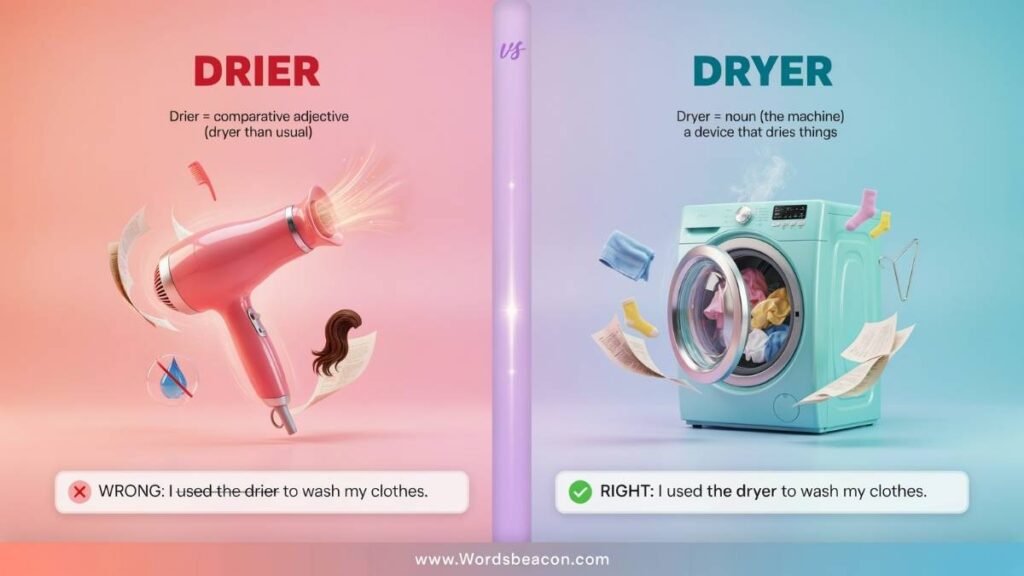
Drier vs dryer can be confusing because these words sound exactly alike but have different meanings. One describes how much moisture something has, while the other usually refers to a machine that removes moisture. Mix them up, and your sentence might need a little extra drying! The good news is that telling them apart is simple once you know the rule. In this guide, you’ll learn what “drier” and “dryer” mean, when to use each word, and how to avoid common spelling mistakes. With clear explanations and everyday examples, you’ll soon know which word fits your sentence perfectly.
quick comparison table
| Topic | Drier | Dryer |
|---|---|---|
| Main meaning | Less wet or less moist | A machine or device that removes moisture |
| Part of speech | Comparative adjective | Noun |
| Example | The air feels drier today. | The clothes are in the dryer. |
| Common phrases | Drier weather, drier skin, drier climate | Hair dryer, clothes dryer, air dryer |
| Quick memory tip | Compares dryness | Names a device |
Understand confusing English more words simply
Whiny vs Whiney Correct Spelling and How to Use Each
Drier vs Dryer The Quick Answer
The difference between drier and dryer comes down to meaning and grammatical function.
Use drier when you compare the dryness of two things. For example, “This towel is drier than the other one” means the first towel contains less moisture.
Use dryer when you refer to a machine or device that removes moisture. For example, “The dryer finished the laundry” refers to an appliance.
However, context matters. Drier can also describe a more subdued style of humor, while dryer occasionally appears as a noun in specialized contexts. In everyday English, though, the adjective-versus-noun distinction will help you choose the right spelling most of the time.
What Does Drier Mean?
Drier is the comparative form of the adjective dry. It describes something that has less moisture than another thing or that has become less wet.
For example, if one shirt contains less water than another, you can call it drier. Similarly, if one region receives less rainfall than another, you can describe its climate as drier.
Drier definition
The word drier means less wet, less moist, or having less water than something else. It can describe physical conditions, weather, food, skin, soil, and even certain styles of communication.
Here are a few examples:
- The weather is drier today than it was yesterday.
- This side of the garden is drier than the area near the fence.
- My skin feels drier during the winter.
- Leave the crackers uncovered if you want them to become drier.
- His humor became drier as he grew older.
Notice that drier describes a quality rather than naming a machine. In each sentence, the word tells you how something compares with another condition or how its condition has changed.
Drier as a comparative adjective
English commonly forms the comparative of a short adjective by adding -er. Because dry ends in a consonant followed by y, the spelling changes from y to i before adding -er.
The pattern looks like this:
- Dry: the basic adjective
- Drier: the comparative form
- Driest: the superlative form
For example:
- The first towel is dry.
- The second towel is drier.
- The towel closest to the heater is the driest.
The comparative drier usually compares two things or conditions. The superlative driest identifies the one with the greatest degree of dryness among three or more things.
Drier in figurative language
Drier doesn’t always describe physical moisture. English speakers also use dry and drier to describe humor, writing, delivery, and other styles.
For example:
“Her humor is drier than her brother’s.”
This sentence means that her humor is more understated, subtle, or deadpan. It has nothing to do with water.
Similarly, a writer might develop a drier style by using fewer emotional expressions and more restrained language. The meaning depends on the context, but the spelling remains drier because the word still functions as a comparative adjective.
Understand confusing English more words simply
Suing vs Sueing Which Spelling Is Correct?
What Does Dryer Mean?
Dryer is most commonly a noun that names a machine or device used to remove moisture from something. You might use a clothes dryer to dry laundry, a hair dryer to dry your hair, or an industrial dryer to remove moisture from materials.
Dryer definition
A dryer is a device or machine designed to make something dry by removing moisture. Depending on its purpose, it may use heat, airflow, ventilation, or another drying process.
Examples include:
- I put the wet towels in the dryer.
- She bought a new hair dryer.
- The factory uses an industrial dryer to process the material.
- The air dryer removes moisture from the compressed air system.
In these sentences, dryer names a device. It doesn’t compare the dryness of two objects.
Common types of dryers
The word dryer appears in several everyday and technical contexts.
Clothes dryer
A clothes dryer removes moisture from laundry after washing. Many household models use heated air and a rotating drum to dry clothes, although designs and energy sources vary.
Example: “The clothes dryer stopped working halfway through the cycle.”
Hair dryer
A hair dryer directs airflow, often heated, toward wet hair to help it dry.
Example: “She used a hair dryer before leaving for work.”
Air dryer
An air dryer removes moisture from air or gas. Industrial systems often use these devices to help protect equipment and maintain suitable operating conditions.
Example: “The workshop installed an air dryer to reduce moisture in its compressed-air system.”
Food or industrial dryer
Food processors and manufacturers use dryers to remove moisture from ingredients, products, or raw materials. Depending on the application, the process can help with storage, handling, or production.
Example: “The manufacturer uses a dryer to remove excess moisture from the material.”
Dryer as a noun
The easiest way to recognize dryer is to check whether the sentence names a machine or device.
Consider these examples:
- The dryer needs a new filter.
- We bought a compact dryer for the apartment.
- The mechanic inspected the air dryer.
- This dryer uses less energy than our old model.
In each example, dryer acts as a noun. You can usually place a word such as the, a, or an before it: the dryer, a dryer, or an industrial dryer.
Drier vs Dryer Key Differences
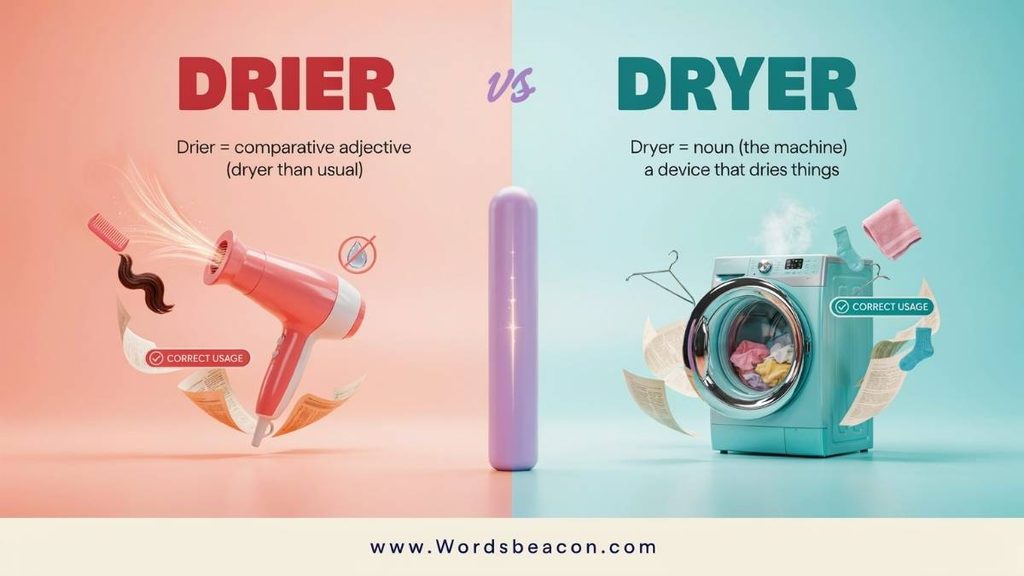
Although drier and dryer sound the same in many English accents, their usual meanings differ.
| Feature | Drier | Dryer |
|---|---|---|
| Typical part of speech | Adjective | Noun |
| Main purpose | Compares levels of dryness | Names a drying device |
| Common question it answers | How dry is it compared with something else? | What machine removes the moisture? |
| Example with clothing | This shirt is drier than that one. | Put the shirt in the dryer. |
| Example with weather | The climate is drier this year. | The industrial dryer processes the material. |
| Related forms | Dry, drier, driest | Dryer, dryers |
The most useful distinction is grammatical. Drier usually describes something, while dryer usually names something.
For example, consider these two sentences:
“The towel is drier.”
“The towel is in the dryer.”
The first sentence compares the towel’s condition with another point of reference. The second tells you where the towel is. Once you identify the role of the word in the sentence, the spelling becomes much easier to choose.
Fix common more word mistakes in English
Nosy vs Nosey Which one Is Correct?
Drier Than or Dryer Than Which Is Correct?
Drier than is the correct phrase when you want to compare levels of dryness. Dryer than is usually incorrect when you intend the comparative adjective because dryer normally refers to a machine.
When to use drier than
Use drier than when one person, object, place, or condition has less moisture than another.
Examples:
- The weather is drier than it was last week.
- This towel is drier than the one in the bathroom.
- The soil near the wall is drier than the soil under the tree.
- My skin feels drier than usual this winter.
- The western side of the country is generally drier than the eastern side.
In each sentence, drier describes a comparison. The word than introduces the thing or condition used as the point of comparison.
Why dryer than is usually incorrect
Consider this sentence:
“The air is dryer than yesterday.”
If you mean that the air contains less moisture than it did yesterday, write:
“The air is drier than it was yesterday.”
The second version uses the standard comparative adjective. The first spelling suggests a machine rather than the quality of the air.
However, dryer can appear before than when the sentence genuinely compares two machines or devices. For example, “This dryer is quieter than the older model.” Here, dryer is a noun, and quieter carries the comparison.
The important point is that dryer itself doesn’t normally replace drier when you describe a greater degree of dryness.
Can you say more dry instead of drier?
Yes, but drier is generally the more natural choice in ordinary comparisons.
For example:
- Natural: “The air is drier today.”
- Also possible in certain contexts: “The air is more dry today.”
The phrase more dry may appear when a speaker wants a particular emphasis or when a technical or stylistic context calls for it. Nevertheless, drier is the usual comparative form in everyday English.
Dry, Drier, Driest Understanding the Grammar
To understand drier vs dryer fully, it helps to learn how the adjective dry changes when you compare things.
The comparative form of dry
Dry describes a condition with little or no moisture. Drier compares that condition with another, while driest identifies the highest degree of dryness within a group.
| Form | Meaning | Example |
|---|---|---|
| Dry | Having little or no moisture | The towel is dry. |
| Drier | Less moist than another thing | This towel is drier than that one. |
| Driest | Having the least moisture in a group | This is the driest towel of the three. |
Why does dry become drier?
When a consonant comes before the final y in a short adjective, English commonly changes the y to i before adding -er or -est.
The same spelling pattern appears in several familiar words:
- Happy, happier, happiest
- Easy, easier, easiest
- Heavy, heavier, heaviest
- Dry, drier, driest
This rule explains why drier is the standard comparative form. You don’t normally write dryer when you mean “more dry.”
Common mistakes with dry and drier
A frequent mistake is to use dryer as the comparative adjective simply because it sounds like drier.
Incorrect: “The weather is dryer this month.”
Correct: “The weather is drier this month.”
Another mistake is to write “more drier.” This combines two comparative forms and sounds unnatural in standard English.
Incorrect: “This room is more drier than the other one.”
Correct: “This room is drier than the other one.”
Use either drier or, in suitable contexts, more dry. Don’t combine more with drier.
Fix common more word mistakes in English
Conex vs Connex Which one Is actually Correct?
Drier vs Dryer Examples in Everyday English
Examples make the distinction easier to remember. The following sentences show how each word works in ordinary situations.
Drier in a sentence
- The weather is drier today than it was yesterday.
- The laundry on the line is drier than the clothes inside.
- This region has a drier climate than the coastal area.
- My hands feel drier after washing the dishes.
- The soil became drier during the week without rain.
- His jokes became drier as the conversation continued.
- The bread will become drier if you leave it uncovered.
Each example uses drier to describe a condition or compare two levels of dryness.
Dryer in a sentence
- I put the wet clothes in the dryer.
- Her hair dryer stopped working this morning.
- The dryer needs to cool down before we clean it.
- The factory uses a large dryer to remove moisture from its products.
- We bought a compact clothes dryer for our apartment.
- The technician checked the air dryer during maintenance.
- Please clean the lint filter before using the dryer again.
Each example uses dryer as a noun that names a device.
A quick comparison table
| Situation | Correct sentence | Why it works |
|---|---|---|
| Comparing towels | This towel is drier than that one. | Drier describes a lower level of moisture. |
| Drying laundry | Put the towels in the dryer. | Dryer names the appliance. |
| Describing weather | The climate is drier this year. | Drier compares climate conditions. |
| Drying hair | I need a new hair dryer. | Dryer names a device. |
| Comparing soil | The soil is drier near the wall. | Drier describes the soil’s condition. |
| Industrial equipment | The air dryer needs maintenance. | Dryer names a machine. |
A useful test is to replace the word with a simple explanation. If you mean “less wet,” choose drier. If you mean “a machine that removes moisture,” choose dryer.
Fix common more word mistakes in English
Bougie vs Boujee which one is correct?
Hair Dryer or Hair Drier?
Hair dryer is the standard spelling for the familiar electrical device used to dry hair. You’ll see this spelling in product descriptions, household instructions, and everyday writing.
For example:
“She used a hair dryer to dry her hair before work.”
The word dryer names the appliance. Although hair drier occasionally appears as an alternative spelling in some contexts, hair dryer is the conventional choice for this device.
Remember the distinction:
- “My hair is drier today.” Drier describes the condition of your hair.
- “I bought a new hair dryer.” Dryer names the appliance.
The same principle applies to other devices. You might describe the air as drier, but you would usually call the appliance an air dryer.
Clothes Dryer or Clothes Drier?
Clothes dryer is the standard term for the machine that dries laundry. The spelling remains dryer because the word names a device.
Examples:
- The clothes dryer is running.
- We need to repair the clothes dryer.
- This clothes dryer has several drying settings.
However, drier is correct when you describe the condition of the clothes themselves.
For example:
“The clothes on the outdoor line are drier than the ones inside.”
In this sentence, drier compares the amount of moisture in the clothes. It doesn’t name a machine.
The difference becomes clear when you consider the function of each word. A clothes dryer makes clothes drier. One word names the machine, and the other describes the result.
Air Dryer or Air Drier?
Air dryer is the standard spelling when you mean a device that removes moisture from air. These devices appear in industrial settings, workshops, manufacturing facilities, and compressed-air systems.
Example: “The technician replaced the filter in the air dryer.”
Use drier when describing the air itself.
Example: “The air in the room became drier after the ventilation system started.”
Although the words sound alike, their grammatical roles differ. The device is a dryer, while the air can become drier.
Dryer vs Dehumidifier Are They the Same?
A dryer and a dehumidifier can both remove moisture, but they don’t necessarily serve the same purpose.
A dryer usually refers to a device designed to dry a particular material or product. A clothes dryer, for example, removes moisture from laundry. An industrial dryer may process food, chemicals, or other materials.
A dehumidifier, by contrast, removes moisture from the air in an enclosed space. People commonly use one to manage indoor humidity.
Here is a simple comparison:
| Feature | Dryer | Dehumidifier |
|---|---|---|
| Main purpose | Dries a material or product | Reduces moisture in indoor air |
| Common example | Clothes dryer | Basement dehumidifier |
| Typical use | Drying laundry or industrial materials | Managing indoor humidity |
| Example sentence | The dryer finished the laundry. | The dehumidifier collected water overnight. |
There can be overlap in how drying equipment works, but the terms aren’t interchangeable in every situation. Choose the name that matches the device’s purpose.
Fix common more word mistakes in English
Immerse vs Emerse Which one Is Correct?
Drier vs Dryer in American and British English
The distinction between drier and dryer generally applies in both American and British English. In either variety, drier is the usual comparative form of dry, and dryer commonly names a machine.
For example, American and British writers can both use these sentences:
- The weather is drier this week.
- I put the clothes in the dryer.
- The soil is drier near the road.
- She bought a new hair dryer.
Regional vocabulary can differ, however. British English often uses tumble dryer for the household appliance that dries laundry. American English commonly uses clothes dryer or simply dryer.
These differences concern the alternative name for the appliance rather than the core spelling distinction between drier and dryer.
Drier vs dryer in American English
In American English, use drier when comparing dryness and dryer when referring to a machine.
Examples:
- The air is drier in winter.
- The dryer is in the laundry room.
- This towel is drier than the other one.
Drier vs dryer in British English
British English follows the same basic distinction.
Examples:
- The weather is drier than usual.
- The tumble dryer needs cleaning.
- The clothes are drier after hanging outside.
The appliance name may vary, but drier remains the standard comparative form.
What about Australian and Canadian English?
Australian and Canadian English also use drier as the comparative adjective and dryer for the machine. Local preferences for appliance names may vary, but the basic grammatical rule remains the same.
When you’re unsure, focus on meaning rather than accent or location. If the word means “less wet,” use drier. If it names a machine, dryer is the usual choice.
Why Drier and Dryer Sound the Same
Drier and dryer are homophones in many English accents. Homophones are words that sound alike but have different meanings or spellings.
Other familiar examples include:
- Their and there
- To, too, and two
- See and sea
- Right and write
Because drier and dryer sound the same, listening alone may not help you choose the correct spelling. Instead, look at how the word functions in the sentence.
For example:
“The room is drier now.”
Here, drier describes the room’s condition.
“The dryer is in the next room.”
Here, dryer names an appliance.
The surrounding words provide the clue. If the word describes a change in moisture, drier usually fits. If the sentence refers to a device, dryer is generally correct.
Learn how to use confusing more words correctly
Flier vs Flyer difference and usage ?
Common Drier vs Dryer Spelling Mistakes
Even confident writers sometimes confuse these words. Fortunately, most mistakes come from a few predictable habits.
Using dryer as a comparative adjective
Incorrect: “The climate is dryer near the mountains.”
Correct: “The climate is drier near the mountains.”
Use drier when you compare levels of dryness.
Using drier for a household appliance
Incorrect: “I put the towels in the drier.”
Correct: “I put the towels in the dryer.”
Although drier can appear as a variant in some uses, dryer is the conventional spelling for the appliance.
Writing more drier
Incorrect: “The air is more drier today.”
Correct: “The air is drier today.”
Drier already expresses comparison, so adding more is unnecessary in standard usage.
Confusing dry with dryer
Incorrect: “This towel is dryer now than before.”
Correct: “This towel is drier now than before.”
The correct comparative form of dry is drier. Dryer usually names a machine.
Choosing by sound alone
Since the two words often sound identical, pronunciation doesn’t reliably tell you which spelling to use. Think about the meaning first, then choose the word that fits.
Learn how to use confusing more words correctly
Reins vs Reigns which spelling is correct ?
Drier vs Dryer in Different Contexts
The same spelling rule applies across everyday life, weather reports, scientific writing, and professional settings.
Everyday situations
You might say, “My hair is drier after spending time outside,” because drier describes a condition. If you’re talking about the appliance you use after washing your hair, write “I need to replace my hair dryer.”
Weather and climate
Weather reports often compare moisture levels across days, seasons, or regions.
Examples:
- The afternoon air is drier than the morning air.
- This summer has been drier than last summer.
- The region has a drier climate than the coast.
In each case, drier describes a comparison in moisture conditions. However, exact weather and climate claims depend on local measurements and the time period being discussed.
Scientific and academic writing
Scientific writing may use drier to compare materials, soil, air, or other samples with different moisture levels.
Example: “Sample A was drier than Sample B after the treatment.”
Drying equipment may also appear in technical descriptions.
Example: “The laboratory used a dryer to remove moisture from the sample.”
In technical contexts, precise definitions matter. A specialized dryer may use a particular method or process, so the surrounding explanation should make its function clear.
Workplace and industrial settings
A technician might inspect an air dryer, while an agricultural worker might describe one field as drier than another.
Examples:
- The air dryer requires routine maintenance.
- The material became drier after processing.
- The production team installed a new industrial dryer.
The word you choose depends on whether you’re naming equipment or describing a condition.
Learn how to use confusing more words correctly
Signer vs Signor Differences and Usage ?
An Easy Way to Remember Drier vs Dryer
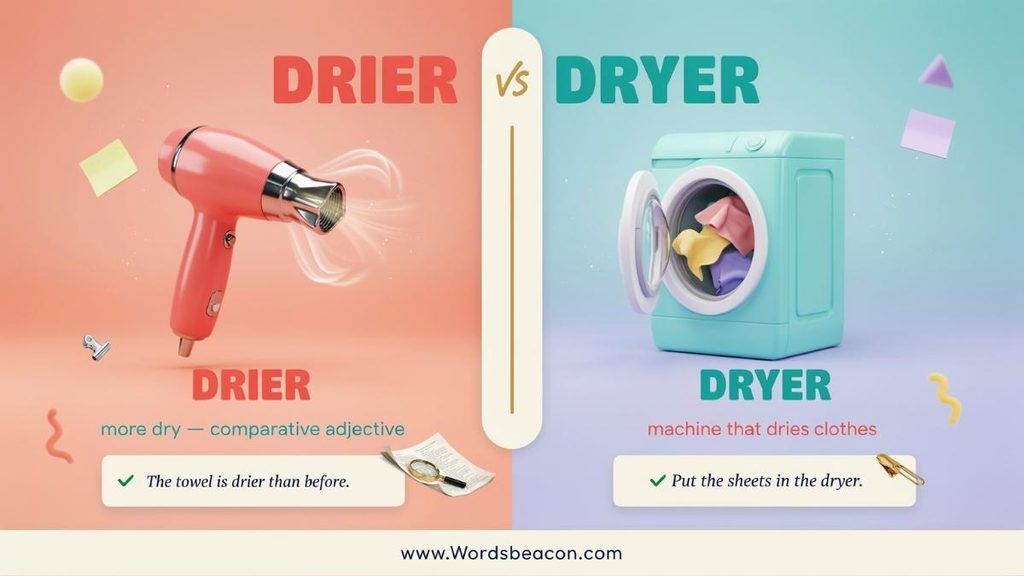
You don’t need to memorize a long grammar rule. Just connect each spelling with its usual purpose.
Drier describes something that has less moisture. Think of the phrase “drier than before.”
Dryer names a machine. Think of a hair dryer or clothes dryer.
Try this simple check whenever you’re unsure:
- If you can replace the word with “less wet,” use drier.
- If you can replace the word with “drying machine,” use dryer.
For example, “The towel is drier” means the towel is less wet. “The towel is in the dryer” means the towel is inside a machine.
This quick test works for most everyday uses and helps you avoid the most common spelling errors.
Learn how to use confusing more words correctly
Cancelation vs Cancellation Which Spelling Is Correct?
practice session Drier vs Dryer
Complete each sentence with the correct word: drier vs dryer. Check your answers at the end.
- The weather is ______ today than it was yesterday.
- I put my wet clothes in the ______.
- This towel is ______ than the one on the chair.
- She bought a new hair ______ last week.
- The soil becomes ______ when there is no rain.
- The technician repaired the broken clothes ______.
- My skin feels ______ during the winter.
- Please clean the lint filter in the ______.
- This region has a ______ climate than the coastal area.
- The factory uses an industrial ______ to remove moisture.
- The clothes outside are ______ than the clothes indoors.
- Our old hair ______ stopped working this morning.
- The air feels ______ after the heater has been running.
- We need to buy a new clothes ______ for our laundry room.
- This towel is ______ than the other two.
- The mechanic checked the compressed-air ______.
- The ground is ______ near the wall because it receives more sunlight.
- My brother put his shoes near the ______ to help them dry.
- The climate became ______ after several weeks without rain.
- She used a hair ______ before styling her hair.
Answers
- Drier
- Dryer
- Drier
- Dryer
- Drier
- Dryer
- Drier
- Dryer
- Drier
- Dryer
- Drier
- Dryer
- Drier
- Dryer
- Drier
- Dryer
- Drier
- Dryer
- Drier
- Dryer
Here’s a trusted source for clear word meanings:
FAQs
What does “drier” mean in a sentence?
“Drier” is the comparative form of “dry.” It describes something that contains less moisture than something else. For example, “This towel is drier than the one in the bathroom.”
Can “dryer” be used as an adjective?
“Dryer” usually functions as a noun that refers to a machine or device that removes moisture. Use “drier” as the comparative adjective when describing something that contains less moisture.
Why does “dry” become “drier” instead of “dryer”?
English grammar often changes the final “y” to “i” before adding “-er” to form a comparative adjective. That’s why “dry” becomes “drier,” just as “happy” becomes “happier.”
What is the difference between drier air and dryer air?
“Drier air” is the standard expression when describing air with less moisture. For example, “The air is drier today than it was yesterday.” “Dryer air” is generally not the preferred choice for this meaning.
Can “drier” describe food?
Yes. You can use “drier” to describe food that contains less moisture than another food or an earlier version. For example, “These crackers are drier than the ones we bought last week.”
What is the superlative form of “dry”?
The superlative form is “driest.” Use it when comparing three or more things or identifying the one with the least moisture. For example, “August is the driest month of the year.”
Can “drier” describe skin or hair?
Yes. “Drier” works when comparing the moisture levels of skin or hair. For example, “My hands feel drier after washing dishes,” or “My hair becomes drier during winter.”
Does “dryer” always refer to a machine?
“Dryer” most commonly refers to a machine or device that removes moisture, such as a clothes dryer or hair dryer. In some technical contexts, it can describe something that causes drying, but its everyday use is primarily as a noun.
How can I remember when to use “drier” or “dryer”?
Use “drier” when comparing dryness and “dryer” when referring to a drying machine. Remember this simple example: “The air is drier, but the dryer dries the clothes.”
Can “drier” and “dryer” be used interchangeably?
No, not in standard everyday writing. Although the words sound alike, they serve different purposes. “Drier” describes something with less moisture, while “dryer” usually names a device that removes moisture.
Conclusion
Confusing “drier” with “dryer” is an easy mistake, but clearing it up is simpler than waiting for wet clothes to dry! Use “drier” when comparing how much moisture something contains, as in “The weather is drier today.” Use “dryer” when talking about a machine that removes moisture, such as a clothes dryer or hair dryer. The easiest way to remember the difference is that drier describes a condition, while a dryer is usually a device. Once you understand this simple rule, you can avoid common spelling mistakes and use both words correctly. After all, good grammar should clear up confusion, not leave you hanging out to dry!

Luna AJS is an experienced blogger and dedicated language enthusiast at Words Beacon. She specializes in making English grammar, spelling, vocabulary and commonly confused words easy to understand. She provides clear explanations, practical examples to help readers write with confidence.