
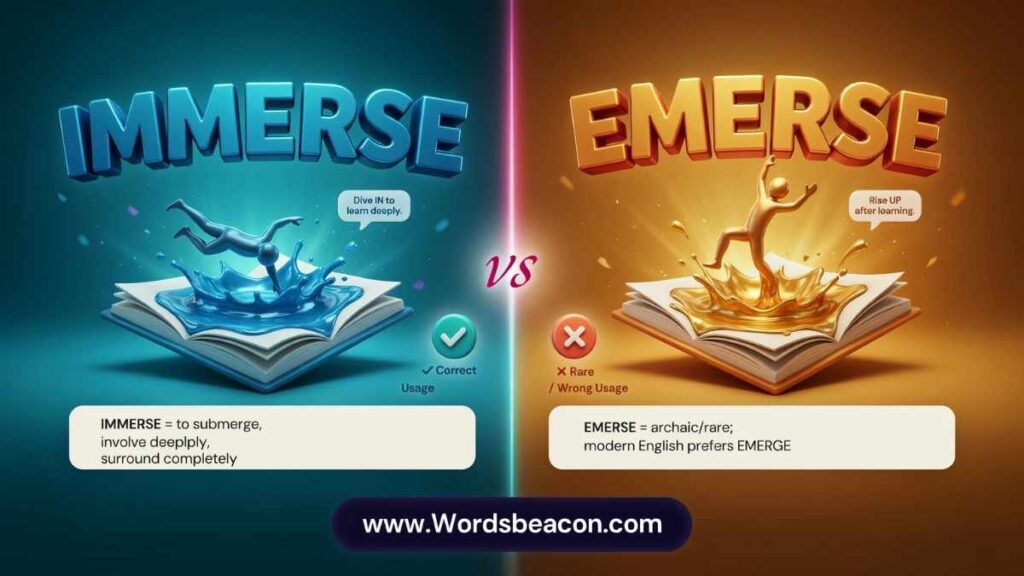
Immerse vs emerse can be confusing because the words look and sound similar, but they don’t mean the same thing. If you’ve ever paused while writing and wondered which word fits your sentence, you’re not alone. The good news is that the difference is easier to understand than it seems. Immerse is the word you’ll usually need when talking about getting deeply involved in an activity or putting something into water. Emerse is much less common and appears mainly in specialized contexts. In this guide, you’ll learn what each word means, how to use it correctly, and how to avoid common grammar mistakes.
Quick Comparison
| Feature | Immerse | Emerse / Emersed |
|---|---|---|
| Main meaning | To put something into liquid or become deeply involved | Emerse is rare as a verb; emersed commonly describes growth above water in botanical contexts |
| Part of speech | Primarily a verb | Emerse is a rare verb; emersed is commonly used as an adjective |
| Everyday usage | Common | Rare or specialized |
| Figurative meaning | Common in learning, work, reading, and cultural experiences | Limited in ordinary English |
| Water-related usage | Placing something into liquid | Describing plant parts that rise above the water’s surface |
| Example | She immersed herself in French lessons. | The aquarium plant developed emersed leaves. |
The quick answer is simple: use immerse when describing physical immersion or deep involvement. Use emerge when something comes out or becomes visible. Reserve emersed for appropriate technical contexts, especially botanical descriptions.
Understand confusing English more words simply
Flier vs Flyer difference and usage ?
What Does Immerse Mean?
The word immerse has two main meanings. Literally, it means to put something into a liquid. Figuratively, it means to become deeply involved in an activity, subject, or experience.
These meanings share an idea: something becomes surrounded by an environment, or a person gives an experience sustained attention.
Immerse Definition and Literal Meaning
The immerse definition is to place something completely into a liquid or to involve someone deeply in an activity or experience.
For example, when you immerse a cloth in water, you place it beneath the surface. When you immerse yourself in a history course, you devote considerable time and attention to learning about the subject.
Consider these examples:
- The technician immersed the sensor in a container of water.
- She immersed the strawberries in cold water before washing them.
- The students immersed themselves in French through daily conversation.
- He immersed himself in research before writing his report.
The first two examples describe physical actions. The others illustrate figurative use, where immerse communicates concentration and active involvement.
Immerse Verb Meaning in Everyday English
The immerse verb meaning extends well beyond water. People regularly use the word to describe becoming deeply involved in work, study, entertainment, art, and cultural experiences.
For instance, a student who spends hours exploring a difficult subject may become fully absorbed in it. Similarly, a reader who loses track of time while enjoying a novel is immersed in a book.
Here are several common applications:
- Learning: Immerse yourself in a language by listening, speaking, reading, and writing regularly.
- Work: Immerse yourself in a project that requires sustained attention.
- Culture: Immerse yourself in local customs, food, music, and traditions while traveling.
- Entertainment: An immersive video game can draw you into its fictional world.
- Research: A scientist may immerse herself in historical records or experimental data.
In each case, immerse suggests more than casual participation. It conveys depth, concentration, or sustained involvement.
Immerse Yourself Meaning
The phrase immerse yourself means to become deeply involved in something by giving it your attention, time, and energy.
For example, you can immerse yourself in Spanish by speaking with other learners, watching Spanish-language programs, and reading simple books. Likewise, you can immerse yourself in literature by exploring different authors and studying their writing styles.
Cultural immersion works similarly. Rather than simply visiting another country, you participate in local activities, learn about traditions, and communicate with the people who live there.
A useful sentence pattern is:
Immerse yourself in + a subject, activity, environment, or experience.
Examples include:
- I want to immerse myself in marine biology.
- She immersed herself in the local culture.
- He hopes to immerse himself in English before studying abroad.
In standard contemporary English, these sentences use immerse rather than emerse.
Meaning of Being Immersed and Fully Immersed
The meaning of being immersed depends on the context. Physical immersion describes a person or object placed beneath a liquid’s surface. Figurative immersion describes intense concentration or involvement.
The phrase fully immersed emphasizes a high degree of involvement.
Compare these examples:
- My hands were immersed in warm water. This describes a physical condition.
- I was immersed in the novel. This describes intense attention.
- The team was fully immersed in the investigation. This emphasizes sustained engagement with the work.
Being fully immersed doesn’t necessarily mean ignoring everything else. Instead, the expression highlights how thoroughly someone is involved in an activity or experience.
How to Use Immerse in a Sentence
Learning common sentence patterns makes correct word usage easier.
| Sentence pattern | Example | Meaning |
|---|---|---|
| Immerse + object + in + liquid | Immerse the brush in water. | Place the brush beneath the surface. |
| Immerse yourself in + subject | Immerse yourself in mathematics. | Become deeply involved in learning. |
| Be immersed in + activity | She was immersed in her work. | She was deeply engaged in work. |
| Become immersed in + experience | He became immersed in the story. | The story captured his attention. |
A common mistake is to leave out an object when the sentence needs one. For example, “She immersed the cloth” may feel incomplete if the reader doesn’t know where she placed it. “She immersed the cloth in water” explains the action clearly.
However, the reflexive construction immerse yourself works because yourself identifies the person experiencing the action.
Learn the difference between often confused words
Signer vs Signor Differences and Usage ?
What Does Emerse Mean?
The emerse meaning requires a little more care because emerse is rare in contemporary English and can be confused with emerge or emersed.
Some historical references record emerse as an obsolete form of immerse. Meanwhile, emersed has an established technical meaning in botany, where it describes plant parts that rise or stand above a liquid’s surface.
This distinction matters because emerse isn’t the standard modern opposite of immerse. In everyday English, emerge is the usual verb for coming out, appearing, or becoming visible.
Emerse Definition and Emerse Word Meaning
The emerse definition depends on the reference and context. As a verb, emerse appears in historical or specialized word records, including as an obsolete form of immerse. It isn’t the normal choice for everyday writing.
An older text might use emerse where a contemporary writer would use immerse. However, the appearance of a word in historical references doesn’t automatically make it appropriate for a modern email, essay, or report.
The related adjective emersed has a clearer technical application. It describes something that rises above a surrounding liquid, particularly the leaves or stems of aquatic plants.
Keep these distinctions in mind:
- Immerse: The standard modern verb for placing something in liquid or becoming deeply involved.
- Emerse: A rare or obsolete verb form that most general readers won’t need.
- Emersed: A recognized adjective used particularly in botanical descriptions of plants growing above water.
- Emerge: The common verb meaning to come out, appear, or become known.
What Does Emerse Mean in Biology?
When people ask what emerse means in biology, they often mean emersed.
In aquatic plant care, an emersed plant grows with some or all of its leaves and stems above the water’s surface. Its roots may remain in water, wet substrate, or another suitable growing medium.
By contrast, a submersed plant grows with its relevant plant parts underwater. Some aquatic species can grow under either condition, although their appearance may change with the environment.
For example:
- An aquarium plant with foliage growing entirely underwater displays submersed growth.
- The same species may develop emersed leaves when its foliage grows above the waterline.
- A plant with roots in wet substrate and leaves exposed to air may be cultivated emersed.
This distinction matters to aquarium enthusiasts and plant growers because changing the growing environment can affect leaf structure, appearance, and development.
Emersed Plant Growth vs Submersed Plant Growth
The difference between emersed and submersed growth involves more than a plant’s position. Growing conditions can influence how leaves develop and how the plant adapts to its environment.
| Feature | Emersed growth | Submersed growth |
|---|---|---|
| Leaf position | Above the water’s surface | Beneath the water’s surface |
| Surrounding environment | Air with suitable moisture | Water |
| Typical setting | Humid greenhouse or wet substrate above the waterline | Aquarium or underwater habitat |
| Leaf appearance | May be thicker or differently shaped | May be thinner or differently shaped |
| Common term | Emersed | Submersed or submerged |
These are general patterns rather than universal rules. Plant responses vary by species, light, humidity, nutrients, and other growing conditions.
Emersed vs Immersed An Important Botanical Difference
In plant care, emersed vs immersed can be confusing because immersed is an ordinary word, while emersed is a specialized botanical adjective.
If a grower describes a plant’s leaves as emersed, the grower means that the leaves rise above the water. If someone says an object is immersed in water, the usual interpretation is that the object has been placed in the water.
In technical descriptions, submersed is often the more precise term for plant growth beneath the water’s surface. Immersed can still be used in its general sense, but it isn’t always the preferred botanical label.
The phrase emersed in culture is also unsuitable when describing a person’s involvement in society or traditions. Write immersed in culture instead.
Learn the difference between often confused words
Reins vs Reigns which spelling is correct ?
Immerse vs Emerse Key Differences
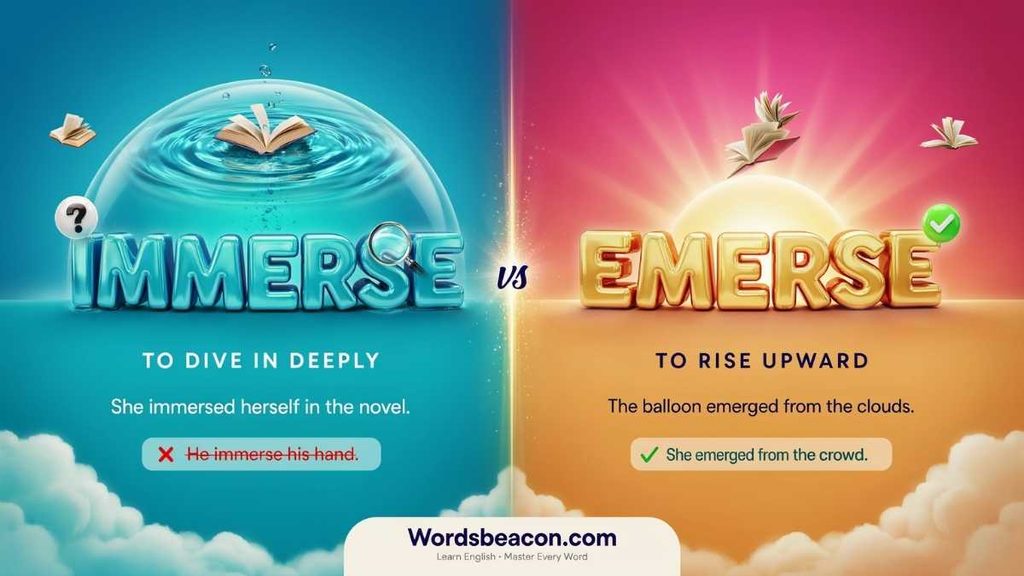
The difference between immerse vs emerse involves spelling, meaning, and modern usage. Immerse is an everyday English verb with literal and figurative meanings. Emerse is rare as a verb, while emersed has a recognized technical use.
Difference in Meaning
The simplest way to distinguish the terms is to focus on the action you want to describe.
- Use immerse when something goes into a liquid or someone becomes deeply involved in an activity.
- Use emerge when someone or something comes out, appears, or becomes known.
- Use emersed when describing the position of certain aquatic plant parts above water.
For example, “The diver immersed herself in the water” describes entering the water. “The diver emerged from the water” describes coming out of it.
Difference in Part of Speech
Grammar provides another way to distinguish these words.
| Word | Part of speech | Example |
|---|---|---|
| Immerse | Verb | Immerse the object in water. |
| Immersed | Past tense or past participle; also an adjective | The object was immersed in water. |
| Immersing | Present participle or gerund | She is immersing the cloth. |
| Emerse | Rare or obsolete verb | It may appear in historical writing. |
| Emersed | Commonly an adjective in botanical terminology | The plant has emersed leaves. |
| Emerge | Verb | The swimmer emerged from the pool. |
The forms immersed and emersed are particularly easy to confuse. Their spelling differs by one letter, but their modern applications can differ significantly.
Difference in Everyday Usage
Immerse appears frequently in educational, professional, recreational, and everyday settings. It fits naturally into sentences about learning, reading, research, and travel.
Emersed is much more specialized. You’ll most often encounter it in botanical references, aquarium discussions, plant-growing instructions, or scientific writing.
Emerge, meanwhile, is a standard everyday verb. It describes both physical movement and figurative changes.
Examples:
- She immersed herself in the course. This means she became deeply involved.
- She emerged from the classroom. This means she came out.
- The plant developed emersed leaves. This describes foliage growing above the water.
Difference in Literal and Figurative Meaning
Immerse has a broad figurative range. You can immerse yourself in a book, immerse yourself in culture, or become immersed in a complicated problem.
Emerge also has figurative uses. Someone can emerge from a difficult period, and important facts can emerge during an investigation.
The difference is the relationship each word describes. Immerse emphasizes involvement, while emerge emphasizes appearance, exit, or transition.
Learn the difference between often confused words
Realist vs Realest difference and usage ?
Immerse vs Emerge What’s the Difference?
Although immerse and emerge look similar, their modern meanings point in different directions.
Immerse means to put something into liquid or become deeply involved in something. Emerge means to come out, appear, or become visible or known.
Compare these examples:
| Immerse | Emerge |
|---|---|
| She immersed herself in the ocean. | She emerged from the ocean. |
| He immersed himself in a new subject. | A new idea emerged during the discussion. |
| The researcher immersed the sample in water. | The sample emerged from the testing chamber. |
| They immersed themselves in local traditions. | New cultural differences emerged during the trip. |
Notice that emerge doesn’t always describe physical movement. An idea can emerge during a discussion just as a person can emerge from a room. In both cases, something becomes apparent or comes out.
Is Emerse the Opposite of Immerse?
Not in standard modern English. Emerge is usually the appropriate word when describing the opposite physical movement.
Think of a swimmer:
- Before entering the pool, the swimmer stands beside the water.
- When the swimmer goes beneath the surface, the swimmer becomes immersed.
- When the swimmer comes back out, the swimmer emerges.
Going in is immersion; coming out is emergence.
Immerse vs Immerge: Are They the Same?
The comparison immerse vs immerge is another source of confusion. Both words have been used in connection with putting or plunging something into liquid, but immerse is the familiar standard choice in contemporary English.
Immerge is rare and may appear in older texts or specialized references. In everyday writing, readers are much more likely to expect immerse.
For example:
- Preferred: “Immerse the filter in clean water.”
- Preferred: “She immersed herself in the subject.”
- Natural in modern writing: “The object was immersed in liquid.”
Unless you’re discussing historical language or quoting a source that uses immerge, there’s little reason to choose it over immerse.
Immerse vs Submerge
Immerse and submerge overlap when they describe placing something beneath a liquid’s surface. However, their emphasis can differ.
Submerge usually stresses going beneath the surface, while immerse can emphasize complete placement in liquid or deep involvement in an experience.
| Word | Typical emphasis | Example |
|---|---|---|
| Immerse | Placement in liquid or deep involvement | Immerse the fabric in dye. |
| Submerge | Going beneath a surface | Submerge the bottle completely. |
| Emerge | Coming out or appearing | The diver emerged from the water. |
In many physical situations, immerse and submerge are interchangeable. However, the figurative phrase immerse yourself in a language sounds natural, while submerge yourself in a language may sound more dramatic or unusual.
Learn the difference between tricky grammar words
Cancelation vs Cancellation Which Spelling Is Correct?
Immerse vs Emerse Examples in Sentences
Definitions become easier to remember when you see the words in realistic situations. These examples cover ordinary writing, science, learning, and everyday conversation.
Immerse Examples
Physical immersion:
- Immerse the tea bag in hot water for three minutes.
- The laboratory worker immersed the glass slide in a cleaning solution.
- She immersed her hands in warm water after working outside.
- The instructions say to immerse the fabric completely before adding the dye.
In each sentence, immerse describes putting something into liquid.
Learning and education:
- The student immersed herself in English grammar before the final exam.
- Language immersion helped the children practice speaking naturally.
- He immersed himself in the subject by reading textbooks and reviewing research.
- The course encourages learners to immerse themselves in everyday conversation.
These examples use immerse figuratively. They describe focused learning rather than an object going underwater.
Work and hobbies:
- She immersed herself in the design project and finished the first draft early.
- I like to immerse myself in a book on rainy afternoons.
- The musician became immersed in composing a new album.
- The researcher was deeply engaged in work throughout the experiment.
The expressions deeply engaged in work and fully absorbed in an activity convey similar ideas, although they aren’t interchangeable in every context.
Emerse Examples and Usage Limitations
Because emerse is rare as a modern verb, avoid inventing ordinary examples that suggest it is interchangeable with emerge.
Instead, distinguish the historical verb from its related technical adjective:
- Historical verb usage: A historical source may use emerse where a modern writer would use immerse.
- Botanical adjective: “The aquatic plant developed emersed leaves above the water’s surface.”
- Contrasting plant conditions: “The grower compared emersed and submersed growth in the same species.”
The latter examples demonstrate the established botanical use of emersed. They aren’t recommendations to use emerse as an everyday verb.
If you’re describing someone coming out of water, use emerge:
- Natural: “The swimmer emerged from the pool.”
- Unnatural in ordinary modern English: “The swimmer emersed from the pool.”
Context matters more than visual similarity. The words may look alike, but their roles in a sentence aren’t interchangeable.
Immerse vs Emerse in a Sentence: Side-by-Side Examples
| Situation | Natural wording | Why it works |
|---|---|---|
| Washing an object | Immerse the object in water. | Immerse describes putting it into liquid. |
| Studying a topic | Immerse yourself in the subject. | The phrase conveys deep involvement. |
| Leaving a pool | The swimmer emerged from the water. | Emerged describes coming out. |
| Describing aquarium leaves | The plant produced emersed leaves. | Emersed identifies growth above water. |
| Discussing a hobby | She immersed herself in painting. | Immerse has a common figurative use. |
| Describing newly discovered facts | Important details emerged later. | Emerge can mean becoming known. |
Learn the difference between tricky grammar words
Pricey vs Pricy Which Spelling Is Correct?
Common Mistakes When Using Immerse vs Emerse
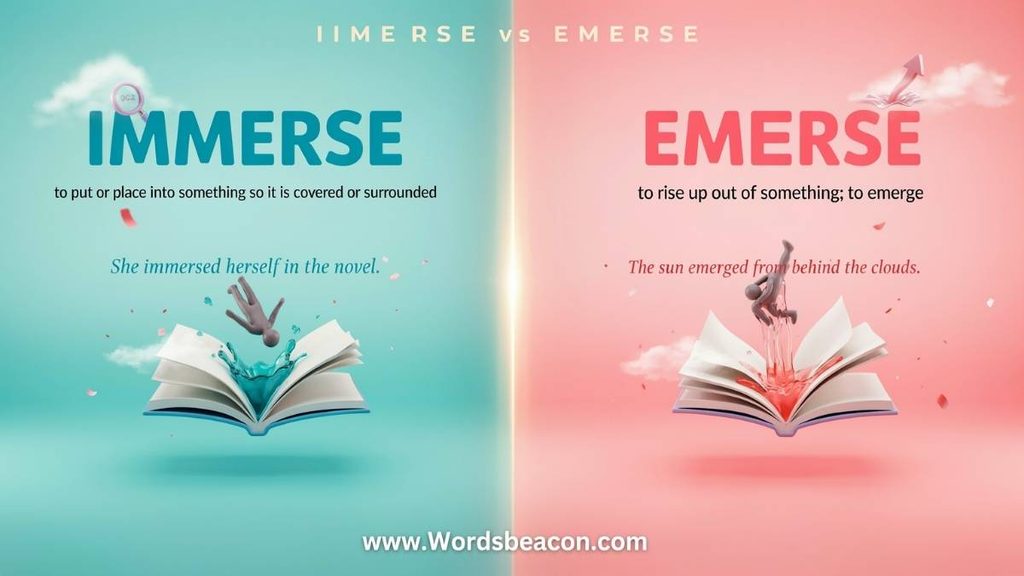
A small spelling difference can create a large difference in meaning. Fortunately, a few simple checks can help you avoid common errors.
Using Emerse Instead of Immerse
If you mean to put something into liquid or become deeply involved in an activity, choose immerse.
Incorrect for ordinary modern usage: “I want to emerse myself in French.”
Correct: “I want to immerse myself in French.”
The corrected sentence communicates the intended meaning and follows standard contemporary usage.
Using Immerse When You Mean Emerge
The reverse mistake happens when a writer wants to describe something coming out of a place.
Incorrect: “The bird immersed from the nest.”
Correct: “The bird emerged from the nest.”
The bird is coming out, not going in. That’s why emerge fits.
Confusing Emersed With Immersed
This mistake often occurs in aquarium and plant-care discussions.
- Immersed generally means placed in liquid or deeply involved in something.
- Emersed is a botanical adjective describing plant parts that rise or stand above water.
For example, a plant with foliage above the waterline may have emersed leaves. A plant growing underwater is described as submerged or submersed, depending on the context.
Assuming Emerse Is Always a Misspelling
It’s tempting to assume that every appearance of emerse is a typographical error. However, historical dictionaries and specialist references preserve uncommon or obsolete forms.
That doesn’t mean you should use the word freely. Distinguish a word that appears in a reference from the word that fits contemporary everyday writing.
When in doubt, consult a reputable dictionary such as Merriam-Webster, Cambridge Dictionary, or Collins Dictionary. For botanical terms, a specialist source can provide additional context.
Assuming Immerse Only Refers to Water
The phrase immerse yourself in a book has nothing to do with getting the pages wet. It describes giving the book your attention and becoming absorbed in its content.
Likewise, cultural immersion means actively engaging with a culture. You might learn its language, try its food, attend community events, or participate in local customs.
This figurative use is well established, so there’s no reason to replace immerse with a rare alternative.
Learn the difference between tricky grammar words
Bellies vs Bellys Which Spelling Is Correct?
Grammar Rules for Immerse vs Emerse
Correct spelling is only one part of correct word usage. Sentence structure, verb forms, and prepositions also matter.
Immerse as a Verb
Immerse is generally a transitive verb when it describes placing an object in liquid. A transitive verb takes a direct object.
Examples:
- The technician immersed the probe in the solution.
- The chef immersed the vegetables in boiling water.
- She immersed herself in the research.
In the last example, herself is a reflexive pronoun because it refers back to the subject, she.
Immerse Past Tense: Immersed or Immerse?
The past tense of immerse is immersed. The same spelling also serves as the past participle.
| Verb form | Example |
|---|---|
| Base form: immerse | Please immerse the cloth in water. |
| Third-person singular: immerses | He immerses the brush in paint. |
| Past tense: immersed | She immersed the sample yesterday. |
| Past participle: immersed | The sample has been immersed in liquid. |
| Present participle: immersing | They are immersing the material in a solution. |
Use immerse for the base form and immersed for past-tense statements or completed actions.
For example, “I want to immerse myself in art history” is correct. “I want to immersed myself in art history” is incorrect because want to must be followed by the base form of the verb.
Choosing the Right Preposition
The most common preposition used with immerse is in.
Examples include:
- Immerse the object in water.
- Immerse yourself in the language.
- Become immersed in the story.
- Remain immersed in the research.
These constructions work in both literal and figurative contexts.
You can also use immerse in passive constructions, such as “The sample was immersed in the solution.” However, active voice often sounds clearer when the person performing the action matters.
Compare:
- Active: “The technician immersed the sample in water.”
- Passive: “The sample was immersed in water by the technician.”
The active version puts the actor first and usually reads more smoothly.
Immerse vs Emerse Pronunciation Guide
The pronunciation of immerse is straightforward once you know where the stress falls. The less common emerse is harder to discuss because references don’t always treat it as a standard modern verb.
Immerse Pronunciation
In American English, immerse is pronounced /ɪˈmɝːs/. The stress falls on the second syllable.
Related forms include:
- Immersed: /ɪˈmɝːst/
- Immersing: /ɪˈmɝːsɪŋ/
The word immersion has a different final consonant sound in its stressed syllable, so it helps to practice each form separately.
Emerse Pronunciation
Because emerse is rare as a modern English verb, pronunciation guidance is less useful than understanding its context. Don’t confuse it with emerge, which ends with the sound found at the end of judge.
The related adjective emersed sounds similar to immersed in many English accents. This similarity helps explain why writers sometimes confuse the two words.
Learn the difference between commonly mixed-up more words
Shiny vs Shiney difference and Which Is Correct?
Etymology and Word Origin
The histories of immerse, emerge, and emersed help explain why the words look similar even though their modern uses differ.
Origin of Immerse
Immerse entered English through Latin and French linguistic history. Its Latin background is associated with immergere, meaning to plunge or dip into something.
Over time, its meaning expanded beyond physical immersion. Today, English speakers commonly use it for deep involvement in subjects, activities, and experiences.
Origin of Emerse and Emersed
The adjective emersed comes from Latin emersus, the past participle of emergere, meaning to rise out or come forth. English has used the word particularly in botanical descriptions of plants rising above water.
This history helps explain the connection between emersed and emerge. However, related origins don’t mean the words have identical modern meanings.
Learn the difference between commonly mixed-up more words
Macaroon vs Macaron Difference and which is correct?
practice session Immerse vs Emerse
Choosing the correct word: immerse, immersed, immersing, emerse, emersed, or emerge. Check the answer key at the end to see how well you understand the difference.
1. You should ______ yourself in the language to improve your speaking skills.
2. The children were fully ______ in the swimming pool.
3. Reading a good novel can ______ you in another world.
4. She spent the afternoon ______ herself in a new research project.
5. The diver prepared to ______ himself beneath the water.
6. After several hours underwater, the diver was ready to ______.
7. The students became completely ______ in their science experiment.
8. Listening to music helps me ______ myself in a peaceful atmosphere.
9. The plant’s leaves grew above the water, showing an ______ growth pattern.
10. The scientist studied how aquatic plants grow when their leaves are ______ above the water.
11. He wanted to ______ himself in the local culture during his trip.
12. The audience was so ______ in the performance that nobody noticed the time.
13. You can ______ your hands in warm water to soften the skin.
14. After being submerged for several minutes, the object began to ______ from the water.
15. She enjoys ______ herself in books during her free time.
16. The botanist compared submerged leaves with ______ leaves growing above the water.
17. To learn a new skill, you must ______ yourself in regular practice.
18. The swimmer slowly ______ from the pool and grabbed a towel.
19. The documentary was so interesting that I became completely ______ in it.
20. In everyday English, “immerse” is the usual word when you mean to involve yourself deeply in an activity, while “______” is rare.
Answers
- Immerse
- Immersed
- Immerse
- Immersing
- Immerse
- Emerge
- Immersed
- Immerse
- Emerged
- Emersed
- Immerse
- Immersed
- Immerse
- Emerge
- Immersing
- Emersed
- Immerse
- Emerged
- Immersed
- Emerse
Here’s a trusted source for clear word meanings:
FAQs
What is the difference between immersion and emersion in everyday English?
Immersion means becoming deeply involved in an activity or being placed in a liquid. Emersion refers to coming out of a liquid or emerging from it. Immersion is common in everyday English, while emersion is much less frequently used.
Can you use “immerse” when talking about language learning?
Yes. To immerse yourself in a language means to surround yourself with it through speaking, listening, reading, and daily practice. For example, living in a country where the language is spoken can help you immerse yourself in the local language and culture.
Why is “emerse” often confused with “emerge”?
The words look and sound similar, but their usage differs. “Emerge” is the standard word for coming into view, appearing, or coming out of something. “Emerse” is uncommon and appears mainly in specialized contexts, including descriptions of aquatic plants.
Should you use “emerse” in formal writing?
Use “emerge” when you mean to appear, become visible, or come out of something. Although “emerse” is a real but rare word, many readers may find it unfamiliar. Use it only when its specialized meaning fits the context.
What does it mean to be immersed in work?
Being immersed in work means concentrating deeply on your tasks. You may become so focused that you lose track of time or pay little attention to what’s happening around you. For example, “She was so immersed in her work that she forgot about lunch.”
Can “immerse” describe something other than water?
Yes. “Immerse” often describes mental involvement rather than physical contact with water. You can immerse yourself in a book, a research project, a new culture, or a creative activity. In each case, the word suggests deep attention and involvement.
What is the difference between an immersed plant and an emersed plant?
An immersed plant has relevant parts growing underwater, while an emersed plant has parts, such as leaves or stems, growing above the water’s surface. Botanists and aquarium enthusiasts use these terms to describe aquatic plant growth and growing conditions.
When should you use “immerse,” “submerge,” or “emerge”?
Use “immerse” when describing deep involvement or placing something in a liquid. And Use “submerge” when something goes beneath a liquid’s surface. Use “emerge” when something comes out, appears, or becomes visible. The right word depends on whether you mean involvement, going under, or coming out.
Can someone be immersed in thoughts or emotions?
Yes. You can be immersed in thought, memories, music, or emotions. The word emphasizes deep mental or emotional involvement. For example, “He was immersed in thought and didn’t hear the phone ring.”
What is the difference between “immersion” and “immersive”?
“Immersion” is a noun that describes the process or state of becoming deeply involved in something. “Immersive” is an adjective that describes an experience or environment that draws someone in. For example, “Language immersion helps learners practice” and “The game offers an immersive experience.”
What does “reimmerse” mean?
“Reimmerse” means to immerse something or someone again. It can describe placing an object back into a liquid or returning to an activity with renewed attention. For clarity, you can also write “immerse again,” especially when your audience may not recognize the less familiar term.
Is “emersion” the opposite of “immersion”?
In the physical sense, emersion can describe emerging from a liquid, making it a counterpart to immersion. However, when immersion refers to deep involvement in work or an activity, its opposite depends on the context. Words such as “disengagement,” “distraction,” or “withdrawal” may express the intended contrast more accurately.
Learn the difference between commonly mixed-up more words
Unphased vs Unfazed difference and correct usage?
Conclusion
Understanding Immerse vs Emerse doesn’t have to be confusing. When comparing Immerse vs Emerse, remember that immerse is the word you’ll use most often when talking about getting deeply involved in something, such as a book, a project, or a new culture. It can also mean putting something into water. Emerse is much less common and appears mainly in specialized contexts, such as describing plants that grow above the water’s surface. If you mean to come out, appear, or become visible, use emerge instead. Understanding the Immerse vs Emerse difference helps you avoid common spelling and grammar mistakes. With a little practice, the Immerse vs Emerse choice will feel natural, and you won’t need to dive into a dictionary every time!

Luna AJS is an experienced blogger and dedicated language enthusiast at Words Beacon. She specializes in making English grammar, spelling, vocabulary and commonly confused words easy to understand. She provides clear explanations, practical examples to help readers write with confidence.