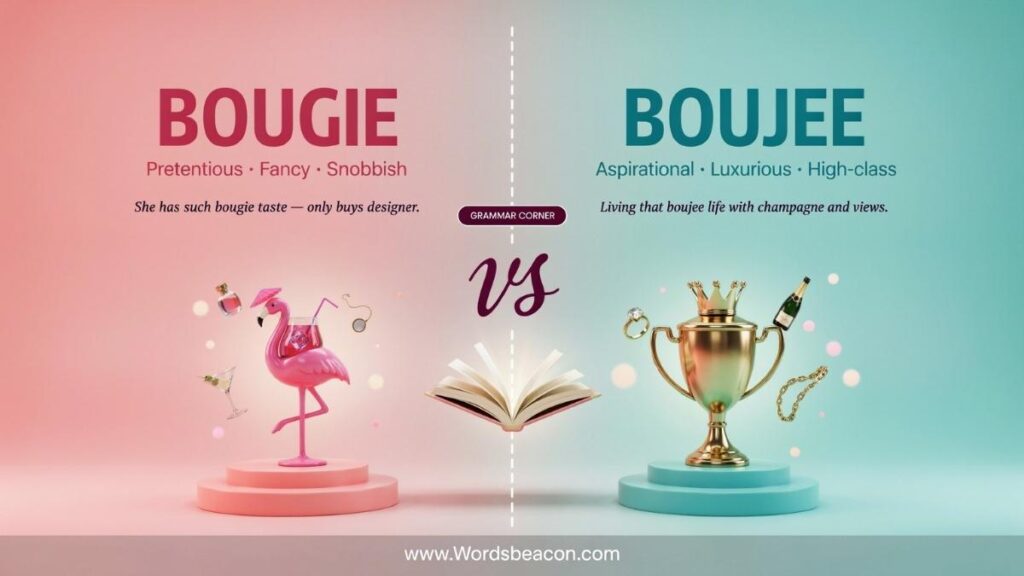
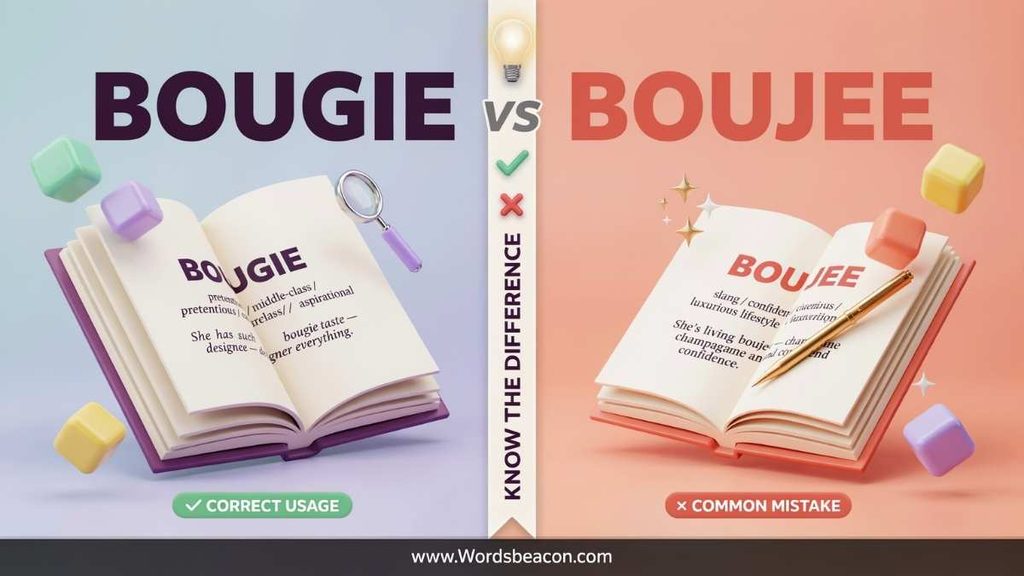
Bougie vs boujee can be confusing because both spellings describe fancy tastes, expensive things, and a love of luxury. But which spelling is correct, and does choosing one over the other really matter? The good news is that you don’t need a luxury shopping budget to figure it out! Bougie is the more established spelling, while boujee is a popular slang variation often used in music, casual conversations, and social media. Although both words share a similar meaning, they can create slightly different tones. This guide explains their meanings, differences, and everyday uses so you can avoid spelling mistakes and choose the right word with confidence.
quick comparison table
| Feature | Bougie | Boujee |
|---|---|---|
| Meaning | Fancy, upscale, luxurious, or status-conscious | Fancy, luxurious, or associated with an upscale lifestyle |
| Spelling | More established spelling | Informal slang variant |
| Tone | Can sound playful, admiring, or critical | Often sounds playful, trendy, or celebratory |
| Origin | Connected to the French word bourgeois | Popularized through modern slang and hip-hop culture |
| Common use | Everyday conversation, informal writing, lifestyle descriptions | Texts, captions, music, and casual conversation |
| Example | That café is too bougie for my budget. | We booked a boujee hotel for the weekend. |
Understand confusing English more words simply
Immerse vs Emerse Which one Is Correct?
What Does Bougie Mean?
Bougie is an informal slang word that describes someone or something associated with luxury, expensive tastes, social status, or an upscale lifestyle. People often use it for people who enjoy fancy things, even when those things seem unnecessary or overly expensive.
For example, someone might call a restaurant bougie because it serves tiny portions on expensive plates. Another person might use the word to describe a friend who insists on drinking specialty coffee instead of making it at home.
The word can express admiration, humor, or criticism. Its meaning depends on the situation and the speaker’s tone.
Bougie Meaning in Everyday Language
In everyday conversation, bougie usually refers to a preference for things that feel luxurious, sophisticated, or expensive.
Consider these examples:
- That hotel is too bougie for a one-night stay.
- My sister has a bougie taste in furniture.
- We found a bougie little café with gold chairs and fancy desserts.
- He bought a bougie coffee machine that costs more than my laptop.
In each sentence, bougie suggests that something feels upscale or costs more than an ordinary alternative.
However, the word doesn’t always describe genuine wealth. Someone can have an average income and still enjoy expensive coffee, designer clothes, or luxury skincare. In that case, bougie describes their preferences rather than their financial situation.
Is Bougie an Insult?
Bougie can be an insult, but it doesn’t have to be one.
When someone says, “You’re so bougie,” they might be teasing you for having expensive tastes. They might also be criticizing you for acting superior or caring too much about social status.
For example:
- Playful: “You’re so bougie. You won’t drink coffee unless it’s from that little café.”
- Critical: “He acts too bougie to shop at an ordinary grocery store.”
- Positive: “This hotel is bougie in the best possible way.”
The context makes the difference. A friend might use bougie affectionately, while a stranger might use it to suggest that someone is snobbish.
Understand confusing English more words simply
Flier vs Flyer difference and usage ?
What Does Boujee Mean?
Boujee is an informal slang spelling closely associated with bougie. It describes someone or something that feels fancy, luxurious, fashionable, or connected to an upscale lifestyle.
The spelling became especially popular through the 2016 hip-hop song “Bad and Boujee” by Migos. The song helped bring the term into mainstream conversations, music, and social media.
Today, people often use boujee when they want a casual, expressive way to describe luxury or expensive tastes.
Boujee Meaning in Everyday Language
Boujee can describe a person, place, product, experience, or lifestyle.
For example:
- She booked a boujee hotel for her birthday.
- That restaurant looks seriously boujee.
- We’re having a boujee dinner tonight.
- His new apartment has a very boujee look.
The word often adds a playful or stylish tone. It can make an ordinary experience sound more glamorous, whether the luxury is genuine or exaggerated for fun.
For instance, buying a fancy coffee before work might inspire someone to post, “Starting my boujee morning right.”
The person doesn’t need to be wealthy. They may simply enjoy treating themselves to something special.
Is Boujee a Real Word?
Yes. Boujee is a recognized informal spelling variant of bougie. Major dictionaries acknowledge the form, although bougie remains the more established spelling.
That means boujee isn’t automatically a spelling mistake. It works in casual writing when it fits the tone and audience.
However, dictionary recognition doesn’t make it suitable for every setting. Boujee remains slang, so you should usually avoid it in formal reports, academic writing, and professional documents.
For example:
- Casual: “We found a boujee restaurant downtown.”
- More formal: “We found an upscale restaurant downtown.”
Both sentences communicate a similar idea, but the second sounds more appropriate in formal writing.
Understand confusing English more words simply
Shiny vs Shiney difference and Which Is Correct?
Bougie vs Boujee What Is the Difference?
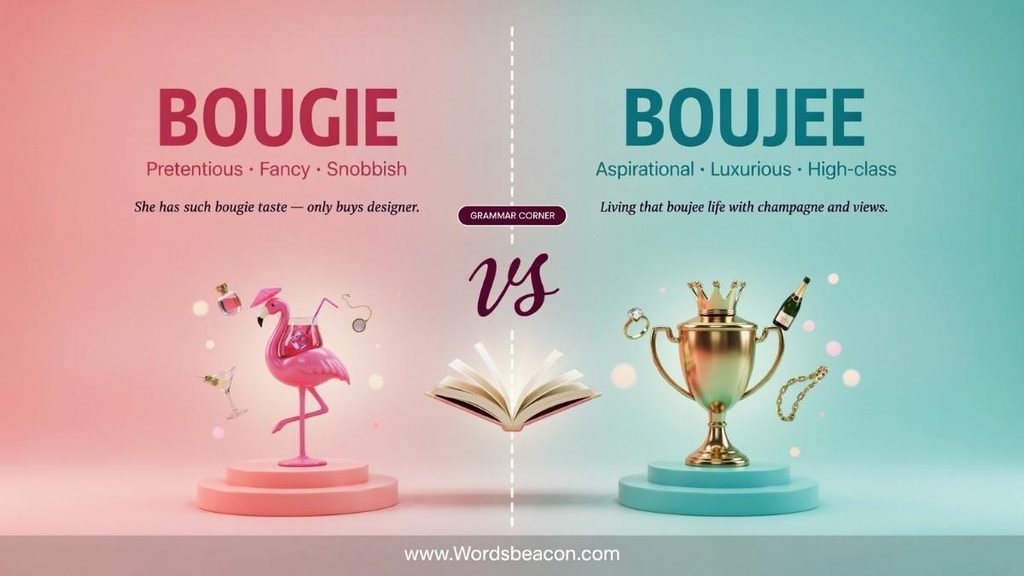
The main difference between bougie vs boujee is spelling and cultural association. Both words generally describe luxury, expensive tastes, or an upscale lifestyle.
Bougie has a longer history as an English slang term. Boujee is a popular variant associated with contemporary slang, hip-hop, and social media.
Although people sometimes use the spellings to suggest different attitudes, the distinction isn’t fixed. One person might use bougie as a compliment, while another might use it as an insult. The same goes for boujee.
Spelling Difference
The spelling is the easiest difference to identify.
Bougie uses the letters “g” and “ie” at the end. Boujee uses “j” and “ee.”
Both spellings usually represent the same pronunciation in slang.
- Bougie: The hotel feels bougie.
- Boujee: The hotel feels boujee.
Neither sentence is inherently wrong. The writer chooses the spelling that best fits the intended style.
Difference in Tone
Bougie sometimes carries a more critical or ironic tone. It can suggest that someone is overly concerned with wealth, appearances, or social status.
Boujee often feels more playful, fashionable, or celebratory, especially in social media captions and casual conversations.
Compare these examples:
- “That restaurant is bougie.” This could suggest that the restaurant is expensive or pretentious.
- “That restaurant is boujee.” This could sound like an enthusiastic description of a stylish place.
However, these are tendencies, not strict rules. Either spelling can express admiration, humor, or disapproval.
Difference in Usage
Bougie is the safer choice when you want the more established spelling. It’s suitable for general informal writing, including lifestyle articles and everyday descriptions.
Boujee often suits casual contexts where a trendy or expressive tone feels natural. You might see it in social media captions, memes, texts, and conversations about fashion or luxury.
For example:
- Blog: “The neighborhood has several bougie cafés.”
- Social media: “A boujee brunch with my favorite people.”
You can use either spelling in casual conversation. Just avoid switching between them randomly in the same article or piece of writing.
Learn the difference between commonly mixed-up more words
Reins vs Reigns which spelling is correct ?
Bougie vs Boujee Which Spelling Is Correct?
Both spellings are used, but bougie is the more established form. Boujee is a recognized informal variant.
If you’re unsure which spelling to choose, use bougie. It has a longer history and is the more common spelling in dictionary entries.
Choose boujee when you deliberately want the contemporary slang style associated with popular culture.
The distinction is similar to choosing between a familiar everyday word and a more playful variation. Your choice affects the tone more than the basic meaning.
When to Use Bougie
Use bougie when you want the established spelling in informal writing.
It works well when describing:
- Expensive restaurants
- Luxury hotels
- Stylish clothing
- Fancy home décor
- High-end products
- People with expensive tastes
Examples:
- My parents booked a bougie resort for their anniversary.
- That boutique sells bougie home accessories.
- Her apartment looks bougie, but she found everything on sale.
When to Use Boujee
Use boujee when you want a more casual, expressive, or pop-culture-inspired tone.
It’s particularly common in:
- Social media captions
- Text messages
- Casual conversations
- Memes and humorous posts
- Informal descriptions of luxury
Examples:
- A boujee dinner calls for a great outfit.
- Just enjoying my little boujee moment.
- We found a boujee café with a beautiful rooftop view.
Neither spelling is restricted to a specific platform. The examples simply reflect the tones each spelling often suggests.
Learn the difference between commonly mixed-up more words
Signer vs Signor Differences and Usage ?
Bougie vs Boujee Examples in Sentences
The easiest way to understand the difference between bougie vs boujee is to see how people use them in everyday situations.
Examples of Bougie
- That restaurant is too bougie for my usual lunch budget.
- She has a bougie taste in home décor.
- We stayed at a bougie hotel near the beach.
- His bougie coffee order takes five minutes to explain.
- This neighborhood has become surprisingly bougie.
- They bought a bougie sofa that looks like it belongs in a magazine.
- My friend is too bougie to use instant coffee.
- The wedding had a bougie theme with candles and crystal glasses.
- That little boutique sells bougie gifts.
- I love the food, but the restaurant feels a bit bougie.
These examples show how bougie can describe people, places, products, and experiences. Depending on the context, it can sound affectionate, humorous, or judgmental.
Examples of Boujee
- We’re having a boujee brunch on Sunday.
- She wore a boujee outfit to the party.
- This hotel room looks so boujee.
- He treated himself to a boujee dinner after getting promoted.
- My weekend plans are simple: a boujee coffee and a good book.
- They booked a boujee suite for their anniversary.
- Her new handbag gives the whole outfit a boujee feel.
- That rooftop bar is perfect for a boujee night out.
- I made my regular pasta look boujee with fresh herbs.
- A little boujee dessert never hurt anyone.
Boujee often gives these sentences a playful, fashionable feel. It can also describe a small luxury that someone enjoys without taking themselves too seriously.
Bougie vs Boujee A Quick Comparison in Real Life
Imagine two friends visiting the same expensive café. One orders a specialty coffee, while the other chooses a simple tea.
The first friend might describe the café as bougie because the prices are high and the menu feels fancy. The second might post a picture with the caption, “Having a boujee afternoon.”
Both descriptions fit the same setting, but they emphasize different things.
| Situation | Bougie example | Boujee example |
|---|---|---|
| Café | This café is too bougie for my budget. | Enjoying a boujee coffee date. |
| Clothing | That store sells bougie designer clothes. | This outfit makes me feel boujee. |
| Travel | We stayed at a bougie resort. | Our boujee vacation starts today. |
| Food | This restaurant is a little bougie. | We made a boujee dinner at home. |
| Home décor | Her apartment has a bougie style. | Giving my living room a boujee makeover. |
The meaning remains similar in each pair. The spelling mainly changes the style and feel of the sentence.
How Do You Pronounce Bougie vs Boujee?
Bougie and boujee are usually pronounced the same way in modern slang. The pronunciation commonly sounds like “BOO-zhee,” although some speakers use a “j” sound instead of the softer “zh” sound.
The spelling doesn’t reliably tell you that a speaker intends a different pronunciation. In everyday conversation, the words generally sound alike.
Why Do They Sound the Same?
The boujee spelling uses “j” to represent the sound many speakers associate with the word. Bougie keeps the spelling connected to bourgeois.
English slang often develops spellings that reflect pronunciation, humor, or cultural style. Boujee follows that pattern.
You don’t need to pronounce the two words differently just because they look different.
Where Did Bougie vs Boujee Come From?
The history of bougie and boujee connects to the French word bourgeois, which refers to the middle class and has also carried associations with social status, material comfort, and conventional respectability.
Over time, bourgeois developed into a term that could criticize people who seemed overly concerned with wealth, possessions, or social standing.
The slang form bougie shortened and adapted that word. Its modern meaning often focuses on expensive tastes, luxury, or behavior that seems pretentious.
The Origin of Bougie
Dictionary sources trace the slang use of bougie to the mid-to-late 1960s, with the word becoming more established in later decades.
The slang meaning grew from the social associations of bourgeois. Instead of referring only to a social class, bougie came to describe people, places, and things that seem upscale, materialistic, or overly concerned with status.
For example, someone might call a person bougie because they prefer luxury brands or look down on less expensive options.
It’s worth noting that bougie has other meanings unrelated to this slang use. In medical contexts, it can refer to a slender instrument used in certain body passages. It has also referred to a type of candle. Those meanings have separate histories, so they shouldn’t be confused with the modern slang adjective.
How Boujee Became Popular
Boujee gained widespread recognition through popular culture, particularly hip-hop.
Migos’ 2016 song “Bad and Boujee” helped popularize the spelling. The word subsequently appeared more frequently in online conversations, captions, memes, and discussions of fashion and lifestyle.
The spelling became associated with a confident, fashionable, and luxurious image. However, its meaning still overlaps heavily with bougie.
The Cultural Background of Boujee
Boujee has important connections to Black American speech and hip-hop culture. Its popularity grew through a cultural context that gives the term more meaning than simply “fancy.”
Because of that history, it’s helpful to understand the context before using it. The word can express pride, humor, or a particular relationship with wealth and social mobility. It can also be used carelessly as a generic label for anything expensive.
As with many slang terms, the speaker, audience, and situation affect how the word comes across.
Learn the difference between commonly mixed-up more words
Cancelation vs Cancellation Which Spelling Is Correct?
Is Bougie vs Boujee More Formal?
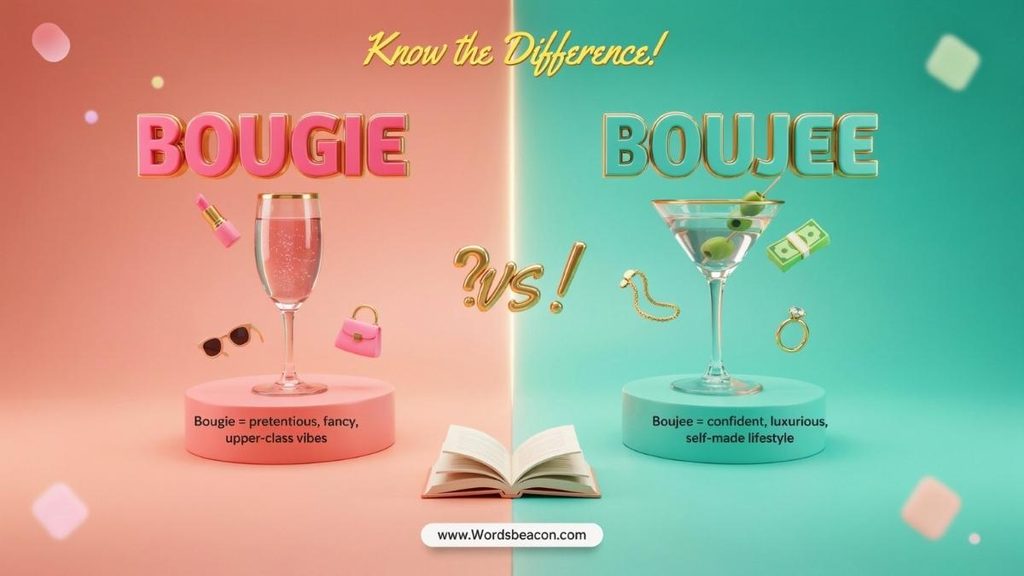
Neither bougie nor boujee is a formal word in most contexts. Both are slang or informal expressions, even though bougie has a longer history and broader dictionary recognition.
For professional or academic writing, choose a more precise alternative.
| Informal wording | More formal alternative |
|---|---|
| A bougie restaurant | An upscale restaurant |
| A boujee hotel | A luxury hotel |
| A bougie lifestyle | An affluent lifestyle |
| A boujee outfit | An elegant or designer outfit |
| A bougie attitude | A status-conscious attitude |
| A bougie person | A person with expensive tastes |
The best replacement depends on what you want to communicate. Upscale and luxurious describe quality or expense. Pretentious suggests that someone is trying too hard to appear important. Status-conscious focuses on concern with social standing.
Learn the difference between similar English words
Macaroon vs Macaron Difference and which is correct?
How to Use Bougie and Boujee in Different Contexts
Both spellings work in casual writing, but your audience should guide your choice.
In Text Messages
Either spelling works in a text message. Choose the one that sounds natural to you.
Examples:
- “That café is so bougie.”
- “Let’s have a boujee night out.”
- “You’re getting bougie with that coffee order.”
These examples sound conversational and informal.
On Social Media
Boujee often fits social media captions because it has a playful, expressive feel.
Examples:
- “A little boujee moment.”
- “Boujee brunch with my favorite people.”
- “Living my boujee life, one coffee at a time.”
Bougie also works well in captions, especially when you’re joking about expensive tastes.
For example: “My bougie side came out when I saw the hotel bathroom.”
In Blog Posts and Articles
Bougie is generally the safer spelling for an informal article because it’s the more established form.
However, if you’re writing about a song, a social media trend, or a specific use of the word boujee, keep that spelling.
For a formal article, you may want to replace both words with clearer descriptions such as upscale, luxurious, or status-conscious.
In Professional Communication
Avoid both spellings in formal emails, reports, proposals, and business presentations unless you’re discussing the slang term itself.
Instead of writing, “The event had a boujee atmosphere,” write, “The event had an elegant atmosphere.”
The second sentence communicates the idea without relying on slang.
Learn the difference between similar English words
Pricey vs Pricy Which Spelling Is Correct?
Common Mistakes When Using Bougie vs Boujee
The two spellings are easy to confuse, but a few simple guidelines can prevent common errors.
Assuming Boujee Is Always Wrong
Boujee is a recognized slang variant. It isn’t automatically a typo.
However, bougie remains the more established spelling, so it’s the safer choice when you aren’t sure which form fits.
Assuming the Words Have Completely Different Meanings
Bougie and boujee generally share the same core meaning. Some speakers use them to suggest different tones, but the distinction varies.
Don’t assume that bougie always means pretentious or that boujee always means luxurious.
Using Either Word in Formal Writing
Both words are informal. In a professional report, an academic paper, or a formal proposal, a more precise term usually works better.
Choose words such as upscale, luxurious, extravagant, or pretentious according to the meaning you intend.
Confusing Bougie With Boogie
Bougie and boogie are different words.
Bougie is slang associated with luxury, expensive tastes, or social status.
Boogie can refer to a style of music or dancing. It also appears in the phrase “let’s boogie,” which means to dance or get moving.
For example:
- “That restaurant is bougie.”
- “Let’s boogie on the dance floor.”
The similar spelling doesn’t make the words interchangeable.
Switching Spellings Without a Reason
If you’re writing an article or a long social media post, choose one spelling and use it consistently.
For general informal writing, bougie is a sensible default. Use boujee when the slang style or cultural context makes it the better choice.
Synonyms for Bougie and Boujee
Several words can replace bougie vs boujee, but each carries a slightly different meaning.
- Fancy: stylish, elaborate, or more special than usual.
- Upscale: associated with higher quality, higher prices, or affluent customers.
- Luxurious: offering comfort, elegance, or expensive features.
- Extravagant: spending or displaying more than necessary.
- Sophisticated: showing refinement, knowledge, or polished taste.
- Pretentious: trying to appear more important, cultured, or wealthy than you are.
- Status-conscious: concerned with social position, prestige, or appearances.
- Chic: stylish and fashionable.
For example, “a bougie hotel” could become “an upscale hotel” if you simply mean that it’s expensive and stylish. If you want to criticize its showiness, “a pretentious hotel” might communicate your point more clearly.
Learn the difference between similar English words
Bellies vs Bellys Which Spelling Is Correct?
practice session Bougie vs Boujee
Complete each sentence with the correct word: bougie vs boujee. Use the meaning and context of each sentence to choose the best answer.
- That luxury hotel looks incredibly ________.
- My friend has a ________ taste in home décor.
- We planned a ________ brunch at a fancy rooftop restaurant.
- She thinks this café is too ________ for her budget.
- He bought a ________ coffee machine that costs a fortune.
- We’re having a ________ dinner to celebrate her promotion.
- That boutique sells ________ designer accessories.
- My sister loves her ________ skincare products.
- They booked a ________ resort for their anniversary.
- His ________ lifestyle includes designer clothes and expensive restaurants.
- She posted a picture of her ________ birthday party.
- This restaurant feels a little too ________ for a casual lunch.
- We dressed up for a ________ night out.
- He made his homemade pasta look surprisingly ________.
- The apartment has a ________ kitchen with marble countertops.
- She joked that her expensive coffee order made her look ________.
- They enjoy visiting ________ cafés on the weekends.
- The song “Bad and ________” helped popularize the modern slang spelling.
- My cousin can be quite ________ when choosing hotels.
- We treated ourselves to a ________ vacation after a busy year.
Answers
- Boujee
- Bougie
- Boujee
- Bougie
- Bougie
- Boujee
- Bougie
- Bougie
- Boujee
- Bougie
- Boujee
- Bougie
- Boujee
- Boujee
- Bougie
- Bougie
- Boujee
- Boujee
- Bougie
- Boujee
Here’s a trusted source for clear word meanings:
FAQs
What does bougie mean in American slang?
In American slang, bougie describes someone or something that seems fancy, upscale, expensive, or focused on social status. For example, someone who prefers luxury hotels and high-end restaurants might be described as bougie.
What does boujee mean in slang?
Boujee is an informal spelling of bougie that often suggests a glamorous, stylish, or luxurious lifestyle. People commonly use it when discussing fashion, dining, travel, and other upscale experiences.
How do you spell bougie when you mean fancy?
Bougie is the more established spelling. Boujee is also a recognized slang variant, especially in casual conversations and pop culture. Both spellings can describe something fancy or luxurious.
Is bougie the same as classy?
Not exactly. Classy describes elegance, refinement, or good taste, while bougie often suggests expensive tastes or an upscale lifestyle. Bougie can sometimes imply pretentiousness, whereas classy usually carries a positive meaning.
What does it mean when someone calls a girl boujee?
It usually means she enjoys fashionable clothes, luxury products, stylish surroundings, or upscale experiences. Depending on the context, the description can sound flattering, playful, or critical. It doesn’t necessarily mean she’s wealthy.
Can a guy be boujee?
Yes. Boujee applies to people of any gender. A guy who enjoys designer clothes, luxury watches, premium travel, or expensive restaurants might be described as boujee.
What does a boujee lifestyle look like?
A boujee lifestyle often includes experiences or possessions associated with luxury. Examples include staying at high-end hotels, visiting trendy restaurants, buying designer accessories, and choosing premium products. However, enjoying an occasional luxury doesn’t mean someone lives an extravagant lifestyle.
What are some examples of bougie things?
Common examples include specialty coffee, luxury skincare, designer furniture, expensive brunch spots, and premium hotel rooms. Whether something seems bougie depends on the setting, personal preferences, and budget.
Is bougie a compliment or an insult?
Bougie can be either. Someone might use it to praise a stylish outfit or an elegant restaurant. However, it can also criticize someone who seems snobbish, materialistic, or overly concerned with appearances. The speaker’s tone and intention determine how it comes across.
Is it rude to call someone boujee?
Not necessarily. Friends may use boujee playfully when teasing each other about expensive tastes. However, someone might take offense if the word sounds judgmental or suggests they’re trying to appear wealthier than they are. Consider your relationship with the person before using it.
Why do people call themselves bougie?
People may call themselves bougie to joke about their expensive tastes, celebrate their personal style, or show that they enjoy treating themselves. The term can express confidence and humor without suggesting that someone is genuinely wealthy.
What is the difference between bougie and classy?
Bougie focuses more on luxury, expensive tastes, and social status. Classy emphasizes elegance, refinement, and tasteful behavior. An expensive designer outfit might seem bougie, while a simple, elegant outfit might be considered classy.
What is a better word for bougie?
The best alternative depends on what you mean. Upscale describes something high-end, luxurious emphasizes comfort and expense, chic means stylish, and sophisticated suggests refinement. If you want to criticize someone for showing off, pretentious may be more accurate.
What is the opposite of bougie?
There isn’t one exact opposite. Depending on the context, modest, simple, down-to-earth, low-key, or unpretentious may communicate the opposite idea. For example, a low-key café may feel very different from a bougie restaurant with elaborate décor and premium prices.
Do people still use bougie and boujee?
Yes. Both spellings remain recognizable in casual conversations, lifestyle discussions, and social media. Bougie is the more established spelling, while boujee often adds a playful or pop-culture-inspired tone.
When did bougie and boujee become popular?
The slang use of bougie dates back several decades, with dictionary sources tracing it to around the 1960s. Boujee gained broader mainstream attention through hip-hop, particularly Migos’ 2016 song “Bad and Boujee.”
Is boujee a proper word?
Boujee is a recognized informal slang variant of bougie. It’s suitable for casual writing when the tone fits, but words such as upscale, luxurious, or fashionable are usually better choices in formal or professional writing.
What does “so boujee” mean?
“So boujee” emphasizes that someone or something seems especially fancy, luxurious, or stylish. For example, saying “This dessert is so boujee” suggests that it looks or feels unusually elaborate or high-end.
What makes someone bougie?
Someone might seem bougie because they prefer expensive products, enjoy upscale experiences, or pay close attention to appearances and status. However, enjoying luxury items doesn’t automatically make someone pretentious. The label often reflects the speaker’s opinion as much as the person’s behavior.
Is bougie slang for fancy?
Yes. Bougie often means fancy in informal American English, but it can also suggest expensive tastes, social status, or materialism. Depending on the context, it may carry a playful, admiring, or critical tone.
Learn the difference between similar English words
Realist vs Realest difference and usage ?
Conclusion
Now that you understand bougie vs boujee, choosing the right spelling should be much easier. Both words describe fancy tastes, luxurious experiences, or an upscale lifestyle. The main difference is that bougie is the more established spelling, while boujee is a popular slang variation often used in casual conversations and social media. Neither spelling is automatically wrong, and both can carry a playful, positive, or critical meaning depending on the context. If you’re unsure which one to use, choose bougie for a familiar spelling or boujee when you want a trendy, casual tone. Remember, enjoying fancy coffee doesn’t make you rich, but paying $15 for one might make you feel pretty boujee!

Luna AJS is an experienced blogger and dedicated language enthusiast at Words Beacon. She specializes in making English grammar, spelling, vocabulary and commonly confused words easy to understand. She provides clear explanations, practical examples to help readers write with confidence.