
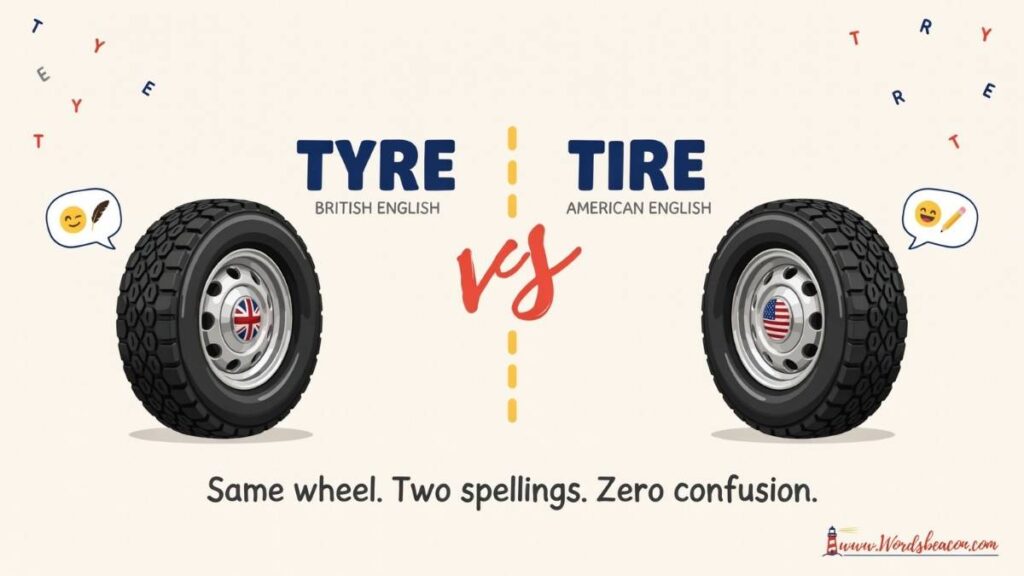
The tyre vs tire question can make one simple car part feel like a surprisingly tricky spelling test. The good news is that the difference is easy to understand. Tire and tyre mean the same thing when they refer to the rubber covering around a vehicle wheel. American English usually uses tire, while British English uses tyre. There is one small catch: tire can also be a verb meaning to become tired or make someone tired, and that spelling stays the same in both varieties. In this guide, you will see when to use tire or tyre, how their plural forms work, and how to avoid common mistakes.
Quick Answer
The simplest answer is that tire and tyre have the same meaning when they refer to a vehicle wheel covering. The spelling changes according to the variety of English being used.
| Word | Standard usage | Meaning |
|---|---|---|
| Tire | American English | Rubber covering fitted around a vehicle wheel |
| Tyre | British English | Rubber covering fitted around a vehicle wheel |
| Tire | American and British English | To become tired or make someone tired |
American English normally uses tire, while British English normally uses tyre for the vehicle part. Cambridge identifies tyre as the UK spelling of tire and defines tire as the rubber ring fitted around a vehicle wheel.
For example, an American writer might say, “The car needs a new tire.” A British writer would normally say, “The car needs a new tyre.”
The vehicle does not change. The spelling does.
Learn the difference between confusing more English words
Sneek vs Sneak difference and usage?
What Does Tire Mean?
In American English, tire is commonly used as a noun for the rubber covering around a vehicle wheel. A tire helps a vehicle maintain contact with the road and plays an important role in traction, handling, braking, and ride comfort.
You might see sentences such as:
“The front tire is flat.”
“The mechanic replaced the rear tire.”
“Check the tire pressure before the trip.”
“These tires have good traction.”
“My spare tire is in the trunk.”
In each sentence, tire is a noun because it names a physical object.
The plural form is tires. Therefore, one tire becomes two or more tires.
Tire as a Verb
The word tire has another completely different use. It can function as a verb meaning to become tired, lose energy, or make someone tired.
For example:
“The long hike began to tire us.”
Here, tire has nothing to do with a vehicle. It describes the effect of the hike on the people taking part in it.
You can also say, “The children began to tire after several hours” or “The steep climb will tire you.”
This meaning creates the tire vs tired confusion for some learners.
Tire is the verb, while tired commonly describes a person’s condition.
For example:
“The long journey will tire me.”
“I am tired after the journey.”
The first sentence describes an action or effect. The second describes a state.
Learn the difference between confusing more English words
Peices vs Pieces difference and usage?
What Does Tyre Mean?
The tyre meaning is essentially the same as the vehicle-related meaning of tire. The difference lies in spelling.
Tyre is the standard British English spelling for the rubber covering fitted around a vehicle wheel.
A British writer might say:
“The car tyre needs replacing.”
“The front tyre is flat.”
“Check the tyre pressure.”
“The mechanic changed all four tyres.”
“The spare tyre is in the boot.”
Here, tyre is a noun. Its plural form is tyres.
This gives you a simple pattern:
American English: tire → tires
British English: tyre → tyres
Tyre as a Noun
The word tyre as a noun refers to the same physical component that Americans call a tire. It can describe the rubber covering on cars, motorcycles, bicycles, trucks, buses, and other vehicles.
The spelling does not indicate a different type of rubber, a different wheel design, or a different manufacturing process. It simply reflects a regional spelling convention.
Tyre as a Verb
This is where things become slightly more interesting.
If you are using British English and want to say that something makes you tired, use tire rather than tyre.
For example:
“The long walk began to tire him.”
That sentence is correct.
Writing “The long walk began to tyre him” would not be the normal standard spelling for the verb meaning to become tired.
Some dictionaries record specialized uses of tyre as a verb connected with fitting tires or tyres to wheels. However, that is not the everyday verb most people mean when they say someone may tire after a long journey.
For ordinary writing, remember the distinction clearly: tyre is the British noun for the vehicle part, while tire remains the usual verb meaning to become tired or make someone tired.
Learn the difference between confusing more English words
Advise vs Advice difference and Usage?
Tyre vs Tire Spelling The Main Difference
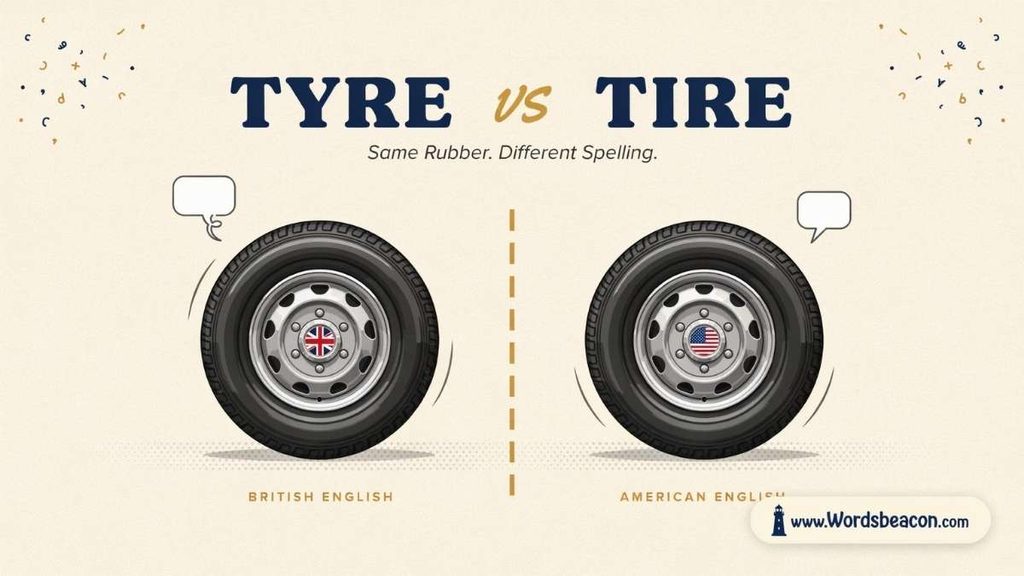
The main tyre vs tire spelling difference is regional.
American English uses tire for the vehicle part.
British English uses tyre.
The two forms have the same basic meaning, so neither should automatically be called wrong.
| Context | American English | British English |
|---|---|---|
| One vehicle wheel covering | tire | tyre |
| More than one | tires | tyres |
| Flat vehicle covering | flat tire | flat tyre |
| Air pressure | tire pressure | tyre pressure |
| Verb meaning become tired | tire | tire |
| Feeling exhausted | tired | tired |
This is a straightforward example of regional spelling differences in the English language. Similar differences appear throughout English vocabulary, which is why a spelling that looks unusual to one reader may be perfectly standard to another.
What Is the Difference Between Tyre and Tire?
If someone asks, “What is the difference between tyre and tire?” the answer is simple.
They are different spellings of the same vehicle-related noun.
Tire is standard in American English.
Tyre is standard in British English.
The difference is linguistic rather than mechanical. A rubber wheel covering does not suddenly become a different object when it crosses from the United States to the United Kingdom.
The same applies to the words used for related things. Americans commonly write tire pressure and tire replacement, while British writers use tyre pressure and tyre replacement.
The meaning remains clear in both varieties.
Tyre vs Tire Comparison
| Feature | Tire | Tyre |
|---|---|---|
| American English | Standard | Not the usual standard spelling |
| British English | Not the usual vehicle spelling | Standard |
| Meaning | Vehicle wheel covering | Vehicle wheel covering |
| Singular | tire | tyre |
| Plural | tires | tyres |
| Pronunciation | Generally the same | Generally the same |
| Verb meaning become tired | Yes | No in ordinary standard usage |
| Example | The tire is flat. | The tyre is flat. |
This comparison answers most questions about the tyre and tire difference in one glance.
Tyre vs Tire Pronunciation
The tyre vs tire pronunciation question is much easier than the spelling question.
When these words refer to the vehicle component, they are generally pronounced alike. The main difference appears on the page rather than in ordinary speech.
That can make the spelling seem even stranger to English learners. You may hear someone say the word and have no idea whether they would write tire or tyre.
The answer depends on their variety of English.
An American writer will normally write tire.
A British writer will normally write tyre.
Pronunciation can vary slightly between accents, as many English words do, but the spelling difference itself does not normally create a separate pronunciation.
Learn the difference between confusing more English words
Crier vs Cryer Difference and usage ?
Tyre vs Tire Plural Tyres vs Tires?
The tyre vs tire plural question has a simple answer.
American English uses tires.
British English uses tyres.
For example:
American English: “The mechanic checked all four tires.”
British English: “The mechanic checked all four tyres.”
Both sentences are grammatically correct. The difference comes from regional spelling.
So, when someone asks, “Is it tyres or tires?” the best answer is that both forms exist, but they belong to different spelling conventions.
The important thing is consistency. If you start an article using American spelling, switching to British spelling halfway through can make the writing look careless.
Is Tyre vs Tire Correct?
The question “Is tyre or tire correct?” does not have one universal answer.
Both spellings are correct when they match the appropriate variety of English.
Use tire for the vehicle noun in American English.
Use tyre for the vehicle noun in British English.
Canadian English generally uses tire as well. Australia and New Zealand generally use tyre.
This means your audience matters.
If you are writing for readers in the United States, tire will look natural. If you are writing for readers in the United Kingdom, tyre will usually be expected.
Neither spelling needs to be treated as a mistake simply because it is unfamiliar in another variety of English.
Is Tire vs Tyre Correct in Canadian English?
Canadian English has its own spelling patterns, and it does not simply copy British or American English in every case.
For this particular word, Canadian English generally uses tire.
One familiar example is the Canadian company Canadian Tire, whose name uses the American-style spelling.
So a Canadian writer would normally write:
“I need to buy new tires.”
This is a good reminder that regional spelling cannot always be reduced to a simple British-versus-American rule.
Is Tyre British English?
Yes. Tyre is the standard British English spelling for the vehicle noun.
A British writer would normally write:
“The car has a flat tyre.”
“The tyres need replacing.”
“The tyre pressure is too low.”
However, British English still uses tire as the verb meaning to become tired or make someone tired.
For example:
“The long journey began to tire him.”
That distinction is worth remembering because it prevents a common spelling mistake.
Learn the difference between similar English words
Laid Down vs Lied Down Difference and usage?
Australian English Tyre and New Zealand English Tyre
Australian English generally uses tyre for the vehicle component. New Zealand English does the same.
That means you will commonly see forms such as car tyre, spare tyre, tyre pressure, and new tyres in Australian and New Zealand writing.
These varieties have strong historical connections to British English spelling conventions, although each variety has developed its own vocabulary and usage over time.
So it is useful to remember:
American English: tire
Canadian English: tire
British English: tyre
Australian English: tyre
New Zealand English: tyre
This is a useful general guide, although a particular organization can follow its own editorial style.
Commonwealth English Tyre
The phrase Commonwealth English tyre can be useful when discussing British-influenced spelling, but it should not be treated as a rule that applies identically to every Commonwealth country.
Different countries have developed their own standards.
Australia and New Zealand generally use tyre. Canada generally uses tire.
That difference shows why regional English is more complicated than simply dividing the language into American and British forms.
When accuracy matters, always consider the specific variety of English rather than relying only on a broad regional label.
Tyre vs Tire Wheel Are They the Same as a Wheel?
The phrases tyre or tire wheel and tire or tyre wheel can lead to another common confusion.
A tire or tyre is not exactly the same thing as a wheel.
The tire or tyre is the rubber covering that fits around the wheel rim. The wheel itself includes the structural components that support the tire and connect it to the vehicle.
In simple terms:
Vehicle → Wheel → Wheel rim → Tire or tyre
Imagine removing the rubber covering from a car wheel. The rubber component is the tire or tyre. The metal structure underneath remains part of the wheel.
This distinction matters in automotive writing because replacing a tire does not necessarily mean replacing the entire wheel.
For example, if a mechanic says, “You need two new tires,” that does not mean the wheel rims must also be replaced.
Why Do Americans Spell Tyre as Tire?
The question “Why is tyre spelled tire in America?” has a more interesting historical answer than many people expect.
The two spellings have a long history of variation. According to the Online Etymology Dictionary, tyre is recorded as the older spelling of the wheel-related noun. The word originally referred to an iron band or material forming part of a wheel rather than the modern rubber covering found on cars.
The spelling later shifted toward tire in wider usage. Britain subsequently revived tyre during the early nineteenth century, and that spelling became the standard British form.
In other words, modern American tire did not simply appear because Americans decided to remove a letter from British tyre. The two spellings developed through a long history of variation and standardization.
That makes the tyre vs tire spelling difference a piece of English language history as much as a spelling rule.
Tyre vs Tire Which Came First?
If you are wondering, “Did tyre or tire come first?” historical evidence gives us a useful answer.
For the wheel-related noun, tyre is documented as the older spelling.
The Online Etymology Dictionary traces the word to the late fifteenth century and identifies tyre as the oldest spelling of the wheel-related term. It also explains that tire later became widespread, while tyre was revived in Britain in the early nineteenth century.
There is another interesting detail here. The original word did not refer to the modern rubber car tire.
It referred to material associated with a wheel rim, particularly an iron band or plates.
Modern rubber tires came much later. Rubber tires for bicycles were in use by the late nineteenth century, and the technology eventually became central to automobile transportation.
So the historical meaning of the word changed along with the technology itself.
Learn the difference between similar English words
Seel vs Seal Difference and usage?
Tire vs Tired What Is the Difference?
The tire vs tired confusion has nothing to do with American versus British spelling.
Tire is a verb.
Tired can function as an adjective and also appears as the past form of the verb tire.
Compare these sentences:
“The long walk will tire us.”
“We are tired after the long walk.”
The first sentence describes something causing fatigue.
The second describes the resulting condition.
Another example makes the difference even clearer:
“Running can tire you.”
“You may feel tired after running.”
The spelling changes because the grammatical role changes.
Tire for Tiredness
The phrase tire for tiredness points to the verb tire and its connection with losing energy or causing fatigue.
You can say:
“The heat began to tire the workers.”
“The children started to tire after playing outside.”
“She tires easily during long walks.”
“I never tire of listening to that song.”
Notice that tire can also appear in the expression “never tire of,” which means never become bored or weary of something.
This meaning is separate from the vehicle noun.
That is why context matters so much when working with English word differences.
Tyre for Tiredness
The phrase tyre for tiredness can create a misleading spelling pattern.
If you mean the verb associated with becoming tired, use tire.
For example:
“The long walk began to tire him.”
Do not automatically change tire to tyre simply because you are writing in British English.
British English uses tyre for the vehicle noun but tire for the ordinary verb meaning to become tired or make someone tired.
This gives you a useful rule:
Vehicle noun: tire in American English, tyre in British English.
Verb meaning become tired: tire.
Past form or adjective: tired.
Once those three uses are separated, the confusion disappears quickly.
Learn the difference between similar English words
Truly vs Truely difference and usage?
Common Mistakes With Tyre and Tire
Mixing Both Spellings
A writer may begin with tire and later switch to tyre without realizing it.
For example:
“The car has four tires, but the rear tyre is worn.”
The sentence is understandable, but the spelling is inconsistent.
If the article follows American English, use tires throughout. If it follows British English, use tyres throughout.
Thinking One Spelling Is Always Wrong
Seeing tyre in an American article can make it look misspelled. Seeing tire in a British article can produce the same reaction in reverse.
However, neither assumption is accurate.
Tire is standard American spelling for the vehicle noun.
Tyre is standard British spelling for the vehicle noun.
The key is regional usage.
Using Tyre for Every Meaning of Tire
This mistake happens when someone learns that British English uses tyre and then changes every tire to tyre.
That does not work.
“The tyre is flat” is correct British English.
“The journey began to tire me” is also correct British English.
The first is a noun describing a vehicle component. The second is a verb describing fatigue.
Confusing Tire With Tired
“I am tire” is incorrect when you mean that you feel exhausted.
The correct sentence is:
“I am tired.”
The verb tire becomes tired in the appropriate grammatical form.
Confusing a Tire With a Wheel
A tire or tyre is the rubber covering around the wheel rim. It is not simply another word for the entire wheel.
This distinction becomes particularly important when discussing repairs, replacement parts, and vehicle maintenance.
Everyday Examples of Tyre vs Tire
The easiest way to understand regional spelling is to see it in real sentences.
American English
“My tire has a slow leak.”
“The mechanic replaced the rear tires.”
“Check your tire pressure before the trip.”
“I bought four new tires.”
“The spare tire is in the trunk.”
“The long journey began to tire everyone.”
British English
“My tyre has a slow puncture.”
“The mechanic replaced the rear tyres.”
“Check your tyre pressure before the trip.”
“I bought four new tyres.”
“The spare tyre is in the boot.”
“The long journey began to tire everyone.”
The final example is especially useful because the regional spelling disappears when tire functions as the verb.
Learn the difference between similar English words
Gluing vs Glueing difference and usage?
A Real-Life Example One Car, Two Spelling Systems
Imagine an American driver taking a car to a repair shop.
The mechanic might write:
“Your front tire is flat. The other three tires look fine.”
Now imagine the same situation in Britain.
The mechanic might write:
“Your front tyre is flat. The other three tyres look fine.”
The car is the same. The repair is the same. The physical part is the same.
Only the spelling convention has changed.
Now imagine the mechanic talking about the driver’s long journey:
“The journey will tire you.”
That sentence works in both American and British English.
This simple example captures the whole tyre vs tire difference.
How to Choose Between Tyre and Tire
Choosing between tyre or tire becomes easy when you identify your audience first.
1.If you are writing for an American audience, use tire and tires.
2.If you are writing for a British audience, use tyre and tyres.
3.If you are writing for a Canadian audience, tire and tires are generally appropriate.
4.If you are writing for an Australian or New Zealand audience, tyre and tyres are generally appropriate.
For international websites, choose the spelling that matches your primary audience or established editorial style.
The most important thing is consistency.
If your article begins in American English, there is no reason to switch to British spelling halfway through. Likewise, a British article should normally keep its British spelling throughout.
How to Spell Tire and Tyre
If you are asking how to spell tire in American English, the answer is:
T-I-R-E
If you are asking how to spell tyre in British English, the answer is:
T-Y-R-E
A simple memory trick can help:
American English uses tire.
British English uses tyre.
For the verb meaning become tired, both varieties use tire.
That last point is the one most likely to trip up learners.
Are Tyre and Tire the Same Thing?
Yes, when they refer to the vehicle component.
A tyre and a tire are the same basic type of rubber wheel covering.
The difference is in spelling rather than physical meaning.
You can think of them as regional variants of the same noun.
An American driver may talk about car tires. A British driver may talk about car tyres. Both are discussing the rubber components fitted around their vehicle wheels.
Is Tyre Another Spelling of Tire?
Yes, when tire refers to a vehicle wheel covering.
Tyre is the standard British spelling corresponding to American tire.
However, the two spellings should not be treated as interchangeable in every grammatical situation.
For example:
“The tyre is flat.”
This uses the British noun.
“I tire easily.”
This uses the verb.
Changing the second sentence to “I tyre easily” would not be the standard spelling for that meaning.
Learn the difference between confusing word pairs
Accept vs Except difference and usage?
Why Regional Spelling Matters
Regional spelling may seem like a small detail, but it can make writing feel much more natural to its intended readers.
An American automotive website will normally use tire pressure, tire repair, tire replacement, and tires.
A British automotive website will normally use tyre pressure, tyre repair, tyre replacement, and tyres.
Readers can understand either version, but consistent regional vocabulary makes the writing feel polished and deliberate.
This matters especially in school assignments, professional writing, websites, product descriptions, news articles, and publications that follow a specific style guide.
Key Facts About Tyre vs Tire
The main facts are easy to remember.
Tire is the standard American English spelling for the vehicle noun.
Tyre is the standard British English spelling for the vehicle noun.
Tires is the American plural.
Tyres is the British plural.
The two vehicle-related forms are generally pronounced alike.
Tire is also a verb meaning to become tired or make someone tired.
British English uses tire for that verb as well.
Canadian English generally uses tire for the vehicle noun.
Australian and New Zealand English generally use tyre.
A tire or tyre is different from a wheel or wheel rim.
Historically, tyre is documented as an older spelling of the wheel-related noun, while tire later became established and tyre was revived as the British standard.
Learn the difference between confusing word pairs
Begun vs Began difference and usage?
Practice Session Tyre vs Tire
Fill in each blank with the correct word: tire, tyre, Tyre vs Tire.
- The car has a flat ______, so we need to stop at the repair shop.
- In American English, the usual spelling is ______.
- In British English, the usual spelling for the vehicle part is ______.
- The mechanic checked all four ______ before the trip.
- We need to replace the front ______ because it has a slow leak.
- British drivers usually check their ______ pressure before a long journey.
- American drivers usually check their ______ pressure before a long trip.
- The bicycle needs two new ______.
- The British spelling of the plural form is ______.
- The American spelling of the plural form is ______.
- The long journey began to ______ everyone in the car.
- She began to ______ after walking for several hours.
- I am ______ after driving all night.
- The mechanic said that the rear ______ was badly damaged.
- In the United States, people normally write “flat ______.”
- In the United Kingdom, people normally write “flat ______.”
- The car has four new ______, according to the American spelling.
- The car has four new ______, according to the British spelling.
- Do not confuse a ______ with a wheel. They are related, but they are not exactly the same thing.
- The verb ______ means to become tired or make someone tired.
- The British noun for the rubber covering around a vehicle wheel is ______.
- The American noun for the rubber covering around a vehicle wheel is ______.
- After the exhausting hike, the group started to ______.
- The driver stopped because one of the ______ had lost air.
- Remember the simple rule: American English uses ______, while British English uses ______ for the vehicle part.
Answers
- tire
- tire
- tyre
- tires
- tire
- tyre
- tire
- tires
- tyres
- tires
- tire
- tire
- tired
- tyre
- tire
- tyre
- tires
- tyres
- tire
- tire
- tyre
- tire
- tire
- tires
- tire, tyre
Here’s a trusted source for clear more words Comparison:
FAQs
Why do Brits say tyre?
British English uses tyre as the standard spelling for the vehicle part. American English generally uses tire. Both words refer to the same thing, so the difference is mainly regional spelling.
Is it tyre or tire in Canada?
Canadian English generally uses tire for the vehicle part. For example, a Canadian writer would normally say, “I need new tires.”
What do Americans call tyres?
Americans call them tires. Tire is the standard American English spelling for the rubber covering fitted around a vehicle wheel.
Is it tyre or tire in the UK?
In the UK, tyre is the standard spelling for the vehicle part. British writers normally use tyre for one and tyres for more than one.
What do the British call car tires?
British people generally call them car tyres. The word refers to the same rubber component that Americans call a car tire.
What is the 3% rule for tyres?
The 3% rule is not a general spelling or grammar rule related to tyres. In automotive discussions, it can refer to specific technical guidelines, so its meaning depends on the context.
What is the 3 tire rule?
The 3 tire rule is not part of the basic difference between tyre and tire. The phrase can refer to different automotive practices, so its exact meaning depends on the source using it.
How does New Zealand spell tire?
New Zealand English generally uses tyre for the vehicle noun. The plural form is tyres.
How do Australians spell tire?
Australian English generally uses tyre for the vehicle noun. For example, an Australian writer would normally write, “The car needs new tyres.”
What are the four types of tires?
There is no single universal list of four tire types because tires can be classified in different ways. Common categories include all-season, summer, winter, and performance tires, although manufacturers may use different classifications.
What countries use the word “tyre”?
Tyre is common in British-influenced varieties of English, including British English, Australian English, and New Zealand English. Other countries may use different spelling conventions.
What is a slang term for tires?
There is no single slang term that everyone uses for tires. Informal names vary by region and context, while tire remains the standard American English form and tyre is standard in British English.
How do you pronounce “Tyre”?
When tyre refers to the vehicle part, it is generally pronounced the same way as tire. The main difference between the two words is their spelling.
What do Brits call a spare tire?
Brits normally call it a spare tyre. The spelling changes from the American spare tire, but the meaning stays the same.
What is the 77 rule for tires?
The 77 rule is not part of the basic tyre vs tire distinction. If you encounter this phrase in an automotive discussion, its meaning depends on the particular rule or source being referenced.
What makes your tyres illegal in the UK?
UK rules can consider factors such as tread depth, damage, condition, and the type of vehicle. A tyre that fails the applicable safety requirements may be illegal to use, so current UK regulations should be checked for specific requirements.
What tire is taller, 65 or 70?
If the other tire-size numbers stay the same, a tire with a 70 aspect ratio has a taller sidewall than one with a 65 aspect ratio. The number represents the sidewall height as a percentage of the tire width.
What is the 4 psi rule on tires?
The 4 psi rule is not a universal requirement for every vehicle. The safest reference is the tire pressure recommended by the vehicle manufacturer for the specific vehicle and driving conditions.
Why do Brits spell tires with AY?
Brits use tyre because it became the established British spelling for the vehicle noun. American English standardized tire instead, creating the spelling difference used today.
How do you spell tire as in sleep?
When tire means to become tired or make someone tired, it is spelled tire in both American and British English. For example, “The long walk began to tire me.”
Do Australians say tyre or tire?
Australians generally use tyre for the vehicle noun. Its plural form is tyres.
What do Brits call a tire?
Brits generally call it a tyre. This is the standard British spelling for the vehicle component.
What do they call tires in Australia?
Australians generally call them tyres. For example, “The car needs four new tyres.”
Is tyre a valid Scrabble word?
Tyre is a recognized English word. However, whether it is accepted in a particular Scrabble game depends on the dictionary or official word list used for that version.
What tires should I stay away from?
There is no single type of tire that everyone should avoid. The right choice depends on the vehicle, road conditions, climate, driving needs, and manufacturer’s specifications. Damaged, excessively worn, incorrectly sized, or unsuitable tires should not be used.
What is a 4 on a tire?
A number such as 4 can have different meanings depending on where it appears on the tire. Tire markings can show size, load rating, speed rating, manufacturing information, and other details, so the surrounding markings are needed to identify it accurately.
What are the three best tires?
There is no universal top three because the right tires depend on the vehicle, climate, road conditions, driving style, and budget. A tire that suits one vehicle may not be suitable for another.
What country is Tyre in the Bible?
In the Bible, Tyre refers to an ancient Phoenician city on the Mediterranean coast. It is unrelated to the modern English word tyre for a vehicle wheel.
What is tire in Italian?
The English word tire is commonly translated into Italian as “pneumatico” when referring to a vehicle tire. The exact term can vary depending on the context.
Does Canada use tyre vs tire?
Canada generally uses tire for the vehicle noun. Although Canadian English has influences from both British and American English, tire is the usual spelling in this case.
What is slang for new tires?
There is no single widely accepted slang term for new tires. Informal expressions vary by region, so new tires is the clearest standard phrase.
Why do Brits spell it tyre?
Tyre became the established British spelling for the vehicle noun through historical spelling development. American English later standardized tire, which created the regional difference seen today.
How is tyre pronounced in the Bible?
If you mean Tyre, the biblical city, its pronunciation can vary slightly by accent and language. It is a proper name for an ancient city and is different from the English vehicle noun tyre, despite the identical spelling.
conclusion
The tyre vs tire confusion is much easier to fix than it first appears. When you mean the rubber part around a vehicle wheel, tire is the standard American spelling, while tyre is the usual British spelling. The plural forms are tires and tyres.
The main trick is to watch the meaning. Tire is also a verb that means to become tired or make someone tired, and this spelling is used in both American and British English. So, a British driver can have a flat tyre, but a long journey can still tire them out.
The easiest rule is simple: use tire for American English, tyre for British English when talking about a vehicle part, and tire for the verb. Keep your spelling consistent, and this small language bump will never slow your writing down again.

Luna AJS is an experienced blogger and dedicated language enthusiast at Words Beacon. She specializes in making English grammar, spelling, vocabulary and commonly confused words easy to understand. She provides clear explanations, practical examples to help readers write with confidence.