
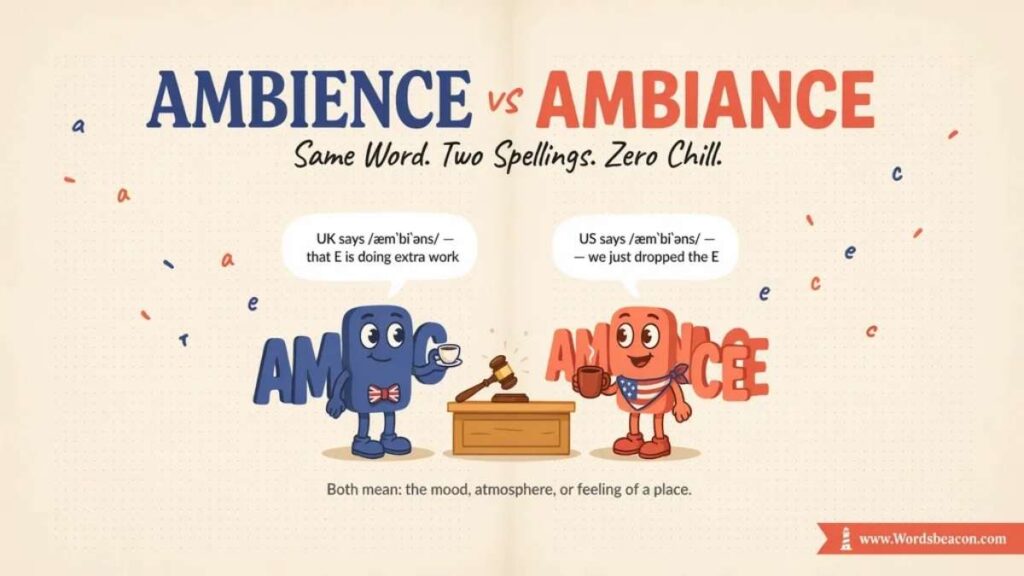
Ambience vs ambiance can turn a simple spelling choice into a surprisingly tricky grammar question. The good news is that these two words have the same basic meaning. Both describe the atmosphere, mood, character, or overall feeling of a place. The main difference comes down to spelling and regional preference. Ambience is more closely associated with British English, while ambiance is especially common in American English. So, that extra “e” does not create a new meaning or change the mood of your sentence. In this guide, you will see what both words mean, how they are used, how they sound, and which spelling fits different types of English writing.
Quick Answer
The easiest way to understand the ambience vs ambiance difference is to focus on what the words mean before worrying about their spelling.
| Feature | Ambience | Ambiance |
|---|---|---|
| Meaning | The atmosphere, character, or mood of a place or situation | The atmosphere, character, or mood of a place or situation |
| Part of speech | Noun | Noun |
| Meaning difference | None in ordinary usage | None in ordinary usage |
| British English | Very common | Also recognized |
| American English | Used and understood | Very common |
| Pronunciation | Generally similar | Generally similar |
| Example | The café has a relaxing ambience. | The café has a relaxing ambiance. |
Both sentences express the same idea. The café has a particular atmosphere that makes people feel relaxed.
So, the ambience and ambiance meaning does not change simply because the spelling changes.
Learn the difference between similar English words
Tyre vs Tire difference and which one is correct?
What Does Ambience Mean?
The ambience meaning is the character or atmosphere of a place or situation. It describes the overall feeling you get from your surroundings rather than one specific feature.
Imagine walking into a small café. The lights are soft, quiet music is playing, wooden tables fill the room, and the smell of fresh coffee is in the air. None of these details alone creates the entire experience. Together, however, they give the café a particular ambience.
That is the basic ambience definition. It refers to the atmosphere or character created by a setting and everything that contributes to the way that setting feels.
Lighting, music, decor, furniture, colors, sounds, scents, architecture, and even the people in a space can influence its ambience.
For example, a restaurant with bright lights, loud music, and busy tables may have an energetic ambience. A restaurant with candles, soft music, quiet conversations, and warm colors may have a relaxing ambience.
The word can describe much more than restaurants. You can talk about the ambience of a hotel, home, office, garden, theater, event, neighborhood, or city.
Ambience in a Sentence
Here are a few natural examples of ambience in a sentence:
The candles give the dining room a warm ambience.
The hotel has a peaceful ambience.
Soft lighting creates a relaxing ambience.
The old theater has a unique ambience.
The garden has a quiet ambience that makes it perfect for reading.
In each example, ambience refers to the overall feeling or character of the setting.
What Does Ambiance Mean?
The ambiance meaning is essentially the same as the meaning of ambience. The ambiance definition describes the mood, character, atmosphere, or distinctive quality of a place or situation.
In American English, ambiance is a familiar spelling, particularly in restaurant reviews, travel writing, hospitality, interior design, and everyday descriptions of places.
Consider a hotel lobby with elegant furniture, warm lighting, soft music, and fresh flowers. You could describe it by saying:
The hotel lobby has an elegant ambiance.
The word does not refer to one piece of furniture or one particular decoration. Instead, it describes the impression created by the space as a whole.
Ambiance in a Sentence
Here are some simple ambiance in a sentence examples:
The restaurant has a cozy ambiance.
The dim lighting creates a romantic ambiance.
The hotel has an elegant ambiance.
The office has a friendly ambiance.
The festival created a lively ambiance throughout the town.
So, what does ambiance mean? In ordinary English, it means the atmosphere or character that a particular place or situation creates.
Learn the difference between similar English words
Sneek vs Sneak difference and usage?
Ambience vs Ambiance The Real Difference
Here is where most of the confusion disappears.
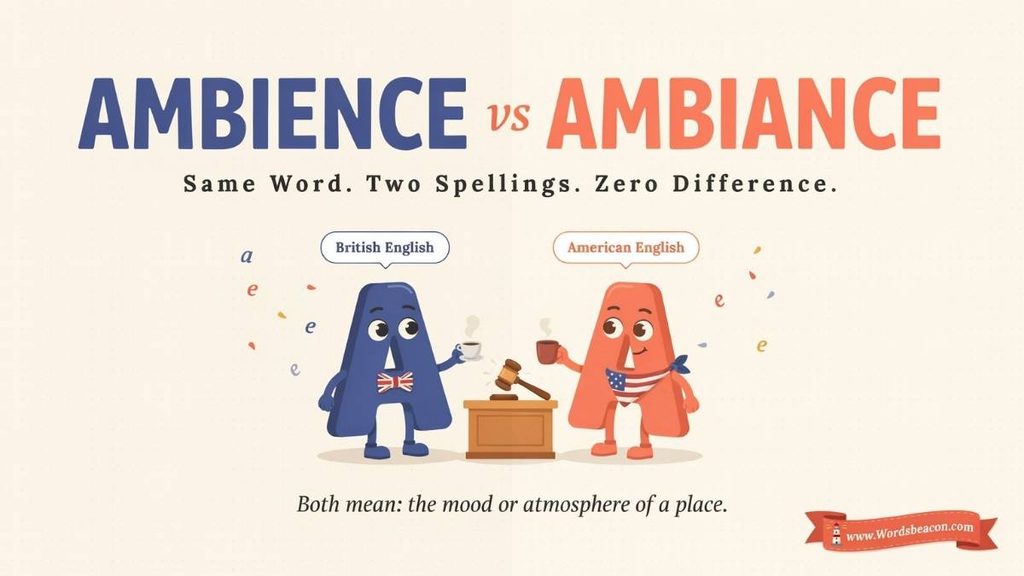
The ambience vs ambiance difference is mainly a difference in spelling and regional preference. The two words generally have the same meaning.
The ambiance vs ambience difference works in exactly the same way. You do not choose one spelling because you want to describe a different type of atmosphere.
A cozy café can have either ambience or ambiance. A busy concert can have either ambience or ambiance. A luxurious hotel can have either ambience or ambiance.
The spelling does not determine the mood.
Both forms are connected to the French word ambiance, which refers to atmosphere or surrounding character. English adopted the word and developed established forms of its own.
That French borrowing also explains why the spelling can look slightly unusual to English learners.
Ambience in British English
Ambience British English usage is very well established. British writers commonly use ambience in restaurant reviews, travel articles, journalism, books, and everyday descriptions.
For example:
The pub has a traditional ambience.
The hotel combines modern design with a relaxed ambience.
The theater has a historic ambience that visitors enjoy.
This does not mean British English never uses ambiance. The alternative spelling is recognized. However, ambience is a particularly natural choice for British English writing.
Ambiance in American English
Ambiance American English usage is also well established. American writers commonly use the word when describing restaurants, hotels, homes, events, stores, cafés, offices, and entertainment venues.
For example:
The restaurant has a sophisticated ambiance.
The hotel offers a peaceful ambiance.
The candles create a romantic ambiance.
At the same time, ambience American English usage is perfectly understandable. American readers recognize the spelling, even though ambiance may feel more familiar to many of them.
The important point is frequency and convention, not a strict correct-versus-incorrect rule.
Learn the difference between similar English words
Peices vs Pieces difference and usage?
Ambience vs Ambiance in American English
When considering ambience vs ambiance in American English, both forms deserve recognition.
Ambiance is especially familiar in US writing, while ambience is also an established English spelling. Therefore, an American writer can encounter both without needing to assume that one is an error.
Consider these sentences:
The café has a relaxed ambiance.
The café has a relaxed ambience.
The meaning remains the same.
For US writing, ambiance may be the more natural choice for many readers. Still, ambience is not automatically wrong in American English.
If a publication uses a particular style guide, follow that guide. Otherwise, choose the form that fits your writing and use it consistently.
Ambiance vs Ambience in British English
The same principle applies when looking at ambiance British English usage.
Ambience is strongly established in British English, while ambiance is also recognized.
For example:
The restaurant has a warm ambience.
The restaurant has a warm ambiance.
Both sentences describe the same restaurant atmosphere.
If you are writing for a British audience, ambience will often feel like the more natural spelling. However, the presence of ambiance does not automatically make a sentence incorrect.
Ambience vs Ambiance Comparison Table
The correct spelling ambience or ambiance question becomes much easier with a direct comparison.
| Question | Ambience | Ambiance |
|---|---|---|
| Is it a word? | Yes | Yes |
| Is it a noun? | Yes | Yes |
| Does it describe atmosphere? | Yes | Yes |
| Can it describe mood or character? | Yes | Yes |
| Common in British English? | Yes | Yes |
| Common in American English? | Yes | Yes |
| Can it describe a restaurant? | Yes | Yes |
| Can it describe a room? | Yes | Yes |
| Can it describe an event? | Yes | Yes |
| Is it an established spelling? | Yes | Yes |
| Does it normally have a different meaning? | No | No |
The simplest rule is worth remembering: the spelling changes, but the basic meaning does not.
Learn the difference between similar English words
Crier vs Cryer Difference and usage ?
Which Spelling Should You Use?
The ambience or ambiance choice usually depends on your audience.
If you are writing in US English, ambiance is a natural choice. If you are following British English conventions, ambience is especially natural.
Your publication or organization may also have its own style guide. When it does, follow that preference instead of switching between spellings.
Consistency matters. If you use ambiance throughout an article, suddenly changing to ambience in one paragraph can make the writing look careless even though both words are correct.
Use Ambience When
Use ambience when your writing follows British English conventions or when the publication you are writing for prefers that spelling.
It can also make sense to use ambience when the surrounding text already follows British spelling patterns.
Use Ambiance When
Use ambiance when writing primarily for a US audience or when an American publication or style guide prefers it.
The spelling is particularly familiar in American restaurant reviews, travel writing, lifestyle content, and descriptions of interiors and events.
If You Are Unsure
Do not turn a small spelling difference into a grammar emergency.
First, identify your audience. Then check the publication or style guide if one exists. Finally, choose one spelling and stay consistent.
The goal is not to prove that one form is better. The goal is to make your writing clear and consistent.
Common Ambience vs Ambiance Mistakes
Assuming They Have Different Meanings
The most common mistake is thinking that ambience and ambiance describe different types of atmosphere.
They generally do not.
A romantic restaurant can have a romantic ambience or romantic ambiance. A quiet library can have a peaceful ambience or peaceful ambiance.
The spelling does not change the experience being described.
Treating One Spelling as Wrong
Another common mistake is assuming that ambience is incorrect in American English or that ambiance is incorrect in British English.
Regional usage is more complicated than that.
English contains many words with established spelling variations. Readers may have a regional preference, but that does not automatically turn another recognized form into an error.
Mixing the Spellings Without a Reason
Imagine reading an article that starts with:
The restaurant has a beautiful ambiance.
A few paragraphs later, the same article says:
The warm ambience attracts visitors.
Neither sentence contains a spelling error. However, the unexplained switch makes the article less consistent.
Choosing one spelling for a piece of writing usually produces a cleaner result.
Using the Word Only for Restaurants
Restaurants may use the word frequently, but ambience and ambiance are not restaurant-only vocabulary.
You can describe the ambience of a bedroom, office, garden, theater, hotel, museum, wedding, city, or workplace.
The word works whenever a setting has a noticeable atmosphere or character.
Confusing Ambience With Mood
Ambience and mood overlap, but they are not always interchangeable.
Mood can refer to an emotional state. For example:
She is in a cheerful mood.
Ambience usually focuses more on the atmosphere created by a setting:
The room has a cheerful ambience.
The first sentence focuses on a person’s emotional state. The second focuses on the environment.
That distinction can help you choose the right word.
Learn the difference between confusing word pairs
Laid Down vs Lied Down Difference and usage?
What Creates Ambience vs Ambiance?
A setting rarely gets its character from one detail. Usually, several elements work together.
Lighting is one of the most noticeable factors. Bright lights can make a place feel energetic and practical, while soft lighting can create a calm or intimate atmosphere.
Music can also change the feeling of a space. Quiet background music may support a relaxing environment, while faster music can make a place feel more energetic.
Decor adds visual character. Furniture, artwork, plants, colors, fabrics, and decorative objects can make a room feel traditional, modern, cozy, formal, or playful.
The interior layout matters as well. An open room can feel spacious, while tightly arranged furniture can make the same space feel busy or crowded.
Sounds and smells also contribute to the sensory experience. The sound of rain can make a café feel peaceful, while the smell of coffee can become part of the identity of a coffee shop.
People can influence ambience too. A quiet library feels different from a crowded social space, even though both are physical environments.
All these elements combine to create the overall feel of a place.
Ambience vs Ambiance Examples
The best way to understand these words is to see how they work in different situations.
Restaurant Example
The restaurant’s warm ambiance comes from its soft lighting, wooden furniture, and quiet music.
Here, ambiance describes the combined restaurant atmosphere rather than one specific feature.
Hotel Example
The hotel’s peaceful ambience makes it a popular place for weekend stays.
The word describes the general feeling created by the hotel and its surroundings.
Home Example
Plants, natural colors, and warm lamps give the living room a welcoming ambience.
The word describes the room atmosphere created by several design choices.
Event Example
Live music and colorful decorations created a lively ambiance at the festival.
Here, ambiance refers to the atmosphere of the event.
City Example
The old streets give the neighborhood a distinctive ambience.
This example shows that the word can describe a larger setting rather than a single room.
Workplace Example
Natural light and open seating create a relaxed ambiance in the office.
The word describes the environment employees and visitors experience.
Learn the difference between confusing word pairs
Seel vs Seal Difference and usage?
Ambience vs Ambiance Pronunciation
Questions about ambience pronunciation and ambiance pronunciation often appear alongside spelling questions.
In ordinary English speech, the two forms are generally pronounced similarly. Small differences can occur because of regional accents and individual speech patterns. Some speakers may also use a pronunciation influenced by French.
The spelling difference does not normally create a completely different English pronunciation.
For learners, the most useful approach is to listen to the pronunciation used in the variety of English they are learning.
Ambience Pronunciation British
For ambience pronunciation British, the word follows the established English pronunciation used in British speech. The stress falls near the beginning of the word.
Ambiance Pronunciation British English
Ambiance pronunciation British English can also follow the standard English pronunciation pattern. The spelling does not require speakers to use a French pronunciation.
Ambience Pronunciation American English
Ambience pronunciation American English may have small differences from British speech because of the accent, but the word remains easily recognizable.
Ambiance Pronunciation American English
Ambiance pronunciation American English generally follows the familiar English pronunciation used in US speech. Some speakers may use a French-influenced pronunciation, but that is not required.
If you are wondering how do you pronounce ambience or how do you pronounce ambiance, focus on the pronunciation used by your target variety of English rather than trying to make the spelling sound more complicated than it is.
Learn the difference between confusing word pairs
Truly vs Truely difference and usage?
Ambience and Ambiance Synonyms
An ambience synonym can be atmosphere, mood, feel, setting, character, environment, or vibe.
An ambiance synonym can include the same alternatives.
However, these words do not work in exactly the same way in every sentence.
| Word | Typical Use |
|---|---|
| Atmosphere | The general character or feeling of a place or situation |
| Mood | An emotional state or prevailing emotional tone |
| Feel | A casual way to describe an overall impression |
| Setting | The place or surroundings where something happens |
| Character | The distinctive qualities of a place |
| Vibe | An informal word for an overall feeling |
| Environment | The physical or social conditions surrounding someone |
For example, “The café has a relaxed atmosphere” sounds natural. “The café has a relaxed vibe” sounds more casual. “The café has a relaxed ambience” sounds descriptive and polished.
Atmosphere vs Ambience
The atmosphere vs ambience question is slightly different from the spelling question because these words overlap without being exact replacements in every context.
Atmosphere has a wider range of meanings.
For example, Earth has an atmosphere. You cannot replace that meaning with ambience.
Atmosphere can also describe a situation:
The atmosphere in the meeting became tense.
Ambience usually focuses more strongly on the character or feeling of a place or setting.
That is why atmosphere is a close ambience synonym, but the two words should not be treated as perfect substitutes in every sentence.
Is Ambience vs Ambiance Correct?
Both are correct.
That answers the long-tail question, “Is ambience or ambiance correct?”
Ambience is an established English noun, and ambiance is also an established English noun and spelling variant.
The choice depends mainly on regional usage, audience, and style.
Is Ambience a Word?
Yes, ambience is a real English word.
If you have wondered, “Is ambience a word?” there is no need to hesitate before using it. It is an established noun that refers to the character or atmosphere of a place or situation.
Its history is connected with French and with the broader vocabulary surrounding the idea of surroundings and atmosphere.
Is Ambiance a Word?
Yes, ambiance is also a real English word.
If you have asked, “Is ambiance a word?” the answer is just as straightforward.
Ambiance is an established noun used in English to describe the atmosphere or character of a setting. It is especially familiar in American English, although it is also recognized elsewhere.
The French word ambiance also exists, which helps explain the history of the English spelling.
Ambience vs Ambiance Grammar
From a grammar perspective, both words are nouns.
You can use them after articles:
The ambience was peaceful.
The ambiance was peaceful.
You can also use them with adjectives:
A pleasant ambience filled the room.
A pleasant ambiance filled the room.
Possessive constructions work as well:
The restaurant’s ambience was elegant.
The restaurant’s ambiance was elegant.
Another common structure is “the ambience of” or “the ambiance of”:
The ambience of the hotel was relaxing.
The ambiance of the hotel was relaxing.
These patterns make the word easy to use once you understand its basic function.
Learn the difference between often confused words
Gluing vs Glueing difference and usage?
Ambience vs Ambiance in Everyday Writing
In Restaurant Reviews
Restaurant reviews are one of the most common places to encounter these words.
A reviewer may discuss lighting, music, seating, decor, noise, and the behavior of other guests before describing the overall ambience or ambiance.
For example:
The food was excellent, and the cozy ambiance made the evening even more enjoyable.
In Travel Writing
Travel writers often use these words to describe the character of a destination.
For example:
The narrow streets and historic buildings give the neighborhood a unique ambience.
The word allows the writer to describe an experience rather than simply list physical features.
In Professional Writing
Ambience or ambiance can also appear in writing about offices, venues, conferences, hotels, and events.
For example:
The redesigned lounge creates a more welcoming ambiance for visitors.
This use is appropriate when the writer wants to describe the experience of a physical space.
In Social Media
Casual writers may use the word vibe instead.
For example:
This café has such a cozy vibe.
Ambiance would sound slightly more descriptive or polished:
This café has a cozy ambiance.
Both communicate a similar idea, but the tone is different.
In Creative Writing
Writers can use ambience to establish a scene.
A dark street, distant thunder, wet pavement, and dim windows can create an uneasy atmosphere before a character even speaks.
This is where ambience becomes particularly useful. It helps readers experience a setting rather than simply look at a list of details.
Learn the difference between often confused words
Accept vs Except difference and usage?
A Simple Case Study One Place, Two Spellings
Consider a fictional coffee shop called Maple Street Café.
The café has warm lamps, wooden tables, plants, quiet jazz, and large windows. Customers speak softly, and the smell of fresh coffee fills the room.
A US-focused review could say:
Maple Street Café has a warm ambiance, with soft lighting and quiet music.
A British-focused review could say:
Maple Street Café has a warm ambience, with soft lighting and quiet music.
The description stays the same.
The lighting has not changed. The music has not changed. The furniture has not changed. The customer experience has not changed.
Only the spelling has changed.
That is the central lesson behind ambience vs ambiance.
How to Remember Ambience vs Ambiance
A complicated memory trick is not necessary.
Think of the two spellings as regional spelling partners.
Ambience is strongly associated with British English.
Ambiance is especially common in American English.
Both refer to atmosphere, character, or overall feel.
The most useful rule is simple: the spelling changes, but the basic meaning stays the same.
Fix common more word mistakes in English
Begun vs Began difference and usage?
Practice Session Ambience vs Ambiance
Fill in each blank with the correct word: ambience vs ambiance.
- The soft lighting created a warm ________ in the restaurant.
- The hotel is known for its peaceful ________.
- The word “________” is especially common in British English.
- Many American writers prefer the spelling “________.”
- The candles added to the romantic ________ of the room.
- The café has a relaxed ________ that makes customers want to stay longer.
- Music, lighting, furniture, and decoration can all affect the ________ of a place.
- The elegant ________ made the wedding reception feel special.
- In British English, “________” is a common spelling of the word.
- In American English, “________” is widely used.
- The quiet garden had a calming ________.
- The restaurant changed its lighting to improve its ________.
- The two spellings generally have the same ________.
- The cozy fireplace gave the living room a welcoming ________.
- The travel writer praised the city for its unique ________.
- Which spelling would you normally expect in British English: ________?
- Which spelling is especially common in American English: ________?
- The soft music helped create a pleasant ________ during dinner.
- The hotel lobby had a luxurious ________ that impressed visitors.
- The café’s ________ changed completely after the owners added brighter lights.
- The peaceful ________ of the library encouraged students to concentrate.
- Both “ambience” and “ambiance” can describe the overall ________ or feeling of a place.
- The restaurant review mentioned the friendly staff and inviting ________.
- If you are writing for an American audience, “________” may be the more familiar spelling.
- If you are writing for a British audience, “________” may be the more familiar spelling.
Answers
- ambience
- ambience
- ambience
- ambiance
- ambience
- ambiance
- ambience
- ambiance
- ambience
- ambiance
- ambience
- ambiance
- meaning
- ambience
- ambiance
- ambience
- ambiance
- ambience
- ambiance
- ambience
- ambiance
- atmosphere
- ambience
- ambiance
- ambience
Here’s a trusted source for clear more words Comparison:
FAQs
Is ambience vs ambiance correct?
Both ambience and ambiance are correct spellings in English. They have essentially the same meaning and describe the atmosphere, character, or overall feeling of a place or setting. Ambience is closely associated with British English, while ambiance is especially common in American English.
What is the difference between ambience and ambiance?
The main difference is spelling and regional usage, not meaning. Ambience is widely used in British English, whereas ambiance is particularly common in American English. Both words can describe the same atmosphere or overall feel.
Is ambience a word in American English?
Yes, ambience is a valid word in American English. However, ambiance is often the more familiar spelling for US readers. You can use ambience in American writing as long as the spelling fits the style you are following.
Is ambiance a word in British English?
Yes, ambiance is also a recognized English word in British English. However, British writers commonly use ambience. The choice does not change the basic meaning of the word.
What does ambience mean in simple English?
Ambience means the overall feeling or atmosphere of a place. Things such as lighting, music, decoration, sounds, scents, and the people around you can all shape the ambience.
What does ambiance mean in simple English?
Ambiance has the same basic meaning as ambience. It describes the mood, atmosphere, or character that you experience in a particular place or setting. For example, a quiet café may have a relaxing ambiance.
Why do ambience and ambiance have different spellings?
Both forms are connected to the French word ambiance. English developed and retained the spelling ambience in addition to the French-influenced form ambiance. Over time, regional preferences helped make ambience more associated with British English and ambiance especially common in American English.
Can ambience and ambiance be used interchangeably?
Yes. In most situations, the two words can be used interchangeably because they carry the same basic meaning. The spelling you choose usually depends on your preferred variety of English or the style of your writing.
Is ambience more common than ambiance?
It depends on the variety of English. Ambience is strongly established in British English, while ambiance is especially common in American English. As a result, neither spelling is universally preferred in every English-speaking region.
Can ambience describe something other than a restaurant?
Yes. Ambience can describe almost any place or setting where the overall atmosphere matters. You might talk about the ambience of a home, hotel, office, garden, theater, shop, event, neighborhood, or city.
How do you use ambience in a sentence?
You can use ambience as a noun when describing the overall atmosphere of a place. For example: “The soft lighting and quiet music created a peaceful ambience in the restaurant.”
How do you use ambiance in a sentence?
Use ambiance in the same way because it is the alternative spelling of the word. For example: “The modern furniture and warm lighting gave the room a welcoming ambiance.”
Is ambience a synonym for atmosphere?
Ambience can be a synonym for atmosphere when you are talking about the overall feeling or character of a place. However, atmosphere has other meanings too, including the layer of gases surrounding a planet.
What is the easiest way to remember ambience vs ambiance?
A simple memory trick is to connect ambience with British English and ambiance with American English. Both describe the same basic idea, so the spelling changes while the meaning stays essentially the same.
Which spelling should you use in American English?
Ambiance is especially common in American English, so it is a natural choice for US-focused writing. Ambience is also correct, though it may feel more closely associated with British usage.
Which spelling should you use in British English?
Ambience is the spelling most strongly associated with British English. If you are writing for a British audience, ambience is therefore a natural choice.
Can ambience describe a person’s mood?
Usually, ambience describes the atmosphere or overall character of a place or situation rather than one person’s private mood. For an individual’s emotional state, words such as mood or feeling are often more precise.
Conclusion
Ambience vs ambiance may look like a tricky spelling battle, but the good news is that there is no real battle at all. Both words have the same basic meaning. They describe the atmosphere, mood, character, or overall feeling of a place. The main difference is the spelling and where each form is commonly used. Ambience is more closely associated with British English, while ambiance is especially common in American English.
So, which one should you use? Choose the spelling that fits your audience and writing style, then use it consistently. Once you know this simple difference, you can stop worrying about the extra “e” and focus on what really creates a great ambience or ambiance: good lighting, pleasant music, and a welcoming atmosphere.

Luna AJS is an experienced blogger and dedicated language enthusiast at Words Beacon. She specializes in making English grammar, spelling, vocabulary and commonly confused words easy to understand. She provides clear explanations, practical examples to help readers write with confidence.