

Lose and loose look almost identical, so it is easy to mix them up. However, that extra “o” changes the meaning completely. Writing “loose weight” instead of “lose weight” is a small spelling mistake, but it can make a sentence sound very different. The good news is that the lose vs loose difference is simple once you know what each word does. Use lose for actions, such as misplacing something, failing to win, or no longer having something. Use loose when something is not tight or firmly attached. Once you learn this simple difference, choosing the right word becomes much easier.
Quick answer
The easiest way to understand lose vs loose is to compare their meanings, grammar, and common examples.
| Word | Meaning | Part of Speech | Example |
|---|---|---|---|
| Lose | Misplace, fail to win, or no longer have something | Verb | I do not want to lose my keys. |
| Loose | Not tight, fixed, or firmly attached | Adjective | These shoes are too loose. |
As you can see, lose describes an action, while loose usually describes a condition. Remember: one “o” in lose, two “o’s” in loose. That small spelling difference can save you from a big grammar mistake.
Fix common more word mistakes in English
Tweek vs Tweak difference and usage?
Lose Meaning What Does “Lose” Mean?
The word lose is primarily a verb. Its basic meaning involves no longer having something, being unable to find something, experiencing a reduction, or failing to win. Depending on the context, it can describe physical objects, opportunities, money, time, feelings, competitions, and much more.
The lose definition becomes especially clear when you think about something that has gone away.
For example, you can lose your keys because you cannot find them. You can lose a game because another player or team wins. And You can lose money because you spend more than you receive. You can also lose interest when something no longer holds your attention.
The Cambridge Dictionary lists several common uses of lose, including not being able to find something, no longer having something, having less of something, failing to win, and stopping a particular feeling such as interest or patience.
Consider these sentences:
I always lose my keys when I am rushing.
Our team could lose the game tonight.
She does not want to lose her job.
He started to lose interest in the project.
They could lose money on the deal.
I lost track of time while reading.
Although these examples look different, they all use lose as a verb. In each case, the word describes an action, change, or result.
Lose Something
One of the most common uses of lose involves misplacing something.
If you lose something, you no longer know where it is or no longer have it.
For example:
I think I lost my phone.
She always loses her glasses.
He lost his passport while traveling.
We cannot afford to lose the documents.
Here, lose does not mean that the object has become loose. Instead, it means the object is missing or no longer in your possession.
That distinction matters because a single letter can create a completely different sentence.
“I lost my keys” means you cannot find your keys.
“My keys are loose” means the keys are not secured or held tightly in a particular place.
Lose a Game
Lose also describes the opposite of winning in a competition.
If you lose a game, match, race, or competition, you fail to win.
For example:
Our team lost the game by two points.
Nobody wants to lose the final.
They lost the match despite playing well.
She hates losing important competitions.
This use makes lose especially common in sports and everyday conversations about success or failure.
The important point is that loose cannot replace lose here. “We might loose the game” is a spelling mistake if the intended meaning is “we might fail to win.”
Lose Track
The verb lose also appears in several common expressions.
One of them is lose track, which means to stop knowing where something is in a sequence or how much time has passed.
For example:
I lost track of time while watching the movie.
She lost track of how many pages she had read.
We lost track of the conversation.
Again, the idea involves something becoming unavailable to you. You no longer have a clear sense of it.
Lose Weight
Another extremely common expression is lose weight.
When someone says, “I want to lose weight,” the verb lose means to reduce the amount of body weight.
The Cambridge Dictionary specifically includes lose weight among the established uses of the verb lose.
That brings us to one of the most common lose vs loose mistakes: writing “loose weight.”
The correct phrase is lose weight.
Learn the difference between confusing more English words
Courtesy vs Curtesy Difference and usage ?
Loose Meaning What Does “Loose” Mean?
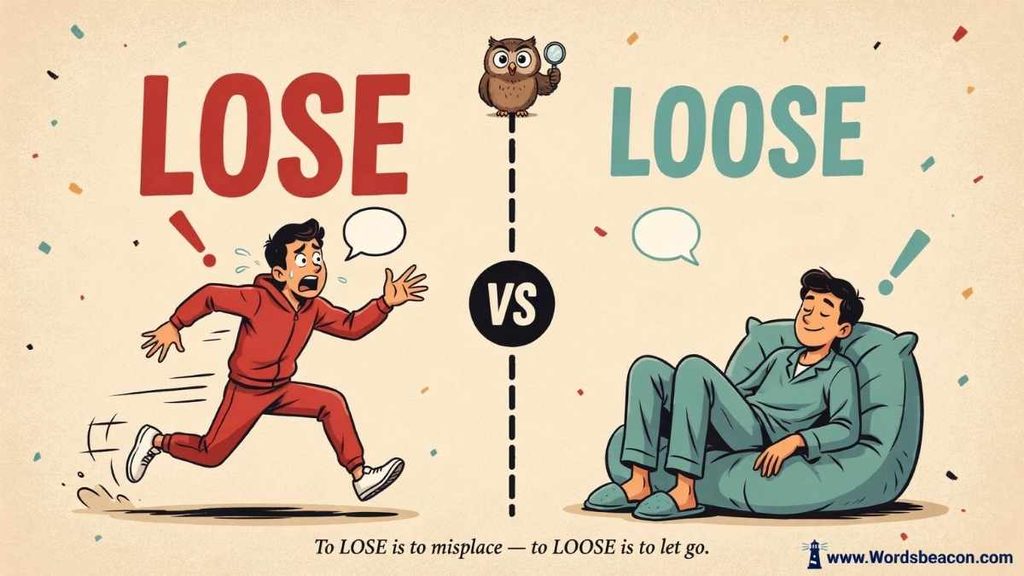
The Loose usually works as an adjective. It describes something that is not tight, not firmly fixed, not securely fastened, or free from restraint.
The simplest loose definition is “not tight.”
That basic idea covers many everyday situations.
A shirt can be loose because it does not fit closely. A screw can be loose because it is not firmly attached. A tooth can be loose because it moves more than it normally should. A knot can be loose because it is not pulled tightly.
Consider these examples:
The shirt is loose.
The screw is loose.
She prefers loose clothing.
His shoelaces are loose.
The child has a loose tooth.
The dog was running loose.
In every example, loose describes a condition rather than the act of losing something.
Loose as an Adjective
The word loose can describe physical objects, clothing, connections, restraints, and even animals that are no longer confined.
For example, loose clothing is clothing that does not fit tightly. Loose pants have extra room rather than a close fit. A loose wire is not securely connected. A loose handle can move because it is not firmly attached.
The word can also describe something that has become unfastened.
For example:
The knot is loose.
The gate was left loose.
One of the straps is loose.
The screw needs tightening because it is loose.
The central idea remains the same: something has too much freedom of movement or lacks a firm connection.
Loose Tooth
A loose tooth provides a particularly clear example.
If someone says, “I have a loose tooth,” they mean the tooth moves because it is not as firmly fixed as it normally is.
They are not saying that they lost the tooth.
Compare the two ideas:
The child has a loose tooth.
The child lost a tooth.
The first sentence describes a tooth that is still present but not firmly fixed. The second says the tooth is no longer there.
That is the loose and lose difference in action.
Loose Clothing
Clothing also makes the distinction easy to understand.
Loose clothing does not fit tightly around the body. It may feel roomy, relaxed, or baggy.
For example:
She likes loose clothing.
He bought a pair of loose pants.
The jacket feels too loose.
The shirt has a loose fit.
Notice how different the meaning becomes when you use lose.
“She likes lose clothing” is incorrect because lose does not describe clothing that lacks a tight fit.
Learn the difference between confusing more English words
More Than vs More Then difference and usage ?
Lose vs Loose Difference
The difference between lose and loose becomes much easier when you look at their parts of speech and meanings together.
Lose is mainly a verb. Loose is mainly an adjective.
Lose can mean to misplace something, no longer have something, have less of something, or fail to win. Loose usually means not tight, not firmly attached, unfastened, or free from restraint.
| Word | Main part of speech | Main meaning | Example |
|---|---|---|---|
| Lose | Verb | Misplace, no longer have, reduce, or fail to win | I do not want to lose my phone. |
| Loose | Adjective | Not tight or firmly fixed | The phone case is loose. |
The lose loose difference also appears in pronunciation and spelling.
Lose has one O after the L.
Loose has two O’s after the L.
Lose ends with a Z sound.
Loose ends with an S sound.
Therefore, the lose vs loose difference involves more than one extra letter. The words differ in meaning, grammatical role, pronunciation, and usage.
Lose vs Loose Spelling
The lose vs loose spelling difference is one of the main reasons English learners mix up these words.
The visual difference looks small:
Lose
Loose
However, that extra O changes the word.
A useful spelling tip is to connect each spelling with its meaning instead of trying to memorize the letters alone.
Think of lose as the word for something going away.
Think of loose as the word for something having extra space or lacking tightness.
For example:
I do not want to lose my wallet.
My wallet strap is loose.
The first sentence describes something that could become missing. The second describes something that is not tight.
This approach works better than simply thinking, “One has one O and the other has two.” The spelling clue helps, but the meaning provides the stronger test.
Learn the difference between confusing more English words
Weiner vs Wiener Which one Is Correct?
Lose vs Loose Pronunciation
The lose vs loose pronunciation difference is important because the words do not sound exactly the same.
Both words begin with the same long “oo” vowel sound. The difference comes at the end.
Lose is pronounced /luːz/.
Loose is pronounced /luːs/.
Cambridge gives the US pronunciation of lose as /luːz/ and loose as /luːs/.
The easiest way to hear the distinction is to focus on the final sound.
Lose ends with a Z sound.
Loose ends with an S sound.
Another useful comparison is rhyme.
Lose rhymes with choose.
Loose rhymes with goose.
So the pronunciation pattern looks like this:
Lose → choose → Z sound
Loose → goose → S sound
This difference can help when speaking, especially when you already know the meaning and simply need to identify the correct word.
Still, pronunciation should not replace context. If you are writing, meaning and grammar usually provide the safest clues.
Lose vs Loose Examples
The best lose vs loose examples come in pairs because the contrast makes the difference obvious.
Consider this pair:
I do not want to lose my keys.
The keys are loose in my bag.
In the first sentence, lose means misplace. In the second, loose describes how the keys are positioned.
Now consider another pair:
Our team could lose the game.
The player picked up the loose ball.
Here, lose means fail to win. Loose describes a ball that is not currently controlled or securely held.
Another pair makes the difference even clearer:
She wants to lose weight.
She prefers loose pants.
The first sentence uses a verb. The second uses an adjective.
One final pair shows how the same noun can appear with either word:
Do not lose the screw.
The screw is loose.
In the first sentence, someone might misplace the screw. In the second, the screw is still there but is not firmly attached.
These examples show the difference between loose and lose with examples in a practical way. Instead of memorizing two isolated definitions, you can see how each word behaves in a real sentence.
Learn the difference between tricky grammar words
Flakey vs Flaky which one is correct ?
Lose Weight vs Loose Weight
Lose weight vs loose weight is probably the most common example of this spelling confusion.
The correct phrase is:
Lose weight.
The incorrect phrase, when you mean reducing body weight, is:
Loose weight.
So, if you are asking, “Is it lose weight or loose weight?” the answer is lose weight.
Lose Weight Meaning
The phrase lose weight means to reduce body weight.
For example:
She wants to lose weight.
He lost weight during the summer.
They discussed ways to lose weight safely.
The verb lose works because the sentence describes a reduction.
The same idea appears in other expressions:
1.lose money
2.lose time
3.lose interest
4.lose energy
5.lose confidence
6.lose weight
In each case, something becomes less or is no longer retained.
Why “Loose Weight” Is Wrong
Loose means not tight or not firmly fixed. That meaning does not fit the idea of reducing body weight.
For example, loose works perfectly in:
She bought loose pants.
His shirt is loose.
The knot is loose.
The screw is loose.
However, it does not work in:
She wants to loose weight.
The intended meaning is not “make weight less tight.” The intended meaning is “reduce weight,” so lose is the correct word.
That is why lose or loose weight which is correct has such a simple answer: use lose.
Learn the difference between tricky grammar words
Premier vs Premiere which one is correct ?
When to Use Lose vs Loose
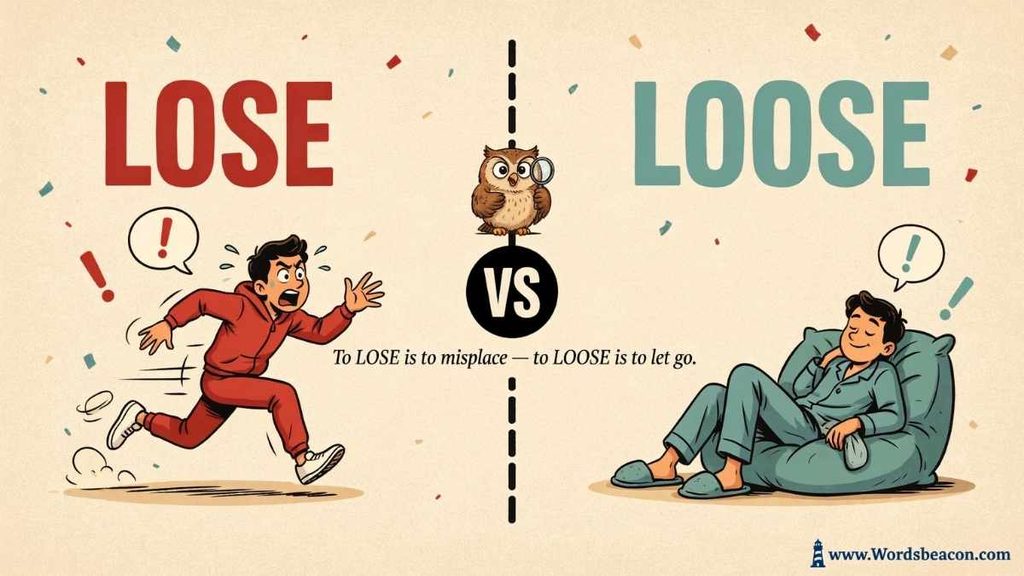
The When to use lose or loose depends on the meaning of the sentence.
If something is missing, reduced, no longer available, or unsuccessful, use lose.
If something is not tight, not firmly fixed, unfastened, or free from restraint, use loose.
For example:
I might lose my wallet.
The wallet strap is loose.
They could lose the match.
The shoelace is loose.
She wants to lose weight.
She prefers loose clothing.
He lost interest.
The connection is loose.
This method covers most examples in everyday English.
Lose vs Loose Grammar
The lose vs loose grammar distinction gives you another reliable way to make the correct choice.
Lose is an action word, so it normally functions as a verb.
Loose is usually a describing word, so it normally functions as an adjective.
Consider these sentences:
I could lose my job.
The button is loose.
In the first sentence, lose tells you what could happen.
In the second sentence, loose describes the button.
That simple part-of-speech difference can help English learners identify the correct word before they even think about spelling.
Lose as a Verb
The verb lose has several forms.
The base form is lose.
The present participle is losing.
The past tense and past participle are lost.
For example:
I lose things easily.
She is losing interest.
He lost his wallet.
They have lost the match.
The past tense is especially important because “losed” is not the standard past form.
Loose as an Adjective
Loose usually describes a noun.
For example:
1.a loose shirt
2.a loose tooth
3.a loose screw
loose pants
a loose connection
a loose knot
The word tells you what the noun is like.
That makes the grammar distinction fairly straightforward.
Is Loose Ever a Verb?
Yes, although this use is much less common in everyday English.
Loose can function as a verb meaning to release, set free, or make something less tight. Cambridge also records verb uses involving releasing something, allowing something to affect a place, firing an arrow or shot, and making something such as a knot less tight.
For example:
The rider loosed the horse.
The character loosed the dogs.
She loosed the knot.
These uses exist in English, but they should not create confusion with the everyday verb lose.
If the meaning is “misplace,” “no longer have,” “reduce,” or “fail to win,” use lose.
If the meaning is “release” or “make less tight” in the specific verb sense, loose can be correct.
Learn the difference between similar English words
Attornies vs Attorneys difference and usage ?
Common Lose vs Loose Mistakes
The most common mistakes happen when writers choose the word based only on appearance.
Mistake Loose weight
Incorrect:
She wants to loose weight.
Correct:
She wants to lose weight.
The sentence describes a reduction, so lose is required.
Mistake Loose the game
Incorrect:
We cannot afford to loose the game.
Correct:
We cannot afford to lose the game.
The team might fail to win, so lose is the correct verb.
Mistake Lose clothing
Incorrect:
She prefers lose clothing.
Correct:
She prefers loose clothing.
The clothing is not tight, so loose is the correct adjective.
Mistake Lose screw
Incorrect:
The screw is lose.
Correct:
The screw is loose.
The screw remains in place, but it is not firmly attached.
Mistake Loose my keys
Incorrect:
I always loose my keys.
Correct:
I always lose my keys.
The intended meaning is misplace, so lose is required.
These mistakes are common spelling errors, especially in quick messages and informal online writing. However, the fix is simple once the meaning becomes familiar.
Learn the difference between similar English words
Bear vs Bare Difference and usage ?
Lose vs Loose in Everyday English
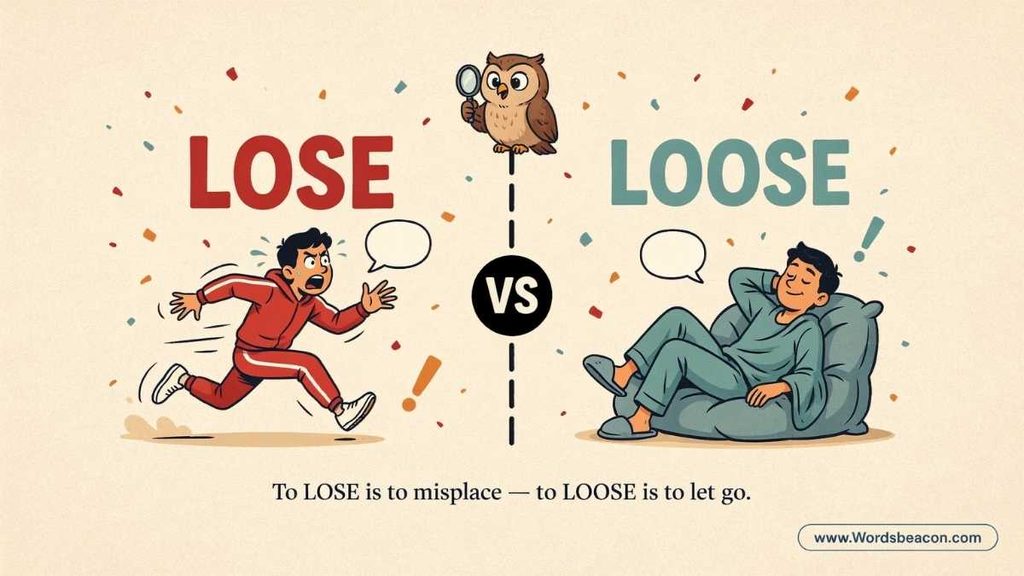
The words appear in many ordinary situations, which makes everyday examples useful for learning them.
At home, you might lose your keys while dealing with a loose cabinet handle. And At work, you might lose track of time while fixing a loose cable. At school, you might lose points because of a spelling mistake involving loose and lose. In sports, a team might lose a game after an opponent grabs a loose ball.
These situations create natural mental connections.
Imagine a basketball game.
A player can lose the game.
The player can also pick up a loose ball.
Now imagine getting dressed.
You can choose loose pants.
You can also decide to lose weight.
The context changes, and the correct word changes with it.
How to Remember Lose vs Loose
The easiest way to remember lose vs loose is to connect each word with one central idea.
Lose means something is gone.
Loose means something is not tight.
That gives you a simple memory trick:
Lose = gone.
Loose = not tight.
The spelling provides another clue.
Lose has one O.
Loose has two O’s.
You can also use pronunciation.
Lose ends with a Z sound and rhymes with choose.
Loose ends with an S sound and rhymes with goose.
So, when you see a sentence, ask three quick questions.
Does the sentence describe something disappearing, being reduced, or failing to win?
If yes, choose lose.
Does it describe something that is not tight or firmly fixed?
If yes, choose loose.
Does the spelling match the meaning?
If the answer to all three checks lines up, you have probably made the correct choice.
Learn the difference between similar English words
Aid vs Aide which one is correct?
Practice session Lose vs Loose
Fill in each blank with lose vs loose.
- I do not want to ______ my keys again.
- These pants are too ______ around the waist.
- Our team might ______ the game tonight.
- She wants to ______ weight before summer.
- The dog got ______ and ran into the park.
- Be careful not to ______ your phone at the airport.
- His shirt is too ______ and needs to be adjusted.
- They were disappointed because they did not want to ______ the match.
- I always ______ track of time when I read a good book.
- The screw is ______, so the chair keeps shaking.
- You should not ______ hope when things become difficult.
- She bought a belt because her old one was too ______.
- He was afraid he would ______ his wallet during the trip.
- The coach warned the players not to ______ focus during the final minutes.
- The horse broke free because the rope became ______.
- If you do not practice, you may ______ the competition.
- My shoes feel ______ after I walked in them all day.
- Try not to ______ your temper during the argument.
- The button is ______ and may fall off soon.
- We cannot afford to ______ this important opportunity.
Answers
- lose
- loose
- lose
- lose
- loose
- lose
- loose
- lose
- lose
- loose
- lose
- loose
- lose
- lose
- loose
- lose
- loose
- lose
- loose
- lose
Here’s a trusted source for clear word meanings:
FAQs
What is the easiest way to remember lose vs loose?
Think of lose as an action and loose as a description. You lose something, lose a game, or lose track of time. In contrast, something is loose when it is not tight or firmly attached.
Why are lose and loose pronounced differently?
Lose ends with a Z sound, while loose ends with an S sound. Lose sounds like “looz,” whereas loose sounds like “loos.” This small pronunciation difference can help you choose the correct spelling.
Is lose always used as a verb?
Lose is primarily a verb. It describes an action or change, such as misplacing something, failing to win, or no longer having something. For example, “I might lose my keys.”
Is loose always an adjective?
No. Loose is most commonly an adjective, but it can also work as a verb in less common contexts. As an adjective, it describes something that is not tight, fixed, or securely attached.
Can loose be used as a verb?
Yes. As a verb, loose can mean to release or set something free. For example, “The rider loosed the arrow.” However, this use is much less common in everyday English.
What is the past tense of lose?
The past tense of lose is lost. For example, “She lost her phone yesterday.” Loose does not change to lost because it is a different word with a different meaning.
What is the past tense of loose?
When loose is used as a verb, its past tense is loosed. This form is uncommon in everyday writing and conversation.
Can lose and loose appear in the same sentence?
Yes. Both words can appear naturally when they have different meanings. For example, “Do not lose the jacket because its button is loose.” Here, lose describes an action, while loose describes the condition of the button.
Does the extra O in loose change the meaning?
Yes. The extra O creates a different word. Lose usually relates to misplacing something, failing to win, or no longer having something. Loose usually means not tight or not firmly attached.
Why do people confuse lose and loose?
People often confuse these words because they look and sound similar. However, their meanings and grammatical roles differ. Once you connect lose with an action and loose with something that is not tight, the difference becomes much easier to remember.
Can loose describe something that is not tight?
Yes. Loose is the correct word when something does not fit tightly or is not firmly secured. For example, “The shoes are loose.”
Can loose describe failing to win?
No. Use lose when someone fails to win a game, race, match, or competition. For example, “Our team could lose the final.”
What does lose mean in everyday English?
Lose can mean to misplace something, stop having something, fail to win, or no longer keep something. For example, you can lose your keys, lose a game, or lose interest in something.
What does loose mean in everyday English?
Loose usually means not tight, not firmly attached, or not securely fixed. For example, you can have loose clothing, a loose button, or a loose screw.
Is loose a spelling mistake for lose?
Not necessarily. Loose is a real English word with its own meaning. It becomes a spelling mistake only when it is used where lose is required.
Is lose a spelling mistake for loose?
No. Lose is also a correct English word. The mistake occurs when lose is used to describe something that is not tight or securely attached.
How can you tell which word belongs in a sentence?
Start with the meaning. If the sentence describes an action such as misplacing something or failing to win, use lose. If it describes something that is not tight or firmly attached, use loose.
What is a quick test for choosing lose or loose?
Try replacing the word with “misplace” or “fail to win.” If that meaning fits, use lose. If the sentence means “not tight” or “not firmly attached,” use loose.
Why does lose have only one O?
Lose has one O in its standard spelling. Adding another O changes the word to loose, which has a different meaning and pronunciation.
Why does loose have two O’s?
Loose contains two O’s and usually describes something that is not tight or securely fixed. The extra O can serve as a simple visual reminder that loose has extra space.
Can lose be followed by a noun?
Yes. Lose can take a noun as its object. For example, “I might lose my wallet” and “They could lose the match” are both correct.
Can loose come before a noun?
Yes. Loose commonly works as an adjective before a noun. For example, “loose clothing,” “a loose screw,” and “a loose tooth” are all correct phrases.
Is lose track correct English?
Yes. “Lose track” is a common expression. It means to stop knowing where something is, what is happening, or how much time has passed. For example, “I lose track of time when I read.”
Is loose track correct English?
No, not when you mean that you no longer know or remember something. The correct expression is “lose track,” as in “I lose track of time.”
Is loose clothing correct?
Yes. Loose clothing does not fit tightly and usually has extra room. For example, “She prefers loose clothing in warm weather.”
Is lose clothing correct?
It can be grammatically correct, but it has a different meaning. “Lose clothing” would mean misplacing your clothes rather than describing clothing that fits loosely.
What is the difference between lose a screw and a loose screw?
“Lose a screw” means you cannot find the screw. “A loose screw” means the screw is not firmly attached. Therefore, the extra O changes the meaning completely.
What is the difference between lost and loose?
Lost is usually the past tense of lose and can describe something that cannot be found. It can also describe someone who does not know where they are. Loose usually describes something that is not tight or securely fixed.
What is the difference between losing and loosing?
Losing is the -ing form of lose. It can mean misplacing something, failing to win, or no longer having something. Loosing is the -ing form of the less common verb loose, which means releasing or setting something free.
Is losing always spelled with one O?
Yes. The standard spelling is losing, with one O. Loosing is a separate word because it comes from the verb loose.
What is the difference between loose and loosen?
Loose is usually an adjective meaning not tight. Loosen is a verb meaning to make something less tight. For example, “The knot is loose” describes its condition, while “Please loosen the knot” describes an action.
Is loose related to loosen?
Yes. Both words relate to the idea of becoming or making something less tight or restricted. However, loose and loosen have different grammatical roles.
What does break loose mean?
“Break loose” means to escape from restraint or become free. For example, “The dog broke loose from its leash.” Here, loose forms part of a common expression.
What does set loose mean?
“Set loose” means to release someone or something from restraint. For example, “The animals were set loose in the field.”
Can lose be used with time?
Yes. “Lose time” is correct when you mean to waste or fail to use available time effectively. For example, “We cannot lose time before the deadline.”
Can loose be used with time?
Usually not when you mean wasting or misusing time. In that context, lose is the correct word.
What is the main grammar difference between lose and loose?
Lose functions primarily as a verb, while loose most commonly functions as an adjective. Therefore, lose generally describes an action, while loose generally describes a condition or quality.
Learn the difference between similar English words
Steer vs Stear which one is correct?
conclusion
The lose vs loose confusion is easy to fix once you understand what each word means. Although the words look almost the same, they have different jobs in a sentence.
Use lose when you mean misplacing something, failing to win, or no longer having something. For example, you can lose your keys, lose a game, or lose your chance. On the other hand, use loose when something is not tight, firmly attached, or secure. You can have loose clothes, a loose button, or a loose screw.
Here is the easiest trick to remember: lose has one “o,” while loose has two. Think of the extra “o” as extra space. Once you remember that, choosing between lose and loose becomes much easier.

Luna AJS is an experienced blogger and dedicated language enthusiast at Words Beacon. She specializes in making English grammar, spelling, vocabulary and commonly confused words easy to understand. She provides clear explanations, practical examples to help readers write with confidence.