

The yours vs your’s confusion is easy to fix once you know the simple rule. Both forms look nearly identical, so that tiny apostrophe can easily sneak into your writing. However, only one spelling works in standard English. Yours is the correct form when you mean something belongs to someone, while your’s is not standard English. The difference becomes even clearer when you compare your and yours. Use your before a noun, such as “your book,” but use yours when the noun is already understood, as in “The book is yours.” Once you learn this pattern, the apostrophe mystery disappears, and your writing becomes clearer, smoother, and more accurate.
quick answer
A quick comparison makes the difference between the two forms easy to remember.
| Word | Correct? | Meaning | Example |
|---|---|---|---|
| Yours | Yes | Shows ownership or belonging | This book is yours. |
| Your’s | No | Nonstandard spelling | This book is your’s. |
The key point is simple: use “yours” without an apostrophe. Use “your” before a noun, but use “yours” when the noun is already understood.
Once you remember that rule, the yours vs your’s confusion becomes much easier to avoid.
Fix common more word mistakes in English
Lose vs Loose which one is correct ?
Yours vs Your’s Which Spelling Is Correct?
If you are looking for the shortest answer to the yours vs your’s question, remember this:
Yours is correct.
Your’s is not the standard English spelling.
The word yours is a possessive pronoun. It refers to something that belongs to or is connected with the person or people being addressed. Cambridge Dictionary defines yours in this way and gives examples such as “Is this pen yours?” and “I have something of yours.”
For example, you can write:
The blue jacket is yours.
Is this phone yours?
That seat is yours.
My answer is different from yours.
However, you should not write:
The blue jacket is your’s.
Is this phone your’s?
That seat is your’s.
The apostrophe does not belong in yours.
| Form | Standard English | Grammatical role | Example |
|---|---|---|---|
| your | Yes | Possessive determiner | This is your book. |
| yours | Yes | Possessive pronoun | This book is yours. |
| your’s | No | Nonstandard form | This book is your’s. |
So, if you are wondering about the yours correct spelling, the answer is yours, without an apostrophe.
What Does Yours Mean?
The yours meaning is “belonging to you” or “connected with you.” It can refer to one thing, several things, a person, an idea, a responsibility, or something else that belongs to or relates to the person being addressed.
For example:
This book is yours.
The decision is yours.
Those keys are yours.
The responsibility is yours.
In each sentence, yours tells the reader who something belongs to.
The word can also appear when you compare one person’s possession with another person’s possession:
My car is older than yours.
Her answer was clearer than yours.
Their house is larger than yours.
Here, yours prevents unnecessary repetition. Instead of saying “your car,” “your answer,” or “your house” again, the pronoun replaces the complete noun phrase.
That is why yours is useful in everyday English. It keeps sentences shorter without losing their meaning.
Learn the difference between confusing word pairs
Tweek vs Tweak difference and usage?
Is Yours a Word?
Yes, yours is a standard English word.
If you searched for is yours a word, the answer is definitely yes. Cambridge Dictionary lists yours as a pronoun and explains that it refers to something belonging to or connected with the person or people being addressed. It also recognizes its use in expressions such as yours sincerely and yours faithfully.
More importantly, yours belongs to a larger group of possessive pronouns.
These include:
| Personal pronoun | Possessive determiner | Possessive pronoun |
|---|---|---|
| I | my | mine |
| you | your | yours |
| he | his | his |
| she | her | hers |
| we | our | ours |
| they | their | theirs |
This pattern explains something important about English grammar. Possession does not always require an apostrophe.
For example, we write mine, yours, hers, ours, and theirs without apostrophes. Cambridge Grammar specifically notes that apostrophe s is not used after possessive pronouns.
Therefore, the apostrophe in your’s is not needed.
Is Your’s Correct?
If the question is is your’s correct, the answer is no in standard English.
The correct form is yours.
For example:
This notebook is yours.
Not:
This notebook is your’s.
Likewise:
Are these shoes yours?
Not:
Are these shoes your’s?
The same rule applies in formal writing, academic work, business communication, emails, and everyday messages. Although your’s can appear because of typing mistakes or informal usage, it is not the standard possessive form.
So, when someone asks whether your’s is correct or incorrect, the standard answer is straightforward: use yours.
Why Is Your’s Incorrect?
The confusion usually comes from a reasonable but incorrect assumption about apostrophes.
Many English possessives do use an apostrophe. For example:
Sarah’s phone
the teacher’s desk
the dog’s collar
James’s notebook
Because these examples show possession with an apostrophe, it can seem logical to write your’s. However, English has different grammatical patterns for possessive nouns and possessive pronouns.
Your’s is not formed by taking your and adding an apostrophe. The established possessive pronoun is simply yours.
The same pattern appears in other possessive pronouns:
mine, not mine’s
hers, not her’s
ours, not our’s
theirs, not their’s
yours, not your’s
Consequently, adding an apostrophe does not make these words more possessive. It creates the wrong form.
This is one reason the difference between yours vs your’s is easier to understand through grammar than through spelling alone.
Learn the difference between tricky grammar words
Courtesy vs Curtesy Difference and usage ?
Your vs Yours The Difference That Matters
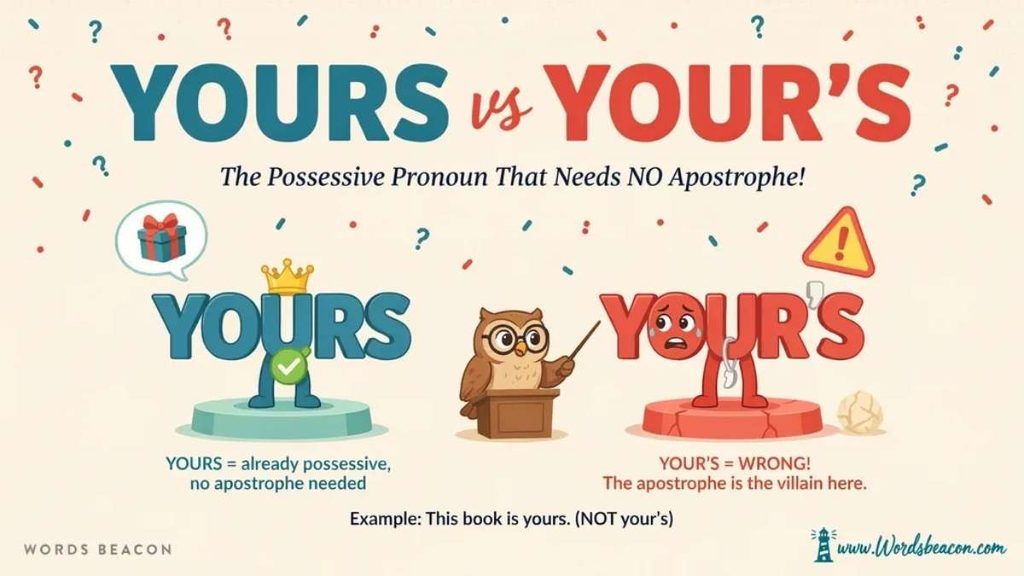
The your vs yours distinction is actually more important than the spelling difference between yours vs your’s.
Why? Because both your and yours are correct words.
They simply work differently.
Your is a possessive determiner. It normally appears before a noun.
For example:
Your phone is ringing.
I like your idea.
Please check your email.
Where is your bag?
Yours, on the other hand, is a possessive pronoun. It can stand in place of a noun phrase.
For example:
The phone is yours.
The idea is yours.
The email is yours.
The bag is yours.
Cambridge Grammar explains the distinction clearly: possessive determiners come before nouns, while possessive pronouns are used in place of nouns.
That difference gives you a simple rule to remember:
Your + noun
Yours = belonging to you
Consider this pair:
This is your jacket.
This jacket is yours.
Both sentences express possession. However, the grammar changes.
In the first sentence, your directly modifies jacket. In the second sentence, yours stands independently.
Your Is a Possessive Determiner
Your tells the reader that something belongs to or relates to the person being addressed.
For example:
1.Your car is outside.
2.Your answer is correct.
3.Your sister called earlier.
4.Your computer needs an update.
5.Your name appears on the form.
In each sentence, a noun follows your.
That pattern is extremely useful when deciding whether to use your or yours. If you have a noun immediately after the word, your will usually be the form you need.
Cambridge Dictionary also identifies your as a determiner and explains that it expresses belonging or connection to the person or group being addressed.
Yours Is a Possessive Pronoun
Yours performs a different job.
It can replace a noun phrase that has already been mentioned or is clear from context.
For example:
This is your book.
This book is yours.
The first sentence contains your book. The second sentence uses yours instead.
Likewise:
1.Your answer is better than my answer.
2.Your answer is better than mine.
3.Your answer is better than yours? That sentence would have a different meaning, but the structure shows how possessive pronouns replace noun phrases.
More naturally:
My answer is different from yours.
Her car is newer than yours.
Their house is larger than ours.
This is why the term possessive pronoun yours is useful. The word expresses possession while standing in for the thing possessed.
Learn the difference between tricky grammar words
More Than vs More Then difference and usage ?
Yours vs Your’s and the Apostrophe Problem
The apostrophe causes most of the trouble in the your’s spelling mistake.
People often learn that an apostrophe can indicate possession. That rule is useful, but it has limits.
Consider:
The student’s book
Here, student’s is a possessive noun.
Now consider:
The book is hers.
Here, hers is a possessive pronoun, so no apostrophe appears.
The same principle applies to yours.
The book is yours.
Not:
The book is your’s.
Therefore, the question “Does yours need an apostrophe?” has a simple answer: no.
The spelling remains yours even when the word clearly expresses ownership.
Yours Possessive How It Works
The phrase yours possessive refers to the use of yours to show ownership, belonging, or connection.
For example:
This desk is yours.
The final decision is yours.
That responsibility is yours.
The red folder is yours.
The word does not necessarily describe physical ownership. It can also describe ideas, duties, choices, opinions, or relationships.
For example:
The choice is yours.
The responsibility is yours.
That opinion is yours.
This success is yours.
So, the meaning of possession can be broader than simply “you own this object.”
Your’s Possessive Is Not the Standard Form
If you search for your’s possessive, you may find examples where writers have added an apostrophe to show possession. Nevertheless, standard English uses yours.
The correct structure is:
That responsibility is yours.
The incorrect structure is:
That responsibility is your’s.
The difference does not change the intended meaning. Instead, it changes whether the spelling follows standard English grammar rules.
For professional, academic, and polished writing, yours is the form to choose.
Your vs Yours Examples
The easiest way to understand your vs yours examples is to compare the forms directly.
| Your | Yours |
|---|---|
| This is your book. | This book is yours. |
| I like your idea. | I like yours. |
| Your answer is correct. | The correct answer is yours. |
| Where is your seat? | Which seat is yours? |
| Your car is outside. | The car outside is yours. |
| Your opinion matters. | That opinion is yours. |
Notice the pattern. Your normally needs a noun after it, while yours can stand alone.
That distinction also answers the question, “What is the difference between your and yours?” The words express a similar relationship, but they occupy different grammatical positions.
Learn the difference between tricky grammar words
Weiner vs Wiener Which one Is Correct?
Yours in a Sentence
If you are looking for yours in a sentence, everyday examples make the rule easier to remember.
Is this wallet yours?
That blue notebook is yours.
The final choice is yours.
My answer is different from yours.
Which seat is yours?
Those keys are yours.
The responsibility is yours.
The examples of yours above show several common uses. Yours can identify an object, compare possessions, express responsibility, or show belonging.
Moreover, it can refer to either one item or multiple items depending on the context.
For example:
This book is yours.
These books are yours.
The grammatical form does not change.
When to Use Yours
Knowing when to use yours becomes much easier when you look at what comes next.
If the word stands alone and means “belonging to you,” use yours.
For example:
That bag is yours.
The decision is yours.
This seat is yours.
The choice is yours.
You can also use yours when comparing possessions:
My phone is newer than yours.
Her office is larger than yours.
Their results were better than yours.
However, do not normally put a noun immediately after yours.
Incorrect:
Yours book is on the table.
Correct:
Your book is on the table.
Or:
The book is yours.
That is the key difference.
When to Use Your
When should I use your? Use your when it comes directly before a noun.
For example:
1.your house
2.your car
3.your name
4.your question
5.your opinion
6.your application
7.your computer
8.Your can describe ownership or connection.
For example:
Please send your application.
I understand your concern.
Where is your phone?
I like your new design.
The word your does not normally stand alone in this possessive use. Cambridge Grammar makes this distinction clear by describing your as a possessive determiner and yours as the corresponding possessive pronoun.
Yours vs Your’s in a Sentence
When deciding between yours vs your’s in a sentence, always choose yours for standard English.
Correct:
This jacket is yours.
Incorrect:
This jacket is your’s.
Correct:
Is this pen yours?
Incorrect:
Is this pen your’s?
Correct:
The final decision is yours.
Incorrect:
The final decision is your’s.
The pattern never changes. If the word means “belonging to you,” write yours.
Learn the difference between tricky grammar words
Flakey vs Flaky which one is correct ?
Common Mistakes With Yours and Your’s
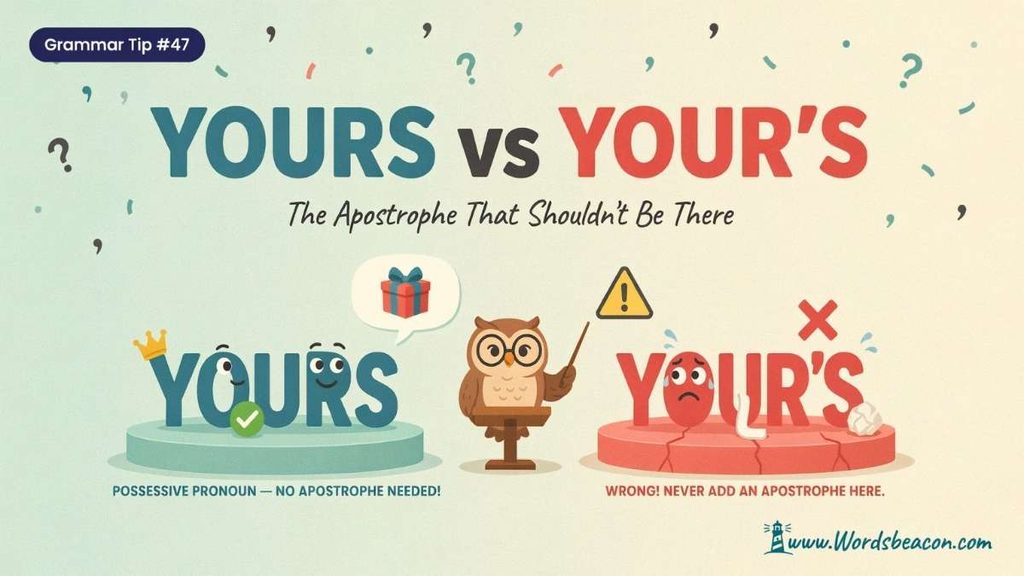
One common mistake involves adding an apostrophe simply because the sentence expresses possession. However, possession alone does not guarantee that an apostrophe belongs in the word.
Another mistake happens when writers confuse your with yours. For example, “This is yours car” is incorrect because yours cannot normally modify a noun. The correct sentence is “This is your car.”
A third mistake involves confusing your with you’re. Your shows possession, while you’re means “you are.”
Compare these:
Your phone is ringing.
You’re holding my phone.
The first sentence describes the phone as belonging to or being associated with you. The second means “you are holding.”
Finally, fast typing can create your’s even when the writer knows the correct form. A quick proofreading check can catch the problem before it reaches an email, assignment, article, or formal document.
Is Your’s a Word?
The question “Is your’s a word?” can be confusing because you may see the spelling in real writing.
However, seeing a form in writing does not automatically make it a standard grammatical form.
For standard English, use yours.
The accepted form is:
Yours
Not:
Your’s
Therefore, if you are writing an academic paper, professional email, application, report, website, or formal letter, yours is the appropriate spelling.
Learn the difference between tricky grammar words
Premier vs Premiere which one is correct ?
Yours in Letters and Emails
Yours has a special place in correspondence because it appears in traditional letter closings.
Common expressions include:
1.Yours sincerely
2.Yours faithfully
3.Yours truly
The spelling remains yours in all three.
For example:
Dear Ms. Taylor,
Thank you for your message. I appreciate the information you provided.
Yours sincerely,
Jordan
The same word can appear in formal correspondence without an apostrophe.
Cambridge Dictionary specifically lists yours sincerely and yours faithfully as letter-ending expressions.
Your or Yours in Letters
If you are asking about your or yours in letters, the answer depends on how the word functions.
Before a noun, use your:
Please review your application.
Thank you for your letter.
I received your message.
As part of a traditional sign-off, use yours:
1.Yours sincerely,
2.Yours faithfully,
3.Yours truly,
So, the difference is grammatical rather than merely stylistic.
Yours Sincerely
Yours sincerely is a traditional formal sign-off.
For example:
Dear Mr. Brown,
Thank you for your response.
Yours sincerely,
Alex
The word yours is not an abbreviation and does not need an apostrophe. It is simply the possessive pronoun used in an established letter-closing expression.
Modern email writing often uses shorter closings such as “Sincerely” or “Best regards,” but yours sincerely remains a recognized formal expression.
Yours Faithfully
Yours faithfully is another traditional formal closing.
For example:
Dear Hiring Manager,
Thank you for considering my application.
Yours faithfully,
Alex
Traditional British and Commonwealth letter-writing conventions have historically used “Yours faithfully” with a generic salutation such as “Dear Sir or Madam.” Usage varies across English-speaking regions, so the conventions of the intended audience matter.
Nevertheless, the spelling remains the same everywhere in standard English:
Yours faithfully
Not:
Your’s faithfully
Yours Truly
Yours truly is another established expression.
It can work as a letter closing and can also appear as an idiomatic phrase in other contexts. Cambridge Dictionary lists yours truly among the expressions associated with yours.
For example:
Yours truly,
Alex
Again, the word yours has no apostrophe.
Yours Sincerely vs Yours Faithfully
The difference between yours sincerely and yours faithfully mainly concerns traditional letter-writing conventions.
In traditional British usage, yours sincerely commonly follows a salutation that names the recipient, such as:
Dear Ms. Johnson,
Yours faithfully has traditionally followed a more general salutation, such as:
Dear Sir or Madam,
Modern professional correspondence is often more flexible. In American English, “Sincerely” and “Sincerely yours” are also common choices.
Therefore, the important point for this article is not which closing you choose. It is how you spell the word.
In every case, use yours.
Learn the difference between commonly mixed-up more words
Attornies vs Attorneys difference and usage ?
Why Doesn’t Yours Have an Apostrophe?
The question “Why doesn’t yours have an apostrophe?” becomes easier once you understand possessive pronouns.
English has possessive nouns and possessive pronouns, and they do not follow exactly the same spelling pattern.
A possessive noun can use an apostrophe:
Maria’s book
The teacher’s desk
The dog’s toy
A possessive pronoun has its own form:
The book is hers.
The desk is ours.
The toy is theirs.
The phone is yours.
As a result, the apostrophe is not missing from yours. It simply does not belong there.
Cambridge Grammar explicitly identifies yours as the possessive pronoun corresponding to the possessive determiner your and notes that apostrophe s is not used after possessive pronouns.
What Type of Pronoun Is Yours?
If you are asking “What type of pronoun is yours?”, the answer is possessive pronoun.
A possessive pronoun shows who or what something belongs to while replacing a noun phrase.
For example:
This is my book.
This book is mine.
That is your book.
That book is yours.
The same structure appears throughout the possessive pronoun system:
My → mine
Your → yours
Her → hers
Our → ours
Their → theirs
This is why yours grammar becomes much easier once you separate possessive determiners from possessive pronouns.
How to Spell Yours
If you want to know how to spell yours, keep the rule simple:
Y-O-U-R-S
There is no apostrophe.
The correct spelling remains the same in every ordinary context.
This is yours.
That bag is yours.
Are these keys yours?
Yours sincerely,
The most common spelling mistake is inserting an apostrophe between r and s. However, that extra mark should be removed during proofreading.
Learn the difference between commonly mixed-up more words
Bear vs Bare Difference and usage ?
A Simple Way to Remember the Difference
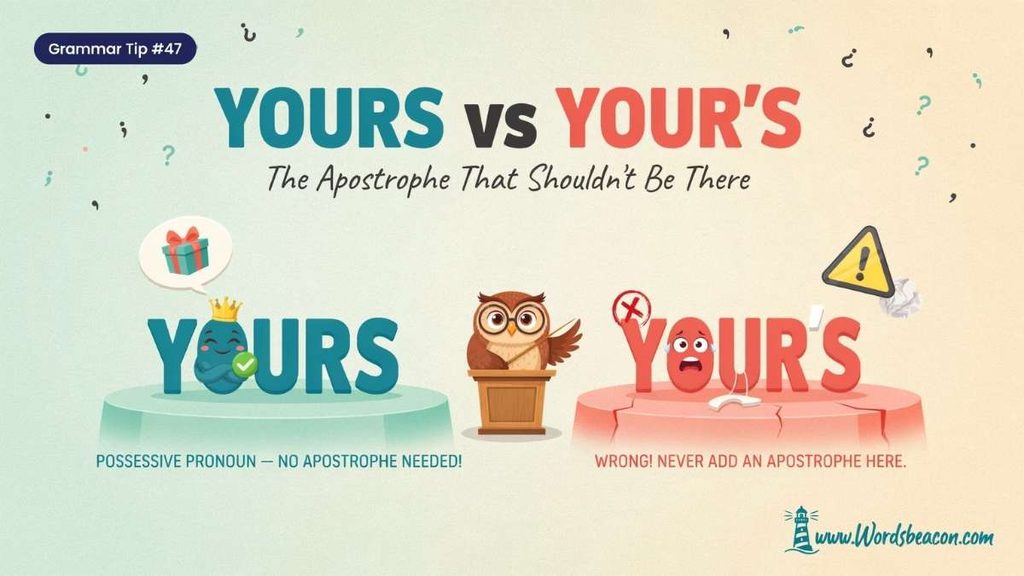
Here is an easy memory trick.
If a noun comes immediately after the word, think your.
If the word stands alone and means “belonging to you,” think yours.
For example:
1.your phone
2.your jacket
3.your answer
4.your idea
Then:
The phone is yours.
The jacket is yours.
The answer is yours.
The idea is yours.
Finally, remember one more rule:
Yours never needs an apostrophe.
That gives you three simple forms to keep separate:
your + noun
yours = belonging to you
you’re = you are
Once those three are clear, many common mistakes disappear.
Learn the difference between commonly mixed-up more words
Aid vs Aide which one is correct?
Practice Session Yours vs Your’s
Fill in each blank with the correct word: your, Yours vs Your’s.
- Is this book ______?
- Please bring ______ notebook to class.
- My phone is newer than ______.
- I think this jacket is ______.
- Where did you put ______ keys?
- That seat is ______, so you can sit there.
- Her answer was different from ______.
- Please check ______ email before the meeting.
- Is this pen ______ or mine?
- We finished our project, and now you can finish ______.
- I like ______ new shoes.
- The choice is ______.
- His house is larger than ______.
- Did you leave ______ bag in the car?
- This responsibility is ______.
- I found a book that I think is ______.
- Your computer is faster than ______.
- Please take ______ coat with you.
- The final decision is ______.
- She accidentally picked up ______ instead of her own.
Answers
- yours
- your
- yours
- yours
- your
- yours
- yours
- your
- yours
- yours
- your
- yours
- yours
- your
- yours
- yours
- yours
- your
- yours
- yours
Here’s a trusted source for clear word meanings:
FAQs
Is “yours” grammatically correct?
Yes. “Yours” is grammatically correct. It works as a possessive pronoun and shows that something belongs to the person being addressed. For example, “This book is yours” clearly shows ownership.
Is “your’s” grammatically correct?
No. “Your’s” is not the standard spelling in modern English. The correct form is “yours,” without an apostrophe.
What is the difference between “yours” and “your’s”?
“Yours” is the standard possessive pronoun, while “your’s” is a nonstandard spelling. For example, “Is this yours?” is correct, whereas “Is this your’s?” is incorrect in standard English.
Does “yours” need an apostrophe?
No. “Yours” does not need an apostrophe. Possessive pronouns such as mine, yours, hers, ours, and theirs normally appear without one.
Why is “your’s” incorrect?
The confusion often comes from the idea that an apostrophe always marks possession. However, English has specific possessive forms that do not use apostrophes. “Your” changes to “yours,” not “your’s.”
Is “yours” a possessive pronoun?
Yes. “Yours” is a possessive pronoun because it shows ownership or belonging without being followed directly by a noun. For example, “The blue jacket is yours” uses “yours” as a possessive pronoun.
Can “yours” come before a noun?
No. Use “your” before a noun. For example, “your car” is correct, while “yours car” is incorrect. On the other hand, “The car is yours” is correct because “yours” stands on its own.
When should you use “yours” instead of “your”?
Use “your” before a noun, such as “your phone” or “your idea.” Use “yours” when it replaces the noun phrase, as in “My phone is old, but yours is new.”
Can “yours” refer to more than one thing?
Yes. “Yours” can refer to one possession or several possessions. For example, “Is this yours?” refers to one thing, while “Are these books yours?” refers to multiple things.
What is the correct spelling of “yours”?
The correct spelling is “yours.” It has no apostrophe. Therefore, when you ask how to spell yours, remember the simple form: y-o-u-r-s.
Can “your’s” ever be used in standard English?
No. “Your’s” is not the standard modern English form. You may see it in informal writing, older material, or as a spelling mistake. In standard writing, use “yours.”
Does “yours” always show physical ownership?
No. “Yours” can express ownership, connection, association, or responsibility. For example, “This responsibility is yours” shows that someone has responsibility for something rather than physical ownership.
Can “yours” stand alone?
Yes. “Yours” can stand alone because it functions as a possessive pronoun. For example, “My seat is near the window, and yours is by the door.”
What is the difference between “Yours vs Your’s”?
“Your” comes before a noun, while “yours” replaces the noun phrase. For example, “Your answer is correct” uses “your” before “answer.” In “Your answer is correct, and yours is too,” “yours” stands in place of the noun phrase.
Is “your’s” correct in formal writing?
No. Avoid “your’s” in formal writing. Use “yours” because it follows standard English spelling and grammar rules.
Can “yours” be used at the end of a letter?
Yes. “Yours” commonly appears in letter and email sign-offs, including “Yours sincerely,” “Yours faithfully,” and “Yours truly.” The spelling remains “yours,” without an apostrophe.
Is “Yours sincerely” correct?
Yes. “Yours sincerely” is a standard letter and email sign-off. It is especially common in formal correspondence. The word “yours” does not need an apostrophe.
Is “Yours faithfully” correct?
Yes. “Yours faithfully” is a traditional formal sign-off used in correspondence. Once again, “yours” remains the correct spelling without an apostrophe.
Is “Yours truly” correct?
Yes. “Yours truly” is grammatically correct and can work as a traditional letter sign-off. The correct spelling is “yours truly,” not “your’s truly.”
Is “I am yours” grammatically correct?
Yes. “I am yours” is grammatically correct. Here, “yours” follows the verb and can express belonging, loyalty, commitment, or affection. The exact meaning depends on the context.
Is “It’s yours” correct?
Yes. “It’s yours” is correct when you mean “it is yours.” In this sentence, “it’s” means “it is,” while “yours” shows possession. “It’s your’s” is not the standard form.
Is “What’s yours” grammatically correct?
Yes. “What’s yours” can be correct depending on the sentence. For example, “Take what’s yours” means to take whatever belongs to you.
How can you remember that “yours” has no apostrophe?
Remember the pattern of possessive pronouns: mine, yours, hers, ours, and theirs. These forms do not use apostrophes. So, when something belongs to you, choose “yours,” not “your’s.”
conclusion
The yours vs your’s confusion is easy to clear once you remember one simple rule. In the yours vs your’s debate, yours is correct, while your’s is not the standard spelling. That extra apostrophe may look innocent, but it does not belong there.
Use your before a noun, such as “your phone” or “your idea.” On the other hand, use yours when you do not name the noun again, as in “The phone is yours” or “My idea is different from yours.”
So, when the yours vs your’s question comes up, keep it simple: write yours without an apostrophe. Once you understand the yours vs your’s difference, the confusion disappears, and your writing becomes clearer and more accurate.

Luna AJS is an experienced blogger and dedicated language enthusiast at Words Beacon. She specializes in making English grammar, spelling, vocabulary and commonly confused words easy to understand. She provides clear explanations, practical examples to help readers write with confidence.