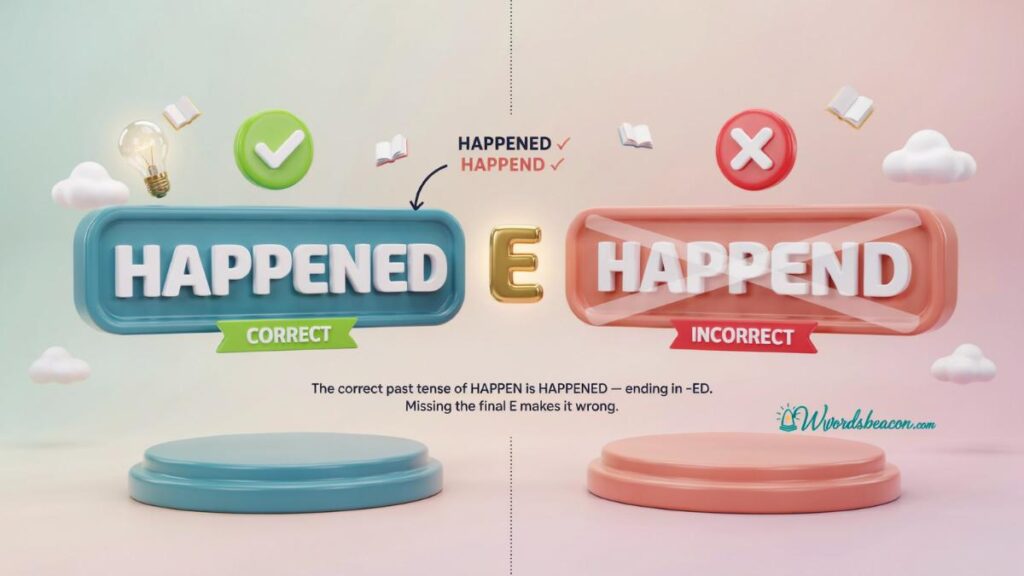
Choosing between happened vs happend can be surprisingly confusing. Both look almost identical, so it’s easy to wonder whether that little E really belongs there. The answer is yes! Happened is the correct spelling, while happend is a common spelling mistake. But there’s more to learn than just adding one letter. Many writers also confuse happen with happened, especially when forming questions with did or didn’t. The good news is that these mistakes are easy to fix once you understand a few simple rules. Let’s clear up the confusion with practical examples and make sure you get it right every time.
comprasion table
| Comparison | Happened | Happend |
|---|---|---|
| Correct spelling | Yes | No |
| Standard English usage | Accepted | Not accepted |
| Word formation | Happen + ed | Incomplete ending |
| Verb form | Simple past and past participle | Misspelling |
| Example | Something happened yesterday. | Something happend yesterday. |
Learn the difference between tricky grammar words
Seeing vs Seing Which Spelling Is Correct?
Is Happened vs Happend Correct?
Happened is the correct spelling in standard English. It describes something that took place in the past or appears as a past participle with a helping verb. Happend, on the other hand, is a spelling error rather than a recognized form of the verb.
For example:
- Correct: Something unexpected happened during the meeting.
- Incorrect: Something unexpected happend during the meeting.
- Correct: What happened to your phone?
- Incorrect: What happend to your phone?
The difference becomes clearer when you look at the original verb. Happen is a regular verb, so you form its past tense by adding -ed.
The correct construction is:
HAPPEN + ED = HAPPENED
The original double P stays in place, and the complete ending includes both E and D. You don’t need to remove a letter or add another consonant.
If you’re wondering, “Is it happened vs happend?” the answer is straightforward: always use happened when referring to the past form of happen.
What Does Happened Mean?
Happened means took place, occurred, or came about. It describes an event, situation, or experience that occurred in the past.
The exact meaning depends on the context. For example, something can happen unexpectedly, regularly, accidentally, or as the result of a particular action.
Consider these sentences:
- Something unusual happened during the interview.
- A power outage happened last night.
- Nothing serious happened during the trip.
- Several changes happened after the new manager arrived.
- I don’t know what happened to my phone.
In each example, happened identifies an event that has already occurred.
The word also appears in expressions that describe chance, experiences, and situations affecting people or objects.
For example:
- I happened to meet an old friend at the airport.
- She happened to be nearby when the accident occurred.
- What happened to your favorite jacket?
In the first two examples, happened suggests that something occurred by chance. In the last example, it asks about an event that affected an object.
Happened as the Past Tense of Happen
Happened is the simple past form of happen. Use it when describing a completed event or situation that took place before the present.
Examples:
- The concert happened last Friday.
- An unexpected problem happened during the interview.
- The accident happened near the school.
- Something unusual happened while we were traveling.
- The meeting happened earlier than expected.
Notice that happened doesn’t change when you use different time expressions. Whether something occurred yesterday, last month, or several years ago, the spelling stays the same.
However, the time expression helps readers understand when the event took place.
| Sentence | Meaning |
|---|---|
| The meeting happened yesterday. | The event occurred yesterday. |
| The accident happened last month. | The accident occurred last month. |
| Something unexpected happened. | An unplanned event occurred. |
| The same thing happened again. | A previous event repeated itself. |
Happened as a Past Participle
Happened also functions as a past participle. You use this form with helping verbs such as has, have, and had to create perfect tenses.
Examples:
- Something has happened to the computer.
- Several changes have happened recently.
- The incident had happened before the police arrived.
- Many unexpected things have happened this year.
Although the spelling remains unchanged, the helping verb determines the tense.
| Construction | Tense | Example |
|---|---|---|
| Has happened | Present perfect | Something has happened. |
| Have happened | Present perfect | Several things have happened. |
| Had happened | Past perfect | Something had happened before we arrived. |
The present perfect connects a past event to the present, while the past perfect places an event before another point in the past.
Why Is Happened the Correct Spelling?
The spelling of happened follows a basic rule for regular verbs: add -ed to the base form to create the simple past and past participle.
The original verb is happen. Since it already contains two P’s, you keep both letters and attach the complete ending.
For example:
- Walk → Walked
- Talk → Talked
- Clean → Cleaned
- Open → Opened
- Happen → Happened
The word doesn’t require an unusual spelling change. You simply add -ed to happen.
The English Spelling Rule Behind Happened
Regular verbs follow several patterns when forming their past tense. Most simply take -ed, while others require a small adjustment to their final letters.
| Base verb | Past tense | Spelling rule |
|---|---|---|
| Walk | Walked | Add -ed |
| Love | Loved | Add -d |
| Study | Studied | Change Y to I and add -ed |
| Stop | Stopped | Double final consonant and add -ed |
| Happen | Happened | Keep existing letters and add -ed |
The comparison between stopped and happened is particularly useful.
In stopped, the final P doubles because the verb follows the consonant-doubling rule. In happened, the word already contains double P. Therefore, you don’t need to add another one.
There is also an important distinction involving the final N. Some verbs double their final consonant before adding -ed or -ing, but happen doesn’t follow that pattern.
Compare:
- Happen → Happened
- Happen → Happening
- Begin → Began
- Begin → Beginning
- Refer → Referred
In begin and refer, the final syllable receives stress, so the final consonant doubles before the relevant ending. The final syllable of happen is unstressed, so its N remains single.
Why Is Happend Incorrect?
Happend is incorrect because it omits the E from the regular -ed ending.
This mistake often occurs when writers rely too heavily on pronunciation. In American English, happened has two syllables, and its final -ed ending sounds like /d/. Consequently, some people assume they only need to add D to happen.
However, English spelling doesn’t always represent pronunciation letter for letter.
Compare these forms:
| Spelling | Status |
|---|---|
| Happened | Correct |
| Happend | Incorrect |
| Hapened | Incorrect |
| Happenned | Incorrect |
| Happenend | Incorrect |
The standard form always includes the complete -ed ending.
If you’re looking for the happend meaning, it’s important to understand that happend has no accepted standard meaning as a form of happen. It is simply a common misspelling of happened.
How to Remember the Correct Spelling
The easiest way to remember the correct spelling of happened is to start with the base verb rather than trying to memorize the entire past-tense form.
Follow these steps:
- Start with HAPPEN.
- Identify the regular past-tense ending, -ED.
- Combine both parts to form HAPPENED.
You can also remember these three points:
- Keep both P’s in the original verb.
- Never remove the E from the -ed ending.
- Don’t add another N to the base word.
For extra practice, write the two forms together several times:
1.Happen → Happened
2.Happen → Happened
3.Happen → Happened
This simple exercise reinforces the relationship between the base verb and its past form.
Understand confusing English more words simply
installment vs Instalment One Word Two Spellings
Happen vs Happened What’s the Difference?
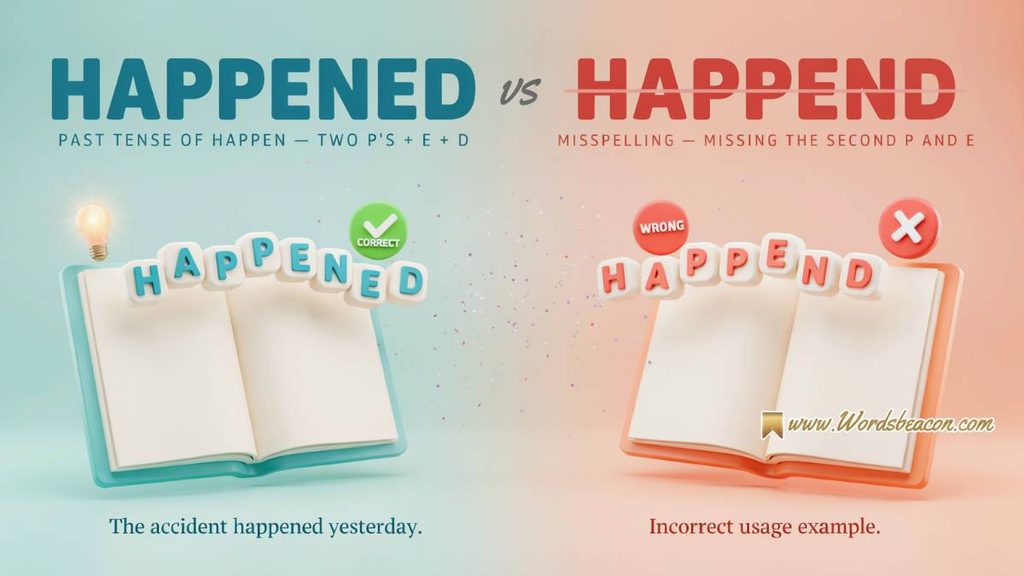
The Happen and happened come from the same verb, but they serve different grammatical purposes. Happen is the base form, while happened is the simple past and past participle.
The main difference involves time and sentence structure.
| Feature | Happen | Happened |
|---|---|---|
| Verb form | Base form | Simple past and past participle |
| Main use | General events and possibilities | Past events and perfect tenses |
| Example | Accidents happen. | An accident happened. |
| After did | Did it happen? | Not used after did as the main verb |
When to Use Happen
Use happen when discussing events in general, possibilities, or situations that may occur in the future.
It also follows modal verbs such as will, can, could, might, and should.
Examples:
- Mistakes happen to everyone.
- What will happen next?
- Unexpected problems can happen during a journey.
- I hope nothing bad will happen.
- Did anything happen yesterday?
The last example is particularly important. Although did refers to the past, happen remains in its base form.
You also use happen in infinitive constructions:
- I didn’t expect this to happen.
- It is possible for mistakes to happen.
- Nobody wants something like that to happen.
When to Use Happened
Use happened when describing an event that occurred in the past or when forming a perfect tense.
Examples:
- The accident happened early this morning.
- Something strange happened during the interview.
- Several changes have happened recently.
- The problem had happened before I joined the company.
The surrounding words establish the time relationship. For example, happened yesterday describes a completed past event, while has happened recently connects an earlier event to the present.
Happen, Happens, Happened, and Happening: All Verb Forms Explained
The verb happen has four common forms. Each one serves a different grammatical purpose.
| Verb form | Grammatical role | Example |
|---|---|---|
| Happen | Base form | Things happen unexpectedly. |
| Happens | Third-person singular present | It happens every year. |
| Happened | Simple past and past participle | It happened yesterday. |
| Happening | Present participle and gerund | Something is happening outside. |
Happen
Happen is the base form of the verb. Use it with I, you, we, and they in the simple present. It also follows modal verbs and the auxiliary did.
Examples:
- Accidents happen when people ignore safety rules.
- I don’t know what will happen tomorrow.
- Things can happen without warning.
- What did happen at the office?
- I didn’t expect this to happen.
Happens
Happens is the third-person singular present form. Use it with singular subjects such as he, she, it, or a singular noun.
Examples:
- It happens every year.
- This problem happens quite often.
- What happens when you press this button?
- The same thing happens whenever it rains.
The S ending follows the subject-verb agreement rule.
Compare:
- Correct: Something happens every morning.
- Incorrect: Something happen every morning.
However, when you use does, the main verb returns to its base form.
- Correct: Does this happen often?
- Incorrect: Does this happens often?
Happened
Happened describes a completed past event or functions as a past participle with an auxiliary verb.
Examples:
- My appointment happened to fall on a Monday.
- The unexpected delay happened last night.
- Something important has happened.
- Everything had happened before we arrived.
Regardless of the sentence structure, the spelling remains happened.
Happening
Happening is the present participle of happen. It commonly appears with forms of be to describe an ongoing event.
Examples:
- What is happening outside?
- Something unusual is happening at work.
- The changes are happening faster than expected.
It can also function as a gerund, which means the verb acts as a noun.
Example:
“Happening unexpectedly can make an ordinary day memorable.”
However, this construction is less common than expressions such as “unexpected events” or “things happening unexpectedly.”
How to Use Happened Correctly in Sentences
Knowing the spelling is important, but choosing the correct verb form matters just as much. Happened appears in several sentence structures, including simple past, present perfect, past perfect, questions, and negative statements.
Happened in Simple Past Tense
The simple past describes an event that took place at a completed time in the past.
Use happened when you want to explain what occurred without connecting the event to the present through a perfect tense.
Examples:
- The meeting happened yesterday.
- Something unusual happened during the flight.
- The accident happened near the school.
- A power failure happened around midnight.
- Several unexpected things happened during our vacation.
Common time expressions include yesterday, last night, last week, two hours ago, and several years earlier.
Consider this example:
Sarah planned to meet her colleague on Monday. However, an unexpected emergency prevented her from attending.
She might explain:
“The meeting happened on Monday, but I couldn’t attend because of an emergency.”
Here, happened identifies the meeting as a past event, while the second clause explains why Sarah missed it.
Happened in Present Perfect Tense
The present perfect uses has or have followed by the past participle.
Its basic structure is:
Subject + has/have + happened
Use this tense when a past event has a connection to the present. The exact time may be unknown, unimportant, or left unstated.
Examples:
- Something strange has happened.
- Several changes have happened recently.
- A misunderstanding has happened between the two teams.
- Many things have happened since we last met.
- Something unexpected has happened to my computer.
Compare these sentences:
| Simple past | Present perfect |
|---|---|
| Something happened yesterday. | Something has happened recently. |
| The problem happened last week. | The problem has happened several times. |
| An accident happened in June. | An accident has happened again. |
In American English, the simple past generally works with a finished time expression such as yesterday, last Monday, or two days ago.
For example:
- Correct: Something happened yesterday.
- Incorrect in standard American English: Something has happened yesterday.
The present perfect focuses on the connection between an earlier event and the present rather than identifying a specific completed past time.
Happened in Past Perfect Tense
The past perfect uses had followed by the past participle.
Its structure is:
Subject + had + happened
Use this construction when one event occurred before another event or reference point in the past.
Examples:
- The accident had happened before the police arrived.
- Something important had happened while I was away.
- The meeting had happened before the manager received the email.
- Nobody knew what had happened before the investigation began.
Imagine a train arriving late at a station. The passengers later learn that a technical problem occurred before the train reached the station.
You could explain:
“The technical problem had happened before the train reached the station.”
The past perfect establishes the order of events. First, the technical problem occurred. Later, the train reached the station.
However, you don’t need the past perfect every time you mention two past events. Use it when the earlier timing needs emphasis or clarification.
Learn the difference between commonly mixed-up more word
Oversight vs Oversite Which Spelling Is Correct?
Did Happen or Did Happened Which Is Correct?
Did happen is correct. And Did happened is grammatically incorrect in standard English.
The reason involves auxiliary verbs. Did already carries the past-tense meaning, so the main verb must remain in its base form.
The basic structure is:
Did + subject + base verb?
Examples:
- Did it happen yesterday?
- Did anything happen during the trip?
- What did happen after the meeting?
- Did the accident happen near your house?
- Why did this happen?
The same rule applies to negative statements:
Subject + did not/didn’t + base verb
Examples:
- It didn’t happen yesterday.
- The accident didn’t happen near the school.
- The problem didn’t happen again.
- They didn’t expect this to happen.
What Did Happen?
What did happen? is grammatically correct. Speakers sometimes use this construction to emphasize a question or request a clear explanation.
For example:
“What did happen after everyone left?”
The auxiliary did carries the past-tense meaning, so happen stays in its base form.
What Happened?
What happened? is a standard past-tense question. It doesn’t require did because happened already expresses the past.
Examples:
- What happened to your car?
- What happened during the interview?
- What happened last night?
- What happened after the power went out?
Both what happened and what did happen are correct. However, the second construction often adds emphasis.
Did Something Happen or Did Something Happened?
Always write did something happen?
| Incorrect | Correct |
|---|---|
| Did something happened? | Did something happen? |
| Did anything happened? | Did anything happen? |
| Did it happened yesterday? | Did it happen yesterday? |
| Why did this happened? | Why did this happen? |
| What did happened next? | What did happen next? |
This rule isn’t limited to happen. It applies to regular and irregular verbs throughout English.
For example:
- Did you walk home?
- Did she call you?
- Did they see the accident?
- Did he finish the assignment?
The main verb stays in its base form after did, regardless of whether it normally takes -ed or changes completely in the past tense.
Learn the difference between commonly mixed-up more word
Filed vs Filled Differences and Everyday Usage
Happened vs Happening vs Had Happened
These three forms often confuse learners because they describe events from different time perspectives. However, their grammatical roles are quite distinct.
| Verb form | Main use | Example |
|---|---|---|
| Happened | Completed past event | It happened yesterday. |
| Happening | Ongoing event | It is happening now. |
| Had happened | Earlier event before another past event | It had happened before I arrived. |
Happened vs Happening
Use happened for an event that occurred in the past. Use happening for an event that is taking place now or was ongoing at a particular time.
Compare:
- The accident happened yesterday.
- The accident is happening right now.
- Something unusual happened last night.
- Something unusual is happening outside.
You can also use happening with was or were to describe an event in progress at a particular time in the past.
Example:
“Something strange was happening when we entered the building.”
The event was already in progress when the speakers arrived.
Happened vs Had Happened
Both forms refer to the past, but had happened establishes a relationship between two past events.
Compare:
- The problem happened before lunch.
- The problem had happened before the manager arrived.
The first sentence simply reports an event. The second emphasizes that the event occurred before another past event.
Has Happened vs Had Happened
Has happened uses the present perfect, while had happened uses the past perfect.
Examples:
- Something has happened to the delivery.
- Something had happened to the delivery before the driver called.
The first sentence connects the event to the present. The second places it before another moment in the past.
Learn how to use confusing more words correctly
Armor vs Armour Simple Spelling Differences Explained
Common Misspellings of Happened
English spelling mistakes often occur when a word contains repeated consonants, unfamiliar letter combinations, or endings that aren’t obvious from pronunciation.
Happened is a good example because writers sometimes forget the E, remove a P, or add unnecessary letters.
| Incorrect spelling | Correct spelling | Explanation |
|---|---|---|
| Happend | Happened | Missing E before D |
| Hapened | Happened | Missing one P |
| Happenned | Happened | Unnecessary extra N |
| Happenend | Happened | Incorrect letter arrangement |
| Happen’d | Happened | Unnecessary apostrophe |
happened vs happend
This is the main spelling confusion.
The incorrect form happend usually results from leaving out the E in the -ed ending.
For example:
- Incorrect: What happend to the package?
- Correct: What happened to the package?
Remember that the base verb is happen, and the complete past-tense ending is -ed.
Hapened vs Happened
The form hapened contains only one P. However, the base verb happen already has two P’s.
Examples:
- Incorrect: Something unexpected hapened at work.
- Correct: Something unexpected happened at work.
Keep both P’s when forming the past tense.
Happenned vs Happened
This spelling includes an unnecessary extra N.
The base verb ends in one N, and you don’t need to double it when adding -ed.
- Incorrect: The event happenned yesterday.
- Correct: The event happened yesterday.
Happenend vs Happened
The spelling happenend incorrectly rearranges the letters in the past-tense ending.
The correct construction is happen + ed, not happen + end.
- Incorrect: The problem happenend again.
- Correct: The problem happened again.
happened vs happend in Questions and Everyday Writing
The confusion doesn’t disappear when you turn a statement into a question.
For example:
- Incorrect: Is it true that something happend?
- Correct: Is it true that something happened?
- Incorrect: Do you know what happend?
- Correct: Do you know what happened?
Whether you’re writing a question, statement, or negative sentence, the spelling remains happened whenever you need this verb form.
Learn how to use confusing more words correctly
Behavior vs Behaviour difference and usage
Happened Spelling and Pronunciation
Understanding how a word sounds can make it easier to remember its spelling. However, pronunciation doesn’t always reveal every letter in English.
The word happened has two syllables and a regular -ed ending.
How Do You Spell Happened?
The correct spelling is H-A-P-P-E-N-E-D.
It contains seven letters:
- H: First consonant
- A: First vowel
- P: First P
- P: Second P
- E: Vowel in the base word
- N: Final consonant of the base verb
- E-D: Past-tense ending
The easiest way to remember the spelling is to recognize the base verb before adding its ending.
HAPPEN + ED = HAPPENED
How Is Happened Pronounced?
In standard American English, happened is pronounced /ˈhæpənd/.
It contains two syllables, with the stress on the first. The final -ed ending sounds like /d/ rather than a separate syllable.
Compare these common pronunciations:
| Word | Pronunciation of -ed |
|---|---|
| Walked | /t/ |
| Played | /d/ |
| Wanted | /ɪd/ |
| Happened | /d/ |
The three common pronunciations of -ed are /t/, /d/, and /ɪd/. The sound depends on the final sound of the base verb.
For happen, the ending follows a voiced sound, so -ed is pronounced /d/.
This explains why some people mistakenly write happend. They hear the final sound but forget that the written ending still requires E and D.
Is Happened a Real Word?
Yes. Happened is a standard English word and the simple past and past-participle form of happen.
It appears in everyday conversations, books, newspapers, academic writing, and professional communication.
Examples:
- What happened during the meeting?
- Something unexpected has happened.
- The incident happened several years ago.
Its grammatical role depends on the sentence, but the spelling never changes.
Is Happend a Real Word?
No. Happend isn’t an accepted standard spelling of the past tense of happen.
You may encounter it in online conversations, social media posts, comments, or informal messages. However, its appearance in digital communication doesn’t make it grammatically correct.
Use happened in school assignments, professional emails, articles, reports, and other forms of standard written English.
Learn how to use confusing more words correctly
Emigrate vs Immigrate Difference and usage
Happened vs Happend in Different Writing Contexts
A spelling rule doesn’t change simply because the audience or writing platform changes. Whether you’re sending a quick text or preparing a formal report, happened remains the correct form.
However, the way you use the word may differ depending on the situation.
Everyday Conversations
People use happened frequently when discussing personal experiences, unexpected events, and previous situations.
Examples:
- What happened at the party?
- Something funny happened yesterday.
- I don’t know what happened to my keys.
- It happened again this morning.
In everyday speech, the word often appears in short questions and explanations.
Emails and Professional Communication
Clear spelling matters in professional messages because errors can distract readers and make communication look careless.
Consider these examples:
- Incorrect: The delay happend because of a technical issue.
- Correct: The delay happened because of a technical issue.
Another example:
- Incorrect: Please explain what happend during the inspection.
- Correct: Please explain what happened during the inspection.
A simple spelling correction makes the message more polished and easier to understand.
Academic and Formal Writing
Students frequently use happened when explaining historical events, describing experiments, or discussing previous experiences.
Examples:
- The chemical reaction happened after the solution was heated.
- Several changes happened during the industrial period.
- The error happened because the instructions were misunderstood.
In academic writing, you can sometimes replace happened with a more precise verb such as occurred or developed. The best choice depends on the sentence’s meaning.
For example:
“The chemical reaction occurred after the solution was heated.”
This version sounds more formal and precise without changing the basic meaning.
News Reports and Storytelling
News writers and storytellers use happened to describe past events and explain how situations developed.
Examples:
- The incident happened shortly after midnight.
- Nobody knew what had happened before the fire started.
- Several unexpected events happened during the investigation.
In formal reporting, occurred may sound more precise. In conversational storytelling, happened often feels more natural.
Text Messages and Social Media
Informal communication doesn’t require formal language in every sentence. Nevertheless, standard spelling remains useful.
Compare:
- Incorrect: Guess what happend today!
- Correct: Guess what happened today!
- Incorrect: I can’t believe that happend.
- Correct: I can’t believe that happened.
A missing letter may seem harmless in a quick message, but using the correct form helps reinforce good writing habits.
Happened Synonyms and Alternative Words
Sometimes, you may want to avoid repeating happened several times in the same paragraph. Fortunately, English offers several alternatives.
However, synonyms aren’t always interchangeable. Each word carries a slightly different meaning or tone.
| Synonym | Meaning | Example |
|---|---|---|
| Occurred | Took place | The accident occurred near the station. |
| Took place | Happened or was held | The ceremony took place on Friday. |
| Transpired | Occurred or became known | Several unexpected events transpired. |
| Developed | Gradually came about | A serious problem developed overnight. |
| Arose | Emerged or appeared | A disagreement arose during the meeting. |
| Came about | Happened or resulted | The change came about after several discussions. |
When Should You Use These Alternatives?
Occurred works well in formal writing, reports, and descriptions of events.
Example: “The power outage occurred during the storm.”
Took place is useful when describing scheduled events, ceremonies, meetings, and activities.
Example: “The conference took place in Chicago.”
Transpired can sound more formal or literary. It can also mean that information became known.
Example: “Nobody understood what had transpired during the investigation.”
Developed describes a situation that emerged or changed over time.
Example: “A problem developed after the software update.”
Arose is particularly useful when discussing difficulties, questions, or opportunities.
Example: “Several concerns arose during the discussion.”
Came about describes how something occurred or resulted from particular circumstances.
Example: “The change came about after several discussions.”
Choosing the right synonym adds variety without changing the intended meaning unnecessarily.
Understand confusing English more words simply
Realize vs Realise Which Spelling Is Correct?
Common Grammar Mistakes With Happened
Spelling isn’t the only area where people struggle with happened. Its relationship with auxiliary verbs and other verb forms can also create confusion.
Here are several mistakes worth avoiding.
Using Happened After Did
Incorrect: Did the accident happened yesterday?
Correct: Did the accident happen yesterday?
The auxiliary did already expresses the past tense. Therefore, the main verb must use its base form.
Using Happened Instead of Happens
Incorrect: It happen every year.
Correct: It happens every year.
Use happens with singular third-person subjects in the simple present tense.
Confusing Happened With Happening
Incorrect: Something unusual is happened outside.
Correct: Something unusual is happening outside.
The present continuous requires a form of be followed by the present participle.
Using Has Happened and Had Happened Incorrectly
Incorrect: Something has happen to my computer.
Correct: Something has happened to my computer.
Incorrect: The accident had happen before we arrived.
Correct: The accident had happened before we arrived.
Both has and had require the past participle in these constructions.
Forgetting the Auxiliary Verb in Perfect Tenses
Incorrect: Something happened recently, and it has affect our plans.
Correct: Something happened recently, and it has affected our plans.
The first verb describes a past event. The second clause uses the present perfect and therefore needs the past participle affected.
Remember that perfect tenses require a helping verb followed by the past participle.
Case Study Why the Extra E Matters
Consider a student named Alex who is writing an English assignment about an unexpected event at school.
Alex writes:
“Something strange happend during the science experiment.”
The sentence communicates the intended idea, but the spelling contains an error.
After checking the base verb, Alex realizes that the correct construction is happen + ed.
The revised sentence becomes:
“Something strange happened during the science experiment.”
The correction restores the missing E and gives the verb its proper past-tense ending.
This example shows why recognizing the base verb is so helpful. Rather than memorizing the entire word as an isolated spelling, you can understand how its parts fit together.
Case Study Why Did Happened Is Incorrect
Now consider another situation.
A student asks:
“Did something happened during the experiment?”
The problem isn’t the spelling of happened alone. It’s the sentence structure.
The auxiliary did already carries the past-tense meaning. Using another past-tense verb immediately afterward creates an incorrect construction.
The correct question is:
“Did something happen during the experiment?”
Compare the two structures:
| Incorrect construction | Correct construction |
|---|---|
| Did it happened? | Did it happen? |
| Did anything happened? | Did anything happen? |
| Why did this happened? | Why did this happen? |
The lesson is simple: use the base form after did.
Understanding this rule helps prevent mistakes beyond happen. It also applies to verbs such as walk, play, finish, and write.
Fix common more word mistakes in English
Complement vs Compliment Difference and Correct Usage
Practice Exercise Happened vs Happend
Understanding a spelling rule is useful, but applying it in real sentences makes it easier to remember. Try these questions to test your knowledge of happened, happen, happens, and happening.
Fill in each blank with the correct word or verb form.
- Something unexpected ______ during the school trip yesterday.
- What ______ to your phone last night?
- Did anything unusual ______ at the office?
- The accident ______ before the police arrived.
- Several changes have ______ since the new manager joined.
- Nothing serious ______ during the meeting.
- What is ______ outside the classroom?
- The same problem ______ every winter.
- I don’t know what ______ after the lights went out.
- Has anything strange ______ recently?
- The event had ______ before we reached the venue.
- Did the package ______ on time?
- Something unusual ______ during our conversation yesterday.
- These mistakes ______ when people rush through their writing.
- Something unusual is ______ in the neighborhood.
- Why did the computer ______ suddenly?
- What ______ at the airport yesterday?
- Several unexpected things have ______ this month.
- The problem didn’t ______ again after the repair.
- Nobody knew what had ______ before the investigation began.
Answers
| No. | Correct answer | Explanation |
|---|---|---|
| 1 | Happened | Simple past describing yesterday’s event. |
| 2 | Happened | Direct question about a past event. |
| 3 | Happen | Use the base verb after did. |
| 4 | Happened | Simple past describes the earlier event. |
| 5 | Happened | Use the past participle after have. |
| 6 | Happened | Simple past describes a completed situation. |
| 7 | Happening | Present continuous describes an ongoing event. |
| 8 | Happens | Third-person singular present form. |
| 9 | Happened | Refers to an event that occurred in the past. |
| 10 | Happened | Present perfect construction. |
| 11 | Happened | Past perfect construction. |
| 12 | Happen | Use the base verb after did. |
| 13 | Happened | Describes a completed past event. |
| 14 | Happen | Plural subject takes the base form. |
| 15 | Happening | Present continuous describes an ongoing event. |
| 16 | Happen | Use the base verb after did. |
| 17 | Happened | Simple past question without did. |
| 18 | Happened | Present perfect construction. |
| 19 | Happen | Use the base verb after didn’t. |
| 20 | Happened | Past perfect construction. |
If you answered most questions correctly, you’ve understood the main spelling and grammar patterns. If a few answers were tricky, revisit the sections about auxiliary verbs and past-tense formation.
Here’s a trusted source for clear word meanings:
FAQs
Which Is Correct, happened vs happend?
Happened is the correct spelling. It is the simple past and past participle of happen. Happend is a misspelling because it leaves out the E in the -ed ending.
Why Is It Happened and Not Happenned?
Happened is correct because the base verb happen ends in a single N. Its final syllable is unstressed, so you don’t double the N when adding -ed. The correct form is happen + ed = happened.
How Do You Spell Happend Correctly?
The correct spelling is happened: H-A-P-P-E-N-E-D. Simply add -ed to the base verb happen without removing or changing any of its original letters.
When Should You Use Happened?
Use happened when describing an event or situation that took place in the past. For example, “Something unexpected happened during the meeting.”
What Does Happend Mean?
Happend has no recognized meaning as a standard English word. It is usually a spelling mistake for happened, which means took place or occurred.
Is “Did Something Happened” Grammatically Correct?
No. The correct question is “Did something happen?” The auxiliary did already expresses the past tense, so the main verb must remain in its base form.
Which Is Correct: “Did Happen” or “Did Happened”?
Did happen is correct because did must be followed by the base form of the main verb. For example, “Did the accident happen yesterday?” is grammatically correct.
Is “It Happened” or “It Was Happened” Correct?
“It happened” is correct when describing a past event. Happen is normally an intransitive verb in this context, so it doesn’t form a passive construction with was. Write “It happened yesterday,” not “It was happened yesterday.”
Which Is Correct: “It Won’t Happen” or “It Happened”?
Both expressions are correct, but they refer to different times. “It won’t happen” describes something that will not occur in the future, while “It happened” refers to an event that already took place.
Is It “What Happened” or “What Happend”?
“What happened?” is correct. Use it to ask someone about a past event or situation. Happend is an incorrect spelling and should be avoided in standard writing.
How Do You Use Happened in a Sentence?
Use happened as the past form of happen to describe an event that occurred earlier. For example, “The power outage happened shortly after midnight.”
What Is a Formal Way to Say Happened?
Occurred is a common formal alternative to happened. Depending on the context, you can also use took place, transpired, or developed. For example, “The incident occurred shortly after midnight.”
When Should You Use Happen or Happened?
Use happen as the base form, especially after did, didn’t, and modal verbs such as will, can, and might. Use happened for past events and after has, have, or had. For example, “Did it happen?” and “It happened yesterday.”
How Do You Pronounce Happen?
In American English, happen is pronounced /ˈhæpən/. It has two syllables, with the stress on the first syllable. The final syllable sounds like “uhn.”
Is “When Did That Happen” or “When Did That Happened” Correct?
“When did that happen?” is correct. Did already marks the question as past tense, so the main verb must stay in its base form. Adding -ed to happen would create a grammatical error.
Is “What Has Happened” Correct Grammar?
Yes. “What has happened?” is grammatically correct. It uses the present perfect tense to ask about a past event that has a connection to the present or whose consequences matter now.
Is “It Just So Happens” or “It Happened” Correct?
Both expressions are correct, but they have different meanings. “It just so happens” describes a present situation or coincidence, while “It happened” refers to an event in the past.
Can Happened Be Used With Has, Have, and Had?
Yes. Happened is the past participle of happen, so it works with all three helping verbs. For example, “It has happened,” “Several things have happened,” and “It had happened before we arrived” are all grammatically correct.
Fix common more word mistakes in English
Ingage vs Engage Which Spelling Is Correct ?
Conclusion
One missing letter can make a big difference! When choosing between happened vs happend, remember that happened is the only correct spelling. It comes from the verb happen, and you form its past tense by adding -ed. Keep both P’s, include the E, and don’t add an extra N.
There’s one more grammar rule worth remembering: use happened for a past event, as in “Something happened yesterday.” However, after did or didn’t, use happen instead. That’s why “Did it happen?” is correct, not “Did it happened?”
Once you understand these simple rules, you won’t have to second-guess this spelling every time you write. And if you accidentally type happend, don’t worry. Mistakes happen! Just make sure you correct this one before it happens again.

Luna AJS is an experienced blogger and dedicated language enthusiast at Words Beacon. She specializes in making English grammar, spelling, vocabulary and commonly confused words easy to understand. She provides clear explanations, practical examples to help readers write with confidence.