
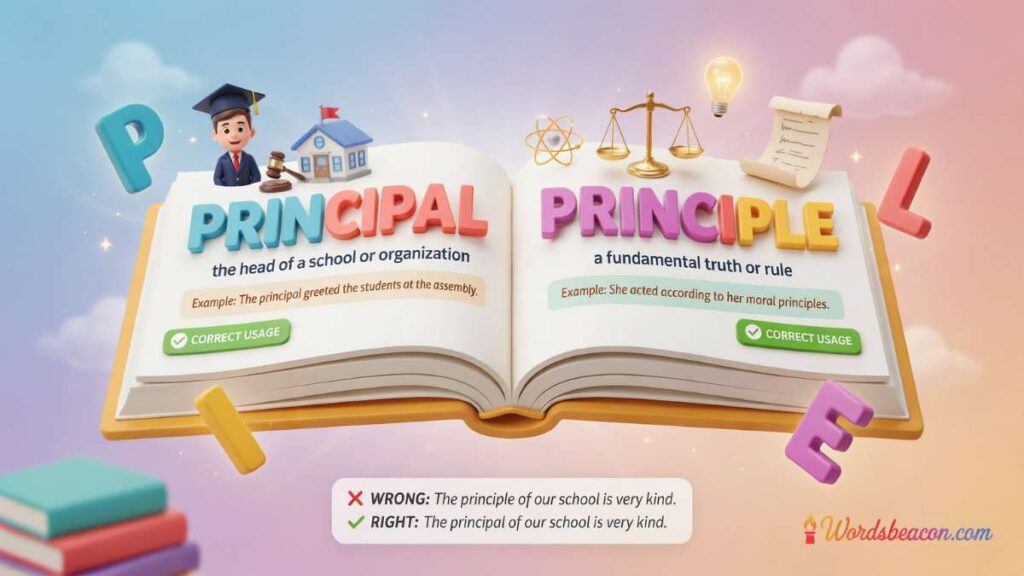
Principal vs principle is one of those spelling pairs that can leave even confident writers scratching their heads. They sound exactly alike and look almost identical, but their meanings are quite different. Mix them up, and your school principal might turn into a personal belief! Although this mistake seems small, it can change the meaning of your sentence and confuse your readers. So, how can you tell which word to use? Don’t worry. The difference is easier than it looks. Once you understand their meanings and see how they work in everyday sentences, you’ll know exactly when to write principal and when to choose principle.
quick comprasion
| Comparison | Principal | Principle |
|---|---|---|
| Meaning | A school leader, original amount of money, or something most important | A basic rule, belief, or fundamental truth |
| Part of speech | Noun and adjective | Noun |
| Common examples | School principal, principal amount, principal reason | Moral principle, scientific principle, guiding principle |
| In education | A person who leads a school | A belief or rule that guides education |
| In finance | The original amount borrowed or invested | A fundamental financial rule or concept |
| Example | The principal welcomed the new students. | Honesty is an important principle. |
| Memory trick | A principal can be your pal. | A principle is a rule you believe in. |
Fix common more word mistakes in English
Analysis vs Analyses difference and usage
What Does Principal Mean?
The word principal generally describes someone or something that holds a leading or primary position. Its exact meaning depends on how you use it in a sentence.
In everyday American English, principal most commonly refers to a school administrator or something that is main or most important. In financial writing, it has another important meaning: the original amount of money borrowed or invested.
The principal definition also depends on its grammatical role. Unlike principle, principal works as both a noun and an adjective.
Let’s look at its different meanings and uses.
Principal as a Noun Meaning and Common Uses
As a noun, principal can identify a person in charge, someone with an important role, or the original amount of money involved in a financial arrangement. The principal meaning changes depending on the context, but it generally refers to a person, amount, or position of primary importance.
Here are its most common uses.
School Principal: A Person Who Leads a School
In American schools, a principal is the person responsible for managing the institution and overseeing its daily activities. The job involves much more than maintaining discipline or announcing school events.
A school principal usually handles responsibilities such as:
- Supervising teachers and other school employees.
- Supporting students and addressing disciplinary concerns.
- Communicating with parents and guardians.
- Managing school policies and daily operations.
- Working to maintain a safe learning environment.
- Supporting academic programs and student achievement.
For example:
- The principal welcomed the new students during orientation.
- Our school principal arranged a meeting with parents.
- The principal introduced a new reading program.
- Teachers discussed classroom concerns with the principal.
In some countries, people use titles such as headmaster or headteacher for the person leading a school. In the United States, principal is the usual term for this position. Therefore, school principal is the correct expression, not school principle.
Principal in Finance The Original Amount of Money
Principal also has an important meaning in banking and finance. It refers to the original amount of money borrowed or invested, separate from interest.
For example, suppose you borrow $15,000 to purchase a car. The $15,000 is the original loan principal. If your lender charges interest, you’ll pay additional money according to the loan agreement.
Consider these sentences:
- She made an extra payment toward her loan principal.
- The bank explained how the principal balance affects monthly payments.
- He wanted to protect his investment principal.
- The borrower reduced the original loan amount through regular payments.
Understanding the meaning of principal in finance is especially useful when discussing mortgages, personal loans, business financing, and investments. Remember that loan principal refers to the amount borrowed, while interest represents the additional cost of borrowing that money.
Principal as a Person With an Important Role
In business and legal situations, a principal can also be a person or organization that authorizes another person to act on their behalf.
For example:
- The principal authorized the agent to negotiate the agreement.
- The business principal approved the proposed transaction.
- The principal signed the contract after reviewing its terms.
In these situations, the principal is the person or organization whose interests the agent represents. The term identifies the party who gives authority to another person to carry out specific duties or responsibilities.
Principal as an Adjective
Principal also works as an adjective. In this role, it means main, primary, chief, or most important.
It describes something that holds the greatest importance in a particular situation. You may see it before words such as reason, concern, objective, character, and office.
For example:
- The principal reason for the delay was bad weather.
- Customer satisfaction is our principal objective.
- Her principal concern was the safety of her children.
- The principal character appears throughout the novel.
- The company’s principal office is located in Chicago.
Notice how principal describes the importance of something in each sentence.
It doesn’t mean that no other factors matter. It simply identifies the main one.
Principal in Different Contexts
The meaning of principal becomes easier to understand when you see how different fields use it.
| Context | Meaning | Example |
|---|---|---|
| Education | Person leading a school | The principal met with teachers. |
| Banking | Original borrowed amount | The borrower paid down the principal. |
| Investment | Original invested capital | She wanted to protect her principal. |
| Business | A leading person or entity | The principal approved the agreement. |
| General writing | Main or most important | Safety was the principal concern. |
Although these meanings appear in different situations, they share an important idea: principal refers to a leading person, amount, or position.
Fix common more word mistakes in English
Happened vs Happend Which Spelling Is Correct?
What Does Principle Mean?
A principle is a fundamental rule, belief, truth, or standard that influences how people think, behave, and make decisions.
Unlike principal, principle doesn’t refer to a school administrator, the main person in a transaction, or the original amount of a loan. Instead, it describes an idea or standard that provides direction.
For example:
- Honesty is an important principle in every healthy relationship.
- The teacher explained the principle behind the experiment.
- Our company follows strict ethical principles.
- She refused to compromise her principles for financial gain.
In each sentence, principle refers to a belief, rule, or fundamental concept.
The principle definition covers several areas of life, including personal values, education, science, business, and professional ethics.
What Does Principle Mean? Definition and Common Uses
Principle functions as a noun. The principle meaning refers to a basic truth, moral belief, scientific concept, or established standard that guides people’s thoughts, decisions, and actions. In simple words, a principle is an idea or rule that helps you understand something or decide how to behave.
You can use the word principle when discussing science, personal values, professional ethics, or organizational standards. Let’s explore its most common meanings with clear explanations and examples.
A Fundamental Truth or Basic Rule
A principle can describe a basic truth or idea that explains how something works or establishes a rule for a particular situation. These fundamental principles provide a foundation for understanding different subjects and solving problems.
For example:
- The principle of gravity helps explain why objects fall toward Earth.
- The basic principle of supply and demand influences market prices.
- The experiment demonstrates an important principle of physics.
- Students learned the fundamental principles of mathematics.
Scientific principles help explain relationships and processes in the natural world. They provide a foundation for understanding more complex ideas. For instance, the principles of physics help scientists explain motion, energy, and other natural phenomena.
In everyday language, a principle can also refer to a basic rule that people follow when making decisions or handling particular situations.
Moral and Ethical Principles
Moral principles are standards that help people decide what is right and wrong. They influence personal choices, relationships, and everyday behavior. These principles often reflect a person’s values and sense of responsibility.
Some common moral principles include:
- Honesty
- Fairness
- Respect
- Responsibility
- Integrity
- Compassion
For example, a person who values honesty may refuse to lie even when telling the truth creates an uncomfortable situation.
Ethical principles also guide professional behavior. Doctors, teachers, business owners, and other professionals follow standards that help them treat people fairly and responsibly. These guidelines encourage trust, respect, and accountability in the workplace.
For example, a doctor follows ethical principles by respecting patient privacy, while a teacher demonstrates fairness by treating students equally. In both situations, principles guide behavior and help people make responsible decisions.
Personal Principles and Beliefs
People often use the word principle to describe the beliefs they follow in their everyday lives. Personal principles influence how individuals treat others, respond to challenges, and make important decisions.
For example:
- He stood by his principles even when others disagreed.
- She believes fairness should guide every important decision.
- They raised their children according to strong family principles.
- I won’t lie because honesty is one of my core principles.
Personal principles can develop through family experiences, education, culture, and individual choices. They may also change as people gain experience and develop a better understanding of the world.
These beliefs help people decide how to respond when they face difficult situations. For example, someone who values kindness may choose to help a struggling colleague even when doing so requires extra time and effort.
Fix common more word mistakes in English
Behavior vs Behaviour difference and usage
How Do Principles Guide Everyday Decisions?
Principles aren’t limited to textbooks, professional rules, or scientific discussions. They also influence ordinary decisions that people make every day. Whether you’re choosing to tell the truth, keeping a promise, or treating someone fairly, your principles often shape your actions.
Consider these everyday examples:
- A student refuses to cheat on an exam because honesty matters to them.
- An employee gives credit to a coworker for their contribution because they believe in fairness.
- A friend keeps a promise because loyalty is one of their personal values.
- A business owner treats customers respectfully because customer trust is important.
In each example, a principle provides a standard for deciding what to do. This is why personal principles matter: they help people stay consistent with their beliefs, even when making the right choice isn’t always easy.
Guiding Principles in Schools and Organizations
Schools, businesses, charities, and other organizations often establish guiding principles to maintain consistent behavior and decision-making. These standards explain what an organization values and how its members should act.
For example:
- A company may follow the principle of putting customers first.
- A school may emphasize fairness and equal opportunities.
- A nonprofit organization may prioritize transparency and accountability.
- A business may establish ethical principles for handling customer information.
These standards give organizations a clear direction and help employees understand what the organization expects from them. They also create a shared foundation for teamwork, professional conduct, and responsible decisions.
For instance, a company that values transparency may openly communicate its policies with customers and employees. Similarly, a school that follows the principle of equal opportunity may work to ensure that every student receives fair treatment.
In these situations, principles are more than simple statements. They act as practical guidelines that influence how people work, communicate, and make decisions.
Different Types of Principles
Principles appear in almost every area of life. Their purpose depends on the subject and the situation.
| Type of principle | Meaning | Example |
|---|---|---|
| Moral principles | Standards of right and wrong | Honesty and fairness |
| Ethical principles | Rules for responsible behavior | Professional integrity |
| Scientific principles | Basic explanations of natural processes | Conservation of energy |
| Business principles | Standards that guide professional decisions | Transparency and accountability |
| Personal principles | Individual beliefs and values | Keeping promises |
| Legal principles | Fundamental rules used in law | Presumption of innocence |
Principle in Everyday Situations
You don’t need to work in a laboratory or manage a company to use the word principle. It appears regularly in ordinary conversations, school assignments, and professional writing.
Here are some natural examples:
- Honesty is one of the most important principles of friendship.
- The principle behind this exercise is simple.
- She believes in treating everyone fairly.
- The teacher explained the basic principles of mathematics.
- Their business follows strong ethical principles.
You may also encounter the expression “in principle.” It means that someone generally agrees with an idea or proposal, even if the practical details still need attention.
For example:
“We agree with the proposal in principle, but we still need to discuss the budget.”
Here, principle refers to the general idea rather than a specific rule.
Learn how to use confusing more words correctly
Seeing vs Seing Which Spelling Is Correct?
Principal vs Principle What Is the Difference?
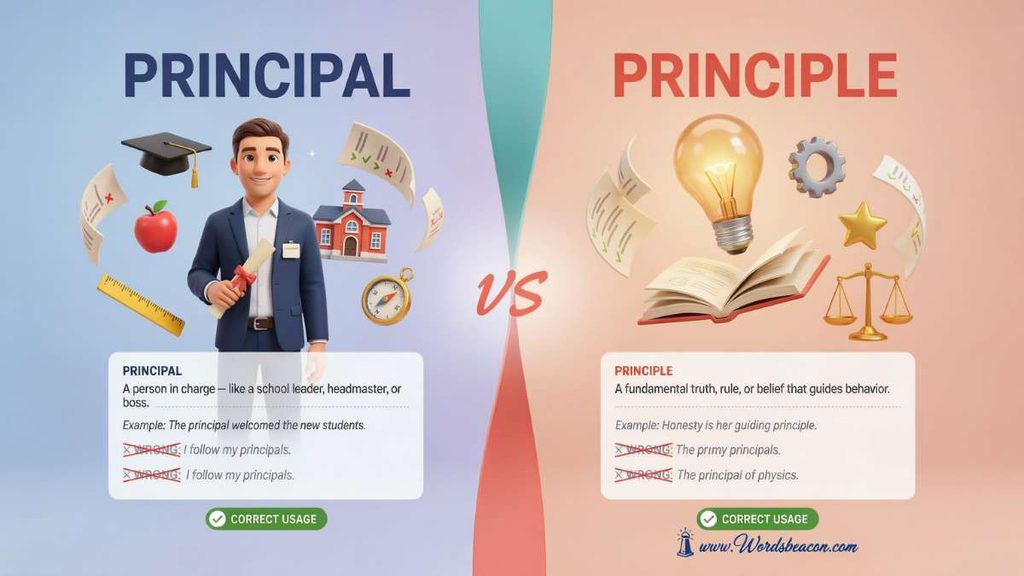
Now that you understand both definitions, let’s make the principal vs principle difference even clearer.
The easiest way to remember the distinction is to connect each word with its main purpose.
Principal refers to a person, an original amount of money, or something that holds primary importance. Principle refers to a belief, fundamental truth, or rule that guides behavior.
Although their pronunciation is identical, their grammatical roles and meanings are different.
Difference in Meaning
The main difference between principal and principle is what each word represents.
Principal can refer to:
- A school leader or administrator.
- A person with an important role in a business or legal arrangement.
- The original amount of money borrowed or invested.
- Something that is main, chief, or most important.
Principle refers to:
- A fundamental rule or truth.
- A moral or ethical belief.
- A scientific concept.
- A standard that guides behavior and decisions.
Consider this sentence:
“The principal explained the principles of the new school policy.”
The first word refers to the person leading the school. The second refers to the fundamental ideas behind the policy.
Both words are correct because they have different meanings.
Difference in Grammar
The principal vs principle grammar distinction is another important part of understanding these commonly confused words.
Principal functions as both a noun and an adjective. Principle functions as a noun.
| Grammatical feature | Principal | Principle |
|---|---|---|
| Noun | Yes | Yes |
| Adjective | Yes | No |
| Refers to a school leader | Yes | No |
| Refers to borrowed money | Yes | No |
| Describes a moral belief | No | Yes |
| Describes primary importance | Yes | No |
For example:
- Noun: The principal called an emergency meeting.
- Adjective: Safety is the principal concern.
- Noun: Honesty is a valuable principle.
You cannot use principle as an adjective in standard English. If you want to describe someone as guided by strong moral beliefs, you can use the adjective principled.
For example: “She took a principled stand against dishonesty.”
Understanding these parts of speech will help you follow English grammar rules and choose the correct word.
Difference in Usage
The best way to understand principal vs principle usage is to compare common expressions.
| Correct expression | Meaning |
|---|---|
| School principal | Person leading a school |
| School principles | Fundamental educational beliefs |
| Principal amount | Original amount of money |
| Moral principles | Beliefs about right and wrong |
| Principal reason | Main reason |
| Guiding principles | Rules that direct decisions |
| Principal objective | Most important objective |
| Scientific principles | Fundamental scientific concepts |
| Principal office | Main office |
When you’re unsure whether to use principal or principle, ask yourself one simple question: Am I talking about a person, an amount, or something important? Or am I talking about a rule, belief, or fundamental truth?
That small check can prevent many spelling mistakes.
Are Principal and Principle Homophones?
Yes. Principal and principle are homophones in standard American English.
Homophones are words that sound alike but have different spellings and meanings.
Other familiar examples include:
- Their, there, and they’re.
- To, too, and two.
- Hear and here.
- Right and write.
- Flower and flour.
The principal and principle pronunciation is generally the same:
- Principal: /ˈprɪnsəpəl/
- Principle: /ˈprɪnsəpəl/
Both words have three syllables, with stress on the first syllable.
Because you hear the same pronunciation for both words, you cannot rely on sound alone to choose the correct spelling. You need to understand the sentence and its intended meaning.
Learn how to use confusing more words correctly
installment vs Instalment One Word Two Spellings
When to Use Principal or Principle
Choosing principal or principle becomes much easier when you know what each word describes.
Use principal when referring to a school leader, original financial amount, or something of primary importance. Use principle when referring to a belief, basic truth, or fundamental rule.
Here is a closer look at when to use principal or principle in everyday writing.
When to Use Principal
Choose principal in these situations:
1.When referring to a school leader
- The principal announced the new school schedule.
- Parents met with the principal to discuss student safety.
- Our principal introduced a new academic program.
2.When describing something important
- The principal cause of the problem was poor communication.
- Our principal goal is to improve customer service.
- Her principal concern was finding a safe solution.
3.When discussing money
- The borrower paid $500 toward the principal.
- The investment principal remained unchanged.
- The bank explained the remaining principal balance.
4.When referring to a leading person
- The principal authorized the agent to negotiate the contract.
- The principal approved the business transaction.
When to Use Principle
Choose principle when discussing beliefs, rules, or fundamental truths.
1.When discussing moral beliefs
- Honesty is an important principle.
- She refused to compromise her principles.
- Fairness should guide every decision.
2.When explaining scientific concepts
- The teacher demonstrated the principle of buoyancy.
- Students studied the principles of physics.
- The experiment helped explain a fundamental scientific principle.
3.When discussing business standards
- Transparency is one of our guiding principles.
- The company follows ethical principles when dealing with customers.
- Accountability is a core principle of responsible management.
4.When describing personal values
- He believes kindness should guide every interaction.
- She made the decision based on her personal principles.
- Respect is one of their family’s most important principles.
Learn how to use confusing more words correctly
Oversight vs Oversite Which Spelling Is Correct?
Principal vs Principle in Specific Contexts
Some situations make this spelling confusion especially common. Education, finance, and business are three important examples because both words can appear in discussions about these subjects.
However, each word still has a separate meaning.
Principal vs Principle in School and Education
In American schools, principal refers to the person who leads and manages an educational institution.
A school principal usually oversees teachers, administrative staff, student discipline, school policies, and daily operations. The exact responsibilities depend on the school district and the institution’s structure.
For example:
- The school principal welcomed the visiting parents.
- Our principal introduced a new reading program.
- The teachers discussed classroom improvements with the principal.
- The principal met with parents to discuss student progress.
The word principle has a different meaning in education. It refers to the beliefs and standards that guide teaching, learning, and school management.
For example:
- Respect is one of the school’s guiding principles.
- Teachers should understand the basic principles of child development.
- The school follows principles of fairness and inclusion.
- Students learn the principles of responsible citizenship.
The distinction is simple: a principal leads a school, while principles guide its decisions and behavior.
The same general distinction applies when discussing a school headmaster or college principal. However, titles differ across educational systems. In the United States, college leaders are more commonly called presidents or deans rather than principals.
Principal vs Principle in Money, Loans, and Interest
Finance is another area where principal has a specific meaning.
When you borrow money, the principal is the amount you originally borrow. Interest is the additional cost you pay for using that money.
For example, suppose you take out a $20,000 loan to purchase a car. The $20,000 represents the original loan principal. Your lender then charges interest according to the loan agreement.
Here’s a simple comparison:
| Financial term | Meaning | Example |
|---|---|---|
| Principal | Original amount borrowed | $20,000 |
| Interest | Cost of borrowing | 6% annual interest |
| Principal payment | Amount applied to reduce the principal | $300 |
| Outstanding principal | Remaining unpaid principal | $19,700 after a $300 principal-only payment |
These figures are illustrative. They assume no other payments, fees, or adjustments.
How do principal and interest work together?
Suppose you borrow $20,000 at a 6% annual interest rate.
If the lender calculates simple annual interest on the full original amount, the interest for one year would be:
$20,000 × 0.06 = $1,200
However, most installment loans use a payment schedule that divides each payment between principal and interest.
For an amortizing loan, the interest portion generally decreases as you pay down the outstanding principal, assuming the interest rate stays the same.
This is important because reducing your principal can lower the amount used to calculate future interest.
The word principle doesn’t refer to the borrowed money itself.
Compare these examples:
- Correct: She paid $500 toward the loan principal.
- Incorrect: She paid $500 toward the loan principle.
- Correct: The principle of compound interest explains how interest can accumulate on previously earned interest.
The last sentence uses principle because it describes a financial concept rather than an amount of money.
Principal vs Principle in Business
Business writing uses both words, but they serve different purposes.
Principal can identify someone who holds a leading position in a transaction or organization. It can also describe the main office, primary objective, or most important business activity.
Examples:
- The principal partner approved the agreement.
- The company’s principal office is in Boston.
- Profitability is not our principal objective this year.
- The principal investor reviewed the proposal.
Principle describes the beliefs and standards that guide professional conduct.
Examples:
- Fair treatment is one of our guiding principles.
- The company follows ethical principles when dealing with customers.
- Transparency is a core principle of responsible management.
- Accountability is one of the organization’s main principles.
Businesses often establish written codes of conduct based on honesty, fairness, respect, and responsibility.
These ethical principles help employees make consistent decisions, especially when a situation falls outside the company’s usual rules and regulations.
Principal vs Principle in Writing and Grammar
In academic writing, business communication, and everyday messages, choosing the correct word makes your meaning clear.
One reason principal and principle cause so much confusion is that spell-checking tools may accept both words. After all, both are correctly spelled English words. The problem occurs when you use a valid word in the wrong context.
For example:
“The school principle discussed the importance of honesty.”
A basic spell-checker may not flag principle because it is a real word. However, the sentence requires principal because it refers to a school administrator.
To avoid similar mistakes:
- Check the meaning before choosing the spelling.
- Identify whether you need a noun or adjective.
- Read the surrounding words for context.
- Check the complete sentence after proofreading.
- Consult a reliable dictionary when you’re unsure.
These simple steps can improve your word choice and help you avoid commonly misspelled or misused words.
Understand confusing English more words simply
Filed vs Filled Differences and Everyday Usage
Principal vs Principle Examples in Sentences
Sometimes, the easiest way to understand two confusing words is to see them in everyday sentences.
The following principal vs principle examples show how each word works in natural English.
Examples of Principal in Sentences
Here are examples of principal used as both a noun and an adjective.
- The principal welcomed the new students on their first day.
- Our school principal organized a meeting with parents.
- The principal approved the proposed changes to the curriculum.
- The borrower made an additional payment toward the principal.
- The bank explained how the loan principal affects monthly payments.
- Her principal concern was the safety of her children.
- The principal reason for the cancellation was severe weather.
- The company moved its principal office to Texas.
- The principal character in the novel faces several challenges.
- Reducing expenses is the principal objective of the new management team.
Examples of Principle in Sentences
These examples show how principle works as a noun.
- Honesty is one of the most important principles of friendship.
- The teacher explained the principle behind the experiment.
- She refused to compromise her principles for money.
- Fairness is a basic principle of good leadership.
- The company follows ethical principles when handling customer information.
- Students studied the fundamental principles of physics.
- Respect is one of our family’s guiding principles.
- The scientist explained the principles of natural selection.
- He believes everyone deserves equal treatment as a matter of principle.
- The organization operates according to clear principles of accountability.
Principal vs Principle in Similar Sentences
The following comparison shows how changing one word changes the meaning of a sentence.
| Principal | Principle |
|---|---|
| The principal addressed the students. | The principle of respect guided the discussion. |
| The principal amount was $5,000. | The principle of compound interest explains the calculation. |
| Safety was the principal concern. | Safety is a fundamental principle. |
| The principal approved the policy. | The policy follows ethical principles. |
| Her principal reason was financial security. | Her decision reflected her personal principles. |
Principal and Principle in the Same Sentence
You can use both words in the same sentence when you need to discuss a leading person or factor alongside a fundamental rule.
For example:
- The principal explained the principles of responsible behavior to the students.
- The principal objective of the business is to follow ethical principles.
- The school principal believes fairness and honesty are essential principles of education.
- The principal investigator explained the scientific principles behind the research.
These principal vs principle sentences make the difference easier to remember. One word identifies a person or something important, while the other describes a rule or belief.
Understand confusing English more words simply
Armor vs Armour Simple Spelling Differences Explained
How to Remember Principal vs Principle
You don’t need to memorize complicated grammar rules to remember principal vs principle. A couple of simple tricks can help you choose the correct spelling whenever these words appear.
The Principal Has a Pal
This is one of the most popular memory tricks for principal vs principle.
Look at the end of principal. It contains the word pal.
Think of a school principal as someone who can be your pal.
For example:
“The principal is my pal.”
This little sentence helps you connect principal with a person, especially a school leader.
Remember that principal also refers to money and primary importance. The trick helps with one common meaning, but context still matters.
Principle Is a Rule You Believe In
Principle ends in ple. You can connect it with the rules and beliefs that guide your behavior.
For example:
- Honesty is a principle.
- Fairness is a principle.
- Respect is a principle.
- Integrity is a principle.
Think of principles as the standards you follow in life.
This connection makes the spelling easier to remember when you’re discussing personal beliefs, moral values, or fundamental rules.
Use Context to Choose the Correct Word
If the memory tricks don’t help, look at the meaning of the sentence.
Ask yourself:
- Am I talking about a school leader? Use principal.
- Am I discussing the original amount of a loan? Use principal.
- Am I describing the main reason or objective? Use principal.
- Am I referring to a moral belief or fundamental rule? Use principle.
- Am I explaining a scientific concept? Use principle.
For example:
“The principal explained the principles of leadership.”
The first word refers to a person. The second describes the fundamental ideas that guide effective leadership.
This simple approach is one of the best ways to differentiate principal and principle without second-guessing yourself.
Common Mistakes When Using Principal and Principle
Even experienced writers sometimes mix up these words. Their identical pronunciation makes spelling mistakes easy to overlook, especially when someone is typing quickly.
Here are some common errors and their corrections.
| Incorrect sentence | Correct sentence | Explanation |
|---|---|---|
| The school principle called a meeting. | The school principal called a meeting. | Principal identifies the school leader. |
| Honesty is an important principal. | Honesty is an important principle. | Principle refers to a moral belief. |
| I paid the principle of my loan. | I paid the principal of my loan. | Principal means the borrowed amount. |
| Fairness is one of our core principals. | Fairness is one of our core principles. | Principles are guiding standards. |
| The principle reason was cost. | The principal reason was cost. | Principal means main or primary. |
| The company follows strong ethical principals. | The company follows strong ethical principles. | Principle refers to an ethical standard. |
Why Are Principal and Principle Confused?
There are several reasons these words cause problems.
They sound exactly alike. Both words have the same pronunciation in standard American English. You can’t identify their spelling simply by hearing them.
Their spelling looks similar. The words differ by only a small change near the end. This makes typing mistakes easy.
Principal has several meanings. It can refer to a school leader, a financial amount, or something most important. Writers sometimes remember one meaning but overlook the others.
Both appear in similar situations. Education, business, and finance may involve both words. However, their meanings remain separate.
The best solution is to understand their definitions rather than rely on pronunciation alone.
Learn the difference between similar English words
Emigrate vs Immigrate Difference and usage
Practice session Principal vs Principle
Choose principal vs principle for each blank. Pay attention to the meaning of the complete sentence rather than relying on how the word sounds.
- The school ______ welcomed the students on Monday morning.
- Honesty is an important ______ in every healthy relationship.
- She made an additional payment toward the loan ______.
- The ______ reason for the delay was heavy rainfall.
- Respect is one of the most important ______ of effective leadership.
- Our college ______ announced the new academic schedule.
- The scientist explained the basic ______ behind the experiment.
- The company’s ______ objective is to improve customer satisfaction.
- He refused to abandon his ______ even when others disagreed.
- The bank explained how the outstanding ______ affects interest charges.
- Fairness is a fundamental ______ of a just society.
- The company’s ______ office is located in New York.
- Students learned the basic ______ of chemistry.
- The school ______ spoke to parents about the new attendance policy.
- She believes kindness should guide every decision as a personal ______.
- The ______ character in the story struggles with difficult choices.
- Transparency is one of the company’s guiding ______.
- The borrower reduced the loan ______ through regular payments.
- The teacher discussed the ______ of responsible behavior.
- Safety remains the ______ concern of the management team.
Answers
| Question | Correct answer |
|---|---|
| 1 | Principal |
| 2 | Principle |
| 3 | Principal |
| 4 | Principal |
| 5 | Principles |
| 6 | Principal |
| 7 | Principle |
| 8 | Principal |
| 9 | Principles |
| 10 | Principal |
| 11 | Principle |
| 12 | Principal |
| 13 | Principles |
| 14 | Principal |
| 15 | Principle |
| 16 | Principal |
| 17 | Principles |
| 18 | Principal |
| 19 | Principles |
| 20 | Principal |
Here’s a trusted source for clear word meanings:
FAQs
What is the difference between principal and principle?
Principal refers to a person in charge, the original amount of money borrowed or invested, or something of primary importance. Principle refers to a fundamental rule, belief, truth, or standard that guides decisions and behavior.
Is a person a principal or a principle?
A person is a principal, not a principle. For example, a school principal leads the school, while a principle is a belief or rule that guides someone’s actions.
Is it school principal or school principle?
School principal is correct. The word principal refers to the person responsible for leading a school. For example, “The school principal welcomed the new students.”
Is it principal vs principle when talking about money?
Principal is correct when discussing money. It refers to the original amount borrowed or invested, excluding interest. For example, “She made an extra payment toward her loan principal.”
Do you pay principal vs principle on a loan?
You pay principal on a loan. The principal is the original amount you borrowed. Your monthly payments may cover both principal and interest, depending on your loan terms.
What does principal mean in simple words?
Principal means a person in charge or the main or original amount of something. For example, a school principal leads a school, while the principal on a loan is the original amount borrowed.
What does principle mean in simple words?
A principle is a basic belief, rule, or idea that guides how you think and act. For example, honesty is an important principle for someone who values telling the truth.
Is it correct to say “I agree in principle” or “I agree in principal”?
“I agree in principle” is correct. It means you support the main idea or general plan, even if you have concerns about some details. The word principle refers to the underlying idea or concept.
What is a British principal called?
In the UK, the title depends on the type of educational institution. A primary or secondary school leader is commonly called a headteacher, while some colleges use the title principal. Principal is also a correct English word in British usage.
Does principal mean CEO?
No. A principal and a CEO are not automatically the same. A principal may lead a school, manage a business, or hold another senior position. A CEO is the chief executive officer who leads an organization or company.
Can I write “Dear Principal” in a formal letter?
Yes. “Dear Principal” is an appropriate greeting when you don’t know the principal’s name. If you know their name, you can use a more personal greeting, such as “Dear Ms. Smith” or “Dear Dr. Smith,” depending on their preferred title.
How do you address a female school principal?
You can address her as “Principal [Last Name]” in a formal letter or email. If she uses an academic or professional title, such as Dr., you can use that instead. Choose the title she prefers.
What is another word for principle?
Depending on the context, synonyms for principle include rule, belief, standard, value, guideline, and fundamental idea. For example, you can use “value” when discussing personal beliefs or “rule” when describing an established guideline.
What is another word for principal?
Depending on the context, principal can mean headteacher, school leader, director, chief, or leader. In finance, it refers to the original amount borrowed or invested, so the best alternative depends on the sentence.
Can you use principles in a sentence?
Yes. For example, “She follows strong principles and treats everyone with respect.” In this sentence, principles refers to the beliefs that guide her behavior.
Is principal a high-ranking title?
Yes, a school principal is generally the senior leader responsible for overseeing a school’s staff, students, daily operations, and educational environment. However, the exact authority of the position varies by institution.
Is a vice principal the same as a principal?
No. A vice principal usually serves as the principal’s deputy or assistant. They help manage school operations, support teachers and students, and may take on leadership responsibilities when the principal is unavailable.
Learn the difference between similar English words
Realize vs Realise Which Spelling Is Correct?
Conclusion
Principal vs principle can be a tricky pair because both words sound exactly alike, yet their meanings are completely different. One small spelling mistake can turn a school principal into a personal belief or make a loan sentence look confusing. But once you understand what each word means, choosing the right one becomes much easier.
Remember, principal refers to a person in charge, the original amount of a loan or investment, or something of primary importance. Principle refers to a rule, belief, or value that guides your decisions and actions. Here’s an easy way to keep them straight: your principal can be your pal, while your principles are the values you stand by.
So, the next time you write about your school principal, loan payments, or personal principles, take a moment to check the context. Don’t let two similar-looking words trip you up. With a little practice, you’ll know exactly when to use principal and when to choose principle!

Luna AJS is an experienced blogger and dedicated language enthusiast at Words Beacon. She specializes in making English grammar, spelling, vocabulary and commonly confused words easy to understand. She provides clear explanations, practical examples to help readers write with confidence.