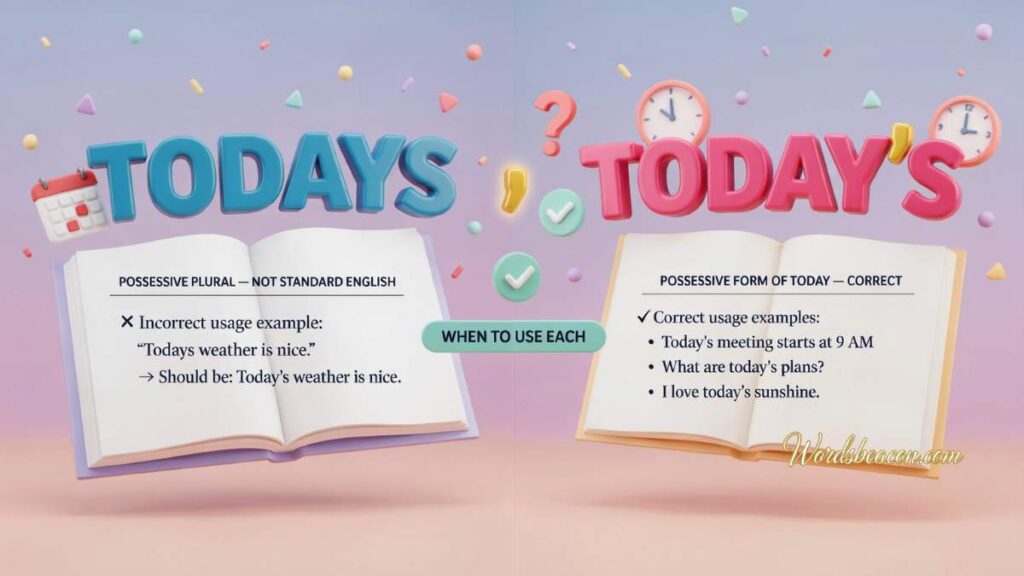
A tiny apostrophe can cause a surprisingly big grammar headache! If you’ve ever wondered whether to write Todays vs Today’s you’re not alone. This common spelling confusion often appears in phrases such as “today’s meeting,” “today’s class,” and “today’s activities.” Although the two forms look almost identical, only one is correct for everyday use. So, what makes the apostrophe so important? In this guide, you’ll learn the difference between Todays vs Today’s, understand how to use each form, and discover common mistakes to avoid. With simple explanations and practical examples, you’ll soon write with confidence without second-guessing that little apostrophe.
Todays vs Today’s The Quick Answer
Today’s is the correct spelling when you want to describe something connected with the current day. It can also work as a contraction of “today is” or “today has.”
Todays without an apostrophe is generally incorrect in ordinary sentences when you intend the possessive form or a contraction.
Here’s a quick comparison:
| Word | Correct Usage | Example |
|---|---|---|
| Today | Refers to the current day | I have an appointment today. |
| Today’s | Shows a relationship with the current day | Today’s meeting starts at noon. |
| Today’s | Means today is | Today’s going to be exciting. |
| Today’s | Means today has | Today’s been busy. |
| Todays | Not the standard possessive or contraction spelling | Todays meeting is important. |
Look at these additional examples:
- Correct: Today’s weather looks beautiful.
- Incorrect: Todays weather looks beautiful.
- Correct: Today’s assignment is due tomorrow.
- Incorrect: Todays assignment is due tomorrow.
- Correct: I will finish the report today.
- Incorrect: I will finish the report today’s.
The main rule is simple: use today’s when the sentence needs a possessive form or contraction. Use today when you’re simply referring to the current day.
Learn the difference between tricky more English words
Ensure vs Insure Difference and usage
What Does Today’s Mean?
Today’s Meaning in English
Today’s is the possessive form of today. It connects the current day with something that happens, exists, or is relevant on that day.
For example, today’s meeting means a meeting scheduled for the current day. Similarly, today’s weather refers to the weather conditions we’re experiencing today.
Here are some common expressions:
- Today’s meeting
- Today’s assignment
- Today’s weather
- Today’s news
- Today’s schedule
- Today’s activities
- Today’s lesson
- Today’s responsibilities
Notice something important: today’s doesn’t always mean that something physically belongs to the day.
For example, when someone says “Today’s news is interesting,” the news doesn’t actually belong to the day. The expression simply connects the news with the current date.
This is how possessive forms work in English. They can show ownership, relationships, connections, and associations.
What Does Today’s Mean in a Sentence?
The meaning of today’s becomes clearer when you look at the complete sentence.
Consider these examples:
Today’s meeting starts at 9 a.m.
The sentence tells you that the meeting is scheduled for the current day.
Today’s weather is warmer than yesterday’s.
Here, today’s refers to the weather conditions for the present day.
Today’s lesson covers English grammar.
The expression connects the lesson with the current day’s class.
In each sentence, today’s appears before a noun and tells readers that the thing being discussed relates to the current day.
Is Today’s Singular or Possessive?
Yes. Today’s is a singular possessive form when you use it to connect the current day with another noun.
In English, singular possessive nouns generally take an apostrophe followed by S.
For example:
| Singular Word | Possessive Form |
|---|---|
| Monday | Monday’s meeting |
| Tuesday | Tuesday’s schedule |
| Yesterday | Yesterday’s news |
| Tomorrow | Tomorrow’s plans |
| Today | Today’s activities |
The same rule applies to all these expressions. The apostrophe comes before the S because the possessive form is based on a singular word.
Therefore, today’s is the correct spelling when you want to describe something associated with the present day.
What Does Todays Mean Without an Apostrophe?
Is Todays a Real English Word?
This question causes much of the confusion surrounding today’s spelling.
In ordinary English writing, todays is not the correct replacement for today’s. If you want to write about a meeting, assignment, date, or event happening on the current day, you need the apostrophe.
For example:
Incorrect: Todays meeting starts at 10 a.m.
Correct: Today’s meeting starts at 10 a.m.
However, the spelling todays can occasionally appear as a plural form of the noun today in unusual literary or creative contexts.
For example:
“We should appreciate our todays and look forward to our tomorrows.”
Here, the writer uses todays to describe different present moments or days. This is an uncommon, expressive construction rather than normal everyday English.
Most writers would use more natural alternatives, such as:
- The days we have.
- Our present moments.
- The days ahead.
- The experiences of our lives.
For regular writing, you should avoid using todays as a substitute for today’s.
Why Do People Write Todays Instead of Today’s?
The missing apostrophe is usually a typing or punctuation mistake. Because both forms look almost identical, it’s easy to overlook the difference. Understanding Todays vs Today’s helps you avoid this common spelling error.
Several things can cause this error:
- Fast typing: People sometimes skip apostrophes when writing quickly.
- Autocorrect: Some keyboards don’t automatically insert the punctuation.
- Grammar confusion: Writers may not understand how singular possessive nouns work.
- Informal messaging: Incorrect spellings can become habits through repeated use in text messages and social media posts.
For example, someone might write:
“Please send me todays meeting notes.”
The meaning is understandable, but the spelling isn’t correct in standard English.
The corrected sentence is:
“Please send me today’s meeting notes.”
Apostrophes may look small, but they help readers understand your meaning. Remembering the difference between Todays vs Today’s can make your everyday writing clearer and more accurate.
Learn the difference between tricky more English words
Principal vs Principle Difference and usage
What Is the Difference Between Todays vs Today’s?
The difference between Todays vs Today’s is mainly about apostrophe placement and grammatical function. Understanding Todays vs Today’s will help you choose the correct spelling in everyday writing.
Today’s has two common grammatical uses: it can show a possessive relationship or act as a contraction. Todays without an apostrophe doesn’t serve either of these purposes in standard everyday writing.
Today vs Today’s What Is the Difference?
Before comparing Todays vs Today’s further, it’s important to understand the difference between today and today’s.
Although they look similar, they perform different jobs in a sentence.
Today can function as an adverb or a noun.
When it works as an adverb, it tells you when something happens.
Example:
“I will finish my assignment today.”
Here, today answers the question “When will I finish my assignment?”
When it works as a noun, it refers to the current day.
Example:
“Today is an important day.”
Now consider today’s:
“Today’s assignment is important.”
In this sentence, today’s connects the assignment with the current day. This distinction makes Todays vs Today’s easier to understand and use correctly.
Compare the three forms:
| Word | Meaning | Example |
|---|---|---|
| Today | The current day | I am working today. |
| Today’s | Something associated with today | Today’s work is difficult. |
| Today’s | Today is | Today’s going to be fun. |
| Today’s | Today has | Today’s been exhausting. |
The difference is easier to remember when you focus on the job each word performs.
Today tells you when something happens or identifies the current day. Today’s connects something with that day or replaces omitted words in a contraction.
Does Today’s Always Mean Something Belongs to Today?
No. A possessive form doesn’t always indicate actual ownership.
For example, consider these expressions:
- Today’s technology
- Today’s society
- Today’s challenges
- Today’s generation
- Today’s world
Nobody owns technology, society, or the world simply because the word today’s appears before them.
Instead, these expressions describe something related to the present time.
Consider this sentence:
“Today’s technology makes communication faster and easier.”
Here, today’s technology means modern technology or the technology available in the present era.
Similarly:
“Today’s generation has access to more digital learning opportunities.”
The expression today’s generation refers to people living in the current period.
This distinction is important because it explains why possessive forms can express relationships rather than literal ownership.
When to Use Today’s
Use today’s when you want to connect something with the current day. You can also use it when the sentence requires the contraction “today is” or “today has.”
Let’s look at both uses separately.
Today’s as a Possessive Form
This is the most common use of today’s.
You place it before a noun to show that something belongs to, happens on, or relates to the present day.
For example:
| Expression | Example Sentence |
|---|---|
| Today’s meeting | Today’s meeting begins at 9 a.m. |
| Today’s agenda | Today’s agenda includes three topics. |
| Today’s weather | Today’s weather looks pleasant. |
| Today’s activity | Today’s activity involves teamwork. |
| Today’s assignment | Today’s assignment requires research. |
| Today’s news | Today’s news covers an important announcement. |
| Today’s schedule | Today’s schedule is quite busy. |
| Today’s video | Today’s video explains basic grammar. |
| Today’s lesson | Today’s lesson focuses on punctuation. |
| Today’s events | Today’s events attracted many visitors. |
All these expressions follow the same rule. You don’t need to change the apostrophe’s position when the noun becomes plural.
For example:
- Today’s activity is interesting.
- Today’s activities are interesting.
The apostrophe stays before the S in both sentences. The S in today’s belongs to the possessive form, while the noun activities has its own plural ending.
Today’s as a Contraction
Here’s another detail that often surprises English learners: today’s can also be a contraction.
The apostrophe + S can replace either “is” or “has.”
This means today’s has two possible contraction meanings, depending on the sentence.
When today’s means today is
Examples:
- Today’s going to be exciting.
- Today’s the perfect time to start.
- Today’s a beautiful day.
- Today’s not the right time for a meeting.
Let’s expand one example:
“Today’s going to be exciting.”
Becomes:
“Today is going to be exciting.”
Both sentences mean exactly the same thing.
When today’s means today has
Examples:
- Today’s been a busy day.
- Today’s brought some unexpected changes.
- Today’s already passed so quickly.
For example:
“Today’s been a busy day.”
Becomes:
“Today has been a busy day.”
The meaning stays the same.
How to Know Whether Today’s Means Today Is or Today Has
You don’t have to guess. Look at the words that follow today’s.
| Sentence | Expanded Form |
|---|---|
| Today’s a wonderful day. | Today is a wonderful day. |
| Today’s getting colder. | Today is getting colder. |
| Today’s been difficult. | Today has been difficult. |
| Today’s brought good news. | Today has brought good news. |
A simple trick can help: replace today’s with “today is.” If the sentence doesn’t make sense, try “today has.”
If neither version works, today’s is probably being used as a possessive form.
For example:
“Today’s meeting starts at noon.”
Neither “today is meeting” nor “today has meeting” works. Therefore, today’s is possessive.
Understand confusing English more words simply
Analysis vs Analyses difference and usage
When to Use Todays Without an Apostrophe
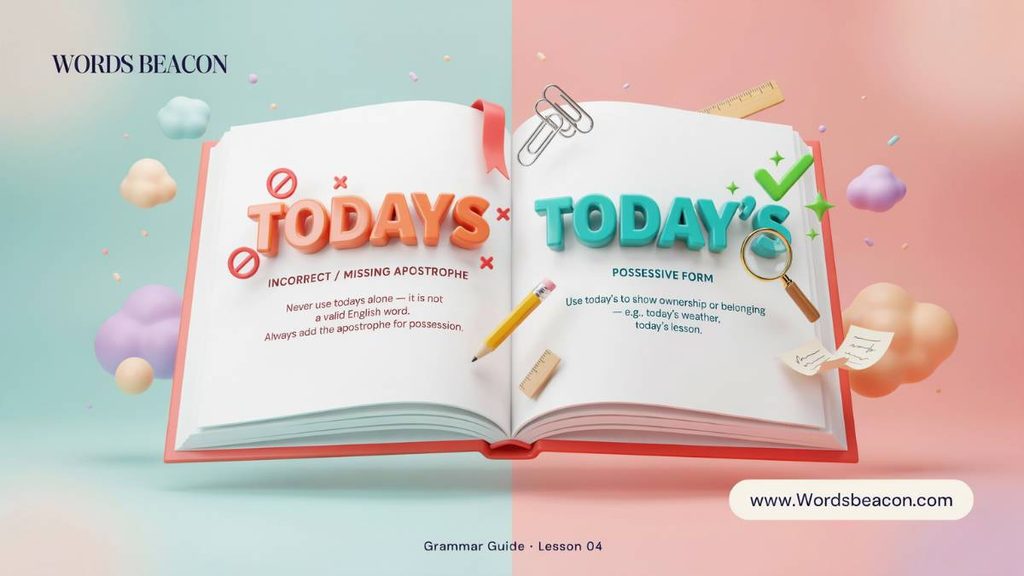
So, when to use todays without an apostrophe?
In ordinary writing, almost never.
If you’re talking about something connected with the current day, you need today’s. If you’re using the contraction of today is or today has, you also need today’s.
The spelling todays may appear in creative writing as an unusual plural noun, but it’s rarely necessary.
Is Todays the Plural of Today?
Todays can theoretically function as a plural form of the noun today, but this usage is uncommon and often sounds unnatural.
In everyday English, people generally use days instead.
For example:
Unnatural: “The todays of this month have been difficult.”
Natural: “The days of this month have been difficult.”
Another example:
Unnatural: “We should appreciate our todays.”
More natural: “We should appreciate the days we have.”
The important point is that today’s is not plural simply because it ends in S. Its S belongs to the possessive or contracted form.
When Might Todays Appear Without an Apostrophe?
You may encounter the spelling in:
- Creative or poetic writing.
- Unusual philosophical expressions.
- Proper names or stylized titles.
- Discussions that deliberately use today as a countable noun.
Even then, the writer should make the intended meaning clear.
For everyday emails, school assignments, articles, and professional documents, stick with today’s when you need the possessive or contracted form.
Understand confusing English more words simply
Oversight vs Oversite Which Spelling Is Correct?
Why Does Today’s Need an Apostrophe?
The apostrophe in today’s follows standard English grammar rules.
When a singular noun expresses possession or association, writers usually add an apostrophe followed by S.
For example:
- The teacher’s desk.
- The student’s notebook.
- The company’s policy.
- Monday’s meeting.
- Today’s assignment.
The word today follows the same pattern.
The Apostrophe Rule for Today’s
The construction is simple:
Today + ‘s = Today’s
The apostrophe comes before the S because today is treated as a singular noun in its possessive form.
Look at these comparisons:
| Incorrect | Correct |
|---|---|
| Todays meeting | Today’s meeting |
| Todays weather | Today’s weather |
| Todays agenda | Today’s agenda |
| Todays activity | Today’s activity |
| Todays date | Today’s date |
| Todays lesson | Today’s lesson |
These examples follow the same possessive apostrophe rule.
Apostrophe Before S vs Apostrophe After S
One common grammar mistake involves placing the apostrophe in the wrong position.
English uses different patterns for singular and plural possessive nouns.
Singular possessive nouns:
Add apostrophe + S.
Examples:
- The student’s book.
- The teacher’s classroom.
- Today’s schedule.
Plural possessive nouns ending in S:
Usually add an apostrophe after the existing S.
Examples:
- The students’ books.
- The teachers’ lounge.
- The players’ uniforms.
Since today’s comes from the singular word today, the correct spelling uses an apostrophe before S.
Writing todays’ is incorrect for the ordinary possessive meaning.
Is Today’s Grammatically Correct?
Yes. Today’s is grammatically correct when you use it as a possessive form or an appropriate contraction.
Examples:
- Today’s class starts at 8 a.m.
- Today’s news is important.
- Today’s going to be memorable.
- Today’s been surprisingly productive.
However, remember that the rest of the sentence must also follow proper grammar.
For example:
Incorrect: “Today’s meeting are important.”
Correct: “Today’s meeting is important.”
The possessive spelling is correct in both versions, but the first sentence has a subject-verb agreement error.
Fix common more word mistakes in English
Happened vs Happend Which Spelling Is Correct?
Todays vs Today’s Examples in Sentences
Sometimes, a grammar rule becomes much easier when you see it in everyday situations. The following examples show how to choose the correct spelling in common expressions.
Today’s Meeting or Todays Meeting?
The correct expression is today’s meeting.
Examples:
- Today’s meeting will begin at 10 a.m.
- I have prepared the documents for today’s meeting.
- Today’s meeting covers the new marketing strategy.
- Please review today’s meeting notes before leaving.
- The manager has postponed today’s meeting.
Why is today’s meeting correct?
Because the expression connects the meeting with the current day.
You can also write:
“The meeting today will begin at 10 a.m.”
Both versions are correct. However, today’s meeting places the emphasis on the meeting associated with the current day.
Today’s Agenda or Todays Agenda?
Always write today’s agenda when referring to the list of topics planned for the current day.
Examples:
- Today’s agenda includes three presentations.
- Please check today’s agenda before the discussion.
- The director has updated today’s agenda.
- Today’s agenda focuses on customer satisfaction.
The apostrophe shows the relationship between the agenda and the current day.
Today’s Activity or Todays Activity?
The correct spelling is today’s activity.
Examples:
- Today’s activity involves solving a group problem.
- The teacher explained today’s activity before the lesson.
- Today’s activity helps students develop communication skills.
- We completed today’s activity in less than an hour.
The same rule applies when you use the plural noun activities.
Correct: Today’s activities include reading, writing, and discussion.
Incorrect: Todays activities include reading, writing, and discussion.
Today’s Weather or Todays Weather?
Use today’s weather because you’re referring to the weather conditions for the current day.
Examples:
- Today’s weather is warmer than yesterday’s.
- I checked today’s weather before leaving home.
- Today’s weather forecast predicts heavy rainfall.
- The children enjoyed today’s sunny weather.
Notice that yesterday’s follows the same apostrophe rule.
Today’s Date or Todays Date?
The correct expression is today’s date.
Examples:
- Please write today’s date at the top of the page.
- Today’s date is November 17, 2026.
- The application requires today’s date.
- I forgot to update today’s date on the document.
The expression refers to the calendar date associated with the current day.
You can also write “the date today.” Both expressions are correct, although their sentence structures differ.
Today’s News, Video, and Lesson
Today’s also appears frequently in news articles, educational materials, and online content.
Here are some examples:
1.Today’s news
- Today’s news includes an important economic announcement.
- I haven’t watched today’s news yet.
2.Today’s video
- Today’s video explains how to use apostrophes correctly.
- Please share today’s video with your classmates.
3.Today’s lesson
- Today’s lesson covers singular and plural nouns.
- The teacher prepared examples for today’s lesson.
The spelling stays the same regardless of the noun that follows it.
Today’s World or Todays World?
The correct expression is today’s world.
For example:
“Today’s world depends heavily on digital communication.”
The phrase refers to modern society and contemporary life.
More examples:
- Today’s world offers countless learning opportunities.
- Today’s world faces serious environmental challenges.
- Technology has transformed today’s world.
- Education plays an important role in today’s society.
The apostrophe is necessary because today’s connects the world with the present era.
Fix common more word mistakes in English
Seeing vs Seing Which Spelling Is Correct?
Today’s in Emails and Professional Writing
A small punctuation mistake can make an otherwise professional email look careless. That’s why it’s worth checking apostrophes before sending workplace messages.
Consider this sentence:
“Please review todays schedule before the meeting.”
The meaning is clear, but the spelling is incorrect.
A better version is:
“Please review today’s schedule before the meeting.”
Here are more examples:
| Incorrect | Correct |
|---|---|
| Todays meeting starts at noon. | Today’s meeting starts at noon. |
| Please check todays report. | Please check today’s report. |
| Todays deadline is approaching. | Today’s deadline is approaching. |
| I have attached todays agenda. | I have attached today’s agenda. |
Today’s in School and Academic Writing
Students often use today’s when discussing lessons, assignments, classroom activities, and homework.
Examples:
- Today’s assignment requires three paragraphs.
- Today’s lecture covers American literature.
- The teacher collected today’s homework.
- Today’s discussion examines climate change.
- Students completed today’s classroom activity.
In academic writing, correct punctuation helps make your work easier to read and understand.
Today’s in News Headlines and Social Media
News organizations, content creators, and social media users frequently use today’s to introduce current information.
Common examples include:
- Today’s Top Stories
- Today’s Special Offer
- Today’s Breaking News
- Today’s Featured Video
- Today’s Weather Update
- Today’s Biggest Headlines
Headlines may leave out unnecessary words to save space, but they still need correct punctuation.
For example:
Correct: Today’s Biggest Stories
Incorrect: Todays Biggest Stories
The apostrophe remains necessary even in short headlines and social media captions.
Learn the difference between tricky more English words
Filed vs Filled Differences and Everyday Usage
Common Mistakes When Using Today’s
Even experienced writers sometimes forget apostrophes. Fortunately, most mistakes are easy to fix once you understand the basic rules.
Forgetting the Apostrophe
This is the most common error.
Incorrect: Todays class starts at nine.
Correct: Today’s class starts at nine.
The possessive form requires the apostrophe before S.
Putting the Apostrophe After S
Some writers mistakenly use todays’ because they confuse singular and plural possessive forms.
Incorrect: Todays’ schedule is ready.
Correct: Today’s schedule is ready.
Remember that today’s is the singular possessive form.
Using Today’s When You Only Mean Today
Not every sentence about the current day needs an apostrophe.
For example:
Incorrect: I will complete the assignment today’s.
Correct: I will complete the assignment today.
Why?
Because today functions as an adverb in this sentence. It tells the reader when the assignment will be completed.
Compare:
- I will attend the meeting today.
- Today’s meeting will start shortly.
The first sentence uses today to describe when an action happens. The second uses today’s to describe the meeting.
Assuming Today’s Always Means Today Is
Another common mistake is treating every occurrence of today’s as a contraction.
Consider:
“Today’s weather is pleasant.”
Here, today’s describes the weather associated with the current day. It doesn’t mean today is.
Now consider:
“Today’s going to be pleasant.”
Here, today’s means today is.
The words that follow the apostrophe-S help you identify the intended meaning.
Adding an Unnecessary Apostrophe
Writers sometimes add apostrophes where they’re not needed.
Incorrect: I will see you today’s.
Correct: I will see you today.
The second sentence is correct because today functions as an adverb. It doesn’t need a possessive ending.
Learn the difference between tricky more English words
installment vs Instalment One Word Two Spellings
Is Today’s Correct in American and British English?
Yes. Both American and British English use today’s with an apostrophe.
There is no spelling difference between these varieties of English.
| Expression | American English | British English |
|---|---|---|
| Today’s meeting | Correct | Correct |
| Today’s weather | Correct | Correct |
| Today’s schedule | Correct | Correct |
| Todays meeting | Incorrect in standard usage | Incorrect in standard usage |
| Todays weather | Incorrect in standard usage | Incorrect in standard usage |
American and British English have some spelling differences. For example, Americans generally write color, while British writers commonly use colour.
However, the apostrophe rules for today’s remain the same.
Whether you’re writing an American article, a British school assignment, or an international business email, use today’s when the sentence requires the possessive or contracted form.
How to Remember the Difference Between Todays vs Today’s
You don’t need to memorize complicated grammar rules to avoid this mistake. A few simple checks can help you choose the right form.
Use the Possession Test
Ask yourself whether you’re connecting something with the current day.
For example:
- Today’s meeting
- Today’s assignment
- Today’s schedule
- Today’s weather
If the expression describes something associated with today, use today’s.
Use the Contraction Test
Try replacing today’s with “today is” or “today has.”
For example:
“Today’s going to be exciting.”
Replace today’s with today is:
“Today is going to be exciting.”
The sentence still makes sense, so today’s works as a contraction.
Try another example:
“Today’s been productive.”
Replace today’s with today has:
“Today has been productive.”
Again, the sentence makes sense.
Use the Sentence Test
Compare these examples:
| Sentence | Correct Form | Reason |
|---|---|---|
| I am busy ___ . | Today | Adverb |
| ___ meeting is important. | Today’s | Possessive |
| ___ going to rain. | Today’s | Today is |
| ___ been exhausting. | Today’s | Today has |
| Please check ___ schedule. | Today’s | Possessive |
These three checks will help you handle most situations in everyday writing.
Learn the difference between similar English words
Armor vs Armour Simple Spelling Differences Explained
Practice Exercises Todays vs Today’s
Now it’s time to test what you’ve learned. Complete the following sentences using Todays vs Today’s.
Pay attention to how each word functions in the sentence.
- ______ meeting will begin at 11 a.m.
- I need to finish my homework ______.
- ______ weather looks perfect for a picnic.
- Please write ______ date on the application.
- ______ going to be a busy day.
- The teacher explained ______ lesson carefully.
- I will send you the report ______.
- ______ agenda contains several important topics.
- ______ been a challenging day for everyone.
- We discussed ______ news during lunch.
- Please check ______ schedule before leaving.
- ______ activity requires students to work in groups.
- I hope ______ brings good opportunities.
- ______ video explains the apostrophe rule.
- The manager has changed ______ meeting time.
- I will complete the task ______.
- ______ discussion focuses on environmental protection.
- ______ already brought several unexpected changes.
- Students must submit ______ assignment before midnight.
- We should appreciate the days we have ______.
Answers
- Today’s
- Today
- Today’s
- Today’s
- Today’s
- Today’s
- Today
- Today’s
- Today’s
- Today’s
- Today’s
- Today’s
- Today
- Today’s
- Today’s
- Today
- Today’s
- Today’s
- Today’s
- Today
Understanding the Answers
Most answers use today’s because they describe something connected with the current day.
Questions 2, 7, and 16 use today because the word tells the reader when an action happens.
Questions 5 and 18 use today’s as contractions:
- Today’s going to be a busy day = Today is going to be a busy day.
- Today’s already brought several unexpected changes = Today has already brought several unexpected changes.
The final question uses today in a different way because it refers to the present day without expressing possession.
Here’s a trusted source for clear word meanings:
FAQs
What is the difference between Todays vs Today’s?
“Today” refers to the current day, while “today’s” describes something that belongs to or is connected with that day.
- Today is a busy day.
- Today’s meeting starts at 10 a.m.
Is “todays” a word?
“Todays” is a rare plural form, but it is not the correct spelling when you mean something related to the current day. In everyday writing, use “today’s” with an apostrophe.
What does today’s mean?
“Today’s” can mean “belonging to today” or “related to today.” It can also be a contraction of “today is” or “today has.”
- Today’s weather looks pleasant.
- Today’s going to be a great day. (Today is)
- Today’s been exhausting. (Today has)
Is it “today’s meeting” or “todays meeting”?
“Today’s meeting” is correct. The apostrophe shows that the meeting is scheduled for or connected with the current day. “Todays meeting” is incorrect in standard English.
Is “today’s call” grammatically correct?
Yes. “Today’s call” is grammatically correct when you mean a call scheduled for or related to the current day.
Example: “I’ll share the report during today’s call.”
Should you write “today’s class” or “todays class”?
Use “today’s class.” The apostrophe connects the class to the current day.
Example: “Today’s class will cover three important grammar rules.”
Which is correct: “today work” or “today’s work”?
“Today’s work” is the natural and grammatically correct expression when referring to tasks or assignments for the current day.
Example: “I finished today’s work before lunch.”
Is it “today’s activity” or “today’s activities”?
Both forms are correct. Use “today’s activity” for one activity and “today’s activities” for more than one.
- Today’s activity involves teamwork.
- Today’s activities include reading and writing.
Is “today morning” or “today’s morning” correct?
Neither expression sounds natural in standard American English. Use “this morning” instead.
Example: “I spoke with my teacher this morning.”
What is another word for today’s?
The best alternative depends on the context. You can use phrases such as “of today,” “current,” or “for today.”
- Today’s schedule → The schedule for today
- Today’s news → The current news
- Today’s events → The events of today
These alternatives may not fit every sentence, so choose the one that preserves your intended meaning.
What does “today’s the day” mean?
“Today’s the day” means that an important, planned, or long-awaited day has finally arrived. In this expression, “today’s” is a contraction of “today is.”
Example: “Today’s the day we finally move into our new home.”
What does “today’s special” mean?
“Today’s special” usually refers to a featured food item, product, or offer available for the current day. Restaurants commonly use this phrase to describe a dish they are highlighting.
Example: “Today’s special is grilled salmon.”
Is “today is Sunday” grammatically correct?
Yes. “Today is Sunday” is a complete and grammatically correct sentence. It identifies the current day of the week.
Is “today’s event” correct?
Yes. “Today’s event” is correct when referring to an event taking place on or connected with the current day.
Example: “Today’s event begins at 6 p.m.”
Is “today’s lesson” correct?
Yes. “Today’s lesson” is the correct expression for a lesson scheduled for the current day.
Example: “Today’s lesson focuses on sentence structure.”
Is “today’s holiday” a correct expression?
Yes. “Today’s holiday” is grammatically correct when referring to a holiday observed or celebrated today.
Example: “Today’s holiday gives many employees a day off.”
Can “today’s” be used with both singular and plural nouns?
Yes. “Today’s” can describe either a singular or plural noun. The noun determines whether the sentence needs a singular or plural verb.
- Today’s activity is interesting.
- Today’s activities are interesting.
How do you use “today’s” in a sentence?
Use “today’s” before a noun to show that something belongs to or is connected with the current day. You can also use it as a contraction of “today is” or “today has.”
Examples:
- Today’s meeting is important.
- Today’s weather looks sunny.
- Today’s going to be busy.
Is “today’s” grammatically correct?
Yes. “Today’s” is grammatically correct when used as a possessive form or as a contraction of “today is” or “today has.” The apostrophe is necessary in standard writing.
Why do people write “today’s” instead of “today”?
People write “today’s” when they want to connect the current day with a particular person, event, activity, or thing.
For example, “today” identifies the current day, while “today’s schedule” means the schedule for that day.
What does “today” mean?
“Today” refers to the current day. It can function as a noun or an adverb.
- Today is my birthday.
- I have a meeting today.
What does “today’s” mean in a headline?
In a headline, “today’s” usually refers to news, events, updates, or topics connected with the current day.
Example: “Today’s Top Stories” means the top stories for today.
Where did the word “today” come from?
“Today” developed from the Old English expression “tō dæġe,” meaning “on this day.” The two parts gradually joined to form the single word used in modern English.
Learn the difference between similar English words
Behavior vs Behaviour difference and usage
Conclusion
The difference between “Todays vs Today’s” comes down to one tiny apostrophe, but that little mark makes a big difference! “Today” refers to the current day, while “today’s” shows that something belongs to or is connected with that day. It can also be a contraction of “today is” or “today has.” Although “todays” may appear in rare contexts, it isn’t the correct choice for everyday expressions such as “today’s meeting” or “today’s work.”
The easiest way to remember the rule is simple: when you talk about something happening today, use “today’s” before the noun. For example, write “today’s class,” “today’s weather,” and “today’s activities.” Once you understand this pattern, you won’t have to second-guess every sentence or let a missing apostrophe steal the show. After all, grammar doesn’t have to be complicated, and today’s writing deserves a little attention to detail!

Luna AJS is an experienced blogger and dedicated language enthusiast at Words Beacon. She specializes in making English grammar, spelling, vocabulary and commonly confused words easy to understand. She provides clear explanations, practical examples to help readers write with confidence.