
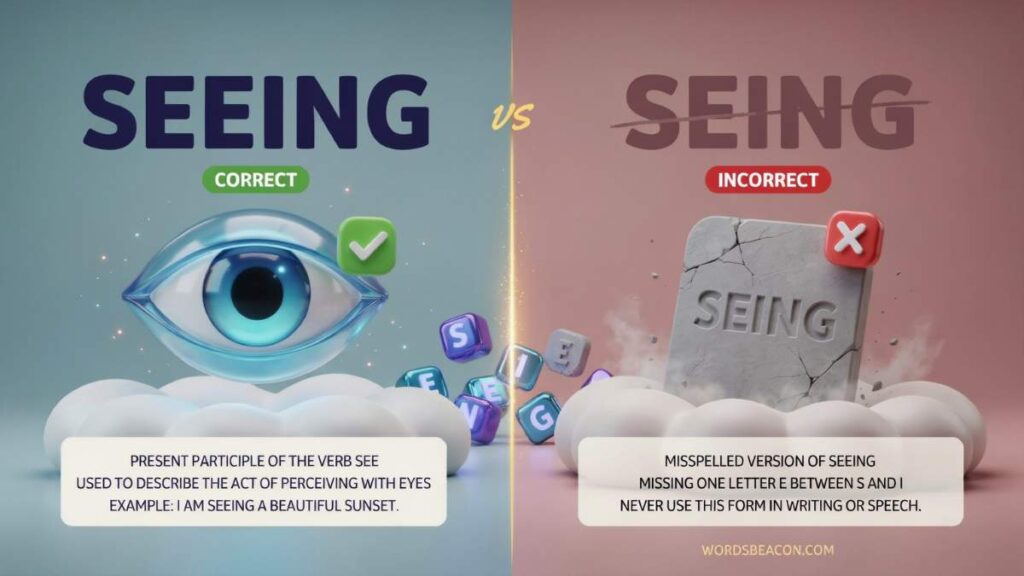
A single missing letter can turn a correctly spelled word into an embarrassing typo, and Seeing vs Seing is a perfect example. Although the two forms look almost identical, only one is accepted in standard English. The correct spelling is seeing, not seing. But why does this word need two e’s, and why shouldn’t you drop one when adding -ing? The answer is simpler than you might think. In this article, we’ll clear up the spelling confusion, explain the rule behind seeing, explore its everyday uses, and help you avoid this common mistake in your writing.
quick Comparison Table
The quickest way to understand the difference between these two forms is to compare their spelling, grammatical function, and standard usage.
| Feature | Seeing | Seing |
|---|---|---|
| Spelling status | Correct | Incorrect |
| Part of speech | Present participle and gerund | No standard grammatical role |
| Root word | See | Intended to be see |
| Word formation | See + ing | Incorrectly formed |
| Meaning | Looking, noticing, meeting, or understanding | No recognized standard English meaning |
| Dictionary usage | Recognized English word | Not a standard alternative |
| Example | I enjoy seeing my friends. | I enjoy seing my friends. |
The main difference is straightforward: seeing is the correct spelling, while seing is a spelling mistake.
For example:
- Correct: I am looking forward to seeing you tomorrow.
- Incorrect: I am looking forward to seing you tomorrow.
Remember this simple formula:
See + ing = Seeing
Keep both e’s from the original verb. You don’t need to remove either one.
Learn the difference between tricky more English words
installment vs Instalment One Word Two Spellings
What Does Seeing Mean?
The word seeing is the present participle and gerund form of the verb see. Its meaning depends on the context in which you use it. Most commonly, it describes noticing something through your eyes. However, English speakers also use it to express understanding, meeting someone, watching something, or experiencing an event.
In everyday English, seeing can communicate several related ideas:
- Visual perception: Noticing people, objects, or events with your eyes.
- Understanding: Recognizing an idea or becoming aware of something.
- Meeting someone: Spending time with another person.
- Visiting a professional: Attending an appointment with a doctor, dentist, or another specialist.
- Watching something: Viewing a movie, performance, or event.
- Considering: Looking at a situation from a particular point of view.
For example:
- I am seeing a beautiful sunset from my balcony.
- After reading the explanation, I’m seeing the problem differently.
- She is seeing someone new.
- He is seeing a doctor about his back pain.
- Seeing that everyone was tired, we decided to leave early.
Although these sentences contain the same word, each one communicates a slightly different idea. Therefore, the surrounding words help readers understand the intended meaning.
Seeing as a Verb
Seeing functions as a verb when it describes an action or experience connected to the base verb see. It commonly appears with helping verbs such as am, is, are, was, and were to form continuous verb constructions.
For example:
- I am seeing a bird outside my window.
- They are seeing a movie tonight.
- She was seeing her dentist when I called.
- We will be seeing our relatives next week.
- The children were seeing the animals for the first time.
In these sentences, seeing helps describe an ongoing action, an arrangement, or an experience.
However, seeing doesn’t always describe something happening at the exact moment of speaking. English speakers also use it for planned meetings and appointments.
For example, “I’m seeing my doctor tomorrow” describes a future arrangement rather than something happening right now.
Seeing as a Gerund
A gerund is a verb form ending in -ing that functions as a noun. Seeing can serve this purpose when it names an activity or experience rather than forming part of a continuous verb phrase.
Consider these examples:
- Seeing is believing.
- Seeing new places makes me happy.
- I enjoy seeing my family.
- Her favorite activity is seeing live performances.
- Seeing the results gave us confidence.
In the first example, seeing acts as the subject of the sentence. And in the second, it also functions as the subject. In the third, it serves as the object of the verb enjoy.
This distinction matters because the same -ing form can perform different grammatical jobs.
Compare:
- Verb: She is seeing a specialist tomorrow.
- Gerund: Seeing a specialist can help her understand the problem.
The spelling stays exactly the same. Only the grammatical function changes.
Understand confusing English more words simply
Complement vs Compliment Difference and Correct Usage
Why Is Seeing Spelled With Two E’s?
The correct seeing spelling becomes easier to remember when you understand how English forms words.
The original verb is see. It already contains two e’s. When you add the suffix -ing, you keep the complete root word and attach the new ending.
The spelling process looks like this:
| Step | Word | Explanation |
|---|---|---|
| Root word | See | Original verb |
| Suffix | -ing | Ending used to form an -ing word |
| Combined form | Seeing | Correct spelling |
Therefore:
See + ing = Seeing
The important point is that English doesn’t require you to remove a letter from every verb before adding -ing. Different verbs follow different spelling patterns.
The Difference Between Double E and Silent E Rules
One reason people write seing is that they remember a common English spelling rule incorrectly.
You may have learned that verbs ending in a silent e usually drop that letter before adding -ing. That’s true for many verbs, but it doesn’t apply to see.
Compare these examples:
| Base Verb | Correct -ing Form | Spelling Change |
|---|---|---|
| See | Seeing | Keep both e’s |
| Agree | Agreeing | Keep both e’s |
| Flee | Fleeing | Keep both e’s |
| Free | Freeing | Keep both e’s |
| Make | Making | Drop the silent e |
| Write | Writing | Drop the silent e |
| Hope | Hoping | Drop the silent e |
| Dance | Dancing | Drop the silent e |
As you can see, verbs ending in double e generally retain both vowels when you add -ing.
However, verbs ending in a single silent e usually drop that letter before taking the suffix.
For instance:
- Make becomes making.
- Write becomes writing.
- Hope becomes hoping.
- Dance becomes dancing.
This explains why seeing keeps both e’s. The two letters in see represent the vowel sound. They aren’t a double-e ending that you shorten when adding -ing.
How to Add ING to See
You don’t need to change the root word when forming its -ing version.
Follow these simple steps:
- Start with the base verb see.
- Identify its existing double-e ending.
- Add the suffix -ing.
- Keep the original spelling unchanged.
The result is seeing.
This is a straightforward example of English word formation. The suffix changes the grammatical form of the verb without changing the spelling of its root.
Understand confusing English more words simply
Oversight vs Oversite Which Spelling Is Correct?
Why Is Seing Incorrect?
The spelling seing is incorrect because it doesn’t follow the standard formation of the -ing form of see.
The mistake often happens when someone assumes that every verb ending in e must lose that letter before taking -ing. However, that assumption overlooks the difference between single-e and double-e endings.
Consider these sentences:
| Incorrect Sentence | Correct Sentence |
|---|---|
| I am seing a bird. | I am seeing a bird. |
| She enjoys seing her friends. | She enjoys seeing her friends. |
| We are seing a doctor tomorrow. | We are seeing a doctor tomorrow. |
| He is seing things differently. | He is seeing things differently. |
| I’m looking forward to seing you. | I’m looking forward to seeing you. |
Is seing a word? In standard English, it isn’t a recognized alternative spelling of seeing.
You might encounter seing in social media posts, text messages, comments, or poorly edited documents. Nevertheless, its appearance online doesn’t make it correct.
If you encounter this form while proofreading, replace it with seeing.
Seeing in Example Sentences
Examples make spelling rules easier to understand because they show how a word works in real situations. The following sentences demonstrate the different meanings and grammatical uses of seeing.
Everyday Conversation
- I’m seeing my best friend after work.
- Are you seeing what I’m pointing at?
- We enjoyed seeing the fireworks last night.
- She’s looking forward to seeing her cousins.
- I can’t wait to start seeing the world.
- He kept seeing the same advertisement everywhere.
- Seeing you again made my day.
- I love seeing the leaves change color in autumn.
- We’re seeing a movie after dinner.
- Seeing the ocean for the first time was unforgettable.
Academic and Educational Writing
- Seeing the results helped researchers understand the experiment.
- Students learn faster by seeing practical demonstrations.
- The teacher explained the concept after seeing the students’ confusion.
- Seeing the evidence changed the direction of the discussion.
- The experiment involved seeing how different materials reacted to heat.
- By seeing the results, students could identify the differences between the samples.
Professional Communication
- I am seeing a client at three o’clock.
- The manager is seeing the new employee this afternoon.
- We look forward to seeing you at the conference.
- She is seeing a specialist to discuss the project requirements.
- Thank you for seeing us on such short notice.
- I’m seeing the team tomorrow to review the new proposal.
Personal and Social Communication
- Are you seeing anyone at the moment?
- I miss seeing my grandparents every Sunday.
- They started seeing each other last summer.
- It was wonderful seeing everyone together again.
- I’m happy about seeing my old classmates.
- Seeing my childhood friends brought back many memories.
These examples show that seeing works in many everyday situations. Its meaning changes with the surrounding words, but its spelling never changes.
Learn how to use confusing more words correctly
Filed vs Filled Differences and Everyday Usage
Common Uses of Seeing
Beyond its basic meaning, seeing appears in several familiar English expressions. Some describe relationships, while others communicate beliefs, appointments, or reasons.
Understanding these expressions will help you recognize natural seeing word usage in conversations and written English.
Seeing Someone
The expression seeing someone can have more than one meaning.
In ordinary conversation, it may simply mean meeting or spending time with another person.
For example:
- I’m seeing my cousin this weekend.
- She’s seeing her old friends after work.
- We’re seeing our neighbors for dinner tonight.
However, in a romantic context, seeing someone often means dating that person or developing a romantic relationship.
For example:
- I’ve been seeing someone for three months.
- Are you seeing anyone right now?
- They’re seeing each other but haven’t made their relationship official.
The context usually makes the intended meaning clear.
If someone says, “I’m seeing my dentist tomorrow,” they’re talking about an appointment. If they say, “I’m seeing someone,” they may be referring to a romantic relationship.
Seeing Is Believing
Seeing is believing is a common English idiom. It means that people often need to witness something themselves before they fully accept that it’s true.
For example:
- I didn’t believe the waterfall was that beautiful until I visited it. Seeing is believing!
- The new technology sounds unbelievable, but seeing is believing.
- He doubted the magician’s abilities until he watched the performance himself.
This expression highlights the importance of direct experience.
However, it doesn’t mean that everything you see is automatically true. Instead, it emphasizes how firsthand observation can make an idea or claim more convincing.
Seeing a Doctor
The phrase seeing a doctor means visiting a medical professional for an examination, advice, diagnosis, or treatment.
For example:
- I’m seeing a doctor tomorrow about my persistent cough.
- She suggested seeing a specialist for another opinion.
- You should consider seeing a dentist if your tooth continues to hurt.
In this context, seeing doesn’t simply refer to looking at a doctor. It describes attending an appointment or receiving professional care.
The same construction works with other professionals:
- Seeing a dentist
- Seeing a therapist
- Seeing a lawyer
- Seeing a financial adviser
- Seeing a specialist
Seeing You Meaning
The phrase seeing you can communicate different ideas depending on the situation.
It may refer to physically meeting someone, noticing their presence, or looking forward to a future meeting.
For example:
- It was nice seeing you yesterday.
- I’m happy about seeing you again.
- I look forward to seeing you next week.
- Seeing you after so many years was a wonderful surprise.
The expression “Nice seeing you” is especially common when ending a conversation after meeting someone.
You might also encounter the phrase “I’ll be seeing you.” It can be a friendly way to suggest that you’ll meet again.
Seeing As Meaning
The expression seeing as introduces a reason or explanation. It is similar to because or considering that in everyday conversation.
For example:
- Seeing as it’s raining, let’s stay inside.
- We decided to leave early, seeing as everyone was tired.
- Seeing as you already know the answer, there’s no need to explain it again.
- I’ll take an umbrella, seeing as the weather forecast predicts rain.
This expression is generally conversational and informal. In more formal writing, because or considering that may be a better choice.
Seeing vs Seen vs Saw
The words seeing, seen, and saw all come from the same base verb, see. However, they serve different grammatical purposes.
Confusing these forms can lead to awkward sentences and common English grammar mistakes.
Here’s how they differ:
| Word | Grammatical Form | Usage | Example |
|---|---|---|---|
| See | Base form | Present tense and infinitive | I see a bird. |
| Sees | Third-person singular | Present tense | She sees a bird. |
| Saw | Simple past | Completed past action | I saw a bird yesterday. |
| Seen | Past participle | Used with helping verbs | I have seen that bird. |
| Seeing | Present participle or gerund | Continuous actions or noun-like use | I am seeing a bird. |
Seeing vs Saw
Use saw when describing an action that happened in the past.
- I saw him yesterday.
- She saw the movie last weekend.
- We saw a beautiful rainbow after the storm.
Use seeing when describing an ongoing action or an activity.
- I am seeing him tomorrow.
- She enjoys seeing movies at the theater.
- They are seeing their relatives this weekend.
Remember that saw is the simple past form, while seeing is the -ing form.
Seeing vs Seen
The main difference between seeing and seen involves their grammatical roles.
Seeing commonly appears in continuous verb forms or as a gerund.
Seen is the past participle of see. It usually appears with helping verbs such as have, has, and had.
Examples:
- I am seeing the results now.
- I have seen the results already.
- She was seeing a specialist.
- She had seen a specialist before.
A common mistake is writing “I have seeing that movie.” The correct sentence is “I have seen that movie.”
Seeing vs Looking
Although seeing and looking both involve vision, they don’t always mean the same thing.
Seeing generally describes the ability to notice something with your eyes. Looking usually involves directing your eyes toward something.
For example:
- I can see the mountains from my window.
- I’m looking at the mountains.
You can look at something without noticing every detail. Similarly, you may see something without deliberately looking for it.
Seeing vs Watching
The Seeing and watching also have different meanings.
Seeing can describe general visual perception, while watching usually involves paying attention to something as it happens or changes.
Compare these examples:
- I can see a bird in the garden.
- I’m watching the bird build its nest.
The first sentence describes noticing the bird. The second emphasizes observing its activity.
Similarly:
- I saw the movie last weekend.
- I watched the movie carefully to understand the story.
Both verbs can describe viewing a movie, but watching often emphasizes the act of paying attention.
Learn how to use confusing more words correctly
Armor vs Armour Simple Spelling Differences Explained
Other Words That Keep Double E Before ING
Seeing isn’t the only English word that retains two e’s when you add -ing. Several other verbs follow the same pattern.
Learning these examples can help you remember the correct spelling of seeing.
| Base Verb | -ing Form | Example |
|---|---|---|
| Agree | Agreeing | They are agreeing on the terms. |
| Flee | Fleeing | The animals were fleeing the area. |
| Free | Freeing | She is freeing the trapped bird. |
| Guarantee | Guaranteeing | The company is guaranteeing the product. |
| See | Seeing | We are seeing the results. |
These examples demonstrate that the double-e spelling remains intact when you add -ing.
However, don’t confuse this pattern with the silent-e rule.
Compare:
- See → Seeing
- Agree → Agreeing
- Flee → Fleeing
- Make → Making
- Write → Writing
- Hope → Hoping
The spelling difference comes from the structure of the original verb.
A useful memory trick is simple: if the base verb ends in ee, keep both e’s before adding -ing.
Pronunciation of Seeing
The correct spelling is only one part of learning a word. Pronunciation also helps you use it confidently in conversation.
In standard American English, seeing is commonly pronounced /ˈsiː.ɪŋ/.
The word has two syllables:
- First syllable: /siː/
- Second syllable: /ɪŋ/
The stress falls on the first syllable.
The first vowel has a long E sound, similar to the vowel in see. The second syllable contains the sound represented by -ing.
A common pronunciation mistake is treating seeing as if it had only one syllable. Another is confusing its vowel sound with words that have different spelling patterns.
Although pronunciation may vary slightly among English speakers, the standard spelling remains the same.
Common Spelling Mistakes Related to Seeing
The confusion between Seeing vs Seing is part of a broader group of English spelling mistakes. Many of these errors happen when writers apply a spelling rule without checking whether it fits the particular word.
Here are some mistakes worth avoiding:
| Incorrect Form | Correct Form | Explanation |
|---|---|---|
| Seing | Seeing | Keep both e’s from see. |
| Seein | Seeing | Don’t omit the final g. |
| Seeng | Seeing | Preserve the correct vowel pattern. |
| I have seeing it. | I have seen it. | Use the past participle after have. |
| I am see you. | I am seeing you. | Use the -ing form after am in a continuous construction. |
| I seen him yesterday. | I saw him yesterday. | Use the simple past form. |
A few simple proofreading habits can prevent these errors:
- Check the original verb before adding a suffix.
- Don’t apply the silent-e rule automatically.
- Learn irregular verb forms such as see, saw, and seen.
- Read the complete sentence to check its grammar.
- Use a reliable dictionary when you’re unsure about a spelling.
Fix common more word mistakes in English
Behavior vs Behaviour difference and usage
Seeing vs Seing How Context Changes the Meaning of a Sentence
The word seeing does more than describe what your eyes notice. Depending on the context, it can communicate an appointment, a relationship, an understanding, or a reason for doing something. This flexibility makes it useful in everyday English. However, when exploring Seeing vs Seing, writers should understand how context affects the meaning of the correct spelling.
For example, compare these sentences:
- I’m seeing a specialist next week.
- She’s seeing someone from her office.
- I can see what you’re trying to explain.
- Seeing as everyone has arrived, let’s begin.
Although these sentences use different meanings, the spelling remains unchanged. Therefore, understanding the context helps you use seeing naturally without falling into the Seeing vs Seing spelling confusion.
When comparing Seeing vs Seing, remember that the correct word can describe several situations without changing its spelling. Whether you’re discussing an appointment, a relationship, or an idea, seeing remains the standard form. This makes Seeing vs Seing an important distinction to understand when writing clear and grammatically correct sentences.
Different Meanings of Seeing in Everyday English
One reason Seeing vs Seing deserves attention is that the correct word appears in several situations. Learning these meanings will help you recognize it in conversations, emails, and other types of writing.
Seeing Someone for an Appointment
In everyday conversations, seeing someone can mean meeting them for a scheduled appointment. Doctors, dentists, teachers, and other professionals commonly use this expression.
Examples:
- I’m seeing my dentist on Friday.
- The manager is seeing a new client this afternoon.
- She has been seeing a physical therapist twice a week.
In these examples, seeing refers to meeting someone rather than simply looking at them.
Seeing Someone Romantically
Seeing someone can also describe dating or spending time with a person in a romantic relationship.
For instance:
- Are you seeing anyone at the moment?
- He’s been seeing someone for several months.
- They started seeing each other last summer.
Here, the meaning has nothing to do with eyesight. Instead, the expression describes a romantic connection.
Seeing as a Way of Explaining a Reason
The expression seeing as introduces a reason or circumstance. It is commonly used in informal conversations when someone wants to explain a decision.
Examples:
- Seeing as it’s getting late, we should head home.
- Seeing as you already finished your work, you can take a break.
- Seeing as the store is closed, we’ll return tomorrow.
This expression is similar to because or considering that. However, it often sounds more conversational.
Fix common more word mistakes in English
Emigrate vs Immigrate Difference and usage
Common Expressions and Phrases With Seeing
English speakers use seeing in several familiar expressions. Learning these phrases can make your vocabulary more natural and help you understand the word beyond its basic meaning.
Seeing Is Believing
This expression means that people often need direct evidence before accepting something as true.
Example: Seeing is believing, especially when someone makes an unbelievable claim.
I’ll Be Seeing You
People use this friendly expression when saying goodbye to someone they expect to meet again.
Example: It was great catching up with you. I’ll be seeing you next week!
Seeing Eye to Eye
This expression means agreeing with someone or sharing a similar opinion.
Example: Although they disagree about many things, they see eye to eye on education.
Seeing the Bigger Picture
This phrase means looking beyond small details and understanding the overall situation.
Example: Before making a decision, try seeing the bigger picture.
These expressions show how seeing contributes to everyday communication. Moreover, they demonstrate why choosing the correct spelling matters in different contexts.
Fix common more word mistakes in English
Realize vs Realise Which Spelling Is Correct?
Seeing vs Seing Sentence Structure Mistakes to Avoid
Correct spelling is important, but using a word in the wrong grammatical structure can also weaken your writing. Therefore, when comparing Seeing vs Seing, pay attention to the words that appear before and after seeing. Understanding these patterns will help you write clearer and more natural sentences.
Using Seeing After Certain Verbs
Some verbs naturally take an -ing form when another action follows them. This pattern is particularly useful when discussing activities, experiences, and personal preferences.
Examples:
- I enjoy seeing my cousins during holidays.
- She avoids seeing that particular movie.
- They discussed seeing a new apartment.
- He admitted seeing the warning sign.
These structures are useful in everyday writing. However, the verb pattern depends on the main verb, so you shouldn’t assume that every verb follows the same rule. This distinction also helps clear up the Seeing vs Seing confusion when you build longer sentences.
Using Seeing After Prepositions
When a verb follows a preposition, the -ing form is often appropriate. As a result, seeing fits naturally into many common English expressions.
Examples:
- She left without seeing the final result.
- He apologized for seeing the message too late.
- They talked about seeing a different doctor.
- I’m interested in seeing your latest project.
In particular, remember that look forward to also takes an -ing form because to functions as a preposition in that expression. Therefore, when learning Seeing vs Seing, understanding this grammatical pattern can help you avoid mistakes beyond spelling.
Avoiding Unnecessary Word Changes
Some writers mistakenly change seeing into another form even when the sentence doesn’t require it. For example, seeing, saw, and seen have different grammatical roles.
Consider these examples:
- Correct: I saw the announcement yesterday.
- Correct: I have seen that announcement before.
- Correct: I am seeing the announcement on my screen now.
Choosing the right form depends on the sentence’s tense and structure. Consequently, checking the surrounding words is just as important as checking the spelling. When you understand these differences, Seeing vs Seing becomes much easier to handle in everyday and professional writing.
How to Use Seeing Naturally in Professional and Everyday Writing
The word seeing works in many writing situations, but its meaning should always fit the tone and purpose of your sentence.
In professional communication, you might write:
- I look forward to seeing you at the conference.
- We appreciate you seeing this project through to completion.
- Thank you for seeing that the necessary changes were made.
In casual communication, you might say:
- I’m seeing my friends tonight.
- Seeing that movie was so much fun.
- Nice seeing you again!
Meanwhile, in educational or descriptive writing, seeing can help explain observations and experiences:
- Seeing the results firsthand helped the students understand the experiment.
- The researchers continued seeing changes during the observation period.
Regardless of the situation, the correct form remains seeing. Once you understand how it fits different contexts, you’ll find it much easier to use confidently.
Learn the difference between tricky more English words
Ingage vs Engage Which Spelling Is Correct ?
practice session Seeing vs Seing
Choose the correct word to complete each sentence: seeing vs seing.
- I enjoy __________ new places whenever I travel.
- She is __________ a specialist about her knee pain.
- We are __________ our friends this weekend.
- __________ the ocean for the first time was unforgettable.
- He has trouble __________ clearly without his glasses.
- Are you __________ anyone these days?
- I look forward to __________ you at the meeting.
- __________ is believing when you witness something yourself.
- They are __________ a movie at the theater tonight.
- My parents are __________ their old friends tomorrow.
- I remember __________ that painting in the museum.
- She is __________ a counselor to discuss her concerns.
- __________ the world through a child’s eyes can be wonderful.
- We are __________ an increase in online sales.
- He is __________ someone who lives in another city.
- Thank you for __________ me after such a long time.
- I am __________ the dentist for a regular checkup.
- __________ familiar faces in a crowd made her smile.
- They enjoy __________ wildlife in its natural habitat.
- I can’t wait to start __________ the results of our hard work.
Answers
- seeing
- seeing
- seeing
- Seeing
- seeing
- seeing
- seeing
- Seeing
- seeing
- seeing
- seeing
- seeing
- Seeing
- seeing
- seeing
- seeing
- seeing
- Seeing
- seeing
- seeing
Here’s a trusted source for clear word meanings:
FAQs
Which is correct Seeing vs Seing?
Seeing is the correct spelling in standard English. Seing is a misspelling because the verb see keeps both e’s when you add -ing.
Why is seeing spelled with two e’s?
Seeing retains the double e from the base verb see. You simply add -ing without removing either letter.
Is seeing a real word?
Yes, seeing is a real English word. It is the -ing form of see and can function as a present participle or a gerund.
What does seeing mean?
Seeing can mean looking at something, understanding an idea, meeting someone, or dating someone. The surrounding sentence determines its meaning.
How do you pronounce seeing?
Seeing has two syllables: see-ing. Its pronunciation is /ˈsiː.ɪŋ/, with the first syllable sounding like the word see.
Is seeing a gerund or a present participle?
Seeing can be both. It functions as a gerund in “Seeing is believing” and as a present participle in “I am seeing the doctor.”
Can you use seeing at the beginning of a sentence?
Yes. For example, “Seeing the beautiful sunset made my day.” Here, seeing introduces the experience that made the speaker happy.
Is seeing always spelled with double e?
Yes. The standard spelling is always seeing when you use the -ing form of see. The spelling seing is incorrect.
Why don’t you drop an e when adding -ing to see?
The verb see already ends in two e’s. Unlike verbs such as make, which becomes making, see keeps both e’s when you add -ing.
What is the difference between see, seeing, saw, and seen?
See is the base form, seeing is the -ing form, saw is the simple past tense, and seen is the past participle. For example: “I see the bird,” “I am seeing the bird,” “I saw the bird,” and “I have seen the bird.”
Can seeing describe a future arrangement?
Yes. You can use seeing in the present continuous to describe a planned arrangement. For example, “I am seeing my dentist tomorrow.”
Does seeing have the same meaning as looking?
Not always. Seeing generally refers to noticing something with your eyes, while looking describes directing your eyes toward something. You can look at an object without actually seeing it clearly.
Can seeing mean understanding something?
Yes. Seeing can express understanding or recognizing an idea. For example, “I can see why you made that decision” means you understand the reason behind it.
Is seeing used in the phrase seeing is believing?
Yes. “Seeing is believing” is a common English expression meaning that experiencing or witnessing something makes it easier to accept as true.
How can you remember the correct spelling of seeing?
Remember that the base word see has two e’s. When you add -ing, keep both letters: see + ing = seeing. This simple spelling pattern will help you avoid writing seing by mistake.
Learn the difference between tricky more English words
Theater vs Theatre Which Spelling Is Correct?
Conclusion
The confusion between Seeing vs Seing may seem small, but that missing letter can make a perfectly good sentence look like it needs a quick repair! The good news is that the correct spelling is easy to remember. Seeing is always correct, while seing is a spelling mistake. Simply keep both e’s in the word see and add -ing to form seeing. Whether you’re seeing a friend, seeing a doctor, or seeing a beautiful sunset, the spelling stays the same. So, don’t let one little letter fool you. Remember the simple rule: see + ing = seeing. Once you understand this pattern, you’ll never have to second-guess this word again!

Luna AJS is an experienced blogger and dedicated language enthusiast at Words Beacon. She specializes in making English grammar, spelling, vocabulary and commonly confused words easy to understand. She provides clear explanations, practical examples to help readers write with confidence.