
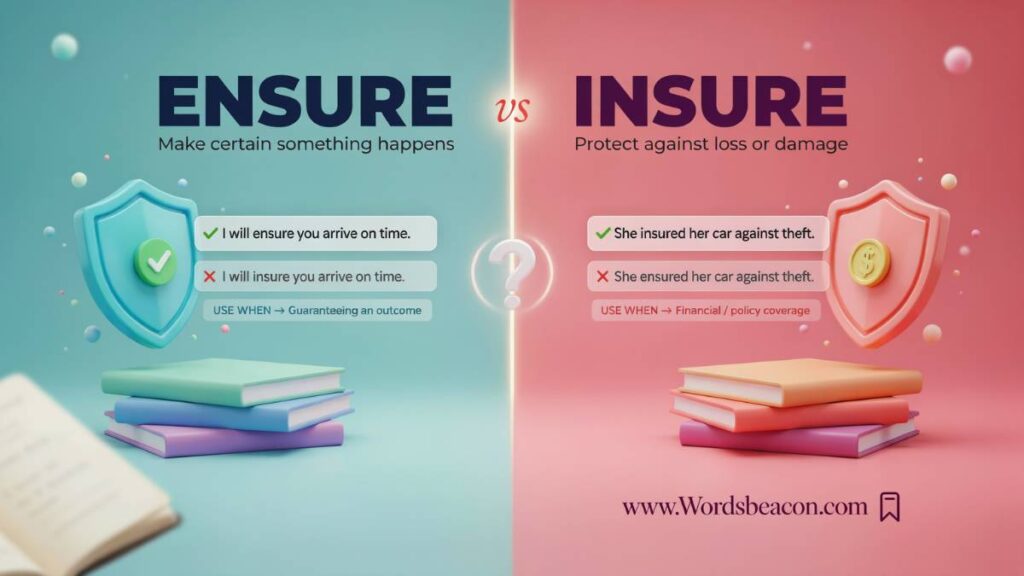
Ensure vs Insure can easily trip you up because these two words sound almost the same but don’t mean the same thing. One helps you make something certain, while the other protects you against financial loss. Mix them up, and your sentence might say something quite different from what you intended! For example, you ensure that your car is ready for a trip, but you insure it against accidents and other covered risks. The distinction is simple once you understand it. This guide breaks down the meanings, differences, common mistakes, and practical examples to help you use ensure and insure correctly and confidently.
comparison table
| Word | Meaning | Main Use | Example |
|---|---|---|---|
| Ensure | To make certain that something happens or is true | Confirming an outcome or preventing a problem | Please ensure that the doors are locked. |
| Insure | To provide financial protection against loss or damage through an insurance policy | Insurance, financial protection, and risk coverage | We need to insure our new car. |
| Assure | To tell someone confidently that something is true or will happen | Giving someone confidence or removing doubt | I assure you that everything is under control. |
Fix common more word mistakes in English
Principal vs Principle Difference and usage
Ensure vs Insure Quick Difference
The easiest way to understand Ensure vs Insure is to focus on what each word does.
- Ensure means to make something certain.
- Insure means to arrange financial protection against a possible loss.
- Assure means to give someone confidence or remove their doubts.
Although ensure vs insure share a similar sound, they serve different purposes in a sentence.
Consider these examples:
- Ensure: Please ensure that every employee receives a copy of the safety instructions.
- Insure: You should insure your business equipment against theft.
- Assure: The manager assured the employees that their jobs were safe.
Notice the difference. The first sentence focuses on making something happen. The second concerns financial protection. The third describes giving people confidence.
In most everyday writing, ensure is the correct choice when you mean make certain. Use insure when you’re discussing an insurance policy or financial protection.
What Does Ensure Mean?
Ensure is a verb that means to make certain that something happens, remains true, or reaches a desired result. When you ensure something, you take steps to prevent uncertainty or make a particular outcome more likely.
You might ensure that a package arrives on time, that a report contains accurate information, or that everyone follows workplace safety rules.
Ensure focuses on the result you want to achieve. It doesn’t necessarily mean that you have complete control over every situation. Instead, it means you take reasonable steps to make something certain.
Examples of Ensure in Everyday English
Here are some common examples:
- Please ensure that your phone is fully charged before the trip.
- Double-check the address to ensure accurate delivery.
- We must ensure that all visitors sign in at the front desk.
- She arrived early to ensure that she had enough time to prepare.
- Good communication helps ensure a smooth project.
- The teacher checked the instructions to ensure that everyone understood the assignment.
Each sentence describes an action taken to make a particular outcome more certain.
How to Use Ensure in a Sentence
Ensure commonly appears before a noun, a pronoun, or a clause beginning with that.
1.Ensure + noun
- Regular maintenance helps ensure safety.
- The company introduced new rules to ensure quality.
- These changes will ensure better communication.
2.Ensure + that + clause
- Please ensure that the report is complete.
- We need to ensure that everyone understands the new policy.
- The manager wants to ensure that the team meets its deadline.
3.Ensure + something + happens or remains true
- She checked the reservation to ensure everything was ready.
- The team reviewed the figures to ensure the results were accurate.
The word works naturally in casual conversations, workplace messages, academic writing, instructions, and formal documents.
Common Contexts for Ensure
You can use ensure in many situations because making something certain is a common part of everyday life.
| Context | Example |
|---|---|
| Workplace | Ensure that all employees follow the safety rules. |
| Education | Teachers should ensure that students understand the lesson. |
| Health and safety | Wash your hands to help ensure proper hygiene. |
| Business | We need to ensure customer satisfaction. |
| Travel | Check your passport to ensure a smooth journey. |
| Technology | Save your work regularly to ensure that you don’t lose important changes. |
| Daily life | Set an alarm to ensure that you wake up on time. |
In each case, ensure refers to making an outcome more certain rather than buying financial protection.
Fix common more word mistakes in English
Analysis vs Analyses difference and usage
What Does Insure Mean?
Insure is a verb that usually means to provide financial protection against a possible loss, accident, damage, or other covered event through an insurance policy.
When you insure something, you arrange coverage with an insurance company. Depending on the policy, the insurer may pay for certain losses or damages if a covered event occurs.
For example, you can insure your car against accidents, your home against certain types of damage, or your business against specific risks.
Unlike ensure, which focuses on making an outcome certain, insure focuses on financial protection against uncertainty.
Examples of Insure in Everyday English
Here are several examples that show how to use insure correctly:
- We decided to insure our new car.
- You should insure your home against covered natural disasters.
- The company insures its delivery vehicles.
- They plan to insure the valuable artwork before shipping it.
- The business owner wants to insure the equipment against theft.
- She contacted an insurance agent to insure her property.
These examples all involve insurance coverage or protection against financial loss.
How to Use Insure in a Sentence
Insure often appears with an object that identifies the property, person, or interest receiving coverage.
1.Insure + object
- We need to insure the house.
- The company insures its vehicles.
- They decided to insure the equipment.
2.Insure + object + against + risk
- She insured her car against theft.
- The company insured its property against fire damage.
- They insured the shipment against loss during transportation.
3.Insure + object + for + amount
- The collector insured the painting for $50,000.
- The homeowner insured the property for its estimated replacement value.
These sentence patterns are especially common in financial, legal, and insurance-related writing.
Common Types of Insurance
The word insure appears in several familiar areas of life and business.
| Type of Insurance | What It Generally Covers |
|---|---|
| Auto insurance | Certain vehicle-related losses, accidents, and liabilities |
| Homeowners insurance | Covered damage to a home and certain related losses |
| Life insurance | A benefit paid to designated beneficiaries under the policy terms |
| Health insurance | Eligible medical expenses and healthcare services |
| Business insurance | Specific business-related risks and financial losses |
| Travel insurance | Certain travel-related problems, depending on the policy |
| Property insurance | Covered damage or loss involving insured property |
Remember that an insurance policy doesn’t automatically cover every possible problem. Coverage depends on its terms, exclusions, limits, and conditions.
Can Insure Mean Make Certain?
Yes, some dictionaries recognize a less common use of insure meaning to make certain or guarantee something. Historically, the meanings of ensure vs insure have overlapped.
However, modern American English generally uses ensure for making something certain and insure for providing insurance coverage.
For example:
- Preferred: We must ensure that the information is accurate.
- Less common: We must insure that the information is accurate.
The first sentence sounds more natural to most American readers. Unless you’re discussing an insurance policy, ensure is usually the better choice.
Fix common more word mistakes in English
Armor vs Armour Simple Spelling Differences Explained
Ensure vs Insure Key Differences
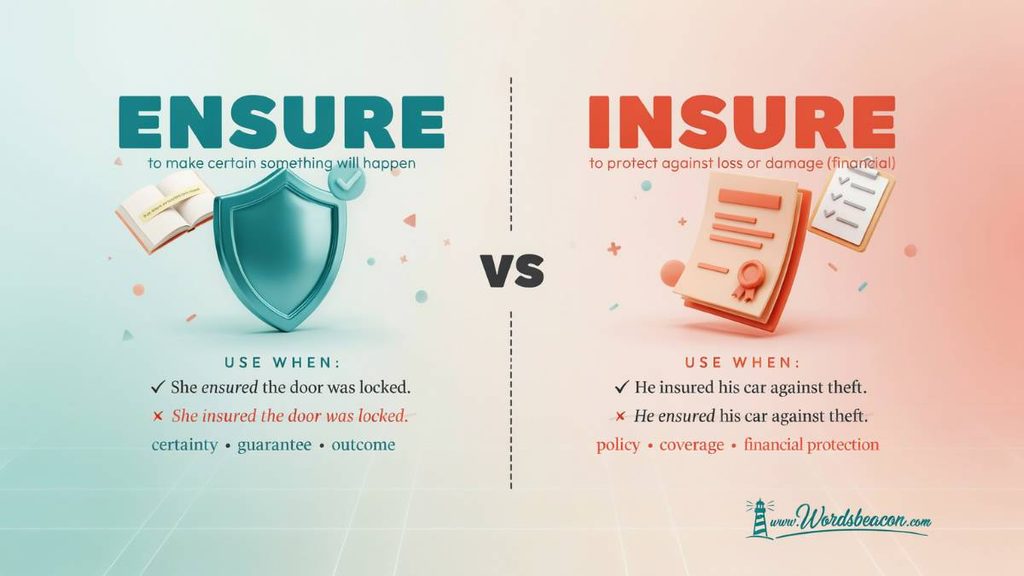
The main difference between ensure vs insure involves certainty versus financial protection.
Ensure describes an action intended to make something happen or remain true. Insure describes arranging protection against financial loss.
The following comparison makes the distinction clearer.
| Feature | Ensure | Insure |
|---|---|---|
| Part of speech | Verb | Verb |
| Main meaning | Make certain | Provide insurance coverage |
| Main purpose | Achieve or confirm an outcome | Protect against financial loss |
| Common context | Work, education, safety, planning | Insurance, finance, property |
| Typical object | Quality, accuracy, safety, success | Car, home, property, business |
| Example | Ensure that the room is clean. | Insure the house against fire. |
| Common phrase | Ensure accuracy | Insure a vehicle |
Difference Between Ensure and Insure in Simple Words
Think of a house as an example.
You install a security system to help ensure that your house stays protected from intruders. You purchase homeowners insurance to insure the house against certain financial losses.
Both actions relate to protection, but they work differently.
- Ensure: Take steps to make something happen or prevent a problem.
- Insure: Purchase or provide financial coverage against a possible loss.
This distinction also applies to business, travel, health, education, and everyday situations.
For instance, a business can ensure that its employees receive proper training while insuring its office equipment against theft. One action focuses on achieving a result; the other involves financial coverage.
Ensure vs Insure Difference in Professional Writing
Choosing the right word matters in professional communication because the two terms can create different expectations.
Consider these examples:
Incorrect for the intended meaning:
- We need to insure that the report contains accurate figures.
- Please ensure your vehicle against accidental damage.
Better choices:
- We need to ensure that the report contains accurate figures.
- Please insure your vehicle against accidental damage.
The first revised sentence concerns accuracy. The second concerns an insurance policy.
When writing business emails, contracts, reports, or instructions, think about the action you’re describing before selecting the word.
Learn how to use confusing more words correctly
Happened vs Happend Which Spelling Is Correct?
When to Use Ensure
Use ensure when you want to express the idea of making something certain, confirming an outcome, or taking steps to prevent a problem.
It works especially well when you’re discussing responsibilities, procedures, quality, safety, and successful results.
Use Ensure for Safety
Safety instructions often use ensure because they describe actions intended to prevent accidents or reduce risks.
Examples:
- Ensure that the emergency exits remain clear.
- Workers must wear protective equipment to ensure workplace safety.
- Check the equipment before use to ensure that it works properly.
- The school introduced new procedures to ensure student safety.
None of these examples involves an insurance policy. Each sentence focuses on making a situation safer.
Use Ensure for Quality and Accuracy
Businesses, schools, and organizations often use ensure when they want to maintain standards.
Examples:
- Proofread the document to ensure accuracy.
- The editor reviewed the article to ensure clarity.
- Regular inspections help ensure product quality.
- The company introduced additional checks to ensure consistent results.
In these sentences, ensure describes actions that support a desired standard.
Use Ensure for Plans and Responsibilities
You can also use ensure when describing tasks that need attention.
Examples:
- Please ensure that the meeting starts on time.
- I will ensure that everyone receives the updated schedule.
- The coordinator checked the venue to ensure everything was ready.
- We must ensure that the customer receives the correct order.
Whenever your intended meaning is make certain, ensure is usually the natural choice.
When to Use Insure
Use insure when you mean arranging insurance coverage or providing financial protection against a covered risk.
The word commonly appears in discussions about vehicles, homes, businesses, travel, property, and other insurable interests.
Use Insure for Cars and Vehicles
Auto insurance helps protect vehicle owners against certain financial losses.
Examples:
- You should insure your new car before driving it.
- The company insures all its delivery vehicles.
- He decided to insure his motorcycle against theft.
- They contacted an agent to insure their commercial trucks.
In each sentence, insure refers to insurance coverage.
Use Insure for Homes and Property
Homeowners and property owners often purchase insurance to protect themselves financially against covered events.
Examples:
- We need to insure our new house.
- The landlord insured the rental property.
- They insured the building against fire damage.
- The museum insured the valuable collection before the exhibition.
These examples involve financial protection rather than simply making a situation certain.
Use Insure for Businesses
Businesses can insure their buildings, equipment, inventory, and other eligible interests.
Examples:
- The restaurant insures its commercial kitchen equipment.
- The company decided to insure its warehouse.
- The business owner insured the shipment before sending it overseas.
- The organization insures its vehicles under a commercial policy.
The exact protection depends on the policy. Insure doesn’t mean that every possible loss is automatically covered.
Learn how to use confusing more words correctly
Oversight vs Oversite Which Spelling Is Correct?
Ensure vs Insure vs Assure What’s the Difference?
Although this article focuses on Ensure vs Insure, the word assure often creates another layer of confusion.
All three words relate to certainty or security, but they have different uses.
- Ensure: Make certain that something happens.
- Insure: Provide financial protection through insurance.
- Assure: Tell someone something confidently to remove doubt or provide reassurance.
The simplest way to remember them is to connect each word with its purpose.
What Does Assure Mean?
Assure means to tell someone confidently that something is true or will happen. It often involves giving reassurance, removing uncertainty, or building confidence.
For example:
- I assure you that the information is correct.
- The doctor assured the patient that the procedure was routine.
- She assured her parents that she would arrive safely.
- The manager assured the team that their concerns would be addressed.
Notice that assure usually involves a person receiving reassurance.
Ensure vs Insure vs Assure Comparison Table
| Word | Main Meaning | Common Use | Example |
|---|---|---|---|
| Ensure | Make certain | Confirming an outcome | Ensure that the package arrives on time. |
| Insure | Provide financial protection | Insurance coverage | Insure the package against damage. |
| Assure | Give confidence or reassurance | Speaking to someone | I assure you that the package is safe. |
How to Choose Between Ensure, Insure, and Assure
Imagine you’re sending an expensive package to another state.
- You ensure that the address is correct.
- You insure the package against covered damage or loss.
- You assure the customer that you’ve checked the shipping details.
The situation stays the same, but each verb describes a different action.
This example also shows why you shouldn’t use these words interchangeably. Their similar sounds don’t make their meanings identical.
Learn how to use confusing more words correctly
Seeing vs Seing Which Spelling Is Correct?
Ensure vs Insure in American English
In American English, ensure and insure sound alike or nearly alike for most speakers. This similarity makes spelling mistakes easy, especially when you’re writing quickly.
However, standard American usage generally keeps their meanings separate.
Use ensure when you mean make certain, guarantee, or take steps to achieve a particular result.
Use insure when you mean provide insurance coverage or protect against financial loss through an insurance arrangement.
Examples of standard American usage:
- Please ensure that your application is complete.
- You should insure your car before taking it on the road.
- The company must ensure that its products meet safety standards.
- The homeowner decided to insure the property against certain risks.
Is Ensure vs Insure More Common?
Ensure appears in many types of writing because people frequently discuss making things certain. You might see it in workplace instructions, academic writing, news articles, business reports, and everyday communication.
Insure appears more often in contexts involving insurance, finance, property, and risk management.
Neither word is inherently more correct than the other. The right choice depends on what you want to communicate.
Ensure vs Insure in British English
The distinction between ensure and insure also appears in British English. However, British English has a familiar additional expression: assurance.
For example, the phrase life assurance is commonly used in the United Kingdom for certain life insurance products.
American English generally uses life insurance for this type of coverage.
Despite this regional difference in terminology, the basic distinction remains useful: ensure means make certain, while insure refers to insurance coverage.
Understand confusing English more words simply
Filed vs Filled Differences and Everyday Usage
Common Mistakes to Avoid When Using Ensure and Insure
Even experienced writers sometimes confuse ensure vs insure. Their similar pronunciation makes the mistake understandable, but a few simple checks can help you avoid it.
Mistake 1: Using Insure When You Mean Make Certain
Incorrect:
- Please insure that all the documents are signed.
Better:
- Please ensure that all the documents are signed.
Why? The sentence describes making sure that a task is complete. It doesn’t involve an insurance policy.
Mistake 2: Using Ensure When You Mean Purchase Insurance
Incorrect:
- I want to ensure my new car against theft.
Better:
- I want to insure my new car against theft.
Why? The sentence refers to financial coverage for a vehicle. Insure is the appropriate word.
Mistake 3: Treating Ensure vs Insure as Perfect Synonyms
These words have related histories and overlapping dictionary senses, but modern American writing generally distinguishes them.
Incorrect:
- The company will ensure its office equipment against fire damage.
Better:
- The company will insure its office equipment against fire damage.
You can also write:
- The company will ensure that its office equipment is properly maintained.
The first sentence concerns insurance. The second concerns maintenance.
Mistake 4: Confusing Assure With Ensure
Incorrect:
- I will assure that the report is ready by Friday.
Better:
- I will ensure that the report is ready by Friday.
However, this sentence is also correct:
- I assure you that the report will be ready by Friday.
The difference is the person receiving reassurance. In the second example, the speaker is directly reassuring someone.
Mistake 5: Choosing a Word Based on Sound Alone
Because ensure and insure sound so similar, relying on pronunciation can lead to errors.
Instead, identify the meaning first.
Ask yourself:
- Am I making something certain? Use ensure.
- Am I arranging insurance coverage? Use insure.
- Am I reassuring someone? Use assure.
This quick check can prevent most common mistakes.
Understand confusing English more words simply
installment vs Instalment One Word Two Spellings
Easy Ways to Remember Ensure vs Insure
You don’t need to memorize complicated grammar rules to remember the difference between ensure vs insure. A few practical associations can make the choice much easier.
Remember Ensure = Make Certain
Connect ensure with certainty.
For example:
- Ensure that the door is locked.
- Ensure that the instructions are clear.
- Ensure that the payment arrives on time.
Whenever you mean make certain, think of ensure.
Remember Insure = Insurance
The word insure contains the same opening letters as insurance.
This connection makes it easy to remember:
- Insure a car.
- Insure a home.
- Insure business property.
- Insure valuable equipment.
If the sentence concerns an insurance policy, insure is usually the correct choice.
Remember Assure = Reassure a Person
Connect assure with a conversation.
For example:
- I assure you that everything is fine.
- She assured him that the plan would work.
- The manager assured the employees that help was available.
Assure commonly focuses on giving someone confidence.
A Simple Memory Trick
Think of three short questions:
- Do I want to make something certain? Ensure.
- Do I want financial protection? Insure.
- Do I want to give someone confidence? Assure.
These questions work in everyday conversations, school assignments, business emails, and professional documents.
Real-Life Examples Ensure vs Insure
Sometimes, the clearest way to understand a word is to see how people use it in realistic situations.
Example 1: Buying a New Car
Suppose you purchase a new car.
You check the brakes, lights, and tires to ensure that the vehicle is safe to drive. You also purchase auto insurance to insure the car against certain financial risks.
Both words fit the situation, but they describe different actions.
Example 2: Running a Business
A business owner wants to reduce mistakes and protect company property.
The owner introduces quality checks to ensure that products meet the required standards. At the same time, the company insures its equipment against covered damage or theft.
Ensure relates to product quality. Insure relates to financial protection.
Example 3: Organizing an Event
An event organizer has several responsibilities.
The organizer checks the guest list to ensure that everyone has a reservation. The organizer may also insure certain equipment against covered damage. Finally, the organizer assures the client that the arrangements are ready.
This example demonstrates how ensure, insure, and assure can appear naturally in the same situation.
Example 4: Traveling Abroad
Before an international trip, you check your passport and travel documents to ensure that everything is in order. You may also purchase travel insurance to insure yourself against certain unexpected expenses.
The first action involves preparation. The second involves financial coverage.
Learn the difference between similar English words
Behavior vs Behaviour difference and usage
Practice session Ensure vs Insure
Test your understanding of Ensure vs Insure by choosing the correct word for each sentence. Use the context to identify whether the sentence describes making something certain or arranging financial protection.
- Please ______ that all the windows are closed before leaving.
- We decided to ______ our new house against fire damage.
- The teacher wants to ______ that every student understands the instructions.
- You should ______ your vehicle before driving it.
- The company introduced new procedures to ______ product quality.
- They plan to ______ the expensive artwork before transporting it.
- Please check the figures to ______ that the report is accurate.
- The homeowner contacted an agent to ______ the property.
- Good planning can help ______ a successful event.
- The business owner wants to ______ the warehouse against certain risks.
- The manager will ______ that all employees receive the updated policy.
- She decided to ______ her jewelry before traveling.
- Regular maintenance helps ______ that the equipment works properly.
- The company needs to ______ its delivery trucks.
- Read the instructions carefully to ______ that you complete the task correctly.
- They agreed to ______ the shipment against possible damage.
- The school introduced additional checks to ______ student safety.
- He wants to ______ his motorcycle against theft.
- The editor reviewed the article to ______ that it contained no factual errors.
- The museum decided to ______ its valuable collection.
Answers
- Ensure
- Insure
- Ensure
- Insure
- Ensure
- Insure
- Ensure
- Insure
- Ensure
- Insure
- Ensure
- Insure
- Ensure
- Insure
- Ensure
- Insure
- Ensure
- Insure
- Ensure
- Insure
Here’s a trusted source for clear word meanings:
FAQs
What Is the Difference Between Ensure vs Insure in Everyday Writing?
Ensure means to make certain that something happens or remains true. Insure usually means to provide financial protection against a possible loss through an insurance policy. For example, you ensure that your documents are complete, but you insure your car against covered damage or theft.
Which Is Correct: “I Want to Ensure” or “I Want to Insure”?
Both phrases are correct, but they express different meanings. Use “I want to ensure” when you want to make something certain. Use “I want to insure” when you want to purchase or arrange insurance coverage. For example, “I want to ensure the report is accurate” and “I want to insure my new vehicle.”
Is “Ensure That” Grammatically Correct?
Yes. Ensure that is a grammatically correct and natural phrase. It introduces a clause explaining what you want to make certain. For example, “Please ensure that all the required documents are submitted before the deadline.”
What Can I Say Instead of Ensure?
Depending on the context, you can replace ensure with make certain, confirm, verify, guarantee, or secure. For example, “Please ensure that the information is correct” could become “Please verify that the information is correct.” Choose a synonym that preserves your intended meaning.
What Are Five Common Synonyms for Ensure?
Five useful synonyms for ensure are guarantee, confirm, verify, secure, and establish. Although these words have similar meanings, they don’t fit every sentence equally well. For example, verify works well when checking information, while guarantee suggests a stronger promise or commitment.
How Can I Say Ensure More Professionally?
In professional writing, consider using confirm, verify, guarantee, or take steps to make certain. The best alternative depends on the situation. For example, instead of writing “Please ensure the figures are accurate,” you could write “Please verify the accuracy of the figures.”
What Is Another Word for Insure?
Common alternatives for insure include cover, provide insurance for, and underwrite. In some contexts, protect may also work. For example, “The company will insure the building” can be rewritten as “The company will provide insurance coverage for the building.”
What Is the Opposite of Insure?
There isn’t one exact opposite of insure. Depending on the context, you can use leave uninsured, cancel coverage, or go without insurance. For example, “The owner chose not to insure the property” means the owner decided against obtaining insurance coverage for it.
Can I Use Ensure When Talking About an Insurance Policy?
Yes, but the two words describe different actions. Use ensure when you mean to make certain that an insurance arrangement is in place. Use insure when you mean to purchase or provide coverage. For example, “Ensure that your policy is active” is correct, while “Insure your home against covered damage” refers to obtaining protection.
How Do I Choose Between Ensure and Insure in a Sentence?
Focus on what you want to communicate. If you’re making something certain, choose ensure. If you’re arranging financial protection against a possible loss, choose insure. For example, “Ensure that the vehicle is ready” describes preparation, while “Insure the vehicle” refers to obtaining insurance coverage.
Learn the difference between similar English words
Emigrate vs Immigrate Difference and usage
Conclusion
Ensure vs Insure may look like a small spelling difference, but using the wrong word can change the entire meaning of your sentence. Think about it: you can ensure that your car is ready for a road trip, but you insure it against accidents and other covered risks. You wouldn’t want to buy an insurance policy just to make sure you’ve packed your bags!
The easiest way to remember the difference is to keep their meanings separate. Ensure means to make certain that something happens or remains true. Insure means to provide financial protection against a possible loss. And when you want to give someone confidence or reassurance, choose assure. Each word has a specific purpose, so there’s no need to mix them up.
Once you understand this simple distinction, choosing between ensure vs insure becomes much easier. Whether you’re writing an email, preparing a business report, or discussing an insurance policy, the right word helps you express your ideas clearly and confidently. Remember: ensure an outcome, insure against a risk, and assure a person. That’s all it takes to keep this common grammar confusion from sneaking into your writing!

Luna AJS is an experienced blogger and dedicated language enthusiast at Words Beacon. She specializes in making English grammar, spelling, vocabulary and commonly confused words easy to understand. She provides clear explanations, practical examples to help readers write with confidence.