
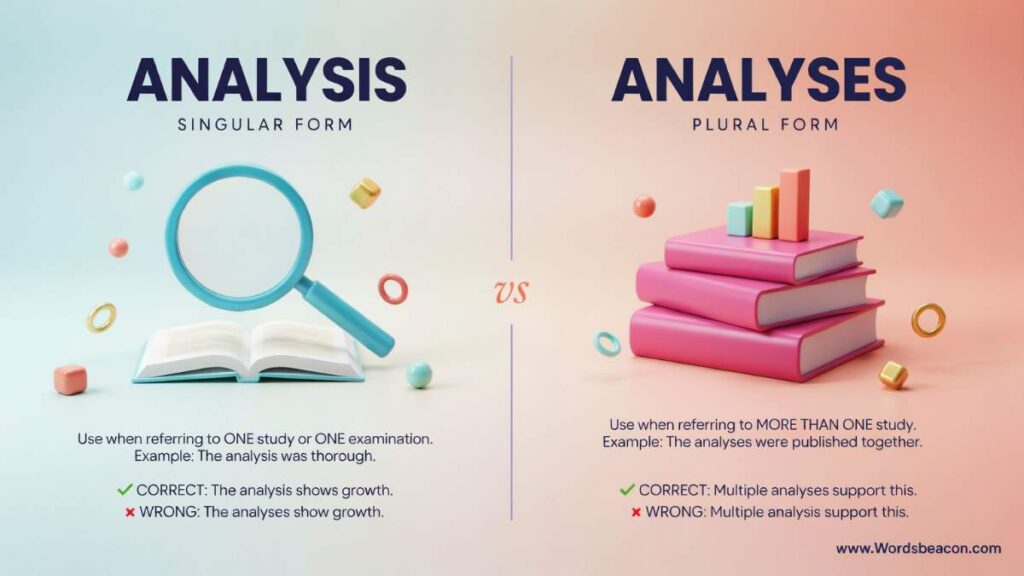
Analysis vs Analyses may look like two spellings of the same word, but they don’t mean exactly the same thing. Mixing them up can lead to simple grammar mistakes and confusing sentences. The good news? The difference is easy to learn. Analysis refers to one examination, while analyses means more than one. There’s also analyzes, which looks similar but has a different grammatical role. So, which word should you use, and how can you avoid choosing the wrong one? Let’s clear up the confusion with simple explanations, everyday examples, and easy grammar tips you can remember.
Analysis vs Analyses Quick Answer
The main difference between analysis vs analyses is the number of examinations being discussed.
- Analysis is a singular noun that refers to one detailed examination or study.
- Analyses is the plural noun that refers to two or more examinations or studies.
Here’s a quick comparison:
| Analysis | Analyses |
|---|---|
| Singular noun | Plural noun |
| Refers to one examination | Refers to multiple examinations |
| Ends in -sis | Ends in -ses |
| Takes singular verbs | Takes plural verbs |
| One analysis | Two analyses |
| This analysis is useful. | These analyses are useful. |
For example:
- Correct: The teacher reviewed one analysis of the student’s work.
- Correct: The teacher reviewed three analyses of the student’s work.
- Incorrect: The teacher reviewed three analysis of the student’s work.
- Incorrect: The teacher reviewed one analyses of the student’s work.
The easiest rule to remember is: one analysis, two analyses.
Fix common more word mistakes in English
Happened vs Happend Which Spelling Is Correct?
What Does Analysis Mean?
The word analysis means a careful examination of something to understand its details, parts, causes, or meaning. It involves looking closely at information instead of making a quick judgment.
For example, a student might examine a poem to understand its message. A business owner might review monthly expenses to find ways to save money. In both situations, the person performs an analysis.
Analysis Definition
Analysis is a noun that describes the process or result of examining something carefully. It can refer to one specific examination or the general activity of studying information.
Consider these examples:
- The analysis of the report revealed several mistakes.
- Her analysis of the situation was accurate.
- Careful analysis helps people make better decisions.
- The researcher completed an analysis of the survey results.
Notice that the word can describe both an individual examination and the general process of examining something.
Analysis Meaning in Everyday Writing
You don’t need to conduct scientific research to use the word analysis. It also appears in ordinary conversations, school assignments, and workplace communication.
For example:
- A teacher asks students to write an analysis of a short story.
- A customer performs an analysis of product prices before buying a phone.
- A manager prepares an analysis of monthly sales.
- A student provides an analysis of a difficult question.
In each example, someone examines information to understand it better.
Analysis in Academic and Professional Writing
In academic writing, analysis often describes the examination of research findings, evidence, or collected information.
For example:
“The analysis of the survey results showed that most students preferred online classes.”
In business writing, the word can describe an examination of expenses, sales, performance, or customer behavior.
For example:
“The company completed a financial analysis before approving the investment.”
Both sentences refer to one particular examination, so the singular form is correct.
What Does Analyses Mean?
Analyses is the plural form of analysis. It refers to two or more separate examinations, studies, or investigations.
Imagine that a researcher examines three different groups of survey responses. If the researcher performs a separate examination for each group, the correct plural form is analyses.
For example:
“The researchers compared three analyses of the survey results.”
The sentence refers to three separate examinations rather than one.
Analyses Definition and Meaning
The word analyses describes multiple examinations of information, situations, problems, or research findings.
Here are some examples:
- The researchers published several analyses of the results.
- Both analyses revealed similar problems.
- The company compared three financial analyses.
- Different analyses produced different conclusions.
The important point is that analyses refers to more than one examination. It doesn’t simply mean that one examination contains lots of information.
Analyses in Academic Writing
Researchers often examine information from different perspectives. They may study separate groups, compare different results, or use several methods to answer research questions.
For example:
“The researchers conducted separate analyses of the survey responses from three age groups.”
Here, the plural form is correct because the researchers performed multiple examinations.
Similarly:
“Previous analyses have identified a connection between sleep quality and academic performance.”
This sentence refers to multiple earlier examinations or studies.
Analyses in Business Writing
Businesses also use the plural form when discussing several examinations.
For example:
- The financial analyses revealed differences in company expenses.
- Several market analyses helped the team understand customer behavior.
- The managers reviewed multiple performance analyses.
- Both risk analyses identified potential problems.
Each example refers to more than one examination. Therefore, analyses is the correct choice.
Fix common more word mistakes in English
Seeing vs Seing Which Spelling Is Correct?
Is Analysis Singular or Plural?
If you’re wondering, “Is analysis singular or plural?” the answer is straightforward: analysis is singular when used as a countable noun.
It refers to one examination, assessment, or investigation. However, it can also function as an uncountable noun when discussing the general process of examining information.
Analysis Is Singular
Use analysis when referring to one specific examination.
Common expressions include:
- An analysis
- One analysis
- This analysis
- A detailed analysis
- An in-depth analysis
- Each analysis
Examples:
- This analysis is helpful.
- The analysis shows a clear improvement.
- Each analysis provides different information.
- An in-depth analysis reveals the main problem.
Notice that the verbs is, shows, provides, and reveals agree with the singular noun.
Is Analyses Plural?
Yes. When used as a noun, analyses is the plural form of analysis.
Use it when referring to two or more examinations.
Common expressions include:
- Two analyses
- Several analyses
- Multiple analyses
- These analyses
- Both analyses
- Different analyses
Examples:
- These analyses are useful.
- Both analyses show similar results.
- Several analyses reveal different patterns.
- Multiple analyses provide additional information.
Because analyses is plural, it takes plural verbs such as are, show, provide, and reveal.
Can Analysis Be Uncountable?
Yes. Analysis can be both a countable and an uncountable noun.
When you refer to one particular examination, you can use an article such as a or an.
For example:
“The researcher completed an analysis of the results.”
However, when you discuss the general process of examining information, you don’t need an article.
For example:
“Careful analysis is important when making decisions.”
Compare the following sentences:
| Countable use | Uncountable use |
|---|---|
| We completed an analysis. | Further analysis is necessary. |
| She presented one analysis. | Careful analysis takes time. |
| The two analyses were useful. | The project requires detailed analysis. |
Both uses are grammatically correct. The meaning determines which construction you need.
Learn how to use confusing more words correctly
installment vs Instalment One Word Two Spellings
What Is the Plural of Analysis?
The plural of analysis is analyses. This word follows an irregular pluralization rule because its spelling changes rather than simply adding an -s to the end.
Many English nouns form their plurals by adding -s or -es. For example:
- Book → Books
- Box → Boxes
- Chair → Chairs
However, analysis follows a different pattern.
Why Does Analysis Become Analyses?
The word analysis comes from Greek and entered English through Latin. It retains a historical plural pattern found in several Greek-origin English words.
Instead of adding an ordinary plural ending, the final -sis changes to -ses.
Here’s the transformation:
| Form | Spelling |
|---|---|
| Singular | Analysis |
| Plural | Analyses |
Remember these points:
- Analysis is the singular form.
- Analyses is the plural form.
- Analysises is incorrect in standard English.
- The spelling changes from -sis to -ses.
How to Spell Analyses Correctly
If you often confuse the two spellings, focus on their final letters.
Analysis ends with -sis, while analyses ends with -ses.
A simple way to remember the difference is to connect each form with its quantity:
- One analysis.
- Two analyses.
- Three analyses.
- Several analyses.
The plural doesn’t require another s after the word. Writing analysises is a common mistake, but it isn’t the correct plural spelling.
Learn how to use confusing more words correctly
Behavior vs Behaviour difference and usage
Analysis vs Analyses Pronunciation Differences

The difference between these words isn’t limited to spelling. They also have different pronunciations.
Both words share the same beginning, but their final syllables sound different.
How to Pronounce Analysis
The standard American English pronunciation of analysis is:
- IPA: /əˈnæl.ə.sɪs/
- Simple pronunciation: uh-NAL-uh-sis
- Syllables: Four
- Stress: Second syllable
The strongest emphasis falls on the second syllable. The word ends with a short vowel sound followed by an /s/.
How to Pronounce Analyses
The standard American English pronunciation of analyses is:
- IPA: /əˈnæl.ə.siːz/
- Simple pronunciation: uh-NAL-uh-seez
- Syllables: Four
- Stress: Second syllable
The final syllable has a longer vowel sound and ends with a /z/ sound.
Analysis vs Analyses Pronunciation: What’s the Difference?
The main difference appears at the end of each word.
| Word | Final sound | Simple pronunciation |
|---|---|---|
| Analysis | /sɪs/ | Sis |
| Analyses | /siːz/ | Seez |
The singular form ends with a sound similar to sis. The plural form ends with a sound similar to seez.
Both pronunciations are used in American English. Learning this small difference can help you recognize the correct word when speaking and listening.
Understand confusing English more words simply
Oversight vs Oversite Which Spelling Is Correct?
When to Use Analysis Instead of Analyses
Choosing between the two forms becomes easier when you consider how many examinations you’re discussing.
Use analysis in the following situations.
When Referring to One Examination
If you’re discussing a single examination, use analysis.
Examples:
- The student submitted an analysis of the poem.
- The company completed a market analysis.
- The researcher presented an analysis of the results.
When Discussing a General Process
Use analysis when referring to the general activity of examining information.
Examples:
- Data analysis requires attention to detail.
- Careful analysis helps prevent mistakes.
- Further analysis is necessary.
When Referring to One Report or Study
If you’re discussing one particular analytical report or study, use the singular form.
Example:
“The final analysis explains why the project failed.”
When to Use Analyses Instead of Analysis
Use analyses when your sentence refers to multiple examinations.
When Discussing Two or More Examinations
Examples:
- The researchers completed two analyses.
- Both analyses reached similar conclusions.
- The company requested three financial analyses.
When Comparing Separate Examinations
Examples:
- The team compared several analyses.
- Different analyses produced different results.
- These analyses provide useful information.
When Discussing Multiple Research Methods
A research project may include several separate examinations of the collected information.
For example:
“The researchers conducted qualitative and quantitative analyses of the survey responses.”
Here, the plural form indicates multiple analytical examinations.
Understand confusing English more words simply
Filed vs Filled Differences and Everyday Usage
Data Analysis or Data Analyses?
Both expressions are correct. However, they don’t always mean the same thing.
Data analysis generally refers to the process of examining and interpreting data or one particular examination.
Data analyses refers to multiple separate examinations of data.
Compare these examples:
| Data analysis | Data analyses |
|---|---|
| Data analysis is important in research. | The researchers completed several data analyses. |
| The company hired a data analysis specialist. | The report compares three data analyses. |
| The data analysis revealed a problem. | The data analyses revealed different patterns. |
The key is to understand whether you’re discussing one general process or several separate examinations.
Analysis vs Analyses Common Grammar Mistakes
Even though the difference is simple, writers often confuse these forms. Most mistakes happen when people forget the irregular plural spelling or use the wrong verb.
Using Analyses for One Examination
Incorrect: The student completed an analyses of the story.
Correct: The student completed an analysis of the story.
Why? The sentence refers to one examination, so the singular form is necessary.
Using Analysis for Multiple Examinations
Incorrect: The researchers completed three analysis.
Correct: The researchers completed three analyses.
Why? The number three requires a plural noun.
Writing Analysises Instead of Analyses
Incorrect: The report contains several analysises.
Correct: The report contains several analyses.
Why? The plural form changes from -sis to -ses. You don’t add another ending.
Using the Wrong Verb
Incorrect: The analyses is accurate.
Correct: The analyses are accurate.
Why? Analyses is plural when used as a noun, so it requires a plural verb.
Another example:
Incorrect: The analysis are complete.
Correct: The analysis is complete.
Why? Analysis is singular and takes a singular verb.
Confusing Analyses With Analyzes
This mistake happens because the two words look and sound similar.
In American English:
- Analyses = plural noun.
- Analyzes = third-person singular verb.
Examples:
“The report includes several analyses.”
“She analyzes the information carefully.”
The first sentence discusses multiple examinations. The second describes an action.
Understand confusing English more words simply
Armor vs Armour Simple Spelling Differences Explained
Analysis vs Analyses Examples in Sentences
The following examples show how to use both forms naturally in everyday and professional writing.
Analysis in a Sentence
- The analysis of the report revealed several errors.
- Her analysis of the situation helped us understand the problem.
- The teacher requested an analysis of the short story.
- A detailed analysis of the results supported the conclusion.
- The company completed a financial analysis before making its decision.
- Careful analysis is necessary when evaluating information.
- The researcher presented an analysis of the survey.
- An in-depth analysis revealed the main cause of the problem.
- The final analysis showed a significant improvement.
- The manager prepared an analysis of monthly sales.
Analyses in a Sentence
- The researchers completed three analyses of the survey results.
- Both analyses revealed similar problems.
- Several analyses supported the research findings.
- The company compared multiple financial analyses.
- These analyses provide useful information.
- The students submitted separate analyses of the story.
- Different analyses produced different conclusions.
- The report contains several statistical analyses.
- The researchers reviewed previous analyses before starting their study.
- Both market analyses identified new opportunities.
Multiple Analysis or Multiple Analyses?
The correct expression for two or more separate examinations is multiple analyses.
The word multiple indicates more than one. Therefore, it normally takes a plural noun in this construction.
Examples:
- Correct: The team conducted multiple analyses.
- Correct: Multiple analyses revealed similar results.
- Incorrect: The team conducted multiple analysis.
However, when discussing one examination that uses multiple methods or perspectives, the sentence may need a different construction.
For example:
“The researcher performed one analysis using multiple methods.”
Here, analysis remains singular because the researcher performed one overall examination.
This distinction helps prevent confusion between multiple methods and multiple examinations.
One Analysis, Two Analyses, or Several Analyses?
The following expressions are useful when writing about different quantities.
| Expression | Correct usage |
|---|---|
| One analysis | One examination |
| A single analysis | One examination |
| Two analyses | Two examinations |
| Three analyses | Three examinations |
| Several analyses | More than two examinations |
| Multiple analyses | More than one examination |
| Each analysis | Every individual examination |
| Both analyses | Two examinations |
Examples:
- One analysis was sufficient.
- Two analyses revealed different results.
- Several analyses supported the conclusion.
- Each analysis examined a separate question.
- Both analyses were accurate.
Remember that each takes a singular noun, while both takes a plural noun.
Different Analysis or Different Analyses?
Both expressions can be correct, depending on the intended meaning.
Use a different analysis when referring to one alternative examination.
Example:
“We need a different analysis of the problem.”
Use different analyses when discussing multiple separate examinations.
Example:
“The researchers conducted different analyses of the collected information.”
Here’s another comparison:
| Expression | Meaning |
|---|---|
| A different analysis | One alternative examination |
| Another analysis | One additional examination |
| Different analyses | Multiple examinations |
| Several analyses | More than one examination |
The article a and the word another help identify a singular examination. The plural form analyses indicates multiple examinations.
Learn the difference between similar English words
Emigrate vs Immigrate Difference and usage
Other Words That Follow the Same Plural Rule
Analysis isn’t the only English word with an irregular plural ending. Several other words change their final -is to -es.
| Singular | Plural |
|---|---|
| Analysis | Analyses |
| Thesis | Theses |
| Crisis | Crises |
| Diagnosis | Diagnoses |
| Hypothesis | Hypotheses |
| Basis | Bases |
| Synthesis | Syntheses |
| Parenthesis | Parentheses |
Examples:
- One thesis, two theses.
- One crisis, several crises.
- One diagnosis, two diagnoses.
- One hypothesis, several hypotheses.
- One basis, multiple bases.
These examples help you recognize a common pluralization pattern in English. However, remember that the correct plural spelling of each word still needs to be learned.
How to Remember the Difference Between Analysis vs Analyses
If the two spellings still look confusing, use this simple trick:
Analysis = One
Analyses = More than one
Also, remember the ending:
- Singular: -sis
- Plural: -ses
Try reading these two sentences aloud:
“One analysis explains the problem.”
“Several analyses examine different parts of the problem.”
The contrast makes the difference easier to remember.
Before choosing either word, ask yourself one question: Am I discussing one examination or more than one?
If you’re discussing one, use analysis. If you’re discussing multiple examinations, use analyses.
Learn the difference between similar English words
Realize vs Realise Which Spelling Is Correct?
practice session Analysis vs Analyses
Choose the correct word, analysis vs analyses, to complete each sentence. Test your understanding of singular and plural forms.
- The researcher conducted a detailed ______ of the survey results.
- Both ______ revealed important differences in the findings.
- The company requested three financial ______ before making a decision.
- Careful ______ is necessary to understand the problem.
- Each ______ provides useful information about the research.
- The scientists performed several statistical ______.
- One ______ was enough to identify the main issue.
- The two ______ reached different conclusions.
- The team completed multiple customer ______ last month.
- Her ______ of the report helped explain the situation.
- These ______ show how the results have changed over time.
- An in-depth ______ of the evidence revealed new details.
- The manager compared both ______ before approving the project.
- The final ______ explains the main reasons for the failure.
- Several research ______ support the original findings.
- The professor asked each student to write an ______ of the poem.
- Different ______ produced similar results.
- The company needs another ______ of its annual expenses.
- The researchers published five separate ______ in their report.
- Further ______ is needed before reaching a final conclusion.
Answers
- Analysis
- Analyses
- Analyses
- Analysis
- Analysis
- Analyses
- Analysis
- Analyses
- Analyses
- Analysis
- Analyses
- Analysis
- Analyses
- Analysis
- Analyses
- Analysis
- Analyses
- Analysis
- Analyses
- Analysis
Here’s a trusted source for clear word meanings:
FAQs
Is “analyses” the correct plural of “analysis”?
Yes. “Analyses” is the correct plural form of “analysis.” For example, “The researchers completed three analyses of the results.”
Can “analysis” ever be plural?
No. “Analysis” is singular, while “analyses” is plural. Use “analysis” for one examination and “analyses” for two or more.
How do you know when to use analysis vs analyses?
Use “analysis” when referring to one examination or process. Use “analyses” when referring to multiple examinations. For example, “This analysis is detailed” and “These analyses are detailed.”
Why does the plural of analysis change to analyses?
“Analysis” comes from Greek and follows an irregular plural pattern. Many words ending in -sis change to -ses in the plural. Other examples include “crisis” and “crises,” as well as “hypothesis” and “hypotheses.”
Is “analyses” a noun or a verb?
“Analyses” can be a plural noun or a verb, depending on the sentence. As a noun, it refers to multiple examinations. As a verb, it is the third-person singular form of “analyse” in British English. For example, “She analyses the results.” In American English, the verb is spelled “analyzes.”
What is the difference between “analyses” and “analyzes”?
“Analyses” is the plural noun, while “analyzes” is the American English verb form. For example, “The report contains two analyses” uses the noun, whereas “She analyzes the report” uses the verb.
Is “data analysis” singular or plural?
“Data analysis” usually refers to the process of examining data. Here, “analysis” is singular. When referring to several separate examinations of data, use “data analyses.”
Can you use “analyses” in academic writing?
Yes. “Analyses” is appropriate when an academic paper discusses multiple examinations, methods, or interpretations. For example, “The study presents three statistical analyses of the collected data.”
What is the difference between an analysis and an explanation?
An analysis examines something closely by breaking it into parts and studying how those parts work or relate. An explanation makes something easier to understand by providing reasons, details, or clarification. An analysis may include an explanation, but the two terms have different meanings.
What is the adjective form of “analysis”?
The adjective form is “analytical.” It describes something that involves careful examination or logical thinking. For example, “The report provides an analytical review of the results.”
What is the adverb form of “analysis”?
The related adverb is “analytically.” It describes an action performed through careful examination or logical reasoning. For example, “The researcher approached the problem analytically.”
What do you call a person who conducts an analysis?
A person who conducts an analysis is generally called an “analyst.” The specific job title depends on the field. Examples include a data analyst, financial analyst, and research analyst.
What is the difference between “analysis” and “analyzing”?
“Analysis” is a noun that refers to an examination or its result. “Analyzing” is the -ing form of the verb “analyze” and describes the action of examining something. For example, “The analysis took two hours” and “She is analyzing the results.”
Can you give an example of analysis in a sentence?
“The teacher’s analysis of the poem helped students understand its central message.” In this sentence, “analysis” refers to the teacher’s detailed examination of the poem.
How can you remember the difference between analysis vs analyses?
Remember that “analysis” refers to one examination, while “analyses” refers to more than one. The spelling provides a useful clue: the singular ends in -sis, while the plural ends in -ses.
Fix common more word mistakes in English
Complement vs Compliment Difference and Correct Usage
Conclusion
Choosing between analysis vs analyses is simple once you remember one rule: analysis is singular, and analyses is plural. Use analysis when you’re talking about one examination and analyses when you’re talking about more than one. That’s the main difference!
One more thing can cause confusion: analyses and analyzes look almost identical, but they aren’t interchangeable. Analyses is the plural noun, while analyzes is the American English verb. For example, you write, “The report includes two analyses” but “She analyzes the results.”
So, before using either word, check whether your sentence refers to one examination, several examinations, or the act of examining something. Keep this simple rule in mind, and you’ll know exactly which spelling to choose. No more second-guessing or letting a tiny spelling change turn grammar into a puzzle!

Luna AJS is an experienced blogger and dedicated language enthusiast at Words Beacon. She specializes in making English grammar, spelling, vocabulary and commonly confused words easy to understand. She provides clear explanations, practical examples to help readers write with confidence.