
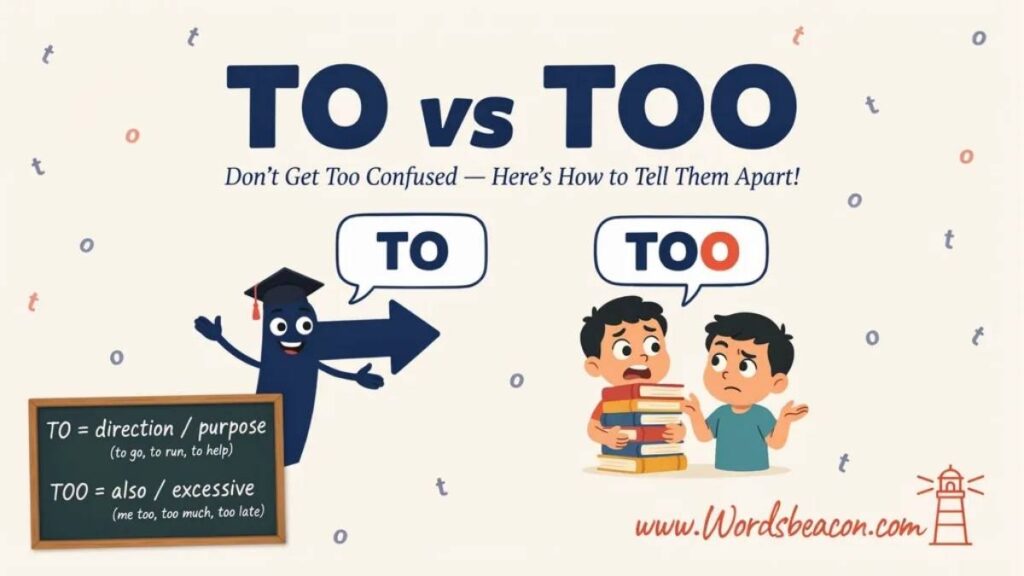
The to vs too confusion can make even a simple sentence feel like a tiny grammar puzzle. These words sound alike, but they have different jobs. Use to for direction, a destination, or before a verb, as in “I want to learn.” Use too when you mean “also” or “more than needed,” as in “I want to learn too” or “It is too cold.” The difference is small, but that extra o in too is doing some serious work. Once you understand what each word means, the confusion quickly disappears. So, let’s break down to vs too in a simple, clear, and memorable way.
quick answer
| Word | Meaning | Main Use | Example |
|---|---|---|---|
| To | Direction, destination, or action | Preposition or infinitive marker | “I want to go.” |
| Too | Also or excessively | Adverb | “I want to go too.” |
Before the table, remember that to vs too may sound similar, but their meanings and grammatical jobs are different. A quick look at the examples can help you spot the correct word.
Fix common more word mistakes in English
Breath vs Breathe which one is correct ?
What Is the Difference Between To vs Too?
The difference between to vs too starts with their grammatical roles.
To commonly functions as a preposition. It can show direction, movement, destination, a recipient, a relationship, or a limit. It also appears before the base form of a verb to create a to-infinitive.
Too is an adverb. It commonly has two major meanings: also and excessively. Cambridge Dictionary describes too as an adverb and explains both of these major uses.
Consider these sentences:
“I want to study.”
“I want to study too.”
The first sentence uses to before the verb study. The second sentence uses to for the infinitive and adds too to mean also.
Now compare these sentences:
“She walked to the store.”
“She was too tired to walk.”
In the first sentence, to introduces the destination. In the second, too means more than was manageable or desirable, while the final to introduces the action walk.
That is the key to understanding the difference between to vs too. The words may sound alike, but their jobs are different.
| Word | Main function | Main meaning | Example |
|---|---|---|---|
| To | Preposition or infinitive marker | Direction, destination, connection, recipient, or an action | “She went to school.” |
| Too | Adverb | Also or excessively | “She went too.” |
| Two | Number word | The number 2 | “She has two books.” |
Therefore, when deciding whether to use to vs too, do not rely on pronunciation. Instead, look at what the word means and what role it plays in the sentence.
Learn the difference between often confused words
Yours vs Your’s which one is correct ?
How to Use To
The word to appears constantly in English. In fact, it has several grammatical uses, so learning one simple definition is not enough.
The meaning of to changes slightly according to context. However, its major uses are easy to recognize once you see the patterns.
To as a Preposition
One important use of to is as a preposition.
A preposition can show how one word relates to another. Merriam-Webster explains that prepositions commonly show direction, location, or time, or introduce an object. To is one of the most common English prepositions.
For example:
“She drove to the office.”
“They walked to the park.”
“He sent a message to his friend.”
“We moved to California.”
In each example, to connects something to a destination or recipient.
The first sentence, for example, shows movement toward a destination. Similarly, the second sentence also describes movement toward a destination. However, the third sentence shifts the focus and identifies the person who receives the message. Finally, the fourth sentence goes a step further by identifying the new destination of the move. Therefore, each sentence describes a different part of the action while still showing a clear connection between them.
This means the preposition to can express more than physical direction.
Consider this sentence:
“She spoke to her manager.”
Nobody necessarily moves toward the manager. Instead, to connects the action of speaking with the person who receives that communication.
Similarly:
“Give the keys to James.”
Here, to identifies the recipient.
So, the uses of to can include direction, movement, destination, recipient, connection, and relationships between words.
To for Direction and Movement
When someone or something moves toward a place, to often identifies the destination.
Examples include:
“We went to the airport.”
“Sarah ran to the door.”
“The children walked to school.”
“They flew to New York.”
The important idea is direction. The word to tells the reader where the movement leads.
However, the destination does not always have to be a physical place.
For example:
“He turned to his brother.”
“She listened to her teacher.”
“I returned to the subject.”
These sentences use to to establish a relationship or direction within the sentence rather than simply describing physical travel.
To for a Recipient or Destination
To can also identify the person or thing that receives something.
Consider:
“She gave the book to me.”
“He sent an email to his manager.”
“They donated money to the organization.”
“I explained the problem to my teacher.”
In each sentence, the noun or pronoun after to receives something, whether that something is an object, communication, money, or information.
This use makes to especially common in everyday communication.
To Before a Verb
Another major grammatical use of to involves infinitives.
A to-infinitive consists of to followed by the base form of a verb.
Examples include:
1.“to read”
2.“to write”
3.“to learn”
4.“to understand”
5.“to travel”
6.“to improve”
You will often see this structure after verbs such as want, need, hope, plan, decide, promise, and try.
For example:
“I want to improve my writing.”
“She hopes to become a doctor.”
“They decided to leave early.”
“He needs to finish the report.”
“We plan to visit our family.”
Here, to does not show direction. Instead, it introduces an action.
This distinction matters because English learners sometimes assume that every to means movement. It does not.
In “I want to learn,” nobody is moving anywhere. The word to simply introduces the verb learn.
To and Infinitive Verbs
The infinitive structure often connects two actions.
For example:
“I want to sleep.”
The first verb is want. The second action is sleep.
Likewise:
“She decided to stay.”
“They agreed to help.”
“He promised to call.”
“We need to leave.”
The first verb establishes the situation, while the to-infinitive introduces the related action.
However, English grammar includes structures where a verb does not take to before the following verb. Modal verbs such as can, could, should, must, and might normally take the base verb directly.
For example:
“I can swim.”
“You should study.”
“We must leave.”
Therefore, do not assume that every verb needs to before another verb. Sentence structure determines the correct form.
Other Uses of To
To can also express a range or limit.
For example:
“The store is open from nine to five.”
“The temperature rose from 10 to 20 degrees.”
“She counted from one to ten.”
In these examples, to marks an endpoint.
It can also appear in comparisons and relationships:
“I prefer tea to coffee.”
“This answer is similar to mine.”
“He is married to an engineer.”
These examples show why the to definition cannot be reduced to one meaning. Its exact function depends on context.
Learn the difference between often confused words
Lose vs Loose which one is correct ?
How to Use Too
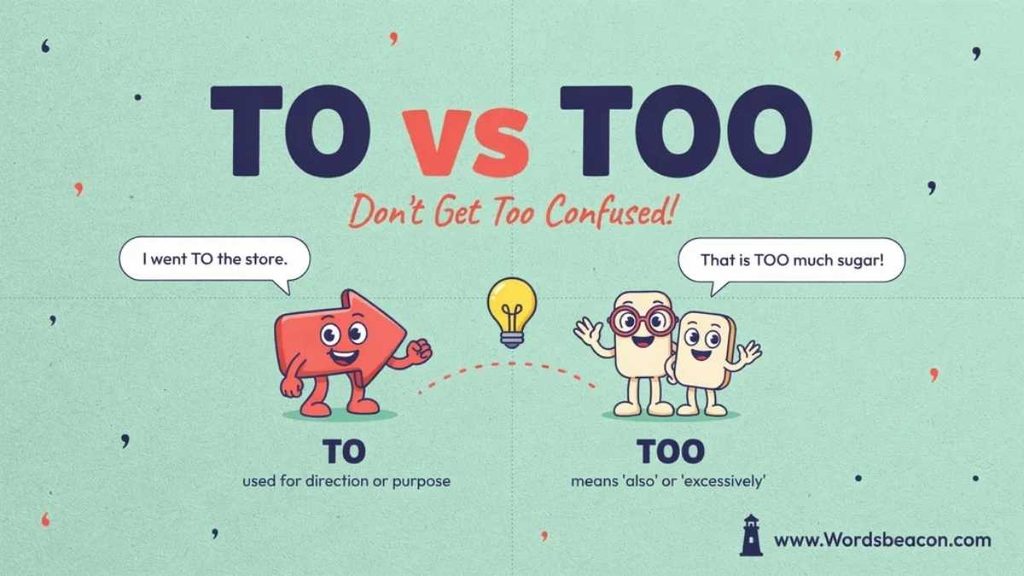
The word too has two central meanings that explain most of its everyday use.
First, it can mean also or as well.
Second, it can mean excessively or more than is wanted, needed, suitable, or enough.
Cambridge Dictionary identifies both uses and notes that too commonly appears at the end of a clause when it means also.
Too Meaning Also or As Well
When too means also, it adds another person, action, or idea.
For example:
“I like coffee too.”
“She wants to come too.”
“We enjoyed the movie too.”
“My brother plays soccer too.”
In each sentence, too adds something.
Suppose someone says:
“I love this song.”
A natural response is:
“I love it too.”
Here, too means “I also love it.”
The same meaning appears in:
“Can I come too?”
“I want one too.”
“She is coming too.”
In informal English, too often appears at the end of a sentence or clause. Cambridge also notes that “me too” is the normal informal response to a statement such as “I love that color.”
For example:
“I love chocolate.”
“Me too.”
The word too is doing the work of also.
Too Meaning Excessively
The second major meaning of too involves excess.
When too means excessively, it tells the reader that something has gone beyond a suitable, wanted, or manageable level. Cambridge gives this meaning as “more than is needed or wanted” or more than is suitable or enough.
Consider:
“The coffee is too hot.”
“The bag is too heavy.”
“The room is too small.”
“The test was too difficult.”
“The music is too loud.”
In each example, the quality has gone beyond a reasonable level for the situation.
The coffee is not simply hot. It is hotter than the person wants.
The bag is not merely heavy. It is heavier than the person can comfortably carry.
The test is not simply difficult. It is difficult beyond a suitable level for the speaker.
This is an important part of the too meaning in English because too often expresses a problem or limitation.
Learn the difference between confusing more English words
Attornies vs Attorneys difference and usage ?
Too Before an Adjective or Adverb
When too means excessively, it commonly appears directly before an adjective or adverb.
For example:
1.“too expensive”
2.“too difficult”
3.“too loud”
4.“too quickly”
5.“too slowly”
6.“too far”
Cambridge specifically notes this pattern and gives examples such as too sweet, too hot, and too quickly.
Compare:
“The car is very fast.”
“The car is too fast.”
Very simply increases the degree of fast. Too suggests that the speed exceeds a desirable or suitable level.
That distinction becomes even clearer here:
“She is very careful.”
“She is too careful.”
The first sentence praises or describes a high degree of care. The second suggests that her level of care exceeds what is necessary.
Therefore, too and very are not interchangeable in every sentence.
Too Much and Too Many
Too also appears with quantities.
Use too much with uncountable nouns:
“There is too much water.”
“There is too much noise.”
“He spends too much time online.”
“She added too much sugar.”
Use too many with countable plural nouns:
“There are too many people here.”
“I bought too many books.”
“We received too many emails.”
“There are too many questions.”
Cambridge also recognizes too little and too few when describing an amount below what is needed.
For example:
“There is too little information.”
“There are too few chairs.”
These patterns show that too can describe both excessive and insufficient quantities when combined with few or little. However, the core idea remains comparison with a suitable amount.
Too With a To-Infinitive
One especially useful pattern combines both words:
“It is too hot to eat.”
“She is too tired to work.”
“The box is too heavy to carry.”
“The question is too difficult to answer.”
This structure can look confusing because to vs too appear close together.
However, their roles are completely different.
In “The box is too heavy to carry,” too describes the excessive degree of heaviness. The second to introduces the verb carry.
The pattern is:
too + adjective or adverb + to + verb
Cambridge gives the same grammatical pattern in examples such as “The water was too cold to swim in.”
Once you understand that structure, sentences containing both words become much easier to read.
Learn the difference between confusing more English words
Tweek vs Tweak difference and usage?
To vs Too Examples
Real sentence examples make the difference much clearer than memorizing definitions alone.
The following to vs too examples cover common situations in everyday English.
| Sentence | Word function | Explanation |
|---|---|---|
| I want to learn. | To | Introduces the infinitive verb learn. |
| She went to school. | To | Shows destination. |
| Give the letter to John. | To | Identifies the recipient. |
| I want to come too. | Both | To introduces come; too means also. |
| The tea is too hot. | Too | Means excessively hot. |
| Can I come too? | Too | Means also. |
| There are too many people. | Too | Shows an excessive number. |
| It is too late to leave. | Both | Too describes excessive lateness; to introduces leave. |
| She wants to help too. | Both | To introduces help; too means also. |
| We walked to the store too. | Both | To shows destination; too adds the meaning also. |
To and Too Examples in Context
Consider a short conversation:
“I am going to the library.”
“I want to go too.”
The first sentence uses going to to identify the destination. The second uses to before the verb go and too to mean also.
Now consider:
“I am too tired to study.”
The first too describes the excessive degree of tiredness. The second to introduces the action study.
Another example makes the contrast even clearer:
“She went to the store, and her sister went too.”
The first to shows destination. The final too means her sister also went.
These examples demonstrate why context matters so much in English grammar.
Learn the difference between confusing more English words
Courtesy vs Curtesy Difference and usage ?
To vs Too vs Two
The confusion becomes slightly bigger when two enters the picture.
To, too, and two usually share the same pronunciation in standard American English, but they have different spellings, meanings, and grammatical functions.
Two is the number 2. Cambridge Dictionary defines two simply as the number 2.
For example:
“I have two sisters.”
“She bought two tickets.”
“We waited two hours.”
“They ordered two pizzas.”
Unlike to vs too, two expresses quantity.
| Word | Meaning | Grammatical role | Example |
|---|---|---|---|
| To | Direction, connection, destination, recipient, or infinitive | Preposition or infinitive marker | “I went to work.” |
| Too | Also or excessively | Adverb | “I went too.” |
| Two | The number 2 | Number word | “I have two tickets.” |
To vs Too vs Two Examples
The sentence “I want to buy two books too” contains all three words.
To introduces the verb buy.
Two identifies the number of books.
Too means also.
Another example is:
“She wants to invite two friends too.”
Again, each word performs a separate job.
To introduces invite.
Two identifies the number of friends.
Too means also.
The pronunciation may sound nearly identical, but the context makes the meaning clear.
Learn the difference between confusing more English words
More Than vs More Then difference and usage ?
Common Mistakes With To and Too

Most to vs too mistakes happen because writers hear the same sound and choose the spelling automatically.
However, the sentence itself usually provides a simple clue.
Using To Instead of Too
Incorrect:
“I want to come to.”
Correct:
“I want to come too.”
The intended meaning is “I also want to come,” so too is necessary.
Another example:
“This bag is to heavy.”
Correct:
“This bag is too heavy.”
Here, too describes an excessive degree of weight.
Using Too Instead of To
Incorrect:
“She wants too leave.”
Correct:
“She wants to leave.”
The word introduces the infinitive verb leave, so to is correct.
Another example:
“We drove too the airport.”
Correct:
“We drove to the airport.”
The word identifies the destination, so to is required.
Confusing Too With Very
Incorrect reasoning:
“The room is too beautiful” must mean the room is very beautiful.
That is not always the intended meaning.
Too often suggests that something exceeds a suitable or expected degree. Very simply intensifies the adjective.
Compare:
“The room is very small.”
“The room is too small.”
The first describes a high degree of smallness. The second suggests the room is smaller than is suitable for the purpose.
That small distinction can change the entire message.
Confusing Too Much With Very Much
This distinction also matters with verbs.
“I like this book very much.”
This means the speaker likes the book a lot.
“I like this book too much.”
This can suggest excessive liking and may imply that the amount of liking has become undesirable.
Cambridge specifically notes that very much commonly emphasizes verbs such as like, dislike, hope, and doubt, while too much does not normally serve the same function.
Therefore, choosing between these expressions requires attention to meaning, not simply grammar.
Forgetting That a Sentence Can Use Both Words
Some writers think they must choose between to vs too.
They do not.
A sentence can naturally contain both.
For example:
“I want to go too.”
“She is too tired to drive.”
“We need to talk to him too.”
“He wants to travel to Canada too.”
The correct choice depends on the role of each individual word.
Learn the difference between tricky grammar words
Weiner vs Wiener Which one Is Correct?
Easy Trick to Remember To vs Too
The easiest way to remember to vs too is to connect too with the idea of addition or excess.
The word too has an extra o.
Think of that extra o as something extra.
When too means also, it adds another person or idea.
“I am going too.”
When too means excessively, something has gone beyond the desired amount or level.
“It is too expensive.”
This is only a memory trick, not an actual grammar rule. Still, it can make the distinction easier to recall.
Replace Too With Also
If you think the sentence means also or as well, try replacing the word with one of those expressions.
“I want to come too.”
“I want to come as well.”
The meaning remains clear.
“She likes coffee too.”
“She also likes coffee.”
If the replacement works, too is likely the correct choice.
Replace Too With Excessively
When too describes a degree, try replacing it with excessively or more than necessary.
“The room is too cold.”
“The room is excessively cold.”
The second sentence sounds more formal, but the basic idea remains.
This test works especially well with adjectives and adverbs.
Check What Comes After the Word
If the word appears before a base verb as part of an infinitive, to is usually correct.
“I want to read.”
“She needs to study.”
“They decided to leave.”
However, if the word means also or appears before an adjective or adverb to show excess, too is usually correct.
“I want to read too.”
“She is too tired.”
“They arrived too late.”
This simple check can solve many cases of to vs too grammar without requiring complicated terminology.
Learn the difference between tricky grammar words
Flakey vs Flaky which one is correct ?
When to Use To vs Too

1.When you are unsure whether to use to vs too, pause and ask one question: What does the word mean in this sentence?
If it shows direction or destination, use to.
“I went to school.”
If it identifies a recipient, use to.
“Give it to me.”
If it introduces an infinitive verb, use to.
“I want to learn.”
If it means also, use too.
“I want to learn too.”
If it means excessively or more than enough, use too.
“It is too difficult.”
This method works because it focuses on word usage rather than pronunciation.
How to Use To and Too Correctly
A practical approach is to read the sentence without focusing on the spelling first.
Ask what idea the word communicates.
1.If you can replace it with also or as well, choose too.
2.If you can replace it with excessively or more than enough, choose too.
3.If it shows direction, destination, connection, or a recipient, choose to.
4.If it introduces a base verb in an infinitive construction, choose to.
For example:
“I want to visit my friend too.”
The first to introduces visit.
The second to identifies the person receiving the visit.
Too means also.
Once you start identifying these roles, the difference between to vs too becomes much more automatic.
Learn the difference between tricky grammar words
Premier vs Premiere which one is correct ?
Practice session To vs Too
Choose either to vs too to complete each sentence.
- I want ___ learn how to cook.
- She is coming ___ the party tonight.
- This coffee is ___ hot to drink.
- We went ___ the library after lunch.
- Can I come ___?
- He needs ___ finish his homework.
- The box is ___ heavy for me to lift.
- Please give this letter ___ Sarah.
- I would like ___ order a sandwich.
- They arrived ___ late for the meeting.
- My brother wants ___ join the team ___.
- She walked ___ the store with her friend.
- I like this movie ___.
- It is ___ cold ___ go outside.
- He decided ___ stay home.
- There are ___ many people in this room.
- We need ___ talk about this problem.
- She wants ___ go ___.
- The music is ___ loud.
- I am happy ___ see you ___.
Answers
- to
- to
- too
- to
- too
- to
- too
- to
- to
- too
- to, too
- to
- too
- too, to
- to
- too
- to
- to, too
- too
- to, too
Here’s a trusted source for clear word meanings:
FAQs
What is the difference between to vs too?
To usually shows direction, movement, connection, or a relationship. It also comes before a verb in an infinitive phrase. Too is an adverb that means “also” or “more than necessary.” For example, “She went to school” uses to, while “She went to school too” uses too.
How can I quickly tell whether to vs too is correct?
Start by checking the meaning. If you mean “also” or “more than necessary,” use too. Otherwise, to is usually the correct choice when you are showing direction, describing a relationship, or placing it before a verb.
Can too come before an adjective?
Yes. Too can come before an adjective when something goes beyond a suitable or expected level. For example, “The water is too cold” means the water is colder than you want or need it to be.
Can too be used with nouns?
Yes, but the structure depends on the noun. Use “too many” with countable plural nouns, such as “too many books.” Use “too much” with uncountable nouns, such as “too much water.”
Can to be used before a verb?
Yes. To commonly comes before the base form of a verb to create an infinitive. For example, “I want to learn” and “They decided to leave” both use to correctly.
Why does too have an extra o?
The extra o gives you a handy memory trick. Think of the second o as something extra. Too can mean “also,” which adds information, or “more than necessary,” which indicates excess.
Can too mean “also”?
Yes. Too can mean “also” or “as well.” For example, “I enjoyed the movie too” means that another person enjoyed it, and the speaker did as well.
Can too mean “more than necessary”?
Yes. Too can describe something that exceeds a suitable or acceptable level. For example, “The box is too heavy” means the box has more weight than is manageable for the situation.
Is to always followed by a verb?
No. To can function as a preposition and come before a noun or pronoun. For example, “We walked to the park” uses to before the noun phrase “the park.” To can also introduce an infinitive, as in “to read.”
Can I end a sentence with too?
Yes. When too means “also,” it often appears at the end of a sentence or clause. For example, “I would like to come too” is completely correct.
What is the easiest way to remember to vs too?
Think of to as pointing toward something and too as adding something extra. For example, “We drove to the beach” shows a destination, while “We went too” means someone else went as well.
Why is “I want too” usually incorrect?
“I want too” is usually incorrect when you want to place another verb after want. The correct form is “I want to go.” However, “I want to go too” is correct because the final too means “also.”
How do to vs too change the meaning of a sentence?
The two words can create different meanings even though they sound similar. “She went to the store” describes a destination. “She went to the store too” adds the idea that she went as well.
What is the difference between “too much” and “to much”?
“Too much” is correct when you mean an excessive amount. For example, “There is too much sugar in this coffee.” “To much” is incorrect when you intend to express excess.
What is the difference between “too many” and “to many”?
“Too many” is correct when you mean an excessive number of countable things. For example, “There are too many people here.” “To many” does not express this meaning.
Can too appear in the middle of a sentence?
Yes. Too can appear in different positions depending on the sentence. For example, “She too enjoyed the concert” means that she also enjoyed it.
Is too only used at the end of a sentence?
No. Although too often appears at the end when it means “also,” it can also appear earlier in a sentence. For example, “He too agreed with the plan” is grammatically correct.
Are to and too pronounced the same way?
They can sound similar in everyday speech, especially because to often has a reduced pronunciation in connected speech. However, they have different meanings and grammatical functions, so spelling still matters when you write.
Why do people confuse to and too?
The words sound alike or very similar in many sentences, which makes them easy to mix up while writing quickly. The best way to avoid the mistake is to focus on meaning rather than sound. Ask whether you mean direction, an infinitive, “also,” or “more than necessary.”
Can to and too appear in the same sentence?
Yes. In fact, they can appear close together without any problem. For example, “I want to go too” uses to before the verb go and too to mean “also.” Once you understand each word’s job, the difference becomes much easier to spot.
Conclusion
The to vs too confusion is easy to fix once you know what each word does. Use to when you talk about direction, a destination, or an action, such as “I went to school” or “I want to learn.” Use too when you mean “also” or “more than needed,” as in “I want to come too” or “The bag is too heavy.”
The easiest trick is to look at the meaning, not just the sound. If you mean “also” or something is extra, choose too. In other cases, to is usually the right choice. With a little practice, these two small words become much easier to tell apart. After all, that extra o in too does not need to cause extra trouble!

Luna AJS is an experienced blogger and dedicated language enthusiast at Words Beacon. She specializes in making English grammar, spelling, vocabulary and commonly confused words easy to understand. She provides clear explanations, practical examples to help readers write with confidence.