

Breath and breathe look almost the same, so it is easy to see why English learners mix them up. One letter, however, changes the word, its pronunciation, and its job in a sentence. The breath vs breathe confusion becomes simple once you know the rule. Breath is a noun, so it names the air you take in or a single act of breathing. Breathe is a verb, so it describes the action of taking air in and letting it out. In other words, you take a breath, but you breathe. Once this difference clicks, choosing the word becomes easier, and your grammar can breathe easy.
quick answer
The easiest way to tell them apart is to remember that breath is a noun, while breathe is a verb.
| Word | Part of Speech | Meaning | Example |
|---|---|---|---|
| Breath | Noun | Air taken in or released | Take a deep breath. |
| Breathe | Verb | To take air in and let it out | Try to breathe slowly. |
The key difference is simple: you take a breath, but you breathe. Once you remember this pattern, the breath vs breathe confusion becomes much easier to avoid.
Fix common more word mistakes in English
Yours vs Your’s which one is correct ?
Breath vs Breathe The Simple Difference
At first glance, breath and breathe seem almost identical. Nevertheless, they perform different jobs in English.
Breath is a noun. It refers to the air that goes into and out of your lungs or to a single action of taking air into the lungs. Breathe is a verb. It describes the action of moving air into and out of the lungs. Cambridge Dictionary makes this same noun-versus-verb distinction in its grammar guidance.
Consider the difference in these sentences:
“Take a deep breath.”
“Breathe slowly.”
In the first sentence, breath names the thing being taken. In the second, breathe describes the action.
That is the central breath and breathe difference. If you remember only one rule, remember this: you take a breath, but you breathe.
The Simple Difference Between Breath and Breathe
The easiest way to understand breath vs breathe is to focus on grammar before spelling.
Breath is a noun because it names something. It can refer to the air moving through your respiratory system or to one instance of taking in air. For example, “She took a deep breath” uses breath as a noun.
Breathe is a verb because it describes an action. For example, “She began to breathe slowly” uses breathe as a verb.
Therefore, when you ask, “What is the difference between breath and breathe?” the answer is not complicated. Breath names the air or an instance of breathing, while breathe describes the action itself.
The distinction becomes even clearer when the words appear together:
“Take a breath and breathe slowly.”
Here, breath and breathe sit next to each other without competing. In fact, they work perfectly together because each word has a different grammatical role.
This also explains why the questions “Is it breath or breathe?” and “Should I use breath or breathe?” depend on the sentence. Neither word is simply the correct version of the other. Instead, each one belongs in different grammatical situations.
Learn the difference between confusing word pairs
Lose vs Loose which one is correct ?
Breath Meaning The Noun
The breath meaning centers on air moving into or out of the lungs. Cambridge Dictionary defines breath as the air that goes into and out of the lungs. It also defines breath as a single action of breathing air into the lungs.
For example:
“She took a deep breath before answering.”
In this sentence, breath refers to one intake of air.
Similarly, “He held his breath” uses breath as a noun because it names the air he kept in his lungs.
The noun also appears in expressions that describe physical effort, pauses, speech, smell, and emotional reactions. For instance, someone can be out of breath after running. Someone can catch their breath after physical activity. A person can speak under their breath. Something beautiful can take your breath away.
Therefore, the word has a broader range than simply “air in the lungs.” Its meaning changes slightly depending on the phrase around it.
That is important because English often stores meaning inside familiar expressions. Once you learn breath in phrases rather than as an isolated word, the correct usage becomes much easier to recognize.
Breathe Meaning The Verb
The breathe meaning focuses on an action. To breathe means to take air into the lungs and release it again. Cambridge Dictionary lists breathe as a verb and gives examples involving breathing in, breathing out, and breathing deeply.
For example:
“Try to breathe slowly.”
Here, breathe tells the reader what action to perform.
The verb can appear in several forms. The base form is breathe. The third-person singular form is breathes. The past form is breathed. The present participle is breathing.
For example:
“I breathe slowly when I relax.”
“She breathes through her nose.”
“He breathed deeply after the race.”
“They were breathing heavily.”
Notice how the spelling changes with grammar. However, the basic word remains the same.
This is why the question “Is breathe a noun or verb?” has a straightforward answer. In its ordinary modern use, breathe is a verb.
Breath Noun vs Breathe Verb
The noun-versus-verb distinction provides the fastest way to solve most breath vs breathe problems.
When you need the name of something, use breath.
When you need an action, use breathe.
Consider the sentence, “I need a breath.” The word breath follows the article a and names something that the speaker needs.
Now consider, “I need to breathe.” The word breathe follows to and describes an action.
The same pattern appears in many sentences:
“She took a breath.”
“She stopped to breathe.”
“He was out of breath.”
“He could hardly breathe.”
The meaning remains connected in every example, but the grammar changes. Therefore, learning the grammar is more useful than trying to memorize every individual sentence.
Learn the difference between confusing word pairs
Tweek vs Tweak difference and usage?
Breath vs Breathe Pronunciation
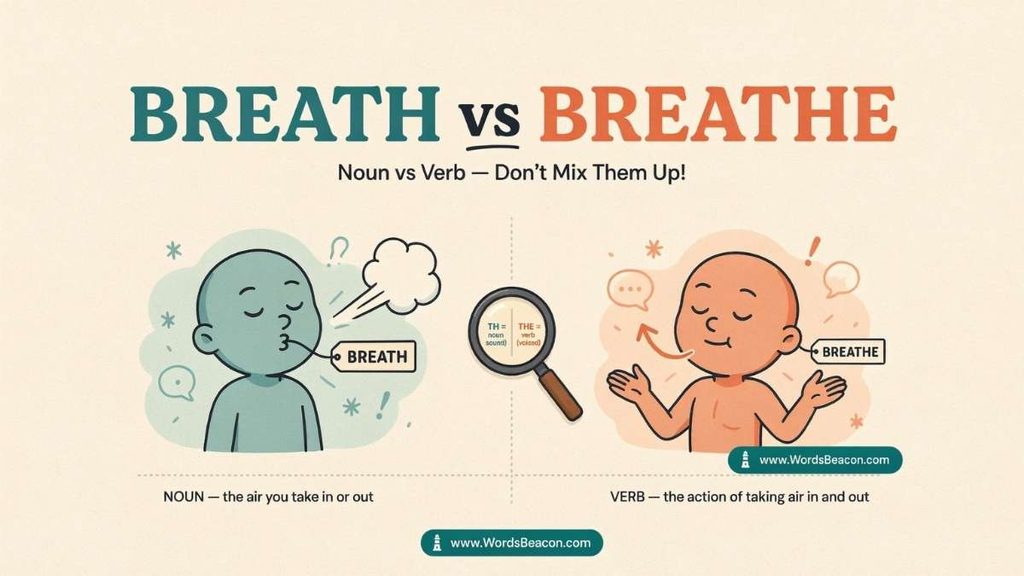
The breath vs breathe pronunciation difference is one of the most useful clues for English learners.
The US pronunciation of breath is /breθ/. The vowel has the short e sound found in words such as “bed” and “red.” The final th is unvoiced, as in “think.” Cambridge Dictionary lists this pronunciation for both UK and US English.
Breathe, on the other hand, is pronounced /briːð/. It contains a long e sound, similar to the vowel in “see” or “tree,” and it ends with the voiced th sound found in “this.” Cambridge Dictionary gives /briːð/ for the US pronunciation.
So, although the spelling differs by only one letter, the sound changes in two important ways.
Breath uses the short e sound.
Breathe uses the long e sound.
Breath ends with an unvoiced th.
Breathe ends with a voiced th.
That is why breath pronunciation and breathe pronunciation deserve attention when you are learning the difference.
Why Are Breath and Breathe Pronounced Differently?
The final e in breathe provides an important spelling clue. Although you do not pronounce that e directly, it helps signal the long vowel sound.
Compare breath with breathe. The first has a short vowel, while the second has a long vowel. English has many spelling patterns in which a final silent e influences the preceding vowel.
A similar relationship appears in pairs such as bath and bathe. The spelling pattern is useful, although it does not work as a perfect rule for every English word.
The final consonant also changes. In breath, the th is unvoiced. In breathe, the th is voiced.
You can feel the difference by placing your fingers lightly against your throat while saying the final sound. A voiced sound creates vibration, while an unvoiced sound does not.
Therefore, when someone asks, “Why are breath and breathe pronounced differently?” the answer involves both the vowel and the final consonant.
Breath vs Breathe in Common Sentences
Context often makes the correct word obvious.
Consider this sentence:
“She took a deep breath before the presentation.”
Because the sentence needs a noun after “a deep,” breath is correct.
Now consider:
“She needed to breathe before continuing.”
Because the sentence needs a verb after “to,” breathe is correct.
The same principle works in everyday situations.
After running, someone might say, “I am out of breath.”
However, they might also say, “I need to breathe more slowly.”
Before giving a speech, someone might say, “Let me take a breath.”
Then they might remind themselves, “Remember to breathe.”
The physical process remains connected, but the grammatical role changes.
Learn the difference between confusing word pairs
Courtesy vs Curtesy Difference and usage ?
Take a Deep Breath vs Breathe?
The correct phrase is “take a deep breath.”
The word breath is correct because it functions as a noun. The sentence tells someone to take a deep breath as an object.
For example:
“Take a deep breath before you begin.”
You could then use breathe in the same sentence:
“Take a deep breath and breathe slowly.”
That sentence provides one of the clearest breath vs breathe examples because both words appear together while performing different grammatical jobs.
The phrase “take a deep breathe” is incorrect in standard English because breathe is a verb, not the noun required after “take a.”
This is a common spelling mistake, but it is also a grammar mistake. Once you recognize the structure, the correct word becomes much easier to choose.
Out of Breath or Out of Breathe?
The correct expression is “out of breath.”
For example:
“She was out of breath after climbing the stairs.”
Here, breath follows the preposition of and functions as a noun.
The phrase describes a person who is breathing heavily or having difficulty breathing normally after effort, excitement, or another situation. Cambridge Dictionary includes “out of breath” among the established uses of breath.
Therefore, “out of breathe” is not the standard expression.
When deciding between “out of breath or out of breathe,” remember that the fixed phrase uses the noun breath.
I Can’t Breathe or Breath?
The correct sentence is:
“I can’t breathe.”
The reason is grammatical. After the modal verb can or its negative form cannot or can’t, English uses the base form of a verb.
You say:
1.“I can’t breathe.”
2.“I can’t run.”
3.“I can’t sleep.”
4.“I can’t speak.”
You do not change the base verb after can.
Therefore, “I can’t breath” is incorrect in standard English.
This same rule applies to other modal verbs:
“She should breathe slowly.”
“He could breathe normally again.”
“They must breathe carefully.”
In each case, breathe functions as the base-form verb.
Learn the difference between confusing word pairs
More Than vs More Then difference and usage ?
Out of Breath and Hard to Breathe
Two expressions can describe similar situations while using different words.
“Out of breath” contains the noun breath.
“It was hard to breathe” contains the verb breathe.
For example:
“After the race, I was out of breath.”
“After the race, it was hard to breathe normally.”
The first phrase describes a condition. The second describes an action that feels difficult.
Therefore, if you see “to” before the word, breathe will often be the correct choice because “to breathe” is an infinitive verb phrase.
That simple grammatical clue can save you from many spelling errors.
Breath vs Breathe vs Breadth
Breath and breathe are not the only words that can cause confusion. Breadth looks similar as well, but its meaning has nothing to do with breathing.
Breadth refers to width or range. It can describe physical size, the scope of a subject, or the range of someone’s knowledge and experience.
For example:
“The breadth of the river made the crossing difficult.”
“The breadth of her knowledge impressed the committee.”
By contrast:
“Take a breath.”
“Try to breathe slowly.”
The three words therefore have separate meanings.
Breath relates to air and breathing.
Breathe describes the action.
Breadth describes width, range, or scope.
Although they share several letters, context quickly separates them.
What Is the Plural of Breath?
The plural of breath is breaths.
For example:
“She took several deep breaths.”
“He counted his breaths while exercising.”
That spelling creates another possible source of confusion because breaths looks similar to breathes.
However, breaths is the plural noun form of breath, while breathes is the third-person singular form of the verb breathe.
Consider the difference:
“She took three breaths.”
“She breathes slowly.”
The first sentence needs a plural noun. The second needs a verb.
This distinction is especially useful when learning breathe vs breath grammar because the extra s does not perform the same grammatical function in both words.
Learn the difference between tricky grammar words
Weiner vs Wiener Which one Is Correct?
Breath and Breathe Inside Longer Words
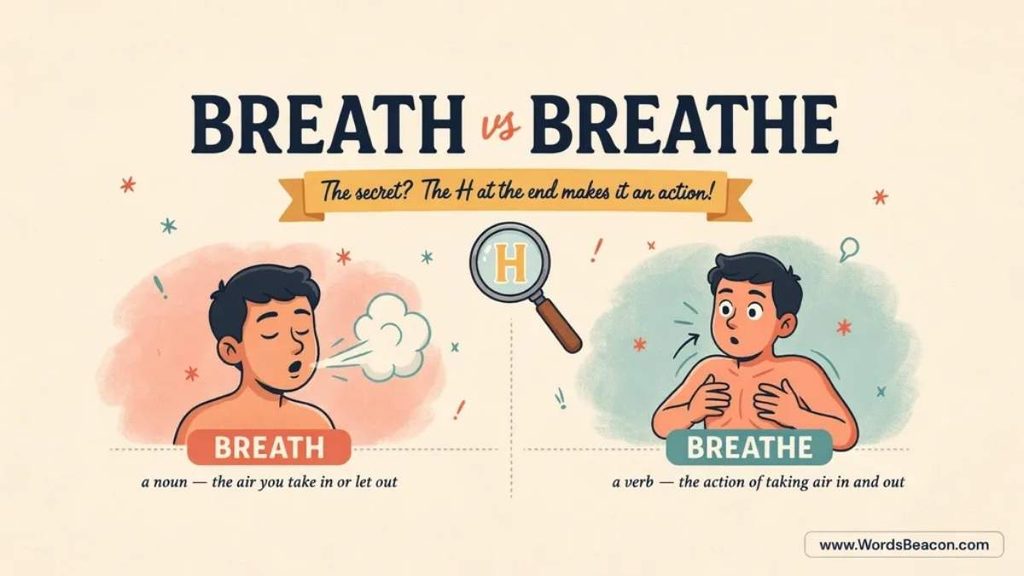
The relationship becomes even more interesting when these words appear in longer forms.
Breath appears in words such as breathless, breathlessness, breathtaking, and breathy.
Breathe produces forms such as breathes, breathed, and breathing.
The word breathing deserves special attention because its spelling can look confusing. When English adds -ing to breathe, the final silent e disappears.
Therefore:
breathe becomes breathing.
The same spelling pattern appears in other verbs, such as write becoming writing and make becoming making.
Cambridge Dictionary defines breathing as the act or process of taking air into the lungs and releasing it.
So, when you see “breathing,” remember that it comes from the verb breathe.
Common Breath vs Breathe Mistakes
The most common mistakes happen when writers focus on appearance instead of grammar.
A sentence such as “Take a deep breathe” looks almost right because breathe is closely related in meaning. Nevertheless, the sentence needs the noun breath.
Likewise, “I cannot breath” may look reasonable at first glance, but the sentence needs a verb after cannot. Therefore, breathe is correct.
The same problem appears in “She was out of breathe.” Since the phrase uses the noun after “of,” the correct form is “out of breath.”
Another common error occurs in “Try to breath deeply.” Because the sentence uses “to” before the verb, the correct form is “Try to breathe deeply.”
These errors are easy to fix once the grammatical role becomes clear.
How to Use Breath and Breathe
When deciding how to use breath and breathe, start with the sentence structure.
If you need a noun, use breath.
If you need a verb, use breathe.
For example:
“Take a breath.”
“Breathe slowly.”
“His breath smelled of garlic.”
“She breathed deeply.”
“He was out of breath.”
“She could hardly breathe.”
The distinction becomes even easier when you replace the word with another obvious noun or verb.
For example, “Take a ___” clearly needs something that can be taken, so breath fits.
Likewise, “Try to ___ slowly” clearly needs an action, so breathe fits.
This approach works better than memorizing isolated spelling rules because it connects spelling with grammar and meaning.
When to Use Breath vs Breathe
The easiest answer to when to use breath vs breathe is to ask one question: What job does the word perform?
Use breath when the word acts as a noun.
Use breathe when the word acts as a verb.
For instance, “a breath,” “your breath,” and “one breath” all use the noun.
Meanwhile, “to breathe,” “can breathe,” “should breathe,” and “will breathe” all use the verb.
This pattern gives you a practical answer to the question, “When should I use breath?”
Use breath when you are naming the air, a single intake of air, or the concept associated with breathing.
And when should you use breathe?
Use breathe when you are describing the physical action of taking air into the lungs and releasing it.
Learn the difference between tricky grammar words
Flakey vs Flaky which one is correct ?
When to Use Breathe Instead of Breath
If the sentence describes something a person does, breathe is usually the correct choice.
For example:
“Try to breathe slowly.”
“She could barely breathe.”
“They learned how to breathe properly.”
“He stopped to breathe.”
Each sentence describes an action.
By contrast, these sentences name the noun:
“Take a breath.”
“She held her breath.”
“He was out of breath.”
“Her breath smelled fresh.”
Therefore, when deciding whether to use breathe instead of breath, look for the action.
If the sentence answers the question “What does the person do?” breathe is likely the right choice.
Breath of Fresh Air Meaning
The phrase “a breath of fresh air” can have a literal or figurative meaning.
Literally, it refers to a refreshing amount of fresh air.
For example:
“I opened the window to get a breath of fresh air.”
However, the phrase often works figuratively. In that use, it describes a person, idea, change, or experience that feels fresh and refreshing.
For example:
“The new approach was a breath of fresh air.”
Here, nobody is talking about actual air. Instead, the phrase compares something refreshing and welcome to the feeling of breathing fresh air.
Notice that the phrase always uses breath, not breathe.
That makes it another useful expression to remember when working through breath vs breathe meaning.
Breathe a Word Meaning
The expression “breathe a word” is another example of breathe being used as a verb.
In the phrase “Don’t breathe a word,” the meaning is not literal. It means do not tell anyone or reveal the information.
For example:
“Don’t breathe a word about the surprise.”
The expression works because breathe functions as a verb. The phrase has a figurative meaning, but its grammar remains the same.
This is a useful reminder that breathe does not always describe ordinary physical breathing. English can use the verb metaphorically as well.
Breathe Life Into Something
The expression “breathe life into” also uses breathe as a verb.
It means to make something more lively, active, exciting, or successful.
For example:
“The new design breathed life into the old website.”
Here, the sentence does not describe literal breathing. Instead, it uses breathing as a metaphor for giving something renewed energy.
Again, the grammatical role remains clear. Breathe is the verb because it describes an action.
Learn the difference between confusing more English words
Premier vs Premiere which one is correct ?
Common Expressions With Breath
Breath appears in many established expressions, which makes learning the word through phrases especially useful.
“Take a deep breath” refers to taking in a large amount of air.
“Catch your breath” means to pause and recover normal breathing after effort.
“Hold your breath” can mean to keep air in your lungs without releasing it. It can also describe waiting anxiously for something to happen.
“Out of breath” describes someone who has difficulty breathing comfortably after exertion or excitement.
“Under your breath” describes speaking very quietly.
“Save your breath” means not to waste your effort explaining or arguing.
“Take your breath away” can describe something so beautiful, surprising, or impressive that it produces a strong emotional reaction.
“A breath of fresh air” can describe something refreshing or pleasantly new.
Because these are established phrases, learning them as complete expressions can make correct usage feel much more natural.
Common Expressions With Breathe
1.Breathe also appears in several familiar expressions.
2.“Breathe deeply” means to take deeper breaths.
3.“Breathe easy” means to relax after a problem or danger has passed.
4.“Breathe a word” means to reveal information, especially in the negative expression “Do not breathe a word.”
5.“Breathe life into” means to give something new energy or vitality.
These expressions show why meaning alone cannot always determine the correct word. Breath and breathe share the same general idea, yet their grammatical roles remain different.
Learn the difference between confusing more English words
Attornies vs Attorneys difference and usage ?
Can Breath and Breathe Appear in the Same Sentence?
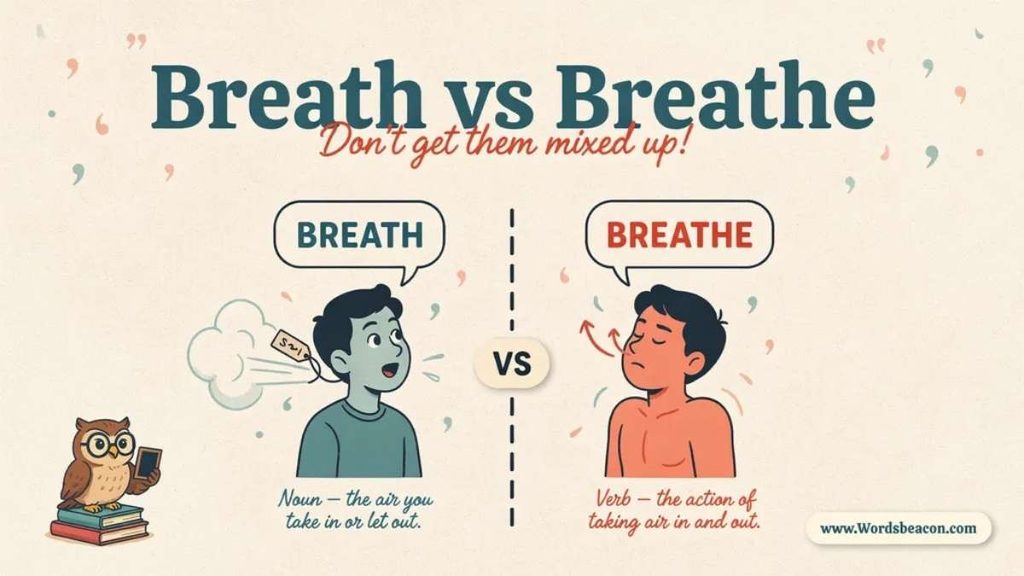
Yes, and they often do.
For example:
“Take a deep breath and breathe slowly.”
This sentence makes the difference between the two words almost impossible to miss.
Breath is the noun. Breathe is the verb.
Another example is:
“He was out of breath and needed to breathe more slowly.”
Again, both words belong because the sentence needs both a noun and a verb.
This is one of the best ways to understand the breath and breathe difference. Instead of treating the words as competitors, think of them as related words that perform different jobs.
Why the Confusion Happens
The confusion between these words comes from their close spelling and closely connected meanings.
They also share the same basic root, so their appearance naturally feels familiar. Furthermore, English spelling often contains silent letters and pronunciation patterns that can surprise learners.
The final e in breathe makes the word look like a simple spelling variation of breath. However, the pronunciation changes as well.
Breath is pronounced /breθ/.
Breathe is pronounced /briːð/.
Therefore, the difference is not simply visual. It affects sound, grammar, and meaning.
Once those three differences become familiar, the words stop feeling interchangeable.
How to Remember Breath vs Breathe
The easiest memory trick is short and practical:
Take a breath. Then breathe.
That single sentence contains the entire rule.
Breath is the noun.
Breathe is the verb.
The pronunciation can provide a second reminder. Breath has the short e sound, while breathe has the long e sound.
The final consonant also changes. Breath ends with an unvoiced th, while breathe ends with a voiced th.
Finally, pay attention to the grammar around the word. If you see “to,” “can,” “could,” “should,” or “must,” the base-form verb breathe will often fit. If you see “a,” “your,” “his,” “her,” or “one,” the noun breath may fit.
These clues work together, so you do not have to rely on spelling alone.
Learn the difference between confusing more English words
Bear vs Bare Difference and usage ?
Practice session Breath vs Breathe
Choose the correct word, breath vs breathe, to complete each sentence.
- Take a deep ______ before you start speaking.
- Try to ______ slowly and calmly.
- She was out of ______ after running up the stairs.
- I need to stop for a moment and ______.
- He held his ______ while swimming underwater.
- It was difficult to ______ in the smoky room.
- She took a quick ______ before answering the question.
- Remember to ______ deeply during the exercise.
- The cold air made his ______ visible.
- I could hardly ______ after the intense workout.
- Take another ______ and relax your shoulders.
- She stopped to ______ before continuing her speech.
- He was completely out of ______ after the race.
- The doctor told him to ______ slowly.
- Please do not hold your ______ for too long.
- She took a deep ______ and walked onto the stage.
- Fresh air made it easier to ______.
- His ______ smelled like peppermint.
- Close your eyes, take a ______, and ______ slowly.
- I cannot ______ properly when the room is too hot.
Answers
- breath
- breathe
- breath
- breathe
- breath
- breathe
- breath
- breathe
- breath
- breathe
- breath
- breathe
- breath
- breathe
- breath
- breath
- breathe
- breath
- breath, breathe
- breathe
Here’s a trusted source for clear word meanings:
FAQs
Can “breath” be used as a verb?
No. Breath is a noun, so it names the air you take in or release, or a single act of breathing. The verb is breathe. For example, “Take a breath” uses the noun, while “Try to breathe slowly” uses the verb.
Can “breathe” be used as a noun?
No. Breathe is a verb that describes the action of taking air into your lungs and releasing it. For example, “She needs to breathe slowly” uses breathe correctly.
What is the easiest way to remember breath and breathe?
Use this simple trick: “Take a breath, then breathe.” Breath is the noun, while breathe is the verb. If you can replace the word with an action, breathe is usually the right choice.
Why does “breathe” have an extra “e”?
The extra e helps distinguish breathe from breath in both spelling and pronunciation. Breath has a short e sound, while breathe has a long e sound. That small letter creates a noticeable difference.
Does the final “e” change how “breathe” sounds?
Yes. Breath is pronounced with a short e sound, similar to the vowel sound in “death.” Breathe has a long e sound, similar to the sound in “see.” The final e helps mark this pronunciation difference.
What is the difference between “breaths” and “breathes”?
Breaths is the plural of the noun breath. Breathes is the third-person singular form of the verb breathe. For example, “She took three breaths” uses breaths as a noun, while “He breathes slowly” uses breathes as a verb.
Can “breath” describe the air coming from your mouth?
Yes. Breath can refer to the air that comes from your mouth or lungs. It can also describe its smell. For example, “Her breath smelled like peppermint.”
Can “breathe” describe animals?
Yes. Breathe can describe the action performed by people or animals. For example, “Cats breathe through their lungs.” In some contexts, the word can also describe plants or materials.
Is “breathing” spelled with the final e from “breathe”?
No. The correct spelling is breathing. When breathe takes the -ing ending, the final e disappears. Therefore, “breatheing” is incorrect.
Why is “breathing” not spelled “breatheing”?
English spelling rules usually drop a silent final e before adding -ing. As a result, breathe becomes breathing. The same pattern appears in other words, such as write becoming writing.
What does “breathing room” mean?
“Breathing room” means extra space, time, or freedom to handle something without pressure. For example, “The extra week gave us some breathing room.” The phrase usually has a figurative meaning rather than referring to actual air.
What does “breathless” mean?
Breathless can mean unable to breathe normally or feeling short of breath. It can also describe someone who feels extremely excited, amazed, or surprised. For example, “The breathtaking view left everyone breathless.”
What does “breathtaking” mean?
Breathtaking usually describes something extremely beautiful, impressive, or surprising. For example, “The sunset was breathtaking.” Although the word comes from breath, it usually has a figurative meaning in everyday English.
What does “breathed” mean?
Breathed is the past tense and past participle of breathe. It describes an action that happened in the past. For example, “He breathed deeply before giving his speech.”
Are “breath” and “breathe” pronounced differently?
Yes. Breath normally has a short vowel sound and an unvoiced “th.” Breathe has a long e sound and a voiced “th.” This pronunciation difference can help you remember which word you need.
How can I hear the difference between “breath” and “breathe”?
Say the words slowly and focus on the middle vowel sound. Breath sounds like “breth,” while breathe has a longer “ee” sound. The ending also differs because the “th” in breathe is voiced.
Can “breath” refer to one inhalation or exhalation?
Yes. Breath can refer to a single act of taking in or releasing air. For example, “She took one deep breath before stepping onto the stage.”
Can “breath” have a figurative meaning?
Yes. Breath appears in many figurative expressions. For example, “The news took my breath away” means the news caused great surprise, excitement, or admiration.
Why do people confuse “breath” and “breathe”?
The two words look almost identical and relate to the same physical process. However, they have different grammatical jobs. Breath is a noun, while breathe is a verb. Remembering that difference clears up most mistakes.
Is “breathe” ever the correct spelling for the noun?
No. When you need the noun, use breath. Breathe is the verb. For example, “Take a breath” is correct, while “Take a breathe” is incorrect.
How can I tell whether I need “breath” or “breathe”?
Check whether the sentence needs a thing or an action. If you are naming a breath, use breath. If you are describing the action of taking air in and releasing it, use breathe.
What is the difference between “breath” and “breathing”?
Breath usually refers to a single breath or the air involved in breathing. Breathing refers to the ongoing process of taking air into the lungs and releasing it. For example, “Take a breath” refers to one breath, while “Slow breathing can help you relax” describes an ongoing action.
conclusion
The breath vs breathe confusion is easy to clear once you remember one simple difference: breath is a noun, and breathe is a verb. You take a breath, but you breathe in and out. That one rule can help you avoid most mistakes.
Think of it this way: breath is the thing, while breathe is the action. So, “Take a deep breath” is correct. “Take a deep breathe” is not. Likewise, “I can’t breathe” is correct because it describes the action of breathing.
The spelling may be tricky at first, but the difference does not have to be. When you see breath, think of the noun. When you see breathe, think of the action. Just remember: take a breath, then breathe. Once that clicks, this common grammar mix-up becomes much easier to handle.

Luna AJS is an experienced blogger and dedicated language enthusiast at Words Beacon. She specializes in making English grammar, spelling, vocabulary and commonly confused words easy to understand. She provides clear explanations, practical examples to help readers write with confidence.