
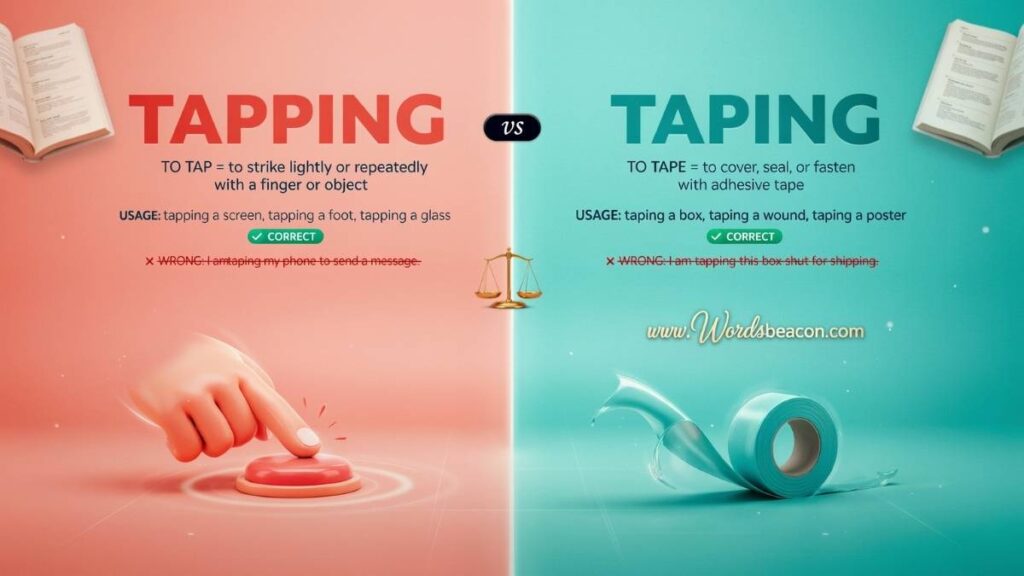
Tapping vs taping can be confusing because the words look almost identical, but they mean different things. Imagine tapping your phone screen to open an app, then taping a package shut before sending it. One involves touching, while the other involves using tape. Mix them up, and your sentence might leave readers wondering what you really mean! The good news is that choosing the right word is easier than it seems. Tapping comes from tap, while taping comes from tape. Once you understand their meanings and spelling rules, you’ll avoid this common grammar mistake and use both words confidently in everyday writing.
quick comparison
| Feature | Tapping | Taping |
|---|---|---|
| Base word | Tap | Tape |
| Meaning | Touching, striking, or operating something with a tap | Applying tape or recording something |
| Spelling rule | Double the final p before adding -ing | Drop the silent e before adding -ing |
| Example | She is tapping the screen. | He is taping the injured ankle. |
| Common contexts | Phones, doors, shoulders, music, and tools | Packaging, sports, physical therapy, and recording |
Learn how to use confusing more words correctly
Training vs Trainning which one is correct ?
What Is the Difference Between Tapping and Taping?
The main difference between tapping and taping is the action each word describes. Although they sound similar, they aren’t interchangeable.
Tapping comes from the verb tap. It usually means touching or striking something lightly, often more than once. You might tap your fingers on a desk, tap a friend on the shoulder, or tap an icon on your phone.
Taping comes from the verb tape. It means attaching or covering something with tape. It can also mean recording an event, conversation, or performance, although people often use recording instead.
Here are two simple examples:
- Tapping the box means touching or striking it lightly.
- Taping the box means securing it with adhesive tape.
The spelling reflects the difference between the base verbs. When you add -ing to tap, you double the final consonant. When you add -ing to tape, you remove the silent e.
What Does Tapping Mean?
Tapping describes the action of touching or striking something with a quick, light movement. The action may happen once or repeatedly, depending on the context.
For example, you might tap a table to get someone’s attention, tap a touchscreen to open an app, or tap your foot while listening to music.
Common Uses of Tapping
Tapping appears in everyday conversations and several specialized fields. For example, it can describe different actions depending on the situation. Moreover, its meaning may vary according to the context in which it is used.
- Touching: For instance, she is tapping her fingers against the desk.
- Technology: Similarly, tap the button to continue.
- Communication: In the same way, he tapped me on the shoulder.
- Music: Additionally, the guitarist uses finger tapping to produce notes.
- Construction and manufacturing: Likewise, a worker may use a tap to cut internal threads into a hole.
- Relaxation techniques: Furthermore, some people use tapping techniques that involve gently tapping specific points on the body.
In each case, tapping involves a form of contact. Therefore, although the specific purpose may differ, the basic action remains similar. In addition, the surrounding context helps you understand exactly what tapping means in each situation.
Tapping on Phones and Touchscreens
Smartphones have made tapping a familiar everyday action. When you tap an icon, button, or menu, you briefly touch the screen to activate a command.
For example:
- Tap the camera icon to open the camera.
- Tap the message to read it.
- Tap the screen twice to zoom in, if the app supports that gesture.
The correct spelling is tapping, not taping, because the base verb is tap.
Tapping in Music
In music, tapping can refer to striking a surface or using fingers to produce notes. Guitarists sometimes use a technique called finger tapping, in which they strike the strings against the fretboard with their fingers.
Tapping can also describe keeping time by tapping your foot or fingers along with a rhythm.
For example: The drummer was tapping a steady beat while the band warmed up.
Tapping in Everyday Expressions
The word tap also appears in expressions that don’t involve literal touching.
For example, to tap into something means to make use of a resource, skill, or opportunity.
- The company wants to tap into a new market.
- She learned how to tap into her creativity.
- The project taps into the community’s local knowledge.
When you add -ing, the correct form is tapping into.
Learn how to use confusing more words correctly
Laser vs Lazer Correct Spelling and Usage ?
What Does Taping Mean?
Taping comes from the verb tape. It usually means attaching, covering, or securing something with adhesive tape. In some contexts, it also refers to recording audio or video.
For example, you might tape a shipping box shut, tape a note to a door, or tape a sports injury for support.
Common Uses of Taping
Taping appears in several practical situations:
- Packaging: He is taping the cardboard box closed.
- Repairs: She is taping the torn paper together.
- Sports: The trainer is taping the player’s ankle.
- Physical therapy: The therapist is taping the patient’s shoulder.
- Recording: The crew is taping an interview.
- Craft projects: The children are taping paper shapes onto a poster.
The meaning depends on the context, but the spelling stays the same.
Taping With Adhesive Tape
One common use of taping involves applying adhesive tape to hold, protect, or cover something.
For example:
- I’m taping the package before shipping it.
- She is taping a reminder to the refrigerator.
- They are taping the edges before painting the wall.
In these examples, taping means using tape as a physical material.
Taping in Sports and Physical Therapy
Sports trainers and physical therapists may use tape to support an area of the body, help manage movement, or provide sensory feedback. The type of tape and the application depend on the purpose.
For example, an athlete might have their ankle taped before a game. A therapist might use kinesiology tape on a shoulder as part of a broader treatment plan.
The correct phrase is taping an ankle or taping a shoulder because the action involves applying tape.
Taping Audio and Video
Taping can also mean recording a conversation, performance, interview, or event. The term comes from older recording methods that used magnetic tape, although people still use the word when recording with digital equipment.
For example:
- The producer is taping the interview.
- They spent the afternoon taping a television segment.
- The students are taping a presentation for their class.
In modern writing, recording may sound more precise when no physical tape is involved. However, taping remains understandable and is still used in many contexts.
Learn how to use confusing more words correctly
Bony vs Boney Which Spellin Is Correct?
Why Is It Tapping but Taping? The Spelling Rules Explained
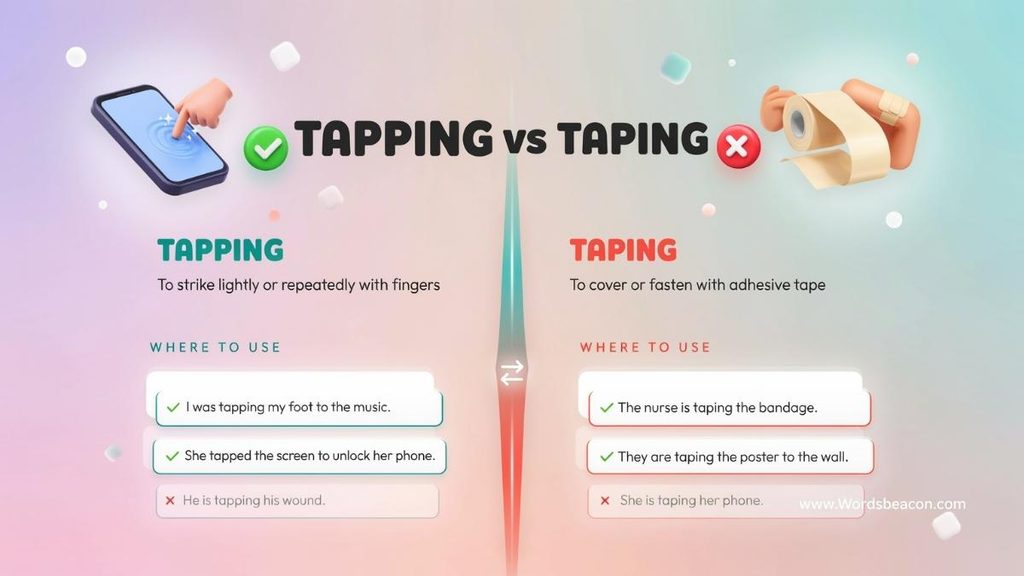
The difference between tapping vs taping becomes easier to remember when you look at the base words.
Tapping comes from tap. Taping comes from tape. Both words take the ending -ing, but they follow different spelling patterns.
Why Does Tap Become Tapping?
The word tap ends in a consonant-vowel-consonant pattern: t-a-p. When a one-syllable verb follows this pattern and receives an ending that begins with a vowel, such as -ing, the final consonant is generally doubled.
Therefore:
- Tap + ing = tapping
- Stop + ing = stopping
- Run + ing = running
- Sit + ing = sitting
The extra p keeps the spelling consistent with the short vowel sound in tap.
Writing taping when you mean repeated touching is incorrect because it changes the spelling to the form associated with tape.
Why Does Tape Become Taping?
The word tape ends with a silent e. When you add -ing to a verb that ends in a silent e, you generally drop the e.
Therefore:
- Tape + ing = taping
- Make + ing = making
- Write + ing = writing
- Dance + ing = dancing
The silent e disappears, but the long a sound remains. That’s why taping has the same long a sound as tape.
Tapping vs Taping A Spelling Comparison
| Base verb | Add -ing | Rule |
|---|---|---|
| Tap | Tapping | Double the final p |
| Tape | Taping | Drop the silent e |
| Clap | Clapping | Double the final p |
| Hope | Hoping | Drop the silent e |
| Plan | Planning | Double the final n |
| Bake | Baking | Drop the silent e |
These patterns explain why tapping and taping are both correct words, even though they follow different spelling rules.
Understand confusing English more words simply
Choosing vs Chosing Which Is Correct and Usage ?
Tapping vs Taping Examples in Sentences
Examples make the difference easier to recognize. Pay attention to the action in each sentence rather than relying on how the words look.
Examples of Tapping in a Sentence
- She is tapping her fingers on the desk while she waits.
- I kept tapping the screen, but the app wouldn’t open.
- The child was tapping on the window to get his father’s attention.
- He started tapping his foot to the beat of the song.
- The technician is tapping the metal component to check its fit.
- She is tapping into her experience to solve the problem.
- The guitarist practiced finger tapping for an hour.
- He was tapping the microphone to see whether it was working.
Each sentence uses tapping to describe a light strike, touch, or related action.
Examples of Taping in a Sentence
- She is taping the box before sending it to her cousin.
- The trainer is taping the player’s ankle before the match.
- He spent the morning taping labels onto the containers.
- The crew is taping an interview for the documentary.
- I’m taping the edges of the wall before painting.
- The therapist is taping the patient’s shoulder as part of the session.
- They are taping the poster to the classroom door.
- The production team is taping a new episode this afternoon.
Each sentence uses taping to describe applying tape or recording something.
Compare Tapping and Taping Side by Side
| Tapping | Taping |
|---|---|
| She is tapping the box to check whether it is empty. | She is taping the box shut. |
| He is tapping his wrist to get someone’s attention. | He is taping his wrist for support. |
| They are tapping the screen to select an option. | They are taping a note to the screen frame. |
| The musician is tapping a rhythm on the table. | The crew is taping the musician’s performance. |
Notice how a single letter change can shift the meaning of a sentence. When you know what action you want to describe, choosing the correct spelling becomes much easier.
Fix common more word mistakes in English
Encorporate vs Incorporate correct Usage
Tapping vs Taping the Wrist, Shoulder, and Knee
Body-related examples often cause confusion because both words can appear in similar sentences. The key is to identify what the person is doing.
Tapping the Wrist vs Taping the Wrist
Tapping the wrist means touching or striking it lightly.
Example: She was tapping her wrist to draw attention to her watch.
Taping the wrist means applying tape to the area.
Example: The trainer was taping the athlete’s wrist before practice.
The first action involves contact with the wrist. The second involves putting tape on it.
Tapping the Shoulder vs Taping the Shoulder
Tapping the shoulder usually means touching someone lightly to get their attention.
Example: He was tapping his colleague on the shoulder.
Taping the shoulder means applying tape to the shoulder, perhaps during a sports or therapy session.
Example: The therapist was taping the patient’s shoulder according to the treatment plan.
Tapping the Knee vs Taping the Knee
Tapping the knee means touching it repeatedly or lightly striking it.
Example: She was tapping her knee nervously during the meeting.
Taping the knee means applying tape to the knee area.
Example: The athletic trainer was taping the player’s knee before the game.
These distinctions apply to other body parts, too. You can tap your elbow or tape your elbow, but the two actions are different.
Fix common more word mistakes in English
Developed vs Developped Which Spelling Is Correct?
Common Mistakes When Using Tapping and Taping
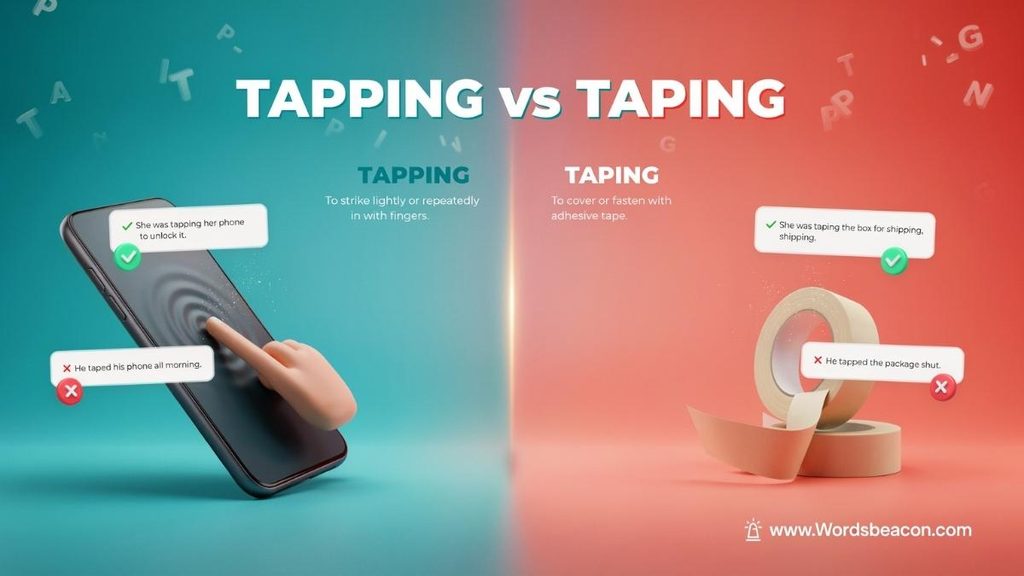
Even experienced writers sometimes mix up these words. Fortunately, a few simple checks can prevent most mistakes.
Writing Tapeing Instead of Taping
Tapeing is a common spelling error. When a verb ends in a silent e, you usually remove that e before adding -ing.
Incorrect: She is tapeing the package.
Correct: She is taping the package.
Remember that the silent e disappears in taping.
Writing Taping When You Mean Tapping
This mistake changes the meaning of the sentence.
Incorrect: He was taping his fingers on the desk.
Correct: He was tapping his fingers on the desk.
If the person is repeatedly touching or striking the desk, use tapping. If the person is attaching something with tape, use taping.
Doubling the Final Letter Incorrectly
Some writers double the final consonant in both words.
Incorrect: He is tapingg the box.
Correct: He is taping the box.
The spelling rule depends on the base word. Tap becomes tapping, while tape becomes taping.
Choosing the Word by Sound Alone
Tapping and taping have different vowel sounds, but spelling by sound alone can still lead to mistakes. Instead, consider the meaning and identify the base verb.
Ask yourself:
- Am I describing a light touch or strike? Use tapping.
- Am I describing the use of tape? Use taping.
- Am I describing a recording session? Taping may fit, although recording is often clearer.
Assuming One Word Is Incorrect
Both tapping and taping are standard English words. Neither is inherently wrong. The error occurs when you use one word in a sentence that calls for the other.
Fix common more word mistakes in English
Wholly vs Wholey correct Spelling and usage ?
Tapping vs Taping in Grammar
Understanding the grammar behind these words helps you use them correctly in different sentence structures.
Tapping and Taping as Present Participles
Both words can function as present participles. They often appear with a form of the verb be to describe an action in progress.
Examples:
- She is tapping the table.
- He is taping the parcel.
- They were tapping their feet.
- The crew was taping the performance.
In each sentence, the -ing form helps create a continuous verb tense.
Tapping and Taping as Gerunds
An -ing word can also function as a noun. In this role, it is called a gerund.
Examples:
- Tapping can help you navigate the touchscreen.
- Taping the package carefully prevents it from opening during transit.
- Finger tapping requires coordination.
- Athletic taping is sometimes used in sports settings.
The word’s function depends on how it appears in the sentence, not simply on its ending.
Tapped vs Taped
The difference also appears in the past tense.
| Present form | Past tense | Meaning |
|---|---|---|
| Tap | Tapped | Touched or struck lightly |
| Tape | Taped | Applied tape or recorded something |
Examples:
- She tapped the screen once.
- She taped the label to the box.
- He tapped his fingers on the table.
- He taped the interview yesterday.
Both past-tense forms double the final consonant before adding -ed. However, the silent e in tape remains when adding -d, giving taped.
Tap vs Tape Understanding the Base Words
The easiest way to choose between tapping and taping is to identify the base verb first.
Tap usually describes a light touch or strike. Tape usually describes the material used to attach or cover something, or the act of recording.
For example:
- Tap the icon to open the menu.
- Use tape to seal the package.
- Stop tapping the desk.
- Start taping the edges before painting.
Once the base verb is clear, the correct -ing form follows naturally.
How to Pronounce Tapping and Taping
Tapping and taping don’t sound exactly alike. The main difference lies in the vowel sound.
Tapping has a short a sound, like the vowel in cat. Taping has a long a sound, similar to the vowel in day.
In standard American English, tapping is commonly pronounced /ˈtæpɪŋ/, while taping is pronounced /ˈteɪpɪŋ/.
Both words have two syllables and stress the first syllable. The vowel sound helps distinguish them when speaking, although the surrounding sentence also provides useful context.
For example, compare these sentences aloud:
- She is tapping the screen.
- She is taping the screen protector into place.
The first describes touching the screen. The second describes attaching something with tape, although a more natural phrase may be applying a screen protector.
Understand confusing English more words simply
Using vs Useing Correct Spelling and usage ?
Tapping vs Taping in American and British English
The spelling difference between tapping and taping is consistent in standard American and British English. Neither variety uses a different spelling rule for these two words.
Examples:
- American English: She is tapping her phone.
- British English: She is tapping her phone.
- American English: He is taping the package.
- British English: He is taping the package.
Vocabulary preferences can vary by region and context, particularly for recording and sports terminology. However, the basic spellings remain the same.
Easy Ways to Remember Tapping vs Taping
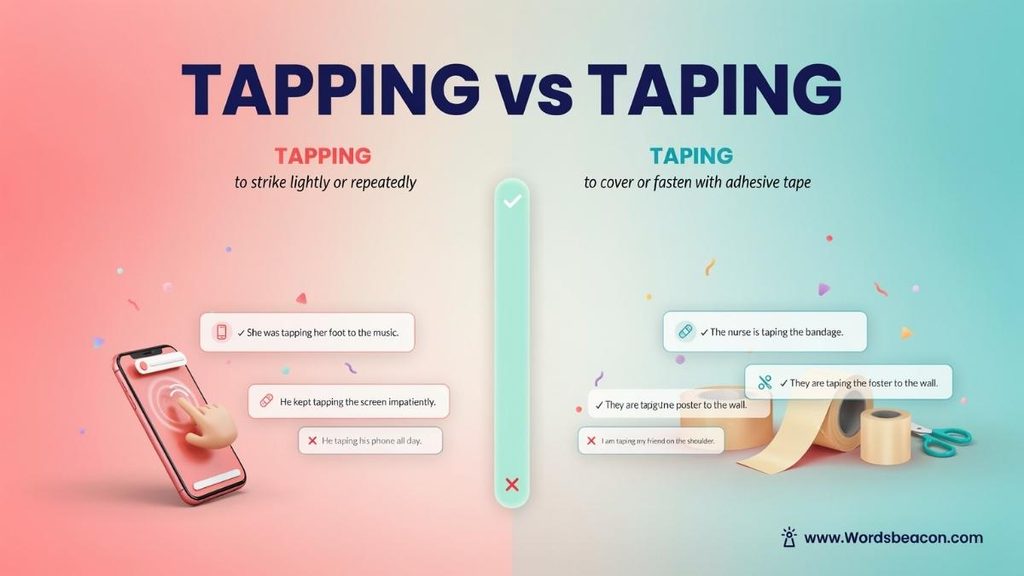
If you often confuse these words, use a simple memory trick.
Remember the Double P in Tapping
Tap has one p. When you add -ing, double it to form tapping.
Think of the repeated p as a reminder of repeated contact. This isn’t the technical reason for the spelling, but it can help you remember the word.
Example: She kept tapping her fingers on the desk.
Remember That Taping Loses the E
Tape ends in a silent e. Remove that e before adding -ing.
Tape + ing = taping.
Example: He is taping the package shut.
Use a Three-Step Check
When you’re unsure whether to write tapping or taping, follow these steps:
- Identify the action in your sentence.
- Choose the base verb: tap or tape.
- Apply the correct spelling rule.
For example, if you’re describing someone touching a phone screen, choose tap and write tapping. If you’re describing someone attaching a label with adhesive tape, choose tape and write taping.
This method works in everyday writing, school assignments, workplace instructions, and professional communication.
Understand confusing English more words simply
Chef vs Cheff Which Is Correct and usage ?
Practice Session Tapping vs Taping
Complete each sentence with the correct word: tapping vs taping.
- She was ______ her fingers on the table while waiting for her coffee.
- The worker is ______ the cardboard box shut.
- Stop ______ the phone screen so quickly.
- The trainer is ______ the athlete’s ankle before the match.
- He kept ______ his foot to the rhythm of the music.
- The crew is ______ an interview for the documentary.
- I noticed him ______ his pencil against the desk.
- They are ______ the poster to the classroom wall.
- She was ______ her knee nervously during the presentation.
- My brother is ______ the gift box before wrapping it.
- The child started ______ the window to get his mother’s attention.
- The production team spent the afternoon ______ a television episode.
- The guitarist practiced finger ______ during rehearsal.
- We are ______ the edges of the wall before painting.
- He was ______ the microphone to check whether it worked.
- The therapist is ______ the patient’s shoulder as part of the session.
- She kept ______ the screen, but the app wouldn’t open.
- The students are ______ their notes to the front of their folders.
- The drummer was ______ a steady beat on the table.
- Dad is ______ the broken paper together with clear adhesive tape.
Answers
- tapping
- taping
- tapping
- taping
- tapping
- taping
- tapping
- taping
- tapping
- taping
- tapping
- taping
- tapping
- taping
- tapping
- taping
- tapping
- taping
- tapping
- taping
Here’s a trusted source for clear word meanings:
FAQs
What Are the Downsides of Taping?
Taping can cause skin irritation, itching, redness, or discomfort, especially if the tape is too tight or removed incorrectly. Some people also experience allergic reactions to adhesives. The risks depend on the type of tape, how you apply it, and your skin’s sensitivity.
What Is the Difference Between Tapped and Taped?
Tapped is the past tense of tap and means touched or struck lightly. Taped is the past tense of tape and means attached something with tape or recorded an event.
Examples:
- She tapped the desk to get everyone’s attention.
- He taped the label to the package.
What Is Tapping in Physical Therapy?
In physical therapy, tapping can refer to light, repeated contact used during certain assessment or treatment techniques. Its purpose depends on the method and the patient’s needs. Tapping is different from kinesiology taping, which involves applying specialized adhesive tape to the skin.
What Does Taping Someone Mean?
Taping someone usually means applying adhesive or athletic tape to their body. For example, a trainer might tape an athlete’s ankle before a game. In a recording context, taping someone can also mean recording them on audio or video.
Does Taping Actually Help?
Taping may help with certain goals, such as supporting an injured joint, providing sensory feedback, or temporarily easing discomfort during movement. However, the results vary by condition and tape type. Taping should complement appropriate care rather than replace a professional assessment when one is needed.
Who Should Avoid Kinesiology Tape?
People with adhesive allergies, open wounds, skin infections, or damaged skin should avoid applying kinesiology tape to affected areas unless a healthcare professional advises otherwise. People with fragile skin or reduced sensation should also seek professional guidance before using it.
What Does Taping Mean in Slang?
The meaning of taping in slang depends on the context. It may refer informally to recording someone or something, although some communities use the term in more specialized ways. Look at the surrounding conversation to determine the intended meaning.
Is Taping Good for Back Pain?
Kinesiology or therapeutic taping may provide temporary comfort for some people with back pain, but research on its effectiveness remains mixed. Taping does not address every underlying cause of pain. Seek medical advice if your back pain persists, worsens, or interferes with daily activities.
Which Tape Is Used for Taping?
The best tape depends on the task. Athletic tape is commonly used for sports support, while kinesiology tape is elastic and designed to move with the body. Medical adhesive tape helps secure dressings, whereas clear adhesive tape, masking tape, and packing tape serve household and packaging needs.
Is KT Tape a Placebo?
KT Tape is a brand of kinesiology tape, not a placebo itself. However, research on kinesiology taping has produced mixed results. Some people report improvements in comfort or movement, but the benefits may be modest and can vary by condition. It should not replace appropriate medical treatment.
What Are the Three Types of Tapping?
There is no single, universally accepted classification of three tapping types. In emotional wellness practices, tapping may refer to methods such as Emotional Freedom Techniques (EFT), which involve tapping specific body points while focusing on a concern. Other fields use the term for different techniques, so the context matters.
How Often Should You Do Tapping?
The recommended frequency depends on the technique and your reason for using it. Emotional wellness exercises may follow a different routine from tapping techniques used in physical therapy. If you’re using tapping as part of a treatment plan, follow the instructions of a qualified professional.
What Does “Tapping a Girl” Mean?
The phrase can have different meanings depending on the context. Literally, it may mean lightly touching a girl, such as tapping her shoulder to get her attention. In some slang or dating conversations, it can carry a sexual meaning. The surrounding conversation usually clarifies the intended use.
Is It Taped Out or Tapped Out?
Both expressions exist, but they have different meanings. Tapped out commonly means exhausted, out of money, or unable to continue. Taped out is less common and may describe an area marked or outlined with tape.
Examples:
- I’m completely tapped out after a long shift.
- The workers taped out the area before starting construction.
What Exactly Is a Tap?
A tap is a light touch or strike, often made with a finger or another object. As a verb, tap means to touch or strike lightly. It can also mean making use of a resource, as in “tap into your experience.” In manufacturing, a tap is a tool used to cut internal threads into a hole.
Does Taping Reduce Pain?
Taping may provide short-term pain relief for some people, depending on the condition and how the tape is applied. However, it does not work equally well for everyone, and research findings vary. If pain persists or limits your daily activities, consult a qualified healthcare professional.
When Should You Avoid Kinesiology Tape?
Avoid applying kinesiology tape over open wounds, infected skin, or areas where the adhesive causes an allergic reaction. Remove the tape if you experience significant itching, burning, swelling, or redness. If you have fragile skin, circulation problems, or reduced sensation, ask a healthcare professional whether taping is suitable for you.
Understand confusing English more words simply
Planing vs Planning Spelling Rules, and Common Mistakes
Conclusion
Tapping vs taping can be confusing because the words look almost the same, but their meanings are different. Tapping means touching or striking something lightly, while taping means attaching something with tape or recording an event. For example, you tap your phone screen to open an app, but you tape a box to keep it closed. The spelling is easy to remember, too: tap becomes tapping with a double p, while tape becomes taping by dropping the silent e. Think about the action before choosing the word, and you’ll get it right. After all, you want to tap the screen, not accidentally tape your fingers together!

Luna AJS is an experienced blogger and dedicated language enthusiast at Words Beacon. She specializes in making English grammar, spelling, vocabulary and commonly confused words easy to understand. She provides clear explanations, practical examples to help readers write with confidence.