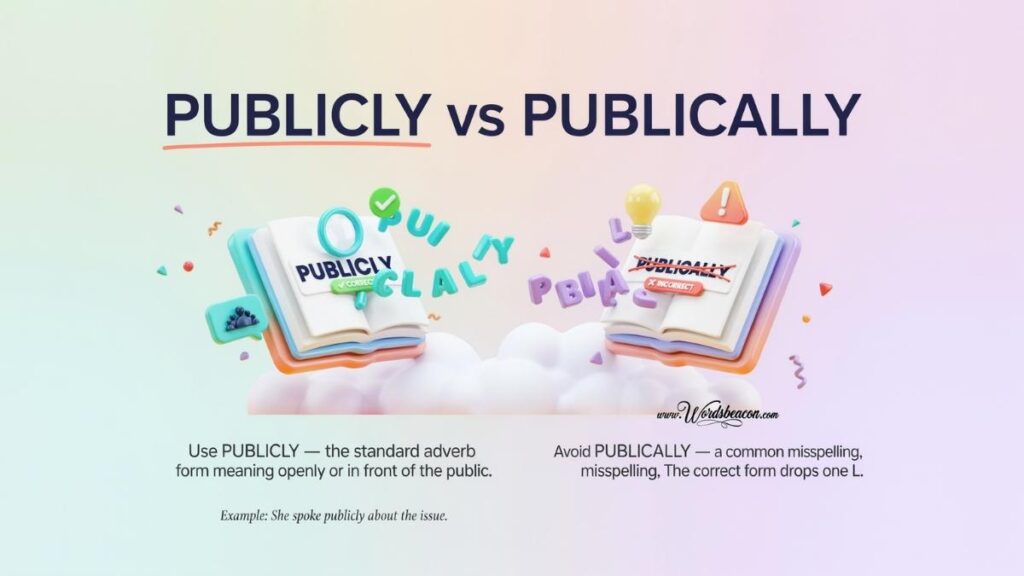
The difference between publicly vs publically can be confusing. Both spellings look correct at first, so you might wonder whether that extra “al” really matters. English spelling has plenty of surprises, but this one is easy to solve! “Publicly” is the standard spelling in both American and British English. Although “publically” appears in some dictionaries, it’s less common and best avoided in formal writing. In this article, you’ll learn what these words mean, why “publicly” is preferred, and how to use the correct spelling in your sentences. By the end, you’ll know which version to choose without second-guessing yourself.
quick comprasion
| Word | Meaning | Usage |
|---|---|---|
| Publicly | Openly, in public, or in connection with public access or funding | Standard and preferred spelling |
| Publically | Generally carries the same meaning as publicly | Rare variant that many editors avoid |
Learn how to use confusing more words correctly
Preform vs Perform which one is correct ?
Publicly vs Publically The Quick Answer
The main difference between publicly vs publically concerns spelling rather than meaning. Both forms can communicate the idea of doing something openly or in a public setting. Nevertheless, publicly is the standard form and the better choice for most situations.
For example, you might write:
- The company publicly announced its new policy.
- The mayor publicly apologized for the delay.
- The athlete publicly thanked her coach.
- The research received publicly funded support.
In each sentence, publicly is the recommended spelling. Although publically appears in some dictionaries, it is much less widely preferred. Consequently, using publicly can help you avoid unnecessary corrections when writing for teachers, editors, employers, or a general audience.
In short, remember this simple rule: when you need this adverb, choose publicly.
What Does Publicly Mean?
Publicly is an adverb that describes how, where, or under what circumstances someone does something. In general, it means openly, in front of other people, or without keeping something secret. Additionally, it can describe activities connected with public institutions, government funding, public ownership, or access for the general population.
Publicly Means Openly or in Front of Others
When someone speaks, acts, or makes a statement publicly, other people can witness the action or learn about it. In other words, the action isn’t limited to a private conversation.
For example:
- The author publicly discussed the inspiration for her novel.
- He publicly admitted that he had made a mistake.
- The organization publicly supported the proposed changes.
- The singer publicly thanked her fans after the concert.
In these examples, publicly emphasizes openness. Rather than keeping the action private, the person or organization makes it known to others.
Consider an apology. If you apologize privately to a colleague, only a small group may know about it. However, if you apologize publicly during a company meeting, a much larger audience can hear your words. The basic action remains the same, but the audience changes.
Publicly Can Describe Government Funding or Ownership
Publicly also appears in expressions related to public resources, government support, and access. In these cases, the word doesn’t necessarily mean that someone performs an action in front of a crowd. Instead, it explains the connection between a resource and the public.
For example:
- The road is publicly funded.
- The records are publicly available.
- The library is publicly owned.
- The research received publicly funded support.
These phrases describe different relationships with the public. A publicly funded project receives financial support from public sources, whereas publicly available records can be accessed by members of the public.
Therefore, when interpreting publicly, always consider the surrounding words. The context helps you determine whether the sentence refers to openness, access, funding, or ownership.
Common Expressions With Publicly
You will frequently encounter publicly in the following expressions:
- Publicly available: accessible to the public.
- Publicly funded: paid for using public money.
- Publicly owned: owned by a government or public body.
- Publicly traded: bought and sold on a public stock exchange.
- Publicly announced: shared openly with an audience.
- Publicly acknowledged: recognized or admitted openly.
- Publicly criticized: criticized where other people can see or hear it.
For instance, a company might make its annual report publicly available. Similarly, a hospital may receive publicly funded support. Meanwhile, an organization might publicly acknowledge the contributions of its volunteers.
As you can see, publicly works in several contexts. Learning these common expressions will help you recognize the word and use it naturally.
Learn how to use confusing more words correctly
Tapping vs Taping difference and usage ?
What Does Publically Mean?
Publically is a rare spelling variant of publicly. Some dictionaries include it, although its status varies from one reference source to another. For example, some references label it nonstandard, while others recognize it as an alternative spelling.
Despite that difference in spelling status, publically generally carries the same meaning as publicly. The main issue, therefore, is not what the word means but whether it is the best spelling for your audience.
Compare these sentences:
- Less preferred: The company publically announced its plans.
- Recommended: The company publicly announced its plans.
Both sentences communicate the same general idea. However, publicly is more familiar to most readers and is the safer choice in edited English.
Why Do People Write Publically?
The spelling publically seems reasonable because English often forms adverbs by adding “-ally” to adjectives ending in “-ic.” As a result, writers may assume that public should follow the same pattern.
Consider these examples:
- Basic becomes basically.
- Automatic becomes automatically.
- Dramatic becomes dramatically.
- Historic becomes historically.
Because these words follow a familiar pattern, publically may look natural at first. Nevertheless, English has exceptions, and publicly is one of them.
Therefore, even if publically seems logical, that doesn’t make it the preferred spelling. When in doubt, use publicly.
Is Publically Always Wrong?
The answer depends on how you define an accepted spelling. Some established dictionaries recognize publically as a variant, so it would be too simplistic to claim that the spelling never appears in accepted references.
However, recognition as a variant doesn’t mean that every editor, teacher, or publication will accept it. For example, the American Heritage Dictionary labels publically a nonstandard variant, while Collins recognizes it as a variant spelling and notes its disputed status in American English.
Consequently, the most practical recommendation is straightforward: use publicly unless you have a specific reason to preserve the alternative form.
Learn how to use confusing more words correctly
Wholly vs Wholey correct Spelling and usage ?
Why Is Publicly Spelled With One A?
To understand the spelling, it helps to look at how English forms adverbs. In many cases, an adverb forms by adding “-ly” to an adjective. For instance, slow becomes slowly, clear becomes clearly, and quiet becomes quietly.
Public follows this pattern:
Public + ly = publicly
Therefore, the standard spelling contains “cly” at the end rather than “cally.” Although publicly might look unusual beside words such as automatically, it is a long-established form.
The Exception to the “-ically” Pattern
Many adjectives ending in “-ic” form adverbs with “-ically.” This familiar pattern explains why writers sometimes add an extra “a” to publicly.
| Adjective | Standard adverb |
|---|---|
| Basic | Basically |
| Automatic | Automatically |
| Historic | Historically |
| Dramatic | Dramatically |
| Public | Publicly |
Notice the final row. Unlike the other examples, public forms its standard adverb without an additional “a.” Consequently, copying the spelling pattern from automatically or historically can lead to a mistake.
However, you don’t need to memorize a long list of spelling rules. Instead, remember the word as a special case: public becomes publicly.
A Simple Memory Trick
Here’s an easy way to remember the correct spelling:
Public + ly = publicly.
In other words, add “-ly” directly to public. You don’t need an extra “a” in the middle.
You can also remember the phrase “Speak publicly.” Both words describe an action that happens openly, and the spelling stays simple.
Whenever you feel tempted to write publically, pause for a moment and recall this formula. With practice, the standard spelling will become much more familiar.
Fix common more word mistakes in English
Training vs Trainning which one is correct ?
Publicly vs Publically in Example Sentences
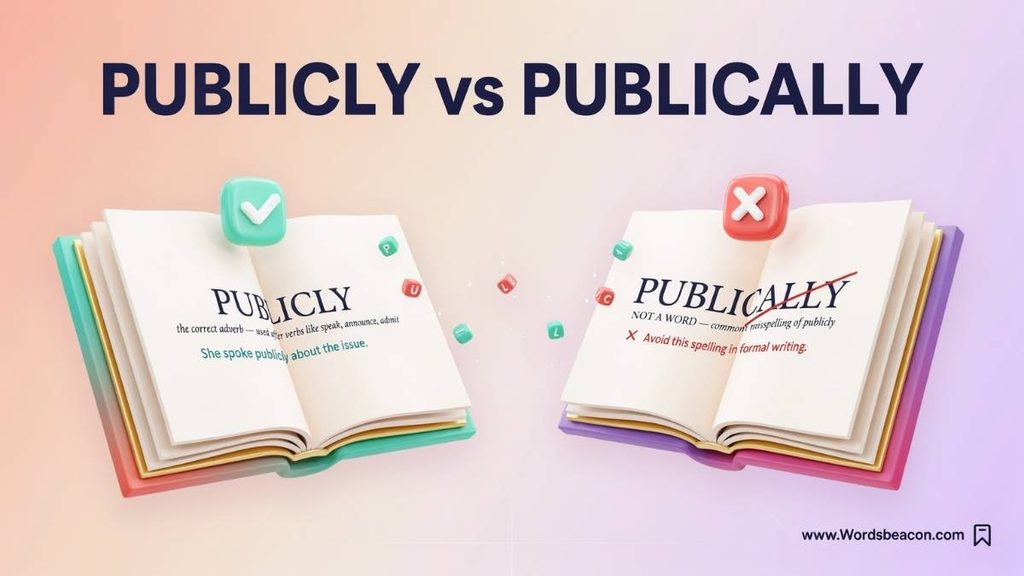
Examples make spelling rules easier to understand because they show how a word works in real situations. Therefore, let’s look at publicly in everyday conversation, business writing, academic work, news reporting, and social media.
Everyday Conversation
In everyday communication, publicly often describes something a person says or does where others can see or hear it.
Examples:
- She publicly thanked her friends for their help.
- He publicly admitted that he had forgotten the appointment.
- The teacher publicly praised the students’ efforts.
In each sentence, publicly tells readers that the action wasn’t limited to a private setting. As a result, the word adds useful context without making the sentence complicated.
Business and Workplace Writing
Publicly is also common in professional communication. Companies and organizations use it when discussing announcements, policies, results, or responses.
Examples:
- The company publicly announced its expansion plans.
- The executive publicly addressed customer complaints.
- The organization publicly confirmed the new policy.
For example, a company might discuss a proposal internally before announcing it publicly. This distinction matters because an internal discussion and a public announcement reach different audiences.
Therefore, publicly can help make business communication more precise.
Academic and Formal Writing
Academic writers use publicly when describing presentations, research findings, and access to information.
Examples:
- The findings were made publicly available.
- The researcher publicly presented the results.
- The report examines publicly funded education programs.
Moreover, publicly works naturally in formal writing because it communicates a clear meaning without adding unnecessary words.
If you’re preparing a research paper, university assignment, or formal report, publicly is the appropriate choice.
News and Media Writing
News articles often use publicly to distinguish an open statement from a private conversation or internal discussion.
Examples:
- The mayor publicly responded to the allegations.
- The agency publicly released its annual report.
- The candidate publicly defended the proposal.
Similarly, journalists may describe an official as publicly supporting a policy while privately expressing concerns about it. In this context, publicly helps readers understand the difference between what someone says openly and what happens behind closed doors.
Social Media and Online Communication
Publicly is equally useful in online communication. Social media posts, company announcements, and public statements often involve information shared with a broad audience.
Examples:
- The creator publicly apologized for the misleading post.
- The company publicly responded to customer feedback.
- The group publicly announced its plans on its official account.
Even though social media writing is often informal, publicly remains the preferred spelling. Therefore, a quick spelling check can help prevent the same mistake from appearing in posts, captions, and announcements.
Fix common more word mistakes in English
Laser vs Lazer Correct Spelling and Usage ?
Publicly vs Publically in Different Types of Writing
The spelling you choose can affect how polished your writing appears. Although readers may understand both forms, publicly is the more widely preferred option.
| Writing situation | Recommended form | Example |
|---|---|---|
| School assignments | Publicly | The student publicly presented the project. |
| Business reports | Publicly | The company publicly disclosed its results. |
| Academic papers | Publicly | The data were made publicly available. |
| News articles | Publicly | The official publicly addressed the issue. |
| Social media posts | Publicly | The brand publicly thanked its customers. |
| Casual messages | Publicly | She publicly shared the announcement. |
As the table shows, you don’t need to change the spelling according to the situation. Instead, use publicly consistently across formal and informal writing.
Furthermore, if you follow an editorial style guide, check its preferred dictionary. That extra step can be useful when preparing work for a publication or organization with specific spelling rules.
Is Publicly Different in American and British English?
No major spelling difference separates American and British English in this case. Publicly is the standard and preferred spelling in both varieties. Likewise, it is the safer choice in Canadian and Australian English.
Although some dictionaries recognize publically as a variant, publicly remains the more familiar option for international communication.
American English
In American English, publicly is the usual spelling in professional, academic, and everyday writing.
Example: The governor publicly announced the new transportation plan.
Although some American references mention publically, they may label it disputed or nonstandard. Consequently, publicly is the better option when writing for a broad American audience.
British English
British English also commonly uses publicly.
Example: The organization publicly supported the community project.
Some British dictionary entries recognize publically as a variant. Nevertheless, publicly remains the preferred form in most edited writing.
Canadian and Australian English
Canadian and Australian writers also generally use publicly.
Example: The council publicly released its annual report.
Therefore, if you write for readers in several English-speaking countries, publicly offers a consistent and widely recognized choice.
Fix common more word mistakes in English
Using vs Useing Correct Spelling and usage ?
Publicly vs Public Understanding the Grammar
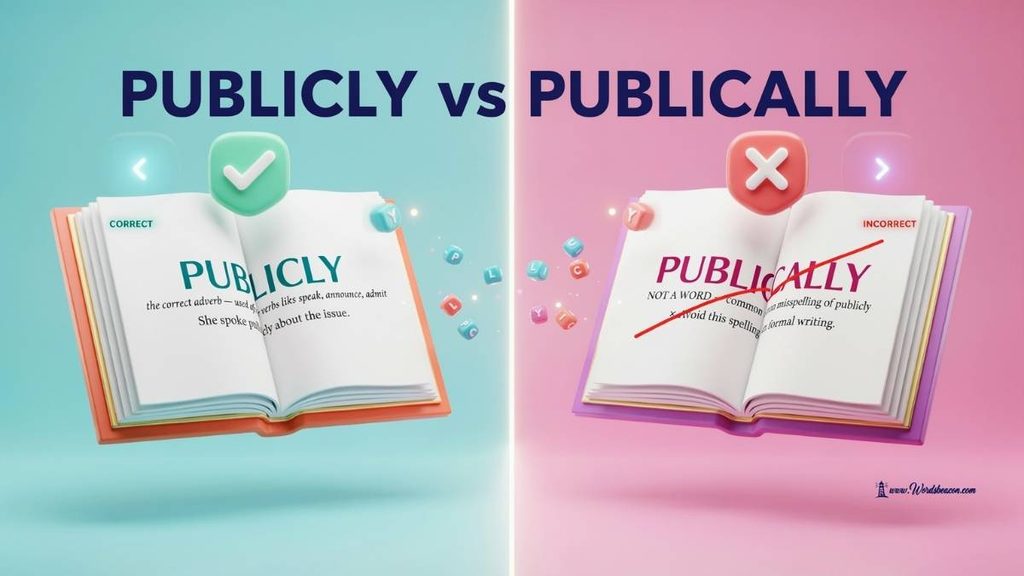
The Publicly and public are related words, but they perform different grammatical jobs. Understanding this distinction can help you avoid another common mistake.
Public Is an Adjective
An adjective describes a noun. Public can describe something that belongs to, serves, or concerns the community.
Examples:
- The public library opens at nine.
- The company held a public meeting.
- The public announcement attracted attention.
- The park is open to the public.
In these sentences, public describes a library, meeting, or announcement. In the final example, the public refers to people in general.
Publicly Is an Adverb
An adverb can describe a verb, an adjective, or another adverb. Publicly often explains how someone performs an action or how a statement is made.
Examples:
- The director publicly praised the team.
- The company publicly shared its findings.
- The report is publicly available.
- The candidate publicly supported the proposal.
In each example, publicly describes an action or condition. Therefore, it tells readers that something happens openly or has a connection to public access.
Public vs Publicly A Quick Comparison
| Word | Part of speech | Example |
|---|---|---|
| Public | Adjective or noun | The public meeting starts soon. |
| Publicly | Adverb | The manager publicly explained the decision. |
A useful way to check your choice is to ask what the word describes. If you need an adjective before a noun, public may fit. If you need an adverb to describe an action, publicly may be the right choice.
However, always consider the full sentence because public can also function as a noun.
Fix common more word mistakes in English
Bony vs Boney Which Spellin Is Correct?
Common Mistakes With Publicly vs Publically
Even careful writers can make spelling mistakes when a word breaks a familiar pattern. Fortunately, recognizing a few common errors makes them easier to avoid.
Adding an Extra A
Less preferred: The company publically announced the results.
Recommended: The company publicly announced the results.
The extra “a” likely comes from the familiar “-ically” pattern. However, publicly follows a different spelling pattern, so the additional letter isn’t needed.
Using Publicly Instead of Public
Incorrect: The publicly meeting begins at noon.
Correct: The public meeting begins at noon.
In this case, public describes the meeting. Publicly doesn’t fit naturally because the sentence needs an adjective rather than an adverb.
Using Public Instead of Publicly
Incorrect: The manager public apologized for the delay.
Correct: The manager publicly apologized for the delay.
Here, apologized describes an action. Therefore, the sentence needs the adverb publicly to explain how the manager apologized.
Assuming Both Spellings Are Equally Preferred
Some dictionaries list publically as a variant. Nevertheless, individual editors, teachers, and publications may prefer only publicly.
For that reason, don’t assume that dictionary recognition makes both forms equally suitable in every setting. If you want clear, professional writing, choose publicly.
Publicly vs Publically Synonyms and Related Words
Sometimes, another word may express your meaning more precisely. Publicly is useful, but it isn’t always the only option.
| Alternative | Meaning | Example |
|---|---|---|
| Openly | Without hiding something | She openly discussed the problem. |
| In public | Where other people can see or hear | He spoke in public for the first time. |
| Officially | Through a formal or authorized statement | The agency officially announced the decision. |
| Transparently | In a clear and open way | The organization handled the process transparently. |
| Publicly available | Accessible to the public | The documents are publicly available. |
| Privately | Away from public view or an audience | They discussed the issue privately. |
Although these words are related, they aren’t always interchangeable. For example, openly suggests a lack of secrecy, whereas officially emphasizes authority or formal approval. Similarly, transparently suggests clarity and openness, while privately often expresses the opposite of publicly.
Therefore, choose the word that best matches your intended meaning rather than replacing publicly simply to avoid repetition.
Understand confusing English more words simply
Encorporate vs Incorporate correct Usage
How to Edit Publicly vs Publically in Your Writing
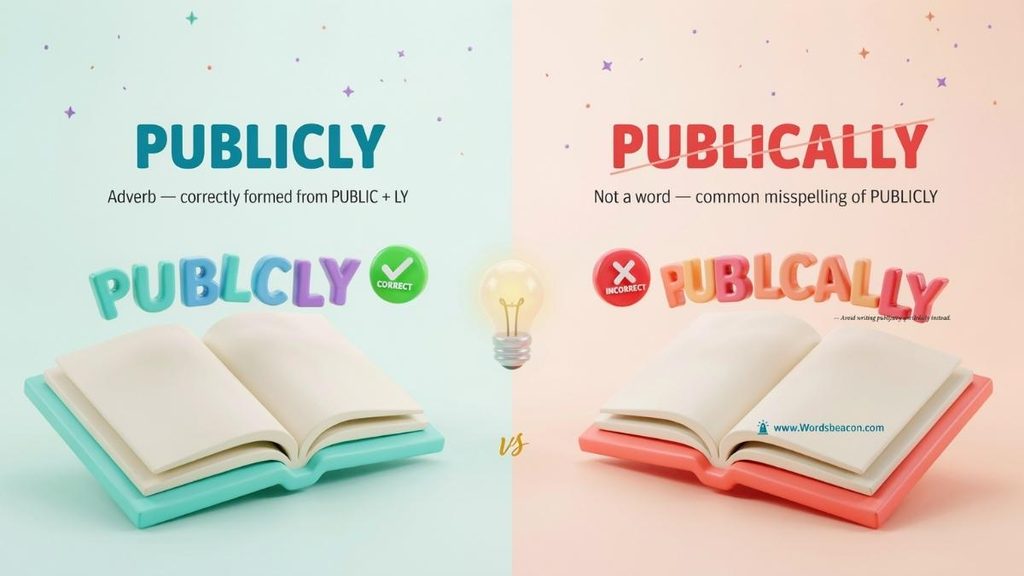
A quick editing routine can help you catch this spelling issue before you submit an assignment, publish an article, or send a business email.
Search for Both Spellings
First, use your document’s search function to look for publicly vs publically. If you find publically, review each instance and consider changing it to publicly.
This step is particularly useful in longer documents. After all, a spelling mistake can appear several times without attracting your attention.
Check the Sentence Meaning
Next, make sure you’re using an adverb when the sentence needs one.
For example:
- The company publicly announced the decision.
- The decision was made public.
- The public announcement appeared on Monday.
Although these sentences use related words, each follows a different grammatical structure. Consequently, checking the entire sentence is more reliable than looking at one word in isolation.
Follow Your Style Guide
If you write for a company, school, publication, or academic institution, follow its preferred dictionary or style guide. Some references recognize publically as a variant, while many editors prefer publicly.
In addition, consistency matters. Avoid switching between the two spellings within the same document unless you have a specific editorial reason.
Read the Sentence Aloud
Finally, read the sentence aloud to check its grammar and flow. This technique can help you catch awkward phrasing, missing words, and unclear meaning.
However, pronunciation alone won’t reliably distinguish publicly from publically because the two spellings are generally pronounced the same way. Therefore, use reading aloud as a general editing technique rather than your only spelling test.
Understand confusing English more words simply
Chef vs Cheff Which Is Correct and usage ?
Practice session Publicly vs Publically
Fill in each blank with the correct spelling: publicly vs publically. Choose the standard and preferred form in each sentence. The answers are provided at the end.
- The company ______ announced its plans to expand.
- The mayor ______ apologized for the delay.
- The report is ______ available to everyone.
- The athlete ______ thanked her supporters.
- The school ______ recognized the students’ achievements.
- The organization ______ supported the new policy.
- The manager ______ addressed the customers’ concerns.
- The government ______ released the report.
- The singer ______ discussed her latest album.
- The charity ______ acknowledged its donors.
- The director ______ explained the decision.
- The business ______ disclosed its financial results.
- The scientist ______ presented the research findings.
- The council ______ announced the new regulations.
- The candidate ______ defended her position.
- The company made the documents ______ available.
- The spokesperson ______ confirmed the announcement.
- The team ______ celebrated its victory.
- The organization received ______ funded support.
- The author ______ shared her opinion about the issue.
Answers
- publicly
- publicly
- publicly
- publicly
- publicly
- publicly
- publicly
- publicly
- publicly
- publicly
- publicly
- publicly
- publicly
- publicly
- publicly
- publicly
- publicly
- publicly
- publicly
- publicly
Here’s a trusted source for clear word meanings:
FAQs
Is “publically” grammatically correct?
“Publically” is recognized by some dictionaries as a variant of “publicly.” However, “publicly” is the standard spelling and the preferred choice in modern English. For formal, academic, and professional writing, use “publicly.”
Why is “publicly” preferred over “publically”?
Although many adjectives ending in “-ic” form adverbs with “-ically,” “public” follows a different pattern. Adding “-ly” produces “publicly,” not “publically.” This is the established spelling in standard English.
Can “publically” appear in published writing?
Yes. You may encounter “publically” in older texts, online articles, or other published material. However, its use does not make it the preferred spelling. Choose “publicly” in your own writing to follow standard usage.
What does “publically” mean in a sentence?
“Publically” generally has the same meaning as “publicly.” It describes an action performed openly, in front of others, or in a way that people can see or know about.
For example, “The company publically announced its decision” uses the less-preferred spelling. The standard version is “The company publicly announced its decision.”
Is “publicly” the correct spelling in American English?
Yes. “Publicly” is the standard spelling in American English. Although some dictionaries recognize “publically” as a variant, it is less common and may be considered nonstandard. Use “publicly” in school assignments, business documents, and formal publications.
Is “publicly vs publically” preferred in British English?
“Publicly” is also the preferred spelling in British English. The standard form remains the same in American and British English, so you can use “publicly” confidently in either variety.
What is the adverb form of “public”?
The adverb form of “public” is “publicly.” It describes an action performed openly, in front of other people, or in a way that is accessible to the public.
Examples:
- The mayor publicly supported the proposal.
- The museum publicly displayed the collection.
- The organization publicly announced its findings.
What is the difference between “publicly” and “in public”?
Both expressions can describe something done where other people can see or hear it. However, “publicly” is an adverb that often suits formal or official contexts, while “in public” emphasizes the setting or the presence of other people.
For example, “She publicly criticized the decision” emphasizes the act of criticism. “She criticized the decision in public” highlights where it happened.
What are some synonyms for “publicly”?
The best synonym depends on the context. Common alternatives include “openly,” “in public,” “officially,” and “transparently.”
For example, “The organization publicly shared its findings” could become “The organization openly shared its findings.” However, these alternatives are not always interchangeable because each conveys a slightly different meaning.
How can I remember the correct spelling of “publicly”?
Use this simple memory tip: public + ly = publicly. You don’t need to add “al” before the ending. When proofreading, look for “publically” and replace it with “publicly” unless you have a specific reason to preserve the original spelling, such as in a direct quotation.
Understand confusing English more words simply
Choosing vs Chosing Which Is Correct and Usage ?
conclusion
The confusion between publicly vs publically is easy to understand. Both spellings look right at first glance, but only one is the standard choice. “Publicly” is the correct spelling for everyday, academic, and professional writing in both American and British English. Although “publically” appears in some dictionaries, it’s less common and best avoided when you want to keep your writing clear. Here’s an easy way to remember it: public + ly = publicly. No extra letters, no grammar headache! Stick with “publicly,” and you’ll never have to second-guess this spelling again.

Luna AJS is an experienced blogger and dedicated language enthusiast at Words Beacon. She specializes in making English grammar, spelling, vocabulary and commonly confused words easy to understand. She provides clear explanations, practical examples to help readers write with confidence.