
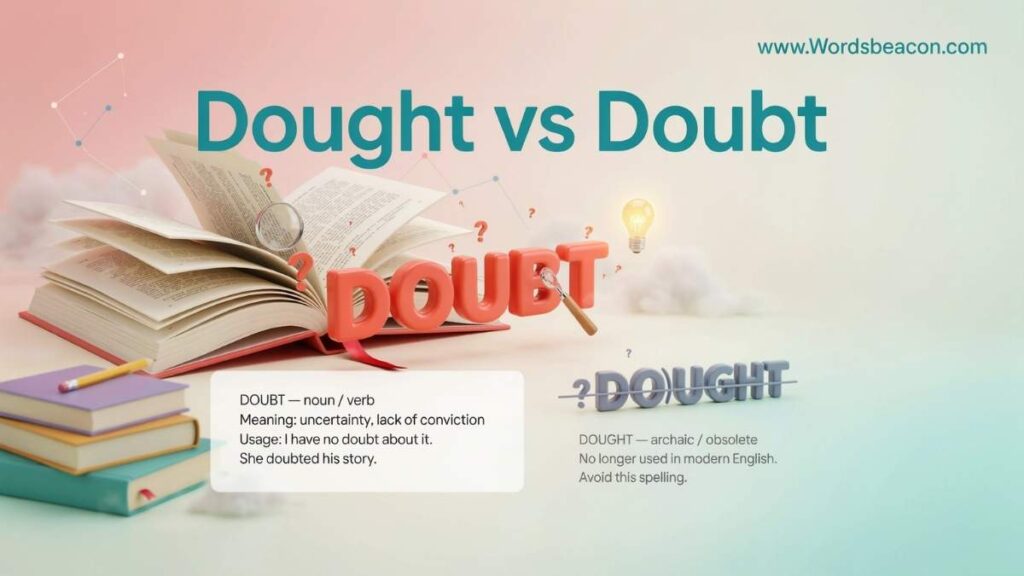
English spelling can be confusing, especially when two words look almost identical. The difference between dought vs doubt is a good example. That silent “b” in doubt is already tricky enough, and adding an extra “o” can make things even more confusing! So, which spelling should you use when talking about uncertainty? The answer is simple: doubt is the correct word in modern English. Although dought appears in some older and regional uses, it isn’t a substitute for doubt in everyday writing. In this guide, you’ll learn what each word means, how to use it correctly, and how to avoid this common spelling mistake.
Quick Comparison
| Feature | Doubt | Dought |
|---|---|---|
| Meaning | Uncertainty or lack of confidence | Historical or regional meanings include strength or ability |
| Correct spelling for uncertainty | Yes | No |
| Part of speech | Noun and verb | Historical uses vary |
| Modern usage | Common | Rare in its historical senses |
| Pronunciation | /daʊt/ | Depends on the historical or regional context |
| Example | I doubt that the story is true. | The word may appear in historical Scottish writing. |
Learn how to use confusing more words correctly
Publicly vs Publically Which Spelling Is Correct?
The main takeaway is straightforward: use “doubt” when you mean uncertainty. If you encounter “dought” in an old text, check its context before deciding whether it is a spelling mistake.
Dought vs Doubt Which Word Is Correct?
For ordinary modern English, “doubt” is correct when you want to express uncertainty, question a claim, or describe a lack of confidence.
For example:
- Correct: I doubt that the story is true.
- Incorrect for the intended meaning: I dought that the story is true.
The second sentence uses a nonstandard spelling for the modern verb “doubt.” However, calling “dought” universally meaningless would overlook its historical and regional uses.
Is Dought a Word?
Yes, “dought” appears in historical English and Scottish dialect records, although it isn’t the standard modern spelling of “doubt.”
Historical Scottish sources record “dought” as a noun associated with power, strength, or ability. Some older dialect uses also relate to deeds or exploits. These meanings are rare or obsolete today.
The important distinction is between recognizing a historical word and using it correctly in modern writing.
Consider these examples:
- “She had doubts about the proposal.” Here, “doubts” means uncertainty.
- “The doughty defender protected the village.” Here, “doughty” means brave and strong.
These words have different grammatical roles and meanings. Don’t assume that similar spellings make them interchangeable.
What Is the Correct Spelling: Doubt or Dought?
When you mean uncertainty, spell the word D-O-U-B-T.
The silent b provides a useful reminder. You don’t pronounce it, but you must include it in the written word.
Examples:
- I have no doubt that she prepared well.
- He began to doubt his decision.
- The evidence left little room for doubt.
All three sentences use the standard spelling correctly.
Learn how to use confusing more words correctly
Wholly vs Wholey correct Spelling and usage ?
What Does Doubt Mean in English?
The word “doubt” describes uncertainty about whether something is true, correct, reliable, or likely to happen. It can also express suspicion about someone’s honesty or a lack of confidence in an outcome.
Doubt doesn’t always mean that you reject an idea. Sometimes, it simply means you need more information before making a decision.
Imagine you’re buying a used car. The seller claims that the car has never been damaged, but its history report shows a previous accident. You may begin to doubt the seller’s claim because the available evidence conflicts with the seller’s statement.
Similarly, a student might doubt their ability to pass an exam. That feeling doesn’t prove the student will fail. It simply reflects uncertainty about the result.
Doubt Definition and Common Meanings
The doubt meaning in English can vary slightly depending on the situation.
- Uncertainty: You don’t know whether something is true.
- Hesitation: You’re unsure about making a decision.
- Disbelief: You find a statement difficult to accept.
- Suspicion: You question someone’s honesty or intentions.
- Lack of confidence: You’re unsure whether you or someone else can succeed.
For example, a manager might doubt whether a deadline is realistic. A customer might doubt a product’s quality after reading conflicting reviews. In both situations, the word expresses uncertainty rather than a confirmed conclusion.
Doubt as a Noun
A noun names a person, place, thing, feeling, or idea. As a noun, “doubt” refers to uncertainty or a particular concern.
Examples:
- I have some doubt about the accuracy of this information.
- Her explanation removed my doubts.
- There is no doubt that preparation improves performance.
- He expressed serious doubts about the proposed changes.
The noun can be countable or uncountable, depending on how you use it.
| Form | Example | Meaning |
|---|---|---|
| A doubt | I have a doubt about this figure. | One particular uncertainty |
| Doubts | She has doubts about the plan. | Several concerns |
| Doubt | There is little doubt about the result. | Uncertainty in a general sense |
Notice that the plural “doubts” often refers to specific concerns. The uncountable use describes uncertainty more generally.
Doubt as a Verb
A verb expresses an action, state, or process. As a verb, “doubt” means to question something, feel uncertain about it, or struggle to believe it.
Examples:
- I doubt that the package will arrive today.
- She doubts his explanation.
- They doubted whether the plan would work.
- We don’t doubt your intentions.
The verb can also express a lack of trust. For example, “I doubt his word” means that I question whether he is telling the truth.
The key distinction is simple: the noun names the uncertainty, while the verb expresses the act or state of questioning something.
Learn how to use confusing more words correctly
Preform vs Perform which one is correct ?
Dought Meaning and Historical Usage
The dought meaning requires more care than a simple spelling correction. Although “dought” isn’t the standard modern spelling of “doubt,” historical English and regional dialects used the form in other ways.
Historical Scottish dictionary records associate “dought” with power, strength, and ability. Some entries also record older meanings connected with deeds or exploits. These uses don’t make “dought” an alternative spelling for the modern word “doubt.”
Dought Definition in Historical Context
In older regional English, “dought” could refer to strength, ability, or power. Its precise meaning depends on the period, dialect, and source.
Consider these distinctions:
- Doubt: uncertainty about something.
- Dought: a rare historical or regional form associated with strength or ability in certain sources.
- Doughty: an established adjective meaning brave, strong, or determined.
For this reason, the correct interpretation depends on context. If you encounter “dought” in an old poem or historical document, examine the sentence rather than automatically replacing the word with “doubt.”
What Does Doughty Mean?
The word “doughty” is worth understanding because it resembles “dought” but has a distinct, recognized meaning.
A doughty person is brave, determined, or strong in the face of difficulty. The word often appears in historical writing, literary descriptions, or deliberately old-fashioned language.
Examples:
- The doughty defender refused to abandon the fort.
- The novel follows a doughty explorer who crosses dangerous terrain.
- The doughty campaigner continued fighting for reform despite repeated setbacks.
Although “doughty” remains a valid English adjective, it sounds old-fashioned in many modern contexts. Writers often choose “brave,” “strong,” or “determined” instead.
Dought vs Doubt Pronunciation How to Say the Word

Pronunciation can make spelling confusing because English doesn’t always pronounce every written letter. “Doubt” is a classic example.
How to Pronounce Doubt
The standard pronunciation of “doubt” is /daʊt/ in American and British English. The vowel sound is the same one you hear in “out” and “mouth.” The word begins with a /d/ sound and ends with a /t/ sound.
You can break the pronunciation into three sounds:
- /d/ as in “day”
- /aʊ/ as in “out”
- /t/ as in “time”
The written b doesn’t contribute a sound.
How to Pronounce Dought
There isn’t one pronunciation that covers every historical or dialectal use of “dought.” Some sources record historical forms as homophones of “doubt,” while older forms and related words may have different pronunciations.
If you’re writing about uncertainty, use “doubt” and its standard pronunciation. You don’t need to decide how to pronounce an unfamiliar historical form unless you’re studying that source specifically.
The distinction matters because similar spellings don’t guarantee identical meanings or grammatical roles.
Fix common more word mistakes in English
Tapping vs Taping difference and usage ?
Why Is the B Silent in Doubt?
The silent b in “doubt” has a historical explanation. It wasn’t added because English speakers suddenly decided to make the spelling more complicated. The letter reflects the word’s history and the influence of Latin on English spelling.
The word entered English through Old French, which inherited it from Latin “dubitare,” meaning to doubt, question, or hesitate. English spelling later reflected the Latin connection more clearly by including the b, even though speakers didn’t pronounce that sound.
Silent Letters in English
English has several words in which a letter appears in writing but doesn’t receive its own sound.
| Word | Silent letter | Pronunciation |
|---|---|---|
| Doubt | B | /daʊt/ |
| Debt | B | /dɛt/ |
| Subtle | B | /ˈsʌtəl/ |
| Knife | K | /naɪf/ |
| Write | W | /raɪt/ |
These examples show why spelling and pronunciation don’t always match letter for letter.
The silent b also helps explain why people make the dought vs doubt spelling mistake. When pronunciation doesn’t reveal a word’s full spelling, writers may rely on guesswork. However, memorizing the standard form is more reliable than spelling every word exactly as it sounds.
How to Remember the Correct Spelling of Doubt
Try one of these memory aids:
- Remember the silent b: The word contains D-O-U-B-T, even though you don’t pronounce the b.
- Connect it with debt: Both “doubt” and “debt” contain a silent b.
- Learn a complete phrase: Memorize “without a doubt” or “I doubt it” instead of learning the spelling in isolation.
- Use the word in context: Writing a few correct sentences helps reinforce the spelling.
- Check a dictionary: If you’re unsure, consult a reputable dictionary rather than relying on pronunciation alone.
Here’s a simple reminder: “Without a doubt, the b belongs in doubt.” It’s short, memorable, and reinforces the correct spelling.
Fix common more word mistakes in English
Encorporate vs Incorporate correct Usage
Dought vs Doubt Grammar How to Use Doubt Correctly
Once you know the correct spelling, the next step is learning how “doubt” works in a sentence. The word follows familiar English grammar rules, but a few patterns deserve attention.
Common Sentence Patterns With Doubt
You can use “doubt” with several common constructions.
| Pattern | Example | Purpose |
|---|---|---|
| Have doubts about | I have doubts about the proposal. | Express concerns |
| Doubt that | I doubt that the claim is accurate. | Question a statement |
| Doubt whether | She doubts whether the plan will succeed. | Express uncertainty about an outcome |
| Leave no doubt | The results leave no doubt about the winner. | Emphasize certainty |
| Be in doubt | The final decision is still in doubt. | Describe an uncertain situation |
| Doubt someone’s word | I doubt his word. | Question someone’s honesty |
These patterns help you write naturally without forcing the word into every sentence.
Doubt, Doubts, Doubted, and Doubting
The correct form depends on the tense, subject, and grammatical structure.
| Word form | Grammatical use | Example |
|---|---|---|
| Doubt | Base verb or noun | I doubt the explanation. |
| Doubts | Plural noun or third-person singular verb | She doubts the result. |
| Doubted | Simple past or past participle | They doubted the evidence. |
| Doubting | Present participle or gerund | He is doubting his choice. |
Remember that the spelling changes according to standard grammar rules, not because “dought” is an alternative form.
For example, “She doubted the result” is correct. “She doughted the result” isn’t the standard modern spelling of the verb meaning to question something.
Common Grammar Mistakes With Doubt
Some mistakes involve spelling, while others involve choosing a phrase that doesn’t express the intended meaning.
Mistake: Using doubt when you mean question.
- Less natural: I have a doubt about your address.
- More natural in American English: I have a question about your address.
The first sentence isn’t necessarily ungrammatical. However, if you simply need clarification, “I have a question” communicates your intention more directly.
Mistake: Using the wrong verb form.
- Incorrect: She don’t doubt the answer.
- Correct: She doesn’t doubt the answer.
The verb must agree with the subject. In the present tense, use “doesn’t” with he, she, or it.
Mistake: Confusing doubt with certainty.
If you intend to communicate confidence in a claim, “I believe the evidence supports the conclusion” may express your meaning more clearly than “I doubt the evidence supports the conclusion.”
The word “doubt” expresses uncertainty or skepticism. Choose another verb if you intend to communicate confidence.
Fix common more word mistakes in English
Training vs Trainning which one is correct ?
Dought vs Doubt Examples in Sentences

Examples make the difference between dought and doubt easier to recognize. The following sentences show how “doubt” works in ordinary communication and how to correct a spelling error.
Correct Examples Using Doubt
Everyday conversation:
- I doubt that the restaurant is still open.
- Do you have any doubts about our plans?
- I don’t doubt that you tried your best.
- There’s no doubt that she knows the answer.
Academic writing:
- The researcher questioned whether the evidence supported the conclusion.
- The new findings cast doubt on the original theory.
- Students sometimes doubt their abilities before an important examination.
Professional communication:
- We have doubts about the accuracy of the financial report.
- The manager doubted whether the deadline was realistic.
- The available evidence leaves little doubt about the cause of the delay.
Literature and storytelling:
- Doubt crept into his mind as the storm approached.
- She never doubted her friend’s loyalty.
- The hero’s self-doubt made the final victory more meaningful.
Each example uses the standard spelling. The surrounding words show whether “doubt” functions as a noun or a verb.
Incorrect Uses of Dought
When “dought” appears in a sentence that expresses uncertainty, replace it with the appropriate form of “doubt.”
| Incorrect sentence | Correct sentence |
|---|---|
| I dought his explanation. | I doubt his explanation. |
| There is no dought about her talent. | There is no doubt about her talent. |
| She has serious doughts about the plan. | She has serious doubts about the plan. |
| I dought that the meeting will happen. | I doubt that the meeting will happen. |
| He never doughted her honesty. | He never doubted her honesty. |
These examples illustrate a common dought spelling mistake: replacing letters in the familiar word with a different sequence.
The correct spelling of “doubt” stays consistent across American and British English. You don’t need a regional spelling variation to express uncertainty.
How to Correct Dought to Doubt
If you spot “dought” in a draft and the sentence refers to uncertainty, use this quick editing process:
- Read the whole sentence to identify the intended meaning.
- Check whether the word expresses uncertainty, suspicion, or a lack of confidence.
- Replace “dought” with the appropriate form of “doubt.”
- Review the sentence for subject-verb agreement and tense.
- Read the corrected sentence again to make sure the meaning remains clear.
For example, “She has dought about the results” should become “She has doubts about the results.” The plural form is appropriate because the sentence refers to concerns about the results.
Understand confusing English more words simply
Laser vs Lazer Correct Spelling and Usage ?
Is “I Have a Doubt” Grammatically Correct?
Yes, “I have a doubt” is grammatically possible. However, it doesn’t always sound like the most natural choice in American English.
The best phrase depends on what you want to communicate. If you need information, ask a question. If you feel uncertain about a claim, express your doubt.
| Expression | Typical meaning |
|---|---|
| I have a question. | I need information or clarification. |
| I have a doubt about this. | I feel uncertain about a specific point. |
| I have doubts about this plan. | I have concerns about the plan. |
| I doubt that this will work. | I don’t think it is likely to work. |
| I’m not sure about this. | I feel uncertain or undecided. |
Suppose your teacher explains a math problem, but you don’t understand one step. “I have a question about the second step” is clearer than “I have a doubt.”
On the other hand, if a business proposal seems unrealistic, “I have doubts about the proposal” is a natural way to express concern.
The phrase “I have a doubt” is more common in some varieties of English than in everyday American conversation. Still, context matters more than treating one expression as universally wrong.
Doubt Synonyms and Antonyms
Learning related words helps you express uncertainty more precisely. Although several words overlap with “doubt,” they don’t all mean exactly the same thing.
Synonyms of Doubt
| Synonym | Meaning | Example |
|---|---|---|
| Uncertainty | Lack of certainty | There is uncertainty about the outcome. |
| Hesitation | A pause caused by uncertainty | She answered without hesitation. |
| Suspicion | A belief that something may be wrong or dishonest | His behavior raised suspicion. |
| Skepticism | An attitude of questioning claims or evidence | The scientist approached the claim with skepticism. |
| Distrust | Lack of trust in someone or something | Years of dishonesty created distrust. |
| Misgiving | A feeling of concern or unease | I had misgivings about the decision. |
Choose the word that best fits the situation. For instance, “skepticism” often describes a questioning attitude, while “distrust” focuses on confidence in a person or institution.
Antonyms of Doubt
Antonyms express the opposite or a contrasting idea.
- Certainty: Confidence that something is true or will happen.
- Confidence: Trust in your own abilities or in someone else’s reliability.
- Assurance: A strong sense of certainty or a statement intended to remove uncertainty.
- Conviction: A firm belief in something.
For example, “She doubted the result” communicates uncertainty. “She was certain of the result” expresses the opposite idea.
Keep in mind that confidence isn’t always proof. Someone can feel certain and still be mistaken.
Fix common more word mistakes in English
Bony vs Boney Which Spellin Is Correct?
Dought vs Doubt in American and British English
One helpful fact about doubt vs dought in English is that the standard spelling doesn’t change between American and British English.
Both varieties use “doubt” to express uncertainty. The spelling and silent b remain the same.
| Variety of English | Correct spelling | Example |
|---|---|---|
| American English | Doubt | I doubt that he’ll arrive on time. |
| British English | Doubt | I doubt that he’ll arrive on time. |
| Australian English | Doubt | I doubt that he’ll arrive on time. |
| Canadian English | Doubt | I doubt that he’ll arrive on time. |
The wording of a sentence may differ by region, but “dought” isn’t the standard regional alternative to “doubt.”
If you encounter “dought” in an old book, historical record, or regional dictionary, check the specific entry before correcting it. The context may reveal an obsolete meaning rather than an ordinary spelling mistake.
Common Expressions That Use Doubt

The word appears in several familiar expressions. Learning them can improve your vocabulary and help you recognize natural usage.
Without a Doubt
“Without a doubt” means certainly or unquestionably.
Example: “She is without a doubt the most experienced person on the team.”
The expression emphasizes confidence rather than uncertainty.
Beyond a Reasonable Doubt
“Beyond a reasonable doubt” is a legal standard used in criminal trials in the United States. It refers to the level of certainty required for a criminal conviction. It doesn’t mean that every imaginable possibility of error must disappear.
Example: “The prosecution must prove the defendant’s guilt beyond a reasonable doubt.”
This expression has a specific legal meaning, so don’t treat it as merely another way to say “probably.”
Benefit of the Doubt
To “give someone the benefit of the doubt” means to accept a reasonable explanation or assume good intentions when you don’t have enough information to reach a firm conclusion.
Example: “I gave him the benefit of the doubt because he had always been reliable.”
The phrase doesn’t mean ignoring evidence. It means avoiding an unnecessarily negative judgment when the facts remain uncertain.
No Doubt
“No doubt” can express strong confidence, but it can also signal that something is likely rather than absolutely certain.
Examples:
- “There is no doubt that she worked hard.” This expresses confidence.
- “He will no doubt call us later.” This suggests that the speaker expects a call.
The surrounding sentence determines the precise meaning.
Understand confusing English more words simply
Using vs Useing Correct Spelling and usage ?
Practice session Dought vs Doubt
Fill in the blanks with the correct word: “doubt vs dought.” Use “doubt” for standard modern English sentences. Remember that “dought” has historical or dialectal uses, but it is not the standard spelling of “doubt.”
- I have no ______ that she will succeed.
- There is some ______ about the accuracy of this report.
- I ______ whether he will arrive on time.
- Without a ______, this is the best book I’ve read.
- She began to ______ his explanation.
- The teacher answered every student’s ______.
- Do not ______ your abilities.
- We have no ______ that the team will win.
- He expressed ______ about the new plan.
- I ______ that the shop is still open.
- The evidence left little room for ______.
- She never ______ her own decisions.
- There is no ______ that practice improves your skills.
- He started to ______ whether he had made the right choice.
- I have serious ______ about this proposal.
- The detective had reason to ______ the suspect’s story.
- Please don’t ______ yourself just because you made a mistake.
- The jury considered whether there was a reasonable ______.
- I have no ______ that you can complete the task.
- The old Scottish text used the word “______” in a historical sense related to strength or ability.
Answers
- doubt
- doubt
- doubt
- doubt
- doubt
- doubt
- doubt
- doubt
- doubt
- doubt
- doubt
- doubts
- doubt
- doubt
- doubts
- doubt
- doubt
- doubt
- doubt
- dought
Here’s a trusted source for clear word meanings:
FAQs
What Is the Difference Between “Dought” and “Doubt” in Modern English?
“Doubt” is the standard modern English word for uncertainty or a lack of confidence. “Dought” has historical and regional uses, but it is not the correct spelling when you mean uncertainty.
Can You Use “Dought” in a Formal Essay?
Avoid using “dought” as a substitute for “doubt” in formal writing. Use “doubt” when discussing uncertainty. However, “dought” may be appropriate when explaining historical English or quoting a source that uses the word in an older or regional sense.
Is “Doubt” a Noun or a Verb?
“Doubt” can function as both a noun and a verb. As a noun, it describes uncertainty, as in “I have some doubt about the result.” As a verb, it means to question something or feel uncertain, as in “I doubt his explanation.”
What Are the Past Tense and -ing Forms of “Doubt”?
The simple past and past participle forms are “doubted,” while the present participle is “doubting.” For example, you might say, “She doubted the answer” or “He is doubting the decision.”
Can “Doubt” Be Used at the Beginning of a Sentence?
Yes. “Doubt” can begin a sentence as either a noun or a verb. For example, “Doubt can make decisions difficult” uses it as a noun, while “Doubt the claim if the evidence is weak” uses it as a verb.
What Does “Beyond Doubt” Mean?
“Beyond doubt” means certain or no longer reasonably questioned. For example, “Her dedication is beyond doubt” means that her dedication is unquestionable.
How Is “Doubt” Different From “Suspicion”?
“Doubt” refers to uncertainty about whether something is true or correct. “Suspicion” suggests a belief that something may be wrong, dishonest, or concealed. For example, you might doubt a claim because the evidence is unclear, but suspect dishonesty when someone’s story keeps changing.
Is “Doughty” Related to the Historical Word “Dought”?
Yes. “Doughty” is an established English adjective meaning brave, strong, or determined. It has an old-fashioned tone and comes from an Old English word associated with strength and competence. Although “doughty” and historical forms of “dought” are related, neither replaces “doubt” in standard modern English.
Understand confusing English more words simply
Chef vs Cheff Which Is Correct and usage ?
Conclusion
The difference between dought vs doubt is easy to remember once you know what each word means. If you’re talking about uncertainty, questioning something, or feeling unsure, doubt is the correct spelling. The word dought does appear in historical and regional English, but you shouldn’t use it as a replacement for doubt in everyday writing. Remember, the b in doubt is silent, but it still belongs there. English spelling can be tricky enough without giving extra letters a free pass! So, the next time you’re unsure which spelling to choose, remember this simple rule: when you mean uncertainty, write doubt. When in doubt, there’s no doubt about the spelling!

Luna AJS is an experienced blogger and dedicated language enthusiast at Words Beacon. She specializes in making English grammar, spelling, vocabulary and commonly confused words easy to understand. She provides clear explanations, practical examples to help readers write with confidence.