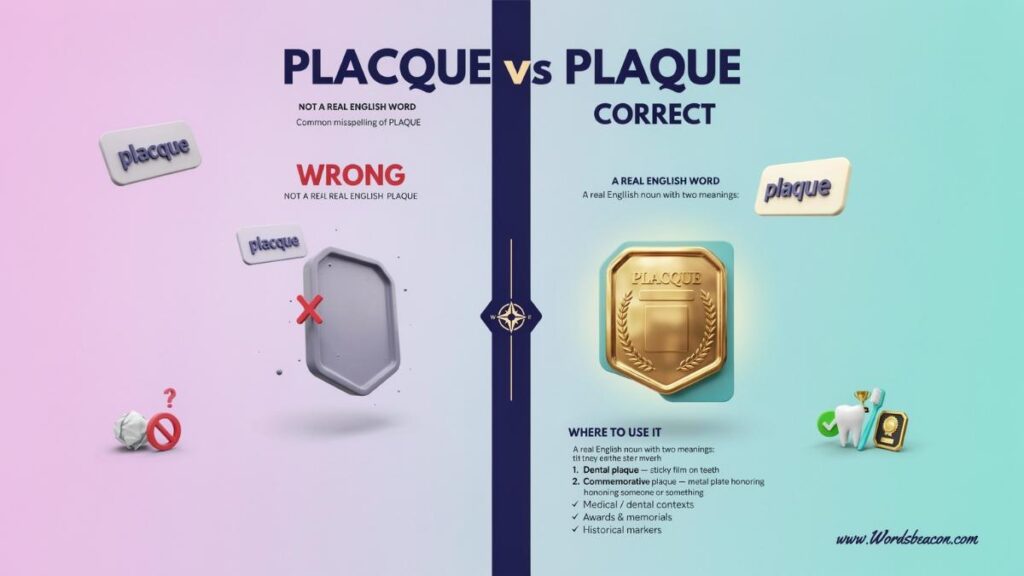
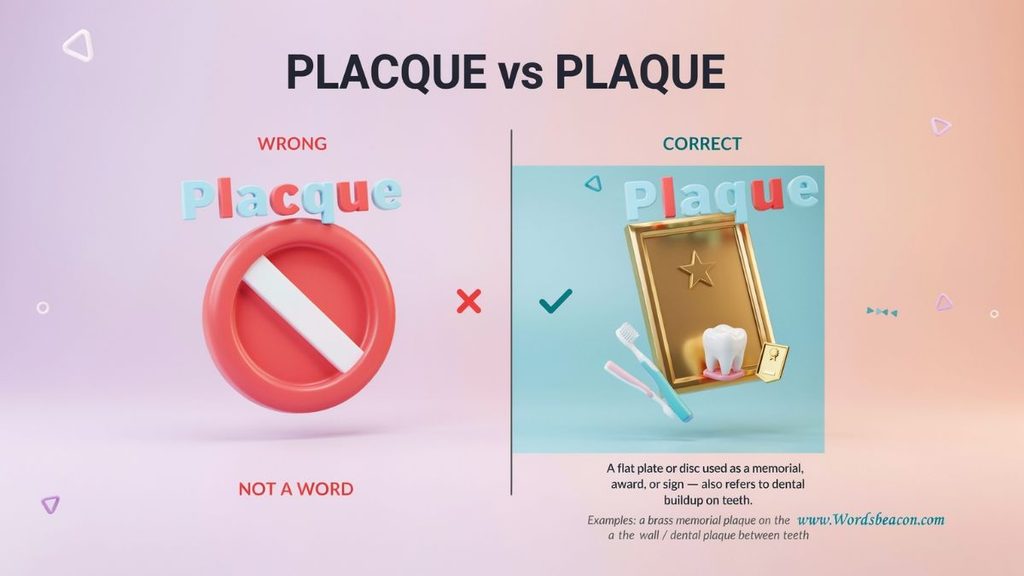
A small spelling mistake can cause a surprising amount of confusion. When comparing placque vs plaque, you might wonder whether both spellings are correct. The answer is simple: plaque is the correct standard spelling, while placque is generally a misspelling. Whether you’re talking about an award on a wall, a memorial plate, or the sticky buildup on your teeth, the spelling stays the same. There’s no need to add an extra letter and make things complicated! In this guide, you’ll learn the meaning, pronunciation, and correct use of plaque so you can avoid common spelling mistakes with confidence.
quick comparison
| Feature | Plaque | Placque |
|---|---|---|
| Spelling status | Standard English spelling | Generally a misspelling of plaque |
| Meaning | A commemorative plate, dental buildup, or medical deposit | No established standard meaning as a common English word |
| Common use | Awards, memorials, dentistry, and medicine | Usually appears because of a spelling mistake |
| Example | The school placed a plaque near the entrance. | The school placed a placque near the entrance. |
| Best choice in formal writing | Yes | No, unless it is an intentional name or specialized spelling |
Learn how to use confusing more words correctly
Phenix vs Phoenix Which Spelling Is Correct?
What Is the Difference Between Placque vs Plaque?
The main difference between placque vs plaque is spelling. Plaque is the accepted English word, whereas placque is generally an incorrect spelling.
Although the two forms look almost identical, only plaque is appropriate for ordinary writing when you mean a commemorative plate, a deposit on teeth, or a patch or buildup described in a medical context.
For example, you might see a plaque on a historical building, hear a dentist discuss dental plaque, or read about plaque in blood vessels. In each case, plaque is the correct spelling.
Placque sometimes appears in online searches, informal messages, or writing produced by people who are unsure about the spelling. However, its appearance does not make it a standard alternative.
Why Do People Confuse Placque vs Plaque?
Several factors make the spelling mistake in placque vs plaque understandable.
First, the letters in plaque do not produce the pronunciation many English learners might expect. The combination of q and u can make the word look unusual, especially if you rarely write it. As a result, some people mistakenly add an extra “c.”
Second, English contains many words with unexpected spellings. Words such as antique, technique, and unique also contain the letters que, although they do not all follow the same pronunciation pattern. Therefore, comparing these words does not always help you remember the correct spelling of plaque.
Finally, plaque has several meanings. Someone who knows the word only from a dental appointment might not immediately recognize it in a sentence about a memorial or an award. This difference in meaning can make placque vs plaque seem more confusing than it really is.
The good news is that you do not need to memorize every meaning to spell it correctly. Remember that plaque is the standard spelling across its common uses. Once you learn this simple rule, you can avoid the same mistake in everyday writing.
Which Spelling Should You Use?
When deciding between placque vs plaque, use plaque in essays, emails, school assignments, business documents, medical discussions, and everyday writing.
For example:
- The museum installed a plaque to honor the artist.
- My dentist explained how plaque forms on teeth.
- Workers cleaned the plaque from the monument.
- Researchers studied plaque buildup in the artery.
In each sentence, plaque is the correct choice.
By contrast, avoid placque when you mean the ordinary English word. If you encounter placque in a draft, correct it to plaque unless you have verified that the unusual spelling belongs to a specific brand, name, or title. This simple check will help you use the correct spelling of plaque with confidence and prevent unnecessary confusion.
Understand confusing English more words simply
Training vs Trainning which one is correct ?
What Does Plaque Mean?
Plaque has several meanings, depending on the subject. Most commonly, it refers to a flat plate that displays information or honors someone, a sticky buildup on teeth, or a deposit or patch described in a medical context.
Although these meanings differ, they share a general idea of something that forms a visible surface, plate, or deposit.
Plaque as a Commemorative Plate
A plaque is often a flat piece of metal, wood, stone, ceramic, or another material that displays words, names, dates, or images.
People use plaques to commemorate important events, recognize achievements, honor individuals, or provide historical information. You may find them on walls, monuments, buildings, school grounds, and memorials.
For example:
- The city placed a bronze plaque outside the historic courthouse.
- The university presented a plaque to the retiring professor.
- A small plaque explains the history of the old bridge.
- The family donated a memorial plaque in honor of their grandmother.
In these examples, plaque refers to a physical object that communicates information or recognizes someone.
A plaque is not necessarily an award. It can also serve as a memorial, a historical marker, a building label, or an informational sign.
Plaque in Dentistry
In dentistry, plaque refers to a soft, sticky film that develops on teeth. It contains bacteria and other substances that accumulate on tooth surfaces.
Dental plaque forms naturally. However, when you do not remove it regularly through brushing and cleaning between your teeth, it can contribute to tooth decay and gum disease.
For example:
- The dentist found plaque along the gumline.
- Brushing twice a day helps control dental plaque.
- Plaque can build up around braces if cleaning becomes difficult.
- Regular dental checkups help identify problems associated with plaque.
Dental plaque differs from tartar, also called calculus. Plaque is relatively soft, while tartar forms when plaque mineralizes and hardens. A toothbrush cannot reliably remove established tartar, so a dental professional may need to remove it.
Therefore, when a dentist discusses plaque, the word describes a biological buildup rather than a decorative object.
Plaque in Medicine
In medicine, plaque can describe a patch of abnormal tissue or a buildup of material, depending on the condition being discussed.
For example, arterial plaque refers to a buildup of substances, including cholesterol and other materials, within the walls of arteries. This buildup can narrow the arteries and affect blood flow.
Medical professionals may also use plaque to describe certain patches on the skin or mucous membranes. The exact meaning depends on the disease, body part, and medical context.
Examples include:
- The scan showed plaque buildup in an artery.
- The dermatologist examined a plaque on the patient’s skin.
- The medical report described a plaque-like patch of tissue.
These uses share the same spelling: plaque. The medical meaning does not require a different spelling such as placque.
Learn how to use confusing more words correctly
Laser vs Lazer Correct Spelling and Usage ?
Is Placque a Real Word?
Placque is generally not accepted as the standard spelling of the common English word plaque. In ordinary writing, dictionaries and established usage support plaque.
However, a spelling that is not standard for a common word may still appear in a proper name, a business name, a product label, or a specialized context. Therefore, it is sensible to check the exact source before correcting a name.
For everyday communication, though, you should use plaque.
Why Does Placque Appear Online?
There are several reasons you might encounter placque online.
First, people often type words as they think they should look rather than as they are conventionally spelled. The unusual ending of plaque can encourage the addition of an extra c.
Second, spelling errors spread when people copy text from an incorrect source. A mistaken spelling can appear in a comment, a website, or a social media post and then be repeated elsewhere.
Third, search engines may display pages containing spelling mistakes because they index text as it appears online. Seeing a word in search results does not automatically mean that the spelling is correct.
Finally, some names and brands use unusual spellings intentionally. Those cases should be considered individually rather than treated as proof that placque is a standard English variant.
Should You Correct Placque to Plaque?
In most situations, yes.
If you’re editing a school assignment, article, email, presentation, or business document, change placque to plaque when it refers to the familiar English word.
For example:
Incorrect: The dentist removed the placque from the patient’s teeth.
Correct: The dentist removed the plaque from the patient’s teeth.
Incorrect: The town installed a placque to honor the soldiers.
Correct: The town installed a plaque to honor the soldiers.
The correction is straightforward because the intended meaning remains the same. You only need to fix the spelling.
Fix common more word mistakes in English
Dought vs Doubt Which Spelling Is Correct?
How to Use Plaque in a Sentence
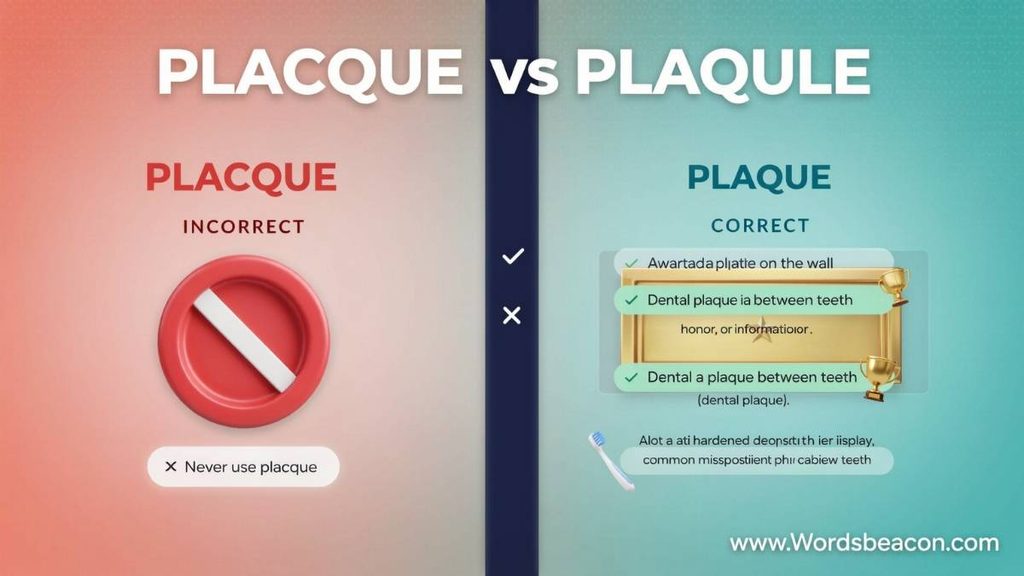
The easiest way to understand plaque is to study how people use it in different situations. Although the meaning changes with context, the spelling remains the same.
Examples of Plaque in Everyday Writing
Here are several examples showing the word in natural sentences:
- The school unveiled a plaque honoring its first principal.
- A brass plaque identified the building’s original architect.
- The dentist explained how plaque contributes to gum irritation.
- The museum displayed a plaque beside the ancient sculpture.
- Researchers examined plaque buildup in the patient’s arteries.
- The family placed a memorial plaque near the garden.
- Regular brushing helps remove plaque from the teeth.
- A small plaque marked the site of the historic event.
- The dermatologist examined a raised plaque on the patient’s skin.
- The organization gave each volunteer a plaque of appreciation.
Notice how the meaning changes with the surrounding words. Phrases such as memorial plaque and brass plaque usually refer to a physical plate. Dental plaque and arterial plaque refer to different kinds of buildup.
Examples of Placque as a Misspelling
The following sentences show how placque may appear incorrectly:
- The dentist removed the placque from my teeth.
- We read the placque outside the museum.
- The school ordered a placque for the retiring teacher.
- The report discussed placque buildup in the artery.
In standard English, replace placque with plaque in all four sentences.
A Simple Comparison Table
| Situation | Correct example | Meaning |
|---|---|---|
| Memorial | The plaque honored the fallen soldiers. | A commemorative plate |
| Education | The school presented a plaque to the winner. | An award or recognition |
| Dentistry | Plaque accumulated along the gumline. | A sticky film on teeth |
| Medicine | The scan showed arterial plaque. | A buildup inside an artery |
| History | The plaque described the building’s origins. | An informational marker |
This comparison shows why context matters when interpreting the word. However, context changes the meaning, not the spelling.
Fix common more word mistakes in English
Publicly vs Publically Which Spelling Is Correct?
Plaque vs Tartar What Is the Difference?
Because plaque is often used in dental discussions, it is helpful to distinguish it from tartar. These terms are related, but they do not describe exactly the same thing.
Plaque is a soft film that forms on teeth. It contains bacteria and can accumulate throughout the day. Regular brushing and cleaning between the teeth help remove it.
Tartar, also known as calculus, develops when plaque hardens through mineralization. Once tartar forms, ordinary brushing generally cannot remove it completely.
| Feature | Plaque | Tartar |
|---|---|---|
| Texture | Soft and sticky | Hard and mineralized |
| Formation | Develops on tooth surfaces | Forms when plaque hardens |
| Removal | Regular brushing and interdental cleaning help remove it | Usually requires professional dental cleaning |
| Main concern | Can contribute to tooth decay and gum disease | Can contribute to gum irritation and make cleaning more difficult |
| Relationship | Can develop into tartar | Develops from mineralized plaque |
For example, a dentist might tell you that plaque has accumulated along your gumline. If you leave that buildup in place, some of it may harden into tartar.
This distinction also helps you understand the word’s meaning. Dental plaque is not the same as a plaque mounted on a wall, even though both use the same spelling.
Plaque vs Other Similar Words
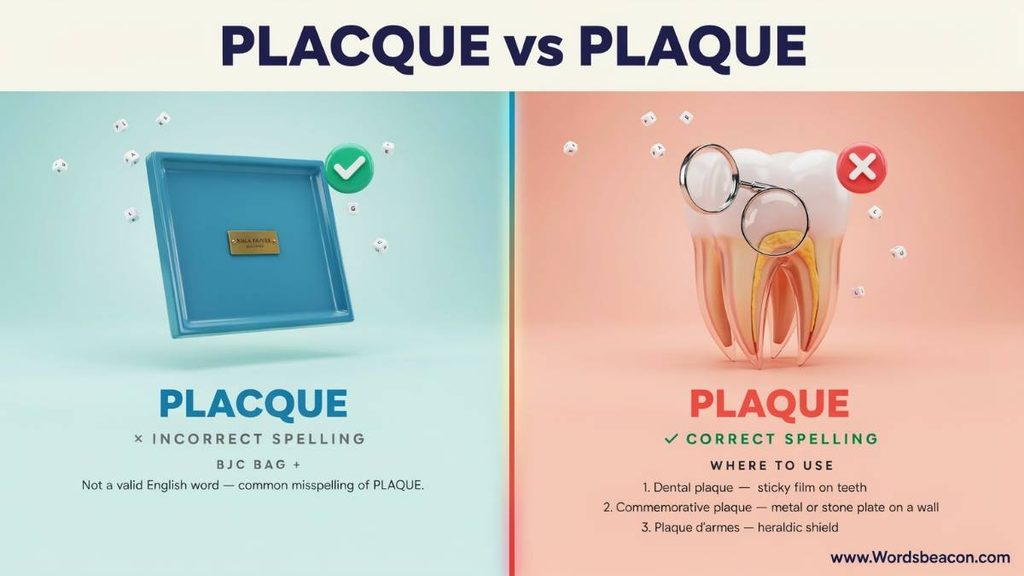
The Plaque is sometimes confused with other words because they share letters, sounds, or related contexts. Understanding these distinctions can make your writing more precise.
Plaque vs Plague
The Plaque and plague look similar, but they have different meanings.
Plaque refers to a commemorative plate, a dental buildup, or a medical deposit. Plague can refer to a serious infectious disease or, more generally, a widespread problem that causes suffering or harm.
Examples:
- The town installed a plaque beside the old hospital.
- The history book described an outbreak of plague.
- Dental plaque can contribute to gum disease.
- The community worked together to address the plague of illegal dumping.
A useful way to remember the distinction is that a plaque may display information or form as a buildup, while a plague refers to disease or a serious widespread problem.
Plaque vs Plate
A plate is generally a flat object, such as a dish used for food or a piece of material that serves a practical purpose. A plaque is often a particular kind of plate used to display information, commemorate an event, or recognize an achievement.
For example:
- She placed the sandwich on a plate.
- The museum displayed a plaque describing the building’s history.
Although the words are related in some contexts, they are not interchangeable in every sentence.
Plaque vs Patch
A patch is a piece of material used to cover or repair something, or an area that differs from the surrounding surface. In medicine, patch can also describe a localized area of altered skin or tissue.
Plaque may describe a raised or thickened area of skin in certain medical contexts, but the terms do not always mean the same thing. Their exact use depends on the condition being described.
For example:
- He used a patch to repair the torn jacket.
- The dermatologist examined a plaque on the patient’s skin.
When discussing a medical condition, use the term provided by a qualified healthcare professional rather than assuming that plaque and patch are interchangeable.
Fix common more word mistakes in English
Preform vs Perform which one is correct ?
How to Remember the Correct Spelling of Plaque
Spelling plaque correctly becomes easier when you connect it to familiar words and real-life situations.
Remember the Ending: Q-U-E
The correct spelling is plaque, with q followed by u and then e.
Think of the spelling as p-l-a-q-u-e. Once you remember that sequence, you can avoid adding the extra c found in the common misspelling placque.
You can also compare plaque with familiar words such as antique and technique. They have different meanings and pronunciations, but their endings can remind you that English sometimes uses the letter combination que.
Connect the Word to a Familiar Object
Imagine a commemorative plaque mounted on a wall in a school or museum. Picture the name, date, or message engraved on its surface.
Whenever you need to write the word, recall that object and its correct spelling.
This technique works because you connect the written form with a clear visual image rather than relying only on memory.
Use a Short Memory Sentence
Try this sentence:
“The plaque has a unique shape.”
Both plaque and unique contain the letter sequence que. Although the words serve different purposes, the shared spelling pattern can help reinforce the correct form.
You can also repeat a short reminder:
“Plaque has one c, not two.”
Strictly speaking, plaque contains no c at all. The reminder is useful because placque adds an unnecessary c before the q.
A more accurate memory line is:
“Plaque has no extra c.”
Check the Word Before Publishing
Spell-checking tools can catch many typing errors, but they do not always identify every incorrect word. Some tools may miss a mistake if the spelling resembles a known name or if the software’s dictionary is limited.
Therefore, when you’re proofreading an article or report, read the sentence in context. Ask yourself whether you mean a commemorative plate, dental buildup, or medical deposit. If so, plaque is almost certainly the spelling you need.
Understand confusing English more words simply
Bony vs Boney Which Spellin Is Correct?
The Origin and History of Plaque
The history of plaque helps explain why its spelling may look unusual to modern English readers.
The English word came through French plaque, which referred to a plate or flat piece of material. Its deeper history is linked to related European forms, including Flemish and Middle Dutch words associated with a disk, patch, or flat piece.
Over time, English developed several uses for the word. One important use refers to a decorative or commemorative plate, while later medical uses describe particular kinds of deposits or patches.
The dental meaning became established in the late nineteenth century. Medical terminology also adopted plaque to describe deposits associated with conditions such as the buildup that can occur in arteries.
Despite these changes in meaning, the standard spelling remained plaque.
Why the Spelling May Look Unusual
English borrowed many words from French and other languages. As a result, spelling does not always match the patterns a reader might expect from modern English pronunciation.
The ending in plaque can seem unfamiliar, especially to someone who has mainly encountered the word in speech. Adding another c may feel logical to a writer who is trying to represent the sound or remember the letter sequence.
However, English spelling often preserves forms inherited from earlier languages. The best approach is to learn the established spelling rather than trying to reconstruct it from pronunciation.
How to Pronounce Plaque
In American English, plaque is commonly pronounced like “plack,” rhyming with words such as back and black.
The pronunciation is short, with one syllable. The final letters do not produce a separate spoken syllable.
For example, in the sentence “The plaque hangs near the entrance,” the word plaque sounds like “plack.”
Pronunciation can vary across English-speaking regions. Some British speakers use a pronunciation closer to “plahk,” while “plack” is also used. However, the spelling remains plaque in both British and American English.
Does Placque Have a Different Pronunciation?
Placque is generally a misspelling rather than a separate standard English word with its own established pronunciation.
Because it resembles plaque, readers would often assume that the writer intended plaque. However, adding a c does not create a recognized alternative spelling for ordinary use.
Therefore, focus on learning the correct spelling rather than trying to assign placque a separate pronunciation.
Learn how to use confusing more words correctly
Tapping vs Taping difference and usage ?
Common Mistakes to Avoid When Using Plaque
Even though plaque is a relatively short word, several mistakes can appear in everyday writing.
Adding an Extra C
The most direct mistake is writing placque instead of plaque.
Incorrect: The museum placed a placque outside the gallery.
Correct: The museum placed a plaque outside the gallery.
The extra c is unnecessary. Remember the sequence p-l-a-q-u-e.
Confusing Plaque With Plague
Because plaque and plague look similar, writers sometimes use one when they mean the other.
Incorrect: The documentary described the dental plague on the patient’s teeth.
Correct: The documentary described the dental plaque on the patient’s teeth.
In contrast, a sentence about a devastating epidemic may require plague.
Assuming Plaque Always Refers to Teeth
Dental plaque is a familiar use of the word, but it is not the only one.
A plaque can also commemorate a person, mark a historic location, recognize an achievement, or describe certain deposits or patches in medicine.
For example, “The city installed a plaque in the park” has nothing to do with dental health.
Treating Every Plaque as an Award
Some plaques recognize achievement, but others provide information or honor people after their deaths. A historical plaque may explain an event, while a memorial plaque may remember a person or group.
Therefore, consider the context before deciding what kind of plaque a sentence describes.
Assuming Search Results Prove a Spelling Is Correct
Finding placque on a website does not mean it is an accepted spelling. Online content can contain typos, and those mistakes can be copied repeatedly.
For formal writing, use plaque unless you have confirmed that placque is part of a proper name or a specific established label.
Understand confusing English more words simply
Encorporate vs Incorporate correct Usage
Practice Session Placque vs Plaque
Fill in each blank with the correct word: Placque vs Plaque . Choose the spelling that fits standard English usage. The answer key appears at the end, so try to complete all sentences before checking your answers.
1. The city installed a bronze ______ to honor the brave firefighters.
2. My dentist explained how dental ______ builds up on teeth.
3. The museum placed a historical ______ beside the ancient painting.
4. Regular brushing helps remove ______ and protect your teeth.
5. The school presented a commemorative ______ to the retiring principal.
6. Researchers examined the buildup of ______ inside the patient’s artery.
7. Visitors stopped to read the ______ outside the historic building.
8. The dental hygienist explained how to control plaque along the gumline.
9. The family placed a memorial ______ in honor of their loved one.
10. The dentist warned that untreated dental ______ can contribute to gum disease.
11. The university awarded a ______ to recognize the professor’s achievements.
12. The medical report described a ______ on the patient’s skin.
13. The editor corrected the misspelling “placque” to ______.
14. A small informational ______ explained the monument’s history.
15. The patient learned that hardened tartar develops from mineralized ______.
16. The town added a memorial ______ to remember the historic event.
17. The doctor discussed arterial ______ and its potential effect on blood flow.
18. The museum’s ______ displayed the name of the building’s original architect.
19. The writer accidentally used “placque” instead of the correct spelling, ______.
20. The dentist recommended daily brushing to reduce dental ______.
Answers
- Plaque
- Plaque
- Plaque
- Plaque
- Plaque
- Plaque
- Plaque
- Plaque
- Plaque
- Plaque
- Plaque
- Plaque
- Plaque
- Plaque
- Plaque
- Plaque
- Plaque
- Plaque
- Plaque
- Plaque
Here’s a trusted source for clear word meanings:
FAQs
Is it Placque vs Plaque ?
Plaque is the correct standard English spelling. Placque is generally a misspelling. Use plaque when referring to a commemorative plate, an award, dental buildup, or a medical deposit.
How do you spell plaque for a wall?
The correct spelling is plaque. A wall plaque is a flat object attached to a wall to display information, commemorate an event, or honor someone. For example, “The museum installed a plaque to explain the building’s history.”
How do you spell plaque like a trophy?
The correct spelling is plaque. An award plaque recognizes an achievement, contribution, or special occasion. Unlike a typical trophy, which often has a three-dimensional design, a plaque usually features an engraved name, message, or date on a flat surface.
What is a wall plaque?
A wall plaque is a decorative, informational, or commemorative plate mounted on a wall. It may display a person’s name, historical information, an award, or a memorial message. Depending on its purpose, it can be made from wood, metal, stone, acrylic, or another durable material.
What are the different ways to spell plaque?
Plaque is the standard spelling in English. Placque is a common misspelling rather than an accepted alternative. The spelling remains the same whether you’re discussing a wall decoration, an award, dental buildup, or a medical deposit.
How do you spell a wooden plaque?
The correct spelling is wooden plaque. The word plaque does not change according to the material used to make it. For example, “She displayed a wooden plaque engraved with her family’s name.”
Are plaque and trophy the same?
No. A plaque is usually a flat plate that displays information or recognizes an achievement, while a trophy is typically a three-dimensional award presented to a winner. Both can celebrate success, but they differ in appearance and design.
What is worse, tartar or plaque?
Both can affect oral health, but tartar is hardened plaque that is more difficult to remove. Regular brushing and cleaning between your teeth help control plaque, whereas established tartar usually requires professional dental cleaning. If left unmanaged, both can contribute to gum problems.
How do British people pronounce plaque?
British English has more than one pronunciation of plaque. Some speakers use a short vowel similar to the one in “black,” while others use a longer vowel, closer to the sound in “father.” The spelling remains plaque regardless of the pronunciation.
How do Australians pronounce plaque?
Australian English commonly uses a pronunciation with a vowel similar to the one in “black.” However, pronunciation can vary among speakers. In all cases, the standard spelling is plaque.
How do you pronounce plaque in American English?
In American English, plaque is commonly pronounced like “plack,” rhyming with “back.” It has one syllable, and the final letters do not create an extra syllable.
Is plaque pronounced “plack vs plaque”?
In American English, plaque is generally pronounced like “plack.” Although the spelling may look as if the final letters should sound different, the word has just one syllable. The standard spelling remains plaque.
What does the French word plaque mean in English?
The French word plaque can mean a plate, slab, sheet, or flat piece of material, depending on the context. English adopted the word and developed related meanings, including a commemorative plate and certain deposits described in dentistry and medicine.
How do you pronounce dental plaque?
In American English, plaque is pronounced like “plack” in the phrase dental plaque. The complete phrase has three syllables: “den-tal” followed by the one-syllable word plaque.
Learn how to use confusing more words correctly
Wholly vs Wholey correct Spelling and usage ?
Conclusion
Choosing between placque vs plaque is easy once you remember one simple rule: plaque is the correct spelling. When comparing placque vs plaque, remember that whether you’re talking about a wall decoration, an award, or the sticky buildup on your teeth, you should use plaque. The spelling placque is generally a mistake, so that extra “c” has no place in ordinary English writing.
To understand placque vs plaque, remember that a plaque can honor someone, celebrate an achievement, or remind you to brush your teeth. Although these meanings are different, the spelling stays the same. So, next time you face placque vs plaque, stick with plaque. Your spelling will be correct, and your grammar won’t need a rescue mission!

Luna AJS is an experienced blogger and dedicated language enthusiast at Words Beacon. She specializes in making English grammar, spelling, vocabulary and commonly confused words easy to understand. She provides clear explanations, practical examples to help readers write with confidence.