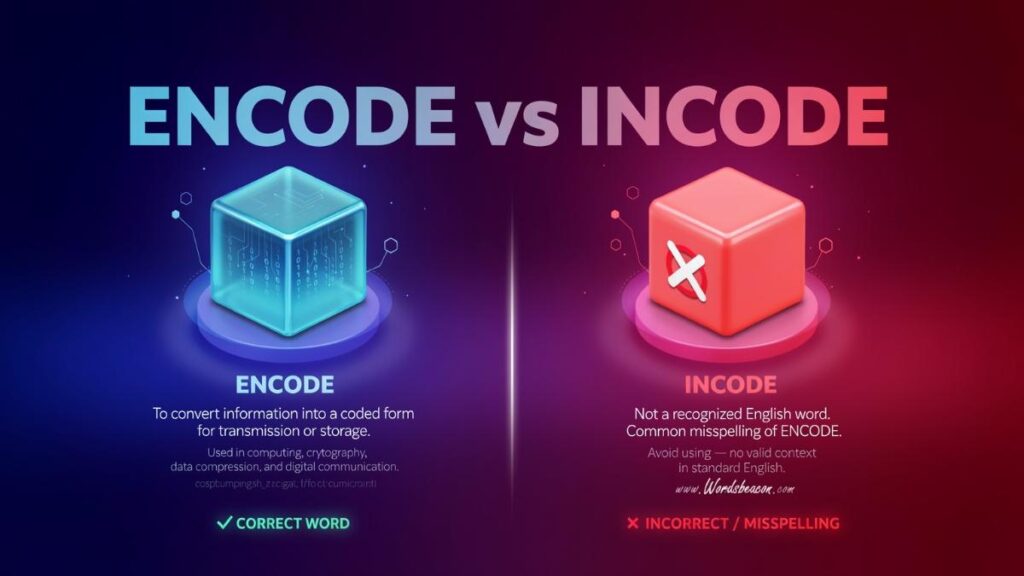
Some English words look so alike that they seem to be competing for the same job. Encode and incode are an example, but they do not mean the same thing. Encode is the standard verb for putting information into a code or expressing it in another form. Incode has a more specific use: it can refer to the inward code of a UK postcode, and it appears in some names. So, which word belongs in your sentence? The answer depends on what you want to say. In this guide to Encode vs Incode, you’ll learn the difference, spot mistakes, and choose a word with confidence.
quick comparison
| Comparison point | Encode | Incode |
|---|---|---|
| Standard usage | An established English verb | A specialized postal term and a word used in proper names |
| Meaning | To represent information through a code or system | The inward code of a UK postcode |
| Part of speech | Verb | Noun in British postal terminology |
| Common context | Communication, language, and general writing | UK postcodes and certain company or product names |
| Example | Please encode the message clearly. | The incode forms the final part of the postcode. |
| Is it a spelling alternative? | Yes, encode is the correct verb for representing information in coded form. | No, incode is not a substitute for encode. |
Learn how to use confusing more words correctly
Placque vs Plaque which one is correct ?
Encode vs Incode The Quick Answer
Encode is the correct word when you want to describe the act of representing information through a code, symbol system, or another defined form.
For example:
- Correct: The sender will encode the message before delivering it.
- Incorrect: The sender will incode the message before delivering it.
However, incode is not always a spelling mistake. In British postal terminology, it refers to the inward code, which forms the final three characters of a standard UK postcode. In addition, the word appears in certain company and product names.
Therefore, context determines the correct choice. Use encode when describing an action involving coded information. Use incode when referring to the specialized postal term or a specific name.
What Does Encode Mean?
Encode is a verb that means to represent information through a code or convert it into a particular form. The information might be a message, an idea, a set of instructions, or another type of content.
In everyday language, encoding can involve turning an idea into words, expressing information through symbols, or using an agreed system to communicate a message.
For example, imagine that you want to explain a complicated idea to a friend. You might use simple words, familiar signs, or a series of symbols to make the information easier to understand. In that situation, you encode the idea into a form your friend can interpret.
Although the exact process varies, the main meaning remains the same: encode describes the act of representing information according to a particular system.
Encode Meaning in English
In standard English, encode commonly means to convert information into code or express it through a system of symbols. It can also describe the way someone puts thoughts into language.
Consider these examples:
- The teacher asked the students to encode the message using symbols.
- She encoded her instructions in a series of simple signs.
- The speaker encoded his ideas in clear, familiar words.
- The organization encoded the information according to its established rules.
In each sentence, encode describes an action. It tells the reader what someone does with the information.
Moreover, encode can appear in different fields without losing its central meaning. In communication, it may describe expressing an idea. In other contexts, it can refer to representing information through an agreed system.
What Does Encode Mean in Communication?
In communication, encode refers to the process of turning an idea into a message that another person can receive and interpret.
For example, suppose you want to tell a friend that a meeting has moved to 3 p.m. You write a message explaining the new time and send it to your friend. By turning your thought into written words, you encode the information.
The same principle applies to spoken language. When you choose words to express your feelings, you encode your thoughts into speech. Likewise, a person can communicate an instruction through a gesture, a sign, or a familiar symbol.
However, encoding does not guarantee that the receiver will understand the message correctly. If your wording is unclear or your symbols are unfamiliar, the other person may misunderstand your meaning.
Therefore, effective communication depends on both the message and the way the sender presents it.
Examples of Encode in Everyday Sentences
The following examples show how encode works in different situations.
| Context | Example sentence | What encode means |
|---|---|---|
| Conversation | She encoded her thoughts in simple words. | Expressed an idea through language |
| Education | The students encoded the message using agreed symbols. | Represented information through symbols |
| Instructions | He encoded the directions in a set of signs. | Converted instructions into a particular form |
| Communication | The sender will encode the message before sharing it. | Prepared information according to a system |
| General writing | The writer encoded a deeper meaning in the story. | Expressed meaning through words and symbols |
These examples share one important feature: encode functions as a verb. Consequently, it describes an action rather than naming a particular part of something.
Learn how to use confusing more words correctly
Phenix vs Phoenix Which Spelling Is Correct?
What Does Incode Mean?
Incode has a narrower use than encode. It is not the standard English verb for putting information into a coded form. Nevertheless, it has a recognized meaning in British postal terminology.
The word also appears in proper names, so it should not automatically be treated as an error. Instead, consider how the writer uses it and what the sentence is trying to communicate.
Incode Meaning in UK Postal Terminology
In British postal terminology, incode is another name for the inward code, the final three characters of a standard UK postcode.
A full postcode has two main sections: the outward code and the inward code. The outward code identifies a broader postal area, while the inward code helps identify a more specific delivery area.
For example, consider the UK postcode SW1A 1AA:
- Outward code: SW1A
- Inward code, or incode: 1AA
The Ordnance Survey, a national mapping organization in Great Britain, describes the incode as the final three characters of the postcode. These characters identify the postcode sector and postcode unit, which support the sorting and delivery of mail.
Therefore, incode is a valid specialist term in this context. However, that specialized meaning does not make it an alternative spelling of the ordinary verb encode.
Is Incode a Real Word?
Yes, but its meaning depends on the context.
In British postal terminology, incode refers to the inward code of a postcode. It also appears as a proper name, including the name of Incode Technologies, a company that provides identity verification services.
However, incode is not the standard verb used when someone represents information through a code. For that meaning, English uses encode.
Compare these sentences:
- Correct: The teacher asked the class to encode the message.
- Correct: The postcode contains an outward code and an incode.
- Correct: Incode is the name of an identity verification company.
Each sentence uses the word in a different context. The first requires a verb, the second uses a specialized postal noun, and the third uses a proper name.
As a result, the safest approach is to check the intended meaning before correcting the spelling.
Incode as a Company or Product Name
Incode also appears in business names. For example, Incode Technologies operates in the identity verification and authentication industry.
In this case, Incode is a proper name rather than an ordinary verb. Its spelling should remain unchanged when you refer to that company.
The same principle applies to other names. Businesses sometimes choose distinctive spellings for their brands, and those spellings do not necessarily follow ordinary vocabulary patterns.
Therefore, do not automatically replace every instance of incode with encode. First, determine whether the word refers to a company, product, postal term, or action.
Understand confusing English more words simply
Laser vs Lazer Correct Spelling and Usage ?
Encode vs Incode The Main Differences
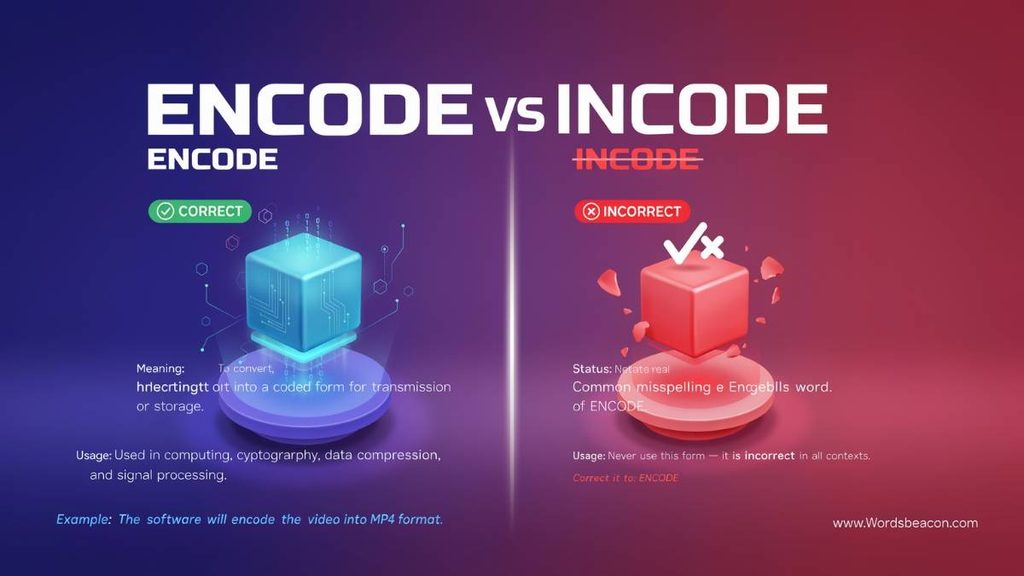
Although encode vs incode differ by only one letter, they serve different grammatical and practical purposes.
Difference in Meaning
Encode describes the action of representing information through a code or system. Incode, when used in British postal terminology, names the inward code of a postcode.
For example, a person can encode a message, but a postcode contains an incode. These uses are not interchangeable because the words describe different things.
Difference in Spelling
The first vowel distinguishes the two spellings:
- Encode begins with e.
- Incode begins with i.
Although the difference looks small, it matters in a sentence. If you want to describe the action of converting information into a coded form, encode is the correct spelling.
On the other hand, if you are discussing the inward code of a UK postcode, incode is appropriate.
Difference in Grammar
Encode is a verb, which means it describes an action. It can change form according to the tense and structure of a sentence.
Incode is a noun when it refers to the inward code of a postcode. A noun names something, while a verb expresses an action or state.
Compare the following examples:
- Verb: They encode the message.
- Noun: The incode identifies the final part of the postcode.
This grammatical difference provides a useful clue. If the sentence describes someone performing an action, encode may be the word you need. If it names a specific postal component, incode may be correct.
Difference in Usage
Encode appears in standard English across communication, education, and general writing. It can describe expressing an idea or representing information in a defined form.
Incode has a more specialized role. Its recognized postal meaning relates to UK postcodes, and it also appears in proper names.
Consequently, encode is the usual choice for general writing about coded information, while incode belongs in the specific contexts where its meaning applies.
Difference in Standard English
Encode is an established English verb that appears in major dictionaries. Incode has a narrower, specialized use.
This distinction matters because a word can be valid in one context without being suitable in another. For example, a postal term does not automatically become an alternative verb simply because the two words look alike.
In short, spelling accuracy requires more than choosing a familiar-looking word. You must also consider meaning, grammar, and context.
Understand confusing English more words simply
Dought vs Doubt Which Spelling Is Correct?
Encode vs Incode Comparison Examples
The following table brings the main differences together and shows how to apply them in real sentences.
| Sentence or phrase | Correct choice | Reason |
|---|---|---|
| Please encode the message before sending it. | Encode | It describes an action. |
| The students encoded the instructions in symbols. | Encoded | It is the past-tense form of encode. |
| The incode contains the final three characters of the postcode. | Incode | It refers to a specific postal component. |
| The sender will incode the message. | Encode | Incode is not the standard verb for this meaning. |
| Incode Technologies provides identity verification services. | Incode | It is a company name. |
| She is encoding the information. | Encoding | It is the present participle of encode. |
Notice that the correct choice depends on the purpose of the sentence. Rather than memorizing a rule that incode is always wrong, remember that it has a specific use that differs from encode.
Understand confusing English more words simply
Bony vs Boney Which Spellin Is Correct?
Examples of Encode vs Incode in Sentences
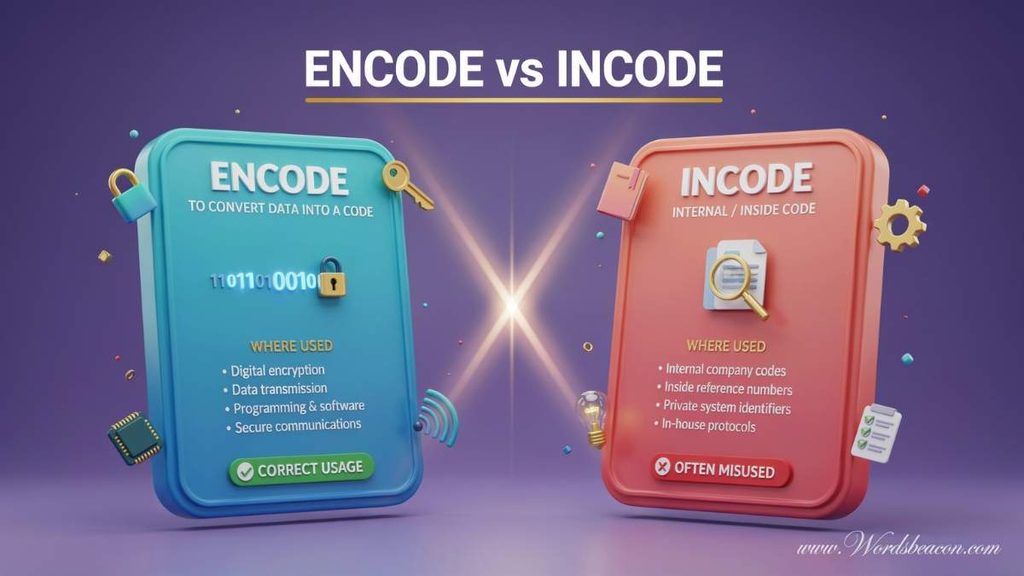
Seeing both words in complete sentences makes their different roles easier to recognize.
Correct Sentences With Encode
Use encode when describing the act of representing information in a coded or defined form.
- The sender will encode the message before sharing it.
- The teacher asked the students to encode the instructions in symbols.
- She encoded her thoughts in words that everyone could understand.
- The organization needs to encode the information consistently.
- He learned how to encode a message using a simple set of signs.
- Clear language helps a speaker encode an idea accurately.
- The writer encoded a subtle message in the story.
- They encoded the instructions so that the team could interpret them.
- She is encoding the information according to the agreed rules.
- The students encoded their answers using the system they learned in class.
In all these examples, encode describes an action involving information or meaning. Its form changes according to the sentence, but the central idea stays the same.
Correct Sentences With Incode
Use incode when referring to the inward code of a UK postcode or an appropriate proper name.
- The incode forms the last three characters of a standard UK postcode.
- The postal record includes both the outward code and the incode.
- The incode helps identify a more specific delivery area.
- Incode Technologies is a company name.
- The form asks for the outward code and the incode separately.
These examples demonstrate why context matters. In the first three sentences, incode has a postal meaning. And In the fourth, it is a proper name. In the fifth, it identifies one part of a postcode.
Incorrect Sentences and Their Corrections
Writers may mistakenly use incode when they intend to describe an action. In such cases, the sentence needs encode or one of its grammatical forms.
| Incorrect sentence | Correct sentence |
|---|---|
| The sender will incode the message. | The sender will encode the message. |
| She incoded the instructions. | She encoded the instructions. |
| The teacher asked us to incode the information. | The teacher asked us to encode the information. |
| Please incode your message before sharing it. | Please encode your message before sharing it. |
| He is incoding the directions. | He is encoding the directions. |
These corrections apply when the intended meaning involves representing information through a code or system. However, if incode refers to a postcode or a proper name, changing it may introduce a mistake rather than fix one.
Understand confusing English more words simply
Publicly vs Publically Which Spelling Is Correct?
Grammar Rules and Word Forms of Encode
Understanding the related forms of encode helps you use the word naturally and accurately.
Is Encode a Verb or a Noun?
Encode is primarily a verb. It describes an action, such as representing information through symbols or putting an idea into words.
The related noun encoding refers to the process itself. Meanwhile, encoder can name a person or thing that performs encoding.
Consider these examples:
- The teacher will encode the message.
- The encoding process requires clear instructions.
- The encoder prepared the information.
- The encoded message was ready to share.
Each form serves a different grammatical purpose. Therefore, choose the word that fits the role it plays in your sentence.
What Are the Correct Forms of Encode?
Encode follows the regular pattern of many English verbs.
| Word form | Example |
|---|---|
| Base form: encode | Encode the message clearly. |
| Third-person singular: encodes | She encodes the message. |
| Simple past: encoded | She encoded the message yesterday. |
| Past participle: encoded | The message has been encoded. |
| Present participle: encoding | She is encoding the message. |
The past tense and past participle both use encoded. Similarly, encoding is the correct form when the action is ongoing or when the word functions as a noun.
These forms follow familiar English spelling patterns, so you do not need to memorize a separate irregular pattern.
How to Use Encode in a Sentence
Encode commonly takes an object that identifies the information being represented.
For example, you can encode a message, encode instructions, or encode an idea in words. You can also explain how someone encoded information, such as through symbols or a familiar system.
Here are a few natural examples:
- Please encode the message clearly.
- The teacher encodes the information in simple symbols.
- She encoded her thoughts in a short note.
- They are encoding the instructions for the activity.
The exact structure depends on what you want to express. Nevertheless, encode remains a verb in each example.
Related Words of Encode
Several related words can make your writing more varied.
- Encoding: the process of representing information through a code or system.
- Encoded: the past-tense and past-participle form of encode.
- Encoder: a person or device that performs encoding.
- Encodable: capable of being encoded.
For example, you might write, “The message is encoded,” instead of repeating the full phrase “someone encoded the message.” Likewise, encoding can describe the process without requiring the verb in every sentence.
These related forms are useful, but they do not make incode an alternative form of encode.
Fix common more word mistakes in English
Preform vs Perform which one is correct ?
Common Mistakes to Avoid
Even a simple spelling distinction can cause confusion when two words look alike. Fortunately, a few practical checks can help you choose correctly.
Assuming Incode Always Means Encode
This is the main mistake to avoid. Incode can refer to the inward code of a UK postcode, but it cannot replace encode when you describe the act of representing information.
For example, “Please encode the message” is correct. By contrast, “Please incode the message” is incorrect for that intended meaning.
Treating Every Unfamiliar Word as a Misspelling
An unfamiliar word is not necessarily wrong. Specialized vocabulary and proper names sometimes differ from the words used in everyday conversation.
For that reason, check the context before making an edit. If the sentence refers to a UK postcode, incode may be correct. If it refers to a company called Incode, preserve the name as written.
Confusing Verbs and Nouns
Encode describes an action, whereas incode can name a postal component. This difference is an effective way to check a sentence.
For example, “They encode the message” describes an action. Meanwhile, “The incode is part of the postcode” names something.
Once you recognize the grammatical role of each word, the distinction becomes easier to remember.
Ignoring the Intended Audience
The word incode is most relevant in discussions of British postal terminology. By comparison, encode appears much more broadly in general English.
Therefore, consider your subject and audience. In an ordinary spelling or grammar article, explain that encode is the standard verb. In an article about UK postcodes, explain the specialized meaning of incode as well.
Fix common more word mistakes in English
Tapping vs Taping difference and usage ?
How to Remember Encode vs Incode
A simple memory aid can help you make the right choice whenever the two spellings cause confusion.
Think of encode as the action of representing information through a code. The word includes code, which makes the connection between the spelling and the meaning easy to remember.
For incode, think of inward code, the specialized postal term used for the final part of a UK postcode.
Before choosing a word, ask yourself two questions:
- Am I describing the action of representing information?
- Am I referring to the inward code of a UK postcode or to a proper name?
If your sentence describes an action, encode is generally the correct choice. If it refers to the postal term or a name, incode may be appropriate.
Most importantly, remember the purpose of the sentence instead of relying only on how the word looks.
Fix common more word mistakes in English
Training vs Trainning which one is correct ?
Practice session Encode vs Incode
Choose the correct word or word form for each sentence. Use encode, encodes, encoded, encoding, or incode, depending on the meaning and grammar.
- Please ______ the message before you share it.
- The teacher asked the students to ______ the information using symbols.
- She ______ the instructions clearly yesterday.
- The inward code of a UK postcode is also called the ______.
- He is ______ his thoughts in simple words.
- The company uses Incode as its official ______.
- Clear language helps a speaker ______ an idea.
- The students have ______ the message according to the instructions.
- The postal form asks for the outward code and the ______.
- She ______ the information in a way her classmates could understand.
- The writer is ______ a message through the story’s symbols.
- They will ______ the instructions before the activity begins.
- In the postcode, the ______ consists of the final three characters.
- He carefully ______ the message so that others could understand it.
- The teacher explained the process of ______ information.
- The sender needs to ______ the message clearly.
- The students are ______ the instructions in familiar signs.
- The ______ identifies the inward part of a UK postcode.
- She has ______ the message into a clear and understandable form.
- Before choosing a spelling, check whether the sentence describes an action or names an ______.
Answers
- Encode
- Encode
- Encoded
- Incode
- Encoding
- Name
- Encode
- Encoded
- Incode
- Encoded
- Encoding
- Encode
- Incode
- Encoded
- Encoding
- Encode
- Encoding
- Incode
- Encoded
- Incode
Here’s a trusted source for clear word meanings:
FAQs
Which Is Correct Encode vs Incode?
Encode is the correct spelling when you mean to represent information through a code or system. Incode is not an alternative spelling of this verb, although it is used in British postal terminology to refer to the inward code of a UK postcode.
What Does Encode Mean?
Encode means to represent information through a code, symbols, or a defined system. In communication, it can also mean putting thoughts into words or other signs so that someone else can interpret them.
What Is the Meaning of Incode?
Incode refers to the inward code of a UK postcode, which consists of the final three characters. The term also appears in proper names. However, it should not replace encode when you mean to represent information through a code.
What Is Encoding in Simple Words?
Encoding is the process of putting information into a particular form so it can be represented or communicated. For example, when you turn an idea into words or symbols, you encode that idea into a message.
What Is an Example of Encode in a Sentence?
An example is, “The teacher asked the students to encode the message using symbols.” In this sentence, encode means to represent the message through a specific system of symbols.
How Do You Encode Something?
To encode something, you represent information according to a particular system or set of rules. For example, you might express an idea in words, use symbols to communicate a message, or represent instructions through familiar signs.
What Is a Synonym for Encode?
Depending on the context, synonyms for encode include represent, convert, translate, and express. However, these words have slightly different meanings, so choose the one that best communicates your intended message.
What Is the Difference Between Code and Encode?
A code is a system of symbols, signs, or rules used to represent information, whereas encode is a verb that describes the act of putting information into a particular form. For example, you can use a code to encode a message.
What Is the Difference Between Coded and Encoded?
Coded and encoded can both describe information represented through a code. However, coded may emphasize that something uses or contains a code, while encoded often emphasizes the process of converting information into a particular form. The best choice depends on the sentence and its intended meaning.
Does Encode Mean Write?
No, encode and write do not mean exactly the same thing. Write means to form words or symbols, while encode means to represent information through a particular system. Writing can be one way to encode an idea, but the two terms are not interchangeable in every context.
How Do You Encode a Text?
You encode text by representing its words or information according to a chosen system. For example, you might express a message through agreed symbols or use a particular format to represent its contents. In everyday communication, choosing words to express a thought is also a form of encoding.
Why Do We Encode Information?
We encode information to represent, organize, store, or communicate it in a suitable form. In everyday life, encoding helps people turn thoughts into words, signs, and symbols that others can understand.
Does Encoded Mean Printed?
No, encoded does not mean printed. Encoded describes information represented through a code or system, while printed means that information has been reproduced on paper or another physical surface. A printed message may contain encoded information, but the two terms have different meanings.
Learn how to use confusing more words correctly
Encorporate vs Incorporate correct Usage
Conclusion
Choosing between encode vs incode doesn’t have to be confusing. Although these words look almost alike, they have different meanings. Encode is the correct verb when you mean to represent information through a code, symbols, or a particular system. Incode, on the other hand, refers to the inward code of a UK postcode or appears in certain proper names.
Here’s an easy way to remember the difference: you encode a message, but a postcode has an incode. Once you understand this distinction, choosing the right word becomes much easier. After all, one small letter shouldn’t turn a simple sentence into a spelling mystery!
Before using either word, think about what you want to say. If you’re describing an action, choose encode. If you’re referring to the inward code of a UK postcode, incode is correct. By checking the meaning and context, you can avoid this common confusion and keep your writing clear, accurate, and grammatically correct.

Luna AJS is an experienced blogger and dedicated language enthusiast at Words Beacon. She specializes in making English grammar, spelling, vocabulary and commonly confused words easy to understand. She provides clear explanations, practical examples to help readers write with confidence.