
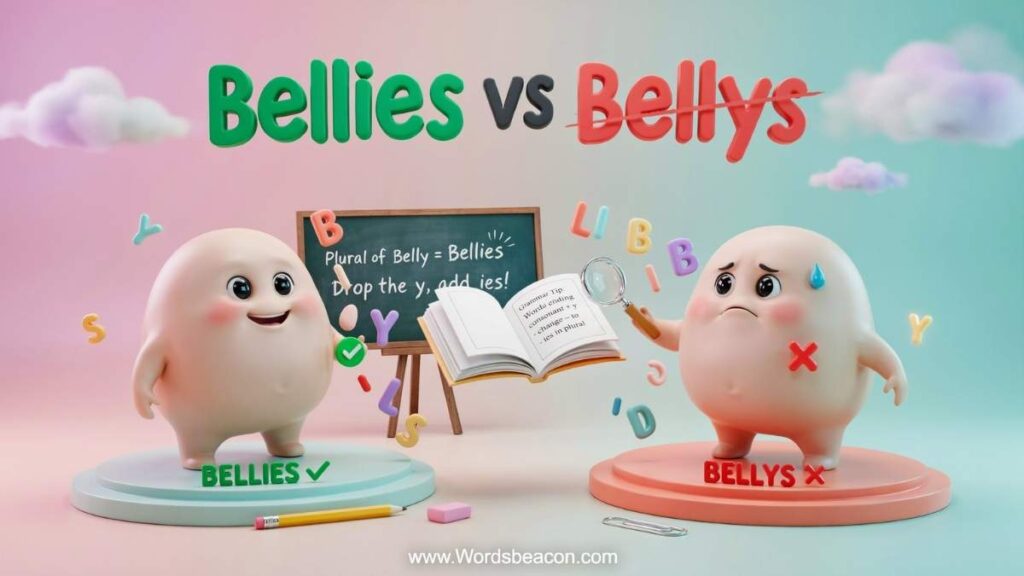
Choosing between bellies vs bellys can be confusing, especially when both spellings seem reasonable. So, which one is correct? The answer is simple: “bellies” is the correct plural of “belly,” while “bellys” is a spelling mistake in standard English. The good news is that you don’t need to memorize a complicated grammar rule to get it right. Once you understand why the final “y” changes to “ies,” the spelling becomes much easier to remember. In this guide, you’ll learn the difference between “bellies,” “bellys,” and “belly’s,” with clear examples to help you avoid this common mistake.
quick answer
| Form | Correct usage | Example |
|---|---|---|
| Belly | Singular noun | The baby has a round belly. |
| Bellies | Standard plural noun | The babies have round bellies. |
| Bellys | Incorrect as the standard plural | The babies have round bellys. |
| Belly’s | Singular possessive or contraction | The belly’s shape changed. |
| Bellies’ | Plural possessive | The bellies’ shapes varied. |
Learn how to use confusing more words correctly
Shiny vs Shiney difference and Which Is Correct?
Bellies vs Bellys Which One Should You Use?
When deciding between bellies vs bellys, always choose “bellies” for the standard plural of “belly.” The spelling follows a common English grammar rule for nouns ending in a consonant followed by “y.”
Consider these examples:
- Correct: The babies had full bellies after dinner.
- Incorrect: The babies had full bellys after dinner.
- Correct: The puppy had a round belly.
- Correct: The puppies had round bellies.
The distinction is straightforward: “bellies” is the accepted plural form, while “bellys” is generally a spelling error.
Although you might encounter “Bellys” in a brand name, username, or other intentionally chosen label, that usage doesn’t make it the standard plural in English. In formal writing, academic assignments, professional documents, and everyday communication, “bellies” remains the correct choice.
What Does Bellies Mean?
“Bellies” is the plural form of “belly,” a noun that commonly refers to the front part of the body around the abdomen. Depending on the context, it can also describe the underside of an animal.
The word appears in everyday conversation, children’s literature, animal descriptions, and informal writing. Its precise meaning depends on how the writer uses it.
Bellies Meaning in Everyday English
In everyday English, “belly” refers to the body area around the stomach and abdomen. People often use it when talking about eating, physical appearance, children, or animals.
For example, someone might say, “My belly is full,” after a large meal. When referring to several people, the sentence becomes, “Their bellies were full.”
Here are more examples:
- The children rubbed their bellies after lunch.
- The kittens had soft, furry bellies.
- The seals rested on the beach with their bellies facing the sun.
- The hikers filled their bellies with warm soup.
- The dancers wore costumes that exposed their bellies.
In each example, “bellies” refers to more than one belly. The spelling remains unchanged regardless of whether the sentence describes people or animals.
Bellies in Different Contexts
The meaning of “bellies” can vary slightly with the situation, although the plural form remains the same.
In children’s stories, the word often creates a playful, approachable tone. A writer might describe puppies with round bellies or children laughing until their bellies hurt.
In casual conversation, “bellies” can describe the feeling of fullness after eating. For example, “Everyone’s bellies were full after the family dinner.”
In animal descriptions, the word may refer to the underside of the body. A wildlife writer might describe fish with silver scales and pale bellies.
These examples demonstrate how one word can serve different purposes without changing its spelling.
Learn how to use confusing more words correctly
Macaroon vs Macaron Difference and which is correct?
What Does Bellys Mean?
The phrase “bellys meaning” often appears in spelling searches because people want to know whether “bellys” is an acceptable word. In standard English, it isn’t the correct plural of “belly.”
Instead, “bellys” usually represents an attempt to form the plural by adding “s” directly to the singular noun.
For example:
Incorrect: The puppies had muddy bellys.
Correct: The puppies had muddy bellies.
The corrected sentence follows the established English spelling rule for nouns ending in a consonant followed by “y.”
However, context still matters. A person may deliberately use “Bellys” as a business name, username, or fictional name. Such uses can be intentional, but they don’t change the standard grammatical form.
Is Bellys a Word?
If you’re asking whether “bellys” is the grammatically correct plural of “belly,” the answer is no. The correct standard spelling is “bellies.”
You may still encounter “bellys” in online posts, informal messages, or names. In those situations, consider whether the writer intended a special name or simply made a spelling mistake.
For conventional English writing, including essays, reports, articles, and emails, use “bellies.”
Belly Plural Understanding the Singular and Plural Forms
Understanding the belly plural form requires only a basic distinction between singular and plural nouns. A singular noun refers to one person, animal, place, or thing, while a plural noun refers to more than one.
Use “belly” when referring to one belly and “bellies” when referring to multiple bellies.
| Singular noun | Correct plural | Example |
|---|---|---|
| Belly | Bellies | The babies have round bellies. |
| Puppy | Puppies | The puppies have muddy bellies. |
| Family | Families | The families attended the event. |
| Baby | Babies | The babies slept peacefully. |
| City | Cities | The cities attracted many visitors. |
The number of people or animals determines which form fits the sentence.
For instance, “The cat has a white belly” describes one cat. By contrast, “The cats have white bellies” describes several cats.
The same rule applies regardless of the context. Whether you’re describing a person, a dog, or a fish, the plural of “belly” is always “bellies” in standard English.
Learn how to use confusing more words correctly
Arial vs Aerial correct spelling and usage ?
Why Is Bellies the Correct Spelling?

The correct spelling of “bellies” follows a common English pluralization rule. To understand why “bellys” is incorrect, examine the final two letters of the singular noun.
The word “belly” ends with a consonant, “l,” followed by the letter “y.” When a noun ends in a consonant plus “y,” you generally change the “y” to “i” and add “es” to form the plural.
The transformation is simple:
Belly → Bellies
This process is an example of noun pluralization, which means changing a noun’s form to indicate that it refers to more than one person, animal, place, or thing.
The Consonant + Y Rule
The consonant + “y” rule applies to many familiar English nouns. When a singular noun ends in a consonant followed by “y,” replace the final “y” with “i” and add “es.”
Consider these examples:
| Singular noun | Correct plural |
|---|---|
| Belly | Bellies |
| Baby | Babies |
| Puppy | Puppies |
| Family | Families |
| City | Cities |
| Party | Parties |
| Story | Stories |
| Country | Countries |
| Cherry | Cherries |
| Lady | Ladies |
Each singular noun ends with a consonant followed by “y.” Therefore, each plural follows the same spelling pattern.
For example, “baby” ends with “b” before the final “y,” so its plural is “babies,” not “babys.” Similarly, “belly” ends with “l” before “y,” so its plural is “bellies.”
Recognizing this pattern makes it easier to apply the rule to unfamiliar words.
The Vowel + Y Rule
Not every noun ending in “y” changes its spelling in the plural. When a noun ends in a vowel followed by “y,” you generally keep the “y” and add “s.”
| Singular noun | Correct plural |
|---|---|
| Boy | Boys |
| Toy | Toys |
| Key | Keys |
| Day | Days |
| Monkey | Monkeys |
| Trolley | Trolleys |
The letter immediately before the final “y” determines which spelling pattern usually applies.
In “boy,” the letter “o” is a vowel, so the plural is “boys.” In “belly,” the letter “l” is a consonant, so the plural becomes “bellies.”
This distinction explains why “bellys” is incorrect even though “boys” and “toys” are correct.
When Should You Change Y to IES?
When you’re unsure about a plural noun ending in “y,” examine the letter immediately before the “y.”
- If the letter is a consonant, you generally change “y” to “i” and add “es.”
- If the letter is a vowel, you generally keep “y” and add “s.”
For example:
- Puppy → Puppies
- Family → Families
- Trolley → Trolleys
- Boy → Boys
Although English has exceptions and special cases, this rule works for ordinary nouns such as “belly.” It also provides a practical way to avoid common spelling errors.
Fix common more word mistakes in English
Realist vs Realest difference and usage ?
Bellies vs Belly’s Understanding Apostrophe Usage
The difference between “bellies” and “belly’s” is grammatical rather than simply visual. While “bellies” is a plural noun, “belly’s” usually indicates possession or acts as a contraction.
Understanding apostrophe usage helps you distinguish these forms correctly.
Belly’s as a Singular Possessive
A singular possessive noun indicates that something belongs to or relates to one person, animal, or thing.
For example:
- The baby’s belly was warm.
- The dog’s belly was covered in fur.
- The belly’s shape changed over time.
In the final example, the apostrophe shows a relationship between the belly and its shape.
However, you shouldn’t use “belly’s” when you simply want to describe multiple bellies. The plural form doesn’t require an apostrophe.
Belly’s as a Contraction
In informal English, “belly’s” can also represent “belly is” or, in an appropriate sentence, “belly has.”
For example, “The belly’s getting bigger” means “The belly is getting bigger.”
Similarly, “The belly’s been hurting all morning” means “The belly has been hurting all morning.”
The surrounding words determine which meaning applies. This is why apostrophes matter: they can change the grammatical function of a word.
Is Belly’s the Same as Bellies?
No. The two forms have different uses.
| Sentence | Meaning |
|---|---|
| The baby has a round belly. | One belly |
| The babies have round bellies. | Multiple bellies |
| The belly’s shape changed. | Singular possessive |
| The belly’s getting bigger. | Contraction of “belly is” |
If you need the plural of “belly,” use “bellies.” If you need to show possession or form a contraction, “belly’s” may be appropriate.
Fix common more word mistakes in English
Unphased vs Unfazed difference and correct usage?
Bellies vs Bellys Examples in Sentences
Examples show how the correct spelling works in everyday writing and help reinforce the pluralization rule.
Ten Examples Using Bellies Correctly
The following sentences demonstrate the standard spelling in a range of contexts.
- The babies had full bellies after their feeding.
- The puppies rolled onto their backs and exposed their soft bellies.
- The children laughed until their bellies hurt.
- The seals rested on the sand with their bellies facing upward.
- The hikers filled their bellies with soup and bread.
- The dancers wore shirts that left their bellies uncovered.
- The fish had silver scales and pale bellies.
- The kittens curled up together, their bellies rising and falling as they slept.
- After the feast, everyone sat quietly with satisfied bellies.
- The cartoon characters had enormous bellies for comic effect.
Each sentence uses “bellies” as a plural noun. The spelling remains correct regardless of whether the subject involves people, animals, or fictional characters.
Incorrect Uses of Bellys and Their Corrections
The following examples highlight common errors and show how to correct them.
| Incorrect sentence | Correct sentence | Reason |
|---|---|---|
| The babies have round bellys. | The babies have round bellies. | Apply the consonant + y rule. |
| The puppies’ bellys were dirty. | The puppies’ bellies were dirty. | Use the correct plural spelling. |
| Their bellys hurt after lunch. | Their bellies hurt after lunch. | Replace the misspelled noun. |
| The fish had white bellys. | The fish had white bellies. | Change y to ies. |
| The children rubbed their bellys. | The children rubbed their bellies. | Use the standard plural form. |
Every correction follows the same rule. Once you understand the spelling pattern, you can identify and correct these errors without memorizing each sentence individually.
Fix common more word mistakes in English
Suit vs Suite correct spelling and usage ?
Common Mistakes When Writing Bellies
Although the pluralization rule is straightforward, several mistakes can cause confusion. Recognizing them will help you improve your spelling and proofreading.
Adding Only S
The most common error is adding “s” directly to “belly.”
Incorrect: Belly → Bellys
Correct: Belly → Bellies
Many English plurals simply add “s,” as in “book → books” and “chair → chairs.” However, nouns ending in a consonant followed by “y” generally follow a different pattern.
Confusing Consonants and Vowels Before Y
Another common mistake is assuming that all words ending in “y” follow the same rule.
Compare “belly” with “boy.” The letter before “y” in “belly” is “l,” a consonant, so the plural becomes “bellies.” In “boy,” the letter before “y” is “o,” a vowel, so the plural becomes “boys.”
Checking the letter before the final “y” can prevent many spelling errors.
Using an Apostrophe to Make a Plural
Some writers mistakenly add an apostrophe when they want to make a noun plural.
Incorrect: The babies have round belly’s.
Correct: The babies have round bellies.
An apostrophe doesn’t ordinarily make a noun plural. Instead, it generally shows possession or marks missing letters in a contraction.
Using the Singular Form for Multiple Things
Using “belly” when you mean several bellies can also create a grammatical problem.
Incorrect: The puppies have soft belly.
Correct: The puppies have soft bellies.
Because the sentence refers to several puppies, the plural form fits the meaning.
Overlooking Spelling Errors During Proofreading
Spell-checking tools can help identify mistakes, but they shouldn’t replace careful proofreading. Unusual names, usernames, and intentionally altered spellings can affect what a tool flags.
When reviewing your writing, pay particular attention to nouns ending in “y.” Check the letter before the final “y” and apply the appropriate pluralization rule.
Fix common more word mistakes in English
Dysregulated vs Disregulated correct usage ?
Bellies vs Bellys in Everyday, Professional, and Academic Writing
The spelling rule remains the same across different types of writing. However, the most appropriate word may depend on your audience and purpose.
Everyday Conversation
In casual conversation, “belly” and “bellies” sound natural and informal.
For example, a parent might say, “The baby’s belly is full.” When talking about twins, the parent might say, “The babies have full bellies.”
These expressions communicate the intended meaning without requiring technical vocabulary.
Medical and Health Writing
In health-related writing, “belly” often appears in plain-language explanations. However, medical professionals may prefer “abdomen” when they need to describe the body region more precisely.
For example:
- Everyday language: The child has a rash on the belly.
- More formal language: The patient has a rash on the abdomen.
The stomach is a specific digestive organ, while the abdomen is the larger body region that contains several organs. Therefore, the words aren’t interchangeable in every medical context.
When writing for a general audience, choose familiar language that communicates the meaning clearly. When anatomical precision matters, use the appropriate medical term.
Educational and Academic Writing
Students should use “bellies” in grammar exercises, essays, and assignments whenever they mean the plural of “belly.”
For example:
Incorrect: Several puppies had muddy bellys.
Correct: Several puppies had muddy bellies.
The word also provides a useful example of the consonant + “y” spelling rule, making it suitable for English grammar lessons.
Professional Communication
Correct spelling helps maintain clarity and credibility in reports, emails, articles, and presentations.
If you’re writing about animal behavior, children’s stories, or everyday experiences, “bellies” may be entirely appropriate. In formal medical writing, a more precise term may better suit the context.
The key is to choose vocabulary that fits the audience while maintaining standard spelling.
Understand confusing English more words simply
Writen vs Written correct spelling and usage ?
Bellies vs Bellys Regional Usage
American, British, Canadian, and Australian English all use “bellies” as the standard plural of “belly.” No standard regional distinction makes “bellys” correct in any of these varieties.
| Variety of English | Standard plural |
|---|---|
| American English | Bellies |
| British English | Bellies |
| Canadian English | Bellies |
| Australian English | Bellies |
Regional spelling differences do exist. For example, American English generally uses “color,” while British English uses “colour.” However, these differences don’t affect every word.
The plural of “belly” follows the same consonant + “y” rule across these varieties of English.
Although you may encounter “bellys” in informal online writing, that usage doesn’t establish it as a recognized regional spelling.
Understand confusing English more words simply
Offered vs Offerred which one is correct ?
Belly vs Stomach vs Abdomen Understanding Related Words
The “Belly,” “stomach,” and “abdomen” refer to related concepts, but they don’t have exactly the same meaning.
Belly
“Belly” is a common, informal word for the front part of the body around the abdomen.
Example: The child rested a hand on her belly.
The plural is “bellies.”
Stomach
“Stomach” can refer to the digestive organ or, in casual conversation, the general area around it.
Example: My stomach feels uncomfortable after lunch.
The standard plural is “stomachs.”
Abdomen
“Abdomen” is the more formal anatomical term for the region between the chest and pelvis.
Example: The doctor examined the patient’s abdomen.
The standard plural is “abdomens.”
Belly Button, Bellyache, and Potbelly
Several familiar words contain “belly,” but each has its own meaning.
A belly button is the mark or indentation left where the umbilical cord attached before birth. A bellyache is an informal term for stomach or abdominal pain. A potbelly describes a noticeably rounded or protruding belly.
These related terms expand your vocabulary, but they don’t change the pluralization rule for “belly.”
Similar Plural Forms Belly vs Other Nouns Ending in Y

Comparing “belly” with other nouns that end in “y” makes the spelling rule easier to remember.
| Singular noun | Correct plural | Spelling pattern |
|---|---|---|
| Belly | Bellies | Consonant + y → ies |
| Puppy | Puppies | Consonant + y → ies |
| Family | Families | Consonant + y → ies |
| Baby | Babies | Consonant + y → ies |
| City | Cities | Consonant + y → ies |
| Party | Parties | Consonant + y → ies |
| Story | Stories | Consonant + y → ies |
| Trolley | Trolleys | Vowel + y → add s |
| Boy | Boys | Vowel + y → add s |
| Toy | Toys | Vowel + y → add s |
| Key | Keys | Vowel + y → add s |
This comparison also clarifies the plural of “trolley.” The standard spelling is “trolleys” because the letter before the final “y” is a vowel.
Although “trolley” and “belly” share the same ending, they follow different pluralization patterns because the letters before “y” differ.
Understand confusing English more words simply
Stellar vs Steller difference and usage?
practice session Bellies vs Bellys
Complete each sentence with the correct word: “belly,” “Bellies vs Bellys,” or “belly’s.” Check your answers at the end.
- The puppies had round, fluffy ______ after dinner.
- The baby rested comfortably with her hand on her ______.
- The children rubbed their ______ after eating a large meal.
- The doctor examined the patient’s ______ for signs of discomfort.
- The kittens exposed their soft ______ while sleeping.
- The ______ shape changed as the baby grew.
- The puppies’ ______ were covered in mud after playing outside.
- One puppy had a white spot on its ______.
- The babies had full ______ after their feeding.
- The ______ getting bigger as the baby grows. (Use the contraction for “belly is.”)
- The fish had silver scales and pale ______.
- The toddler laughed while his father tickled his ______.
- The ______ color looked different under the bright light. (Show possession by one belly.)
- The children had happy smiles and full ______ after lunch.
- The puppies had muddy ______ after running through the garden.
- The baby cried because her ______ hurt.
- The ______ been hurting since breakfast. (Use the contraction for “belly has.”)
- The animals rested on the grass with their ______ facing the sun.
- The ______ of the two babies were equally round.
- The correct plural of “belly” is ______.
Answers
- bellies
- belly
- bellies
- belly
- bellies
- belly’s
- bellies
- belly
- bellies
- belly’s
- bellies
- belly
- belly’s
- bellies
- bellies
- belly
- belly’s
- bellies
- bellies
- bellies
Here’s a trusted source for clear more words Comparison:
FAQs
Is “bellies” always the correct plural of “belly”?
Yes. “Bellies” is the correct standard plural of “belly.” English spelling rules generally require you to change the final “y” to “i” and add “es” when a noun ends in a consonant followed by “y.”
Can “bellys” ever be used intentionally?
Yes. “Bellys” may appear in a brand name, username, or other proper name. However, when you need the standard plural of “belly,” always use “bellies.”
Why does “belly” become “bellies” instead of “bellys”?
The word “belly” ends in a consonant followed by “y.” Under the usual English pluralization rule, you change the “y” to “i” and add “es.” The same pattern applies to words such as “baby” and “puppy,” which become “babies” and “puppies.”
Does “bellies” mean the same thing as “stomachs”?
Not exactly. “Bellies” usually refers to the outer body area around the abdomen, while “stomachs” can refer to the digestive organs. People sometimes use these words interchangeably in casual conversation, but their meanings differ in medical and anatomical contexts.
What is the difference between “bellies” and “bellied”?
“Bellies” is the plural form of the noun “belly.” “Bellied” is a related word used in certain descriptions, such as “pot-bellied pig,” which describes an animal with a rounded belly.
What is another word for “bellies”?
Depending on the context, you can use “abdomens,” “tummies,” or “midsections.” “Abdomens” sounds more formal and anatomical, while “tummies” has a softer, more casual tone.
Is “belly’s” correct English?
Yes, but only when the sentence calls for a possessive form or contraction. For example, “The belly’s shape changed” shows possession, while “The belly’s getting bigger” means “The belly is getting bigger.” Use “bellies” when referring to more than one belly.
How do you use “bellies” in a sentence?
You can write, “The puppies had full bellies after dinner.” In this sentence, “bellies” refers to multiple puppies and uses the correct plural spelling.
What is the difference between “belly” and “tummy”?
Both words can refer to the front part of the body around the abdomen. However, “belly” is common in everyday conversation, while “tummy” often sounds more gentle, playful, or child-friendly.
What does “belly” mean in slang?
In informal English, “belly” usually refers to the stomach area or a rounded abdomen. Its meaning can vary in jokes, expressions, and casual conversations, so the surrounding context helps clarify the intended meaning.
Why do some plural nouns end in “ies” instead of “ys”?
English spelling rules depend on the letters at the end of a word. When a noun ends in a consonant followed by “y,” you generally change “y” to “i” and add “es.” For example, “belly” becomes “bellies,” and “family” becomes “families.”
What is the difference between “bellies” and “bellies’”?
“Bellies” is the regular plural noun, while “bellies’” is the plural possessive form. For example, “The babies have round bellies” uses the plural, while “The bellies’ shapes were different” shows possession or association with multiple bellies.
Conclusion
Choosing between bellies vs bellys is simple once you understand the spelling rule. “Bellies” is the correct plural of “belly,” while “bellys” is a common spelling mistake. When comparing bellies vs bellys, remember that a noun ending in a consonant followed by “y” usually changes the “y” to “i” and adds “es.” For example, “baby” becomes “babies,” “puppy” becomes “puppies,” and “belly” becomes “bellies.”
Understanding bellies vs bellys spelling also helps you avoid confusion when writing sentences. Remember, “belly’s” serves a different purpose because it shows possession or forms a contraction rather than a plural. Once you learn the difference between bellies vs bellys, you’ll find it easier to use the correct form. After all, getting your spelling right is much easier than giving your spell-checker a stomachache!

Luna AJS is an experienced blogger and dedicated language enthusiast at Words Beacon. She specializes in making English grammar, spelling, vocabulary and commonly confused words easy to understand. She provides clear explanations, practical examples to help readers write with confidence.