
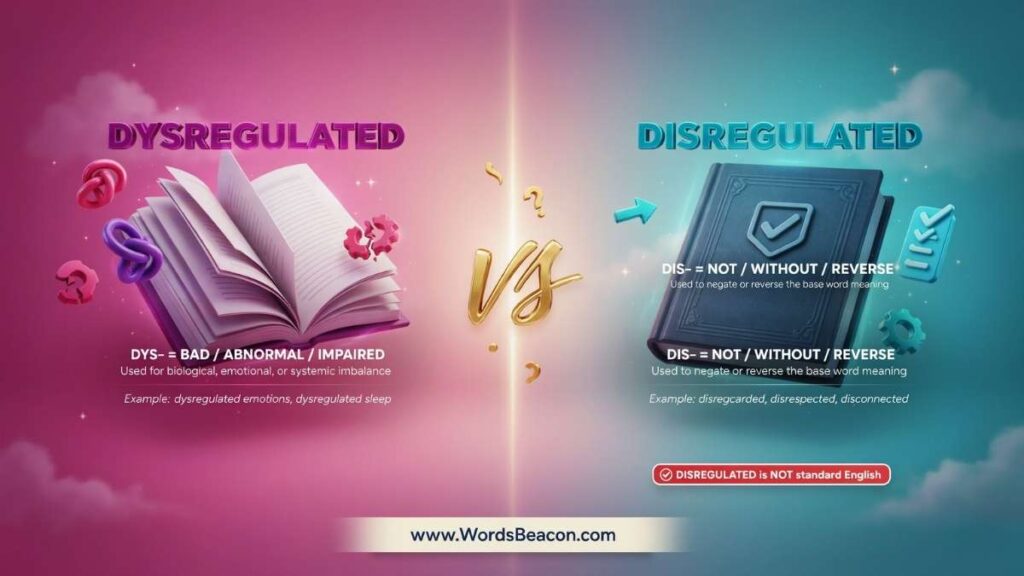
The dysregulated vs disregulated confusion can turn one simple spelling choice into a surprisingly tricky grammar puzzle. Both forms look believable because dys- and dis- appear in many English words. Still, they do not share the same role here. Dysregulated is the standard choice when you mean that something is not being regulated normally or effectively. Disregulated may appear occasionally, but it is far less common and is not the preferred form in formal writing. This guide makes the dysregulated vs disregulated difference easy to understand. You will learn the meanings, correct usage, common mistakes, and simple ways to remember the right spelling without letting one little letter cause a grammar headache.
auick answer
| Feature | Dysregulated | Disregulated |
|---|---|---|
| Standard term for impaired regulation | Yes | Generally not the preferred form |
| Used in psychology | Yes | Rare |
| Used in medicine | Yes | Rare |
| Used in scientific writing | Yes | Uncommon |
| Related noun | Dysregulation | Disregulation is uncommon |
| Recommended formal spelling | Dysregulated | Usually avoid when you mean dysregulated |
| Example | Dysregulated emotions | Disregulated emotions |
Fix common more word mistakes in English
Offered vs Offerred which one is correct ?
Dysregulated vs Disregulated Difference
The dysregulated vs disregulated difference is mainly a matter of standard terminology and word formation.
Dysregulated describes something whose normal regulatory process has become impaired, disrupted, abnormal, or poorly controlled. The word can describe emotional responses, behavior, nervous-system activity, metabolic processes, immune responses, and other biological or psychological processes.
Disregulated sometimes appears in real-world writing, but it is not the standard term you should normally choose when you mean dysregulated. The established noun is dysregulation, and the established adjective is dysregulated.
For example:
- The child became dysregulated after a stressful event.
- The researchers studied dysregulated immune activity.
- The disease may involve dysregulated glucose metabolism.
- Emotional dysregulation can affect how a person responds to stress.
Cambridge specifically gives examples involving dysregulated glucose metabolism and altered cell-signaling activity.
That broader usage matters. Dysregulated isn’t simply a trendy psychology word. It has a well-established role in medicine and science.
What Does Dysregulated Mean?
The simplest dysregulated meaning is “not regulated normally.”
The word describes a system or process that has difficulty maintaining its expected pattern of control. That doesn’t necessarily mean the system has stopped working. Instead, its regulatory process may be excessive, insufficient, poorly timed, poorly coordinated, or otherwise impaired.
Think of a thermostat.
A properly regulated thermostat responds to temperature changes and helps keep a room within a target range. If its control mechanism starts reacting too strongly or too slowly, the heating system still works, but its regulation has gone off track.
Biological regulation works in far more complicated ways, but the basic idea is similar.
Dysregulated Definition
A practical dysregulated definition is:
Dysregulated means affected by impaired, abnormal, disrupted, or poorly functioning regulation.
Collins defines the adjective in pathology as being affected by impaired regulation.
The exact meaning depends on what you’re describing.
For example, dysregulated emotions concern emotional control. Dysregulated glucose metabolism concerns a physiological process. Dysregulated immune activity concerns biological regulation.
The word stays the same while the regulated system changes.
Dysregulated as an Adjective
Dysregulated normally functions as an adjective.
It describes a noun rather than naming the regulatory problem itself.
Common combinations include:
- dysregulated emotions
- dysregulated behavior
- dysregulated nervous system
- dysregulated immune response
- dysregulated stress response
- dysregulated glucose metabolism
- dysregulated biological processes
Compare these two sentences:
The nervous system is dysregulated.
The study examined nervous system dysregulation.
The first sentence uses the adjective. The second uses the noun.
Learn the difference between confusing more English words
Stellar vs Steller difference and usage?
What Does Dysregulation Mean?
Dysregulation is the noun form connected with dysregulated.
The dysregulation meaning refers to a condition or process in which normal regulation has become impaired or abnormal.
Cambridge defines dysregulation in medical contexts as a situation in which a bodily process is not controlled as it normally should be. In psychology, it uses the term for difficulty controlling emotions.
Collins similarly defines dysregulation as an impairment of the regulation of a bodily process.
That gives you a useful word family:
regulate → dysregulate → dysregulated → dysregulation
Once that pattern becomes familiar, the spelling becomes much easier to remember.
Dysregulation Definition
A simple dysregulation definition is:
Dysregulation is impaired or abnormal control of a process that normally requires regulation.
That process might involve emotions, behavior, metabolism, immunity, hormones, neurological activity, or another physiological mechanism.
What Does Disregulated Mean?
Now comes the tricky part.
The question “what does disregulated mean?” doesn’t have the same straightforward answer as “what does dysregulated mean?”
Disregulated does appear in real-world writing. However, it isn’t the established standard form for the medical, psychological, and biological concept usually expressed by dysregulated.
In other words, you may encounter it, but you shouldn’t assume that its appearance makes it an equally preferred alternative.
Is Disregulated a Word?
If you’re asking is disregulated a word, the safest practical answer is that it is not the standard word to use for impaired or abnormal regulation.
It can appear in published or informal material, which means it would be too simplistic to pretend that nobody has ever used the spelling. However, standard contemporary terminology strongly favors dysregulated for the meaning discussed here.
That distinction matters in professional writing.
A word can appear somewhere on the internet without becoming the recommended spelling. Online writing contains typos, informal expressions, historical forms, copied material, and specialized terminology.
Therefore, frequency alone doesn’t settle a terminology question.
Disregulated Definition
A disregulated definition is difficult to establish as an equal counterpart to the standard definition of dysregulated.
In many cases, writers who use disregulated clearly intend to express the idea of poor or abnormal regulation. In those situations, dysregulated is the better-established form.
So if you’re editing a sentence such as:
The patient became disregulated after the stressful event.
The standard revision would be:
The patient became dysregulated after the stressful event.
Dysregulated vs Disregulated Why the Confusion Happens

The confusion makes sense once you look at the two prefixes.
English uses dis- in many extremely common words:
- disagree
- disconnect
- dislike
- disorganized
- dissatisfied
- disorder
As a result, dis- feels familiar.
The prefix dys- is less common in everyday conversation. It appears more frequently in medical, scientific, and technical vocabulary.
That difference creates a natural spelling trap.
When people hear a word ending in regulated, they may instinctively attach the familiar prefix dis-. The result looks perfectly reasonable:
dis + regulated = disregulated
Unfortunately, English doesn’t always build words according to the pattern that seems most obvious.
The established term is dysregulated.
Why Is Dysregulated Spelled With Dys?
The answer lies partly in the history of the prefix.
The prefix dys- has Greek roots and commonly conveys ideas such as abnormal, difficult, impaired, or faulty. It appears in a range of medical and scientific terms.
Examples include:
- dysfunction
- dyslexia
- dysphagia
- dyskinesia
- dysregulation
The prefix isn’t simply another version of dis-. It has its own history and established uses.
Dys- Meaning
The general dys- meaning relates to something being abnormal, impaired, difficult, or faulty.
That fits dysregulation well.
A dysregulated process isn’t necessarily absent. Rather, the regulation isn’t functioning properly.
Dis- Meaning
The dis- prefix has several functions in English. Depending on the word, it can indicate negation, reversal, separation, removal, or an opposite state.
That doesn’t mean every dis- word has exactly the same meaning.
The important point here is that you can’t simply replace dys- with dis- because both prefixes occur in English.
The correct form depends on the word’s established history and usage.
Learn the difference between confusing more English words
Suit vs Suite correct spelling and usage ?
Dysregulated vs Disregulated Difference in Medical Writing
The correct spelling becomes especially important in medical terminology.
Medical writing depends on precise vocabulary because small terminology differences can affect how readers interpret a process.
Dysregulated appears in descriptions of many physiological mechanisms.
For example, scientific literature discusses:
- dysregulated immune responses
- dysregulated gene expression
- dysregulated metabolism
- dysregulated signaling
- dysregulated inflammation
- dysregulated physiological processes
Collins provides examples involving dysregulated genes, autophagy, immune systems, and inflammatory processes.
This shows that dysregulated has a much wider scientific meaning than simply “emotionally overwhelmed.”
Dysregulated Meaning in Medical Terms
The dysregulated meaning in medical terms generally concerns a biological process whose normal regulatory mechanism has become impaired or altered.
For example, glucose metabolism depends on complex regulatory mechanisms. When researchers describe glucose metabolism as dysregulated, they’re pointing to abnormal regulation rather than merely saying that glucose exists without control.
Likewise, immune activity requires regulation. Too little activity can create problems, while excessive or poorly controlled activity can also cause harm.
The word therefore describes the regulatory problem. It doesn’t automatically identify the underlying disease or cause.
Learn the difference between tricky grammar words
Arial vs Aerial correct spelling and usage ?
Is Dysregulated a Medical Term?
Yes.
Dysregulated is an established medical and scientific term. Cambridge classifies its medical use as specialized and provides examples involving glucose metabolism and cellular signaling.
The term also appears in scientific literature across areas such as biology, physiology, immunology, neuroscience, and metabolism.
However, there’s an important point to remember: dysregulated describes a state or process. It doesn’t automatically function as a diagnosis.
For example, saying that a process is dysregulated doesn’t by itself tell you why the process changed.
That distinction keeps medical terminology accurate.
Dysregulated Meaning in Psychology
The dysregulated meaning in psychology focuses more often on emotional, behavioral, or other psychological regulation.
The APA Dictionary of Psychology defines dysregulation as an excessive or otherwise poorly managed mechanism or response. It specifically gives emotional dysregulation as an example.
That makes dysregulated a legitimate psychological term.
Emotional Dysregulation
Emotional dysregulation describes difficulty managing emotional responses effectively.
A person may experience:
- unusually intense emotional responses
- difficulty calming after becoming upset
- rapid changes in emotional state
- strong reactions to relatively small triggers
- difficulty returning to a calmer baseline
However, strong emotions alone don’t prove emotional dysregulation.
Everyone experiences anger, sadness, fear, excitement, frustration, and stress.
The more useful question concerns regulation: How intense is the response? How long does it last? How easily can the person recover? Does it fit the situation? Does it interfere with daily functioning?
Those details provide much more information than simply labeling an emotion as “dysregulated.”
Dysregulated Emotions
The phrase dysregulated emotions often appears in psychology and child-development discussions.
It can describe emotions that become unusually intense, difficult to manage, or poorly matched to the circumstances.
For example:
A child may become overwhelmed by a noisy environment and struggle to calm down.
An adult may experience an unusually intense reaction to a stressful event and have difficulty returning to a calmer state.
Neither example automatically establishes a mental health diagnosis.
Context remains essential.
Dysregulated Nervous System What Does It Mean?
The phrase dysregulated nervous system has become common in discussions about stress, trauma, sleep, anxiety, and emotional health.
In general terms, it refers to altered or impaired regulation of nervous-system responses.
However, this phrase can become too broad when people use it to explain every symptom under the sun.
A careful explanation should identify the specific process involved.
For example, a writer might discuss:
- altered stress responses
- changes in arousal
- autonomic nervous-system activity
- difficulty returning to a calmer state
- disrupted sleep regulation
- altered emotional responses
That approach is more informative than simply saying that someone’s “nervous system is out of balance.”
Nervous System Regulation
Your nervous system constantly responds to internal and external information.
It helps coordinate attention, movement, sensory processing, arousal, and many physiological responses.
Stress can activate rapid protective responses. The familiar fight, flight, or freeze response is one example of the body’s response to perceived danger.
Those responses can be useful. They help you respond quickly when something genuinely threatens you.
The problem isn’t the existence of a stress response. The issue can arise when regulation becomes impaired or when a response doesn’t settle appropriately.
Learn the difference between tricky grammar words
Writen vs Written correct spelling and usage ?
Dysregulated vs Unregulated
Another common search is dysregulated vs unregulated.
These terms overlap, but they aren’t identical.
Unregulated generally suggests that something lacks regulation, oversight, or control.
Dysregulated suggests that a regulatory system exists but isn’t functioning normally.
| Term | General meaning | Example |
|---|---|---|
| Regulated | Operating under normal control | Regulated body temperature |
| Dysregulated | Regulation is impaired or abnormal | Dysregulated glucose metabolism |
| Unregulated | Regulation or oversight is absent or insufficient | An unregulated market |
The distinction becomes clearer in professional writing.
If you mean “not controlled normally,” dysregulated may be the more precise choice.
If you mean “not subject to regulation,” unregulated may be more appropriate.
Context decides the winner.
Dysregulated vs Unregulated Difference
The dysregulated vs unregulated difference can be summarized with one idea:
Dysregulated usually describes a problem within a regulatory process. Unregulated usually emphasizes the absence or lack of regulation.
Consider these examples:
The immune response became dysregulated.
This suggests that the body’s regulatory process isn’t working normally.
The industry remains largely unregulated.
This means the industry has limited regulatory oversight.
The two sentences describe very different situations.
So, don’t replace dysregulated with unregulated simply because both words relate to control.
Learn the difference between tricky grammar words
Emaculate vs Immaculate correct spelling and usage ?
Dysregulated vs Disregulated in Psychology
Psychology provides one of the clearest examples of why the spelling matters.
Researchers and clinicians use dysregulation when discussing poorly managed emotional or behavioral responses.
The APA Dictionary of Psychology specifically recognizes dysregulation and connects emotional dysregulation with extreme or inappropriate emotional responses.
The term also appears in research on dysregulated behavior.
A PubMed-indexed review describes dysregulated behaviors as behaviors that can provide short-term benefits while producing recurring long-term distress or impairment.
Dysregulated Behavior
Dysregulated behavior can refer to behavior that becomes difficult to control, unusually reactive, impulsive, or harmful within a particular context.
Again, context matters.
A single emotional outburst doesn’t automatically establish a pattern of behavioral dysregulation.
Professional writing should describe the actual behavior rather than relying on a vague label.
Dysregulated vs Disregulated ADHD
People often search for dysregulated vs disregulated ADHD because emotional dysregulation and behavioral regulation frequently appear in discussions about ADHD.
The spelling doesn’t change because the subject is ADHD.
Use:
dysregulated behavior
emotional dysregulation
difficulty with emotional regulation
Don’t switch to disregulated simply because you’re writing about ADHD.
At the same time, emotional dysregulation shouldn’t be treated as synonymous with ADHD. Similar regulation difficulties can occur in many different contexts.
Dysregulated vs Disregulated in Adults and Children
The spelling remains the same for both groups.
Whether you’re researching dysregulated vs disregulated in adults or dysregulated vs disregulated in children, use dysregulated when you mean impaired or abnormal regulation.
The surrounding context can differ.
Children are still developing self-regulation skills. Their ability to manage frustration, emotions, attention, and behavior changes as they grow.
Adults may also struggle with emotional control, stress responses, attention, or behavioral regulation.
Age changes the developmental context. It doesn’t change the spelling.
Learn the difference between confusing word pairs
Who’s vs Whose difference and correct usage ?
Dysregulated vs Disregulated Examples
Here are several examples that make the distinction easier to see.
| Less appropriate | Standard form | Why |
|---|---|---|
| The child became disregulated. | The child became dysregulated. | Dysregulated is the established term. |
| The study examined emotional disregulation. | The study examined emotional dysregulation. | Dysregulation is the standard noun. |
| Researchers found disregulated immune activity. | Researchers found dysregulated immune activity. | Scientific usage favors dysregulated. |
| Her emotions seemed disregulated. | Her emotions seemed dysregulated. | The adjective is dysregulated. |
The pattern is consistent: when the intended meaning involves impaired regulation, use the dys- form.
Examples of Dysregulated in Sentences
Emotional Examples
The child became dysregulated after several stressful events.
She had difficulty calming down after the argument and felt emotionally overwhelmed.
The therapist discussed strategies for improving emotional regulation.
The situation triggered an unusually intense emotional response.
Medical Examples
The researchers observed dysregulated glucose metabolism.
The study examined dysregulated immune responses.
The disease can involve abnormal regulation of several physiological processes.
Researchers identified dysregulated gene activity in the affected cells.
Scientific Examples
The experiment examined how stress can alter physiological regulation.
The researchers investigated dysregulated signaling pathways.
The findings suggested changes in normal regulatory mechanisms.
These examples show why the word belongs in more than one field.
Dysregulation vs Disregulation
The noun follows the same rule as the adjective.
The standard form is dysregulation.
Not:
emotional disregulation
Instead:
emotional dysregulation
The APA Dictionary of Psychology uses dysregulation as the established psychological term.
Cambridge also recognizes dysregulation as a specialized noun in medical and psychological contexts.
Dysregulation vs Disregulation Difference
The dysregulation vs disregulation difference is therefore straightforward in standard usage:
Dysregulation is the established noun for impaired or abnormal regulation.
Disregulation is not the standard noun you should normally use when discussing the same concept.
Once again, the word family gives you the safest clue:
regulation → dysregulation → dysregulated
Learn the difference between confusing word pairs
Wich vs Which difference and correct usage ?
Common Mistakes With Dysregulated
Writing Disregulated Instead of Dysregulated
This is the most common spelling mistake.
The difference is only one letter, but the correct prefix matters.
Write:
dysregulated
not:
disregulated
Writing Disregulation Instead of Dysregulation
The same issue appears with the noun.
Write:
dysregulation
not:
disregulation
Confusing Dysregulated With Unregulated
Don’t treat the words as interchangeable.
A dysregulated process has impaired regulation.
An unregulated process lacks sufficient regulation or oversight.
The context determines which term fits.
Treating Every Strong Emotion as Dysregulation
A person can experience intense anger or sadness without having emotional dysregulation.
Emotions naturally vary in strength.
The term becomes more meaningful when the person’s emotional response shows persistent difficulty with regulation, recovery, or appropriate adjustment.
Treating Dysregulated as a Diagnosis
Dysregulated describes a pattern or state. It doesn’t automatically identify a disorder.
That distinction becomes especially important in psychological and medical writing.
Learn the difference between confusing word pairs
Offense vs Offence difference and correct usage ?
How to Use Dysregulated in a Sentence
The easiest structure is:
Subject + be + dysregulated.
Examples:
The system became dysregulated.
The patient’s glucose metabolism was dysregulated.
Her emotional responses appeared dysregulated.
You can also place dysregulated before a noun:
- dysregulated behavior
- dysregulated emotions
- dysregulated immune activity
- dysregulated metabolism
- dysregulated nervous system
- dysregulated stress response
For formal writing, choose the specific noun whenever possible. “Dysregulated system” is useful, but “dysregulated glucose metabolism” tells the reader much more.
Pronunciation and Spelling
Pronunciation can contribute to the confusion because the two spellings look and sound similar.
Cambridge lists the US pronunciation of dysregulated as /dɪsˈreɡ.jə.leɪ.t̬ɪd/.
The important spelling lesson is simple: hearing the word correctly doesn’t necessarily reveal whether it contains dys- or dis-.
That is why remembering the word family helps more than relying on sound.
How to Remember Dysregulated
Here’s an easy memory trick:
Remember the chain:
regulate → dysregulate → dysregulated → dysregulation
The dys- stays in place.
You can also connect dysregulated with dysfunction. Both words use the dys- prefix to describe something abnormal or impaired.
So when you’re stuck between dysregulated or disregulated, ask yourself:
“What is the related noun?”
If the noun is dysregulation, the adjective is dysregulated.
That little trick can save you from repeatedly making the same spelling mistake.
Why Correct Terminology Matters
A spelling error in casual conversation may not cause much trouble. In medical writing, academic writing, and scientific writing, however, terminology carries more weight.
Using the established term helps readers understand exactly what you mean.
It also makes your writing easier to compare with research literature and professional resources.
For example, researchers use terms such as dysregulated immune responses, dysregulated gene expression, and metabolic dysregulation across scientific literature. Collins also documents these kinds of medical and biological uses.
Therefore, using dysregulated isn’t simply about pleasing a grammar checker. It helps your terminology match established professional usage.
Learn the difference between confusing word pairs
Man vs Men difference and Correct Usage ?
Practice Session Dysregulated vs Disregulated
Fill in each blank with the correct word: dysregulated vs disregulated.
- The therapist helped the child manage his ______ emotions.
- Emotional ______ can make it difficult to respond calmly to stressful situations.
- The doctor explained that the patient had a ______ physiological process.
- The article discussed how a ______ nervous system may react strongly to stress.
- She learned several self-regulation skills to manage her ______ behavior.
- The researcher studied emotional ______ in adults.
- The patient showed signs of a ______ stress response.
- The psychologist explained the effects of ______ emotions on behavior.
- The correct spelling in standard medical and psychological writing is ______.
- Many people accidentally write ______ when they mean dysregulated.
- A person in a ______ state may struggle to control intense emotional responses.
- The study examined nervous system ______ and its effect on stress responses.
- The therapist taught techniques for improving emotional regulation in people with ______ emotions.
- The doctor used the term ______ to describe impaired regulation of a bodily process.
- Difficulty regulating emotions can contribute to a ______ emotional state.
- The report described the child’s ______ behavior during periods of stress.
- If a system cannot maintain healthy regulation, you may describe it as ______.
- The student asked whether ______ was the correct spelling, but the teacher recommended dysregulated.
- In psychology, ______ often refers to difficulty managing emotions or responses effectively.
- When writing a medical report, choose ______ rather than disregulated when you mean impaired or abnormal regulation.
Answers
- dysregulated
- dysregulation
- dysregulated
- dysregulated
- dysregulated
- dysregulation
- dysregulated
- dysregulated
- dysregulated
- disregulated
- dysregulated
- dysregulation
- dysregulated
- dysregulated
- dysregulated
- dysregulated
- dysregulated
- disregulated
- dysregulation
- dysregulated
Here’s a trusted source for clear more words Comparison:
Frequently Asked Questions
Is it spelled dysregulated or disregulated?
The standard spelling is dysregulated. Use it when you mean that a system, process, behavior, or response is not being regulated normally or effectively. Disregulated may appear in some writing, but it is much less common and is not the preferred spelling for this meaning.
What is the difference between dysregulation and disregulation?
Dysregulation is the standard term for impaired, abnormal, or poorly managed regulation. Disregulation appears occasionally, but it is uncommon and generally not the preferred form in professional writing. When you mean abnormal regulation, dysregulation is the clearer choice.
Why is dysregulated spelled with dys instead of dis?
Dysregulated uses the prefix dys-, which comes from Greek and can express abnormality, difficulty, or impaired functioning. The similar-looking prefix dis- appears in many English words, so writers sometimes choose disregulated by mistake. The standard form keeps the y: dysregulated.
Is dysregulated a medical term?
Yes. Medical and clinical writing uses dysregulated to describe bodily or physiological processes that do not maintain normal regulation. The term can apply to different systems and processes depending on the medical context.
Is dysregulated used in psychology?
Yes. Psychology commonly uses dysregulated and dysregulation when discussing difficulty managing emotional, behavioral, or psychological responses. Emotional dysregulation, for example, describes problems with managing emotional responses effectively.
Is disregulated a correct word?
Disregulated can be found in English usage, so it is not accurate to say that nobody ever uses it. However, it is uncommon for the meaning intended in this spelling comparison. In most standard medical, psychological, scientific, and professional writing, dysregulated is the preferred form.
Is disregulation the correct noun form?
Dysregulation is the standard noun form. It describes impaired or abnormal regulation. Although disregulation may appear occasionally, dysregulation is the more established choice for formal and professional writing.
What does dysregulated mean in simple terms?
Dysregulated means not regulated normally or effectively. In simple terms, something has difficulty maintaining its usual balance, control, or response. The word can describe emotions, behavior, bodily processes, or other systems.
Can dysregulated describe emotions?
Yes. Dysregulated emotions are emotions that become unusually difficult to manage or control. The phrase often appears when discussing strong or poorly managed emotional responses.
Can dysregulated describe behavior?
Yes. Dysregulated behavior can refer to behavior that reflects difficulty managing emotional or behavioral responses. The meaning depends on the situation and the specific context in which the term appears.
Is dysregulated the opposite of regulated?
Generally, yes. Regulated suggests that something operates within an expected or controlled pattern, while dysregulated suggests impaired or abnormal regulation. The exact contrast can vary depending on the process being discussed.
What is the difference between dysregulated and unregulated?
Dysregulated usually describes regulation that is impaired or not working properly. Unregulated more directly means that something lacks regulation or control. Therefore, the two words overlap in some contexts but do not always mean exactly the same thing.
Is dysregulated the same as deregulated?
No. Dysregulated usually describes impaired or abnormal regulation. Deregulated often describes something from which rules, restrictions, or formal controls have been removed or reduced. They may look similar, but they serve different purposes.
Can dysregulated describe a physical process?
Yes. Dysregulated can describe physiological processes when their normal regulatory mechanisms do not function properly. That is why you may encounter the word in medical and scientific writing as well as psychology.
Can dysregulated describe a system?
Yes. A system can be described as dysregulated when its normal regulatory process becomes impaired or abnormal. Depending on the context, the system could involve physiology, behavior, emotions, or another controlled process.
What is the noun form of dysregulated?
The noun form is dysregulation. For example, you can write “emotional dysregulation” when discussing difficulty managing emotional responses. Dysregulated works as an adjective, while dysregulation names the condition or process.
How do you use dysregulated in a sentence?
You can use dysregulated to describe something that has impaired or abnormal regulation. For example: “The researchers examined dysregulated emotional responses during stressful situations.” You can also use it with physiological or behavioral processes when the context supports that meaning.
Which spelling should you use in professional writing?
Choose dysregulated. It is the more established and recognizable form in medical, psychological, scientific, and professional contexts. Using the standard spelling also helps readers understand your intended meaning immediately.
What is the easiest way to remember dysregulated?
Remember that the correct form keeps the y from dys-. Think of dysregulated as “regulation that is not working normally.” When you mean impaired or abnormal regulation, write dysregulated rather than disregulated.
What is the difference between dysregulated and disregulated in one sentence?
Dysregulated is the standard and preferred term for abnormal or impaired regulation, while disregulated is an uncommon alternative that writers generally should avoid in formal usage.
conclusion
The dysregulated vs disregulated confusion is easy to clear up once you know which form to use. If you mean that something is not working or responding normally, dysregulated is the standard choice. You will see it in medical, psychological, scientific, and everyday writing, especially when people discuss emotions, behavior, or body processes.
Disregulated does appear occasionally, but it is much less common and is not the preferred form in formal writing. So, when you are unsure, choose dysregulated. Think of the y in dys- as your little spelling reminder.
In short, write dysregulated, not disregulated, when you mean impaired or abnormal regulation. Once you remember that simple difference, this spelling mix-up becomes much easier to handle. Your grammar can breathe a little easier too.

Luna AJS is an experienced blogger and dedicated language enthusiast at Words Beacon. She specializes in making English grammar, spelling, vocabulary and commonly confused words easy to understand. She provides clear explanations, practical examples to help readers write with confidence.